

System Analysis

- System analysis is one of the most useful conceptual tools in modern geography because it allows the geographer to study complex geographical reality as an interconnected whole. Instead of examining population, resources, transport, settlements, economy, environment or culture as isolated facts, system analysis studies them as mutually linked components of a larger spatial order.
- In Geography Optional, the topic appears under “Models, Theories and Laws in Human Geography”. Its importance lies in the fact that it provides the methodological base for many geographical models: central place theory, gravity model, regional input-output model, migration models, urban land-use models, ecosystem models, watershed models and regional planning models.
- In simple words, system analysis asks three fundamental questions:
- What are the elements of a geographical phenomenon?
- How are these elements linked through flows, feedbacks and controls?
- How does the whole system behave when one component changes?
- Thus, system analysis is not merely a theory; it is a way of thinking. It is especially relevant in geography because geographical phenomena are inherently spatial, dynamic and interdependent.
Meaning of System and System Analysis
- A system is a set of interrelated and interdependent elements forming a unified whole. The elements may be physical, economic, social, cultural, political or technological. A system has a boundary, receives inputs, transforms them through processes and produces outputs. It also operates within a wider environment.
- In the words of James, a system may be defined as “a whole, such as a person, state, culture or business, which functions as a whole because of the interdependence of its parts.” This definition is particularly useful for geography because geographical realities are rarely isolated. A city, a region, a farm economy, a river basin or a migration stream functions through the interaction of several parts.
- Example: An agricultural region may be treated as a system. Its inputs are land, labour, water, seeds, fertilizers, credit and technology. Its processes include sowing, irrigation, weeding, harvesting and marketing. Its outputs include crops, income, employment, waste and environmental impacts. The system is affected by monsoon, market prices, state policy, soil fertility and farmer behaviour.
- System analysis is the method of identifying the components of a system, examining their relationships, measuring flows among them and predicting the behaviour of the system under changing conditions.
- In Human Geography, system analysis is used to study cities, markets, transport networks, migration streams, regional economies, population-resource relationships, political territories and human-environment interactions. Its special value lies in handling complex multivariate situations, which are common in geography.
Origin and Intellectual Background
- The system approach emerged from General System Theory, associated with Ludwig von Bertalanffy. Bertalanffy argued that different sciences could be unified by studying common patterns of organisation, interaction, hierarchy, equilibrium and feedback.
- The idea was first developed in biology during the 1920s. Bertalanffy argued that an organism cannot be properly understood by studying its organs separately; it must be studied as a system of associated parts. Later, he realized that the same logic could be applied to non-biological systems. This created the possibility of a general theory of systems applicable to biology, physics, geography, economics, sociology and planning.
- According to Mesarevic, General System Theory is not merely concerned with analogy among systems; it tries to set up a general theory from which the characteristics of different systems can be deduced. Hence, it seeks the deductive unification of system-analytic concepts.
- The approach entered geography mainly during the quantitative revolution, when geographers were trying to make the discipline more analytical, scientific and predictive.
- Important contributors include:
| Scholar | Contribution |
|---|---|
| Ludwig von Bertalanffy | Developed General System Theory; emphasized open systems and interdependence |
| R. J. Chorley | Introduced system thinking into geomorphology; applied open-system ideas to landforms |
| Chorley and Haggett | Promoted integrated models in geography |
| Leopold and Langbein | Used entropy and steady-state concepts in fluvial systems |
| B. J. L. Berry | Studied cities as systems within systems of cities |
| Richard J. Huggett | Wrote Systems Analysis in Geography and showed its use in ecological, hydrological, regional and spatial-interaction problems |
| David Harvey | Strengthened analytical explanation in geography |
The emergence of system analysis also reflects geography’s transition from descriptive regional geography to analytical, model-based and problem-solving geography.
Chorley and Berry suggested system analysis and General System Theory as basic tools for geographical understanding because geography deals with complex relationships between living and non-living components of the environment. Chorley emphasised four major advantages:
- Systems should be studied rather than isolated phenomena.
- Basic principles governing systems should be identified.
- Analogies across different fields can enrich explanation.
- General principles are needed to understand different kinds of systems.
Basic Structure of a Geographical System
- A geographical system is not a random collection of geographical facts. It is an organized arrangement of elements, relationships, flows and boundaries operating within a wider environment. The structure of a system tells us what the system is made of, how its parts are connected, and how it interacts with the outside world.
- In geography, this structure is especially important because most geographical phenomena are spatially distributed and functionally linked. A village, city, river basin, industrial region, transport network or agricultural region can be treated as a system only when its elements and linkages are clearly identified.
- A geographical system has three basic structural components:
- Elements: The basic units of the system, such as farms, villages, cities, industries, households, rivers, roads or institutions.
- Internal links: The connections among elements, such as movement of people, goods, capital, energy, information or decisions.
- External links: The connections between the system and its surrounding environment.
Elements
- Elements are the basic building blocks of a system. They may be physical, social, economic, political or cultural. In a river basin, the elements may include tributaries, slopes, soil, vegetation, settlements and agricultural fields. In an urban system, the elements may include residential areas, markets, industries, transport terminals, administrative centres and service zones.
- The choice of elements depends on the objective and scale of study. For example, in a national urban system, cities may be treated as elements; but in the study of a single city, wards, roads, households, industries and land-use zones may become the elements.
Attributes
- Every element has certain attributes or characteristics. A city as an element may have population size, density, occupational structure, service functions and connectivity. A farm may have size, soil type, irrigation status, crop pattern and productivity.
- Thus, in geographical system analysis, the element is not merely the object itself but the relevant attributes of that object.
Links or Relationships
- Links connect the elements of a system. These links may be visible or invisible, material or non-material.
- Examples:
- Roads linking villages and towns
- Trade flows between producing and consuming regions
- Migration streams between rural and urban areas
- Information flows through digital networks
- Ecological links between forest, rainfall, soil and runoff
- Without links, elements remain isolated facts. With links, they become part of a functioning geographical system.
Flows
- Flows are the actual movements that operate through links. They may include movement of water, energy, goods, people, capital, information, pollutants or decisions.
- For example, in a metropolitan system:
- Labour flows from suburbs to central business districts.
- Capital flows into real estate and infrastructure.
- Waste flows from households to disposal sites.
- Information flows through governance and digital platforms.
- Flows reveal the functional character of the system.
Boundary
- Every system has a boundary that separates it from its environment. In geography, boundaries may be natural, administrative, functional or conceptual.
- Examples:
- A river basin is bounded by a watershed.
- A district is bounded by an administrative line.
- A metropolitan region is bounded by commuting influence.
- A market region is bounded by the area served by a central place.
- The boundary is important because it decides what is included in the system and what is treated as external environment. In practical research, boundary drawing is often difficult. For example, Delhi may be studied as a municipal system, NCR urban system, Yamuna basin system, air pollution system or national capital region, depending on the research problem.
Environment
- The environment is the wider setting within which the system operates. It influences the system and is also influenced by it.
- For an agricultural system, the environment includes climate, market prices, government policy, technology, rural society and global trade. For an industrial system, the environment includes raw material sources, labour market, transport network, energy supply, political stability and environmental regulation.
Input, Throughput and Output
- A system receives inputs, transforms them through internal processes and produces outputs.
- Input -> Throughput / Process -> Output
- Example of an agricultural system:
- Input: Land, water, seeds, fertilizers, labour, credit, technology
- Throughput: Ploughing, sowing, irrigation, weeding, harvesting, marketing
- Output: Crops, income, employment, waste, soil exhaustion, groundwater depletion
- This input-output structure helps geographers analyse cause, process and consequence in a systematic manner.
Feedback and Control
- Feedback is the return flow of information from output to input or decision-making authority. Control refers to the mechanism that regulates the system.
- Example:
- If groundwater depletion reduces agricultural output, farmers may shift crops, government may regulate tube-wells, or planners may promote micro-irrigation. This is feedback leading to control.
- Feedback makes the system dynamic rather than static.
Mathematically, a system may be represented as:
A = (a1, a2, a3 … an)
Here, a1, a2, a3 … an are the elements of the system. If the environment is included as an additional element, the system may be written as:
B = (a0, a1, a2 … an)
Here, a0 represents the environment of the system. This shows that the geographer must decide which elements are internal to the system and which belong to the external environment.
Worked Example: Urban Transport System
An urban transport system can be analysed through its structure:
| Structural Part | Example in Urban Transport |
|---|---|
| Elements | Roads, buses, metro, railway stations, vehicles, commuters, traffic signals |
| Attributes | Road width, passenger capacity, travel time, frequency, cost, accessibility |
| Links | Road routes, metro lines, pedestrian paths, feeder services |
| Flows | Daily commuters, vehicles, fuel, information, traffic data |
| Boundary | Municipal city, metropolitan region or commuting zone |
| Environment | Land use, population growth, fuel prices, technology, policy, climate |
| Input | Capital, labour, vehicles, energy, infrastructure |
| Process | Movement, scheduling, routing, traffic regulation |
| Output | Accessibility, congestion, pollution, travel efficiency |
| Feedback | Traffic monitoring, public complaints, route revision, policy changes |
This example shows that a geographical system is both spatial and functional. It occupies space, but it also works through movement, interaction and feedback.
Major Elements of System Analysis
Inputs
- Inputs are the resources, energy, information or stimuli entering the system. In human geography, inputs may include labour, capital, technology, raw material, policy, migration or information.
- Example: In an industrial system, iron ore, coal, electricity, labour, capital and transport facilities are inputs.
Outputs
- Outputs are the products, services, results or impacts generated by the system.
- Example: An industrial region produces goods, income, employment, pollution, urbanization and regional inequality.
Process or Throughput
- The process is the mechanism through which inputs are transformed into outputs.
- Example: In a city, land, labour, capital and infrastructure are transformed into housing, services, employment and cultural landscapes.
Boundary
- The boundary separates the system from its external environment. In geography, boundaries may be physical, administrative, functional or perceptual.
- Example: A river basin has a watershed boundary; a metropolitan region has a functional commuting boundary.
Environment
- Every system operates within a wider environment or supra-system. The environment influences the system and is also influenced by it.
- Example: The urban system of Delhi operates within the wider NCR, Indian economy, monsoon climate, air-shed, federal governance and global capital networks.
Feedback
- Feedback is the return flow of information from output to input or control. It helps the system adjust its behaviour.
- There are two major types:
- Negative feedback: Restores balance and maintains stability.
- Positive feedback: Reinforces change and may produce growth, decline or instability.
- Example of negative feedback: If groundwater declines, water-use restrictions and recharge policies may restore balance.
- Example of positive feedback: A growing city attracts industries, industries attract migrants, migrants expand the labour market, and the city grows further.
Control
- Control refers to regulation and decision-making within the system.
- Example: Urban master plans, land-use zoning, environmental laws and fiscal policies act as controls in urban-regional systems.
Structure, Function and Development
- The elements of a system may be studied through three dimensions:
- Structure: Arrangement of elements and links.
- Function: Flows or exchange relationships operating through the links.
- Development: Changes in structure and function through time.
- For example, in a transport system, the structure consists of roads, railways, nodes and terminals; the function consists of passenger and freight movement; and development is visible in expansion from road-based movement to metro, expressway and multimodal corridors.
Scale of Elements
- The meaning of an element depends on the scale of analysis. A country may be an element in the world economy, a firm may be an element in a national economy, a department may be an element in an organization, and a worker may be an element in a department.
- Similarly, a car may be an element in a traffic system, but it may itself be studied as a mechanical system.
Types of Systems
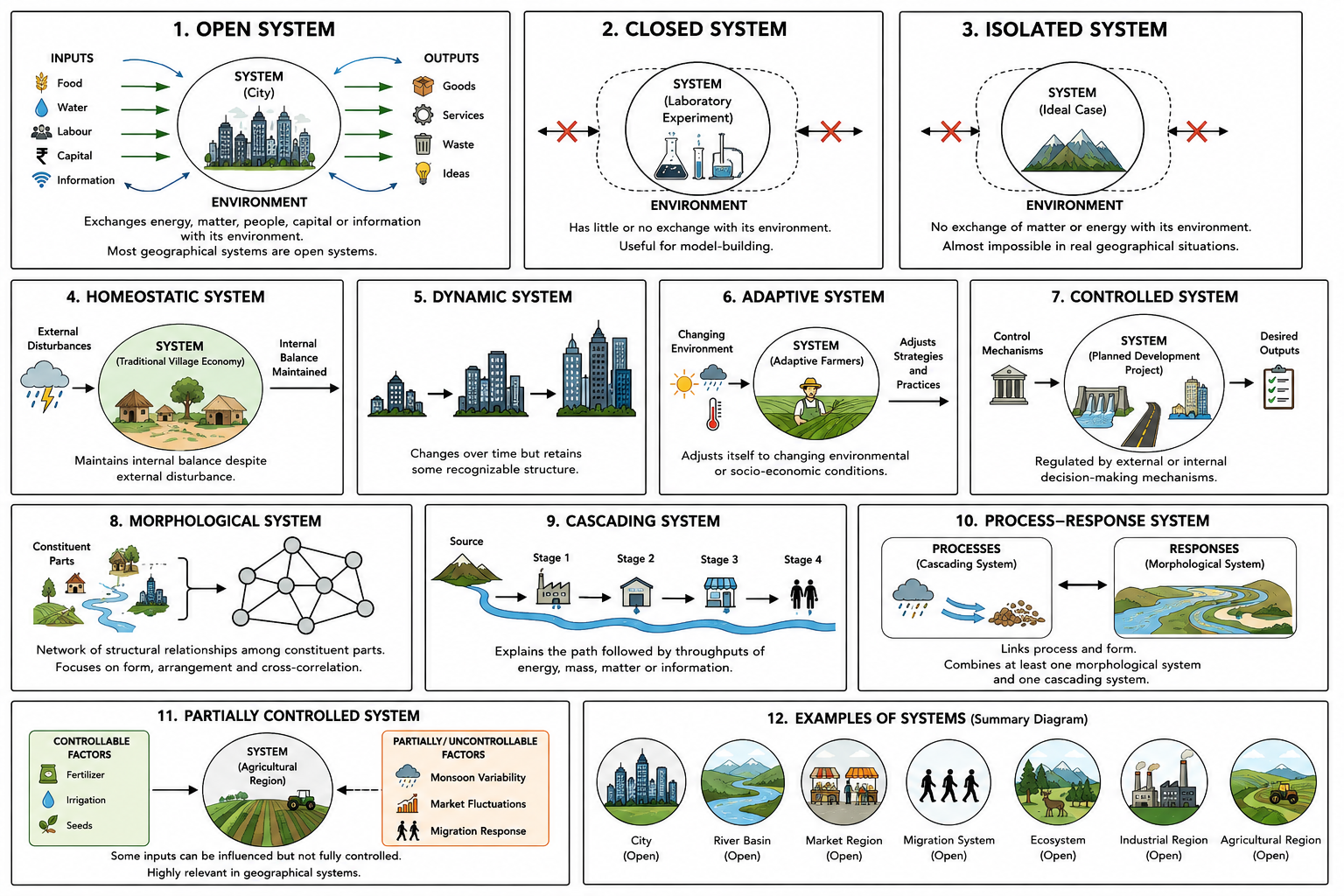
Open System
- An open system exchanges energy, matter, people, capital or information with its environment.
- Most geographical systems are open systems.
- Examples:
- City
- River basin
- Market region
- Migration system
- Ecosystem
- Industrial region
- Agricultural region
- A city imports food, water, labour, capital and information, and exports goods, services, waste and ideas. Hence, it is a classic open system.
Closed System
- A closed system has little or no exchange with its environment. Perfectly closed systems are rare in geography, but the idea is useful for model-building.
- Example:
- A laboratory experiment
- A simplified theoretical model with fixed assumptions
Isolated System
- An isolated system has no exchange of matter or energy with its environment. It is almost impossible in real geographical situations, but it may be used as an ideal concept.
Homeostatic System
- A homeostatic system maintains internal balance despite external disturbance.
- Example:
- Traditional village economy maintaining a stable relationship among land, labour, caste occupation and local exchange, before major market penetration.
Dynamic System
- A dynamic system changes over time but retains some recognizable structure.
- Example:
- Urbanization, demographic transition, migration streams and industrial regions.
Adaptive System
- An adaptive system adjusts itself to changing environmental or socio-economic conditions.
- Example:
- Dryland farmers adopting drought-resistant crops, micro-irrigation and crop insurance in response to climate variability.
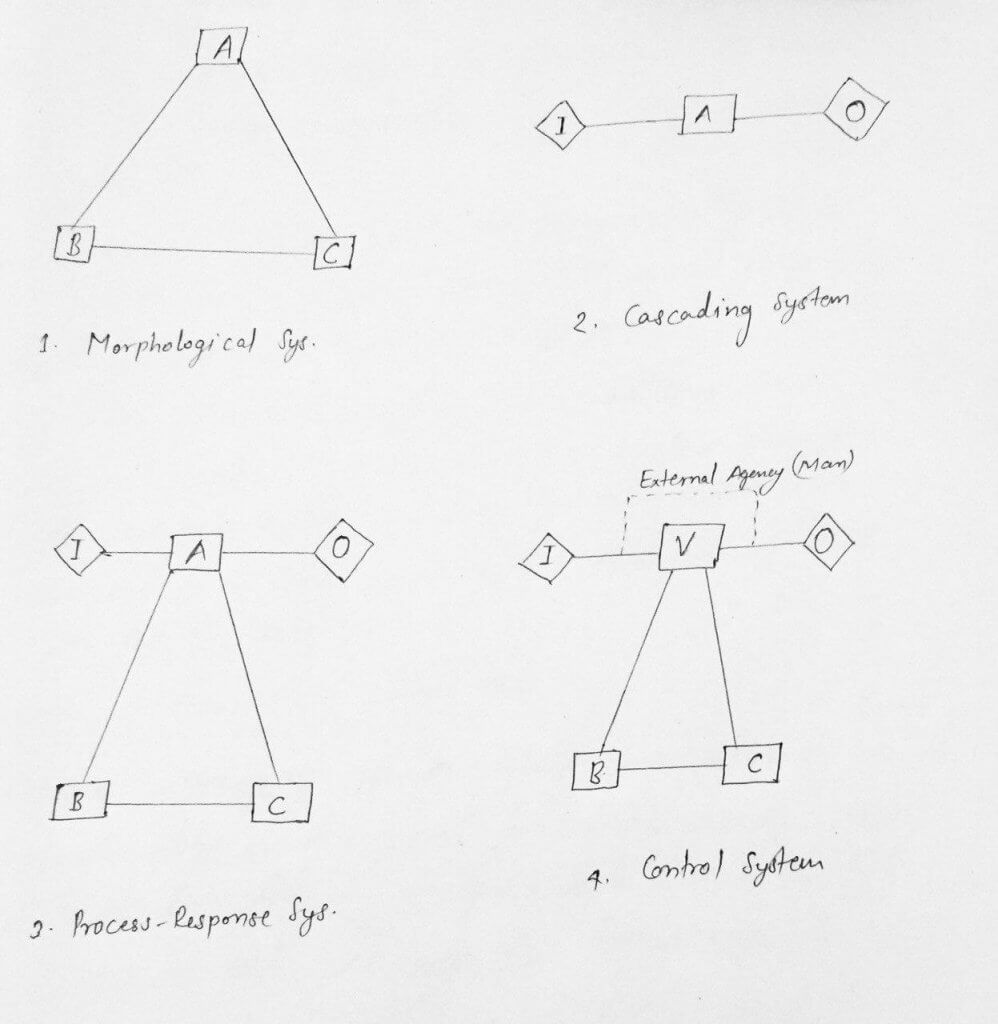
Controlled System
- A controlled system is regulated by external or internal decision-making mechanisms.
- Example:
- Command area development under irrigation planning
- Special Economic Zones
- Smart city projects
- Metropolitan transport planning
Morphological System
- A morphological system refers to the network of structural relationships among constituent parts. It focuses on form, arrangement and cross-correlation.
- Example:
- Drainage network pattern
- Urban land-use zones
- Settlement morphology
Cascading System
- A cascading system explains the path followed by throughputs of energy, mass, matter or information.
- Example:
- Water moving through a river basin
- Goods moving through a supply chain
- Commuters moving through an urban transport network
Process-Response System
- A process-response system links process and form. It combines at least one morphological system and one cascading system.
- Example:
- In a river basin, water discharge and sediment movement are processes, while channel shape and floodplain morphology are responses.
Partially Controlled System
- Partially controlled systems are highly relevant in geography because many inputs can be influenced but not fully controlled.
- Example:
- In agriculture, fertilizer, irrigation and seeds may be controlled, but monsoon variability cannot be fully controlled.
- In regional planning, infrastructure investment may be controlled, but migration response and market behaviour may not be fully predictable.
Relationships in a System
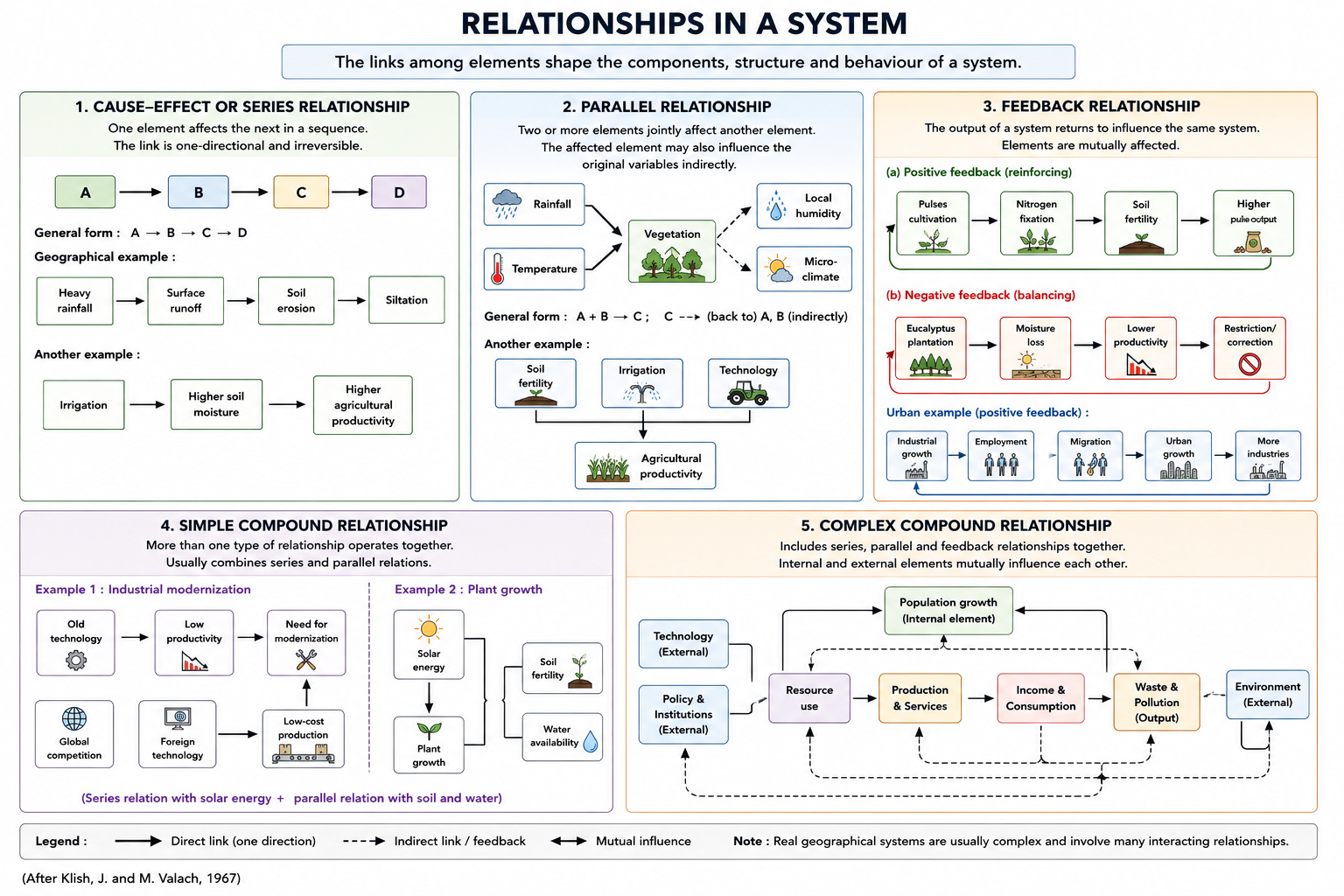
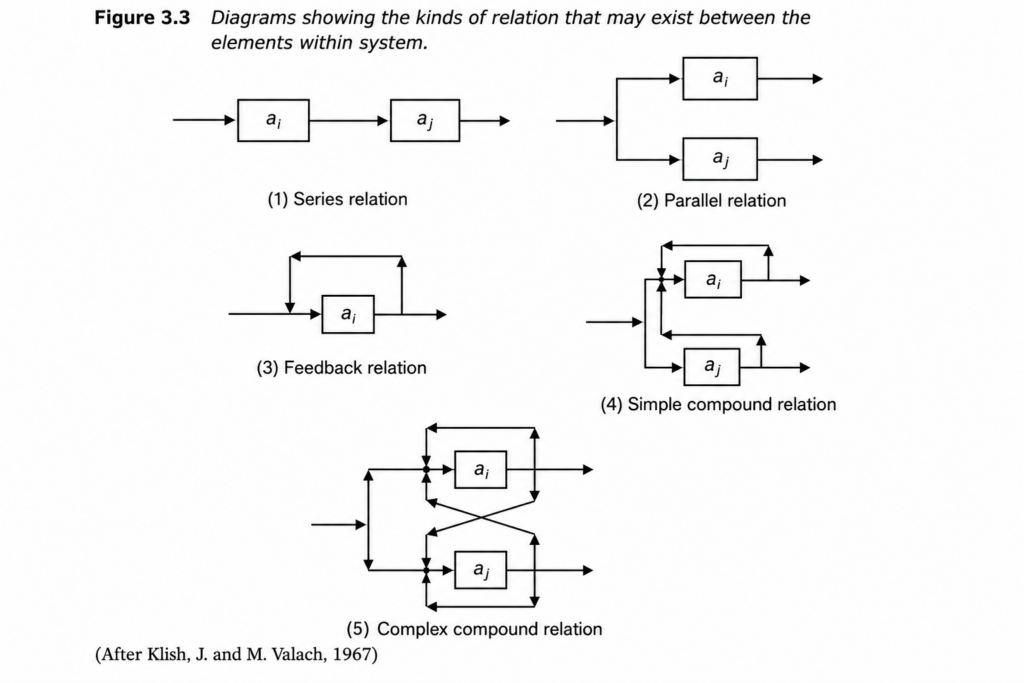
- The links among elements shape the components, structure and behaviour of a system. A system is not understood merely by identifying its elements; it is understood by examining how these elements are connected. Different patterns of links create different types of relationships.
- In geographical systems, relationships may be simple, linear, reciprocal or highly complex.
- Some links may operate in one direction, while others may operate in both directions.
- Some relationships are direct and visible, such as roads connecting towns; others are indirect and hidden, such as the impact of market demand on crop choice or the effect of land-use change on local climate.
- The most common relationships in system analysis are:
- Cause-effect or series relationship
- Parallel relationship
- Feedback relationship
- Simple compound relationship
- Complex compound relationship
- These relationships help the geographer explain flows, interactions, processes and changes in a spatial system.
Cause-Effect Relationship
- The cause-effect relationship is the simplest form of relationship. It is also called a series relationship because elements are connected in a sequence.
- In this relationship, one element affects another, but the second element does not directly affect the first in the same chain.
- Thus, the link is largely one-directional and irreversible.
- A -> B -> C
- Here, A affects B, and B affects C.
- A -> B -> C
- Geographical example:
- Rainfall intensity affects runoff, runoff affects soil erosion, and soil erosion affects siltation. However, soil erosion does not directly affect rainfall intensity in the same immediate sequence.
- Heavy rainfall -> Surface runoff -> Soil erosion -> Siltation
- Another example:
- Irrigation -> Higher soil moisture -> Higher agricultural productivity
- Rainfall intensity affects runoff, runoff affects soil erosion, and soil erosion affects siltation. However, soil erosion does not directly affect rainfall intensity in the same immediate sequence.
- This type of relationship is useful in explaining many physical and economic processes. However, it is a simplified relationship because most real geographical systems are not purely linear.
Parallel Relationship
- A parallel relationship exists when two or more elements jointly affect another element. Sometimes the affected element may also influence the original variables indirectly. This relationship is more realistic than a simple series relation because geographical phenomena are generally influenced by multiple factors at the same time.
- Geographical example:
- Rainfall and temperature together influence vegetation. Vegetation, in turn, may affect local humidity, evapotranspiration and micro-climatic conditions.
- Rainfall + Temperature -> Vegetation
- Vegetation -> Local humidity / micro-climate
- Another example:
- Soil fertility + Irrigation + Technology -> Agricultural productivity
- Rainfall and temperature together influence vegetation. Vegetation, in turn, may affect local humidity, evapotranspiration and micro-climatic conditions.
- Parallel relationships are important in agricultural geography, climatology, population studies and regional development because outcomes are rarely produced by a single factor.
Feedback Relationship
- Feedback relationship is a more advanced and dynamic relationship. In this relationship, the output of a system returns to influence the same system. Thus, elements are mutually affected.
- Feedback may be of two types:
- Positive feedback: It reinforces the original process and produces growth, expansion or cumulative change.
- Negative feedback: It checks the original process and helps restore balance or stability.
- Positive feedback example:
- Farmers grow pulses or leguminous crops. These crops enrich the soil with nitrogen. Better soil fertility increases the production of pulses. Thus, the process reinforces itself.
- Pulses cultivation -> Nitrogen fixation -> Soil fertility -> Higher pulse output
- Farmers grow pulses or leguminous crops. These crops enrich the soil with nitrogen. Better soil fertility increases the production of pulses. Thus, the process reinforces itself.
- Negative feedback example:
- Excessive eucalyptus plantation may reduce soil moisture and groundwater availability. This may reduce agricultural productivity and force farmers or planners to restrict such plantation. Here, the feedback checks the process.
- Eucalyptus plantation -> Moisture loss -> Lower productivity -> Restriction / correction
- Excessive eucalyptus plantation may reduce soil moisture and groundwater availability. This may reduce agricultural productivity and force farmers or planners to restrict such plantation. Here, the feedback checks the process.
- Urban example:
- Industrial growth -> Employment -> Migration -> Urban growth -> More industries
- This is positive feedback because growth generates further growth. But if congestion, pollution and high land prices rise sharply, they may push industries outward, producing negative feedback.
- Feedback relationship is central to cybernetics and system analysis because it shows that systems are self-adjusting, self-reinforcing or self-correcting.
Simple Compound Relationship
- A simple compound relationship contains more than one type of relationship operating simultaneously. It usually combines series and parallel relations. In this case, components are modified by their own internal processes and are also influenced by external components.
- Geographical example:
- Industrial modernization in India may be understood as a simple compound relationship. Old technology reduces competitiveness; global competition encourages adoption of new foreign technology; new technology increases productivity and reduces cost.
- Old technology -> Low productivity -> Need for modernization
- Global competition + Foreign technology -> Low-cost production
- Both internal pressure and external influence operate together.
- Industrial modernization in India may be understood as a simple compound relationship. Old technology reduces competitiveness; global competition encourages adoption of new foreign technology; new technology increases productivity and reduces cost.
- Another example:
- Solar energy -> Plant growth
- Soil fertility + Water availability -> Plant growth
- Here, plant growth is affected by a series relation with solar energy and a parallel relation with soil and water.
- In physical geography, the solar system can also be understood through simple compound relations: solar radiation affects planetary energy conditions, while gravitation operates as a parallel force maintaining orbital relations.
Complex Compound Relationship
- A complex compound relationship is the most realistic and most difficult type of relationship.
- It includes series, parallel and feedback relationships together. In such systems, internal and external elements mutually influence each other. Most real geographical and biological systems are of this type.
- In this type of relationship, it is difficult to identify one single cause because many variables interact simultaneously. Change in one element may produce changes in several other elements, and those changes may return to influence the original element.
- Environmental example:
- Urban flooding is shaped by rainfall intensity, drainage capacity, land-use change, encroachment, governance, wetland loss, solid waste and climate variability.
- Heavy rainfall -> Runoff -> Waterlogging
- Urbanization -> Impervious surface -> Higher runoff
- Wetland loss -> Lower absorption -> Flood intensity
- Solid waste -> Drain blockage -> Waterlogging
- Flooding -> Policy response -> Drainage improvement / relocation
- Urban flooding is shaped by rainfall intensity, drainage capacity, land-use change, encroachment, governance, wetland loss, solid waste and climate variability.
- Ecosystem example:
- An ecosystem is the best example of a complex compound relationship. Climate, soil, vegetation, animals, microorganisms and human activities interact with one another. Deforestation may change runoff, soil erosion, biodiversity, local temperature, rainfall pattern and livelihood systems. These changes may further influence human decisions and ecological recovery.
- Urban example:
- A metropolitan city is also a complex compound system. Population growth, land prices, transport routes, employment centres, housing demand, pollution, migration, governance and technology interact continuously. This is why solving urban problems requires integrated planning rather than single-factor intervention.
- Complex compound relationships are the most common in geography. Human body, metro cities, river basins, ecosystems, migration systems and regional economies all show this type of relationship. This explains why system analysis is essential for modern applied geography.
Input-Output Behaviour
- The behaviour of a system refers to flows, stimuli, responses, inputs and outputs.
- If the environment changes, at least one element of the system is affected, and this effect is transmitted through connected elements.
- Environmental change -> Affected element -> System-wide response -> Output
- In economic geography, the world map of iron ore production and trade may be described in system terms:
- Elements: producing and consuming centres
- Links: trade routes
- Function: amount of iron ore transported
- Development: changing pattern over time

Application of System Analysis in Human Geography
Urban Geography
- Cities are open, dynamic and complex systems. A city has land-use zones, transport networks, population groups, economic activities, political institutions and environmental subsystems.
- System analysis helps in:
- Understanding urban growth
- Studying commuting patterns
- Planning transport networks
- Managing solid waste
- Controlling air pollution
- Analysing urban heat island
- Predicting housing demand
- Studying city-region interaction
- Example: Delhi NCR may be studied as a system where Delhi, Gurugram, Noida, Ghaziabad and Faridabad function as interconnected nodes through flows of labour, capital, real estate, transport and services.
Settlement Geography
- Settlement systems are hierarchical and functionally linked.
- System analysis helps in understanding:
- Village-town relationships
- Central place hierarchy
- Rural service centres
- Market areas
- Functional regions
- Rank-size distribution
- Christaller’s Central Place Theory can be interpreted as a system of settlements where higher-order centres provide specialized services to wider hinterlands, while lower-order centres provide basic services to smaller areas.
Population Geography
- Population is a dynamic system involving fertility, mortality, migration, age structure, literacy, employment and social institutions.
- System analysis helps in studying:
- Demographic transition
- Migration streams
- Population-resource relationships
- Urban population growth
- Regional population imbalance
- Example: Out-migration from Bihar and eastern Uttar Pradesh to Delhi, Punjab, Maharashtra and Gujarat is not merely a population movement. It is linked with agrarian stress, wage differences, labour demand, social networks, transport connectivity and remittances.
Economic Geography
- Economic regions are systems of production, exchange, consumption and regulation.
- System analysis is useful in:
- Industrial location
- Input-output analysis
- Regional economic planning
- Growth pole analysis
- Commodity-chain studies
- Market-area analysis
- Example: The automobile cluster around Chennai operates as a system involving ports, highways, skilled labour, component suppliers, global firms, state policy, logistics and export markets.
Agricultural Geography
- Agriculture is a human-environment system. It includes natural factors, technology, institutions and markets.
- System analysis helps in understanding:
- Crop combination
- Land-use change
- Irrigation command areas
- Green Revolution regions
- Agricultural productivity
- Food security
- Climate-resilient agriculture
- Example: Punjab’s agricultural system is shaped by canal and tube-well irrigation, MSP procurement, HYV seeds, fertilizers, mechanization, paddy-wheat monoculture, groundwater depletion and state policy.
Political Geography
- States, boundaries, frontiers, electoral regions and geopolitical blocs may be studied as systems.
- Applications:
- Borderland studies
- Federal relations
- Geopolitical alliances
- Electoral geography
- Resource conflicts
- Example: The India-Bangladesh borderland is a system of political boundary, migration, trade, riverine geography, cultural continuity, security concerns and border infrastructure.
Regional Planning
- System analysis is especially important in regional planning because regions are multi-variable systems.
- It helps planners to:
- Identify backward regions
- Assess resource potential
- Link growth centres with hinterlands
- Estimate infrastructure gaps
- Plan transport corridors
- Predict environmental impacts
- Design balanced regional development strategies
- Example: Aspirational districts can be studied as regional systems involving health, education, agriculture, skill development, infrastructure, governance and social indicators.
Environmental Geography
- Human-environment interaction is best understood through system analysis.
- Applications:
- Watershed management
- Climate change adaptation
- Disaster risk reduction
- Pollution control
- Ecosystem services
- Carrying capacity assessment
- Environmental impact assessment
- Example: Floods in the Brahmaputra basin are a result of rainfall, snowmelt, sediment load, river morphology, embankments, land-use change, settlement expansion and governance.
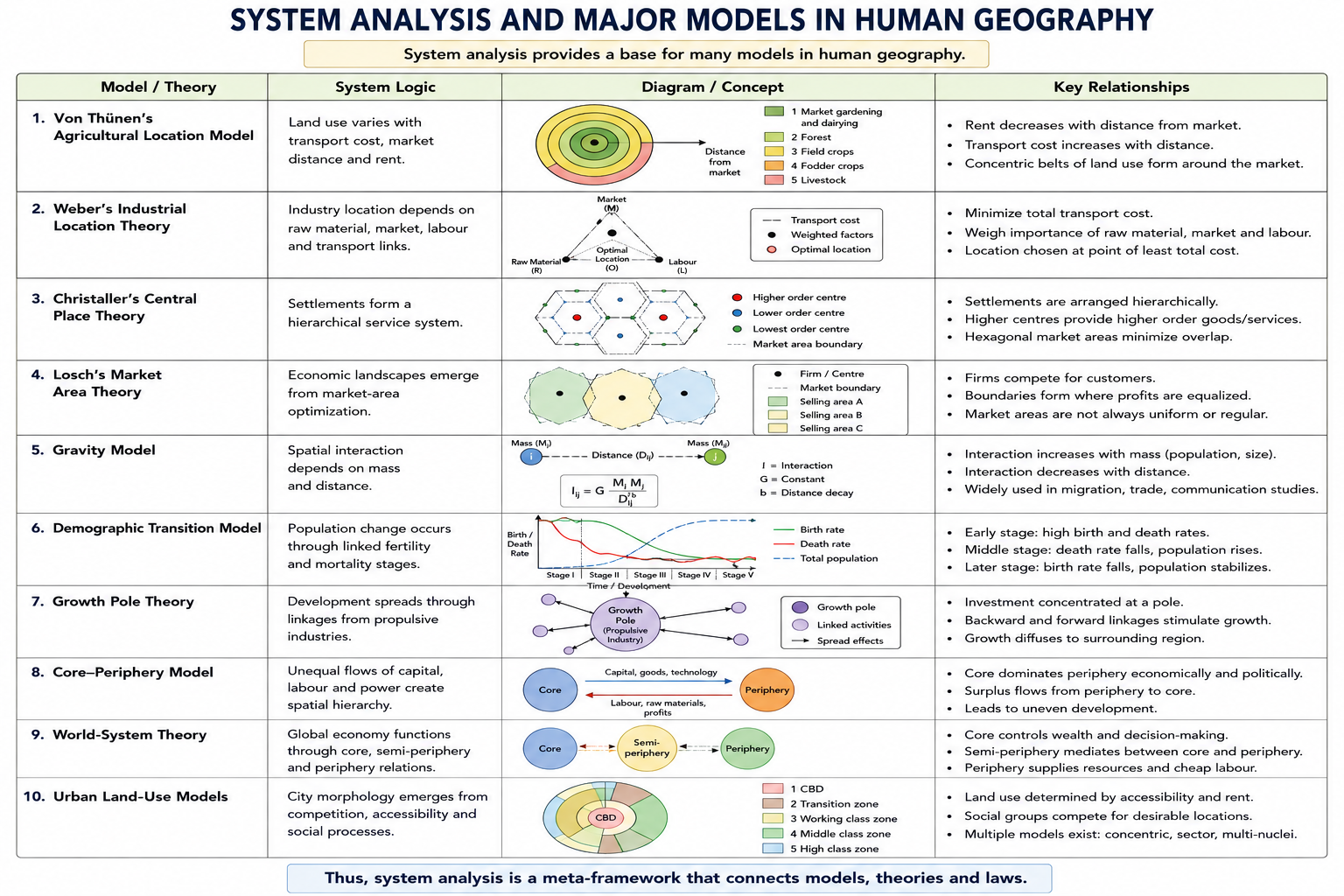
System Analysis and Major Models in Human Geography
System analysis provides a base for many models in human geography.
| Model / Theory | System Logic |
|---|---|
| Von Thunen’s Agricultural Location Model | Land use varies with transport cost, market distance and rent |
| Weber’s Industrial Location Theory | Industry location depends on raw material, market, labour and transport links |
| Christaller’s Central Place Theory | Settlements form a hierarchical service system |
| Losch’s Market Area Theory | Economic landscapes emerge from market-area optimization |
| Gravity Model | Spatial interaction depends on mass and distance |
| Demographic Transition Model | Population change occurs through linked fertility and mortality stages |
| Growth Pole Theory | Development spreads through linkages from propulsive industries |
| Core-Periphery Model | Unequal flows of capital, labour and power create spatial hierarchy |
| World-System Theory | Global economy functions through core, semi-periphery and periphery relations |
| Urban Land-Use Models | City morphology emerges from competition, accessibility and social processes |
Thus, system analysis is a meta-framework that connects models, theories and laws.
System Analysis and Evolution of Geography as Science
- System analysis is closely linked with the transformation of geography from a descriptive subject into an analytical and predictive science.
| Stage | Nature | Geographical Expression |
|---|---|---|
| Descriptive stage | Description and mapping of phenomena | Ancient and medieval geography; travel accounts; regional descriptions |
| Analytical stage | Search for explanation and laws behind observed patterns | Humboldt, Ritter, environmental studies, spatial distribution analysis |
| Predictive stage | Use of models and laws to predict spatial behaviour | Post-Second World War quantitative geography, locational theories, planning models |
- The real rise of system analysis in human geography is mainly a post-Second World War development. Locational theories, spatial interaction models, regional planning models and controlled-system approaches helped geography move toward prediction and applied problem-solving.
- However, geography is not a fully controlled science like laboratory physics. Many geographical systems are only partially controlled. For example, a planner may control fertilizer supply, canal irrigation or transport investment, but cannot fully control monsoon, farmer decisions, market prices or migration behaviour.
Methodology of System Analysis
The method of system analysis generally follows these steps:
- Define the problem
- Example: Why is a city facing water scarcity?
- Delineate the system boundary
- Example: Municipal boundary, metropolitan region or river basin?
- Identify elements
- Example: Water sources, population, industries, distribution network, rainfall, groundwater, governance.
- Identify flows and linkages
- Example: Water supply, wastewater, finance, demand, policy decisions.
- Measure variables
- Example: Per capita water availability, groundwater level, leakage rate, demand-supply gap.
- Construct a model
- Example: Water balance model or GIS-based urban water system model.
- Analyse feedbacks and thresholds
- Example: Over-extraction causing groundwater decline; tanker dependence causing inequality.
- Predict scenarios
- Example: Future demand under different population growth and rainfall conditions.
- Suggest policy intervention
- Example: Rainwater harvesting, wastewater reuse, aquifer recharge, demand management.
Importance of System Analysis in Geography
System analysis is important because it converts geography from a descriptive discipline into an analytical and applied discipline.
- Holistic Understanding
- It studies the whole rather than isolated parts. This is crucial because geographical problems are multi-dimensional.
- Example: Urban pollution cannot be understood only as an environmental issue; it is linked with transport, industry, population density, energy use, governance and lifestyle.
- Interdisciplinary Integration
- System analysis integrates physical geography, human geography, economics, sociology, political science, ecology and planning.
- Prediction and Simulation
- It helps geographers predict future outcomes.
- Examples:
- Urban growth simulation
- Flood forecasting
- Traffic modelling
- Population projection
- Land-use change modelling
- Policy Relevance
- It is useful for applied planning, such as:
- Regional development
- Smart cities
- Watershed planning
- Disaster management
- Environmental impact assessment
- Transport planning
- Climate adaptation
- It is useful for applied planning, such as:
- Understanding Feedback and Unintended Consequences
- Many policies fail because they ignore feedback effects.
- Example: Subsidized electricity for agriculture may increase irrigation, but it may also cause groundwater depletion, crop pattern distortion and fiscal stress.
- Useful in GIS and Remote Sensing
- Modern GIS-based modelling, spatial decision support systems, land-use modelling and urban analytics are rooted in system thinking.
- Theorization and Model Building
- System analysis supports theorization and model-building. It gives geography a systematic language for describing elements, links, flows, functions and development.
- From Description to Objective Interpretation
- It helped geography move beyond mere description toward rational interpretation, explanation and prediction.
- Technical Apparatus for Complexity
- System analysis provides concepts such as feedback, threshold, equilibrium, hierarchy and control, which help in dealing with complex structures.
Criticism and Limitations
- Despite its importance, system analysis has limitations.
- Overemphasis on Quantification
- System analysis developed during the quantitative revolution and often gives priority to measurable variables. Human emotions, culture, power, identity and perception may be ignored.
- Mechanistic View of Society
- Human societies are not machines. People do not always behave rationally or predictably. Behavioural and humanistic geographers criticize system analysis for reducing human agency.
- Boundary Problem
- Delineating the boundary of a system is difficult.
- Example:
- Should Mumbai be studied as a municipal system, metropolitan system, coastal system, financial system or global-city system?
- Data Constraints
- Accurate system modelling requires reliable data. In developing countries, data gaps, informal economies and unrecorded flows create problems.
- Complexity and Non-linearity
- Real-world systems are complex. Small changes may produce large outcomes, and large interventions may produce little change.
- Example:
- A small drainage blockage may cause severe urban flooding, while a large infrastructure project may fail if social behaviour is ignored.
- Neglect of Power and Inequality
- Radical geographers argue that system analysis may describe flows and structures but may not sufficiently explain who controls the system and who benefits from it.
- Example:
- Urban land-use models may describe spatial structure but may underplay class power, real estate speculation, eviction and informality.
- Positivist Bias
- System analysis is often associated with positivism, which assumes that reality can be objectively measured and generalized. This may lead to the neglect of unseen or qualitative variables.
- Weak Treatment of Human Values
- Normative values such as beliefs, attitudes, desires, hopes, fears, aesthetic preferences and ethical concerns are difficult to quantify. Therefore, humanistic and welfare approaches criticize system analysis for producing an incomplete picture of geographical reality.
- Technical Complexity
- System analysis can become technically demanding because it often uses abstract mathematical language, models, data sets and diagrams. This may limit its use in field-based and qualitative research.
Contemporary Relevance
- System analysis has become even more relevant in the twenty-first century because geographical problems are increasingly interconnected.
- Important contemporary applications include:
- Climate change adaptation
- Urban resilience
- Disaster risk reduction
- Sustainable development goals
- Food-water-energy nexus
- Smart city governance
- Circular economy
- Regional inequality
- Global supply chains
- Migration and remittance networks
- Pandemic geography
- Example: COVID-19 showed that health, migration, transport, economy, governance and urban density are parts of a single socio-spatial system.
- Similarly, climate change cannot be understood only as atmospheric change; it is linked with energy systems, agriculture, urbanization, geopolitics, technology, consumption and vulnerability.
Indian Examples:
- Delhi NCR as an Urban System
- Delhi NCR includes multiple urban nodes connected by transport, labour markets, real estate, industries, administration and service economies. Air pollution in Delhi cannot be solved by focusing only on Delhi because crop residue burning, vehicular emissions, construction dust, industrial clusters, meteorology and regional governance are all part of the wider system.
- Punjab Agriculture as an Agro-Economic System
- Punjab’s paddy-wheat system is linked with MSP, procurement, groundwater, electricity subsidy, mechanization, labour migration, food security and soil degradation. System analysis shows that changing crop pattern requires simultaneous changes in market assurance, irrigation policy, farmer incentives and consumer demand.
- Himalayan Region as a Fragile Human-Environment System
- The Himalayan system includes geology, slope, rainfall, glaciers, rivers, roads, tourism, hydropower, settlements and disaster vulnerability. Landslides and flash floods are not isolated natural events; they are outcomes of interactions among terrain, climate, infrastructure and land-use change.
- Mumbai Metropolitan Region as a Coastal-Urban System
- Mumbai’s flooding problem is linked with monsoon rainfall, tidal conditions, drainage congestion, reclamation, wetland loss, informal settlements, real estate pressure and governance fragmentation.
- Aspirational District Programme as a Regional Development System
- The programme treats backwardness as a multi-sectoral system involving health, nutrition, education, agriculture, water resources, infrastructure, financial inclusion and governance capacity.
In System analysis, Humanism and welfare approach was rejected because it is impossible to quantify human emotions and his decisions making process.





Thank you
Very helpful, very informative. Thank you.
thank you so much LR
Keep Reading
Thank you so much … I have no word to Say thanks … Very impressive initiative for those who don’t join paid classes
Thank you so much for the kind words! Knowing this helps you in your journey and makes it all worthwhile. Keep learning and all the best!
Very meaningfull for my study . Thank you
You are amazing
Thank you so much! That really means a lot, especially when breaking down tricky topics like human geography perspectives and models.
Hearing that the notes are making a difference in your preparation is the best motivation. Keep pushing forward, and happy learning!
I think you are underrated!🤣🤣
Haha, I appreciate that!
It’s amazing. 1st time i felt that I can deal with human geography.. Esp perspective and models etc.
Thank you so much! Making these complex topics easier to handle is exactly what we aim for. Happy learning!
pls also add source of the content….. book u used …
Models in GEOGRAPHY by Majid Husain