- Environmental geography studies the relationship between human beings and their environment in its spatial and temporal setting. It is the part of geography that bridges the physical sciences (climatology, geomorphology, hydrology, biogeography) and the social sciences (economics, sociology, anthropology, policy studies).
- Peter Haggett, in Geography: A Modern Synthesis (1972), saw geography as concerned with two interacting systems:
- the ecological system, which links people with their environment;
- the spatial system, which links one region with another through flows of people, goods and ideas.
- Environmental geography works mainly on the first, without losing sight of the second.
- It has three analytical foci: the environment itself, the human agent, and the interactions between the two.
Meaning and Definitions

Meaning of environment
- The word comes from the Old French environner, “to surround”. In English, “environment” first meant simply the state of being surrounded.
- Thomas Carlyle gave it its modern sense in 1827, using it to translate the German Umgebung, the conditions in which a person or thing lives.
- In biology, Jakob von Uexküll (1864–1944) developed the idea of the Umwelt (1909): each organism lives in its own perceived surrounding world. His work gave ecology a working concept of environment.
- In the wider sense, environment is every condition, force and influence that surrounds an organism and affects its life: abiotic and biotic, climatic, social and economic.
- Indian law takes the same broad, relational view. The Environment (Protection) Act, 1986 defines environment to include water, air and land, and the inter-relationship among them and human beings, other living creatures, plants, micro-organisms and property.
Definitions compared
| Scholar or source | Definition or emphasis |
|---|---|
| Chris C. Park (1980) | The sum total of conditions surrounding man at a given point in space and time |
| Douglas and Holland | The aggregate of all external forces, influences and conditions that affect the life, behaviour, growth and development of organisms |
| P. Gisbert | Anything immediately surrounding an object and exerting a direct influence on it |
| US National Environmental Policy Act (1969) | The natural and man-made surroundings and the interrelations of their components with human activity |
| Environment (Protection) Act, India (1986) | Water, air and land and their inter-relationship with living beings and property |
Defining environmental geography
- Environmental geography is the study of the spatial attributes of interrelationships between living organisms and the natural environment in general.
- Above all, it studies the relationship between technologically advanced “economic man” and his natural environment, within a temporal and spatial framework.
- Kenneth Hewitt and F. Kenneth Hare (Man and Environment: Conceptual Frameworks, 1973) defined it as the systematic description of the components of the environment and of human interaction with those components.
- The current view treats environmental geography as the integrative “third” field between physical and human geography. It studies coupled human–natural systems, from local resource use to global environmental change.
Why geography is suited to the task
- Arthur N. Strahler and Alan H. Strahler, in Geography and Man’s Environment (1977), placed man and land at the heart of geography. No other discipline joins the spatial, temporal, biotic and abiotic dimensions as fully:
- It studies the spatial attributes of all phenomena, human and natural, at every scale from local to global.
- As an integrating science, it brings the lithosphere, hydrosphere, atmosphere and biosphere together as one interacting system and links social with natural science.
- Geographers can identify environmental regions, locate and map them, and explain the causes of their variation.
- It bridges physical processes and the demographic, cultural and economic processes that drive environmental change.
Nature and Scope
Nature of environmental geography
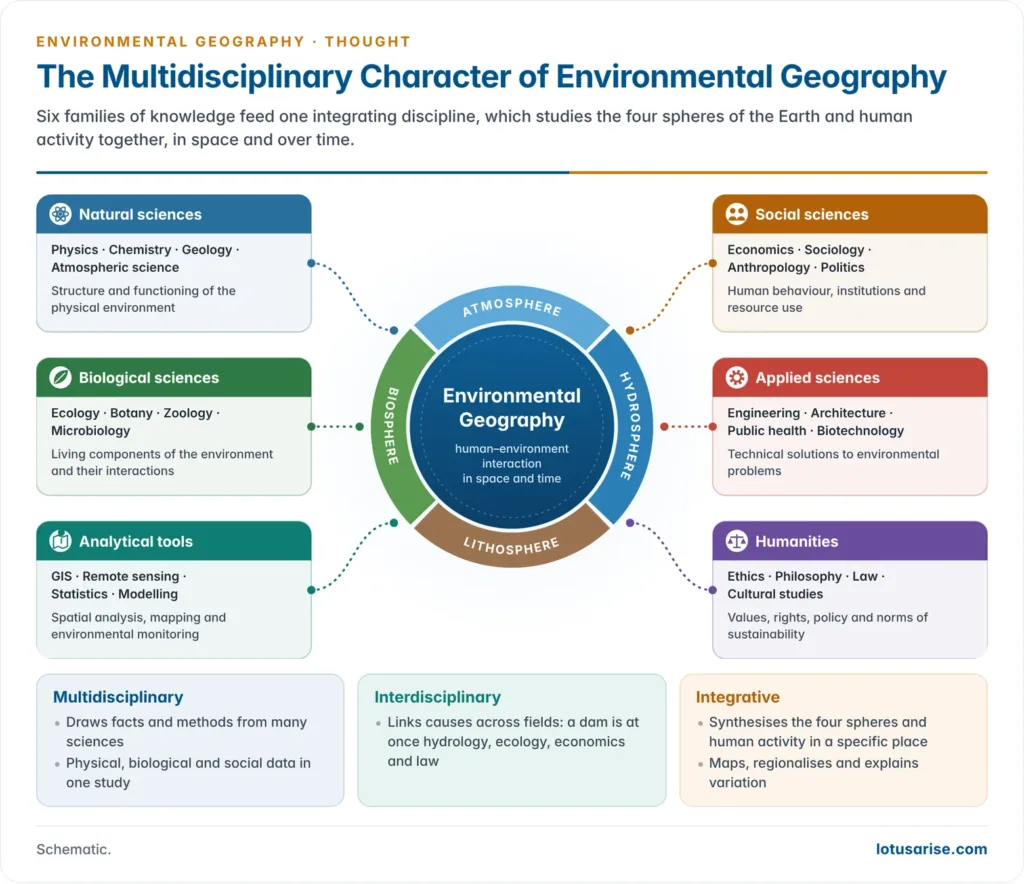
- Multidisciplinary, interdisciplinary and integrative:
- It borrows facts and methods from physics, chemistry, biology, geology, economics, sociology, law and policy studies.
- It links causes across these fields; a dam is at once a question of hydrology, ecology, economics and law.
- It synthesises them in a specific place.
- Holistic and systemic: the environment is treated as a system of interacting parts, so a change in one sphere ripples through the others.
- Spatial and temporal: it asks where environmental conditions and problems occur, why there, and how they change over time.
- Multi-scalar: from a village watershed to the global climate system.
- Applied and problem-solving: it supplies the knowledge base for resource management, hazard reduction, planning and policy.
- Value-laden: questions of equity, ethics and justice (who pollutes, who suffers) are part of the subject, not outside it.
Scope of environmental geography
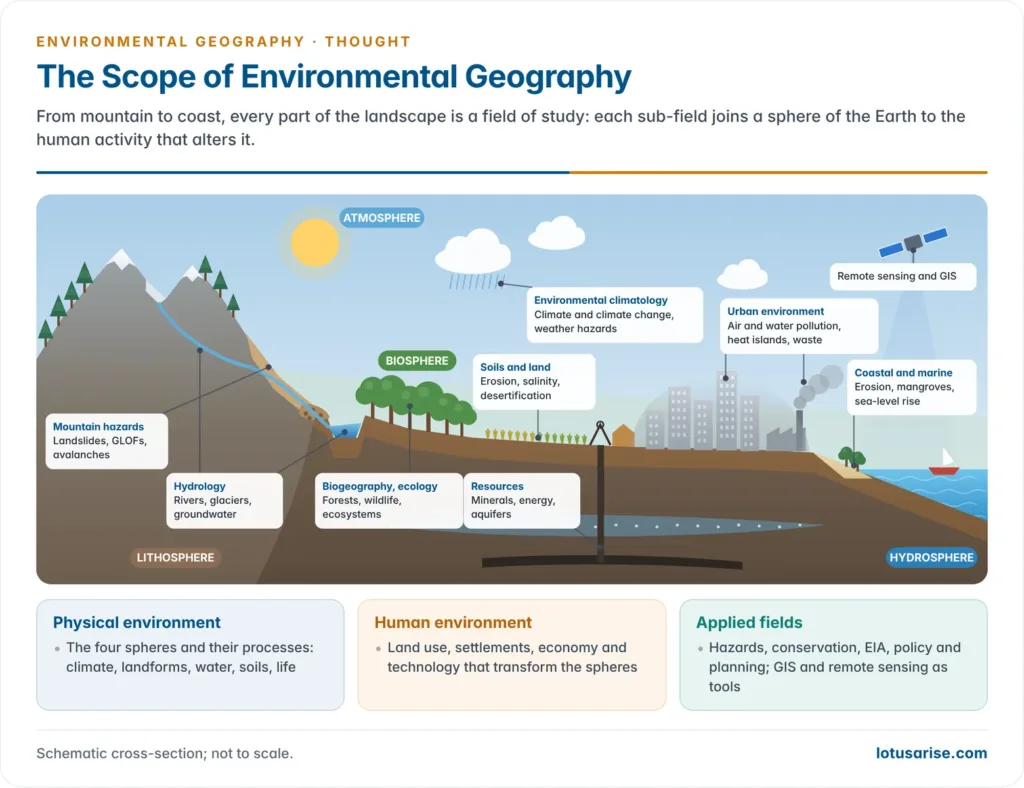
- Resources: creates awareness of renewable and non-renewable resource endowments, their patterns of use and their sustainability.
- Ecological systems: gives knowledge of ecosystems and the cause-and-effect relationships within them.
- Biodiversity: records the richness of plant, animal and microbial life and the threats to it.
- Hazards and disasters: explains natural and human-induced hazards, such as floods, earthquakes, cyclones and landslides, and their mitigation.
- Policy choices: evaluates alternative responses to an environmental problem before action is taken.
- Citizenship: builds environmentally literate citizens aware of environmental laws, rights and duties.
- Population and health: exposes the links between population growth, health, hygiene and environmental quality, and the role of technology in reducing damage.
- Indigenous knowledge: identifies eco-friendly traditional skills and technologies, such as tank irrigation, sacred groves and terrace farming.
- Sustainability: promotes the sustainable use of inherited resources for future generations, linking theory to the practice of sustainable development.
Sub-fields within the scope
| Sub-field | Focus | Example |
|---|---|---|
| Environmental geomorphology | Landforms and processes as resources and hazards | Landslide zoning in the Himalaya |
| Environmental climatology | Climate as a resource, a hazard and a changing system | Urban heat islands; heat waves |
| Hydrology and water resources | Rivers, glaciers, groundwater and their use | Groundwater depletion in Punjab |
| Biogeography and ecology | Ecosystems, biodiversity and conservation | Western Ghats biodiversity |
| Soils and land | Erosion, salinity, desertification | Chambal ravines |
| Environmental pollution | Air, water, soil, noise and waste | Winter smog in Delhi NCR |
| Hazards and disasters | Vulnerability, risk and response | Floodplain zoning |
| Environmental management and planning | Policy, law, EIA, restoration | Environmental impact assessment of projects |
| Environmental perception | How people see, value and respond to nature | Perception, attitude, value and emotion in conservation |
| Geospatial analysis | GIS, remote sensing and modelling | Satellite atlases of land degradation |
Core concepts of the field
- Environment as a system: the four spheres exchange energy and matter through inputs, stores and outputs, held in balance by feedbacks.
- Negative feedback restores balance; positive feedback, as when melting ice lowers albedo and speeds warming, amplifies change.
- Carrying capacity: the largest population an area can support without degrading its resource base.
- Ecological footprint: the land and water area needed to supply a population’s consumption and absorb its waste; it lets environmental degradation be compared across places.
- Vulnerability and resilience: how exposed a community is to harm, and how well it absorbs a shock and recovers.
- Scale: a process looks different at the scale of a field, a river basin and the globe, and so do its remedies.
- Sustainability: meeting present needs without compromising future generations, the organising goal of the whole field.
Relevance in India
- Constitutional base:
- The 42nd Amendment (1976) added Article 48A (a duty of the State to protect and improve the environment) and Article 51A(g) (a fundamental duty of citizens to protect nature).
- The courts have read the right to a clean environment into Article 21.
- Institutions and policy:
- The National Green Tribunal (2010) hears environmental disputes.
- The National Action Plan on Climate Change (2008) runs through eight national missions.
- Mission LiFE (Lifestyle for Environment, October 2022) carries the subject into everyday behaviour. These form the core of environmental policy in India.
- Climate commitments:
- India pledged net zero by 2070 at COP26 in Glasgow (2021).
- Its updated NDC (2022) aims to cut the emissions intensity of GDP by 45% from 2005 levels and to draw about 50% of installed power capacity from non-fossil sources, both by 2030.
- The geographer’s agenda in India:
- It spans Himalayan hazards, winter smog over the Indo-Gangetic Plain, groundwater depletion in the north-west, coastal erosion and the loss of forests and wetlands.
- Each joins a physical process to a human cause in a specific region.
Environmental geography, ecology and environmental science
| Basis | Ecology | Environmental science | Environmental geography |
|---|---|---|---|
| Core question | How organisms relate to each other and their surroundings | How the environment works and how to fix its problems | Where and why human–environment relations vary |
| Centre of attention | Organisms, populations, ecosystems | Physical, chemical and biological processes | People in place, across scales |
| Human role | Often one species among many | A source of impacts | An active agent and a variable |
| Distinctive tool | Field experiment, energy and nutrient budgets | Laboratory and monitoring | Mapping, regionalisation, spatial analysis |
Components and Types of Environment
The four spheres
- The physical environment is made of the four spheres of the Earth:
- Lithosphere: the solid Earth, with rocks, landforms, minerals and soils.
- Hydrosphere: oceans, rivers, lakes, ice and groundwater.
- Atmosphere: the gaseous envelope with its weather and climate.
- Biosphere: the zone of life, where the other three meet and interact.
- Energy drives them: solar radiation from outside and internal heat from within the Earth. Matter cycles between them.
Types of environment
Physical (natural) environment
- The terrestrial and atmospheric conditions that exist independently of human agency, shaped over geological time by natural processes.
- Components: rivers, mountains, plains, deserts, oceans, volcanoes, weather systems, seasons, soils, minerals.
- Key feature: humans have limited or no control over these conditions.
- Also includes the biological environment: natural vegetation and wildlife that evolve through ecological processes.
Social (human-made) environment
- Humans cannot live directly in the raw physical environment, so they modify it through technology, knowledge and capital. The result has two interlinked layers:
- Outer environment:
- The physical environment as modified by technology: cities, transport networks, industries, dams, agricultural landscapes and communication systems.
- It reflects humanity’s technical capacity to adapt nature to human needs.
- Inner environment:
- The socio-cultural sphere: customs, traditions, religious beliefs, social organisation, economic systems and moral codes, often called “social heritage”.
- It shapes how people behave and decide within the physical environment.
- Indian example: sacred groves (devrais in Maharashtra, kavus in Kerala, orans in Rajasthan) are a religious tradition that conserves biodiversity.
- Outer environment:
- Environments are also classed by scale, as micro-environment (a field, a house, a city block) and macro-environment (a biome, the global climate).
The ecological basis
- Ecology, from the Greek oikos (house) and logos (study), was named by Ernst Haeckel in 1866. It is the science of the relationships between organisms and their surroundings; its levels, factors, niches and population interactions are set out in the principles of ecology.
- The ecosystem, a term coined by Arthur George Tansley (1935), is ecology’s working unit. Its structure, productivity, energy flow and biogeochemical cycles give environmental geography its functional base.
- Energy flows one way through an ecosystem and is lost as heat at each step, while nutrients cycle. Human interference with either, by clearing forests or adding fertiliser and carbon, is the root of most environmental problems.
Humans as an environmental agent
- Humans act on the environment in three roles:
- as a biological organism: a consumer in food chains, dependent on air, water and food;
- as a social being: organised in cultures and institutions that decide how nature is used;
- as a technological “economic man”: the most powerful agent of change on the planet.
- Scale of human impact today:
- The term Anthropocene, popularised by Paul J. Crutzen and Eugene F. Stoermer (2000), names an age in which human activity rivals natural forces. Geologists rejected it as a formal epoch in March 2024, but it remains a widely used concept for the influence of man on the environment.
- The Planetary Health Check of September 2025 found seven of nine planetary boundaries breached, with ocean acidification the latest to cross into the danger zone. These are among the global ecological changes and imbalances that now define the field’s agenda.
Evolution and Approaches
Evolution of environmental geography
- Classical roots:
- Hippocrates, in Airs, Waters, Places (about 400 BCE), and Aristotle linked climate to the body and temperament of peoples.
- Ibn Khaldun (Muqaddimah, 1377) related the character of societies to climatic zones.
- Modern foundations:
- Alexander von Humboldt (1769–1859) saw nature as one interconnected web, a view set out in his contributions to geographical thought.
- George Perkins Marsh, in Man and Nature (1864), gave the first systematic account of human destruction of the environment: deforestation, soil loss and changes to rivers.
- Age of environmentalism (1880s–1920s):
- Friedrich Ratzel, Ellen Churchill Semple and Ellsworth Huntington made the environment the controlling factor in human affairs. This environmentalism dominated early academic geography.
- Reaction and middle paths (1900s–1950s):
- Possibilism grew in France.
- Harlan H. Barrows (Geography as Human Ecology, 1923) redefined the subject as the study of human adjustment to environment.
- Carl Ortwin Sauer studied the cultural landscape and attacked determinism’s premature generalisations.
- The Princeton symposium Man’s Role in Changing the Face of the Earth (1955, published 1956) reversed the question: it asked what humans do to nature.
- Eclipse (1950s–1960s): the quantitative revolution turned geography towards spatial science, and human–environment questions were pushed to the margins.
- Rejuvenation (1960s onwards): an environmental crisis brought the theme back with new tools.
- Rachel Carson’s Silent Spring (1962), Garrett Hardin’s “tragedy of the commons” (1968) and *The Limits to Growth* (1972) set the tone, and the Stockholm Conference (1972) put the environment on the global agenda.
- David R. Stoddart (1965) proposed the ecosystem as a geographic principle. Richard J. Chorley and Barbara A. Kennedy (1971) built physical geography on systems analysis.
- Gilbert F. White (Human Adjustment to Floods, 1945) and later Ian Burton, Robert W. Kates and White (The Environment as Hazard, 1978) founded hazards research.
- Radical, Marxian and political-ecology geographers asked who controls nature and who bears the costs.
- The Brundtland Report (1987), the IPCC (1988) and the Rio Earth Summit (1992) made sustainable development and climate change central themes.
- Contemporary phase:
- The field now covers global environmental change, earth system science, climate justice and the Anthropocene.
- It relies on GIS and remote sensing. Noel Castree, David Demeritt, Diana Liverman and Bruce Rhoads (A Companion to Environmental Geography, 2009) consolidated it as a recognised sub-discipline.
Approaches to the study of environmental geography
- The approaches below are ways of studying the environment. The history of ideas behind each, from Darwin’s influence to political ecology, is traced in the man–environment relationship.
| Approach | Focus | Key proponents |
|---|---|---|
| Ecosystem (systems) approach | Inputs, flows and feedbacks among the spheres; humans as one component | Tansley (1935), Stoddart (1965), Chorley and Kennedy (1971) |
| Human ecological approach | Human adjustment to the natural and social environment | Barrows (1923) |
| Cultural ecological approach | How the “culture core” adapts to the environment | Julian Steward (1955) |
| Spatial and regional approach | Patterns, regions and areal differentiation of environmental conditions | Ecological and agro-ecological regions |
| Behavioural and perception approach | How people perceive and respond to hazards and resources | White, Kates; behavioural geography |
| Political ecology approach | Power, markets and the state in resource use and degradation | Piers Blaikie and Harold Brookfield (1987) |
| Historical approach | Change in environment and land use over time | Marsh (1864), Sauer |
| Geospatial approach | Mapping and monitoring with GIS, remote sensing and models | Satellite-based land-use and land-cover change |
Human–Environment Paradigms: An Overview
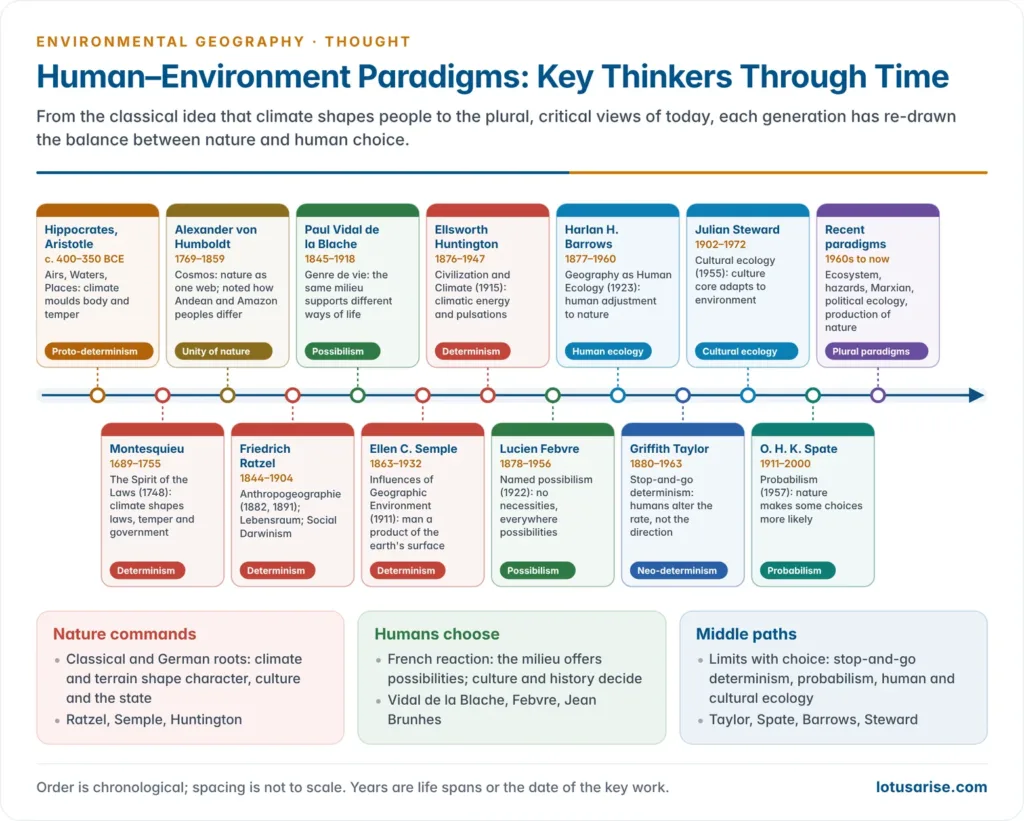
- The central question of environmental geography is how far the physical environment decides human life and culture. Over two centuries it has produced a sequence of paradigms, each re-drawing the balance between nature and human choice.
Environmental determinism
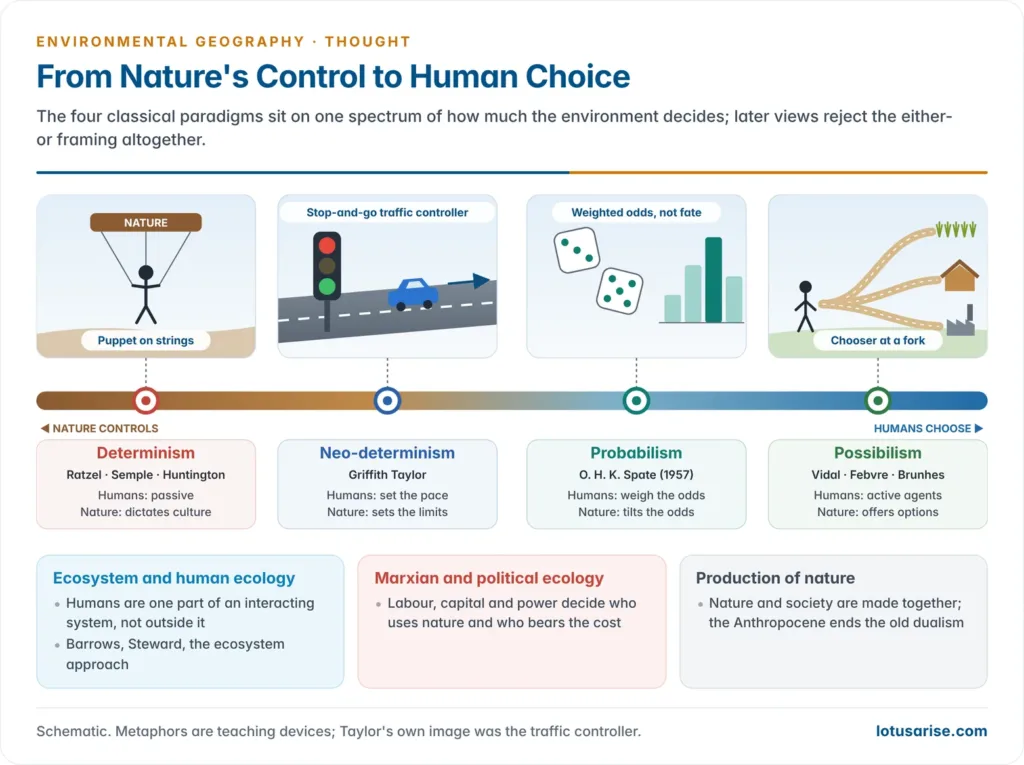
- Environmental determinism holds that the physical environment controls human life: culture, social organisation, politics and economy are products of nature, and humans are passive agents.
- Lineage: the idea runs from Aristotle through Montesquieu (The Spirit of the Laws, 1748) to Friedrich Ratzel’s “new determinism”, which added Social Darwinism.
- Ratzel (Anthropogeographie, 1882 and 1891) applied “struggle for existence” and “survival of the fittest” to states through the concept of Lebensraum (living space).
- Ellen Churchill Semple (Influences of Geographic Environment, 1911) carried it to the United States, arguing that plains peoples and mountain peoples differ because of their environments.
- Ellsworth Huntington (Civilization and Climate, 1915) went furthest: temperate, changeable climates stimulate achievement, while tropical heat and humidity breed lethargy.
- Criticism:
- It ignores human agency, culture and technology.
- It cannot explain why similar environments produce different cultures: the pastoral Gujjar-Bakarwals and the settled Kashmiri farmers live in the same mountain setting.
- It was used to justify racism and imperialism.
- Carl Ortwin Sauer faulted it for premature generalisation without observation, and Barrows for overstating environmental influence.
Possibilism
- Possibilism arose in France as a reaction against German determinism.
- Paul Vidal de la Blache (1845–1918) argued that nature offers possibilities, not necessities, and that humans, as active agents with culture and free will, choose among them.
- His concept of genre de vie (way of life) showed that the same environment can support different lifestyles, depending on cultural heritage and accumulated knowledge.
- Lucien Febvre, who named the school (1922), summed it up: there are no necessities, but everywhere possibilities, and man, as master of these possibilities, is the judge of their use.
- Jean Brunhes extended it to the study of human imprints on the land.
- Indian example: terrace farming in the Himalaya and canal irrigation turning parts of the Thar into cropland show human choice reworking natural limits.
Neo-determinism (stop-and-go determinism)
- Griffith Taylor (1880–1963) took a middle course: neither absolute determinism nor unlimited possibilism fits reality.
- In extreme environments, such as the Australian deserts or the Arctic, nature sets firm limits that cannot be crossed without severe cost.
- His metaphor: man is like a traffic controller in a large city, who can alter the rate but not the direction of progress. Humans can speed up, slow down or pause, but nature fixes the route.
- Indian example: Joshimath (2023) was built on old landslide debris, and a 1976 committee had warned against heavy construction there. Its subsidence shows the limits nature sets when they are ignored.
Probabilism
- Oskar Hermann Khristian Spate (1957) proposed probabilism as a further middle ground.
- The environment does not decide outcomes, but it makes some human responses more probable than others.
- Statistical generalisations about land use, population density and crop yields are therefore possible, but they always admit exceptions.
Comparing the classical paradigms
| Criterion | Determinism | Possibilism | Neo-determinism | Probabilism |
|---|---|---|---|---|
| Human role | Passive agent | Active agent | Conditional agent within limits | Chooser weighing the odds |
| Environment’s role | Controls and decides | Offers options | Sets ultimate limits | Tilts the probabilities |
| Key scholars | Ratzel, Semple, Huntington | Vidal de la Blache, Febvre, Brunhes | Griffith Taylor | Spate |
| Metaphor | Puppet on strings | Player choosing a role | Traffic controller | Weighted dice |
| Standing today | Rejected in its extreme form | Widely accepted | Revived by climate limits | Used in quantitative work |
| Indian example | Monsoon-bound rainfed farming | Himalayan terraces | Joshimath subsidence | Kharif yield odds with rainfall |
Beyond the classical debate
- Human and cultural ecology: Barrows and Julian Steward treated people as one part of an adapting system, not as puppets or masters.
- Ecosystem and systems approach: humans became a component inside the ecosystem, linked by flows of energy and matter.
- Behavioural approach: decisions follow the environment as perceived, not as it objectively is; hence hazard perception and resource appraisal.
- Marxian and radical views: nature is shaped by labour, capital and class, and degradation follows from how production is organised; this is the Marxian view on the environment.
- Political ecology: degradation is traced to power, markets and the state, as in the work of Piers Blaikie and Harold Brookfield (1987).
- Production of nature: Neil Smith (1984) argued that capitalism produces nature itself, so the social production of nature dissolves the nature–society dualism.
- Environmental ethics: Arne Næss (1973) contrasted deep ecology with shallow ecology, giving nature value of its own beyond human use.
- The current view: human–environment relations are a two-way, co-evolving system.
- Nature sets limits, which climate change, sea-level rise and Himalayan hazards make plain. Human choices, technology and power decide how those limits are met.
- This synthesis of limits and choice, with sustainability as its goal, is why environmentalism has returned as a paradigm in geography.