

Origin and the Rise of Rajputs

Understanding the origin and the rise of Rajputs is a core theme in Medieval Indian History for UPSC aspirants, since it explains how a new ruling class emerged in early medieval India, how it organised political power through lineage and feudal structures, and how it shaped the society, culture and economy of the period.
Emergence of the Term “Rajput” (6th Century AD)
- The term Rajput begins to appear in historical records from the 6th century AD onwards.
- The word is derived from “Rajaputra”, meaning the son of a ruler or king.
- From this period, several new ruling families started identifying themselves as Rajputs.
- The exact origin of the Rajputs is controversial and has been explained through different schools of thought — social, political, and historical — each offering a distinct interpretation of how this new ruling class came into being.

Tribal Origin Theory (V.A. Smith)
- This theory was put forward by V.A. Smith.
- According to this view, several tribal and aboriginal communities gradually transformed into Rajputs after acquiring political power.
- Important examples cited:
- Gonds became Chandelas
- Bhars became Rathores
- Kharvars became Gahadwals
- The theory draws support from the idea that the Dharmashastras recognise the possibility of lower castes being elevated to higher castes, and that this social elevation was not a one-time event but a continuous historical process.
- Thus, some tribal groups, after gaining land and power, gradually adopted Kshatriya identity and became Rajputs.
Origin from Newly Powerful Local Groups (Kshatriyisation and Rajputisation)
- After the decline of large empires, many local groups — tribal chiefs, warrior lineages, and regional rulers — gained political power.
- These newly powerful groups:
- Claimed Kshatriya status
- Prepared false or fabricated genealogies to show descent from ancient Kshatriya dynasties
- In this process, Brahmanas played a major role by:
- Preparing family lineages
- Performing rituals
- Granting social legitimacy to the ruling families
- Two terms describe this social transformation:
- Kshatriyisation — term used by Hermann Kulke
- Rajputisation — term used by H. Sinha
- Through this process, many ruling families entered the Rajput social order.
Foreign Origin Theory of the Rajputs
- According to this theory, the Rajputs were descendants of foreign races that entered India at different times, including the Sakas, Kushanas, and Hunas.
- This theory was supported by:
- Dr. V.A. Smith
- Col. James Todd
- William Crooke
- Ishwari Prasad
- D.R. Bhandarkar
- The main argument given by James Todd was that the Rajputs worshipped fire, and since fire was the chief deity of the Sakas and Hunas, the Rajputs were considered to be of foreign origin.
- However, the absorption of foreigners into Hindu society was not a new process at the time the Rajputs emerged.
- There are historical examples of matrimonial alliances between Indians and foreigners — for instance, a Satavahana prince married the daughter of Rudradaman, showing social integration between native and foreign elites.
Mixed Origin Theory (Dr. D.P. Chatterjee)
- This theory was formulated by Dr. D.P. Chatterjee.
- According to this view, the Rajputs were a mixed race — some descended from the Aryans, and others from foreign races such as the Hunas and Sakas.
- The theory explains that the Rajputs emerged through a combination of native and foreign elements, and that their origin cannot be traced to a single source.
Kshatriya Theory of Origin (G.S. Ojha)
- This theory was given by Gauri Shankar Hirachand Ojha.
- According to him, the Rajputs were not of foreign origin but were descendants of the ancient Kshatriyas, belonging to the Solar and Lunar dynasties.
- His arguments include:
- Fire worship was a tradition of the Aryans, not of foreigners alone, so it does not prove foreign origin.
- Bardic literature supports this view.
- The term Rajaputra is mentioned in the Puranas.
- Banabhatta uses the term Rajaputra for a high-born Kshatriya.
- However, this theory has been rejected by most modern historians on historical grounds, owing to the lack of firm historical and archaeological evidence.
Agnikula Theory
- This theory is based on late medieval legends, such as the Prithviraj Raso of Chand Bardai.
- According to this theory, the Rajputs were produced from a sacrificial fire-pit (Agnikunda):
- The sacrifice was performed by Rishi Vashistha.
- The place of the sacrifice was Guru Shikhar at Mount Abu.
- Four Rajput clans are said to have originated from the Agnikunda:
- Chauhans
- Chalukyas
- Parmaras
- Pratiharas
- Some historians interpret this theory as a symbolic reference to purification rites, performed to remove the “impurity” of foreigners and absorb them into the Hindu social order.
Overall View on the Origin of the Rajputs
- The diversity in the customs, beliefs, religious practices, and traditions of the Rajputs suggests that their origin was not uniform.
- Rajputs who worship the Sun may be regarded as having foreign roots.
- Rajputs who worship the serpent (Naga) are likely descended from the aboriginal tribes of India.
- Therefore, the Rajputs appear to have emerged through a combination of tribal transformation, foreign assimilation, social elevation, and political rise over a long historical process — confirming that no single theory fully explains the origin and the rise of Rajputs.
The Evolution of Rajput Polity
- The Arab invasion of Sind and Multan (712–13 A.D.) marked an important turning point in the political history of western India.
- Within the next twenty-five years, the Arabs advanced into Marwar, Malwa, and Broach, and issued serious threats to several other parts of India.
- These continuous raids disrupted the old political order, weakened existing powers, and led to significant changes in the political map of Western India and the Deccan.
- In this situation of political instability, powers like the Rashtrakutas and several clans later known as Rajputs emerged as important political forces.
- Many of these Rajput clans were not known in earlier times and began to play an important political role from about the eighth century onwards.
- Lineages such as the Paramaras and the Chahamanas had obscure beginnings, passed through many political struggles and uncertainties, and gradually rose to prominence during the inter-state conflicts among major powers like the Gurjara Pratiharas and Rashtrakutas.
- Although the rise of the Rajputs seems accidental at first view, a closer study of early political developments shows that their emergence was not sudden — it occurred within the existing hierarchical political structure.
- Their rise should therefore be understood as a gradual historical process rather than a sudden political transformation.
- The political developments of medieval Western India show that political authority was distributed through a network of ruling lineages, operating within the framework of a monarchical form of polity.
- Thus, the rise of the Rajput clans was linked with the broader process of lineage-based political organisation.
Proliferation of Rajput Clans
- The main sources for tracing the proliferation of Rajput clans are the bardic chronicles.
- These sources show that once a ruling clan was established, it often divided into several branches.
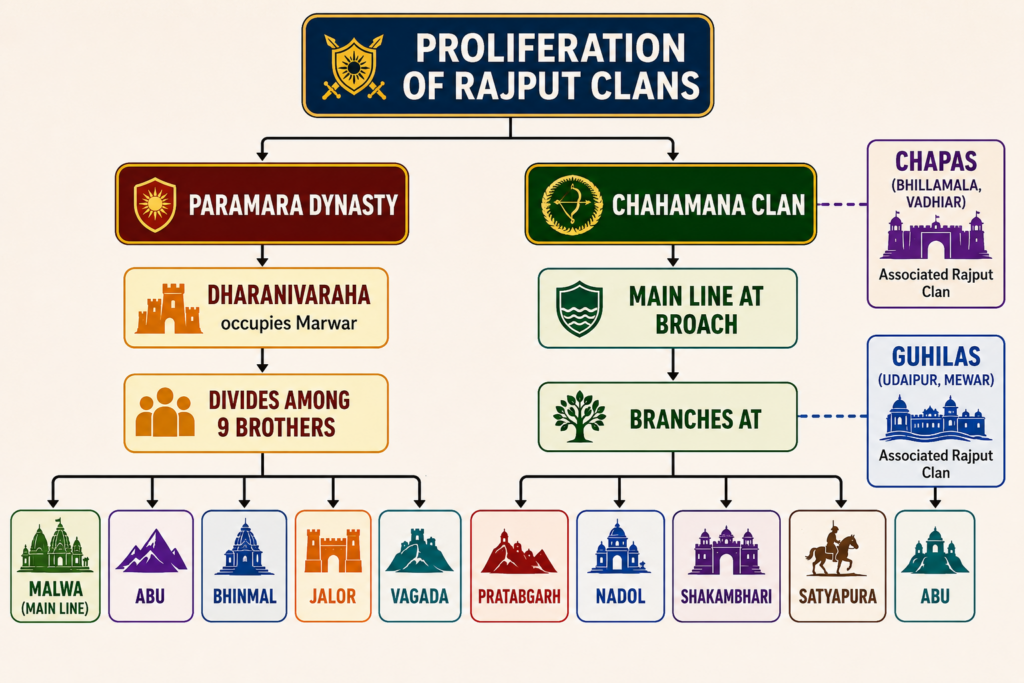
- A clear example is the Paramara dynasty:
- Dharanivaraha of the Paramaras occupied Marwar and divided it among his nine brothers.
- As a result, apart from the Paramaras of Malwa, at least four other Paramara lines came to rule in Abu, Bhinmal, Jalor, and Vagada.
- A similar process is seen in the Chahamana clan — apart from the Chahamanas of Broach, other branches ruled in Pratabgarh, Nadol, Shakambhari, Satyapura, and Abu.
- The Chapas were another important Rajput clan of the early medieval period, ruling over principalities such as Bhillamala and Vadhiar.
- The Guhilas established their rule over Udaipur and Mewar.
- Several minor Rajput clans also emerged alongside these major clans, reflecting the widespread expansion of Rajput power.
Formation of Lineage Power
- The formation and consolidation of lineage power did not take place in a uniform manner — different clans followed different historical paths.
- One of the main indicators of the formation of lineage power was the colonisation of new areas, clearly visible in the expansion in the number of settlements.
- Colonisation was often the result of annexation of new territories through organised military strength.
- The territorial expansion of Western Indian powers was achieved in many regions at the cost of tribal settlements.
- For example, the Mandor Pratihara ruler Kakkaka is said to have resettled a region that earlier had a dangerous reputation due to the presence of the Abhiras.
- There are several examples of the suppression of tribal populations, such as the Shabaras, Bhillas, and Pulindas, in Western and Central India.
- The bardic tradition also indicates that the Guhila kingdoms of southern Rajasthan succeeded the earlier tribal chiefdoms of the Bhils.
- Political authority could also be established by replacing one ruling lineage with another:
- In Jalor, Kirtipala, a Chahamana Rajput, attacked the Paramaras of Jalor and made Jalor the capital of his new kingdom.
- Similarly, the Chahamana line of Broach was established by replacing the Gurjaras of Broach.
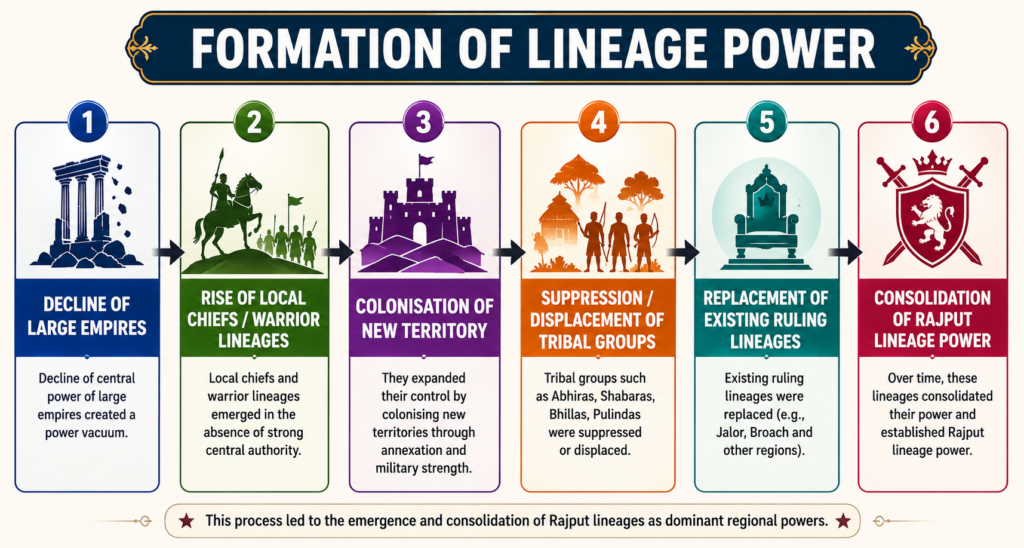
- Thus, the formation of lineage power took place through colonisation, military conquest, and replacement of ruling families — processes that were interconnected, not isolated from one another.
Process of Rising in Social Status
- The political history of Western India shows that a large ethnic group of a region could successfully compete for political authority.
- From among these groups, certain families achieved political dominance and emerged as ruling lineages.
- These ruling families gradually rose in the social hierarchy, especially under:
- Favourable political circumstances
- Successful control over land and military resources
Consolidation of Lineage Power
- One of the most important means of consolidation was the distribution of land among members of the ruling lineage.
- Land assignments included Grasa, Grasabhumil, and Bhukti.
- These land grants were held under the authority of the King and helped in maintaining loyalty and strengthening control over territory.
- Another major method of consolidation was the large-scale construction of fortresses, which:
- Served defensive purposes
- Acted as centres of control over surrounding rural areas
- Strengthened the political authority of ruling families
- The marriage network among ruling clans was another important factor, creating inter-clan relationships and long-term political cooperation.
- Since most of these families were ruling Rajput clans, such marriage relations carried direct political implications.
- Important examples include the Paramara–Rashtrakuta and Chahamana–Paramara matrimonial relations.
Nature and Structure of Polity
Political Instability
- Mobilisation of military strength could not only displace a ruling lineage but also create a new locus and network of power.
- Example — the Vagada branch of the Paramaras: This branch remained a loyal feudatory line for centuries until Chamundaraja, one of its rulers, defied the Paramaras of Malwa and became independent in the second half of the eleventh century. Vagada was lost to the kingdom of Malwa at the beginning of the twelfth century; three decades later, the Paramara family of the Vagada branch was dethroned by a different genealogy.
- This example illustrates the frequent change of ruling class in the regions — a defining feature of Rajput political instability.
Bureaucratic Structure
- It is unlikely that early medieval powers such as the Chaulukyas, Paramaras, and Chahamanas could provide stable government without a powerful bureaucracy within the structure of their polities.
- Several officers are named in inscriptions as having assisted in the transaction of state affairs.
- The Lekhapaddhati furnishes the names of karanas (departments) of government, and is believed to apply mainly to the Chaulukya government, since the largest number of its documents belong to the Chaulukya period in Gujarat’s history. A few karanas mentioned in the work also appear in Chaulukya records.
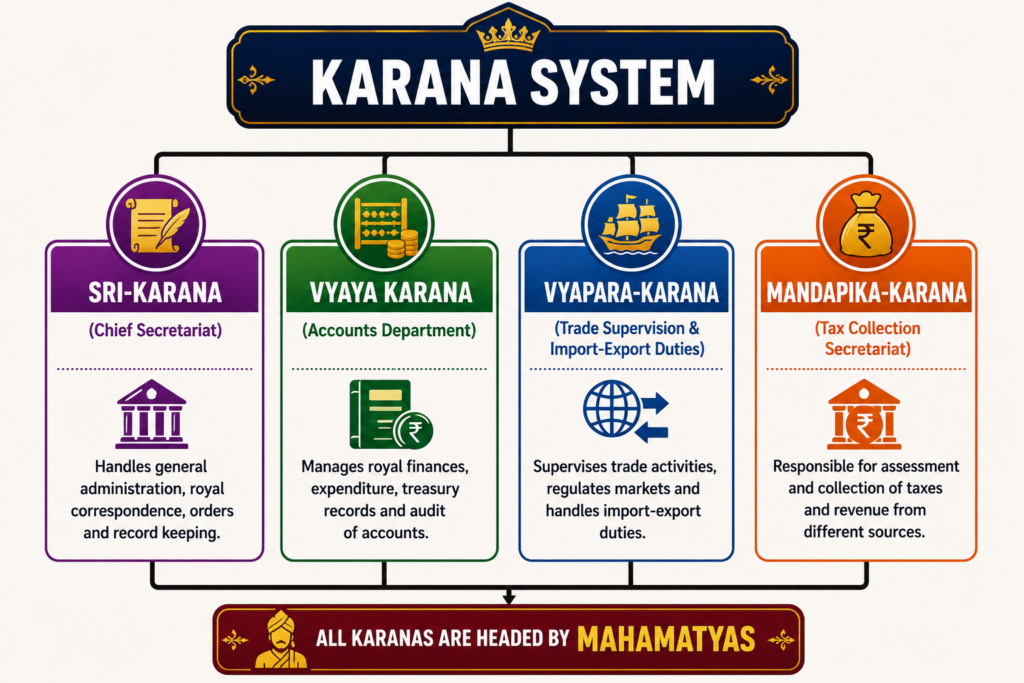
- Such karanas were headed by ministers known as mahamatyas.
- Besides the mahamatyas, other officers included mahamantrins, mantrins, and sachivas, though their exact status is only casually mentioned in a few inscriptions.
- Other frequently mentioned officers:
- Mahasandhivigrahika — minister of peace and war, also responsible for conveying grants.
- Mahakshapatalika — head of the accounts/record office, keeping full accounts of state income and expenditure.
- Mahamantrin / Mahapradhana (chief minister) — held charge of the royal seal and exercised general supervision over all departments.
- Dandanayaka / Senapati — primarily a military officer.
- Baladhipas — officers in charge of military stationed in outposts and towns, placed under the Dandanayaka.
- The whole administration was controlled by a department called the Baladhikarana, stationed at the capital.
Lineage State and Feudal Polity
- From the Gupta period onwards, there was a marked inter-relatedness of polities, resulting from the horizontal spread of state society.
- The consolidation of lineage power was closely linked with landholding — the exercise of important governmental functions was gradually tied to land.
- Under the Gurjara Pratiharas, references exist to estates held by chiefs of the Chahamana, Guhila, and Chalukya clans.
- The Kalvan plates of Yashovarman (from the time of the Paramara king Bhojadeva) mention a chief who had acquired a royal charter of 84 villages from his overlord.
- In these Rajput states, different levels of power cut across all major political structures, reflecting the feudal polity.
- The samanta system was not a uniform category — it encompassed a wide range of statuses, all corresponding to the landed aristocracy of the period.
- Feudatories were known generically as mandalika, but sometimes styled themselves as maharajadhiraja, mahamandalesvara, mahamandalikas, mahasamantas, and samantas.
- The most important feudatory princes of the Chaulukyas were the Paramaras of Abu and the Chahamanas of Jalor.
- A considerable portion of the Chahamana state was held by landed intermediaries called thakkuras, ranakas, and bhoktas, on condition that they supplied quotas of soldiers when required by the overlord.
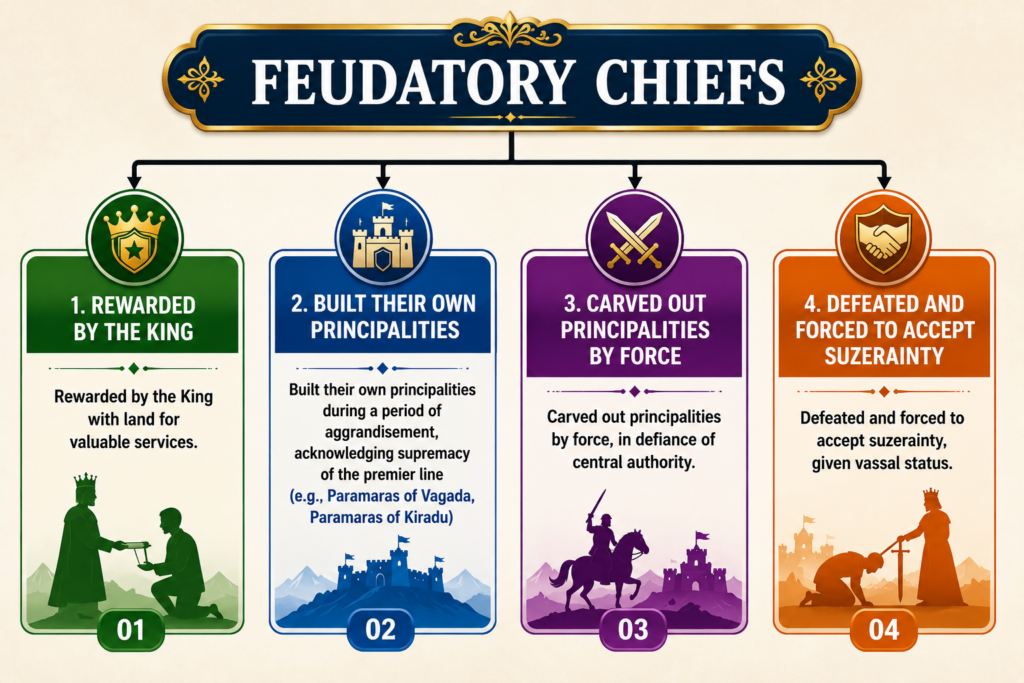
- Big feudatory chiefs enjoyed a large degree of internal autonomy:
- They could create their own sub-feudatories and appoint their own officers.
- They could distribute their lands among their dependents — the thakkuras served feudatory chiefs in almost all feudatory states under the Paramaras.
- Feudatories could also assign taxes, alienate villages, and exempt people from taxation — this practice of granting land along with fiscal and administrative rights is called sub-infeudation.
- Over time, the samanta system encompassed a proliferating range of designations, assuming the character of a hierarchical political formation with ranks such as ranaka, rauta, thakkura, samanta, and mahasamanta.
- The incidence of grants to state officials varied by region:
- Only a few of the roughly half-dozen known Paramara official ranks received land grants.
- Very large territories were granted to vassals and high officers under the Chaulukyas of Gujarat — Chaulukya copperplates of the 12th–13th centuries, compared with the Lekhapaddhati, show that vassals and high officers gradually merged into one another.
- Some Chandella inscriptions of the late 12th and early 13th centuries specifically instruct feudatories, royal officials, forest officials, and constables to give up their perquisites in villages transferred as gifts; there are also references to the resumption of such rights.
- Feudatories owed fiscal and military obligations to the overlord, and the authority of the feudatories was generally derivative, dependent on fulfilling certain conditions:
- Supplying quotas of soldiers in time of need — e.g., the Paramaras of Vagada fought in the cause of the imperial Paramaras of Malwa.
- However, feudatory chiefs were eager to free themselves whenever an opportunity arose, since the relationship between suzerain and vassal rested largely on force.
- For example, the Guhilas of Mewar accepted Paramara overlordship after being defeated by Vakpati-II, but attempted to re-establish their lost position during the confusion following the death of Bhoja-I.
- The most important duty of a feudatory prince was to help his suzerain against the enemy — sometimes conquering new territories or bringing another prince under vassalage.
- At the accession of a new king, feudatories swore loyalty to their new overlord, who confirmed them in their possessions; feudatories also paid tribute in cash and kind.
- There was no hard and fast rule regarding feudatory obligations — the relationship depended on circumstances and the relative strength of feudatory versus suzerain, and often on the personality of the overlord.
- Overlords undertaking distant expeditions had to entrust capable generals with administering territories as feudatory chiefs.
- Samantas often had no permanent bonds and were ready to transfer allegiance to a powerful invader for greater privileges.
Summary: Prominent Features of Rajput Polity
- A strong feudal character:
- Period of feudal consolidation.
- Overlord–subordinate relationship as an essential feature.
- A chain of personal allegiance binding retainers to chiefs, tenants to lords, and barons to kings.
- Hierarchical political structure represented by various ranks.
- Fiefs/estates as the central feature of polity:
- Administrative structure based on control and possession of land, with a special pattern of land distribution.
- Landholding was a status symbol, consolidating the political position of individuals.
- Land holdings became centres of local control and the foci of power, forming the basis of local ruling elites.
- Greater degree of autonomy in the political system:
- At the lower level, autonomy in administration, fiscal matters, and justice gave birth to local politics, which then integrated into larger state politics — a hallmark of Rajput polity.
- Feudal lords fulfilled military and fiscal obligations in return for this autonomy — providing military assistance and paying tribute in cash and kind to the king.
- Weak centralisation:
- The overlord–subordinate relationship was the core of the political system, and the relative strength of the feudatory vis-à-vis the suzerain determined the system’s stability.
- Vassals wielded vast administrative and financial powers, often extending to sub-infeudation, creating a hierarchy of landed intermediaries and fragmentation of political authority.
- Application of force and the ability to overawe samantas, along with mutual distrust and acrimony, were important in maintaining this relationship — since the tendency towards autonomy was always strong, this disrupted political stability and weakened centralised control.
- The kingship concept:
- The concept of an all-powerful king was important, though in a limited sense — a number of authorities vested in the king, but this did not mean centralised control.
- Existence of a council of ministers, whose role was primarily advisory.
- Military being feudal in character:
- The king’s standing army was greatly supplemented by the armies of feudal lords.
- Military assistance was one of the two main obligations of feudatories, alongside old military organisation and strategy.
- Existence of bureaucracy:
- Sources suggest the bureaucracy was well organised and elaborate, though this may not reflect historical reality.
- Official designations continued as before — Akshapatalika, Mahapratihara, Mahasandhivigrahika — but the bureaucracy did not play a significant role because the polity was fundamentally feudal, with a devolution of powers to feudal lords.
- The revenue system:
- Mainly based on land tax, with certain levies on trade and commerce.
- Under great pressure due to the feudal economy — a centralised revenue system lost relevance, and revenue instead rested on feudal tribute.
- Marked by oppression and immobility of peasants and restricted use of metal money.
Rajput Society and Culture
- Rajput society was feudal in its organisational set-up, split into various clans, each under one or more hereditary ruling houses, with great loyalty and implicit obedience shown to chieftains.
- The main profession of the Rajputs was fighting in defence of their clan and chief.
- Village communities were governed by their own panchayats and enjoyed considerable autonomy in internal affairs.
- There was no written law of the land — Rajput states ran on local customs and traditions; the feudal administrative set-up was usually not elaborate, efficient, or stable.
- The Rajputs were known for their undaunted courage and chivalry — honest, generous, hospitable, and known for keeping their word, though somewhat haughty and emotional.
- They were simple, outspoken, and straightforward, rejecting the Machiavellian principles of deceit and treachery in war.
- They were sometimes generous to a fault in their treatment of a vanquished foe.
- The Rajputs were freedom-loving people with a keen sense of honour and self-respect, constituting the “sword-arm of Hindustan.”
- They treated fighting as a sport and smilingly laid down their lives for the honour of family, clan, or regional leader.
Position of Rajput Women
- Rajput women enjoyed considerable freedom and respect in society.
- Known for their chastity and devotion to their husbands; there was no purdah system among them.
- They had some freedom in selecting their husbands — the swayamvar was in vogue among princesses for this purpose.
- Some Rajput ladies of higher families were educated and took active part in public life, though women continued to be denied the right to study the Vedas.
- Many women participated in warfare, fighting shoulder to shoulder with their menfolk.
- When their warriors were defeated or killed, Rajput women safeguarded their honour by burning themselves alive or committing mass suicide — a practice known as jauhar.
- At the same time, rigid caste system, sati, child marriage, and a ban on widow remarriage were very common among the Rajputs, and the custom of sati, though not insisted upon, was prevalent.
Caste System
- Caste system was the basis of social organisation, with continuous proliferation of castes.
- Disabilities suffered by lower castes increased during this period — workers such as weavers, fishermen, and barbers, along with tribal groups, were treated harshly.
- The Rajputs emerged as a new caste, and over time, all ruling families belonging to various castes came to be classified as Rajputs.
Education and Science
- Education was confined to a small section — Brahmans and some sections of the upper classes.
- Nalanda in Bihar was the famous centre of higher learning; other important centres were Vikramasila and Uddandapura.
- Several Saiva centres of learning flourished in Kashmir.
- Religion and philosophy were the popular subjects of study and discussion.
- On the whole, the growth of scientific knowledge slowed down, as society became increasingly rigid, thinking remained confined to traditional philosophy, and India developed an insular attitude, cut off from the main currents of scientific thought outside the country.
Religion
- The Rajputs were champions of Hinduism, though some patronised Jainism.
- They made rich donations and land grants to Brahmans and temples, acting as protectors of Brahmanical privileges and the caste system — in return, Brahmans legitimised their rule.
- Buddhism was losing popularity during this period, though it received great patronage under the Palas of Bengal. Jainism was patronised by the Chalukyan rulers of Karnataka.
Art and Architecture
- Rajput rule saw the climax of temple-building activity in North India.
- The Khajuraho temples in Madhya Pradesh, built by the Chandellas, show that the art of sculpture had attained its height.
- The Mount Abu Jain temple is another fine example.
- Rajputs built several canals, dams, forts, palaces, and towers — the palaces of Jaipur and Udaipur, and the forts of Chittor, Mandu, Jodhpur, and Gwalior, are fine specimens of palace and fort architecture.
- They also built works of public benefit such as stepped wells (baolis) and bunds.
- The Lingaraj Temple at Bhubaneswar and the Surya (Sun) Temple at Konark exhibit the excellence of temple architecture of this age.
Patronage of Arts and Letters
- Many books and plays were written in Sanskrit.
- Vastupala, a famous minister of the Chalukyan ruler Bhima in Gujarat, was a writer and patron of scholars, and the builder of the beautiful Jain temple at Mount Abu.
- Dhara, the capital of the Paramara rulers, was a famous centre for Sanskrit learning.
- Many works were written in Apabhramsha and Prakrit, representing the regional languages — the Jain scholar Hemchandra wrote in both Sanskrit and Apabhramsha.
- Notable examples include Kalhana’s Rajatarangini (a history of Kashmir) and Chand Bardai’s Prithviraj Raso (dealing with the exploits of his patron, Prithviraj Chauhan).
Limitations of Rajput Society
- The excessively martial character of the Rajputs had a dark side as well.
- Their love for personal freedom, vanity, inflated ego, and false sense of pride did not permit them to subordinate their interests or obey more capable leaders.
- They lacked political foresight and displayed an absence of overall national consciousness — terms like “patriotism,” “motherland,” and “state” carried only narrow, parochial, or regional connotations for them.
- As a result, constant wars and clannish feuds among them hampered the growth of national unity and the emergence of a strong national state in India.
- Various clans went to war, or their chiefs fought duels, simply to display military prowess.
- They converted mutual warfare into a sport, wasting valuable resources in men and material and neutralising military strength.
- Because of these self-destructive tendencies, the Rajputs failed to take concerted action against the Muslim invaders.
- They nonetheless upheld traditional high ethical norms in fighting — protecting refugees and vanquished enemies, and not attacking unarmed enemies — adhering to these moral conventions despite repeated harm.
General Conditions of the People
- There was great disparity in the standard of living.
- Ministers, officials, and feudal chiefs who had the opportunity to accumulate wealth lived in luxury and splendour.
- Ordinary people lived in misery, burdened with land revenue and other taxes levied at the whims of feudal lords, besides having to render forced labour.
The Economy during the Rajput Age
Agriculture as the Main Occupation
- Agriculture remained the primary occupation of the people during the Rajput period.
- Rajput rulers made efforts to improve irrigation facilities and increase agricultural production:
- Canals and tanks were dug.
- Rainwater was collected in artificial lakes.
- Dams were constructed across rivers and streams.
- These irrigation measures brought more land under cultivation, improved agricultural output, and strengthened the economic condition of cultivators.
- However, despite these improvements, peasants sometimes suffered under autocratic feudal chiefs — forced labour, heavy demands, and exploitation were present in some areas.
Taxes and Sources of State Income
- Land revenue was the chief source of state income, determined under a set formula based on:
- Fertility of the soil
- Availability of irrigation facilities
- Nature of crops grown
- Land revenue was paid mainly in agricultural produce, and partly in cash.
- Apart from land revenue, the state also derived income from gifts, fines, minerals, tolls, forest produce, and leased-out lands — sources that helped rulers maintain their administration, army, and court expenditure.
Industry
- Although several industries existed, the condition of industry declined overall during this period.
- Important industries included:
- Cotton cloth making (everyday clothing)
- Woollen cloth production (especially in colder regions)
- Weapon industry (swords, spears, shields, armour)
- Salt manufacture
- Carving of high-quality artistic pieces
- Statue making from Ashtadhatu (eight metals)
- Pottery making
- Ornament making (gold, silver, and other metals)
- Other small-scale industries included ‘gur’ (jaggery) making, sugar production, oil extraction, and liquor making.
- These industries were mostly local in nature, serving nearby rural and urban markets.
Trade and Commerce
- Both internal and external trade declined during the Rajput period, though this decline was not uniform throughout India — some regions remained active in trade.
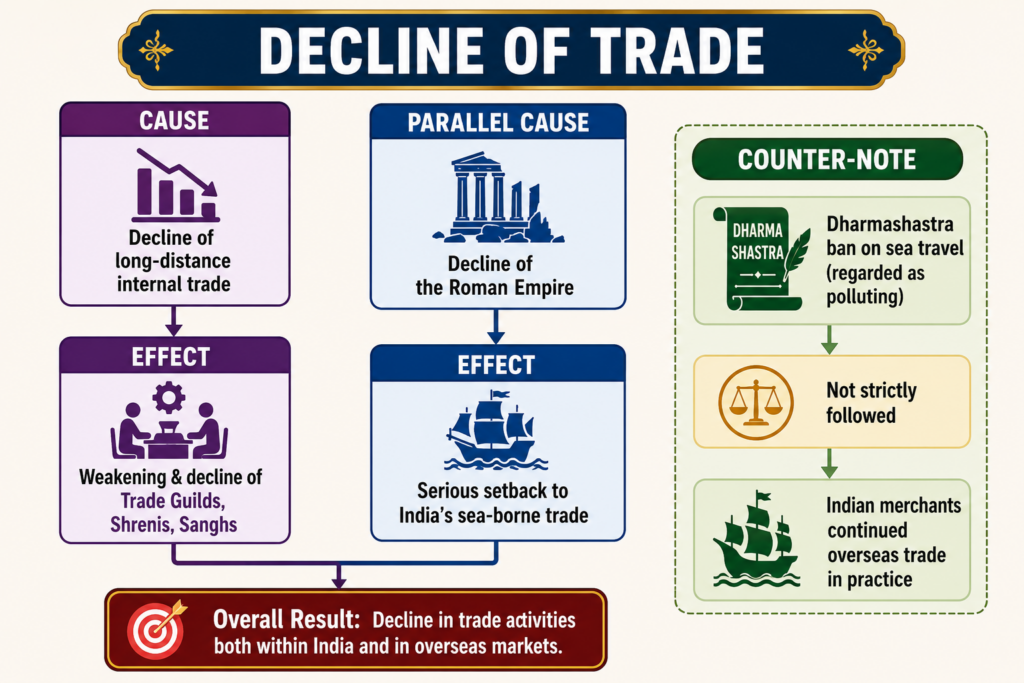
- The decline of long-distance internal trade led to the weakening and decline of trade guilds, shrenis, and sanghs.
- The Dharmashastras written during this period imposed a ban on sea travel, since travel across the “salt seas” (oceans) was regarded as polluting — however, this ban was not always strictly followed, and Indian merchants continued to travel overseas in practice.
- Along with sea-borne trade, India maintained foreign trade through land routes as well.
- From the 6th century onwards, a brisk trade developed between South India and Southeast Asian countries.
- Literary sources such as Harisena’s Brihatkatha-kosh reflect the geographical knowledge of different regions, describing peculiar features of local languages, dress patterns, and social customs.
- Several stories exist about the adventures of Indian merchants, the most famous being the tales of Sindbad the Sailor.
- In South India, merchants were organised into powerful guilds, the most famous being Manigramam and Nanadesi.
- Due to the decline of the Roman Empire, India’s sea-borne trade suffered a serious setback.
- India’s imports during this period included:
- High-breed horses from Central Asia and Western countries
- High-quality wine
- Chinese silk
- Grapes from Cambodia
- Spices from Southeast Asian countries, and several other luxury articles
- India’s major exports included sandalwood, camphor, cloves, indigo, ivory, coconut, herbs of many types, black pepper, cardamom, hides, tusar, and woollen clothes.
Conclusion
The origin and the rise of Rajputs cannot be attributed to a single cause or community. It was the outcome of a long historical process combining tribal transformation, Kshatriyisation, foreign assimilation, and gradual political consolidation within the framework of a lineage-based feudal polity. Understanding this evolution — from scattered local chiefdoms to a structured, if decentralised, Rajput political order — is essential for UPSC History Optional aspirants attempting questions on early medieval polity, feudalism, and state formation in India.




