

- Forests give people far more than habitat and environmental regulation. They are also resources to draw on for fuel, lumber, recreation and commerce, and this view of forests has been a prominent reason for efforts to preserve them.
- Growing awareness among governments and the public, in India and abroad, has given rise to government agencies and a thriving industry in forest resource management.
- Its mission is to develop, protect and manage the many resources of forests through professional stewardship, so that life improves for the public while the resource stays conserved and sustainable.
- A forest is an important renewable resource. Forests differ in composition and diversity, cover large areas, yield many products, feed living organisms, protect the environment, and can add substantially to a country’s economic development.
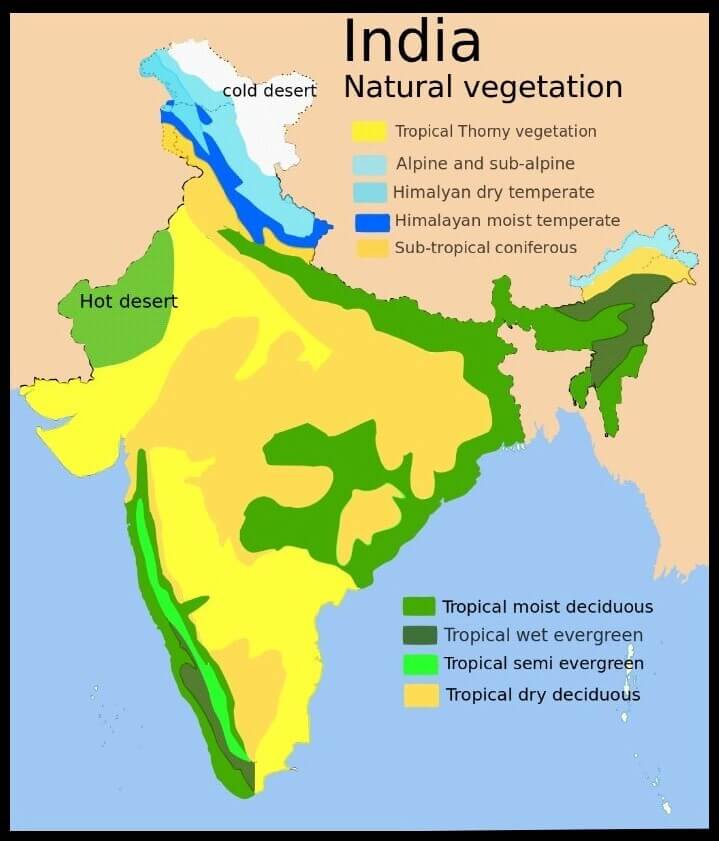
- The natural types, their climate and their species belong to natural vegetation. Here the forest is treated as a resource.
Forests as a Resource
Key Terms
- Clear-cut: a parcel of forest stripped of its trees.
- It can destroy a forest, above all where reforestation is slow and wind and water erosion leave the bare land unfit for regrowth.
- It can also raise biodiversity in forests long protected from fire.
- Deforestation: a reduction in forest area caused by human activity.
- Ecological services: what human communities gain from healthy forest ecosystems, such as clean water, stable soil and clean air.
- Forest monoculture: a forest dominated by one tree species, which lacks the ecological diversity to withstand disease and parasites over the long term.
- Sustainability: practices that keep a balance between human needs and the environment, and between present and future needs.
World and India
- World share: older estimates put about 30% of the world’s area under forest and 26% under pasture. The FAO’s Global Forest Resources Assessment 2025 gives 4.14 billion hectares, 32% of the land.
- By continent, older shares of forested area: Africa (33%), Latin America (25%), Asia and the former USSR (14%), North America (11%) and Europe (3%).
- The 2025 assessment reads differently: Europe, with Russia, 25%, South America 20%, North and Central America 19%, Africa 16%, Asia 15% and Oceania 4%.
- India: forest cover was 21.67% of the geographical area in 2019. The India State of Forest Report (ISFR) 2023, released on 21 December 2024, gives:
| Class | Area (sq km) | Share of India (%) |
|---|---|---|
| Forest cover | 7,15,343 | 21.76 |
| Tree cover | 1,12,014 | 3.41 |
| Forest and tree cover | 8,27,357 | 25.17 |
| Recorded forest area | 7,75,377 | 23.59 |
- Recorded forest and forest cover differ. Only 5,20,365 sq km of forest cover lies inside recorded forest, and 1,94,977 sq km lies outside it. Land use statistics, on their own basis, count 72.02 million hectares as forest, as the land use classes show.
- Against the goal: the National Forest Policy seeks 33% under forest or tree cover, and India’s forest cover alone still falls well short.
- Stock and carbon (2023): growing stock 6,430 million cubic metres, of which 4,479 million lies inside forests and 1,951 million outside. Carbon stock is 7,285.5 million tonnes.
- Older comparison: India, with about 17.5% of the world’s people, held nearly 2% of its forests, and just 0.06 hectare a person against a world figure of 1.08. The 2025 assessment puts the world at about 0.5 hectare a person, and India ninth by area with about 72.7 million hectares.
Types of Forest as a Resource
- Beyond the ecological types, forests are sorted by how they are held and how far they can be used:
| Basis | Classes | Resource meaning |
|---|---|---|
| Legal status (2023, recorded area) | Reserved 4,43,253 sq km (57%), Protected 2,12,859 sq km (28%), Unclassed 1,19,265 sq km (15%) | Older shares were 54%, 29% and 17%. Unclassed forest is largely degraded and unproductive |
| Ownership | Government, corporate bodies, private | Private holdings are under about 1%, as in Meghalaya, Odisha, Punjab and Himachal Pradesh |
| Composition | Coniferous about 3.5 million hectares; broad-leaved about 95% | Sal 16.55%, teak 13.82% and bamboo 7.48% of the broad-leaved area |
| Exploitability | Exploitable about half, potentially exploitable about a quarter, the rest inaccessible | Inaccessible tracts lie in the high Himalaya of Kashmir and Arunachal Pradesh |
- Coniferous forests hold valuable softwood, such as deodar, chir, fir, spruce and pine, but rough terrain and poor transport hold back their use.
- Exploitable and potentially exploitable forests lie in Assam, Arunachal Pradesh, Tripura, the Western Ghats, Satpura, Maikal, the Chota Nagpur plateau, the Andaman and Nicobar Islands, Odisha, and adjoining Andhra Pradesh and Chhattisgarh.
- Other broad-leaved timber includes rosewood, Indian laurel, shisham, gurjan and benteak.
Distribution of the Resource
- Largest forest cover (2023): Madhya Pradesh (77,073 sq km), Arunachal Pradesh (65,882 sq km) and Chhattisgarh (55,812 sq km).
- A large total often reflects a large State, so the share of a State’s own area is a better index.
- Highest share (2023): Lakshadweep (91.33%), Mizoram (85.34%) and the Andaman and Nicobar Islands (81.62%). In all, 19 States and Union Territories stand above 33%, and eight stand above 75%.
- Why some States are poor in forest:
- Scanty rain in Rajasthan and Gujarat.
- Clearing for farms in Punjab, Haryana, Uttar Pradesh and Bihar.
- Low rain, steep bare slopes and snow in the high parts of Jammu and Kashmir and Ladakh.
- Rain shadow in the semi-arid Deccan, and clearing for cultivation on the Tamil Nadu and Andhra coasts.
- Forests are scarce where people need them most: the crowded Ganga plain has only about 5% of its area under forest.
- By region (older shares of India’s forest): Peninsular plateau and hills 57%, Himalaya 18%, Western Ghats and west coast 10%, Eastern Ghats and east coast 10%, Great Plain 5%.
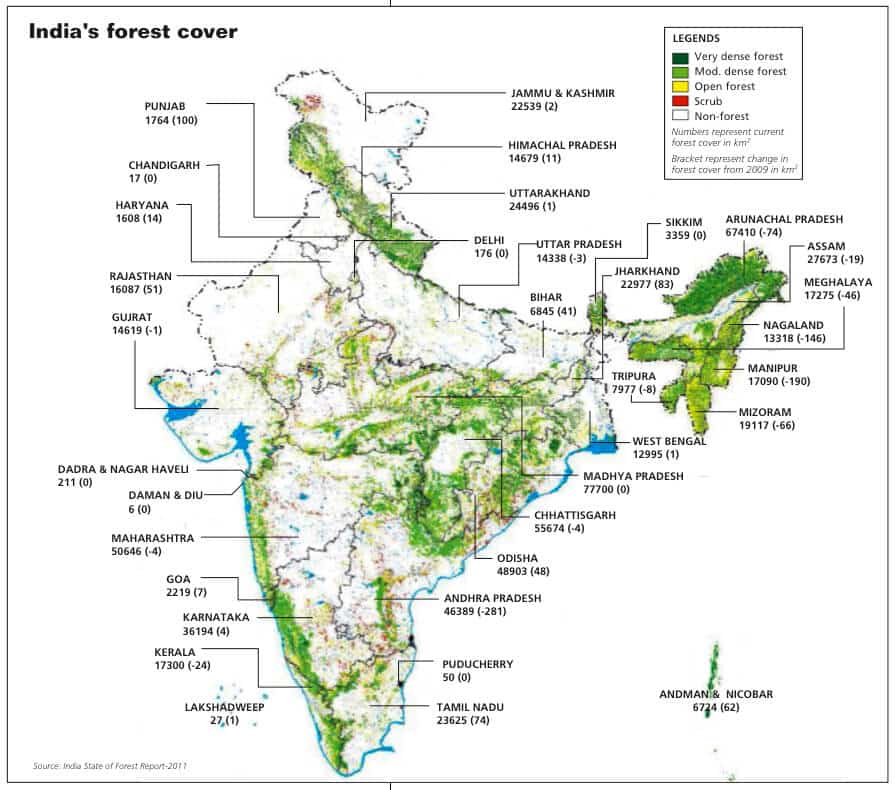
- This map shows 2011 figures, with changes since 2009, before Telangana and Ladakh were separated. “Gujrat” and “Andman” are misspellings, and current State figures appear in the list above.
Forest Products
Major Forest Products
- These are timber, smallwood and fuelwood, including charcoal.
- Species: of some 5,000 wood species in Indian forests, about 450, or about 9%, have commercial value.
- Hardwoods: teak, mahogany, logwood, ironwood, ebony, sal, greenheart, kikar and semal, used for furniture, wagons, tools and other goods.
- Softwoods: deodar, poplar, pine, fir, cedar and balsam. They are light, strong, durable and easy to work, so they suit construction and paper pulp.
- End use, by the older account:
| Wood | Burnt as fuel | Used in industry |
|---|---|---|
| Hardwood | 70% | 30% |
| Softwood | 30% | 70% |
- Older energy role: forests met about 40% of the country’s energy needs and over 80% of rural needs. Of about 52 million cubic metres of wood produced, about 77% went as fuel.
- Current timber: the annual potential from trees outside forests alone is 91.51 million cubic metres (2023).
- States, in older production tables: Jammu and Kashmir led timber, followed by Punjab and Madhya Pradesh. Karnataka led fuelwood, followed by West Bengal and Maharashtra.
Minor Forest Products
- These are all products other than wood, of plant and animal origin. In law, the Forest Rights Act, 2006 treats such minor forest produce, including bamboo, as a community right.
- The PM Van Dhan Yojana (2018), run by the Ministry of Tribal Affairs and TRIFED, helps tribal groups add value to this produce.
Grasses, Bamboos and Canes
- Grasses: most serve as fodder or thatch, and some for cordage and matting.
- Sabai, bhabar and elephant grass go into paper. Sabai is the most important, with over two million tonnes a year collected in older data.
- This perennial clothes bare sub-Himalayan slopes, and occurs in Bihar, Odisha, West Bengal, Madhya Pradesh and western Himachal Pradesh.
- Khus roots make cooling screens.
- Munj, a tall grass, makes chicks, stools and chairs, and its leaves are twisted into string.
- Sabai, bhabar and elephant grass go into paper. Sabai is the most important, with over two million tonnes a year collected in older data.
- Bamboo: botanically a grass, though tree-like: woody, long-lived and up to about 30 m high. India has more than 100 species.
- Bamboo-bearing area: older accounts gave over one lakh sq km, and ISFR 2023 gives 1,54,670 sq km.
- Older leading areas: Andhra Pradesh with Telangana (19.7 thousand sq km), Madhya Pradesh (14.9), Odisha (10.5), Assam (10.0), Arunachal Pradesh (7.8) and Karnataka (6.0).
- Bulk of production: Andhra Pradesh, Telangana, Tripura, Rajasthan, Mizoram, Madhya Pradesh, Maharashtra, Gujarat, Karnataka, Keralam (Kerala), Manipur, Punjab, Nagaland, and the Andaman and Nicobar Islands.
- It is the “poor man’s timber”, cheaply supplying roofs, walls, floors, mats, baskets, cord and cart hoods. Young shoots and seeds are eaten.
- Older consumption: construction 32%, rural use 30%, paper pulp 17%, packaging 7%, others 14%.
- Law: a 2017 amendment of the Indian Forest Act, 1927 took bamboo out of the definition of a tree, so bamboo grown outside forests needs no felling or transit permit.
- Cane: it thrives in moist forests.
- Major producers: the Andaman and Nicobar Islands, Karnataka, Madhya Pradesh, Keralam, Maharashtra, Nagaland, Manipur, Arunachal Pradesh and Mizoram.
- Also suited: parts of Assam, West Bengal, Tamil Nadu, Jharkhand, Chhattisgarh and Odisha.
- Uses: furniture, baskets, mats, bags, rope and string, sports goods, walking sticks and umbrella handles.
Tans and Dyes
- Tannins are secretions of plant tissue, used by the leather industry.
- Sources: mangrove, amla, oak, hemlock, anwal, wattle, myrobalans, ratanjot, dhawri flowers, babul and avaram.
- Dyes: red sander (bright red), khair (chocolate), palas flowers, fruits of Mallotus philippensis, wattle bark and roots of Morinda tinctoria.
- The two together came to about two lakh tonnes a year.
Oils
- Commercial sources: sandalwood, lemongrass, khus and Eucalyptus globulus.
- Uses: soap, cosmetics, confectionery and pharmaceuticals.
Gums and Resins
- Gums ooze from tree stems and other parts, either naturally or after the bark or wood is cut or blazed.
- Karaya, from Sterculia trees of dry deciduous forests, is the most important.
- Uses: textiles, cosmetics, confectionery, medicines, inks.
- Producers: Madhya Pradesh, then Maharashtra and Andhra Pradesh with Telangana, in older data, with Gujarat and Karnataka behind them.
- Exports go to the USA, UK and France.
- Resin comes mainly from chir pine, in the Himalaya of Arunachal Pradesh, Uttarakhand, Himachal Pradesh, Jammu and Kashmir, and parts of Punjab.
- Distilled crude resin separates into oil of turpentine (25%) and solid resin (75%).
- Turpentine thins paints and varnishes, and feeds the making of camphor, pine oil, disinfectants, medicines, wax, polish and perfumes.
- Resin serves makers of soap, rubber, plastic, paper, paint, varnish, linoleum, greases, adhesive tape and phenyl, and waterproofing.
Fibres and Flosses
- Fibres come from the tissues of certain trees. Most are coarse and go into rope, but ak (Calotropis) gives a fine, strong, silky fibre used for fishing nets.
- Flosses come from certain fruits and stuff pillows and mattresses.
Leaves
- Tendu leaves, the wrappers of bidis, matter most. Older output is put at about 6 lakh tonnes a year.
- Madhya Pradesh leads with 246 thousand tonnes, then Bihar 53.5, Andhra Pradesh with Telangana 51.2, Maharashtra 33 and Gujarat 12.9.
- The tree also grows in Rajasthan, Karnataka, Uttar Pradesh and West Bengal, which yield smaller amounts.
- Leaves and bidis go to Pakistan, Bangladesh, Sri Lanka and other Asian and African countries.
- Leaves of Bauhinia vahlii make plates and cups, and sweet sellers use them as wrappers.
Drugs, Spices and Poisons
- Drugs come from the fruits, flowers, roots, stems and leaves of many plants.
- Quinine has long been named the most important. It comes from the bark of cinchona, a planted tree grown since the 1860s in the Darjeeling hills and the Nilgiris, not a wild forest tree.
- Spices: galangal, cinnamon (dalchini), and lesser and greater cardamom (elaichi).
- Poisons with medicinal value in small, regular doses: strychnine, aconite, datura and ganja.
Edible Products
- Many species give food from their fruit, flower, leaf or root.
- Fruits: mango, bel, ber, jamun, khirni, phalsa, sitaphal.
- Kernels: cashew, walnut, achar, chilgoza.
- Pickles and vegetables: amla, imli, karaunda, munga, kachnar, mushrooms, guchchi.
- Others: mahua and palmyrah yield liquor, and tejpata flavours curries.
Animal Products
- Lac leads this group. A tiny insect, now named Kerria lacca, secretes it while sucking sap from palash, peepal, kusum, sissoo, ber and other hosts.
- Uses: medicines, plastics, electrical insulation, dyeing silk, bangles, paints, sealing wax and wood finishes.
- Output: older accounts credit India with 85% of world production, about 18.5 thousand tonnes. Recent estimates put it at about 20,000 tonnes a year, with India still the leading producer.
| State | Older share (%) | Recent share (%) |
|---|---|---|
| Jharkhand | 40 | 54.60 |
| Chhattisgarh | 30 | 18.37 |
| Madhya Pradesh | Not listed | 13.03 |
| West Bengal | 15 | 5.57 |
| Maharashtra | 5 | 4.50 |
| Odisha | Small | 3.55 |
- Gujarat, Uttar Pradesh and Assam were also listed in the older count of lac States.
- Lac exports: older accounts say about 95% of output left the country, to the USA, Russia, Germany and the UK. A recent estimate puts it nearer 65%.
- Other animal products: honey and wax, silk moths, ivory, deer antlers, and the horns and hides of dead animals.
Forests in the Economy
- About 3.5 million persons work in forest activities, and forests give about 2% of total government revenue, on older figures.
- Revenue has run well above forest spending in several States, such as Maharashtra, Karnataka, Uttarakhand, Keralam, Andhra Pradesh and Odisha.
- Foreign exchange is also earned from exports.
Indirect Uses of Forests
- Soil erosion:
- Forests help prevent and control erosion by water and wind. Where cover goes, runoff rises, seepage falls, and the loosened soil is carried away.
- Reckless clearing in the Shiwaliks, the Chota Nagpur plateau, the Western Ghats and the Deccan has made erosion a serious problem.
- Flood control:
- Roots take up much of the rain and release it slowly, which regulates river flow. The cover thus works as a rain-holder and rain-banker.
- Trees act like millions of tiny dams, checking water as a barrage does.
- As forests go, more runoff arrives with sand and silt, blocks stream channels and raises flood frequency and intensity.
- Check on deserts:
- Strong winds carry sand long distances, and so spread deserts. Roots bind the sand and hold it in place.
- A belt of trees, about 650 km by 8 km, lines the edge of the Thar to check its advance.
- Soil fertility: fallen leaves decompose into humus, which enriches the soil.
- Climate:
- Forests soften extremes, reducing summer heat and winter cold.
- They influence rainfall by cooling moist winds, and raise relative humidity through transpiration.
- They slow surface winds and so retard evaporation.
Problems of Indian Forestry
- Inadequate and dwindling cover:
- This is the biggest problem. Cover was 20.6% in 2003 and 21.76% in 2023, against the 33% required.
- Older accounts called the cover “fast dwindling”. The national figure has in fact crept up, partly through trees outside recorded forest, while natural forest stays under pressure.
- Demand for products, clearing for farms, shifting cultivation and overgrazing all press on it. Of about 529.70 million livestock (304.42 million bovine, older data), about a tenth of the bovines graze in forests.
- Much of the gain from afforestation is cancelled by diverting forest land to non-forest use.
- This is the biggest problem. Cover was 20.6% in 2003 and 21.76% in 2023, against the 33% required.
- Low productivity:
- Older figures, cubic metres per hectare a year: India 0.5, USA 1.25, Japan 1.8, France 3.9 and a world average of 2.1.
- Nature of the forests and uneconomic use:
- In many parts they are dense, hard to reach, slow-growing and without pure stands, while others are thin and only thorny bush.
- This leaves much waste, and working them turns out costly despite cheap labour.
- Lack of transport:
- About 16% of forest land is inaccessible.
- Timber is cheap and bulky, so it cannot bear high rail and road freight, and cheap, efficient transport is the condition for working these forests.
- Railways serve crowded areas, not forests. All-weather forest roads are few, and water transport has limited scope.
- Forest fires:
- They destroy large tracts every dry season, and trained staff to fight them are short.
- ISFR 2023 records 2,03,544 fire detections in the 2023-24 season.
- Diseases, insects and pests:
- These cause considerable loss. Sal borer threatens thousands of hectares of sal forest in Madhya Pradesh and Chhattisgarh.
- Control has often relied on the primitive method of hiring tribal workers to catch and kill the insects.
- Obsolete lumbering and sawing:
- Old methods cause waste and low productivity.
- Inferior wood that seasoning and preservation could make useful goes unused, while sawmills run on old machinery and poor power supply.
- Lack of commercial forests:
- Most Indian forests are kept for protection.
- Concern over environmental damage has made people see forests as a protective agent rather than a commercial commodity.
- Lack of scientific techniques:
- Forests here have mostly regrown naturally, while developed countries quicken growth through new methods.
- Many trees are malformed, slow-growing or poor yielders.
- Concessions to tribal and local people:
- Older accounts blame customary rights to free grazing and to removing timber, fuel and minor produce, along with shifting cultivation and encroachment by peripheral villages, for lower yields.
- Since 2006, the Forest Rights Act treats such rights as a historical injustice to be corrected, so the debate has moved from concessions to rights.
- Dams:
- Pandit Jawaharlal Nehru called dams and valley projects the “temples of modern India”, and they serve many purposes.
- They also destroy forest, degrade catchments, cost flora and fauna, spread water-borne disease, disturb forest ecosystems, and force the rehabilitation and resettlement of tribal people.
- Mining:
- Methods: surface mining for shallow deposits and sub-surface mining for deep ones. Both degrade land and cost topsoil. About 80,000 hectares of land were estimated to be under mining stress.
- Effects: perennial springs and streams dry up in the mountains. Vegetation and the soil below it are removed, which destroys topography and landscape.
- Examples:
- Mussoorie and the Dehradun valley: large-scale deforestation from indiscriminate mining. Forest there fell at an average rate of 33%, and the growing non-forest area became unstable and prone to landslides.
- Goa: since 1961, mining has destroyed more than 50,000 hectares of forest land.
- Coal: Jharia in Jharkhand, Raniganj in West Bengal and Singrauli on the Madhya Pradesh–Uttar Pradesh border have caused extensive deforestation.
- Almora: magnetite and soapstone mining destroyed 14 hectares on slopes at Khirakot in the Kosi valley.
- Radioactive minerals in Keralam, Tamil Nadu and Karnataka pose similar threats.
- Western Ghats: copper, chromite, bauxite and magnetite projects threaten their rich forests.
Forest Conservation
- Forests are rightly called an index of a nation’s prosperity. Losing them sets off a chain through the ecosystem: topsoil washes away, rain turns erratic and floods grow frequent and severe.
- “Man finds forests but leaves deserts” has long been said of India. The National Remote Sensing Agency once reported yearly losses of about 1.3 million hectares, and about 25 million hectares of tree land were laid bare over four decades.
- Later biennial assessments show net cover rising slowly, so that alarming loss figure is best read as an older estimate.
- Conservation is not denial of use. It means proper use without harm to the economy or the environment, and it needs coordination among departments.
- The causes and consequences of deforestation make this a national task, not a piecemeal one.
Measures of Conservation
- Afforestation:
- Intensive programmes, with stress on fuelwood, timber and grasses, using high-yielding varieties where suitable.
- Trees along roads, railways, rivers, canal banks, lakes and ponds.
- Green belts in towns, and community forests on community and gram sabha land.
- Agriculture and shifting cultivation:
- Make encroachment on forests punishable.
- Gradually replace shifting cultivation with terraced farming, orchards and silviculture, and give those who depend on it other livelihoods.
- Rural needs: provide other sources of fuel, and keep customary rights within the carrying capacity of the land.
- Development projects:
- Plan them for minimal damage.
- Put a mandatory reforestation clause in mining contracts.
- Make industries adopt anti-pollution devices and replace lost forest through new plantations.
- People:
- Involve tribal and local people directly in protecting, regenerating and managing forests.
- Encourage Van Mahotsava and awareness of the Chipko movement.
- Lend to villagers who wish to revive degraded land.
- Science:
- Use scientific methods against fire, disease and pests.
- Fund forestry research in universities.
- Working methods: better logging and extraction, transport to remote forests, steady power for sawmills, modern seasoning and preservation, trained staff, and a thorough inventory of forest resources.
- Outlook: change people’s attitude through special programmes, demonstrations, seminars and workshops on the social value of forests.
Social Forestry
- Jack Westoby, an FAO forest economist, first used the term in 1968. The National Commission on Agriculture (1976) brought it into Indian policy, for raising trees to supply firewood, small timber and minor produce to rural people. It aims to ease pressure on natural forests, and was launched formally in 1978.
- Social forestry and agroforestry have five main parts:
| Component | What it does | Where noted |
|---|---|---|
| Agroforestry | Trees with crops on the same land | Widely practised |
| Community forestry | Trees on public land, protected by the community | Gujarat, Tamil Nadu, Rajasthan, Keralam, Karnataka, Uttar Pradesh, Haryana, Odisha, Himachal Pradesh |
| Commercial farm forestry | Trees in place of crops, for sale | Haryana, Punjab, Gujarat, Uttar Pradesh, Rajasthan |
| Non-commercial farm forestry | Trees on field margins, for own use | Gujarat, Haryana, Keralam, Karnataka |
| Urban forestry | Green belts, avenues, parks | In and around towns |
Forest Policy and Law
| Year | Instrument | Main point |
|---|---|---|
| 1894 | First Forest Policy, October 1894 | Followed the advice of John Augustus Voelcker, a British agricultural chemist who reported on Indian farming |
| 1927 | Indian Forest Act | Reserved, protected and village forests |
| 1952 | National Forest Policy | One-third under forest: 60% in the hills, 20% in the plains. Functional classes: protection, national and village forests, and tree-lands |
| 1980 | Forest (Conservation) Act | Curbs diversion of forest land; tightened in 1988 |
| 1988 | National Forest Policy | Environmental stability above revenue. One-third overall, two-thirds in hills |
| 2006 | Forest Rights Act | Recognises rights of forest-dwelling communities |
| 2010 | National Green Tribunal Act | Specialist tribunal that hears civil cases under the 1980 Act and other green laws |
| 2016 | Compensatory Afforestation Fund Act | Statutory base for CAMPA money; 90% to States, 10% to the Centre |
| 2023 | Van (Sanrakshan Evam Samvardhan) Adhiniyam | New name for the 1980 Act, in force since 1 December 2023 |
- 1952 policy also sought to wean people from shifting cultivation, tighten forest law, train staff, improve research, control grazing and promote welfare.
- 1988 policy rests on protection, conservation and development:
- preserve the ecological balance and natural heritage;
- check soil erosion in catchments, and sand dunes in Rajasthan and along coasts;
- raise cover by planting on a huge scale, including social forestry;
- supply fuelwood, fodder, minor produce and small timber to villagers and tribal people;
- raise productivity, use wood efficiently and find substitutes;
- build a people’s movement, with women, to ease pressure on existing forests.
- A draft National Forest Policy (2018) was circulated, but it has not replaced the 1988 policy.
- Working plan guidelines ask for up-to-date plans stressing conservation, tribal rights, grazing control and limits on clear-felling. Clear-felling blocks may not exceed 10 hectares (hills) or 25 hectares (plains), and critical catchments are to be fully protected.
Programmes and Institutions
- Van Mahotsava: the national tree-planting festival started in 1950 by Kanaiyalal Maneklal Munshi, then Union Minister for Agriculture.
- Joint Forest Management: under a Government of India circular of 1990, village committees protect degraded forest and share in its produce. Green India Mission: launched in February 2014, it works largely through these committees.
- Nagar Van Yojana (2020): forests and green spaces in and around towns.
- Ek Ped Maa Ke Naam: launched on 5 June 2024, with 80 crore seedlings planted by 25 September 2024.
- Climate target: India seeks an additional carbon sink of 2.5–3.0 billion tonnes of CO2 equivalent by 2030, and ISFR 2023 reports 2.29 billion tonnes already achieved over 2005.
- Investment has stayed thin: forestry took 0.39–0.71% of plan outlay from the First to the Sixth Plan, 1.03% in the Seventh and 0.94% in the Eighth.
- International Year of Forests: 2011.
- Research: ICFRE, the Indian Council of Forestry Research and Education at Dehradun, runs:
- Forest Research Institute, Dehradun
- Arid Forest Research Institute, Jodhpur
- Rain Forest Research Institute, Jorhat
- Institute of Wood Science and Technology, Bengaluru
- Tropical Forest Research Institute, Jabalpur
- Institute of Forest Genetics and Tree Breeding, Coimbatore
- Himalayan Forest Research Institute, Shimla
- Institute of Forest Productivity, Ranchi
- a research centre at Prayagraj (formerly Allahabad)
Case Studies
- Jhum cultivation:
- Jhum, or shifting agriculture, is subsistence farming in which a forest tract is cleared and cropped for a few years. When yields fall, the cultivators abandon it and clear the next tract.
- It has destroyed large areas in the North-Eastern States and Odisha.
- Population growth both widens the clearing and brings farmers back to old plots too soon, so the land cannot recover. Older accounts put the cycle at about five years in Nagaland, Meghalaya, Mizoram, Manipur and Tripura.
- Chipko movement:
- A socio-ecological movement, or Chipko Andolan, built on Gandhian satyagraha and non-violent resistance. Its method was hugging trees to stop their felling.
- It began in the early 1970s in the Garhwal Himalaya of Uttarakhand, as concern over rapid deforestation grew.
- Mandal, April 1973: villagers stopped felling, with Chandi Prasad Bhatt and his Dasholi Gram Swarajya group behind them.
- Reni, Chamoli district, 26 March 1974: peasant women led by Gaura Devi blocked the contractors, defending traditional forest rights threatened by the state Forest Department’s contractor system.
- Sunderlal Bahuguna carried the message across the country.
- Hundreds of grassroots actions followed. By the 1980s it had spread throughout India, and led to people-sensitive forest policies, stopping open felling as far as the Vindhyas and the Western Ghats.
- A 15-year ban on felling green trees in the Himalayan region came in 1980.
- The Appiko movement of 1983 in Uttara Kannada, led by Pandurang Hegde, carried the idea to Karnataka.
- Western Himalayan region:
- Forest loss and degradation here have been widespread in recent decades, bringing erosion of topsoil, irregular rainfall, changing weather patterns and floods.
- Roads on hill slopes undermine their stability and strip protective vegetation.
- Tribal people face shortages of firewood and timber because of large-scale felling, and heavier traffic adds to pollution.
Previous Year Questions
2026Deforestation in the upper reaches of a river augments the magnitude of soil erosion. Elaborate your answer citing the example of any North Indian river.2024Examine the impacts of social forestry on the socio-economic transformation of rural areas.2023Discuss the impact of the National Green Tribunal Act, 2010 on forest conservation in India.2022Discuss the impact of the Forest Rights Act, 2006 on local forest communities in India.2020Explain the effects and causes of deforestation and its impact on the pattern of agriculture in India.2018Illustrate with suitable examples the endeavours undertaken in augmenting conservation of water and vegetation in India.2014Why have agro and social forestry failed to achieve their objectives?2000Examine the National Forest Policy of India.1994Examine the forest resources of India and explain the principles of conservation which could be applied to improve the forest wealth of India.1991Critically examine the relationship between deforestation and environmental degradation with specific examples from any one region in India.1988Analyse the ecological significance of forests in different regions of India indicating the impact of rapid deforestation.1986Describe the programmes for management and development of forests in India under the National Forest Policy. Mention briefly the roles of other institutions in the development of forestry in the country.





Like the content as it helped me in my exam and cleared the concept.
Same here
Thanks
nice