- Gender and biodiversity studies how the different roles, knowledge, rights and power of women and men shape the way biological diversity is used, conserved and lost, and how its loss affects each group differently.
- Gender does not mean women alone. It means the socially constructed roles of, and relations between, women and men, which vary across time and place and intersect with age, wealth, caste, class and ethnicity.
- In India the gender dimension of biodiversity management was long neglected. Government-led in-situ and ex-situ conservation seldom built gender into planning or management, and only in recent decades has gender been accepted as a core variable in conservation.
- The neglect is striking because tribal and rural women have kept a close, knowledge-intensive relationship with plants, seeds and animals for millennia.
- Women are neither passive beneficiaries nor mere victims of biodiversity loss. They are its custodians, managers, innovators and transmitters.
- The seeds they select, store and share, the medicinal plants they grow in home gardens and gather from forests, and the landraces kept alive through cooking and ritual are daily acts of conservation that carry no formal recognition and no payment.
- Vandana Shiva summed it up: women “produce, reproduce, consume and conserve biodiversity in agriculture”.
- The core argument: the loss of biodiversity and the marginalisation of women are linked. Both grow from development models that devalued local knowledge and reduced diverse farming and forest systems to commercial monocultures.
Gender and Biodiversity: Concepts and Context

Why gender matters in biodiversity
- Wider use, deeper stake: natural resources support the livelihoods of both sexes, but rural women traditionally use a far greater variety of plants, trees and animals.
- They gather food, fodder, fuel, fibre, water and medicine, so they have a direct, existential stake in keeping that variety alive.
- Unequal burden of loss: when habitats and species disappear, the poorest suffer first, and most of the poor are women.
- Deforestation lengthens the walk for fuelwood, fodder and water; loss of wild greens and tubers hits household nutrition, which women manage.
- The survival paradox: women hold rich conservation knowledge, yet poverty and lack of rights can force poor women to over-use the very resources they would protect.
- Hence their place in movements: this stake explains why women joined in large numbers in people’s movements such as Chipko.
- Differentiated knowledge: women and men know different things about the same ecosystem because they do different work.
- Ignoring women’s knowledge means losing half of the local knowledge base. It also weakens conservation projects that rely on it.
Women’s roles across the biodiversity value chain
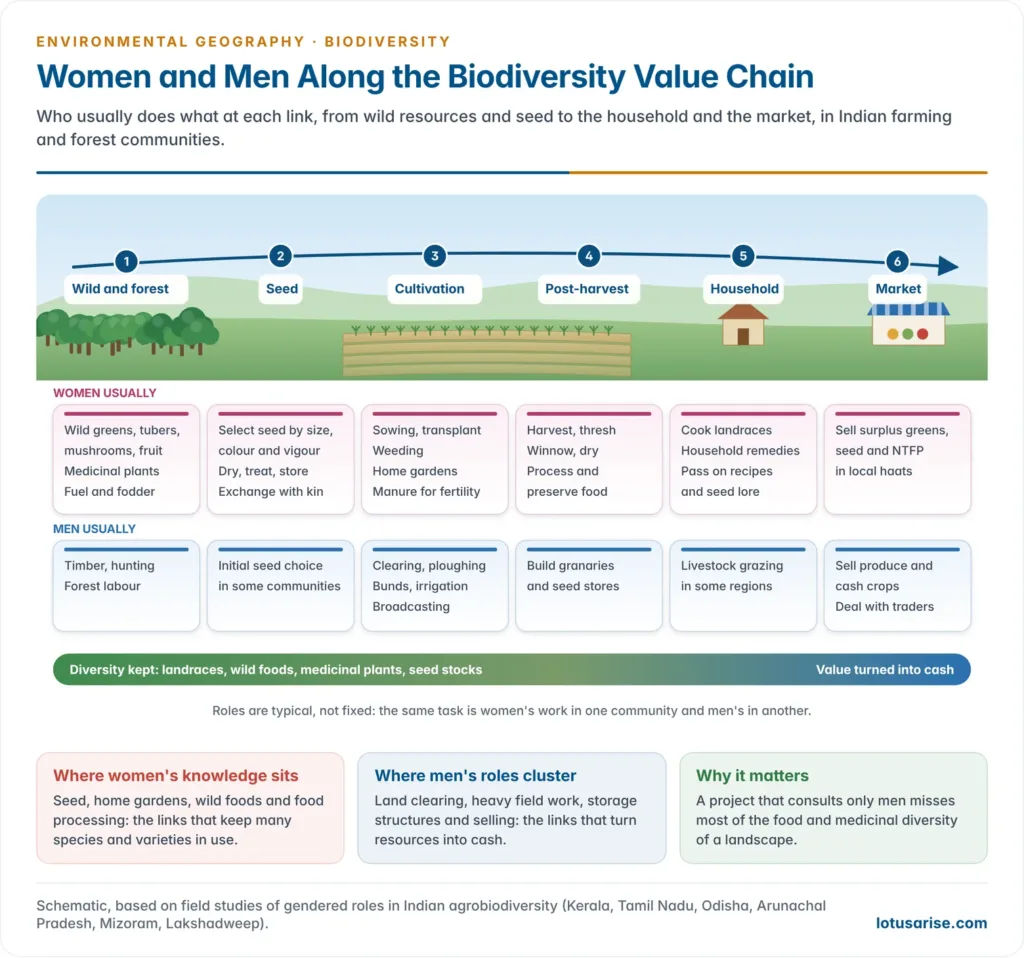
- Women work at every link of the biodiversity value chain, from the wild and the seed to the plate and the market. Their roles cluster in the links that maintain diversity; men’s roles cluster in links that convert resources into cash.
- Seed and planting material:
- Seed selection for the next season, judging grain size, colour, vigour and pest damage;
- seed treatment and storage in clay pots, gourds, bamboo bins and smoke-dried bundles;
- seed exchange with kin and neighbours, which keeps landraces moving between villages.
- Cultivation: sowing, transplanting, weeding and pest watching, and the care of home gardens, which are small reservoirs of vegetables, spices, fruit and medicinal plants.
- Wild and forest resources: collection of uncultivated greens, tubers, mushrooms, fruit and minor forest produce, and of fuelwood and fodder.
- Plants dismissed as “weeds” by agronomists are often women’s food and medicine.
- Livestock and fisheries: care of small ruminants and poultry, fodder collection, and fish processing and vending in coastal and riverine communities.
- Post-harvest and food: threshing, winnowing, drying, processing, cooking and food preservation.
- Recipes keep crops in use. A millet or a tuber that is still cooked is a crop that is still grown.
- Knowledge transmission: women pass on traditional ecological knowledge (TEK) to the next generation through oral tradition, demonstration and practice.
| Link in the chain | Tasks usually done by men | Tasks usually done by women |
|---|---|---|
| Land and soil | Clearing, ploughing, bunding | Applying manure and household refuse to restore fertility |
| Seed | Initial seed choice in some communities | Seed selection, cleaning, drying, storage and exchange |
| Crop care | Broadcasting, irrigation | Sowing, transplanting, weeding |
| Wild resources | Timber, hunting | Wild greens, tubers, medicinal plants, fuel and fodder |
| Post-harvest | Building storage structures and granaries | Harvesting, winnowing, processing, food preparation |
| Market | Selling produce, cash crops | Home gardens, food and medicinal plants for the household |
- These divisions are typical, not fixed. The same task (seed selection, winnowing) is done by women in one community and by men in another.
- Gender roles in biodiversity are therefore socially constructed, not biologically determined.
Feminisation of agriculture
- Feminisation of agriculture is the growing share of women in farm work and farm management, especially in hill and rain-fed areas.
- Male out-migration to towns for wage work leaves women as the de facto managers of land, crops, seed and livestock.
- They take decisions on land, crop and seed without formal rights over those resources.
- Scale in India: in the Periodic Labour Force Survey 2023–24, 64.4% of all women workers (and 76.9% in rural areas) worked in agriculture, against 36.3% of men workers.
- Globally, women made up about 43% of the agricultural labour force of developing countries (FAO, 2011).
- Owners or workers? Women’s work far outruns their ownership.
- Women held only about 14% of operational holdings and under 12% of the operated area (Agriculture Census 2015–16).
- 43.3% of women aged 15–49 owned a house or land, alone or jointly, in the National Family Health Survey (NFHS-5, 2019–21). Sole ownership of farmland is much lower.
- Consequences for biodiversity:
- Women’s responsibility for food, fuel and water gives them a strong interest in conserving croplands, forests and commons.
- Without titles, credit, extension and inputs, they cannot invest in conservation, and they are left out of decisions on seed and land use.
- The Ministry of Agriculture marks 15 October as Mahila Kisan Diwas (from 2016), and the Mahila Kisan Sashaktikaran Pariyojana (2011) under the rural livelihoods mission trains women farmers in agroecological practice.
Ecofeminism and feminist environmentalism
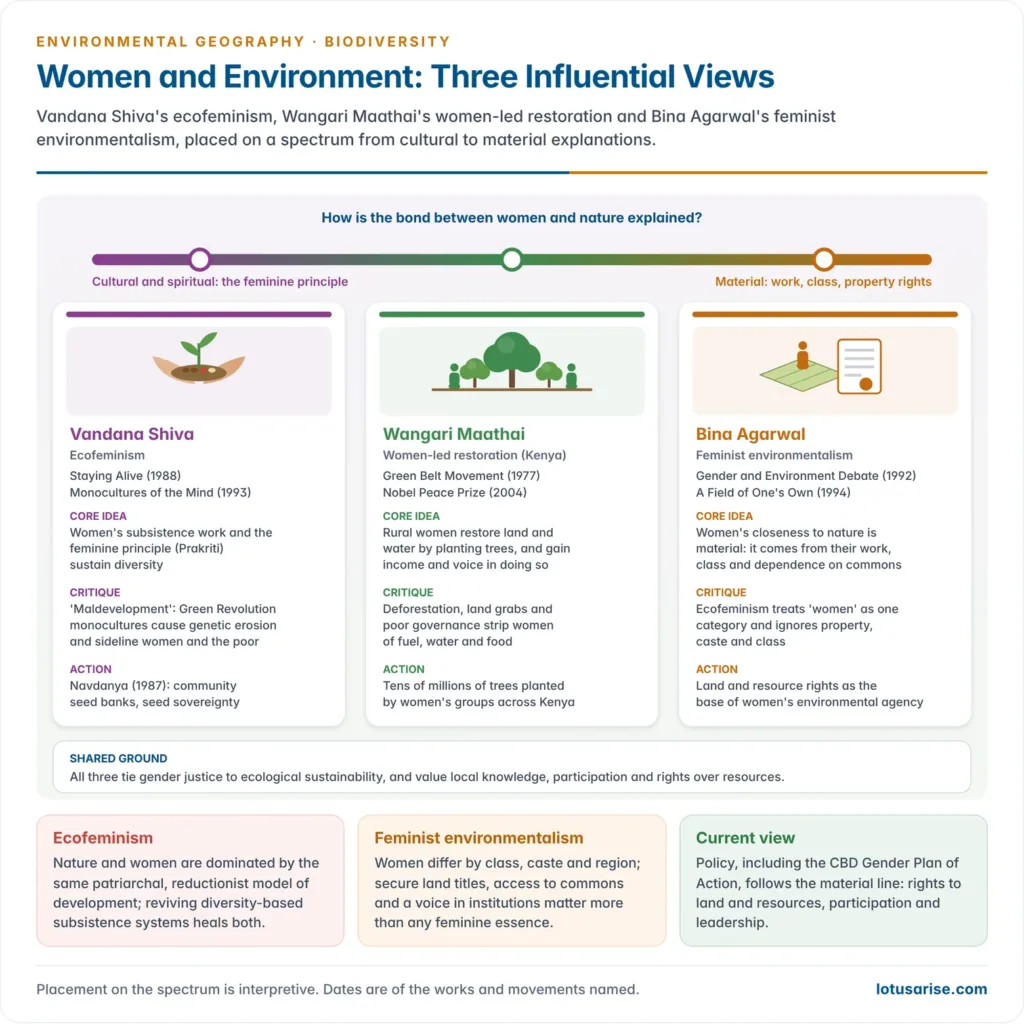
- Ecofeminism links the domination of nature with the domination of women, arguing that both must be challenged together. Its theory, from Françoise d’Eaubonne (1974) and Carolyn Merchant (1980) to Vandana Shiva, is a part of environmental ethics and the deep ecology debate.
- Vandana Shiva, in Staying Alive: Women, Ecology and Survival in India (1988) and Monocultures of the Mind (1993):
- Maldevelopment: development as usually practised benefits capital at the cost of women, nature and the poor.
- Critique of the Green Revolution: industrial monocultures marginalise small farmers, degrade soils and cause genetic erosion.
- Women as custodians: the feminine principle (Prakriti) and women’s subsistence work sustain diversity. She founded Navdanya (1987) for seed sovereignty.
- Bina Agarwal, in “The Gender and Environment Debate: Lessons from India” (1992) and A Field of One’s Own: Gender and Land Rights in South Asia (1994):
- Women’s closeness to nature is material, not mystical. It comes from the gendered division of labour, their class position, their lack of property rights and their dependence on commons.
- She called this feminist environmentalism and made land rights the foundation of women’s environmental agency.
- Wangari Maathai of Kenya founded the Green Belt Movement (1977), which mobilised rural women to plant trees, and won the Nobel Peace Prize (2004).
- Her work showed that women-led restoration is both practical and politically transformative.
- Shared ground: all three link gender justice, ecological sustainability and equity, and stress local knowledge, participation and rights over resources.
- The current consensus in policy and research leans to Agarwal’s material line: secure rights, access and voice, rather than any essential “feminine” bond with nature.
| Basis | Ecofeminism (Shiva) | Feminist environmentalism (Agarwal) |
|---|---|---|
| Woman–nature link | Spiritual and cultural; the feminine principle | Material; rooted in work, class and property |
| Root cause of crisis | Patriarchal, reductionist maldevelopment | Unequal rights to land and resources, state and market control |
| View of women | A unified category of custodians | Differentiated by class, caste and region |
| Remedy | Revive diversity-based, subsistence systems | Land rights, access, voice in institutions |
Gender Roles in Biodiversity Management: Indian Evidence
The MSSRF gender-and-biodiversity studies
- The M.S. Swaminathan Research Foundation (MSSRF), Chennai, works with a pro-nature, pro-poor and pro-women orientation in technology development and dissemination. It has led Indian research on the gender dimension of biodiversity.
- In the late 1990s, with FAO support, it studied gender dimensions in biodiversity management, focusing on agrobiodiversity, in distinct ecosystems under threat:
- Wayanad (Kerala), the Kolli Hills (Tamil Nadu), the Jeypore tract of Koraput and Bhitarkanika (Odisha), and the Lakshadweep Islands;
- plus Arunachal Pradesh and Mizoram in the North-East.
- Key findings:
- Gender roles are context-specific. Tasks assigned to men and women varied widely between locations.
- Where traditional agriculture survived and women were not secluded, their part in biomass-related work was high and their knowledge of and interest in conservation were clear.
- Women dominated seed preservation where they were the main food producers, as among the Apatanis of Arunachal Pradesh and the Garhwalis of the western Himalaya.
- The same held where women shared responsibility with men, as among the Mizos, Nagas and some hill tribes of the Western Ghats.
- Knowledge was eroding with age and social change, as in parts of Odisha.
- Where markets had penetrated deeply (much of Tamil Nadu), women were less involved in conservation but still kept a role in seed preservation.
- Outside interest revives local pride. Attention to local diversity motivated young women and men, seen in the revival of agrobiodiversity in the Kolli Hills, of mangrove diversity in Bhitarkanika, and in the work of the Young Mizo Association.
Regional case studies of gendered roles
| Region and community | Men’s roles | Women’s roles | Significance |
|---|---|---|---|
| Wayanad, Kerala (Kurichiya) | Land preparation, paddy seed selection, seed storage, bunds | Weeding, harvesting, winnowing, drying grain; medicinal plants in home gardens | Sacred groves protect medicinal plants; ritual taboos keep menstruating women away from seed stores |
| Kolli Hills, Tamil Nadu (Malayali) | Ploughing, broadcasting, marketing | Drying, cleaning, selecting and storing seed; transplanting, weeding, processing | Seed coated with red earth and sun-dried before storage; women barred from some sacred groves |
| Jeypore tract, Koraput, Odisha | Ploughing, sowing paddy, building seed stores | Selecting millet and oilseed seed; transplanting, weeding; main role in seed storage; herbal gardens | A centre of rice genetic diversity; a FAO Globally Important Agricultural Heritage System (2012) |
| Ziro valley, Arunachal Pradesh (Apatani) | Firewood, some paddy decisions | Older women match paddy varieties to soils and select pure seed | Wet rice with paddy-cum-fish culture; women’s knowledge sustains the system |
| Mizoram (Mizo jhum villages) | Choosing and clearing jhum sites, burning | Sowing, weeding, storing seed within the household | Women are the primary managers of jhum crop diversity |
| Lakshadweep Islands | Coconut plantation, harvesting, pest control | Coconut nurseries, post-harvest work, trees of food value | Clearly divided economic roles; both hold knowledge of island plants |
- Bhitarkanika (Odisha): the mangrove case added a coastal dimension, where households depend on mangroves for fish, fuel and thatch and local interest helped revive mangrove diversity.
Tribal women and agricultural biodiversity
- India’s Scheduled Tribe population was 10.43 crore (8.6%) in the 2011 Census, in over 700 notified communities. The largest numbers live in central India: Madhya Pradesh, Maharashtra, Odisha, Rajasthan, Gujarat, Jharkhand and Chhattisgarh.
- Tribes form the majority in Mizoram, Nagaland, Meghalaya and Arunachal Pradesh, and the tribal areas of the Western and Eastern Ghats hold further communities.
- These regions coincide with India’s agro-biodiversity hotspots, the centres of crop genetic diversity:
| Region | Key crops and genetic resources |
|---|---|
| North-Eastern states | Rice, maize, jute, sugarcane relatives (Saccharum), cucurbits, soyabean, citrus, buckwheat, many beans |
| Central India | Minor millets, rice, chickpea, niger, sesame, forage grasses |
| Western Himalaya | Buckwheat, amaranth, soyabean, cowpea, pome and stone fruits |
| Tamil Nadu hills (Javadi, Chitteri, Anamalai) | Edible greens, tubers such as Asparagus racemosus, yams (Dioscorea), neem, medicinal plants |
- In-situ guardians: over millennia, tribal women and men have conserved landraces and wild relatives of inestimable value.
- This genetic wealth is feedstock for crop breeding and a safety net for resource-poor farmers against drought, pests and market shocks.
- Women’s knowledge in the Tamil Nadu hills: tribal women of the Javadi, Chitteri and Anamalai hills use many plants from forests and fields, including so-called weeds. They know:
- the edible greens, vegetables, fruits and seeds and their uses;
- the seasonal availability of edible and medicinal plants;
- how to collect wild plants and domesticate them in home gardens.
- Seed custody: women process and store viable seed of crops and landraces for the next season, drying and cleaning grain alongside household work, and help men conserve traditional cultivars in the field.
- Soil fertility: tribal women also maintain soil fertility, applying cattle dung and household refuse as organic manure.
The Konda Reddys of Andhra Pradesh
- The Konda Reddys (“rulers of the hills”) are a tribal community of the Godavari hill tracts of Andhra Pradesh, living in isolated hills, valleys and forest clearings and practising shifting cultivation called podu.
- Women’s food knowledge:
- They gather wild foods by season, and prepare a staple porridge from pounded maize and finger millet (Eleusine coracana), stored in bottle-gourd (Lagenaria siceraria) containers. It is eaten from June until the next harvest.
- Common millet and foxtail millet are eaten steamed, seasoned or cooked like rice, and wild plants and seasonal tubers add dietary resilience.
- Indigenous seed-storage methods:
- Ear-on-plant maturation: ear heads are left on the plant until fully mature, preventing kernel damage from early harvesting.
- Smoke preservation of maize: cobs hang under the roof above the hearth, with a reed-and-bamboo mat below to keep off flames; the smoke repels pests.
- Field drying of millets: part of the common and foxtail millet crop is left to mature and dry in the field for seed.
- These methods show a refined grasp of seed physiology, pest control and storage ecology, built by observation and passed on largely through women.
The Irula and Malayali: community seed conservation
- The Irula and Malayali tribes of the Tamil Nadu hills and neighbouring areas grow paddy and millet varieties that are drought-resistant and partly disease- and pest-tolerant, conserved and improved over generations.
- The seed reserve is sacred: after harvest a large share of grain is set aside as sowing material and never eaten.
- If food runs short, families borrow from neighbours or turn to forest foods, but the seed reserve stays untouched. This is seed sovereignty in its original, community-controlled form.
- Indigenous granaries are rodent- and pest-proof, thatched with a local grass (Themeda) suited to the weather, with repellent leaves against storage pests.
- Why traditional cultivars: they respond to organic manure, suit local diets, need no external inputs and are adapted to local agro-climates, a resilience formal breeding cannot fully copy.
- The Malayali community granary: every family contributes grain to a hamlet granary managed by the headman. It:
- lends grain for marriages, festivals and daily needs;
- gives food security when a household falls short;
- keeps seed continuity across seasons, a pre-modern seed bank with social insurance;
- keeps minor millets in cultivation against market pressure toward monoculture.
Gender and genetic diversity
- Men and women play important but different roles in conserving agrobiodiversity:
- Activities vary widely by location; no universal pattern exists.
- Women preserve high-quality seed where they are the main food producers.
- Men’s and women’s knowledge is distinct and complementary, shaped by their tasks, not ranked.
- In conservative communities women’s activities are restricted, and their entry into sacred groves may be barred.
- Women conserve food and medicinal plants for the household; men favour crops of commercial value.
- Implication: a conservation programme that consults only men will miss most of the food and medicinal diversity of a landscape.
Threats to women’s biodiversity knowledge
- Changing diets and food culture: as millets, wild greens and tubers leave the plate, women’s knowledge of processing, cooking and storage fades, and so do the plants and household food security.
- Commercial monoculture: high-input systems built on introduced varieties displace landraces and shift decisions to men and markets.
- Market penetration: subsistence farming turns commercial, devaluing non-market crops (minor millets, local varieties) and the women who keep them.
- Changing households: male migration, smaller families and labour shortages alter farm management and agrobiodiversity.
- Social disruption: epidemics such as HIV/AIDS (in parts of Africa and Asia), conflict and displacement break the chains of knowledge transfer.
- Loss of commons: enclosure, diversion of forest land and degradation of village commons remove the wild resources women depend on.
- Biopiracy and patents: commercial use of traditional knowledge without consent or benefit sharing appropriates what women have kept.
Gender, biodiversity and climate resilience
- Diverse seed is climate insurance. Landraces of millets, rice and pulses kept by women include types that tolerate drought, flooding, salinity and pests, so household and community seed stores are also adaptation assets.
- Millets need little water, grow on poor soils and resist heat. The UN declared 2023 the International Year of Millets at India’s proposal.
- Millet systems in the Koraput hills, the Deccan and central India are largely managed by women, and the Odisha Millet Mission (2017) works through women’s self-help groups and farmer groups.
- Climate change bears harder on women. The IPCC’s Sixth Assessment Report (2022) identifies gender among the social factors that raise vulnerability.
- Drying springs and degraded forests lengthen the time women spend on water, fuel and fodder, and heat stress falls on outdoor farm work.
- Diversity spreads risk. Mixed cropping, home gardens and wild foods spread risk across many species, which is why women-managed diversity-based farming often holds up better in bad years than a single cash crop.
Women-Led Movements and Institutions in India
Forest and river movements
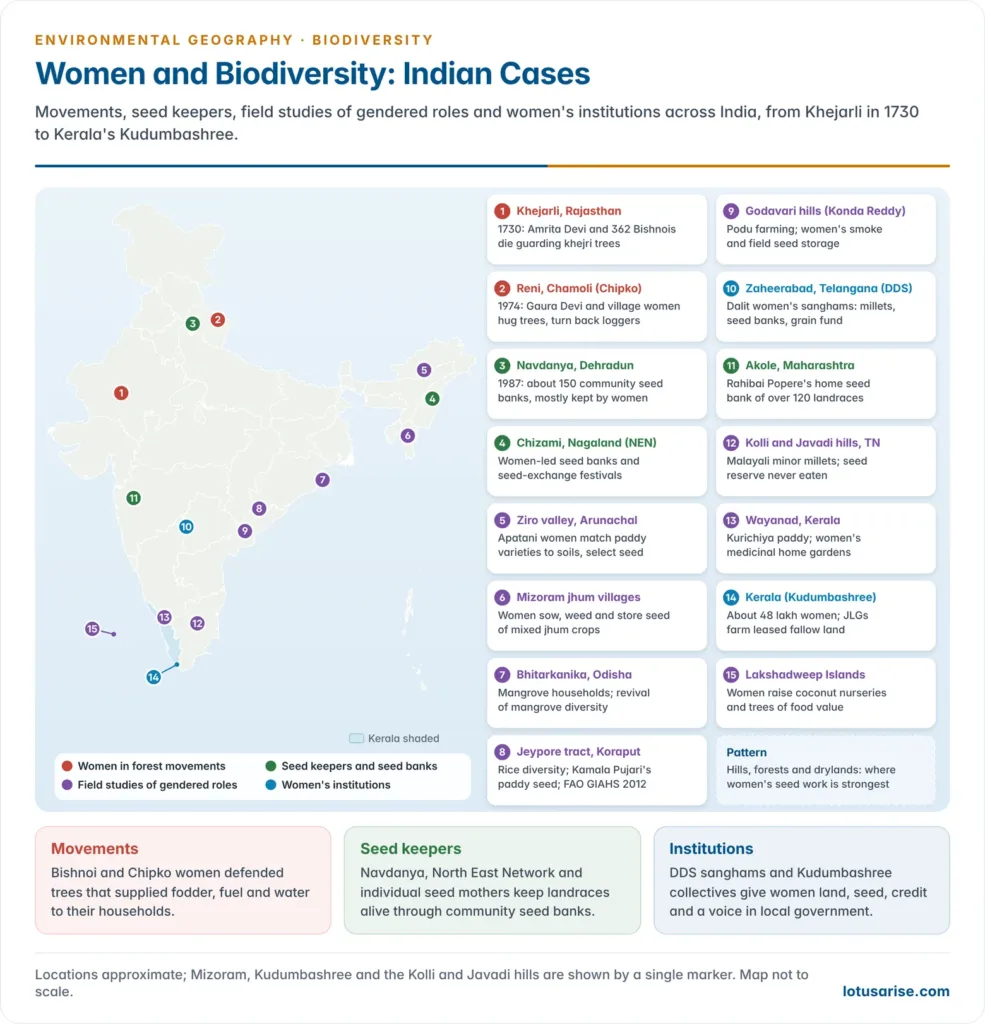
- Khejarli (1730): Amrita Devi of the Bishnoi community hugged a khejri tree (Prosopis cineraria) to stop soldiers of the Jodhpur ruler from felling it and was killed; 363 Bishnois died. The national award for wildlife protection by individuals and communities bears her name.
- Chipko (from 1973): the movement began at Mandal (Chamoli) in April 1973 against commercial felling in the Garhwal Himalaya.
- At Reni, in March 1974, Gaura Devi, head of the village Mahila Mangal Dal, and 27 other women hugged the trees and turned back the loggers while the men were away.
- Chipko made visible that forest degradation by contractors was also a crisis of women’s livelihoods: fodder, fuel and water.
- A state committee confirmed the Reni forest’s fragility, and in 1980 the Centre imposed a 15-year ban on green felling in the Himalayan forests of Uttar Pradesh.
- Village women then formed Mahila Mangal Dals to guard and regenerate community forests.
- Narmada Bachao Andolan (from 1985), led by Medha Patkar, opposed large dams on the Narmada. Women took part in large numbers because they bore the heaviest costs of displacement and lost access to river, forest and farm resources.
- Appiko (1983) in Uttara Kannada carried Chipko’s tree-hugging method to the Western Ghats.
Seed sovereignty and seed keepers
- Seed sovereignty is the right of farmers, and above all women, to save, use, exchange, develop and sell their own seed without corporate control or legal restriction.
- Women are central because they have kept seed for generations and are the first losers when seed is monopolised, patented or made unaffordable.
- Navdanya (“nine seeds”), founded by Vandana Shiva in 1987, runs a seed-conservation farm in the Doon Valley (Uttarakhand).
- It has set up about 150 community seed banks in 22 states and conserved over 4,000 rice varieties, along with millets, pseudo-cereals and pulses.
- Most seed-bank keepers and users are women farmers, and the movement campaigns against GM crops and seed patents.
- North East Network (NEN), a women’s rights organisation founded in 1995, works in Chizami (Phek district, Nagaland) on women-led seed banks, seed-exchange festivals and food sovereignty, treating ecological justice as inseparable from gender equity.
- Individual seed keepers:
- Rahibai Soma Popere, a Mahadev Koli farmer of Akole (Ahmednagar, Maharashtra), the “Seed Mother“, runs a home seed bank of over 120 landraces of about 30 crops; she received the Padma Shri (2020).
- Kamala Pujari of the Koraput tribal belt, Odisha, conserved and spread indigenous paddy varieties with the MSSRF Jeypore seed bank; she received the Padma Shri (2019).
- Legal cover: the Protection of Plant Varieties and Farmers’ Rights Act, 2001 lets farmers save, use, sow, exchange, share and sell farm-saved seed (not branded seed of protected varieties), and its Plant Genome Saviour awards reward communities that conserve landraces.
Deccan Development Society, Zaheerabad
- The Deccan Development Society (DDS) began in 1983 around Zaheerabad (now Sangareddy district, Telangana), in the semi-arid Deccan, with sanghams (village groups) of Dalit women, most of them small and marginal farmers.
- It was founded by P.V. Satheesh (1945–2023) and now works in about 75 villages.
- Millet-based biodiversity farming: women grow mixed rain-fed crops, often 10 or more on one plot, centred on sorghum, finger millet, foxtail millet and pulses, with no chemicals.
- This keeps alive the rain-fed agriculture of the Deccan drylands against cash-crop monoculture.
- Community institutions run by women:
- Seed banks in women’s homes and a collective community gene fund; a borrower returns twice the seed after harvest.
- A community grain fund, an alternative public distribution system that buys and supplies local millets.
- Collective farming on leased land, bringing fallow land back into use.
- Community media: Sangham Radio, India’s first rural community radio, and Dalit women trained as filmmakers.
- A month-long mobile biodiversity festival (jatara) of bullock carts carries seeds and millet foods from village to village.
- The women sanghams won the UNDP Equator Prize (2019) for innovation in rain-fed millet cultivation.
Kudumbashree, Kerala
- Kudumbashree, the Kerala State Poverty Eradication Mission, was inaugurated on 17 May 1998. It is a three-tier network of women’s neighbourhood groups (NHGs), area development societies and community development societies, linked to local governments.
- By March 2025 it had about 48 lakh women in over 3.17 lakh NHGs.
- Collective farming: women form joint liability groups (JLGs) of 4–5 members that lease fallow land and grow paddy, bananas, tubers and vegetables.
- Lakhs of women farmers in tens of thousands of JLGs have brought tens of thousands of hectares of fallow back into cultivation, mostly with low chemical inputs, compost and bio-inputs.
- Biodiversity links: reviving paddy fields restores wetland habitat, and the groups keep traditional tubers and vegetables in production.
- Its convergence with local self-government gives women a place in the panchayat bodies that also host the Biodiversity Management Committees.
Women in forest management and self-help groups
- Joint Forest Management (JFM) began with the Government of India’s resolution of 1 June 1990, sharing protection and usufruct of degraded forests with village committees.
- Guidelines of 2000 asked that at least 50% of the general body and 33% of the executive committee be women, with a woman among the office-bearers.
- Self-help groups (SHGs) linked to JFM and to the national rural livelihoods mission have become channels for nursery raising, non-timber forest produce (NTFP) collection and processing, and micro-credit for forest-dependent women.
- Limits in practice: women’s presence is often nominal. Meetings are held at times they cannot attend, men dominate decisions, and closure of forests for regeneration can shift the burden of fuel and fodder collection onto women.
- These institutions sit within wider forest management in India, where women’s tenure remains the weakest link.
Policy Framework, Gaps and the Way Forward
International framework
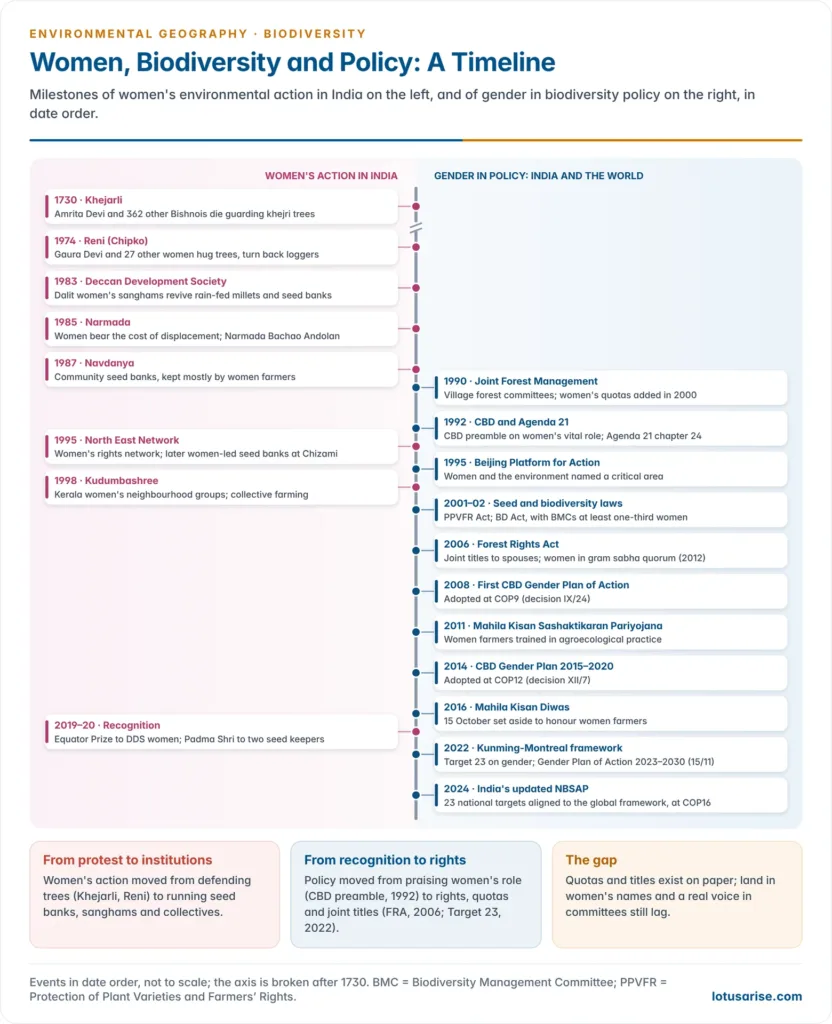
- Convention on Biological Diversity (1992): its preamble recognises “the vital role that women play in the conservation and sustainable use of biological diversity” and the need for their full participation at all levels of policy-making and implementation. The CBD now has 196 parties.
- Agenda 21 (1992), chapter 24, called for global action for women toward sustainable development; the Beijing Platform for Action (1995) made women and the environment one of its 12 critical areas.
- CBD gender plans:
- the first Gender Plan of Action (COP9, decision IX/24, 2008);
- the 2015–2020 Gender Plan of Action (COP12, decision XII/7);
- the Gender Plan of Action 2023–2030, adopted at COP15 (Montreal, December 2022) by decision 15/11.
- The Gender Plan of Action 2023–2030 supports gender-responsive implementation of the Kunming-Montreal Global Biodiversity Framework. It has three expected outcomes:
- Equal opportunity and capacity for all women and girls to contribute to the CBD’s three objectives, including rights to land, natural resources and water;
- Biodiversity policy, planning and programming that address equally the perspectives, needs and human rights of women and girls;
- Enabling conditions: sex-disaggregated data, gender-responsive finance and capacity-building.
- It asks parties to appoint a national gender and biodiversity focal point, to build gender into national biodiversity strategies and action plans (NBSAPs), and to report progress, with a mid-term review before COP17.
- Kunming-Montreal Global Biodiversity Framework (2022), Target 23: “Ensure gender equality in the implementation of the framework through a gender-responsive approach“, with equal rights and access to land and natural resources and women’s full, equitable, meaningful and informed participation and leadership at all levels.
- Target 22, on inclusive and gender-responsive participation in decision-making, names women and girls alongside indigenous peoples and local communities.
- Nagoya Protocol (2010; in force 2014): calls for the participation of women in access and benefit-sharing. India ratified it in 2012.
- Bioversity International (formerly IPGRI) and the FAO stress that research and extension must build on gender-differentiated local knowledge to help farmers keep plant genetic resources in their agro-ecosystems.
Indian framework
- Biological Diversity Act, 2002 (amended in 2023): local bodies set up Biodiversity Management Committees (BMCs), which prepare People’s Biodiversity Registers and share in benefits.
- Under the Biological Diversity Rules, 2004, at least one-third of a BMC’s nominated members must be women, with a share for Scheduled Castes and Scheduled Tribes.
- India released its updated NBSAP (2024–2030) with 23 national targets aligned to the global framework at COP16 (Cali, October 2024).
- Scheduled Tribes and Other Traditional Forest Dwellers (Recognition of Forest Rights) Act, 2006 (FRA):
- Section 4(4): forest rights are heritable but not alienable, and are registered jointly in the names of both spouses, or in the name of a single head where a household is headed by one person, often a woman.
- Gram sabha quorum (Rules as amended in 2012): half of all members, of whom at least one-third must be women.
- Community forest resource rights let gram sabhas protect and manage forests, biodiversity and NTFP, the base of women’s gathering economy.
- PPVFR Act, 2001: farmers’ rights over seed; women farmers are farmers under the Act.
- JFM (1990, 2000 guidelines) and the rural livelihoods mission with its women’s SHGs and the Mahila Kisan Sashaktikaran Pariyojana.
- These sit within India’s environmental legislation, which otherwise says little about gender.
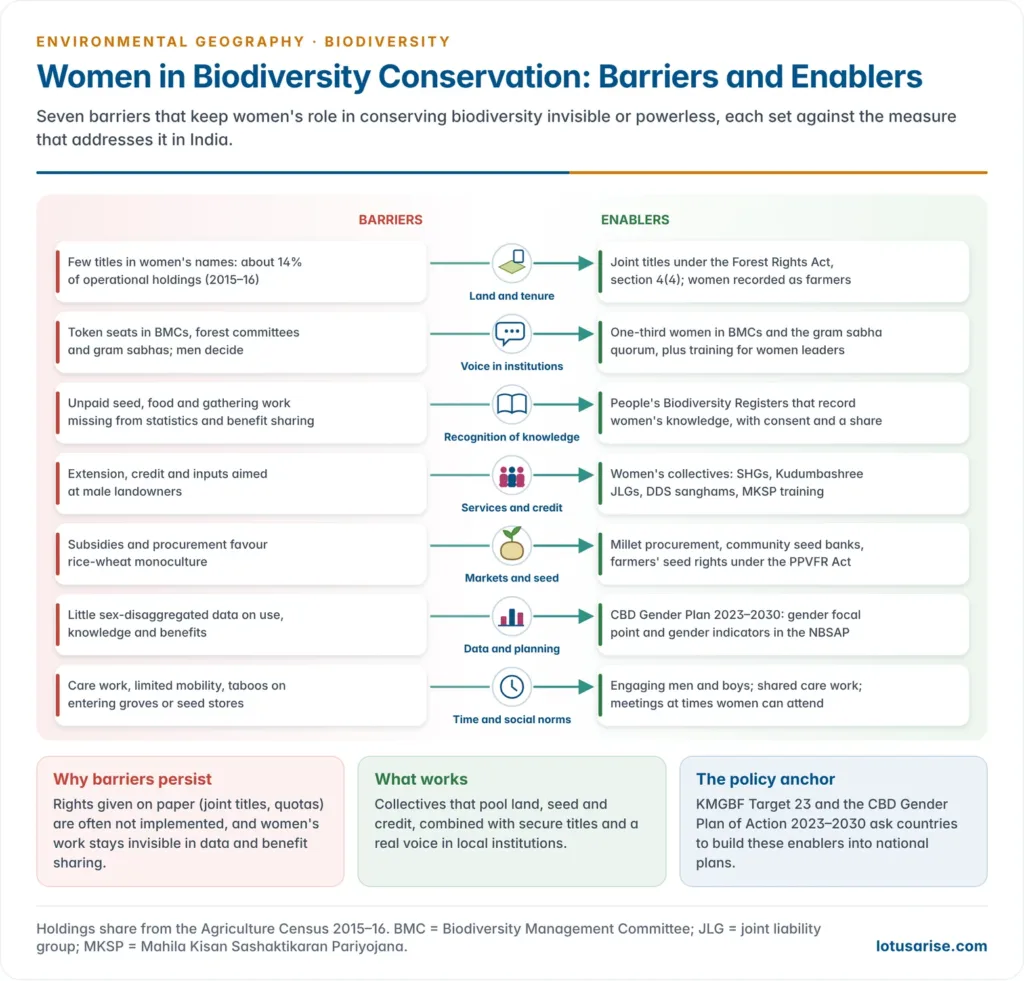
Barriers and policy gaps
- Land and tenure: few women hold titles to farmland or forest land; joint titles under the FRA are often not issued in practice.
- Participation without power: women are under-represented or silent in BMCs, JFM committees and gram sabha meetings; quotas fill seats but not voice.
- Invisible work: women’s seed, food and gathering work is unpaid and missing from statistics and from benefit-sharing.
- Weak data: little sex-disaggregated data on resource use, knowledge and benefits.
- Extension and credit bias: extension services, credit and technology are aimed at male landowners.
- Time poverty and social norms: care work, taboos on entering groves or seed stores, and restrictions on mobility.
- Market and policy pressure: subsidies and procurement that favour rice–wheat monoculture over millets and diverse systems.
A gendered long-term strategy for genetic resources
- Field research, the CBD and the FAO framework, and the seed-sovereignty movements point to a common strategy for the conservation, use, improvement and management of genetic resources:
| Requirement | What it means |
|---|---|
| Acknowledge gender differences | Recognise differing roles and contributions of women and men of different socio-economic groups as central to conservation |
| Value knowledge | Treat women’s and men’s knowledge, skills and practices (TEK) as intellectually and economically valuable, with a right to benefit |
| Equitable agricultural policy | Incentives for sustainable use, especially in-situ conservation linked to ex-situ gene banks |
| Appropriate legislation | Laws that protect threatened genetic resources for food and livelihoods and guarantee community use and management |
| Community benefit sharing | Benefits from commercial use of genetic diversity go to the local community, with gender-sensitive access and benefit-sharing |
| Gender in legal instruments | Gender written explicitly into national and international biodiversity law, impact assessment and governance |
| Access to resources | Women’s access to land, water, education, extension, credit and appropriate technology |
| Participation in decisions | Real voice for rural women and men from BMCs and gram sabhas to national policy |
- Practical steps for India:
- issue joint and individual titles under the FRA and record women as farmers in land and crop records;
- make People’s Biodiversity Registers record women’s knowledge with prior informed consent and a share in benefits;
- fund community seed banks and millet procurement, building on the International Year of Millets (2023), so that women’s crops have a market;
- collect sex-disaggregated data and name a gender focal point for the NBSAP;
- train extension staff to work with women farmers’ collectives and SHGs.
- The wider lesson: biodiversity is kept where those who use it daily have rights, knowledge and a voice. Securing these for women is both a matter of gender justice and the most practical route to conserving India’s biological and agricultural diversity.
Previous Year Questions
- No direct PYQ has been asked on this sub-topic yet.