

- Tribal areas are the contiguous regions where Scheduled Tribes live in large numbers and form the majority or a large minority: the hills, forests, plateaus and islands of the tribal belt.
- They are both cultural regions and administrative units: the Fifth and Sixth Schedules of the Constitution give many of them special forms of government.
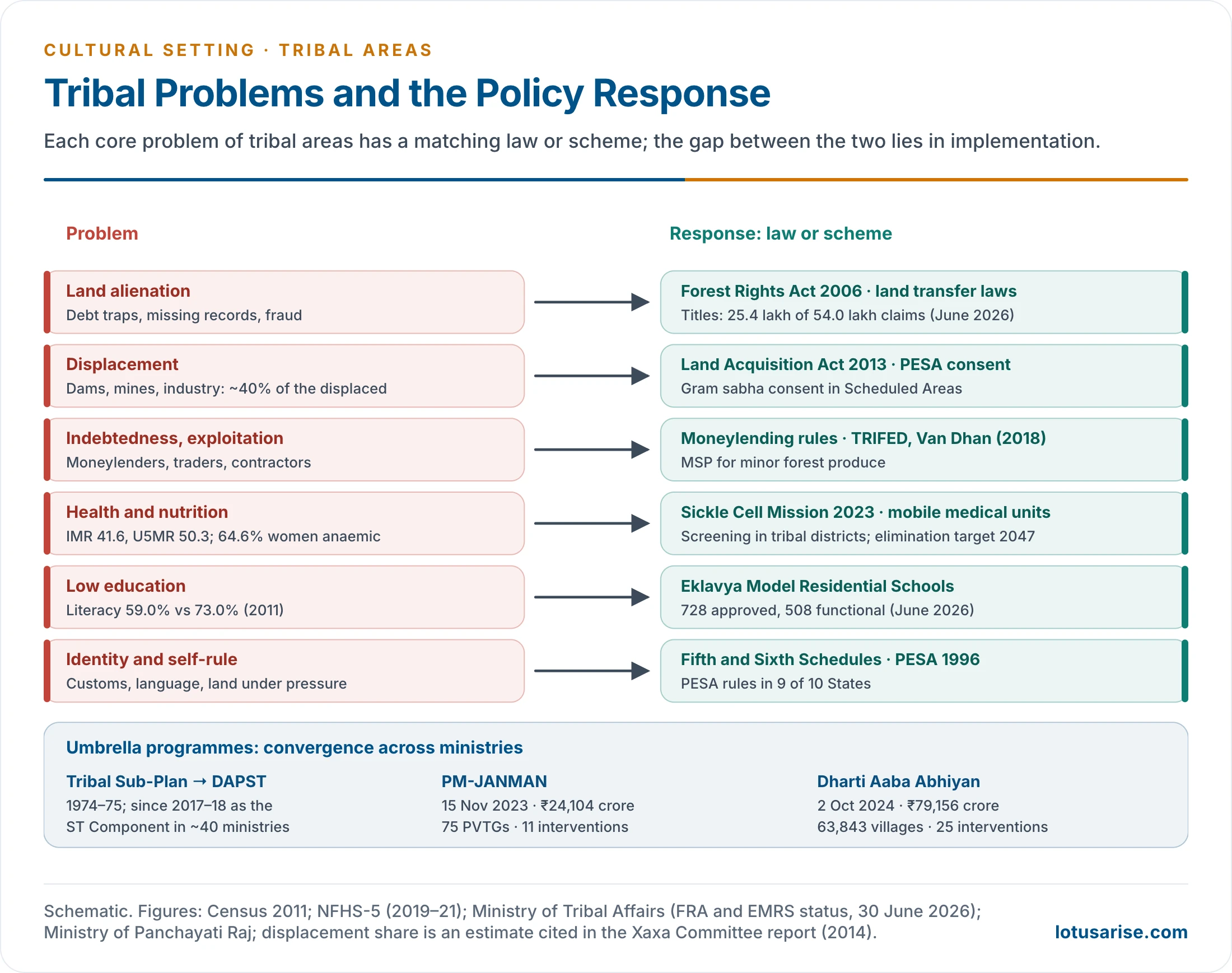
- Their people share common problems: land alienation, displacement, indebtedness, poor health and education, and threats to identity. Policies to address them run from the Tribal Sub-Plan (1974) to PESA (1996), the Forest Rights Act (2006), PM-JANMAN (2023) and the Dharti Aaba Janjatiya Gram Utkarsh Abhiyan (2024).
Tribal Areas

The Tribal Belt
- India’s tribes are very diverse in language, population size, ecological setting, livelihood and degree of acculturation, but share with other marginalised groups weak political representation, economic deprivation and cultural discrimination.
- “Tribe” is a socio-cultural category; “Scheduled Tribe” is a politico-administrative one.
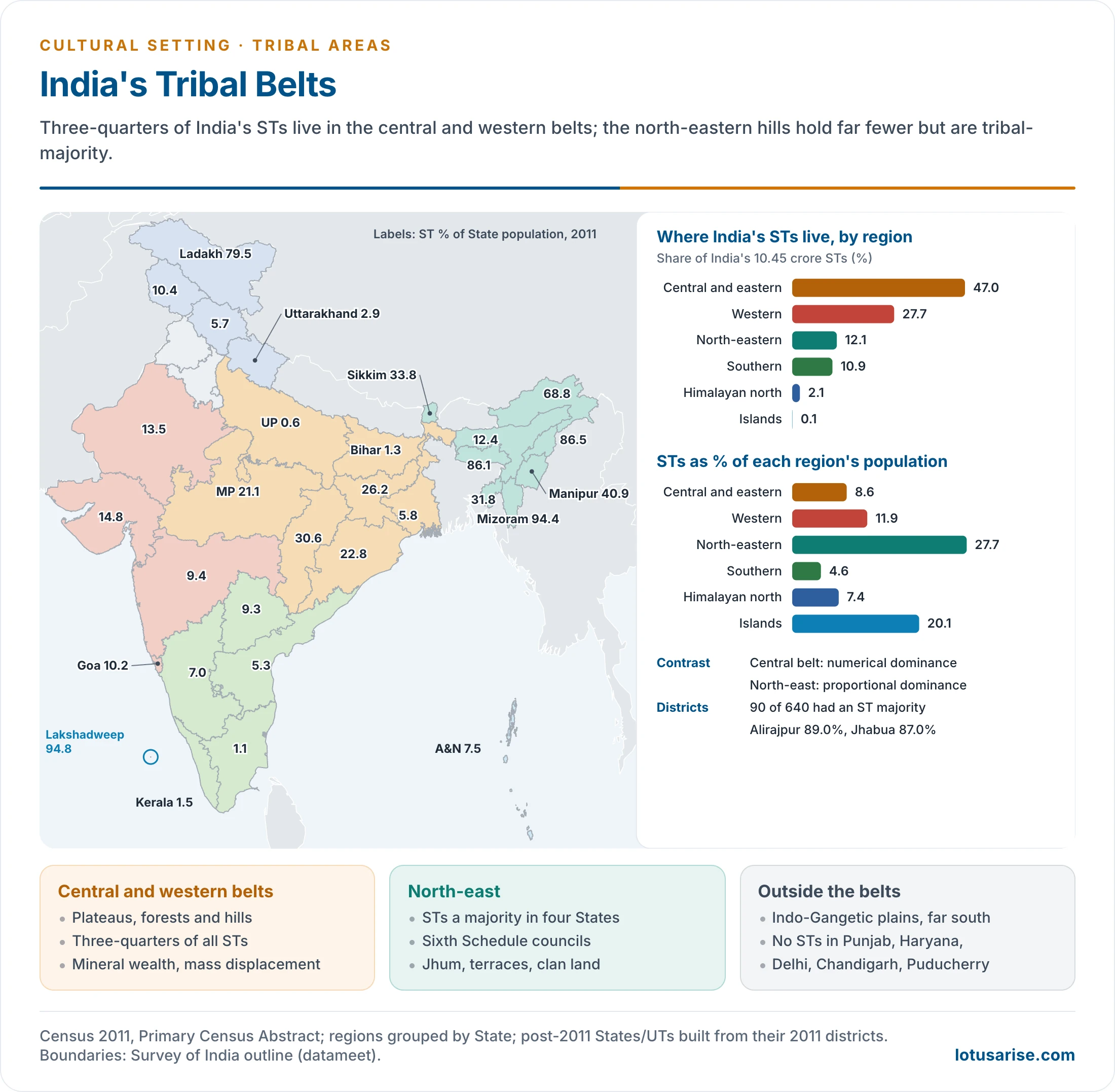
- Five tribal regions (share of India’s STs, Census 2011):
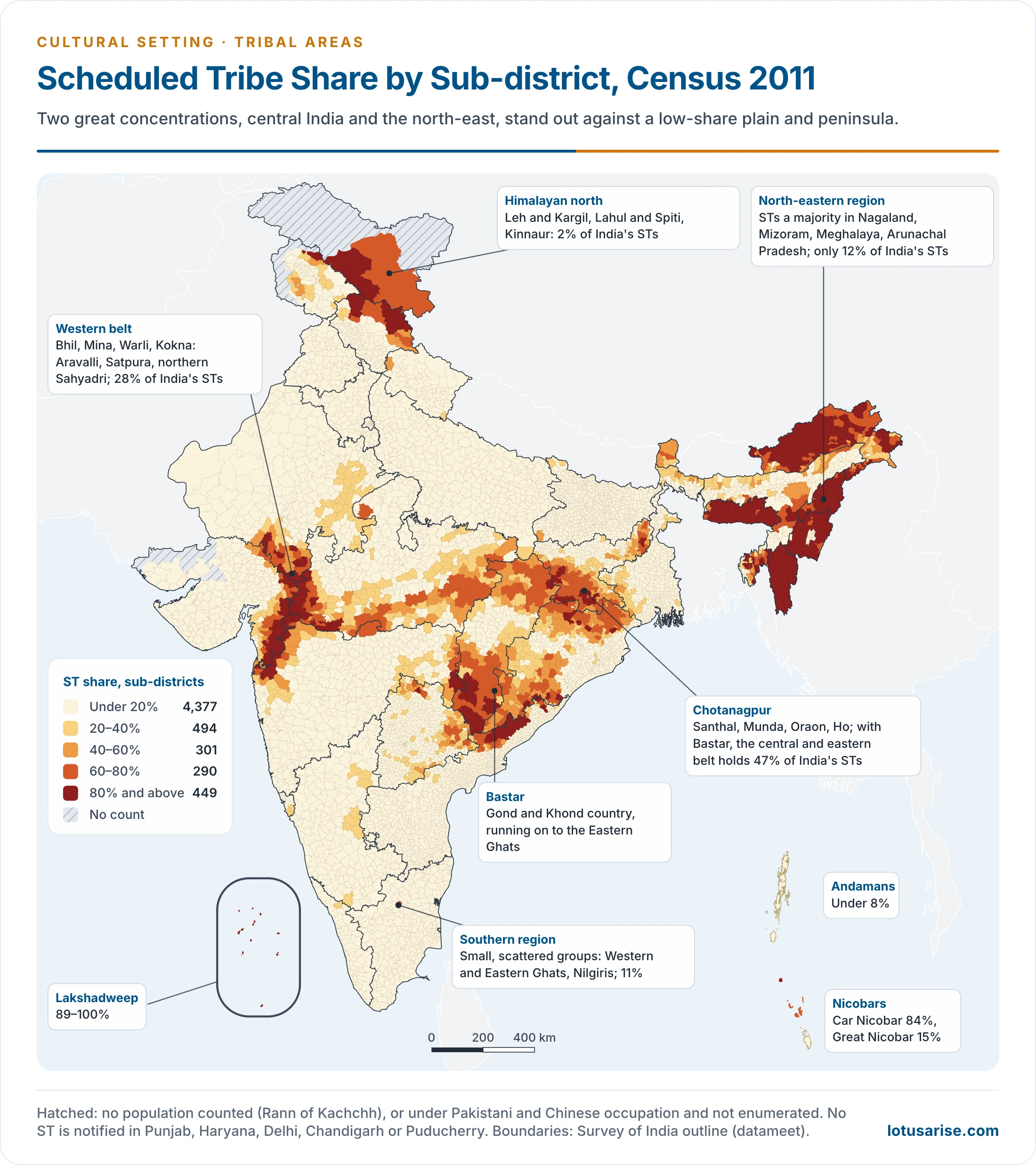
- Central and eastern belt (47%): the Chotanagpur plateau, Bastar, the Satpura–Vindhya and Maikal hills and the Odisha highlands; Gond, Santhal, Munda, Oraon, Ho and Khond country.
- Western belt (28%): the Aravalli, Satpura and the northern Sahyadri in Rajasthan, Gujarat and Maharashtra; Bhil, Mina, Warli and Kokna.
- North-eastern region (12%): the Purvanchal hills, the Meghalaya plateau and Arunachal Pradesh, where STs are a majority in Mizoram, Nagaland, Meghalaya and Arunachal Pradesh.
- Southern region (11%): small, scattered groups in the Western and Eastern Ghats and the Nilgiris, with many PVTGs.
- Himalayan north (2%) and the islands: pastoral groups of Jammu and Kashmir, Ladakh, Himachal Pradesh and Uttarakhand; the hunter-gatherers of the Andamans.
Distribution of Tribes
- Census 2011 counted 10.45 crore STs in 705 notified communities, 8.6% of India’s people, 90% of them rural.
- Two great concentrations:
- About two-thirds of all STs live in seven States of the central and western belts: Madhya Pradesh (14.7% of India’s STs), Maharashtra (10.1%), Odisha (9.2%), Rajasthan (8.9%), Gujarat (8.6%), Jharkhand (8.3%) and Chhattisgarh (7.5%).
- The north-east has far smaller numbers but the highest shares.
- No ST is notified in Punjab, Haryana, Delhi, Chandigarh or Puducherry.
- Districts: STs form a majority in 90 districts (2011), from Alirajpur and Jhabua to Bastar, Gumla and the hill districts of the north-east.
- The pattern reflects relief, forest cover, historical refuge and distance from the agrarian plains, the determinants of the spatial patterns of caste and tribe composition.
Scheduled Areas: The Fifth Schedule
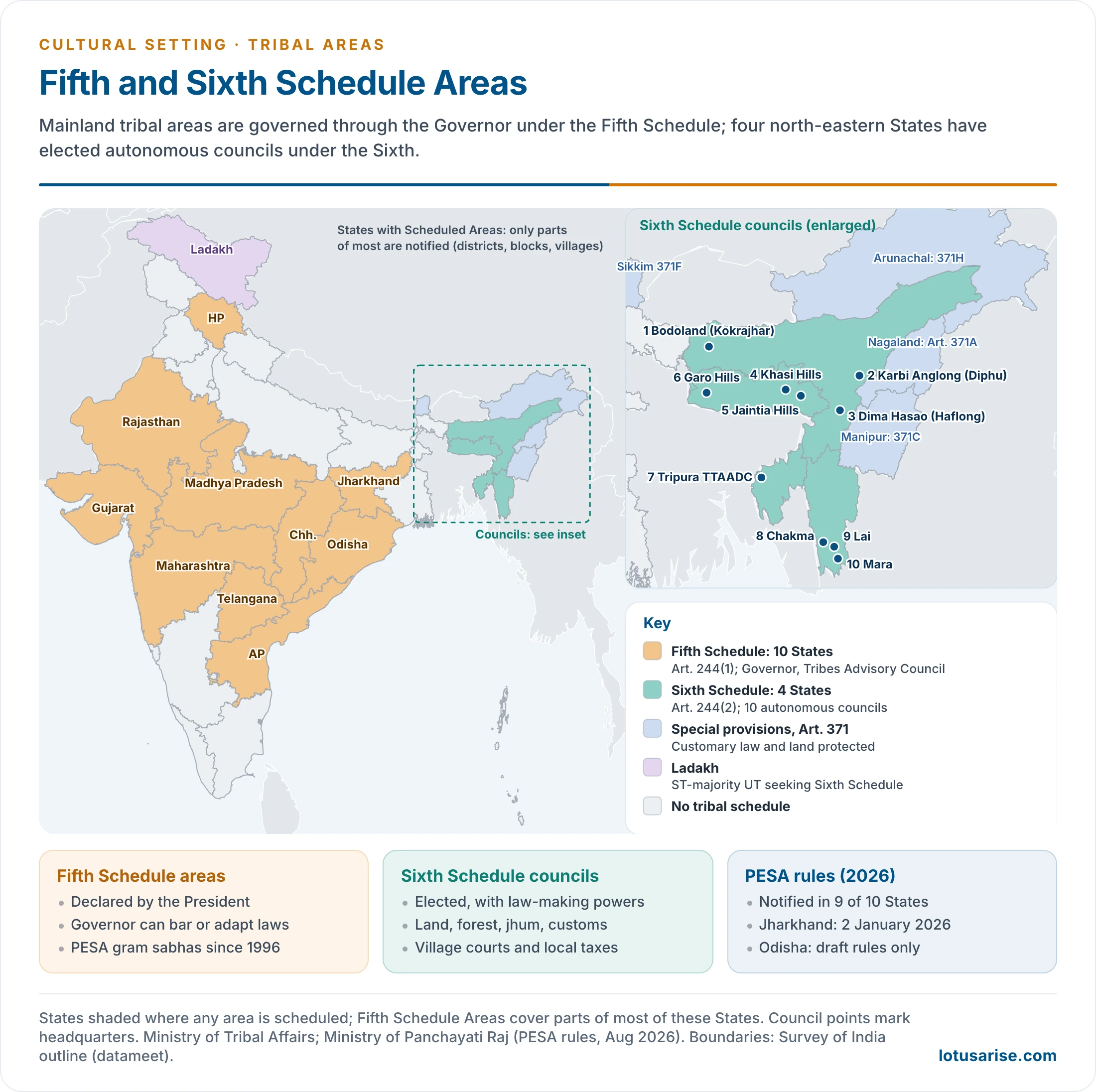
- Scheduled Areas are “such areas as the President may by order declare” (Fifth Schedule, under Article 244(1)).
- Criteria used for declaration:
- preponderance of tribal population;
- compactness and reasonable size;
- a viable administrative unit (a district, block or tehsil);
- economic backwardness compared with neighbouring areas.
- Ten States have Scheduled Areas: Andhra Pradesh, Chhattisgarh, Gujarat, Himachal Pradesh, Jharkhand, Madhya Pradesh, Maharashtra, Odisha, Rajasthan and Telangana.
- The Scheduled Areas cover about 11.3% of India’s land area.
- Some cover whole districts (13 districts in Jharkhand), others only blocks or villages.
- Special powers of the Governor:
- to direct that any law of Parliament or the State shall not apply to a Scheduled Area, or apply with changes;
- to make regulations for peace and good government, especially to prohibit transfer of tribal land, regulate allotment of land and control moneylending;
- to report to the President on these areas, on which the Union may give directions to the State.
- Tribes Advisory Council (TAC): up to 20 members, three-fourths of them ST members of the State Assembly. It advises on ST welfare. States with STs but no Scheduled Areas may also be directed to form one.
The Sixth Schedule
- The Sixth Schedule (Article 244(2) and Article 275(1)) applies to tribal areas of Assam, Meghalaya, Tripura and Mizoram.
- It protects tribal populations and gives them autonomy through Autonomous District Councils (ADCs) and Regional Councils.
- Each ADC normally has up to 30 members (the Bodoland council has 46), most of them elected. It has legislative, executive and judicial powers.
- It can make laws on land, forests, water, shifting cultivation, village administration, inheritance, marriage and social customs, run village courts, collect some taxes and set up schools and dispensaries. The Governor may entrust it with further functions such as agriculture.
- Ten autonomous councils exist:
| State | Autonomous councils |
|---|---|
| Assam | Bodoland Territorial Council, Karbi Anglong, Dima Hasao |
| Meghalaya | Khasi Hills, Jaintia Hills, Garo Hills |
| Tripura | Tripura Tribal Areas ADC |
| Mizoram | Chakma, Lai, Mara |
- Other north-eastern States have special provisions under Article 371 instead: 371A protects Naga customary law and land ownership, while 371C (Manipur’s hill areas), 371F (Sikkim) and 371H (Arunachal Pradesh) give other safeguards.
- Ladakh, with an ST majority, has sought inclusion in the Sixth Schedule since becoming a Union Territory in 2019.
| Feature | Fifth Schedule | Sixth Schedule |
|---|---|---|
| Article | 244(1) | 244(2), 275(1) |
| Where | 10 States of mainland India | Assam, Meghalaya, Tripura, Mizoram |
| Key body | Tribes Advisory Council (advisory) | Autonomous District Council (legislative) |
| Who controls | Governor and State government | Elected tribal council |
| Self-rule | PESA gram sabhas | Customary law and council laws |
Problems of Tribal People
Nature of the Problems
- Tribes are generally backward economically and educationally, but the situation varies:
- In the north-east, the tribes have high politicisation, higher literacy and a better standard of living than in other regions. The region’s problems are more about ethnic conflict, insurgency and autonomy.
- In the mainland (central India), poverty, unemployment, indebtedness and land loss are acute.
- Problems also differ with the degree of contact. Shyama Charan Dube (1982) classified Indian tribes by their contact with non-tribal society:
- aboriginals living in seclusion;
- tribes associated with neighbouring non-tribal society but keeping their distinctiveness;
- tribes living in villages alongside castes and sects while keeping their identity;
- tribes degraded to the status of untouchables;
- tribes that enjoy high social, economic and political status.
Social Problems
- Illiteracy and educational deprivation:
- Causes:
- poverty, which pushes children into work;
- language barriers, since teaching is often in a language the child does not speak;
- an irrelevant curriculum;
- few schools and teachers in remote areas.
- Backwardness is worst in remote, forested and hilly areas, where isolation is greatest.
- Causes:
| Literacy (%) | 1961 | 1971 | 1981 | 1991 | 2001 | 2011 |
|---|---|---|---|---|---|---|
| All persons | 28.3 | 34.5 | 43.6 | 52.2 | 64.8 | 73.0 |
| STs | 8.5 | 11.3 | 16.4 | 29.6 | 47.1 | 59.0 |
| All females | 15.4 | 22.0 | 29.8 | 39.3 | 53.7 | 64.6 |
| ST females | 3.2 | 4.9 | 8.0 | 18.2 | 34.8 | 49.4 |
- Gender gaps:
- Tribal women face dual marginalisation. Female literacy (49.4%) is far below male literacy (68.5%).
- Girls drop out because of housework, early marriage and the lack of nearby schools and toilets.
- Women traditionally enjoyed better status than in caste society, but modernisation has eroded it.
- Health and nutrition (NFHS-5, 2019–21):
- Infant mortality 41.6 and under-five mortality 50.3 per 1,000 among STs, against 28.0 and 32.8 for the “other” group.
- About 40% of ST children are stunted, and 64.6% of ST women are anaemic (India: 57.0%).
- Malaria, tuberculosis and sickle cell disease are concentrated in tribal belts.
- Causes: remote facilities, food insecurity, low awareness of preventive care, and reliance on traditional healers (ojha, kabiraj) and quacks.
- Assimilation and loss of identity:
- Contact with dominant cultures brings loss of traditional practices and growing inequality within tribes.
- Customary institutions and indigenous knowledge decline, and many tribal languages are endangered.
- Conflict between customary systems and modern law creates insecurity.
- Alcohol: rice beer and mahua liquor have long been part of ritual and social life, but about 51% of ST men now drink, against about 30% of other men, and the shift to commercial liquor brings health risks, domestic violence and a drain on income.
Economic Problems
- Loss of control over natural resources:
- Tribes once held customary rights over land, forests, water and wildlife: the base of their subsistence economy and identity.
- Colonial forest laws (from 1865 and 1878) turned forests into reserved and protected forests and curtailed these rights.
- After Independence, mineral development in Jharkhand, Odisha and Chhattisgarh and growing population pressure continued the process.
- The Forest Rights Act (2006) aims to restore these rights.
- Poverty: in 2015–16, 50.6% of STs were multidimensionally poor, the highest of any social group.
- Land alienation:
- Tribal land passes to non-tribals through debt traps, manipulated or missing land records, fraudulent transfers and encroachment.
- Land transfer regulations and PESA prohibit this, but enforcement is weak, and the result is landlessness.
- Indebtedness: credit at exorbitant interest for food, ceremonies or medical needs often ends in bonded labour or the loss of land.
- Displacement and rehabilitation:
- Dams, mines, steel plants and parks cluster in tribal areas: the Chotanagpur plateau (Bokaro), Odisha’s mining belt (Rourkela), Bhilai and the Narmada dams.
- Tribal people are estimated to be about 40% of all people displaced by development since 1951, though they are 8.6% of the population.
- Problems: cash compensation that is quickly spent, poor resettlement, migration as unskilled labour, cultural dislocation and stress.
- Exclusion from welfare: low awareness of schemes, administrative barriers, bureaucratic apathy and poor accountability keep many tribal families out of scholarships, hostels, pensions, ration cards and MGNREGA work.
- Subsistence economy:
- Hunting, gathering, shifting cultivation and small-scale farming with simple tools give little surplus.
- Households are exposed to crop failure and climatic shocks, and the move to a market economy is difficult.
- Unemployment and distress migration:
- Seasonal unemployment and few non-farm jobs push distress migration to cities, brick kilns and plantations as unskilled, informal labour.
Environmental Problems
- Human–wildlife conflict:
- Habitat fragmentation by roads, railways, plantations, mines and embankments has sharpened conflict, causing crop and livestock loss, deaths and retaliatory killing, worst in the north-east, the Dooars, central India and the Western Ghats.
- Habitat degradation:
- Tribal regions lie in fragile zones (forests, hills and biodiversity hotspots) and suffer deforestation, shrinking common property resources, monoculture plantations and pollution around industries.
- Physical constraints: difficult terrain and poor communications limit access to markets, health care and schools and delay service delivery; heavy rainfall in the foothills and the north-east brings seasonal disease.
- Livelihood crisis: fuelwood, fodder and minor forest produce are declining, and soil erosion and water scarcity cut farm yields.
- Ecologically rich regions become economically poor through unsustainable extraction.
- Case: the Dooars:
- Tea plantations in the West Bengal–Assam foothills have taken over forest and grassland and fragmented elephant corridors.
- Results: human–elephant conflict, loss of biodiversity, and poor housing for tea-garden workers, most of them Santhal, Oraon and Munda migrants, whom long garden closures push into further migration.
Political and Security Problems
- Left-wing extremism has been concentrated in the central tribal belt (Bastar, the Jharkhand–Odisha borderlands), feeding on land loss, displacement and poor governance. It has also kept development away.
- Ethnic conflict and insurgency in the north-east: clashes between tribes and with settlers (the Bru exodus of 1997, violence in Bodo areas), and demands for autonomy and statehood.
- Identity demands: inclusion in the ST list (Gurjars in Rajasthan, Koch-Rajbongshi and Ahom groups in Assam), or separate statehood.
Tribal Development Policy
Approaches
- Isolation: Verrier Elwin (1939) proposed protecting tribes in “national parks” away from outside exploitation.
- Assimilation: Govind Sadashiv Ghurye saw tribes as “backward Hindus” to be absorbed into the mainstream.
- Integration: Jawaharlal Nehru’s Tribal Panchsheel (in his foreword to Elwin’s A Philosophy for NEFA, 1959) set out five principles:
- tribes should develop along the lines of their own genius;
- their rights in land and forests should be respected;
- tribal teams should be trained for administration and development;
- tribal areas should not be over-administered;
- results should be judged by the quality of human character, not statistics or money spent.
Evolution of Programmes
- 1954: 43 Special Multipurpose Tribal Projects (later called Blocks).
- Tribal Development Blocks (TDBs), from the Third Plan:
- Community development blocks where STs were 66% or more of the people became TDBs, stressing agriculture, soil conservation, education, health, cooperation and communications.
- They numbered 504 by the end of the Fourth Plan. They were area-based units of tribal development, and the TSP later absorbed them into larger projects.
- The Shilu Ao Study Team (1969) found blocks too small for planning, schemes fragmented, and little tribal participation.
- Tribal Development Agencies (1971–72): pilot district agencies.
- Tribal Sub-Plan (TSP, 1974–75):
- Launched in the Fifth Plan for areas of tribal concentration.
- Funds from all sectors are earmarked in proportion to the ST population, and are non-divertible and non-lapsable.
- Its units:
- 194 Integrated Tribal Development Projects or Agencies (ITDPs/ITDAs) for large tribal areas;
- 259 MADA pockets (Modified Area Development Approach): 10,000+ people, at least half ST;
- 82 clusters: 5,000+ people, at least half ST;
- separate projects for the 75 PVTGs.
- The TSP covers 22 States and 2 UTs.
- Three-tier planning: micro (block: schools, primary health, minor irrigation, cooperatives), meso (ITDP: higher education, markets, roads, power), macro (State: medium irrigation, industry, research).
- Since 2017–18 it runs as the Scheduled Tribe Component, tracked as the Development Action Plan for STs (DAPST) across about 40 ministries.
- Critique: the sub-plan lacked independent status within the State plan, and planning was top-down, with little tribal participation; bureaucratic rigidity and weak political will added to the failures.
- Bastar (Chhattisgarh) is a case in point: over 65% tribal, it runs from the isolated Abujhmar hills of the Hill Maria to the Bhatra plains near Jagdalpur, and Bailadila iron-ore mining brought growth but little local benefit.
Legal Safeguards
- PESA, 1996 (Panchayats (Extension to the Scheduled Areas) Act):
- Extends Panchayati Raj to Fifth Schedule Areas, recognising gram sabhas as competent to safeguard traditions, community resources and customary dispute resolution.
- Gram sabhas must be consulted on land acquisition and must approve plans. They get ownership of minor forest produce and control over minor minerals, village markets, moneylending and land alienation.
- Nine of the ten States have notified PESA rules; Jharkhand did so on 2 January 2026. Odisha has only draft rules (2023).
- Forest Rights Act, 2006 (Scheduled Tribes and Other Traditional Forest Dwellers (Recognition of Forest Rights) Act):
- Recognises individual rights to forest land cultivated before 13 December 2005 (up to 4 hectares).
- Recognises community rights: grazing, fishing, minor forest produce. It also recognises Community Forest Resource (CFR) rights to protect and manage forests, and habitat rights for PVTGs.
- The gram sabha initiates and verifies claims.
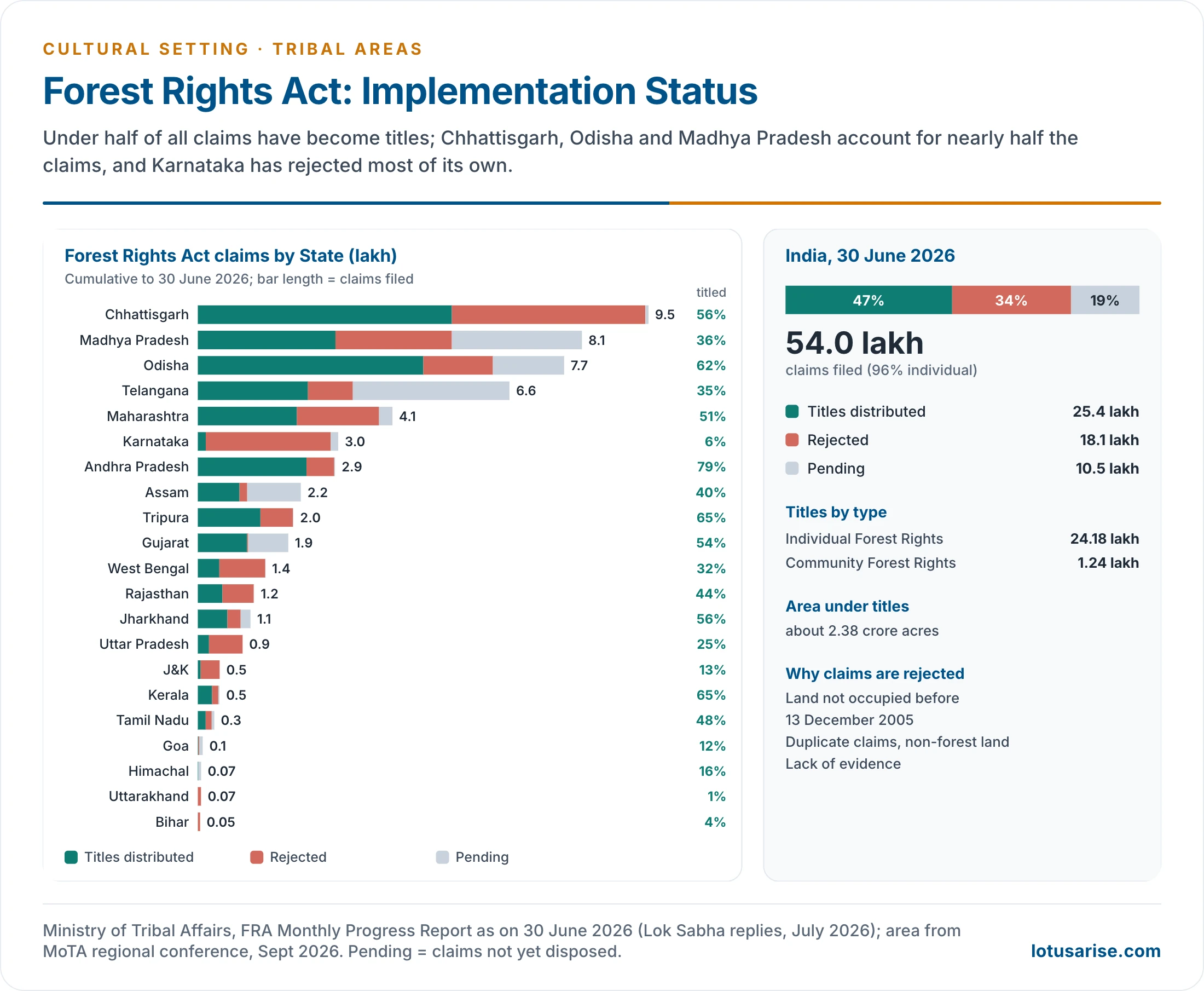
- Status (30 June 2026):
- 54.0 lakh claims filed; 25.4 lakh titles distributed (1.24 lakh of them community titles), covering about 2.38 crore acres.
- 18.1 lakh (34%) were rejected and 10.5 lakh (19%) are pending.
- Main reasons for rejection: land not occupied before the cut-off date, duplicate claims, non-forest land and lack of evidence.
- Impact on forest communities:
- Where CFR rights are recognised, gram sabhas manage and sell forest produce: Mendha-Lekha (Gadchiroli) has sold its own bamboo since 2011.
- In 2013 the gram sabhas of the Niyamgiri hills (Odisha) rejected bauxite mining on their land.
- Elsewhere, tenure remains insecure: rejection rates are high, and the Supreme Court’s 2019 eviction order for rejected claimants was soon stayed.
- Other laws: State land transfer regulations (the Chotanagpur Tenancy Act 1908, the Santhal Parganas Tenancy Act 1949), the SCs and STs (Prevention of Atrocities) Act, 1989, and the land acquisition law of 2013, which requires gram sabha consent in Scheduled Areas.
Major Schemes
- Education:
- Eklavya Model Residential Schools (EMRS) in every block with over 50% ST population and at least 20,000 tribal people.
- 728 approved, 508 functional (June 2026), with over 1.5 lakh students.
- Pre- and post-matric scholarships, hostels and ashram schools.
- Eklavya Model Residential Schools (EMRS) in every block with over 50% ST population and at least 20,000 tribal people.
- Livelihoods:
- NSTFDC loans for self-employment.
- TRIFED, with Van Dhan Vikas Kendras (2018) and minimum support prices for minor forest produce.
- Health: the National Sickle Cell Anaemia Elimination Mission (2023) screens tribal areas, with the aim of ending the disease by 2047.
- PM-JANMAN (15 November 2023): ₹24,104 crore over three years for the 75 PVTGs, through 11 interventions of 9 ministries.
- Dharti Aaba Janjatiya Gram Utkarsh Abhiyan (DAJGUA):
- Launched on 2 October 2024, named after Birsa Munda (“Dharti Aaba”).
- Outlay ₹79,156 crore for 2024–25 to 2028–29.
- It aims to saturate infrastructure gaps in 63,843 tribal-majority villages, benefiting over 5 crore tribal people.
- 25 interventions by 17 ministries. It also funds gram sabhas and CFR management under the FRA.
- Pradhan Mantri Adi Adarsh Gram Yojana: converts villages with large ST populations into model villages through convergence.
Why Tribal Areas Still Lag
- Implementation gaps: TSP funds diverted; PESA rules late and gram sabha powers overridden by line departments.
- Rights not secured: a third of FRA claims rejected, CFR rights under-recognised, land records missing or out of date.
- Development model: mining, dams and industry extract resources without benefit-sharing (Bailadila in Bastar, the Narmada dams), while displacement outpaces rehabilitation.
- Delivery failures: vacant teacher and doctor posts, distant facilities, and schemes designed for the plains.
- Elite capture: benefits concentrated among the better-off tribes and households.
- Conflict: insurgency and ethnic violence that keep the State and services away.
- The Xaxa Committee (2014) called for strict enforcement of PESA and the FRA, prior informed consent of gram sabhas for land acquisition and land-for-land rehabilitation.
Way Forward
- Prospects: tribal areas hold much of India’s forest, mineral and hydropower wealth; with secure rights and fair benefit-sharing, forest produce, horticulture and tourism can support local livelihoods.
- Ecology-based development: tribal communities, who traditionally managed their forests, need community-led forest management under CFR rights, value addition to forest produce and protection of commons.
- Self-rule: real powers for gram sabhas and autonomous councils, and full use of the Fifth and Sixth Schedules.
- Land security: updated records, restoration of alienated land and consent before acquisition.
- Culturally sensitive services: mother-tongue teaching, tribal health workers and attention to sickle cell disease and anaemia.
- Conservation with participation: a say in the management of parks and reserves.
Previous Year Questions
1989Discuss the problems of the tribal areas and suggest measures for solving them.1992Write short note: Salient features of Tribal area planning.1995Discuss the problems of Tribal areas in India.1998Critically examine the problems and prospects of tribal areas in India.2002Elucidate the role of Tribal development blocks in development of Tribal areas.2005Identify the tribal areas of India and highlight their important problems.2006Present an account of Tribals, tribal areas and their problems in India.2012Elucidate the role of Tribal Development Blocks in the development of Tribal areas.2013Planning and development of ‘Tribal Regions’ in India.2016Describe the major tribal regions of India and their problems.2020Identifying areas covered under tribal sub-plan, discuss the programmes initiated to address their problems.2022Discuss the impact of Forest Rights Act, 2006 on the local forest communities in India.2024In spite of various tribal area development programmes in India, tribal areas still lag behind. Discuss critically with examples.





Thank you so much 💕💕
Thank
thank u Amit sir for your quality content
thank u so much….