

- The English word culture comes from the Latin cultus or cultura, “tilling, cultivation, refining”. Culture is the refinement of human life, to the point where its product evokes admiration: its customs, traditions, beliefs and ways of living.
- The Sanskrit sanskriti, from the root kri (“to do”), carries the same idea: customs, language, religion and belief refined and raised together form sanskriti.
- A cultural region is a geographical area with homogeneity in cultural attributes, such as language, religion, customs and social practice, and with a distinct identity from the areas around it.
- Cultural identity is sharpest in a small region and grows more diffuse across a large one.
- India forms the Indic culture realm of the world. Laurence Dudley Stamp called it a “paddy culture”, for its rice-based agrarian base, and John Norman Leofric Baker a “sub-continental culture”, for its diversity within unity.
- The realm is broadly marked by:
- the joint family and the village community;
- the caste system and, historically, semi-feudal land relations;
- subsistence agriculture, especially paddy;
- a monsoon rhythm that sets one seasonal calendar for social and economic life;
- the deep imprint of Vedic traditions and values, alongside many other living traditions.
- Within this realm India divides into cultural regions. Language, religion and custom are the main bases for drawing them.
Bases and Schemes of Cultural Regionalisation

Bases
- Language: the clearest and most mappable trait. It was the basis of the reorganisation of states in 1956 and is recorded at every census.
- The census asks no question on ethnicity except for Scheduled Tribes, so mother-tongue data is the main statistical window on India’s ethnic and cultural mosaic.
- Religion: a strong marker of identity and of the cultural landscape: shrines, pilgrim routes, festivals, diet and dress.
- Customs and traditions: folk dance, folklore, folk medicine, marriage and kinship rules, house types and food.
- Ethnic and racial composition: older schemes used racial categories (Nordic, Mediterranean, Mongoloid, Proto-Australoid). Genetics now shows that all Indians descend from a few ancient ancestral groups mixed in varying proportions, so these labels are at best rough descriptions of racial groups, not sharp boundaries.
- Labels those schemes attached to the regions below:
- Indic Sikh: Nordic and Oriental Mediterranean.
- Indic Buddhist: Tibeto-Mongoloid.
- Pahari Indic: Tibeto-Mongoloid and Oriental Mediterranean.
- Main Indic: Oriental Mediterranean and Nordic.
- Western Indic: Alpinoid, Dinaric, Oriental Mediterranean, Proto-Australoid and Palaeo-Mediterranean.
- Dravidian: Palaeo-Mediterranean.
- Labels those schemes attached to the regions below:
- Physical setting and history: mountains, plateaus and forests created refuges and isolated pockets, while open plains drew successive peoples and empires.
- No single trait gives a satisfactory map. Language and religion regions seldom coincide, so cultural regions combine several traits and remain indicative.
Areas of Attraction, Relative Isolation and Isolation
- Bendapudi Subbarao (The Personality of India, 1958) classified India’s regions by how they received and kept culture over time.
- Areas of attraction (nuclear regions): open, fertile river basins on the main routes. Successive peoples and cultures entered and replaced older ones.
- The Indus basin, the Ganga basin, Bengal, the Malwa plateau, Maharashtra, the lower Krishna basin (Andhra–Karnataka) and Tamil Nadu.
- Areas of relative isolation: regions away from the main highways. Their isolation was broken from time to time, so old and new traits coexist.
- Lower Sindh and Rajasthan, Gujarat, Assam, Odisha and Keralam (Kerala).
- Areas of isolation: forested hills and plateaus that served as refuge zones. Older peoples and ways of life survived here.
- The central Indian tribal belt (Chotanagpur, Bastar, the Vindhya–Satpura hills) and the north-eastern hills.
- The scheme explains why tribal cultures survive in the hills and forests while the plains carry layered, composite cultures.
- Limits: the scheme rests on archaeology up to the early historic period. Roads, railways, markets and the modern state have since broken most isolation, yet today’s Scheduled Tribe heartlands still coincide closely with Subbarao’s areas of isolation.
Material Culture Zones
- Nirmal Kumar Bose (Peasant Life in India, 1961) led a survey of material traits in villages across India: village forms, cottage types, staple diet, oils and oil presses, ploughs, husking tools, dress, footwear and bullock carts.
- Material traits form two broad overlapping regions, a northern and a southern one, meeting in a wide zone of interpenetration from Maharashtra to Bihar and Odisha.
- These boundaries do not match language-family boundaries. Material culture spreads independently of language.
- Bose compared Indian unity to a pyramid: most differentiation at the material base, and progressively more unity in ideas and values towards the top.
Regional Divisions of India
- R. L. Singh (India: A Regional Geography, 1971) divided India into macro, meso and micro regions. The larger units are physical, but the smaller ones follow historical–cultural tracts with their own names and identity: Awadh, Rohilkhand, Bundelkhand, Malwa, Vidarbha, Marathwada, Konkan, Tulu Nadu.
- Such named tracts, often older than any modern state, are the vernacular regions of India. Many survive as dialect areas, cuisine regions and electoral identities.
Ten Cultural Regions (after Joseph E. Schwartzberg, 1967)
- Using religion, language, ethnic character and customs, India is commonly divided into ten major cultural regions, adapted from Joseph E. Schwartzberg’s work on South Asian regions (1967).
| Region | Area | Language | Religion | Distinctive traits |
|---|---|---|---|---|
| Dardic Muslim | Kashmir valley, Doda, Kargil | Kashmiri | Muslim majority | Srinagar as centre |
| Indic Sikh | Punjab, Chandigarh | Punjabi (Gurmukhi) | Sikh majority | Gurdwaras in every village |
| Indic Buddhist | Ladakh, Lahaul–Spiti, Sikkim | Tibeto-Himalayan | Buddhist | Gompas, monasteries |
| Pahari Indic | Hills of Himachal, Uttarakhand | Pahari, Hindi, Kinnauri | Hindu | “Dev Bhumi” shrines |
| Main Indic (Hindu–Hindi) | Haryana to Bihar, Rajasthan, MP | Hindi | Hindu, with Muslim pockets | Cultural heartland |
| Eastern Indic | Bengal, Odisha, Assam plains | Bengali, Odia, Assamese | Hindu, Muslim | Composite culture |
| Eastern Tribal | North-East hills | Tibeto-Burman, Khasi | Christian, Hindu, tribal | Matrilineal Khasi and Garo |
| Peninsular Tribal | Jharkhand, Chhattisgarh, Odisha, MP, Rajasthan hills | Munda, Dravidian tribal tongues | Tribal, Hindu, Christian | Forest-based economy |
| Western Indic | Maharashtra, Gujarat, Goa | Marathi, Gujarati, Konkani | Hindu, with Muslim, Buddhist, Jain | Trade and pilgrim centres |
| Dravidian | Tamil Nadu, Karnataka, Keralam, Andhra Pradesh, Telangana | Tamil, Kannada, Malayalam, Telugu | Hindu, with Muslim, Christian | Temple architecture, classical arts |
- Dardic Muslim region:
- The Kashmir valley, northern Jammu (Doda and the Chenab valley) and the Kargil part of Ladakh, where Muslims form the majority.
- Kashmiri language and traditions dominate. Hindu and Sikh minorities largely share the Kashmiri way of life. A Himalayan setting and long contact gave the region a distinct Dardic identity.
- Srinagar is the main cultural centre.
- Sufi shrines (Hazratbal, Charar-e-Sharif), the Rishi order and the Kashmiri Pandit tradition give the valley a distinct syncretic heritage, known as Kashmiriyat.
- Indic Sikh region (Sikh–Gurmukhi region):
- All of Punjab and Chandigarh. Sikhs are 57.7% of Punjab’s population (Census 2011).
- Punjabi in the Gurmukhi script is the defining trait.
- Centres: the Golden Temple (Amritsar), Anandpur Sahib, Damdama Sahib (Talwandi Sabo) and Sirhind.
- Baisakhi, Bhangra and Giddha, the langar (community kitchen) and canal-irrigated wheat farming mark its cultural landscape.
- Indic Buddhist region:
- Ladakh (especially Leh), Lahaul–Spiti and the Tibetan settlement of Dharamshala in Himachal Pradesh, and Sikkim.
- Gompas and monasteries (Hemis, Thiksey, Rumtek) dot the landscape. People speak Tibeto-Himalayan languages of the Sino-Tibetan family.
- Pahari Indic region:
- The mountainous parts of Himachal Pradesh and Uttarakhand, called Dev Bhumi for their many Hindu shrines.
- Centres: Kedarnath, Badrinath, Gangotri, Yamunotri, Haridwar, Devprayag, Rudraprayag, Naina Devi and Chamunda Devi.
- Languages: Pahari dialects (Garhwali, Kumaoni, Kangri), Hindi and Kinnauri.
- Village deities (devtas) carried in procession, as at the Kullu Dussehra, terraced fields and slate-roofed houses are characteristic.
- Main Indic region (Hindu–Hindi region):
- A vast area across Haryana, Delhi, Rajasthan, Uttar Pradesh, Bihar and Madhya Pradesh: the cultural heartland of the Indic realm.
- Hindu religion and Hindi language dominate, with significant Muslim communities in western Uttar Pradesh and the towns.
- It varies internally in caste structure, conservatism and patriarchy, and social customs and taboos. Braj, Awadh, Bundelkhand, Bhojpur and Mithila are its sub-regions.
- Its sacred centres, such as Varanasi, Prayagraj, Mathura–Vrindavan, Ayodhya, Gaya and Pushkar, and the wheat–sugarcane farming of the plains make it the core of the realm.
- Eastern Indic region:
- West Bengal, Odisha, the plains of Assam and the non-tribal tracts of Chhattisgarh and Jharkhand, with Bengali influence strongest.
- Its Hindu base was joined by Muslim communities, which grew especially from the Sultanate and Mughal periods in east Bengal, and by Christian communities in the colonial period. The result is a composite culture.
- Rice and fish, Durga Puja (on UNESCO’s intangible heritage list since 2021), the Baul tradition, the Jagannath cult of Puri and the Sattriya monasteries of Assam are its markers.
- Eastern Tribal region (mixed cultural region of the North-East):
- A heterogeneous region of many tribal groups. Cuisine, family customs and dance vary with the local dominance of Hindu, Christian or tribal traditions.
- The Khasi and Garo of Meghalaya are matrilineal; the Meitei of Manipur are patrilineal.
- Jhum (shifting cultivation), village councils, bamboo architecture and festivals such as Hornbill (Nagaland) and Wangala (Garo hills) are characteristic.
- Languages belong mainly to the Tibeto-Burman branch (Naga languages, Mizo, Meitei, Garo), with Khasi in the Austro-Asiatic family.
- Peninsular Tribal region:
- The tribal tracts of Jharkhand, Odisha, Chhattisgarh, Madhya Pradesh and southern Rajasthan, and the Andaman and Nicobar Islands.
- Munda languages of the Austro-Asiatic family (Santali, Mundari, Ho) and Dravidian tribal languages (Gondi, Kurukh) are spoken. The family’s other branch here is Mon-Khmer, to which Nicobarese belongs.
- Forest-based livelihoods and community institutions are distinctive.
- Sacred groves (sarna), dormitory institutions, the Karma and Sarhul festivals, and the Bhil, Gond and Santal heartlands form its sub-regions.
- Western Indic region:
- Maharashtra, Gujarat and Goa, with Marathi, Gujarati and Konkani culture.
- Centres: Dwarka, Ahmedabad, Surat, Mumbai, Nashik (Trimbakeshwar), Aurangabad (Ajanta–Ellora), Nagpur and Amravati.
- Mainly Hindu, with Muslim, Jain and Buddhist communities. Maharashtra holds 77% of India’s Buddhists (Census 2011), mostly from the 1956 conversions led by B. R. Ambedkar.
- Dravidian region:
- Tamil Nadu, Karnataka, Keralam, Andhra Pradesh and Telangana.
- Dravidian languages dominate: Tamil, Kannada, Malayalam and Telugu.
- Centres: Rameswaram, Madurai, Kanyakumari, Thanjavur, Tirupati, Mysuru and Bengaluru.
- Known for temple architecture (Dravida style) and the classical arts: Bharatanatyam, Kuchipudi, Kathakali, Mohiniyattam and Carnatic music.
- Rice-based cuisine, Pongal and Onam, cross-cousin marriage and tank-irrigated temple villages mark its landscape.
Language, Religion and Customs as Determinants
Language
Linguistic Diversity
- India is multi-ethnic, multilingual and multi-religious. Peoples from West and Central Asia, the Mediterranean, South-East Asia, Mongolia, China, Tibet and Myanmar entered the subcontinent over millennia, each with its own speech. Mixing of peoples led to mixing of languages.
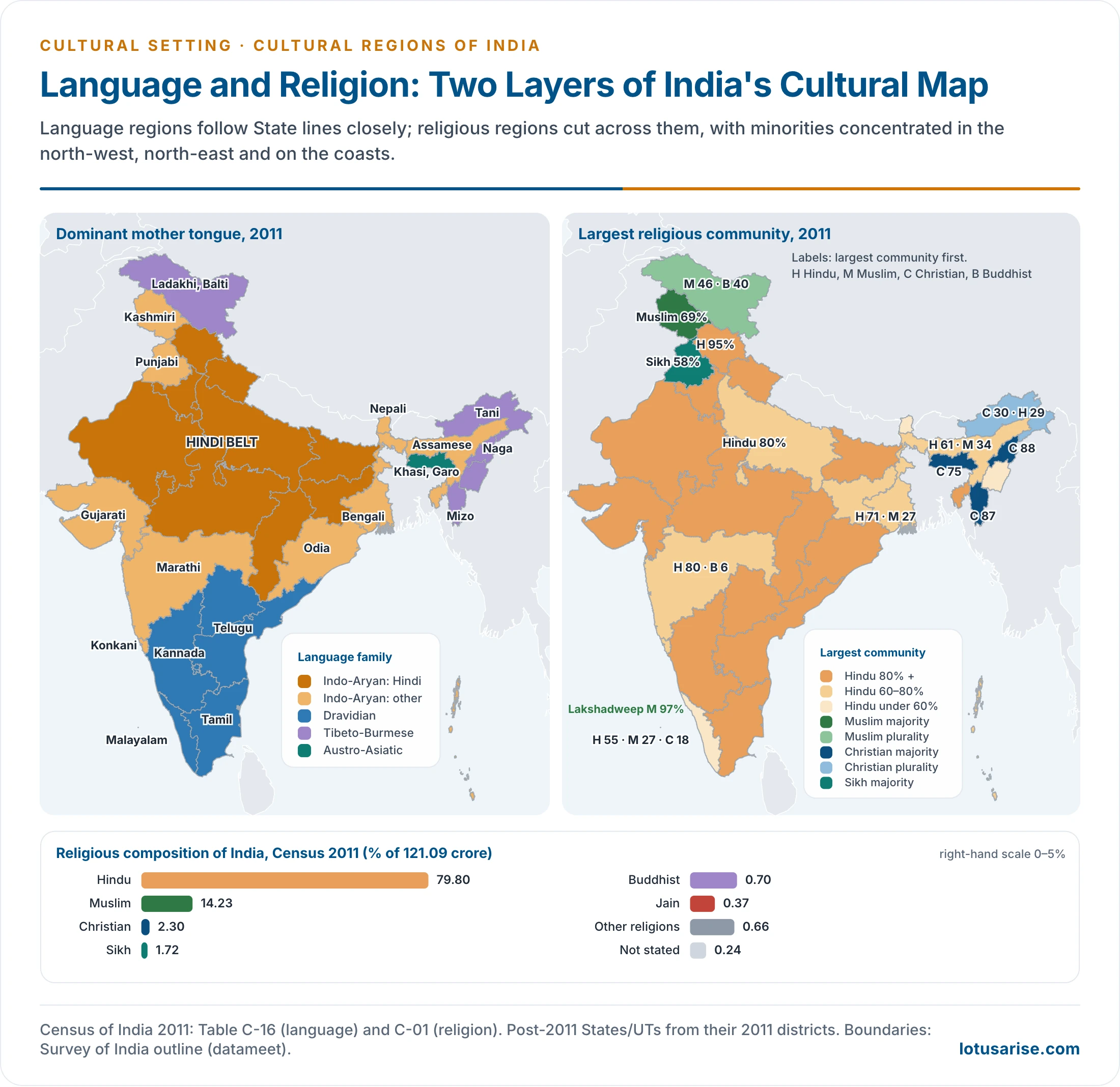
- Each language has a core and a periphery. Broad linguistic identities became the basis of the States Reorganisation Act, 1956, and of later states. The rise of linguistic regions and states is the clearest case of culture shaping India’s political map.
- Andhra State (1953) followed the death of Potti Sriramulu after a fast for a Telugu state.
- The States Reorganisation Commission (Fazl Ali, 1953–55) led to the 1956 Act.
- Bombay State was split into Maharashtra and Gujarat in 1960, and Haryana was carved out of Punjab in 1966.
- Census 2011:
- 19,569 raw mother-tongue returns were rationalised into 1,369 mother tongues.
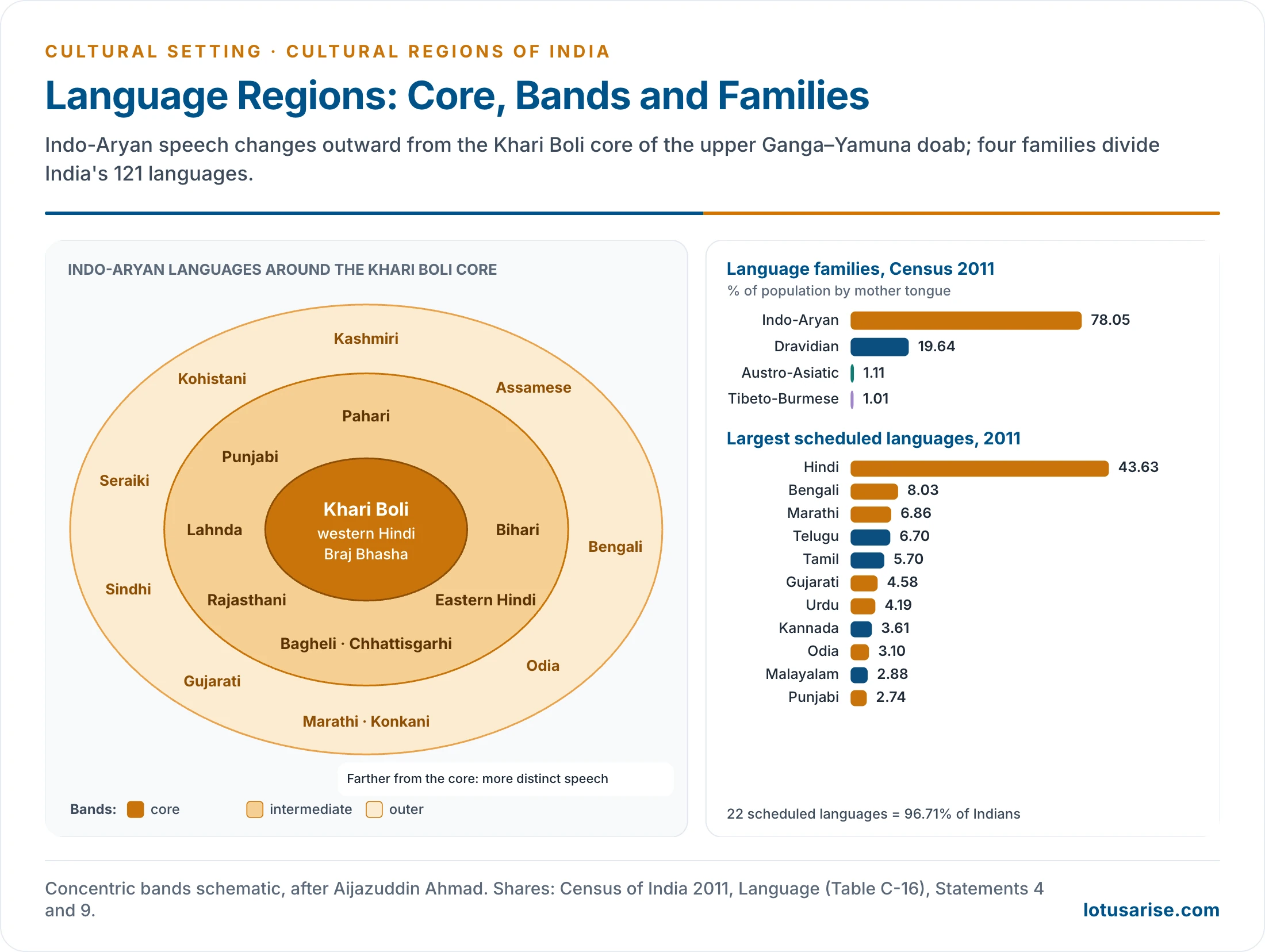
- These were grouped into 121 languages with 10,000 or more speakers each: 22 scheduled and 99 non-scheduled.
- 96.71% of Indians have a scheduled language as their mother tongue. An older reckoning had the fifteen main scheduled languages (out of 22) covering over 92%.
- Census 1961 recorded 187 languages, of which 94 had fewer than 10,000 speakers each.
- The People’s Linguistic Survey of India (Bhasha Research and Publication Centre, 2013) counted about 780 living languages, against about 1,100 in 1961. It estimated that about 220 had disappeared in the previous fifty years, mostly languages of nomadic and coastal communities.
Language Families
- Indian languages belong to four main families, named in older Sanskrit tradition as Arya, Dravida, Nishada and Kirata.
| Family | Share of population, 2011 | Languages, 2011 | Main areas |
|---|---|---|---|
| Indo-European (Indo-Aryan) | 78.05% | 21 | North, west, east and central India |
| Dravidian | 19.64% | 17 | South India; tribal pockets of central India |
| Austro-Asiatic | 1.11% | 14 | Jharkhand, Odisha, West Bengal; Meghalaya; Nicobar |
| Tibeto-Burmese | 1.01% | 66 | Himalaya and the North-East |
- Indo-Aryan:
- The most widespread group, spoken across northern India.
- Its core is the Khari Boli region of Haryana, Delhi and western Uttar Pradesh, the base of modern standard Hindi and Urdu.
- Away from the core, speech changes into a chain of dialects and languages. Aijazuddin Ahmad represented this as concentric bands of diffusion around the Khari Boli core:
- an inner core: Khari Boli, Braj Bhasha and western Hindi;
- an intermediate band: Punjabi, Pahari, Lahnda, Rajasthani, eastern Hindi, Bihari, Bagheli and Chhattisgarhi;
- an outer band: Kashmiri, Kohistani, Sindhi and Seraiki, Gujarati, Marathi and Konkani, Odia, Bengali and Assamese.
- Hindi is the official language of the Union and the mother tongue of 43.63% of Indians (Census 2011; about 40% in older counts). Older accounts put its speakers at over 90% of the Hindi-belt states. It dominates Uttar Pradesh, Bihar, Madhya Pradesh, Rajasthan, Haryana, Delhi, Himachal Pradesh, Uttarakhand, Jharkhand and Chhattisgarh.
- Urdu (4.19%) is close to Hindi in speech and is written in the Perso-Arabic script. Born in India, it has no single regional base: its speakers live in Uttar Pradesh, Bihar, Telangana, Maharashtra, Karnataka and the cities. It is an official language of Jammu and Kashmir.
- Dravidian:
- Spoken mainly in the four southern states: Telugu (6.70%), Tamil (5.70%), Kannada (3.61%) and Malayalam (2.88%). Together they are about 19% of India.
- Tamil has a classical literature from the early centuries CE, and Telugu has been called the “Italian of the East” for its vowel-ending words.
- Tribal Dravidian languages, such as Gondi and Kurukh, are spoken in central India.
- Austro-Asiatic:
- The Munda languages (Santali, Mundari, Ho) of the tribal belt in Jharkhand, Odisha, West Bengal, Chhattisgarh and Madhya Pradesh.
- Khasi in Meghalaya, and Nicobarese.
- Tibeto-Burmese: the Himalaya and the North-East. It has three broad groups:
- Tibeto-Himalayan: Ladakhi, Balti, Bhotia, Chamba, Lahauli, Kinnauri, Lepcha and Tibetan, in Ladakh, Himachal Pradesh and Sikkim. Bhotia and Kinnauri lead in Himachal Pradesh.
- North Assam (Arunachal) group: Adi (Abor), Aka, Miri (Mising), Mishmi and Nyishi.
- Assam–Myanmar group: Bodo, Garo, Naga languages, Mizo, Kachin, Kuki and Meitei.
Linguistic Regions and Major Languages
| Linguistic region | Core State/UT | Speakers, 2011 (% of India) |
|---|---|---|
| Hindi | UP, Bihar, MP, Rajasthan, Haryana, Delhi, HP, Uttarakhand, Jharkhand, Chhattisgarh | 43.63 |
| Bengali | West Bengal, Tripura, Barak valley of Assam | 8.03 |
| Marathi | Maharashtra | 6.86 |
| Telugu | Andhra Pradesh, Telangana | 6.70 |
| Tamil | Tamil Nadu, Puducherry | 5.70 |
| Gujarati | Gujarat, Dadra and Nagar Haveli and Daman and Diu | 4.58 |
| Kannada | Karnataka | 3.61 |
| Odia | Odisha | 3.10 |
| Malayalam | Keralam, Lakshadweep | 2.88 |
| Punjabi | Punjab, adjoining Haryana | 2.74 |
| Assamese | Assam | 1.26 |
| Kashmiri | Kashmir valley | 0.56 |
- Rank order (Census 2011): Hindi, Bengali (second), Marathi (third), Telugu (fourth), Tamil, Gujarati, Urdu, Kannada, Odia and Malayalam.
- Bengali: core in West Bengal, periphery in Assam, Jharkhand, Bihar, Odisha and Tripura.
- Telugu: core in Andhra Pradesh and Telangana, extending into Karnataka and Tamil Nadu.
- Tamil: core in Tamil Nadu (92% of speakers in an older count), extending into Karnataka, Andhra Pradesh and Puducherry. It best preserves the old Dravidian tradition.
- Kannada: core in Karnataka (91%), extending into Tamil Nadu, Maharashtra and Andhra Pradesh.
- Malayalam: the smallest of the four main Dravidian languages, core in Keralam (92%), extending into Tamil Nadu, Karnataka and Maharashtra.
- Marathi: core in Maharashtra (93%), with speakers in Karnataka, Madhya Pradesh, Gujarat and Goa. Konkani, of the Konkan coast and Goa, is a separate scheduled language.
- Gujarati: from Gujarat into Maharashtra and Rajasthan, and widely in the diaspora.
- Odia: descends from an eastern Apabhramsa and has absorbed much Sanskrit vocabulary.
- Assamese: distinct in pronunciation and grammar, though often grouped with Bengali in the eastern Indo-Aryan branch.
Religion
Religion and the Cultural Landscape
- Religion has been defined in many ways:
- Friedrich Schleiermacher saw it as the feeling of absolute dependence.
- William James described it as an enthusiastic temper of espousal.
- Rudolf Otto saw the essence of religious awareness in awe, a unique blend of fear and fascination before the divine.
- Main characteristics of religious life: traditionalism; myth and symbol; a concept of salvation; sacred places and objects; sacred actions (rituals); sacred writings; and the sacred community (monastic orders).
- Religion, like language, is a symbol of group identity and a cultural rallying point: shared values, beliefs and expectations unite its followers. It shapes diet, dress, settlement form and even resource use, such as sacred groves and tank irrigation. Geographers study the interaction between religion and landscape.
- India is a multi-religious country. It is the birthplace of Hinduism, Buddhism, Jainism and Sikhism. Later arrivals kept their identity:
- Syrian Christians on the Keralam coast trace their church to the 1st century CE.
- Muslims came from West and Central Asia, and Parsis from Persia (about the 8th–10th centuries CE).
- Each community has its own spatial pattern of religion: Hindus spread nationwide, while most religious minorities are concentrated in border, coastal and hill states, where they shape distinct cultural regions.
Religious Composition and Concentration (Census 2011)
| Community | Population (crore) | Share (%) | Main concentrations |
|---|---|---|---|
| Hindu | 96.63 | 79.80 | Nationwide; highest share in Himachal Pradesh (95.2%), Odisha, Chhattisgarh |
| Muslim | 17.22 | 14.23 | Lakshadweep (96.6%), Jammu and Kashmir, Assam, West Bengal, Keralam, UP, Bihar |
| Christian | 2.78 | 2.30 | Nagaland (87.9%), Mizoram (87.2%), Meghalaya (74.6%), Manipur, Keralam, Goa |
| Sikh | 2.08 | 1.72 | Punjab (57.7%), Chandigarh, Haryana, Delhi |
| Buddhist | 0.84 | 0.70 | Maharashtra (77% of all Buddhists), Ladakh, Sikkim, Arunachal Pradesh |
| Jain | 0.45 | 0.37 | Maharashtra, Rajasthan, Gujarat, Madhya Pradesh; mostly urban |
| Others and not stated | 1.08 | 0.90 | Tribal faiths of Jharkhand, Arunachal Pradesh; Parsis |
- Change in share, 2001 to 2011 (percentage points): Hindu −0.7, Muslim +0.8, Christian none, Sikh −0.2, Buddhist −0.1, Jain none.
- Religious regions, by leading faith:
- Mainly Hindu: most of the country, with scattered Muslim, Christian, Sikh, Buddhist and tribal groups.
- Mainly Muslim: the Kashmir division and Kargil. Muslims are also strong in northern Keralam, in the Rohilkhand and upper Doab divisions of Uttar Pradesh, and in cities such as Ahmedabad, Bhopal, Hyderabad, Kolkata, Mumbai and Surat.
- Mainly Sikh: Punjab and Chandigarh.
- Mainly Buddhist: Ladakh.
- Mixed: Arunachal Pradesh (tribal faiths, Hindu, Buddhist); the other north-eastern hill states (Christian, tribal, Hindu, Muslim, Buddhist); and Keralam (Hindu, Muslim, Christian).
- Secondary groups inside the Hindu core: Christians in Chotanagpur and on the south-western and southern coasts, and Muslims in the Tarai, western Uttar Pradesh and the Hyderabad area.
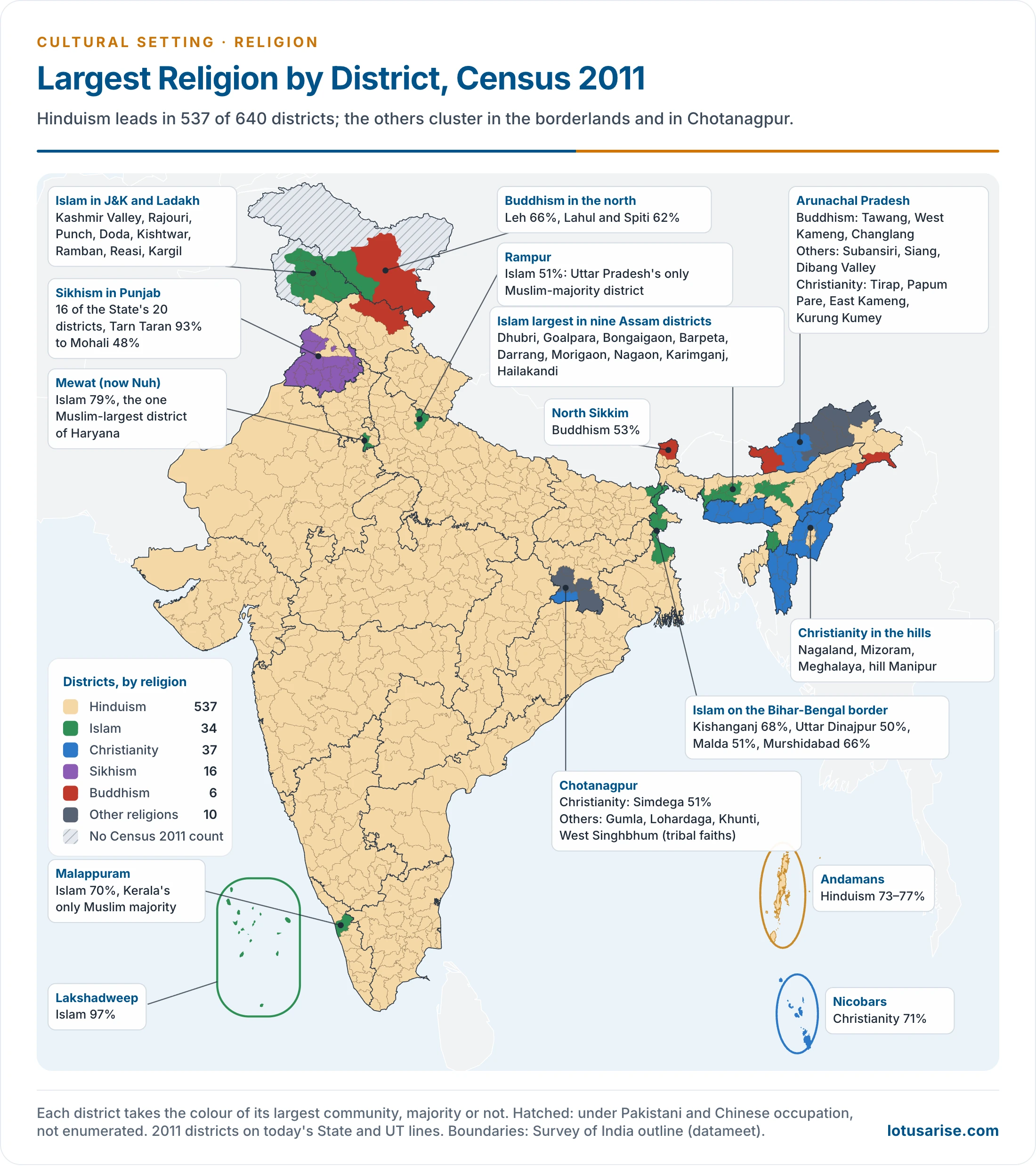
- Hindus: followers of one of the world’s oldest religions, polytheistic in practice (80.5% in Census 2001), found throughout India. They are in a minority in Jammu and Kashmir, Ladakh, Punjab, Lakshadweep and the Christian-majority North-East (Nagaland, Mizoram, Meghalaya).
- Their share is highest in Himachal Pradesh (95.2%) and lowest in Mizoram (2.75%). It is above the national average in Andhra Pradesh, Bihar, Gujarat, Himachal Pradesh, Haryana, Karnataka, Madhya Pradesh, Odisha, Rajasthan, Tamil Nadu and Tripura, and well below it in Jammu and Kashmir, Punjab and the Christian-majority North-East. Hindus are also a minority in parts of Keralam.
- Muslims: followers of a strictly monotheistic faith, spread across the country, with large numbers in Uttar Pradesh, West Bengal, Bihar, Maharashtra, Assam, Keralam, Andhra Pradesh, Karnataka, the Kashmir valley and the southern districts of Uttarakhand.
- Lakshadweep (96.6%) and Jammu and Kashmir (68.3%) are Muslim-majority. Assam (34.2%), West Bengal (27.0%) and Keralam (26.6%) have large shares.
- Their share is above the national average in Assam, Bihar, Jharkhand, Jammu and Kashmir, Keralam, Uttar Pradesh and West Bengal, and lowest in Mizoram (1.35%).
- Christians:
- The church in Keralam dates to the 1st century CE.
- Majorities in Nagaland, Mizoram and Meghalaya, and large shares in Manipur (41.3%), Goa (25.1%) and Keralam (18.4%).
- Keralam has the largest number of Christians, about a fifth of India’s total. Andhra Pradesh, Meghalaya, Nagaland and Tamil Nadu also have over one million each.
- Christianity is a universal religion, with the largest following in the world.
- Sikhs:
- Guru Nanak (1469–1539) founded the faith in the 15th century. It rejected caste distinctions, stressed equality and allowed widow remarriage. For long it stayed confined to Punjab, with Gurmukhi as its script.
- About 77% of India’s Sikhs live in Punjab. The rest live in Haryana, Delhi, Chandigarh, Rajasthan and the Terai of Uttar Pradesh and Uttarakhand.
- A large diaspora lives in Canada, the UK, the USA, Australia, New Zealand, Kenya, Pakistan, Afghanistan, Singapore and Hong Kong.
- Buddhists:
- Gautama Buddha taught in the middle Ganga plain around the 5th century BCE (traditional dates 563–483 BCE).
- About 77% of India’s Buddhists now live in Maharashtra. Traditional Himalayan pockets are Ladakh, Lahaul–Spiti, Sikkim, Arunachal Pradesh and Tripura.
- Jains: India is the homeland of Jainism, which has no sizeable following abroad. Jains are 0.37% of the population, concentrated in Maharashtra, Rajasthan, Gujarat and Madhya Pradesh, with others in Uttar Pradesh, Uttarakhand and Karnataka, mainly in towns. The community is prominent in trade, business and politics.
- Parsis (Zoroastrians):
- Census 2011 counted only about 57,000 Parsis, about 80% of them in Greater Mumbai and the rest mainly in Gujarat (Navsari, Udvada, Surat, Ahmedabad).
- The ethic of the faith is summed up as good thoughts, good words, good deeds, and its scripture is the Avesta. It was the dominant faith of the old Persian Empire. Parsis absorbed some Hindu customs, do not favour celibacy and allow remarriage.
- Their small and declining numbers prompted the Jiyo Parsi scheme (2013).
Sacred Geography
- Pilgrimage binds regions together. Surinder M. Bhardwaj (Hindu Places of Pilgrimage in India, 1973) showed a hierarchy of pilgrim centres by the area from which they draw pilgrims:
- pan-Hindu centres such as Varanasi, Puri, Rameswaram, Dwarka and Badrinath;
- supra-regional, regional and sub-regional centres;
- local shrines serving a few villages.
- Circuits such as the Char Dham, the twelve Jyotirlingas and the Shakti Peethas link the four corners of India. Ajmer Sharif, Nizamuddin, Velankanni, the Golden Temple and Bodh Gaya draw pilgrims across faiths and regions.
- Higher-order centres have wide, overlapping pilgrim fields, which cut across language regions and work as functional cultural regions.
Customs
- Customs are a key element of cultural geography. A custom is an act repeated so often that it becomes characteristic of the group performing it. A habit belongs to one person; a custom belongs to most of a group.
- Customs are closely tied to resource use. Tradition-bound societies keep rich oral folk traditions: folk dance, folklore, folk medicine and craft.
- These help mark cultural regions:
- folk dances: Bihu (Assam), Bhangra and Giddha (Punjab), Garba (Gujarat), Lavani (Maharashtra), Ghoomar (Rajasthan), Theyyam (Keralam);
- house forms: bhunga (Kutch), haveli (Shekhawati), Keralam’s sloping-roofed nalukettu;
- food, dress and marriage rules: matriliny in Meghalaya, cross-cousin marriage in the south, village exogamy in the north.
- Irawati Karve (Kinship Organisation in India, 1953) mapped four kinship zones:
- Northern zone: marriage outside the village and the clan; no cousin marriage; the bride moves far from home.
- Southern zone: cross-cousin and uncle–niece marriage; marriage within a close circle of kin.
- Central zone: a mixed belt, from Rajasthan and Gujarat to Odisha, with traits of both.
- Eastern zone: the tribal societies of the North-East and the Munda belt, with their own kinship systems, including matriliny.
- These zones cut across language boundaries and help explain regional differences in women’s status, sex ratio and age at marriage.
Cultural Regions Based on Language, Religion and Customs
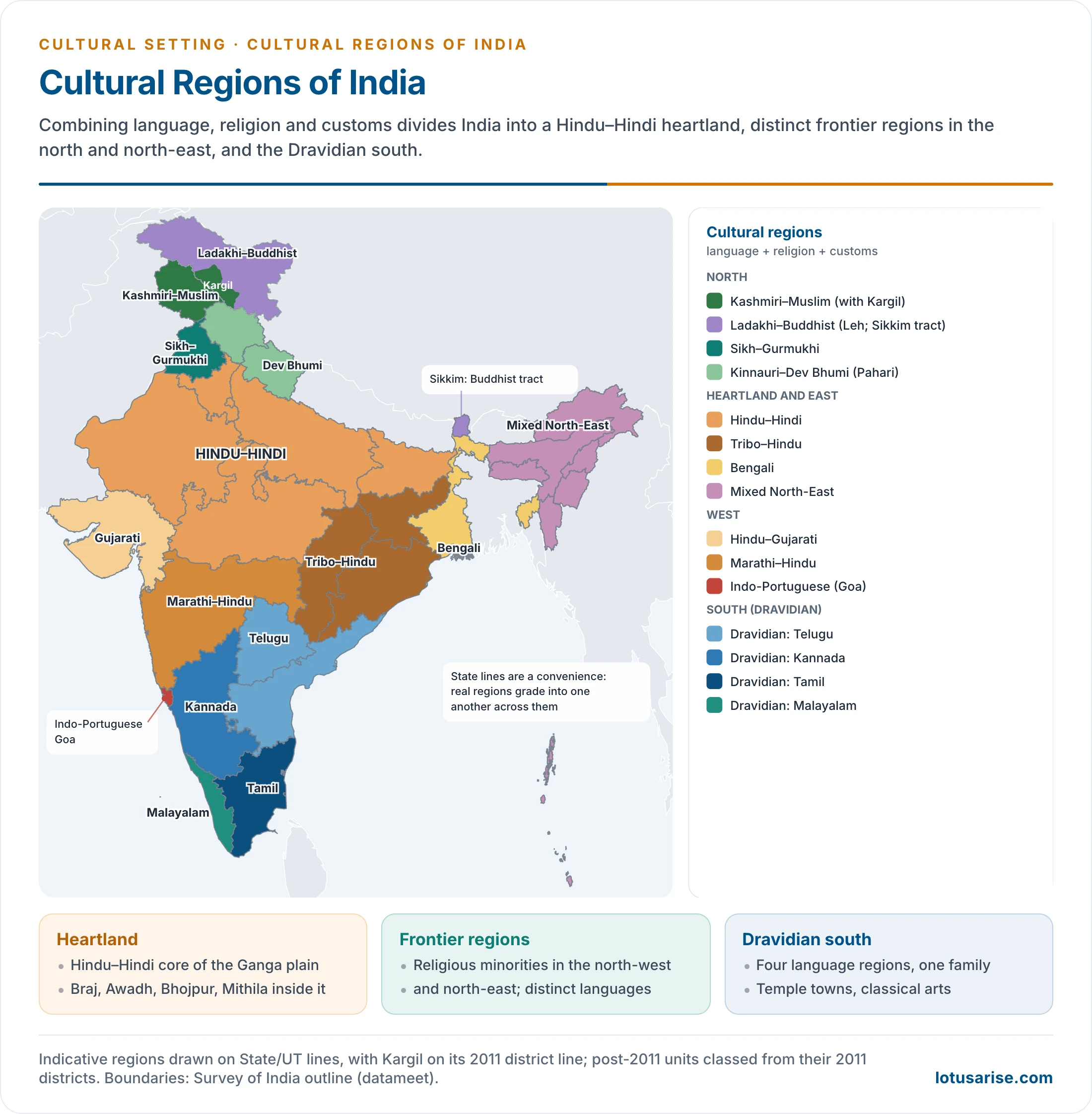
- Combining language, religion, customs and traditions, India may be divided into ten broad cultural regions. They correspond closely to the regions above. Many maps add a Hindu–Gujarati and an Indo-Portuguese region and split the Dravidian south into four.
- Ladakhi–Buddhist region:
- Ladakhi-speaking Buddhists and their gompas and monasteries.
- Leh, and Dharamshala in Himachal Pradesh, are its sacred and cultural centres.
- Kashmiri–Muslim region:
- The Kashmir valley, northern Jammu (Doda) and Kargil.
- Predominantly Muslim, with Kashmiri the main language. Hindu and Sikh minorities speak Kashmiri and follow Kashmiri traditions.
- Sikh–Gurmukhi region:
- Punjab and Chandigarh.
- A Sikh majority speaking Punjabi, with a Hindu minority. Gurdwaras stand in almost every village and town, and the Golden Temple in Amritsar is the chief pilgrimage centre.
- Kinnauri–Dev Bhumi region:
- The mountainous parts of Himachal Pradesh and Uttarakhand, with shrines such as Kedarnath, Badrinath and Haridwar.
- Kinnauri and Pahari dialects in Himachal Pradesh; Garhwali, Kumaoni and Hindi in Uttarakhand.
- Hindu–Hindi region:
- Bihar, Haryana, Madhya Pradesh, Rajasthan, the plains of Uttarakhand and Uttar Pradesh: the Hindi heartland.
- Muslims form a sizeable minority in western Uttar Pradesh and the towns. Sikhs and Christians live mainly in cities such as Delhi, Kanpur, Lucknow, Varanasi, Meerut, Agra and Prayagraj.
- Mixed cultural region of the North-East:
- Arunachal Pradesh, Assam, Manipur, Meghalaya, Mizoram, Nagaland and Tripura.
- Areas of Hindu, Christian, Muslim and tribal dominance, with great diversity of language, custom, dance, music and folk medicine. The Ahom cultural tract of upper Assam is a distinct sub-region.
- Bengali region:
- West Bengal and adjoining parts of Odisha, Jharkhand, Bihar and Tripura.
- Mainly Hindu, with Muslims as a large minority.
- Tribo–Hindu region:
- The Chotanagpur plateau and the forested uplands of Chhattisgarh and Odisha.
- Hindu and tribal (Sarna) faiths, with significant Christian communities. Hindi, Odia and tribal languages are spoken.
- Marathi–Hindu region:
- Maharashtra, Goa and the adjoining parts of Karnataka, Telangana and Gujarat.
- Marathi language and a Hindu majority, with Muslim and Buddhist pockets.
- Hindu–Gujarati region:
- Gujarat, with Kutch and Saurashtra as distinct sub-regions.
- Gujarati language; a Hindu majority with strong Vaishnava and Jain traditions and a Muslim minority. Navratri Garba (UNESCO intangible heritage, 2023), vegetarian cuisine and a long trading and overseas tradition mark it.
- Indo-Portuguese region:
- Goa, under Portuguese rule from 1510 to 1961.
- Konkani language, Catholic churches and festivals beside Hindu temples, Indo-Portuguese houses and cuisine, and a distinct legal heritage (the Goa civil code).
- Dravidian region:
- Andhra Pradesh, Telangana, Karnataka, Keralam and Tamil Nadu.
- Subdivided into Telugu, Kannada, Tamil and Malayalam sub-regions, each with its own script, literature, cuisine and performing arts.
Significance of Cultural Regions
- Planning units: cultural regions suit regional planning, tourism circuits and the delivery of services in the people’s own language, such as mother-tongue schooling under the National Education Policy 2020.
- Administration and politics: language and culture shaped the map of states. They also lie behind inter-state boundary disputes, such as Belagavi between Maharashtra and Karnataka, and behind demands for autonomy in tribal areas through the Sixth Schedule.
- Tensions: cultural regions can harden into “sons of the soil” politics against migrants, or into ethnic conflict, as in parts of the North-East. Recognising diversity while protecting mobility is a lasting policy task.
- Heritage: cultural regions carry intangible heritage, from Kalbelia and Chhau to Durga Puja and Garba, and Geographical Indication products such as Madhubani painting, Kanchipuram silk and Darjeeling tea.
Unity in Diversity
- Cultural regions show that India is not a homogeneous cultural entity but a mosaic of cultural landscapes. These landscapes are shaped by:
- geography: mountains, plains, plateaus and coasts;
- history: migration, conquest, religious movements and empires;
- society: language, caste, ethnicity and custom.
- Limits of the schemes:
- Boundaries are transition zones, not lines.
- Language and religion regions overlap only partly.
- State-based maps hide sub-regions such as Braj, Mithila or Tulu Nadu.
- Migration and urbanisation are making cities culturally plural everywhere.
- Cultural regions keep changing:
- New states such as Uttarakhand, Jharkhand and Chhattisgarh (2000) and Telangana (2014) were created on grounds of regional identity and development, not only language.
- Demands to add languages such as Bhojpuri and Rajasthani to the Eighth Schedule show sub-regions asserting themselves.
- Migration to cities spreads regional cuisines, festivals and languages far beyond their home regions.
- Despite this diversity, shared traditions run across regions: pilgrimage circuits that link the four corners of the country, epics retold in every language, common festivals and a shared constitutional order. India remains a classic case of unity in diversity expressed through cultural regions.
Previous Year Questions
2002In what way the language, religion and tradition can form the basis of cultural regionalisation of India? Elaborate.2023Explain the cultural regions of India based on their cultural attributes.




There is no national language in India. Hindi and English are considered as official languages of India.# check Indo – Aryan Language content…
Thanks, guys for pointing out the mistake. I have corrected the same. Keep reading.
You notes are good. Upload the rest especially Economic Geography before prelims. Thanks!
Sure, Thanks
Please upload all notes in pdf form…
Visit: https://store.lotusarise.com/
Good work Lotusarise… very useful for geography optional
Very helpfull. thanks a lot for providing such priceless materials.
Outstanding work. Proud of you team lotusarise
sir please upload : Religious minorities topic as soon as possible and thanku so much
Read here: https://lotusarise.com/religious-minorities-in-india/