Religious Minorities

- India represents one of the most complex examples of religious pluralism in the world, where multiple faiths coexist within a shared civilizational space.
- The Government of India has officially notified six religious communities as minorities under the National Commission for Minorities Act, 1992: Muslims, Christians, Sikhs, Buddhists, Zoroastrians (Parsis), and Jains.
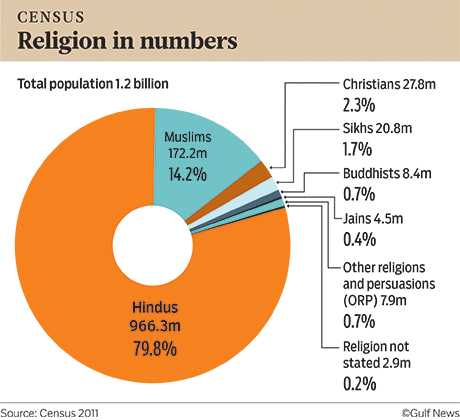
- Together, these groups comprise approximately 19% of the population (one-fifth of India’s population) of the country, with Muslims being the largest minority, followed by Christians and Sikhs.
- The population of Muslims are 14.2%; Christians 2.3%; Sikhs 1.7%, Buddhists 0.7%, Jain 0.4% and Parsis 0.006%.
- From a Geography Optional perspective, religious minorities are not merely a sociological category but a spatial, demographic, and developmental phenomenon, shaping regional identities, settlement patterns, and socio-economic landscapes.
- Religious minorities are numerically smaller groups practicing distinct religions within a larger society, often requiring safeguards to preserve their identity and ensure equitable access to resources.
- In India, minority status is legally recognized under the National Commission for Minorities Act, 1992.
- The Constitution of India does not define the term minority.
- Importantly, the concept is not purely numerical; it also includes historical disadvantage, cultural distinctiveness, and socio-economic vulnerability.
Spatial Distribution
- Religious minorities in India exhibit distinct spatial clustering, leading to the formation of identifiable cultural regions:
- Muslims → Concentrated in Uttar Pradesh, West Bengal, Assam, Kerala
- Christians → North-East India (Nagaland, Mizoram, Meghalaya), Kerala, Goa
- Sikhs → Punjab (dominant majority region)
- Buddhists → Maharashtra (Neo-Buddhist movement), Ladakh
- Jains and Parsis → Urban-industrial regions (Mumbai, Gujarat)
- Geographical Significance
- Creation of religio-cultural landscapes
- Influence on urban morphology (ghettos, enclaves)
- Impact on migration and regional identity formation
- India’s diversity is thus best understood as a “cultural mosaic” rather than a melting pot, where multiple identities coexist spatially.
Constitutional Framework and Secularism
Concept of Secularism in Indian Context
- India follows a model of “positive secularism”, which differs from the Western notion of strict separation between religion and state, as it implies:
- Equal respect for all religions (Sarva Dharma Sambhava)
- State intervention where necessary to ensure social reform and equality
- Recognition of India’s multi-religious and culturally diverse society
- Secularism in India is thus not anti-religion but pro-pluralism, aiming to maintain unity in diversity while protecting minority rights.
Constitutional Basis of Secularism
- Though the term “Secular” was explicitly added to the Preamble by the 42nd Constitutional Amendment Act, the spirit of secularism was inherent in the Constitution from the beginning.
- The Constitution ensures a balance between:
- Individual religious freedom
- Collective cultural rights
- State neutrality with constructive engagement
Fundamental Rights Ensuring Religious Freedom
1. Equality and Non-Discrimination
- Article 14 → Guarantees equality before law, ensuring that no religion is privileged or discriminated against
- Article 15 → Prohibits discrimination on grounds of religion, race, caste, sex, or place of birth
- Article 16 → Ensures equal opportunity in public employment, irrespective of religious identity
2. Freedom of Religion
- Articles 25–28 provide the core framework of religious freedom:
- Article 25 → Freedom of conscience and the right to profess, practice, and propagate religion
- Article 26 → Freedom to manage religious affairs and institutions
- Article 27 → Prohibits taxation for promotion of any particular religion
- Article 28 → Restricts religious instruction in state-funded educational institutions
- These provisions ensure that religion remains a personal and community matter, without undue state interference.
Cultural and Educational Rights of Minorities
- Article 29 → Protects the right of minorities to conserve their language, script, and culture, which has strong geographical relevance in preserving cultural regions
- Article 30 → Grants minorities the right to establish and administer educational institutions of their choice, enabling:
- Cultural continuity
- Educational empowerment
- These rights are critical for maintaining cultural diversity across regions, especially in minority-concentrated areas.
Directive Principles and State Policy
- Though not enforceable, Directive Principles support secularism indirectly by promoting:
- Social justice and welfare
- Reduction of inequality across regions and communities
- Policies like:
- Minority welfare programmes and Area-based development schemes, aim to ensure balanced regional development, especially in backward minority regions.
Institutional Mechanisms for Minority Protection
- The state has created several bodies to operationalize constitutional safeguards:
- National Commission for Minorities (NCM)
- Ministry of Minority Affairs
- National Commission for Minority Educational Institutions (NCMEI)
- These institutions work towards:
- Monitoring minority rights
- Addressing grievances
- Implementing development schemes
- However, their effectiveness is sometimes limited by:
- Lack of enforcement powers
- Variations in implementation across states
Secularism and Federal Structure
- India’s federal structure allows states to adapt policies according to regional realities, leading to:
- Variation in implementation of minority welfare schemes
- Different approaches to language, education, and religious practices
- This reflects a geographical dimension of secularism, where:
- National principles remain constant
- Regional expressions vary
Challenges to the Secular Framework
- Despite strong constitutional provisions, several challenges persist:
- Communal tensions and identity-based politics
- Uneven socio-economic development of minority groups
- Debates over Uniform Civil Code vs cultural autonomy
- Administrative and institutional limitations in implementation
- These challenges highlight the gap between constitutional ideals and ground realities.
Minority Concentration Areas: A Spatial Development Approach
Rationale: Why a Spatial Approach to Minority Development?
- Religious minority issues in India are not uniformly distributed but show clear spatial clustering, where certain districts and regions exhibit:
- High concentration of minority populations
- Simultaneous low socio-economic indicators and infrastructure deficits
- Therefore, instead of a purely community-based approach, the government adopted an area-based (spatial) development strategy, recognizing that:
- Backwardness is often region-specific rather than identity-specific
- Development gaps can be addressed more effectively through targeted regional planning
Identification of Minority Concentration Areas (MCAs)
- Minority Concentration Areas (MCAs) include:
- Minority Concentration Districts (MCDs)
- Minority Concentration Blocks (MCBs)
- Minority Concentration Towns (MCTs)
- These areas were identified based on two key criteria: 1. Population Criteria
- Districts/areas where ≥ 25% population belongs to minority communities
- In states/UTs where a minority is already in majority, a threshold of 15% for other minority groups is applied
- Religion-specific socio-economic indicators:
- Literacy rate
- Female literacy rate
- Work participation rate
- Female work participation rate
- Basic amenities indicators:
- Housing quality (pucca houses)
- Access to safe drinking water
- Electricity availability
- This dual approach ensures that both demographic concentration and development deficits are considered together.
Extent and Distribution of MCAs
- Based on Census data and surveys:
- 90 Minority Concentration Districts
- 710 Blocks and 66 Towns identified for targeted intervention
- These areas are spread across:
- Northern plains (UP, Bihar, West Bengal)
- Eastern and North-Eastern India
- Some pockets in Western and Southern India
- These regions often overlap with:
- Economically backward districts
- Areas with high population density and low infrastructure development
Multi-sectoral Development Programme (MsDP)
- The government launched the Multi-sectoral Development Programme (MsDP) to address the development deficits in MCAs, which was later restructured as:
- Pradhan Mantri Jan Vikas Karyakram (PMJVK)
- The core objective is to:
- Improve socio-economic indicators and basic amenities
- Bring these regions at par with national averages
Key Focus Areas of Development
- The programme adopts a multi-dimensional development strategy, targeting: 1. Education Infrastructure
- Construction of schools, classrooms, hostels
- Support for secondary education and girls’ education
- Provision of teaching aids and digital infrastructure
- Establishment of Primary Health Centres (PHCs) and sub-centres
- Construction of Anganwadi centres
- Focus on maternal and child health
- Provision of pucca housing
- Access to safe drinking water and sanitation
- Electrification and energy access
- Setting up Industrial Training Institutes (ITIs)
- Vocational training programmes
- Promotion of income-generating activities
- Roads, connectivity, and market linkages
- Urban amenities in minority-dominated towns
- The focus is on infrastructure-led development, rather than selective individual benefits, ensuring inclusive regional growth
Planning Approach and Implementation Strategy
- The programme is based on:
- Baseline surveys to identify development deficits
- Preparation of district/block-specific development plans
- Key features include:
- Convergence with existing Centrally Sponsored Schemes (CSS)
- Priority to minority-dominated localities within districts
- Emphasis on saturation approach (ensuring all basic facilities are covered)
- Importantly, benefits are not restricted only to minorities but extend to:
- All eligible populations in the region, promoting inclusive development
Geographical Significance of MCA Approach
- The MCA strategy reflects a shift towards spatial planning in social policy, highlighting:
- Recognition of regional inequality as a core development issue
- Integration of population geography with development planning
- Focus on localized intervention rather than uniform national schemes
- It aligns with broader geographical principles:
👉 “Development is uneven across space and requires area-specific interventions.”
Achievements and Positive Outcomes
- Improved access to:
- Education and health infrastructure
- Basic amenities like water, housing, and electricity
- Enhanced:
- Human development indicators
- Livelihood opportunities in targeted areas
- Reduction in:
- Regional disparities (to some extent)
Limitations and Challenges
- Despite progress, several challenges persist:
- Implementation gaps and delays
- Lack of adequate monitoring and evaluation
- Uneven performance across states
- Limited awareness among beneficiaries
- Over-reliance on existing schemes rather than innovative solutions
- In some cases, benefits are diluted due to:
- Administrative inefficiencies
- Weak institutional capacity
Socio-Economic Profile and Regional Inequality
- Diversity within Minority Socio-Economic Conditions
- Religious minorities in India do not form a homogeneous group; rather, they display significant intra-group and inter-regional variations in socio-economic status, influenced by:
- Historical trajectories
- Regional development levels
- Access to education and economic opportunities
- While some communities such as Jains and Sikhs show relatively higher socio-economic indicators, others—particularly Muslims and certain Christian tribal groups—face structural disadvantages in specific regions.
- Religious minorities in India do not form a homogeneous group; rather, they display significant intra-group and inter-regional variations in socio-economic status, influenced by:
- Education and Human Capital Development
- Educational attainment among minorities varies widely across regions:
- In several minority-concentrated districts, there is:
- Lower literacy and female literacy rates
- Limited access to quality schooling infrastructure
- Higher dropout rates, especially among girls
- Lack of educational infrastructure in Minority Concentration Areas (MCAs) results in:
- Reduced human capital formation
- Intergenerational transmission of poverty
- In several minority-concentrated districts, there is:
- However, some minority groups (e.g., Jains, urban Christians) exhibit:
- High literacy and professional education levels
- Strong presence in service sectors
- Educational attainment among minorities varies widely across regions:
- Employment and Occupational Structure
- Occupational patterns among minorities reflect both traditional roles and structural constraints:
- Many minority populations, especially Muslims, are concentrated in:
- Informal sector employment
- Self-employment (artisan work, small trade)
- Low-paying and insecure occupations
- Limited representation in:
- Organized sector jobs
- Government services
- Many minority populations, especially Muslims, are concentrated in:
- Regional disparities are evident:
- Urban minorities may have better access to markets
- Rural minority populations often remain economically marginalized
- Occupational patterns among minorities reflect both traditional roles and structural constraints:
- Income Levels and Poverty Patterns
- Minority-dominated regions often exhibit:
- Higher poverty levels
- Lower per capita income
- Limited access to financial institutions
- Poverty is particularly acute in:
- Minority Concentration Districts
- Backward regions of eastern and northern India
- However, disparities are not uniform:
- Some communities (e.g., Jains) have high income and business dominance
- This highlights the importance of regional and community-specific analysis
- Minority-dominated regions often exhibit:
- Access to Basic Amenities and Infrastructure
- In many minority-concentrated areas, access to basic services remains limited:
- Poor housing conditions (kuccha houses)
- Inadequate access to:
- Safe drinking water
- Electricity
- Sanitation facilities
- These deficits are key indicators used in identifying Minority Concentration Areas, showing that:
- Minority issues are often linked with regional underdevelopment rather than identity alone
- In many minority-concentrated areas, access to basic services remains limited:
- Urbanization and Spatial Segregation
- A significant proportion of minorities reside in urban areas, especially:
- Muslims in cities
- However, urbanization has led to:
- Spatial segregation (ghettoization)
- Formation of community-specific neighborhoods
- Consequences include:
- Limited access to quality infrastructure and services
- Reduced social mobility
- Reinforcement of economic marginalization
- At the same time, some urban minority clusters have developed:
- Strong internal economic networks
- Specialized occupational niches
- A significant proportion of minorities reside in urban areas, especially:
- Regional Inequality and Spatial Disparities
- Minority socio-economic conditions are strongly influenced by regional development levels:
- Better outcomes in:
- Southern and Western India (Kerala, Tamil Nadu, Maharashtra)
- Greater deprivation in:
- Northern and Eastern regions (UP, Bihar, West Bengal, Assam)
- Better outcomes in:
- This indicates that:
- Regional planning and governance play a critical role
- Minority deprivation is often part of broader regional backwardness
- Minority socio-economic conditions are strongly influenced by regional development levels:
- Gender Dimensions within Minority Communities
- Women in minority communities often face double disadvantage:
- As members of minority groups
- Due to gender inequality
- Key issues include:
- Lower female literacy rates
- Limited workforce participation
- Restricted access to healthcare and education
- However, variation exists:
- In some regions (e.g., Kerala), minority women show better educational and health indicators
- Women in minority communities often face double disadvantage:
Socio-Economic Status of Religious Minorities
(A) Demographic Characteristics and Household Structure
- The sex ratio trends show variation across religious groups, reflecting both demographic behaviour and socio-cultural factors:
- Among Muslims, the sex ratio declined in both rural and urban areas between 2004–05 and 2009–10, indicating persistent demographic pressures
- In contrast, Christians recorded an improvement in sex ratio, suggesting relatively better gender conditions and social indicators
- The average household size is highest among Muslims, both in rural and urban areas, which can be linked to:
- Higher fertility levels
- Joint family structures in certain regions
- Socio-economic conditions affecting family size
- Christians exhibit the lowest household size, indicating:
- Higher urbanization levels
- Better socio-economic conditions
- Greater adoption of nuclear family systems
- Across all religious groups, rural household size remains higher than urban, reflecting:
- Agrarian lifestyles
- Lower urban migration in some communities
(B) Occupational Structure and Livelihood Patterns
1. Rural Economy
- In rural India, self-employment forms the backbone of livelihoods for all religious groups, particularly in agriculture:
- Sikh households show the highest dependence on agricultural self-employment (≈36%), reflecting their strong agrarian base, especially in Punjab
- Muslims have the highest proportion of rural labour households (≈41%), indicating:
- Greater dependence on wage labour
- Lower land ownership and asset base
2. Urban Economy
- In urban areas, occupational patterns differ significantly:
- Muslims show the highest share of self-employment (≈46%), largely in:
- Informal sector activities
- Small-scale trade, services, and artisan work
- Christians have the highest proportion of salaried employment (≈43%), indicating:
- Better integration into formal sector jobs
- Higher educational attainment
- Muslims show the highest share of self-employment (≈46%), largely in:
(C) Landholding and Asset Distribution
- Land ownership patterns highlight agrarian inequality across religious groups:
- Majority of households across all groups fall within marginal landholding category (0.005–0.40 hectare), indicating:
- Fragmentation of land
- Subsistence-level agriculture
- About 43% of Christian households and 38% of Muslim households cultivate small plots (less than 1 hectare), reflecting limited agrarian assets
- Larger landholdings (above 4 hectares) are most common among Sikhs (≈6%), followed by Hindus, highlighting:
- Regional agricultural prosperity
- Historical land ownership patterns
- Majority of households across all groups fall within marginal landholding category (0.005–0.40 hectare), indicating:
(D) Income Levels and Consumption Patterns
- Monthly Per Capita Expenditure (MPCE) serves as an indicator of economic well-being:
- Sikh households have the highest MPCE, followed by Christians, indicating:
- Higher income levels
- Better access to resources and markets
- Muslim households show lower MPCE (≈Rs. 980 compared to Rs. 1659 for Sikhs), reflecting:
- Economic vulnerability
- Concentration in low-income occupations
- Sikh households have the highest MPCE, followed by Christians, indicating:
- This highlights economic disparities across religious groups, but also emphasizes regional economic contexts (e.g., Punjab vs Eastern India).
(E) Education and Literacy Profile
- Educational attainment shows clear inter-community differences:
- Christians exhibit the highest literacy rates, for both males and females in rural and urban areas
- They also have the highest proportion of population with secondary and higher education, followed by Sikhs
- Among Muslims:
- Lower levels of educational attainment persist, especially in rural areas
- This impacts employment opportunities and income levels
- Attendance rates in educational institutions (age 0–29):
- Highest among Christians across all categories (rural/urban, male/female)
- Urban areas show higher attendance than rural areas, reflecting better infrastructure and access
(F) Labour Force Participation and Work Patterns
- Labour Force Participation Rate (LFPR):
- Male LFPR is significantly higher than female across all religious groups
- The gender gap is greater in urban areas, indicating socio-cultural constraints on female employment
- Christians show:
- Highest LFPR among rural males, rural females, and urban females
- Lowest gender gap in participation, indicating relatively better gender empowerment
- For urban males, LFPR is highest among Sikhs, reflecting:
- Strong participation in economic activities
(G) Work Participation Rate (WPR) and Education Linkages
- WPR trends mirror LFPR patterns:
- Male participation is significantly higher than female participation
- Gender disparity is more pronounced in urban areas
- Educational profile of workers:
- In rural areas:
- Majority of male workers are either illiterate or have primary education
- Majority of female workers are illiterate (≈59%), indicating severe educational deprivation
- In urban areas:
- Majority of workers have secondary or higher education
- In rural areas:
- Among religious groups:
- Christians and Sikhs have the highest share of educated workers (secondary and above)
- Muslims show relatively lower educational attainment among workers (≈30% in urban areas)
(H) Unemployment Patterns
- Unemployment trends vary by region and community:
- Rural unemployment is lower than urban unemployment, reflecting:
- Availability of informal and agricultural work
- In rural areas:
- Highest unemployment among Christians (male ≈3%, female ≈6%)
- In urban areas:
- Highest unemployment among Sikhs (male ≈6%, female ≈8%)
- Rural unemployment is lower than urban unemployment, reflecting:
- This indicates that:
- Urban labour markets are more competitive
- Higher education does not always guarantee employment
Major Issues and Challenges
- Identity, Integration and Cultural Geography
- Religious minorities often seek to preserve their distinct cultural and religious identity, which is reflected in:
- Unique settlement patterns, religious institutions, and cultural landscapes
- Continuity of traditions, festivals, and community practices
- At the same time, this raises a broader challenge of balancing:
- Cultural autonomy vs national integration
- Diversity vs social cohesion
- In many regions, India has successfully maintained syncretic traditions (Bhakti–Sufi interactions, shared sacred spaces), yet periodic identity assertions highlight the dynamic nature of cultural geography.
- Religious minorities often seek to preserve their distinct cultural and religious identity, which is reflected in:
- Regional Socio-Economic Inequality
- A major challenge is the uneven socio-economic development of minority communities across regions, where:
- Certain minority-dominated districts show low literacy, poor health indicators, and limited infrastructure
- These areas often overlap with historically underdeveloped regions (Eastern India, parts of North India)
- However, inequality is not uniform:
- Some minorities (e.g., Jains, Sikhs, sections of Christians) exhibit higher socio-economic status
- This highlights that: 👉 Minority issues are often embedded within broader regional development disparities rather than purely religious identity.
- A major challenge is the uneven socio-economic development of minority communities across regions, where:
- Educational and Human Capital Constraints
- In several minority-concentrated areas:
- Access to quality education remains limited
- Higher dropout rates are observed due to economic constraints and lack of institutional support
- Additional challenges include:
- Language barriers in education (mother tongue vs dominant language)
- Limited presence in higher education and professional sectors
- However, targeted schemes and urban exposure have improved outcomes in certain regions, indicating scope for policy-driven change.
- In several minority-concentrated areas:
- Employment and Economic Participation
- Occupational patterns among minorities often reflect:
- Concentration in informal sector, small trade, artisan work, and self-employment
- Limited representation in organized and public sector employment
- Structural challenges include:
- Limited access to credit and formal financial systems
- Skill gaps and low participation in modern industries
- At the same time, some communities have developed strong entrepreneurial networks, showing resilience and adaptability.
- Occupational patterns among minorities often reflect:
- Urban Segregation and Spatial Inequality
- Rapid urbanization has led to spatial clustering of minority communities, resulting in:
- Formation of ethnic or religious enclaves (ghettoization)
- Limited access to quality infrastructure and services
- Consequences include:
- Reduced social mobility
- Reinforcement of economic marginalization
- However, such clustering can also:
- Provide social security networks and cultural continuity
- Support local economic ecosystems
- Rapid urbanization has led to spatial clustering of minority communities, resulting in:
- Political Representation and Participation
- Concerns are often raised regarding adequate political representation of minorities, especially in legislative bodies and decision-making institutions
- This may result in:
- Perception of exclusion
- Limited influence in policy formulation
- However, India’s democratic system provides:
- Opportunities through elections, coalition politics, and regional parties
- Space for political participation and negotiation
- Communal Tensions and Social Cohesion
- Periodic communal conflicts have impacted:
- Inter-community relations
- Settlement patterns (migration and segregation)
- Regional stability
- These incidents can lead to:
- Loss of life and property
- Long-term distrust among communities
- Balanced perspective:
- Such conflicts are localized and episodic, while everyday life in most regions reflects peaceful coexistence and interaction
- Periodic communal conflicts have impacted:
- Legal and Policy Debates
- Issues such as:
- Uniform Civil Code (UCC)
- Anti-conversion laws
- Citizenship-related policies
- Represent a broader tension between:
- Uniformity in law and governance
- Protection of cultural and religious diversity
- Different states adopt varied approaches, reflecting:
- India’s federal structure and regional diversity
- Issues such as:
- Institutional and Governance Challenges
- Despite constitutional safeguards, challenges remain in implementation:
- Limited effectiveness of minority institutions due to:
- Lack of enforcement powers
- Administrative constraints
- Policy implementation gaps at the state and local level
- Limited effectiveness of minority institutions due to:
- This results in:
- Uneven outcomes across regions
- Perception gaps regarding state support
- Despite constitutional safeguards, challenges remain in implementation:
- Gender Dimensions within Minority Communities
- Women in minority communities often face multiple layers of disadvantage, including:
- Lower literacy and workforce participation
- Limited access to healthcare and education
- However, improvements are visible in some regions due to:
- Education and awareness
- Government interventions
- Women in minority communities often face multiple layers of disadvantage, including:
Religious Minorities and Development Geography
Religion and Development Geography
- Development Geography examines spatial patterns of development, inequality, and human well-being, and religious minorities form an important dimension of this analysis because:
- Their distribution is regionally concentrated rather than uniform
- Their socio-economic conditions often reflect localized development deficits
- Thus, the issue of religious minorities must be understood through: 👉 “Where they live (space) + How they live (development) + Why disparities exist (regional processes)”
Spatial Concentration and Development Outcomes
- Religious minorities in India are often concentrated in specific regions, such as:
- Indo-Gangetic plains (UP, Bihar, West Bengal)
- North-East India (tribal Christian belts)
- Coastal regions (Kerala, Goa)
- Urban-industrial clusters (Mumbai, Ahmedabad)
- Development outcomes in these regions vary significantly:
- Regions like Kerala show:
- High literacy
- Better health indicators
- Strong social development across communities
- Regions like Eastern UP, Bihar, Assam show:
- Lower human development indicators
- Higher poverty levels
- Regions like Kerala show:
- This indicates that: 👉 Regional context plays a greater role than religious identity alone in determining development outcomes
Minority Concentration Areas as Development Units
- The identification of Minority Concentration Areas (MCAs) reflects a shift towards:
- Area-based development planning
- Targeting regions with both high minority population and development deficits
- These areas often coincide with:
- Backward districts
- Poor infrastructure and service delivery
- Programmes like PM Jan Vikas Karyakram (PMJVK) aim to:
- Bridge development gaps
- Improve infrastructure and human capital
Dimensions of Development among Minorities
- Human Development Indicators
- Minority-dominated regions often show:
- Lower literacy and educational attainment
- Poor health outcomes
- Higher dependency ratios
- However, variations exist:
- Some communities (Jains, Sikhs) show high HDI indicators
- Minority-dominated regions often show:
- Economic Development
- Economic participation patterns include:
- High concentration in informal sector and self-employment
- Limited access to formal employment and credit systems
- Regional economies influence outcomes:
- Industrialized regions → better opportunities
- Agrarian backward regions → limited growth
- Economic participation patterns include:
- Infrastructure and Basic Services
- Minority concentration regions often lag in:
- Housing quality
- Drinking water and sanitation
- Electricity and connectivity
- This reinforces:
- Spatial inequality
- Development lag
- Minority concentration regions often lag in:
Urbanization and Development Patterns
- Urban areas show dual patterns:
- Opportunities:
- Access to markets, education, healthcare
- Employment diversification
- Challenges:
- Ghettoization and spatial segregation
- Informal settlements with poor infrastructure
- Opportunities:
- Thus, urbanization does not automatically ensure development; it often leads to: 👉 “Uneven urban development within cities”
Role of Regional Planning and Governance
- Development outcomes among minorities are strongly influenced by:
- State policies and governance quality
- Regional planning approaches
- Implementation of welfare schemes
- States like Kerala and Tamil Nadu demonstrate:
- Inclusive development models
- Better integration of minorities
- Whereas weaker governance regions show:
- Persistent development gaps
Social Capital and Development
- Religious minorities often rely on community-based networks, which:
- Provide economic support and social security
- Facilitate informal employment and entrepreneurship
- However, excessive reliance on internal networks may:
- Limit integration with broader economic systems
Development Challenges
- Key challenges include:
- Regional imbalance → concentration of backwardness in certain regions
- Sectoral imbalance → dominance of informal economy
- Urban-rural divide → different development constraints
- Access inequality → limited reach of state services
- These challenges are spatially embedded and require region-specific solutions
Policy Approach: Towards Inclusive Development
- Effective strategies include:
- Area-based development (MCAs) rather than identity-based targeting
- Investment in education, healthcare, and infrastructure
- Promotion of skill development and entrepreneurship
- Strengthening urban planning to reduce segregation
- Use of data-driven regional planning tools
Way Forward
(A) Strengthening Area-Based Development Planning
- There is a need to deepen the spatial planning approach in minority-concentrated regions by:
- Moving beyond generic welfare schemes to micro-level (district/block) planning based on local needs
- Integrating Minority Concentration Areas (MCAs) with broader frameworks like aspirational districts and regional development programmes
- Ensuring convergence of schemes related to education, health, infrastructure, and livelihoods so that development is holistic rather than fragmented
- This approach recognizes that: 👉 Regional backwardness, not identity alone, is the core driver of minority deprivation
(B) Improving Education through Mother Tongue and Regional Languages
- Promoting mother tongue-based education at the primary level is crucial for:
- Enhancing learning outcomes and cognitive development
- Reducing dropout rates in minority-dominated areas
- Preserving linguistic and cultural identity
- At the same time, a multilingual approach should be adopted:
- Regional language + national link language + global language (English)
- This ensures both cultural continuity and economic mobility
- Special focus is required for:
- Tribal and lesser-known languages, which are at risk of extinction
(C) Promoting Inclusive Urban Planning
- Rapid urbanization has led to spatial segregation (ghettoization) of minority communities, which needs to be addressed through:
- Inclusive housing policies to avoid community-based clustering
- Development of mixed neighbourhoods with equitable access to services
- Upgradation of infrastructure in minority-dominated urban areas
- Urban planning must ensure:
- Equal access to education, healthcare, transport, and employment hubs
- Reduction in social and economic isolation
- This aligns with the principle: 👉 “Cities should act as spaces of integration, not segregation.”
(D) Enhancing Data-Driven District-Level Policy Interventions
- Effective planning requires granular and disaggregated data on:
- Education, health, employment, and infrastructure
- Community-wise and region-wise indicators
- There is a need to:
- Strengthen district-level databases and GIS-based mapping of minority regions
- Conduct regular socio-economic surveys to track progress
- Data-driven governance will help in:
- Identifying micro-regional disparities
- Designing targeted and efficient interventions
(E) Encouraging Inter-Community Interaction and Cultural Exchange
- Strengthening social cohesion and cultural integration is essential for balanced development:
- Promote platforms for inter-community dialogue and cooperation
- Encourage shared cultural spaces, festivals, and institutions
- Support educational curricula that emphasize pluralism and shared heritage
- This helps in:
- Reducing social distance and stereotypes
- Strengthening national integration while preserving diversity
(F) Ensuring Balanced Legal and Policy Reforms
- Legal reforms should aim to strike a balance between:
- Uniformity in governance
- Protection of cultural and religious diversity
- Policy-making should be:
- Consultative and inclusive, involving all stakeholders
- Sensitive to regional and cultural variations
- The objective should be to:
- Promote equity and justice
- Avoid both excessive homogenization and fragmentation
(G) Strengthening Institutional Capacity and Governance
- Improve the effectiveness of institutions dealing with minority welfare by:
- Enhancing accountability and monitoring mechanisms
- Providing adequate financial and administrative support
- Ensuring better coordination between central, state, and local governments
- Focus on last-mile delivery of schemes, especially in remote and backward regions
(H) Promoting Economic Inclusion and Skill Development
- Encourage skill development programmes tailored to regional economic contexts, such as:
- Traditional crafts, MSMEs, and local industries
- Integration into modern sectors like services and digital economy
- Improve access to:
- Credit, markets, and entrepreneurship opportunities
- This will help shift from:
- Subsistence-level activities → sustainable economic growth