Linguistic Diversity in India

- Language is not merely a tool of communication but a repository of culture, knowledge, and identity, as it preserves traditions, values, and collective memory of a society across generations.
- It functions as a system of symbols, meanings, and expression, enabling individuals to articulate their thoughts, emotions, and social experiences, and therefore acts as a foundation of social interaction and cultural continuity.
- Language also acts as a source of power and social organization, as it can be used both as an instrument of domination (through linguistic hegemony) and liberation (through identity assertion and cultural revival).
- The mother tongue plays a central role in shaping personality, cognition, and worldview, since it is the first medium through which an individual understands society and internalizes cultural norms.
- A society or nation without its own linguistic base risks losing its cultural distinctiveness and civilizational continuity, making language preservation an essential component of nation-building.
- Nature and Extent of Linguistic Diversity in India:
- India is rightly described as a polyglot country, characterized by extraordinary linguistic plurality arising from:
- Geographical diversity (mountains, plateaus, plains, isolated regions)
- Historical processes of migration, settlement, and cultural interaction
- The country exhibits multi-layered linguistic diversity in the form of:
- 22 Scheduled Languages (8th Schedule of Constitution)
- Hundreds of languages and thousands of dialects and mother tongues
- Census data reflects this complexity:
- Thousands of mother tongues have been recorded over time, indicating increasing linguistic consciousness and identity assertion
- A large number of languages are spoken by small populations within limited geographical areas, often within a radius of a few kilometers
- Linguistic diversity is further characterized by the presence of multiple language families, including:
- Indo-European (Indo-Aryan)
- Dravidian
- Tibeto-Burman (Sino-Tibetan)
- Austro-Asiatic
- Andamanese and other minor groups
- Importantly, no Indian state is completely monolingual, and most states exhibit:
- Multilingual populations
- Coexistence of regional languages, dialects, and migrant languages
- India is rightly described as a polyglot country, characterized by extraordinary linguistic plurality arising from:
- Multilingualism and Social Reality
- Indian society is inherently multilingual, where:
- Individuals often speak two or more languages depending on region, occupation, and social interaction
- Many people do not necessarily use their mother tongue as their primary language, especially in urban and migratory contexts
- The widespread use of languages like Hindi (often combined with Urdu) extends beyond mother tongue statistics, indicating a functional linguistic integration across regions.
- Linguistic diversity in India is therefore not merely about the number of languages but about the functional coexistence and interaction among them, creating a dynamic linguistic landscape.
- Indian society is inherently multilingual, where:
Importance of Linguistic Diversity
- Cultural and Civilizational Significance
- Language is a carrier of culture, and each language encodes:
- Unique traditions, folklore, literature, and worldviews
- Indigenous knowledge systems accumulated over centuries
- Loss of language leads to erosion of cultural heritage and identity, making preservation of linguistic diversity essential for sustaining India’s pluralistic civilization.
- Language is a carrier of culture, and each language encodes:
- Intellectual and Cognitive Development
- Research indicates that education in the mother tongue enhances cognitive and intellectual development, as individuals grasp concepts more effectively in familiar linguistic frameworks.
- Students educated in their mother tongue often demonstrate:
- Better comprehension
- Higher academic achievement
- Stronger analytical abilities
- Social Integration and Identity Formation
- Language plays a crucial role in:
- Formation of social identity and group belonging
- Maintenance of ethnic and regional cohesion
- It helps individuals remain connected to their cultural roots, while also enabling interaction across diverse communities.
- Language plays a crucial role in:
- Facilitation of Multilingual Competence
- A strong foundation in the mother tongue facilitates learning of additional languages, as:
- Linguistic skills are transferable
- Early literacy strengthens overall language acquisition
- A strong foundation in the mother tongue facilitates learning of additional languages, as:
- Economic and Developmental Dimensions
- Linguistic diversity has economic implications, especially in:
- Localization of markets and services
- Promotion of regional entrepreneurship and cultural industries
- Proficiency in local languages enhances employment opportunities and economic participation, particularly in a diverse and decentralized economy like India.
- Linguistic diversity has economic implications, especially in:
- Psychological and Cultural Confidence
- Mastery of one’s language fosters:
- Self-confidence and pride
- Awareness of cultural identity and heritage
- It strengthens emotional expression, as language is deeply linked to thought processes and emotional articulation.
- Mastery of one’s language fosters:
Language Distribution and Diversity in India
- India is often referred to as a “veritable tower of Babel”, while A.R. Desai describes it as a “museum of tongues”, reflecting the extraordinary diversity of languages in the country.
- Linguist Grierson in his Linguistic Survey of India noted that:
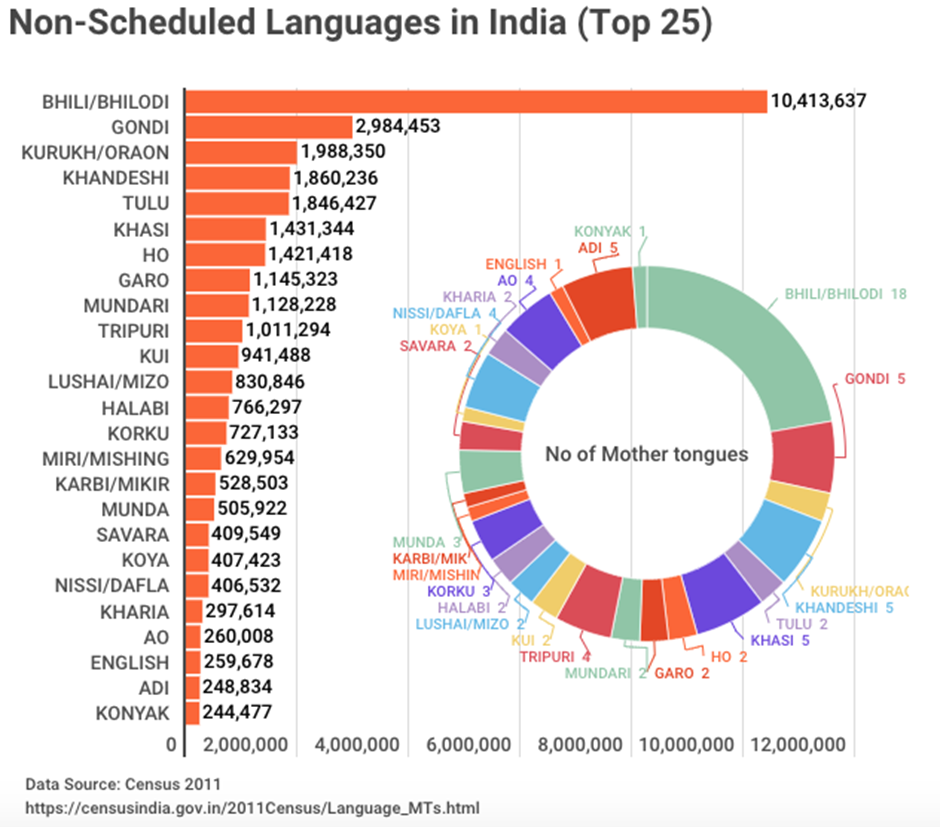
- India has 179 languages and 544 dialects, highlighting its linguistic richness.
- Census data further reflects the diversity:
- 1971 Census reported 1,652 languages spoken as mother tongues.
- The distribution of languages is uneven across space:
- A large number of languages are concentrated in North India, but
- Many languages, especially tribal languages, are spoken by less than 1% of the population.
- Thus, Indian linguistic diversity is marked by:
- Large-scale languages spoken by millions, and
- Micro-level linguistic diversity among smaller communities.
Classification of Languages in India
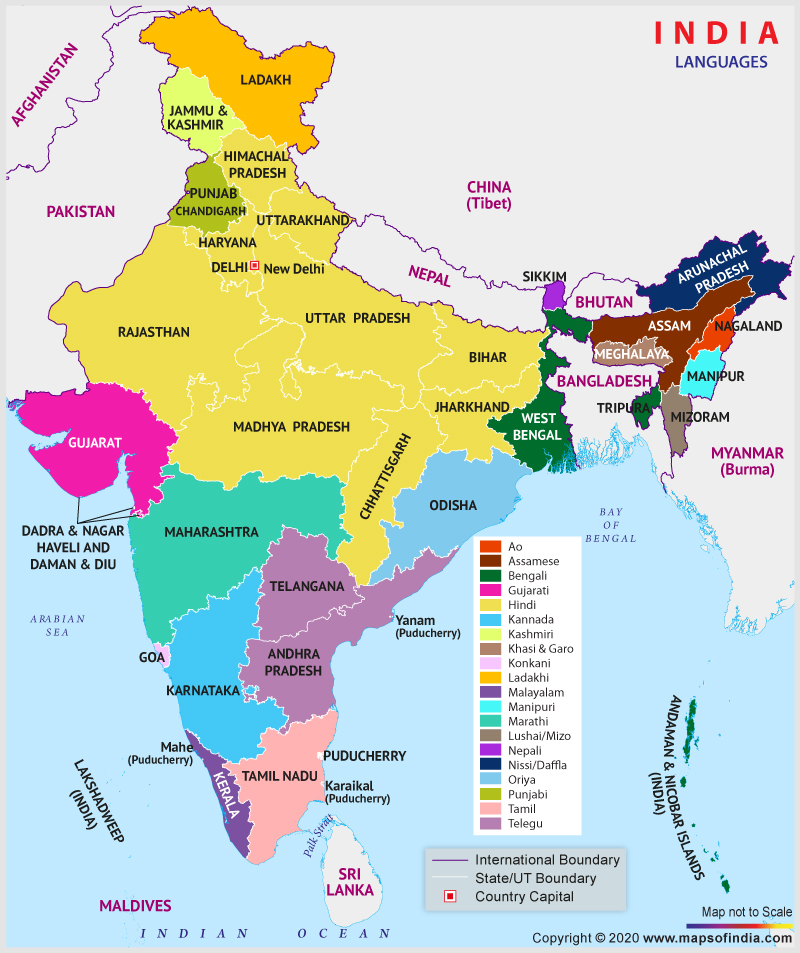
- India’s languages are broadly classified into four major linguistic groups:
- Indo-Aryan Language Family
- Includes languages such as:
- Hindi, Urdu, Punjabi, Assamese, Bengali, Oriya, Gujarati, Marathi, Kashmiri
- Dominant in Northern, Western, and Eastern India
- Includes languages such as:
- Dravidian Language Family
- Includes:
- Tamil, Telugu, Kannada, Malayalam
- Predominantly spoken in Southern India
- Includes:
- Austric (Austro-Asiatic) Languages
- Spoken mainly by tribal populations in Central India
- Sino-Tibetan Language Family
- Spoken by tribal communities in North-Eastern India
- Indo-Aryan Language Family
Historical Evolution and Linguistic Reorganization
- At the time of Independence (1947):
- India consisted of numerous princely states, which were later integrated into the Union under the leadership of Sardar Vallabhbhai Patel.
- The Constitution of India (adopted in 1949, effective 1950):
- Defined India as a Union of states and Union Territories
- Linguistic Reorganization of States (1950s):
- States were reorganized on the basis of language, leading to:
- Each state having a dominant regional language, but
- Continued existence of multilingual populations within states
- States were reorganized on the basis of language, leading to:
Constitutional Recognition and Language Status
- Initially, the Constitution recognized 18 major languages, which later expanded to 22 languages in the 8th Schedule.
- These languages belong to:
- Indo-Aryan and Dravidian families, and
- Some European languages (e.g., English, Portuguese, French) spoken in specific regions like Goa and Puducherry
- Examples of language families:
- Indo-Aryan: Hindi, Bengali, Marathi, Gujarati, Oriya, Punjabi, Bihari, Rajasthani, Assamese, Sanskrit, Sindhi, Kashmiri
- Dravidian: Tamil, Telugu, Malayalam, Kannada
- Official Language Status:
- Hindi is the official language of India
- English continues as an associate official language
Distribution and Prominence of Major Languages
- According to the 1991 Census:
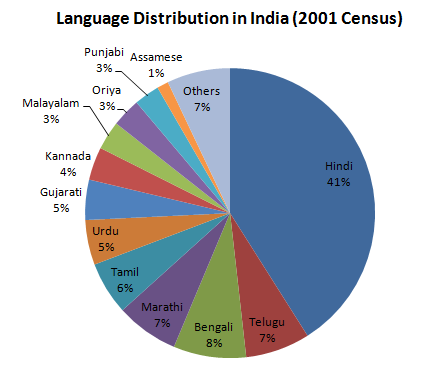
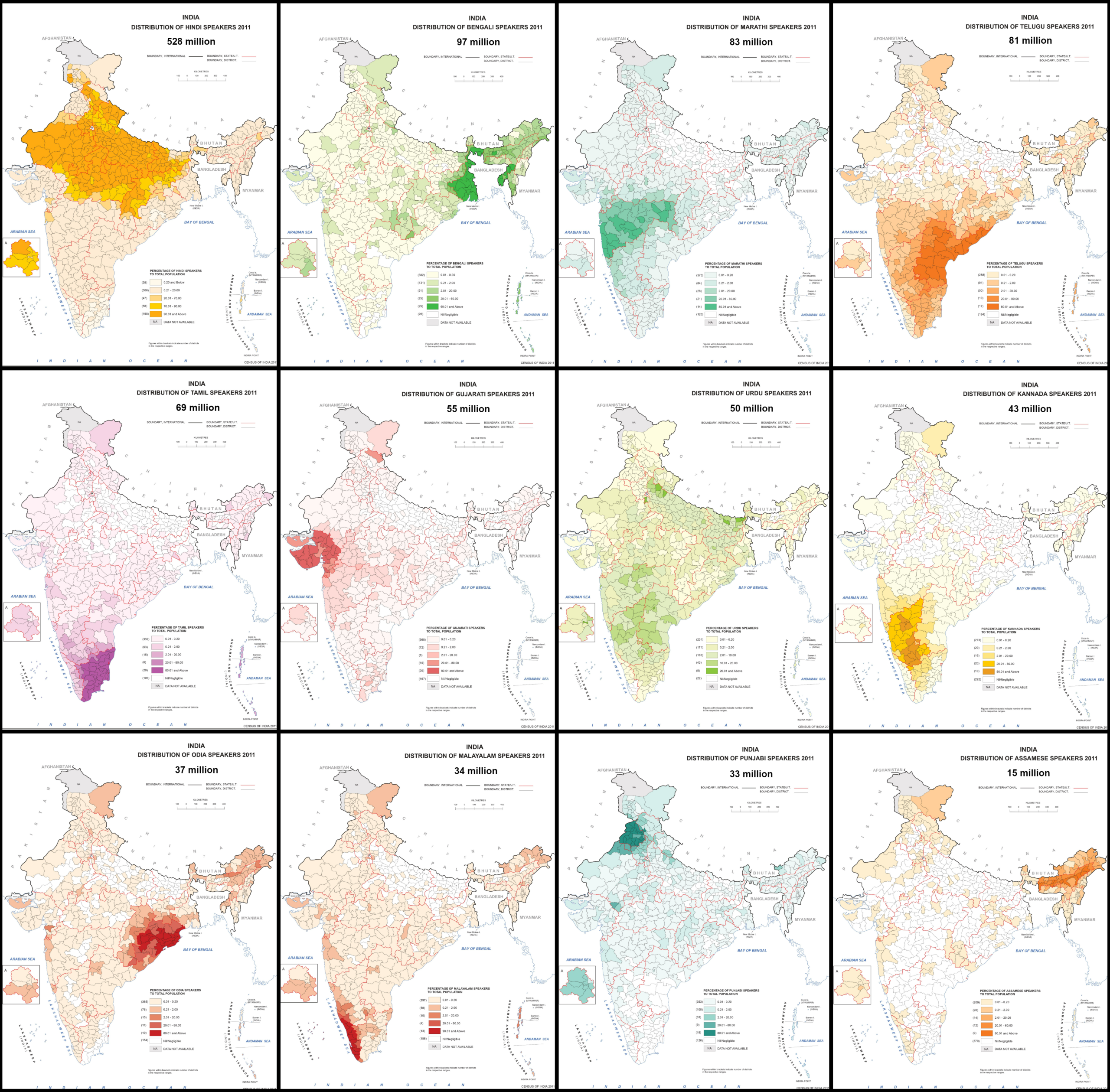
- Hindi is spoken by 247.85 million people
- Followed by:
- Telugu (72.08 million)
- Bengali (71.78 million)
- Other major languages spoken by millions include:
- Marathi, Tamil, Urdu, Gujarati, Malayalam, Kannada, Oriya, Bhojpuri, Punjabi
- Despite Hindi’s dominance:
- Replacing English as a lingua franca remains difficult due to India’s multilingual character
Linguistic Issues and Regional Conflicts
- Linguistic diversity sometimes creates challenges for national integration, especially in:
- Bilingual or multilingual border regions
- Examples of linguistic tensions:
- Goa – conflict between Marathi and Konkani speakers
- Belgaum (Karnataka–Maharashtra border) – conflict between Marathi and Kannada speakers
- Assam – tensions between Bengali and Assamese speakers
- Bihar and Uttar Pradesh – conflicts involving Urdu, Hindi, and Oriya speakers
- There have also been demands such as:
- Inclusion of English in the 8th Schedule of the Constitution
- Thus, linguistic diversity is:
- A cultural strength, but also
- A potential source of socio-political tensions
Language Data and Statistics in India
- 1961 Census:
- 1,652 major languages recorded
- 2011 Census:
- 121 languages recognized with at least 10,000 speakers
- 14 languages have more than 10 million speakers
- Current usage patterns:
- 87 languages used in print media
- 71 languages used in radio broadcasting
- 15 languages used for administrative purposes
- 47 languages used as medium of instruction in schools
- India’s linguistic diversity reflects:
- Historical migration and cultural diffusion
- Geographical barriers and regional isolation
- Socio-political processes like state formation and identity assertion
- It operates simultaneously as:
- A cultural asset promoting diversity and pluralism, and
- A challenge for national integration and governance
Protection of Linguistic Minorities in India
Need for Protection of Linguistic Minorities
- India is home to over 1,369 different languages, many of which face a real threat of disappearing in the near future, reflecting both the richness and vulnerability of its linguistic diversity.
- According to the 2011 Census data on mother tongues:
- A total of 19,569 languages were recorded, which after linguistic scrutiny and categorization were rationalized to 1,369 mother tongues, indicating the complexity of linguistic classification.
- Nearly 400 of these languages are at risk of extinction within the next 50 years, highlighting the urgency for preservation efforts.
- This situation underscores:
- The immense linguistic diversity of India, and
- The urgent need to protect and nurture languages spoken by minority communities, particularly those with small speaker bases.
- Scholars like P. Avinash Reddy emphasize that:
- While constitutional protections exist,
- Institutional threats and systemic neglect persist, making affirmative action crucial for safeguarding minority languages.
Constitutional Provisions for Linguistic Minorities
- Article 30(1) of the Indian Constitution:
- Grants linguistic minorities the fundamental right to establish and manage educational institutions of their choice, thereby ensuring cultural and linguistic preservation.
- Article 351:
- Directs the Union to promote the use of Hindi across India as a medium of expression, which, although aimed at integration,
- May lead to marginalization of speakers of non-Hindi languages, especially when English is also promoted at the cost of local and regional languages.
- Article 350A:
- Mandates that every state must provide primary education in the mother tongue, recognizing the importance of linguistic accessibility in education.
- Article 350B:
- Provides for the appointment of a Special Officer for Linguistic Minorities, whose responsibilities include:
- Investigating matters related to linguistic minorities
- Reporting findings to the President
- Provides for the appointment of a Special Officer for Linguistic Minorities, whose responsibilities include:
- However, a key limitation exists:
- Neither the Constitution nor any legislation explicitly defines what constitutes a linguistic minority, leading to ambiguity in implementation.
Judicial Interpretation of Linguistic Minority Status
- In DAV College vs State of Punjab (1971):
- The Supreme Court defined a linguistic minority as a group that has a distinct spoken language, regardless of whether it has a script or not, thereby broadening the concept.
- The Court further clarified that:
- Minority status must be determined in relation to the specific legislation being challenged, and
- If it is a state law, minority status must be assessed in relation to the population of that state, not the entire country.
- In T.M.A Pai Foundation vs State of Karnataka:
- The Apex Court reaffirmed that linguistic minority status is to be determined at the state level, emphasizing regional context.
- In Association of Teachers in Anglo-Indian School vs Association of Aids of Anglo-Indian School:
- The judiciary held that even if English is an official language of a state (e.g., West Bengal),
- The Anglo-Indian community using English can still be considered a linguistic minority, reinforcing the principle of contextual minority recognition.
Role and Limitations of Commissions
- According to the National Commission for Religious and Linguistic Minorities:
- A linguistic minority is determined by:
- Numerical inferiority,
- Non-dominant status within a state, and
- A distinct linguistic identity
- A linguistic minority is determined by:
- The Commission highlights that:
- Exclusive adherence to a minority language may lead to socio-economic backwardness, which can be mitigated by learning the majority language.
- However, critical limitations in the Commission’s approach include:
- Lack of focus on developing institutional mechanisms and support structures for minority languages
- Emphasis on assimilation through majority language learning, rather than preservation of minority languages
- The Commission’s recommendations indicate:
- A tendency toward systematic state discrimination based on language, as it fails to ensure equal opportunities for linguistic minorities
- In a 2006 workshop on linguistic minorities:
- It was recommended that the term “linguistic minority” be clearly defined,
- And that such a definition be used to frame laws providing affirmative action based on socio-economic backwardness
Issues in Education and Language Policy
- It is emphasized that:
- Merely knowing the majority language does not address the backwardness of linguistic minorities,
- Effective solutions require:
- Incorporation of minority languages into the education system, which would:
- Preserve languages and associated knowledge systems
- Make learning easier and more accessible for minority students
- Incorporation of minority languages into the education system, which would:
- However, existing recommendations are seen as:
- Half-hearted attempts, as they do not ensure:
- Use of minority languages as the medium of instruction
- Half-hearted attempts, as they do not ensure:
- This leads to:
- Forced linguistic assimilation, where minority communities are compelled to adopt dominant languages due to lack of institutional support
Affirmative Action and Linguistic Minorities
- The most vulnerable linguistic minorities are:
- Tribal communities, whose languages are often endangered
- Current situation indicates:
- Very few government schemes or mechanisms exist to integrate tribal languages into the education system
- Although many linguistic minorities belong to indigenous groups (Scheduled Tribes) and receive:
- Reservations in higher education,
- This creates contradictions:
- Students are taught in a majority language during primary and secondary education,
- Leading to linguistic alienation and cultural assimilation
- Consequences include:
- High dropout rates among students from linguistic minorities, due to unfamiliar medium of instruction
- Loss of language and cultural identity among those who continue education
Findings of Committees and Policy Insights
- The High-Level Committee on Socio-Economic, Health, and Educational Status of Tribal Communities highlights:
- Low literacy rates among Particularly Vulnerable Tribal Groups (PVTGs) due to:
- Poor educational infrastructure
- Inadequately trained teachers
- Lack of instruction in tribal languages
- Irrelevant curriculum
- Low literacy rates among Particularly Vulnerable Tribal Groups (PVTGs) due to:
- The Draft National Policy on Tribal Groups acknowledges that:
- The changing educational landscape can endanger tribal languages,
- And emphasizes the importance of mother-tongue education at the primary level
Gaps in Affirmative Action
- It is evident that:
- Most students from indigenous linguistic minorities fail to benefit from affirmative action in higher education, due to earlier disadvantages
- There is a need for:
- Recognition of systemic gaps in the education system, and
- Integration of linguistic minority languages into formal education
- Affirmative action can be effective only when:
- The medium of instruction is the students’ own language, and
- English or the majority regional language is taught as a second language, ensuring both inclusion and opportunity
Impact of Linguistic Diversity on the Development of Various Regions
- Communication Barriers and Regional Fragmentation
- One of the biggest challenges of linguistic diversity in India is the lack of a common language, which creates:
- Difficulties in communication between people from different regions despite Hindi being the Union’s official language
- Situations where individuals struggle to communicate effectively due to language differences, especially in inter-state interactions
- Administrative and social disconnect between regions, affecting national integration
- One of the biggest challenges of linguistic diversity in India is the lack of a common language, which creates:
- Educational Challenges and Learning Outcomes
- Limited education in regional languages creates structural problems in human resource development:
- In many states, English is the primary medium of instruction, which is not the mother tongue of most students, leading to difficulty in understanding concepts and falling behind in studies
- It creates barriers for students who are not fluent in English, restricting access to quality education
- Language of instruction and cultural disconnect:
- Most schools in India teach in Hindi or English, making it challenging for children to learn and retain their native languages
- This leads to gradual erosion of linguistic diversity, as younger generations struggle to communicate fluently in their mother tongues
- Limited education in regional languages creates structural problems in human resource development:
- Threat to Survival of Languages
- Linguistic diversity is under pressure due to modernization and education systems:
- Many Indian languages are at risk of dying out as younger generations shift towards dominant languages
- The lack of institutional support for regional and tribal languages accelerates language loss
- Linguistic diversity is under pressure due to modernization and education systems:
- Economic Implications of Linguistic Diversity
- Linguistic diversity creates challenges in economic integration and business operations:
- Different regions speaking different languages make it difficult for businesses to communicate effectively across the country
- This leads to misunderstandings, delays in operations, and even loss of business opportunities
- Labour market inequalities:
- Many companies require proficiency in English, putting non-English speakers at a disadvantage
- Employers often prefer candidates who can speak the local language, creating barriers for inter-state migration and employment
- Linguistic diversity creates challenges in economic integration and business operations:
- Political Challenges and Identity Mobilization
- Linguistic diversity influences political processes and governance:
- Politicians often find it difficult to communicate effectively with a linguistically diverse population
- This leads to reliance on divisive rhetoric to appeal to specific linguistic communities, contributing to a fragmented political landscape
- Linguistic identities may be mobilized for:
- Electoral gains
- Regional assertion and demands (e.g., language-based movements)
- Linguistic diversity influences political processes and governance:
- Social Inequality and Marginalization
- Linguistic diversity can deepen social inequality:
- Individuals who do not speak Hindi or English are often marginalized and discriminated against in both urban and rural areas
- They face difficulties in accessing employment, education, and basic services
- This results in:
- Widening gap between the rich and poor
- Exclusion of linguistic minorities from mainstream development processes
- Linguistic diversity can deepen social inequality:
- Governance and Administrative Challenges
- Linguistic diversity creates operational challenges in governance:
- Crafting policies that cater to people from different linguistic backgrounds becomes complex
- Translating official documents into multiple languages is costly and time-consuming
- Administrative efficiency is affected due to:
- Communication gaps between state and citizens
- Delays in implementation of policies
- Linguistic diversity creates operational challenges in governance:
- Cultural Strength and Developmental Opportunities
- Despite challenges, linguistic diversity offers significant developmental opportunities:
- It reflects India’s rich cultural heritage and historical evolution, making it a source of identity and cohesion
- It promotes learning, cultural exchange, and intellectual growth
- Linguistic diversity contributes to:
- Knowledge diversity
- Cultural industries (literature, media, arts)
- Soft power of India
- Despite challenges, linguistic diversity offers significant developmental opportunities:
- Measures to Address Challenges
- Promotion of common link languages:
- Promoting Hindi as a widely spoken language, along with English as an associate language, can help bridge communication gaps and reduce language-based discrimination
- Strengthening regional language education:
- Encouraging education in regional languages will improve conceptual understanding and preserve linguistic heritage
- Role of technology:
- Digital platforms and online resources can support education and communication in regional languages
- Skill development and employment:
- Language training programs can help non-English speakers improve their proficiency and access better job opportunities
- Governance reforms:
- Multilingual administrative frameworks and inclusive policies can reduce linguistic barriers
- Promotion of common link languages:
Three Language Formula
- The New Education Policy (NEP) 2020 endorses the three-language formula, but its implementation remains uneven across states:
- Tamil Nadu has rejected the three-language policy, choosing to retain its long-standing two-language policy (Tamil and English)
- For more than five decades, Tamil Nadu has adhered to this model and claims to have achieved significant social and economic progress, highlighting the debate between uniformity and regional autonomy
- The three-language formula was first introduced in the National Education Policy (1968) under the Indira Gandhi government as an attempt to balance national integration with linguistic diversity:
- In Hindi-speaking states, the prescribed languages were Hindi, English, and a modern Indian language (preferably from South India)
- In non-Hindi-speaking states, the formula consisted of English, Hindi, and one regional/Indian language
- The rationale behind the formula was:
- To address the lack of uniformity in the teaching system across different regions
- To bridge the divide where Hindi dominated the north, while regional languages and English prevailed in other parts of India
- To reduce confusion and challenges in inter-state communication
- The formula aimed to achieve:
- Accommodation of group identity and linguistic diversity
- Affirmation of national unity through linguistic integration
- Improvement in administrative efficiency by enabling multilingual communication
- In 1968, the policy was implemented nationwide, except in Tamil Nadu, which continued with its two-language model
- The National Policy on Education (1986) did not substantially alter the 1968 framework and reiterated the importance of promoting Hindi
Progress and Limitations in Implementation
- Since education is a state subject, the implementation of the formula has been left to individual states, resulting in uneven adoption:
- Only a few states have adopted the formula in its true spirit
- In many Hindi-speaking states, Sanskrit replaced a modern South Indian language, thereby defeating the objective of promoting inter-state linguistic understanding
- Tamil Nadu consistently followed the two-language policy (Tamil and English) and did not implement the three-language formula
- These deviations highlight:
- The gap between policy design and ground-level implementation
- The persistence of regional linguistic priorities over national linguistic integration goals
Three-Language Formula under NEP 2020
- NEP 2020 re-emphasizes the importance of multilingualism while introducing flexibility:
- It recommends that the medium of instruction until at least Grade 5, preferably till Grade 8 and beyond, should be the home language/mother tongue/local or regional language
- The three-language formula continues to be promoted as a tool for multilingual competence and national unity
- Key features of the NEP approach include:
- Greater flexibility, with no language imposed on any state
- States, regions, and students are allowed to choose their three languages, provided that at least two are native Indian languages
- The Ministry of Education emphasizes non-imposition and cooperative federalism in language policy implementation
Expert Opinions and Pedagogical Perspectives
- Educational experts and practitioners highlight several benefits of the three-language formula, particularly regarding mother tongue-based education:
- Sridhar Rajagopalan (Educational Initiatives) argues that:
- Pedagogical research shows that children learn best in their mother tongue or local language during primary classes
- English should be learned but should not be the medium of instruction in early years
- The language spoken in a child’s surroundings should ideally be the medium of instruction
- Sanskrit is gaining recognition globally, including in European universities as an academic discipline
- V.K. Tewari (Director, IIT Kharagpur) emphasizes that:
- Strengthening primary education in regional languages, along with introducing Sanskrit under the three-language framework, can significantly benefit rural areas
- It can improve accessibility and conceptual clarity among students
- Sanjay Padode (IFIM Business School) notes that:
- Conducting foundational education in the mother tongue enables students to grasp basic concepts quickly
- It reduces cognitive burden caused by learning through unfamiliar languages
- Aekta Nandwana Chanda (ChildFund India) highlights implementation gaps:
- While promoting mother tongue education till Class 5 is commendable, teaching-learning materials are available only in a few standard languages
- There is an urgent need for investment in educational content across diverse languages, including tribal languages
- Sridhar Rajagopalan (Educational Initiatives) argues that:
Debate over Language
- Language in Judiciary and Policy Debate
- The Haryana Government’s decision to implement the use of Hindi in courts and tribunals subordinate to the Punjab and Haryana High Court triggered a significant debate regarding its practicality and implications:
- The decision is expected to bring substantial changes in the functioning of the lower judiciary at the state level
- It reflects a broader debate on language use in governance and administration, especially in multilingual societies like India
- The Haryana Government’s decision to implement the use of Hindi in courts and tribunals subordinate to the Punjab and Haryana High Court triggered a significant debate regarding its practicality and implications:
- Arguments Against the Use of Hindi in Courts
- Several lawyers and stakeholders questioned the rationale behind the decision, raising constitutional and practical concerns:
- Constitutional Concerns:
- It was argued that the move is discriminatory and violates Article 19(1)(g) of the Indian Constitution, which guarantees the right to practice any profession
- Reference was made to Section 30 of the Advocates Act, 1961, which allows advocates to practice throughout India
- Language barriers may restrict lawyers from effectively practicing across states, thereby limiting professional mobility
- Practical Constraints:
- Most law colleges in India teach in English, and legal education is largely English-centric
- Hindi legal terminology is not well-developed or widely understood among legal practitioners
- Due to language constraints, some lawyers may find it difficult to operate in courts using Hindi
- Constitutional Concerns:
- Several lawyers and stakeholders questioned the rationale behind the decision, raising constitutional and practical concerns:
- Judicial Response and Developments
- The issue reached the Supreme Court, but judicial intervention remained limited:
- The case was withdrawn as premature, as no formal notification had been issued at that time
- When the matter reached the Supreme Court in June 2020, the Court refused to intervene
- Observations of the Supreme Court Bench (CJI S.A. Bobde, Justices A.S. Bopanna and Hrishikesh Roy):
- Approximately 80% of litigants do not understand English, raising concerns about accessibility and inclusivity
- The Court observed that there is nothing inherently wrong with using Hindi as the official language in subordinate courts in some states
- It noted that even during British rule, evidence was recorded in vernacular languages, indicating historical precedence
- The issue reached the Supreme Court, but judicial intervention remained limited:
- Administrative Practices and Precedents
- Instances of vernacular language usage in judiciary:
- In May 2018, the Punjab and Haryana High Court provided a copy of a judgment in Hindi to a litigant
- This marked a shift towards linguistic accessibility in judicial processes
- Instances of vernacular language usage in judiciary:
- Core Issues in the Language Debate
- The debate reflects a deeper structural tension between:
- Accessibility vs Uniformity:
- Use of regional languages improves accessibility for litigants
- However, lack of uniformity may create difficulties for legal professionals across regions
- Professional Mobility vs Linguistic Identity:
- A common language like English facilitates nationwide legal practice
- Regional languages promote inclusivity and local participation
- Efficiency vs Inclusiveness:
- English ensures standardized legal terminology and efficiency
- Vernacular languages enhance comprehension and justice delivery for common people
- Accessibility vs Uniformity:
- The debate reflects a deeper structural tension between:
- Broader Implications for Indian Society
- The debate over language in courts highlights larger issues in India’s multilingual framework:
- The need to balance linguistic diversity with administrative efficiency
- The importance of ensuring access to justice in languages understood by litigants
- The challenge of creating a uniform yet inclusive governance structure
- The debate over language in courts highlights larger issues in India’s multilingual framework:
- The debate over language in judiciary is not merely administrative but deeply connected to constitutional rights, accessibility, and linguistic identity.
- While the use of Hindi or regional languages can enhance inclusivity and access to justice, it must be balanced with the need for uniform legal standards and professional mobility.
- A pragmatic approach would involve multilingual judicial systems, capacity building in regional legal terminology, and gradual transition mechanisms to ensure both efficiency and inclusiveness in India’s judicial and administrative framework.
Conclusion
- India’s linguistic diversity is both fascinating and complex, reflecting the country’s rich cultural heritage and historical evolution.
- While it creates challenges in communication, unity, governance, and socio-economic equality, it also offers opportunities for learning, growth, and cultural enrichment.
- Addressing issues such as standardization of languages, education in non-dominant languages, effective communication, political unity, and social equality is crucial for balanced regional development.
- Linguistic diversity remains a defining feature of India’s identity, shaped by centuries of migration, trade, conquest, and cultural interaction, and must be managed through inclusive and adaptive policy frameworks to ensure a more integrated and prosperous society.