

- Tribal areas are the contiguous regions where Scheduled Tribes live in large numbers and form the majority or a large minority: the hills, forests, plateaus and islands of the tribal belt.
- They are both cultural regions and administrative units: the Fifth and Sixth Schedules of the Constitution give many of them special forms of government.
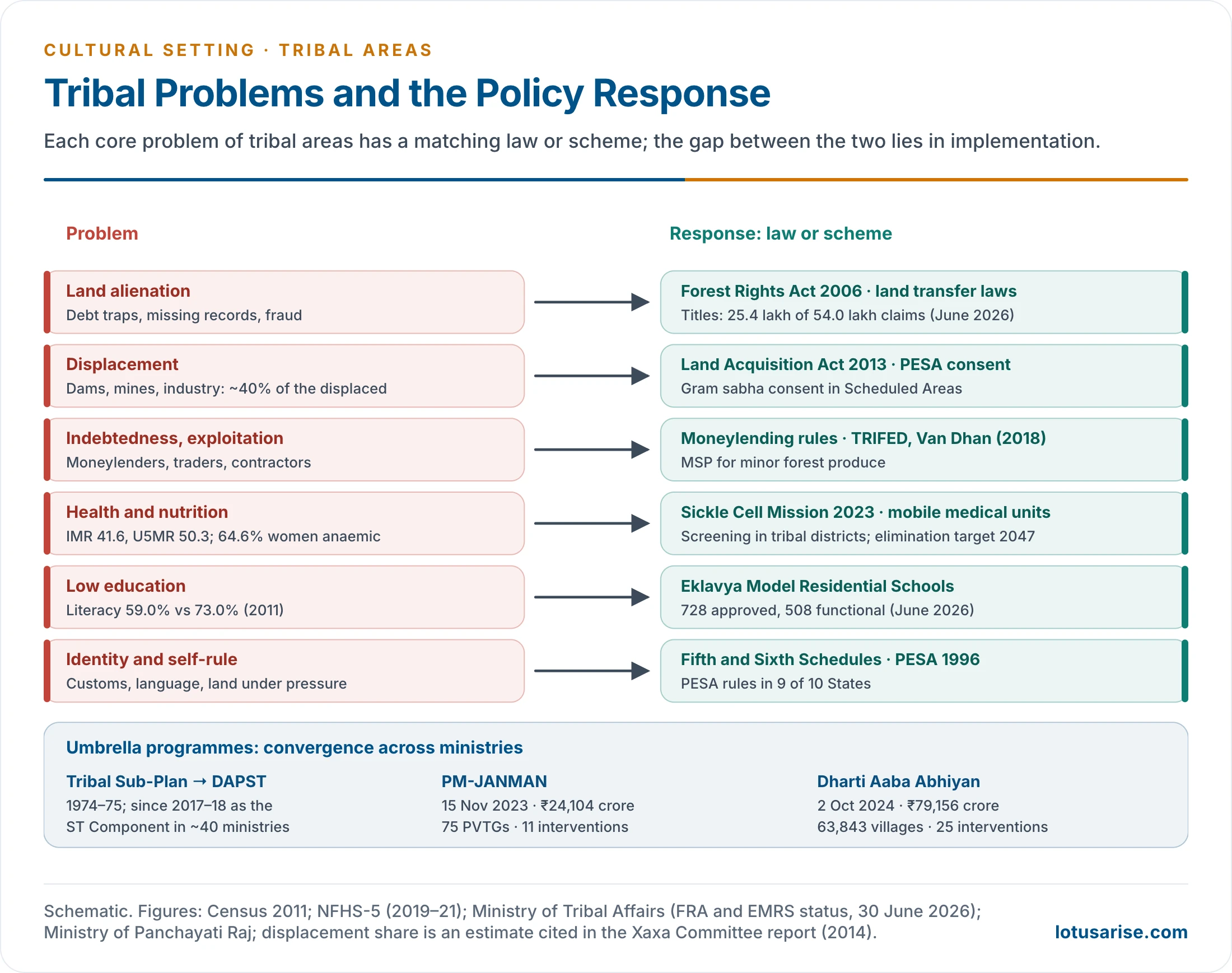
- Their people share common problems: land alienation, displacement, indebtedness, poor health and education, and threats to identity. A long line of policies has tried to address them, from the Tribal Sub-Plan (1974) to PESA (1996), the Forest Rights Act (2006), PM-JANMAN (2023) and the Dharti Aaba Janjatiya Gram Utkarsh Abhiyan (2024).
Tribal Areas

The Tribal Belt
- India’s tribal belt is the set of contiguous areas of tribal settlement: groups that remained genetically and culturally distinct, unlike population groups that mixed widely across the subcontinent.
- The ST population is a numerical minority but enormously diverse. Tribes differ in:
- language, physical features and population size;
- their ecological setting and mode of livelihood;
- the extent of acculturation, level of development and social stratification.
- India’s tribes have distinct cultures and histories. They also share much with other marginalised groups: weak political representation, economic deprivation and cultural discrimination.
- Tribal societies hold knowledge systems from which the rest of society has much to learn.
- “Tribe” is a socio-cultural category; “Scheduled Tribe” is a politico-administrative one.
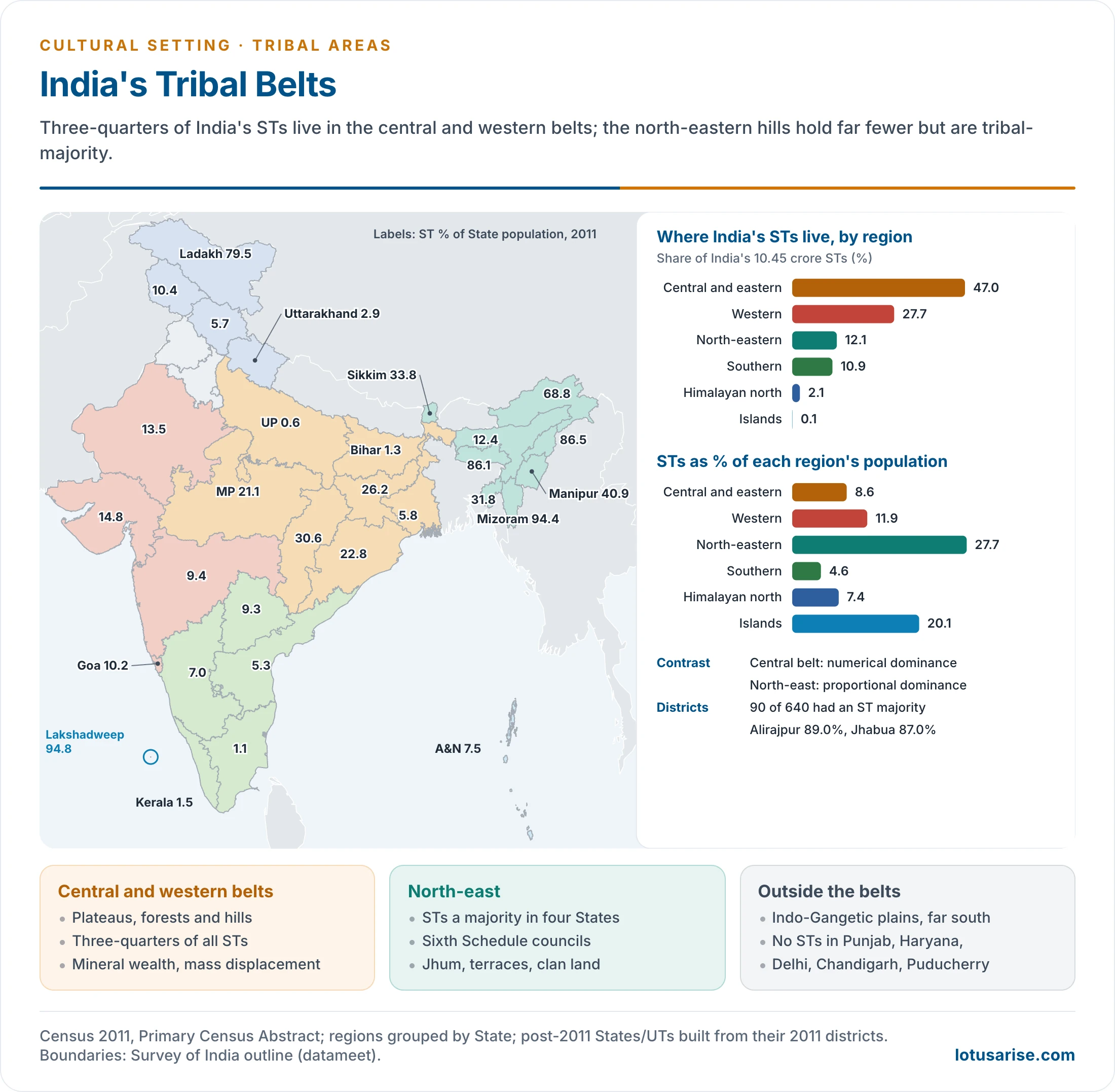
- Five tribal regions (share of India’s STs, Census 2011):
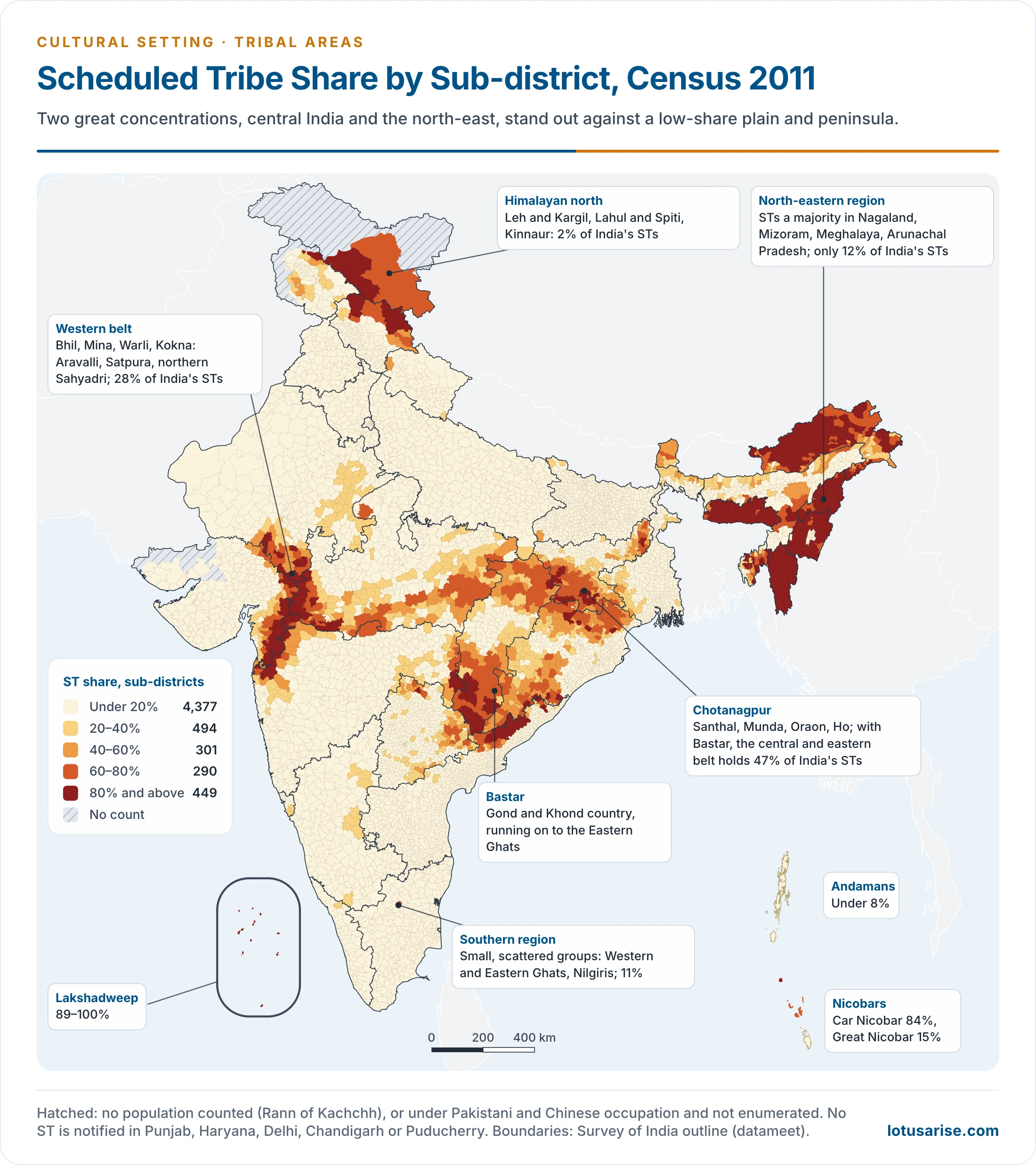
- Central and eastern belt (47%): the Chotanagpur plateau, Bastar, the Satpura–Vindhya and Maikal hills and the Odisha highlands; Gond, Santhal, Munda, Oraon, Ho and Khond country.
- Western belt (28%): the Aravalli, Satpura and the northern Sahyadri in Rajasthan, Gujarat and Maharashtra; Bhil, Mina, Warli and Kokna.
- North-eastern region (12%): the Purvanchal hills, the Meghalaya plateau and Arunachal Pradesh, where STs are a majority in Mizoram, Nagaland, Meghalaya and Arunachal Pradesh.
- Southern region (11%): small, scattered groups in the Western and Eastern Ghats and the Nilgiris, with many PVTGs.
- Himalayan north (2%) and the islands: pastoral groups of Jammu and Kashmir, Ladakh, Himachal Pradesh and Uttarakhand; the hunter-gatherers of the Andamans.
Distribution of Tribes
- 705 communities were notified as STs in 30 States and UTs (Census 2011).
- Census 2011:
- The ST population was 10.45 crore, or 8.6% of India; 90% rural.
- Decadal growth 2001–11 was 23.7%, against 17.7% for the whole population.
- The ST sex ratio was 990, against 943 for India.
- Two great concentrations: central India and the north-east.
- More than half of all STs live in central India: Madhya Pradesh (14.7% of India’s STs), Maharashtra (10.1%), Odisha (9.2%), Rajasthan (8.9%), Gujarat (8.6%), Jharkhand (8.3%), Chhattisgarh (7.5%) and Andhra Pradesh–Telangana (5.7%).
- The first seven of these alone hold about two-thirds of India’s STs.
- The north-east (Assam, Nagaland, Mizoram, Manipur, Meghalaya, Tripura, Sikkim, Arunachal Pradesh) has the highest shares but only 12% of the numbers.
- Elsewhere: West Bengal (5.1%), Karnataka (4.1%), Assam (3.7%) and Meghalaya (2.5%). All other States and UTs together hold 11.6%.
- More than half of all STs live in central India: Madhya Pradesh (14.7% of India’s STs), Maharashtra (10.1%), Odisha (9.2%), Rajasthan (8.9%), Gujarat (8.6%), Jharkhand (8.3%), Chhattisgarh (7.5%) and Andhra Pradesh–Telangana (5.7%).
- No ST is notified in Punjab, Haryana, Delhi, Chandigarh or Puducherry.
- Districts: STs form a majority in 90 districts (2011), from Alirajpur and Jhabua to Bastar, Gumla and the hill districts of the north-east.
- The determinants of this pattern belong to the spatial patterns of caste and tribe composition: relief, forest cover, historical refuge and distance from the agrarian plains.
Scheduled Areas: The Fifth Schedule
- Scheduled Areas are “such areas as the President may by order declare” (Fifth Schedule, under Article 244(1)).
- Criteria used for declaration:
- preponderance of tribal population;
- compactness and reasonable size;
- a viable administrative unit (a district, block or tehsil);
- economic backwardness compared with neighbouring areas.
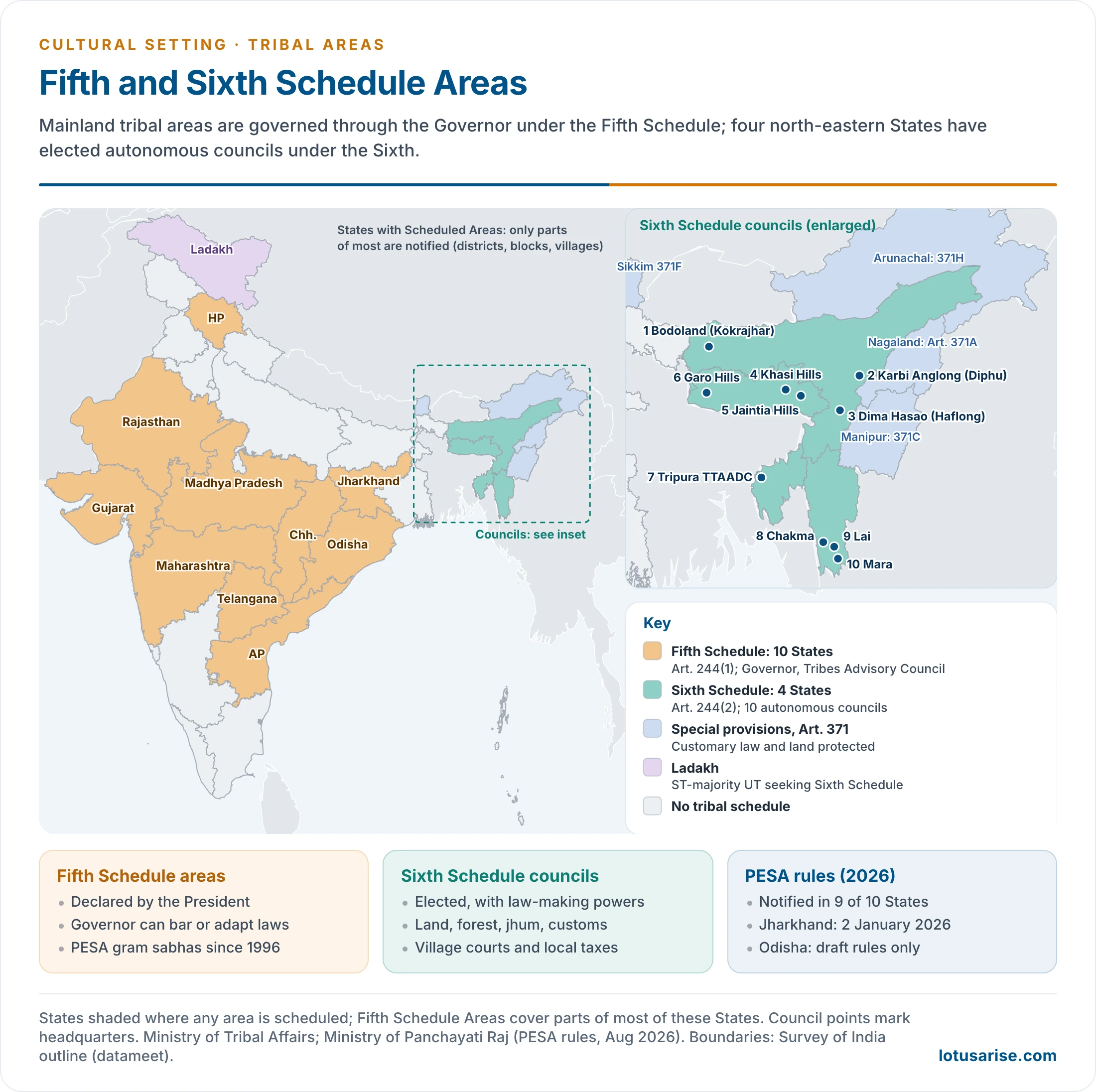
- Ten States have Scheduled Areas: Andhra Pradesh, Chhattisgarh, Gujarat, Himachal Pradesh, Jharkhand, Madhya Pradesh, Maharashtra, Odisha, Rajasthan and Telangana.
- The Scheduled Areas cover about 11.3% of India’s land area.
- Some cover whole districts (13 districts in Jharkhand), others only blocks or villages.
- Special powers:
- The Governor may direct that any law of Parliament or the State shall not apply to a Scheduled Area, or apply with changes.
- The Governor may make regulations for peace and good government, especially to prohibit transfer of tribal land, regulate allotment of land and control moneylending.
- The Governor reports to the President on the administration of these areas. The Union may give directions to the State.
- Tribes Advisory Council (TAC): up to 20 members, three-fourths of them ST members of the State Assembly. It advises on ST welfare. States with STs but no Scheduled Areas may also be directed to form one.
- PESA (1996) extends Panchayati Raj to these areas with powers for the gram sabha.
The Sixth Schedule
- The Sixth Schedule (Article 244(2) and Article 275(1)) applies to tribal areas of Assam, Meghalaya, Tripura and Mizoram.
- It protects tribal populations and gives them autonomy through Autonomous District Councils (ADCs) and Regional Councils.
- Each ADC normally has up to 30 members (the Bodoland council has 46), most of them elected. It has legislative, executive and judicial powers.
- It can make laws on land, forests, water, shifting cultivation, village administration, public health and sanitation, inheritance, marriage and social customs. The State can entrust it with agriculture. It can run village courts, collect some taxes and set up schools and dispensaries.
- Ten autonomous councils exist:
| State | Autonomous councils |
|---|---|
| Assam | Bodoland Territorial Council, Karbi Anglong, Dima Hasao |
| Meghalaya | Khasi Hills, Jaintia Hills, Garo Hills |
| Tripura | Tripura Tribal Areas ADC |
| Mizoram | Chakma, Lai, Mara |
- Other north-eastern States protect tribal custom and land through Article 371 instead: 371A for Nagaland, 371C for Manipur’s hill areas, 371F for Sikkim and 371H for Arunachal Pradesh.
- Ladakh, with an ST majority, has sought inclusion in the Sixth Schedule since becoming a Union Territory in 2019.
| Feature | Fifth Schedule | Sixth Schedule |
|---|---|---|
| Article | 244(1) | 244(2), 275(1) |
| Where | 10 States of mainland India | Assam, Meghalaya, Tripura, Mizoram |
| Key body | Tribes Advisory Council (advisory) | Autonomous District Council (legislative) |
| Who controls | Governor and State government | Elected tribal council |
| Self-rule | PESA gram sabhas | Customary law and council laws |
Problems of Tribal People
Nature of the Problems
- Tribes are generally backward economically and educationally, but the situation varies:
- In the north-east, the tribes have high politicisation, higher literacy and a better standard of living than in other regions. The region’s problems are more about ethnic conflict, insurgency and autonomy.
- In the mainland (central India), poverty, unemployment, indebtedness and land loss are acute. Plains landlords and moneylenders steadily replaced tribal landowners.
- A survey by B. K. Roy Burman (1972) found tribes the most backward group, mainly through low literacy and a subsistence economy.
- Problems differ in degree between:
- hill tribes and plains tribes;
- forest-based groups and settled farmers;
- those who are Hinduised or Christian and those who keep a traditional way of life.
- Shyama Charan Dube (1982) classified Indian tribes by their contact with non-tribal society:
- aboriginals living in seclusion;
- tribes associated with neighbouring non-tribal society but keeping their distinctiveness;
- tribes living in villages alongside castes and sects while keeping their identity;
- tribes degraded to the status of untouchables;
- tribes that enjoy high social, economic and political status.
- The common problems are poverty and exploitation, economic and technological backwardness, socio-cultural handicaps and the difficulty of assimilation with the non-tribal population.
Social Problems
- Illiteracy and educational deprivation:
- In 1991, about 70% of STs were illiterate. In 2011, ST literacy (59.0%) was still well below the national 73.0%.
- Causes:
- poverty, which pushes children into work;
- nomadic or semi-nomadic life in some groups;
- language barriers, since teaching is often in a language the child does not speak;
- an irrelevant curriculum;
- few schools and teachers in remote areas;
- low awareness of the value of schooling, with superstition and prejudice against it.
- Backwardness is worst in the remote, forested and hilly areas, a sign of spatial isolation.
| Literacy (%) | 1961 | 1971 | 1981 | 1991 | 2001 | 2011 |
|---|---|---|---|---|---|---|
| All persons | 28.3 | 34.5 | 43.6 | 52.2 | 64.8 | 73.0 |
| STs | 8.5 | 11.3 | 16.4 | 29.6 | 47.1 | 59.0 |
| All females | 15.4 | 22.0 | 29.8 | 39.3 | 53.7 | 64.6 |
| ST females | 3.2 | 4.9 | 8.0 | 18.2 | 34.8 | 49.4 |
- Gender gaps:
- Tribal women face dual marginalisation. Female literacy (49.4%) is far below male literacy (68.5%).
- Girls drop out because of housework, early marriage and the lack of nearby schools and toilets.
- Women traditionally enjoyed better status than in caste society, but modernisation has eroded it.
- Health and nutrition (NFHS-5, 2019–21):
- Infant mortality 41.6 and under-five mortality 50.3 per 1,000 among STs, against 28.0 and 32.8 for the “other” group.
- About 40% of ST children are stunted, and 64.6% of ST women are anaemic (India: 57.0%).
- Malaria, tuberculosis and sickle cell disease are concentrated in tribal belts.
- Causes: remote facilities, food insecurity, low awareness of hygiene and preventive care, and reliance on traditional healers (ojha, kabiraj) and quacks, not linked with modern medicine.
- Changing roles of women:
- Deforestation lengthens the walk for fuelwood, fodder and water.
- Mining and commercialisation bring wage work but also exploitation and consumerism. Old gender roles are disrupted without support systems.
- Assimilation and loss of identity:
- Contact with dominant cultures brings loss of traditional practices, internal stratification and intra-tribal inequality.
- Its roots lie in colonial policy, unequal entry into the market and uneven exposure to modernisation.
- Customary institutions and indigenous knowledge decline. Many tribal languages are endangered.
- Conflict between customary systems and modern law creates insecurity.
- Those displaced from their land are not absorbed into the modern economy. The result is pauperisation and loss of social support.
- Contact with dominant cultures brings loss of traditional practices, internal stratification and intra-tribal inequality.
- Alcohol:
- Rice beer and mahua liquor have long been part of ritual and social life. About 51% of ST men drink, against about 30% of other men.
- The shift from home brews to commercial liquor brings health risks, domestic violence and a drain on income.
- Prevalence is highest in the east: Assam and West Bengal (about 70%), Odisha (69%) and Jharkhand (67%).
- In Sikkim, Manipur, West Bengal, Maharashtra and Goa, more urban than rural ST men drink.
Economic Problems
- Loss of control over natural resources:
- Tribes once held customary rights over land, forests, water and wildlife: the base of their subsistence economy and identity.
- Colonial forest laws (from 1865 and 1878) turned forests into reserved and protected forests and curtailed these rights.
- After Independence, mineral development in Jharkhand, Odisha and Chhattisgarh and growing population pressure continued the process.
- The Forest Rights Act (2006) aims to restore these rights.
- Poverty and exploitation:
- Absolute poverty is lacking the means for basic needs: clean water, nutrition, health care, clothing and shelter. Relative poverty is having less than others in a society.
- Rural poverty has long been measured by Below Poverty Line (BPL) lists. The 2002–07 survey scored households from 0 to 4 on 13 parameters, including landholding, housing, clothing, food security, sanitation, literacy, labour, livelihood, children, indebtedness and migration.
- In 2015–16, 50.6% of STs were multidimensionally poor, the highest of any social group.
- Causes: land alienation, a low-productivity subsistence economy, and exploitation by moneylenders, traders and contractors.
- Many tribal districts are among the Aspirational Districts.
- Land alienation:
- Tribal land passes to non-tribals through debt traps, manipulated or missing land records, fraudulent transfers and encroachment.
- Land transfer regulations of the Scheduled Area States and PESA prohibit this, but enforcement is weak.
- The result is landlessness and loss of economic independence.
- Indebtedness: credit at exorbitant interest for food, ceremonies or medical needs often ends in bonded labour or the loss of land.
- Displacement and rehabilitation:
- Dams, mines, steel plants and parks are concentrated in tribal areas: the Chotanagpur plateau, Odisha’s mining belt, West Bengal, central India (the Narmada dams), and Bhilai, Rourkela and Bokaro.
- Tribal people are estimated to be about 40% of all people displaced by development since 1951, though they are 8.6% of the population.
- Problems: cash compensation that is quickly spent, poor resettlement, migration as unskilled labour, cultural dislocation and stress.
- Exclusion from welfare:
- Low awareness of schemes and administrative barriers keep many tribal families out of them.
- These include scholarships, boys’ and girls’ hostels, ashram schools, vocational training, fellowships for higher studies, residential schools, NSTFDC loans, the Adivasi Mahila Sashaktikaran Yojana, the Tribal Forest Dwellers Empowerment Scheme, old-age pensions for BPL families, BPL ration cards, MGNREGA job cards and bank accounts.
- Over 70% of tribal households in some regions had no bank account. Bureaucratic apathy and poor accountability add to the gap.
- Subsistence economy:
- Hunting, gathering, shifting cultivation and small-scale farming with simple tools give little surplus. Even plough-using tribes supplement farming with hunting and collecting. Labour is little divided, units are small and there is almost no capital.
- They leave households exposed to crop failure and climatic shocks. The move to a market economy is difficult.
- Unemployment and distress migration:
- Seasonal unemployment and few non-farm jobs push distress migration to cities, brick kilns and plantations as unskilled, informal labour.
- Low skills, isolation and poor infrastructure are the structural causes.
- Ill-health as an economic burden: poor health lowers productivity and earnings, reinforcing poverty. Even under colonial rule, tribal plantation and mine labour suffered high mortality from malaria and blackwater fever. The Dooars Labour Act (1912) provided only for inspection of sanitation and public health.
Environmental Problems
- Human–wildlife conflict:
- Tribes long lived in balanced coexistence with forests and wildlife.
- Conflict has risen sharply through:
- deforestation and habitat fragmentation by roads, railways and highways, including road widening and broad-gauge conversion;
- tea estates and plantations (Dooars, Assam);
- mining and quarrying, including dolomite and boulder mining in Himalayan foothill rivers;
- river training through large embankments, which alters river systems;
- encroachment, and growing wildlife numbers without larger habitats;
- ecotourism.
- Results: crop and livestock loss, deaths and retaliatory killing. It is worst in the north-east, the Dooars, central India and the Western Ghats.
- Habitat degradation:
- Tribal regions lie in fragile zones: forests, hills and biodiversity hotspots.
- They suffer deforestation, the shrinking of common property resources, monoculture plantations, pollution of soil and water, and unplanned settlements around industries.
- Physical constraints:
- Difficult terrain limits transport and access to markets, health care and schools.
- Poor communications delay service delivery.
- Heavy rainfall in the foothills and the north-east brings seasonal disease.
- Livelihood crisis: fuelwood, fodder and minor forest produce are declining, and soil erosion and water scarcity cut farm yields. Tribal people are forced into wage labour and exploitative markets.
- “Ecologically rich regions become economically poor” through unsustainable extraction.
- Case: the Dooars:
- Tea plantations in the West Bengal–Assam foothills have taken over forest and grassland and fragmented elephant corridors.
- Results: human–elephant conflict, loss of biodiversity, and poor housing and sanitation for tea-garden workers, most of them Santhal, Oraon and Munda migrants.
- Workers suffer long closures of gardens, lasting months or years. Many go to western India to earn more, and middlemen often cheat them.
- Socio-environmental links:
- Loss of land and resources leads to exploitation and migration. Migration brings cultural dislocation and continued exploitation by middlemen.
- Tribal communities are sometimes treated as vote banks while their core issues go unaddressed.
Political and Security Problems
- Left-wing extremism has been concentrated in the central tribal belt (Bastar, the Jharkhand–Odisha borderlands), feeding on land loss, displacement and poor governance. It has also kept development away.
- Ethnic conflict and insurgency in the north-east: clashes between tribes and with settlers (the Bru exodus of 1997, violence in Bodo areas), and demands for autonomy and statehood.
- Identity demands: inclusion in the ST list (Gurjars in Rajasthan, Koch-Rajbongshi and Ahom groups in Assam), separate statehood, or Sixth Schedule status (Ladakh).
Tribal Development Policy
Approaches
- Isolation: Verrier Elwin (1939) proposed protecting tribes in “national parks” away from outside exploitation.
- Assimilation: Govind Sadashiv Ghurye saw tribes as “backward Hindus” to be absorbed into the mainstream.
- Integration: Jawaharlal Nehru’s Tribal Panchsheel (in his foreword to Elwin’s A Philosophy for NEFA, 1959) set out five principles:
- tribes should develop along the lines of their own genius;
- their rights in land and forests should be respected;
- tribal teams should be trained for administration and development;
- tribal areas should not be over-administered;
- results should be judged by the quality of human character, not statistics or money spent.
Evolution of Programmes
- 1954: 43 Special Multipurpose Tribal Projects (later called Blocks).
- Tribal Development Blocks (TDBs), set up from the late 1950s and named in the Third Plan:
- They covered blocks with a tribal majority and stressed agriculture, soil conservation, education, health, cooperation and communications.
- The Shilu Ao Study Team (1969) found blocks too small for planning, schemes fragmented, and little tribal participation.
- Tribal Development Agencies (1971–72): pilot district agencies under the Collector.
- Tribal Sub-Plan (TSP, 1974–75):
- Launched in the Fifth Plan for areas of tribal concentration.
- Funds from all sectors are earmarked in proportion to the ST population, and are non-divertible and non-lapsable.
- Its units:
- Integrated Tribal Development Projects (ITDPs) for large tribal areas;
- MADA pockets (Modified Area Development Approach): 10,000+ people, at least half ST;
- clusters: 5,000+ people, at least half ST;
- separate projects for PVTGs.
- Three-tier planning: micro (block: schools, primary health, minor irrigation, cooperatives), meso (ITDP: higher education, markets, roads, power), macro (State: medium irrigation, industry, research).
- Since 2017–18 it runs as the Scheduled Tribe Component, tracked as the Development Action Plan for STs (DAPST) across about 40 ministries.
- Critique:
- TSP funds are often notional, diverted or spent on general schemes. The sub-plan lacked independent status within the State plan.
- Benefits went to the better-off among tribes.
- Planning was top-down, with little tribal participation; bureaucratic rigidity and weak political will added to the failures.
- Bastar (Chhattisgarh) shows these tensions:
- Over 65% of its people were tribal. Its regions run from the isolated Abujhmar hills of the Hill Maria to the more advanced Bhatra plains near Jagdalpur.
- Bailadila iron-ore mining and railways brought growth but little local benefit.
Legal Safeguards
- PESA, 1996 (Panchayats (Extension to the Scheduled Areas) Act):
- Extends Panchayati Raj to Fifth Schedule Areas, recognising gram sabhas as competent to safeguard traditions, community resources and customary dispute resolution.
- Gram sabhas must be consulted on land acquisition and must approve plans. They get ownership of minor forest produce and control over minor minerals, village markets, moneylending and land alienation.
- Nine of the ten States have notified PESA rules; Jharkhand did so on 2 January 2026. Odisha has only draft rules (2023).
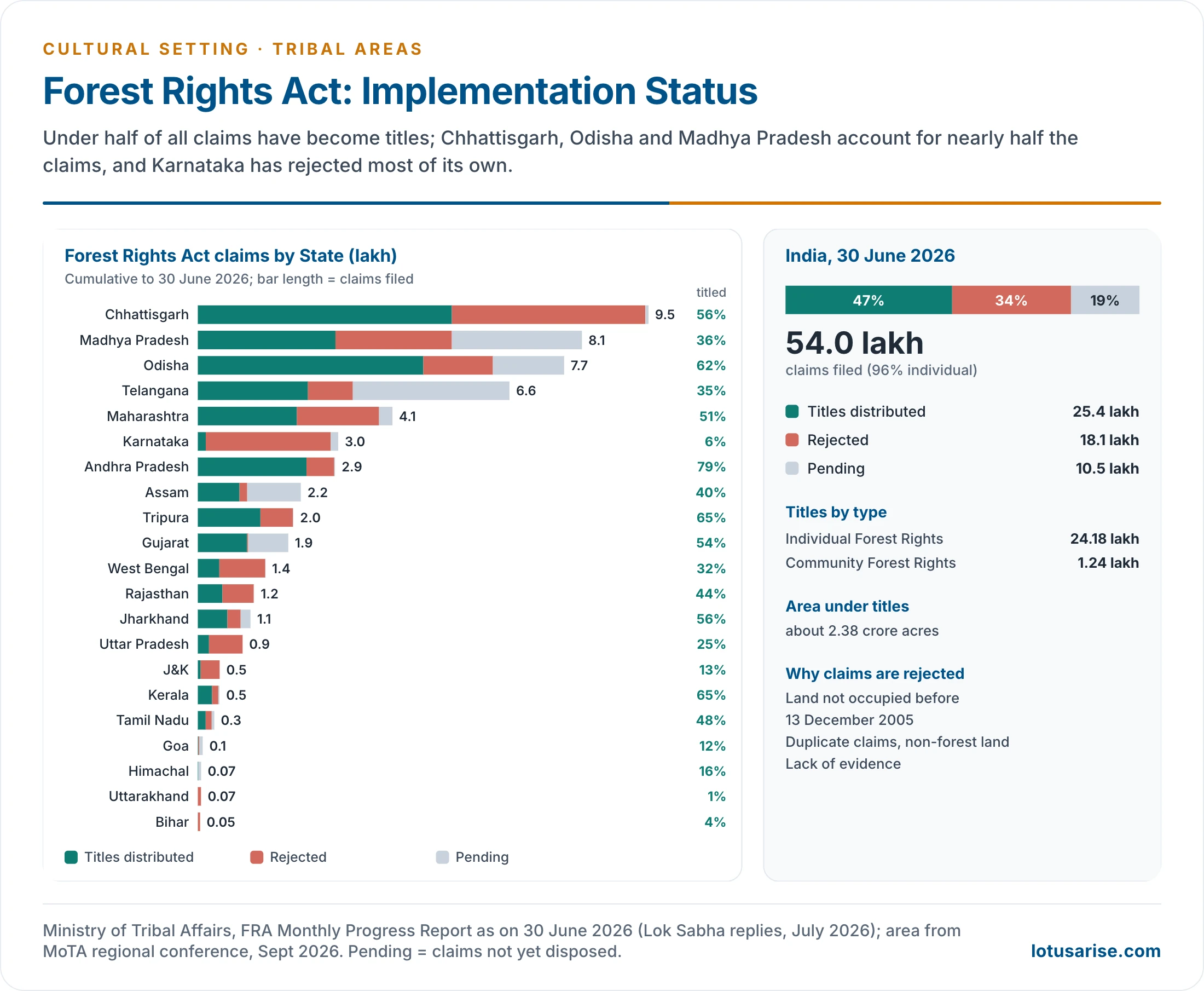
- Forest Rights Act, 2006 (Scheduled Tribes and Other Traditional Forest Dwellers (Recognition of Forest Rights) Act):
- Recognises individual rights to forest land cultivated before 13 December 2005 (up to 4 hectares).
- Recognises community rights: grazing, fishing, minor forest produce. It also recognises Community Forest Resource (CFR) rights to protect and manage forests, and habitat rights for PVTGs.
- The gram sabha initiates and verifies claims.
- Status (30 June 2026):
- 54.0 lakh claims filed; 25.4 lakh titles distributed (24.2 lakh individual, 1.24 lakh community), covering about 2.38 crore acres.
- 18.1 lakh (34%) were rejected and 10.5 lakh (19%) are pending.
- Main reasons for rejection: land not occupied before the cut-off date, duplicate claims, non-forest land and lack of evidence.
- Other laws:
- State land transfer regulations (for example the Chotanagpur Tenancy Act 1908 and the Santhal Parganas Tenancy Act 1949).
- The SCs and STs (Prevention of Atrocities) Act, 1989.
- The Right to Fair Compensation and Transparency in Land Acquisition, Rehabilitation and Resettlement Act, 2013, which requires gram sabha consent in Scheduled Areas.
Major Schemes
- Education:
- Eklavya Model Residential Schools (EMRS) in every block with over 50% ST population and at least 20,000 tribal people.
- 728 approved, 508 functional (June 2026), with over 1.5 lakh students.
- Pre- and post-matric scholarships, hostels and ashram schools.
- Eklavya Model Residential Schools (EMRS) in every block with over 50% ST population and at least 20,000 tribal people.
- Livelihoods:
- NSTFDC loans for self-employment.
- TRIFED, with Van Dhan Vikas Kendras (2018) and minimum support prices for minor forest produce.
- Health: the National Sickle Cell Anaemia Elimination Mission (2023) screens tribal areas, with the aim of ending the disease by 2047.
- PM-JANMAN (15 November 2023):
- ₹24,104 crore over three years for the 75 PVTGs, through 11 interventions of 9 ministries.
- Interventions: housing, roads, water, mobile medical units, Anganwadis, hostels, electricity, telecom and Van Dhan centres.
- Dharti Aaba Janjatiya Gram Utkarsh Abhiyan (DAJGUA):
- Launched on 2 October 2024, named after Birsa Munda (“Dharti Aaba”).
- Outlay ₹79,156 crore (Centre ₹56,333 crore) for 2024–25 to 2028–29.
- It aims to saturate infrastructure gaps in 63,843 tribal-majority villages in 549 districts and 2,911 blocks, benefiting over 5 crore tribal people.
- 25 interventions by 17 ministries. It also funds gram sabhas and CFR management under the FRA.
- Pradhan Mantri Adi Adarsh Gram Yojana: converts villages with large ST populations into model villages through convergence.
Why Tribal Areas Still Lag
- Implementation gaps: TSP funds diverted; PESA rules late and gram sabha powers overridden by line departments.
- Rights not secured: a third of FRA claims rejected, CFR rights under-recognised, land records missing or out of date.
- Development model: mining, dams and industry extract resources without benefit-sharing, while displacement outpaces rehabilitation.
- Delivery failures: vacant teacher and doctor posts, distant facilities, and schemes designed for the plains.
- Elite capture: benefits concentrated among the better-off tribes and households.
- Conflict: insurgency and ethnic violence that keep the State and services away.
- The Xaxa Committee (2014) recommended:
- strict enforcement of PESA and the FRA;
- prior informed consent of gram sabhas for land acquisition;
- land-for-land rehabilitation;
- better education in tribal languages;
- stronger tribal health systems.
Way Forward
- Tribal problems are part of a wider crisis of ecological imbalance and unsustainable development.
- Tribal people, once custodians of nature, have been displaced from their ecological base and exposed to degradation and economic insecurity.
- Development aligned with ecology: community-led forest management under CFR rights, value addition to forest produce, and protection of commons.
- Self-rule: real powers for gram sabhas and autonomous councils, and full use of the Fifth and Sixth Schedules.
- Land security: updated records, restoration of alienated land and consent before acquisition.
- Culturally sensitive services: mother-tongue teaching, tribal health workers and attention to sickle cell disease and anaemia.
- Conservation with participation: community participation in parks and reserves, and fair benefit-sharing from minerals.
- The goal is balance: between development and ecology, and between modernisation and traditional knowledge.
Previous Year Questions
1989Discuss the problems of the tribal areas and suggest measures for solving them.1992Write short note: Salient features of Tribal area planning.1995Discuss the problems of Tribal areas in India.1998Critically examine the problems and prospects of tribal areas in India.2002Elucidate the role of Tribal development blocks in development of Tribal areas.2005Identify the tribal areas of India and highlight their important problems.2006Present an account of Tribals, tribal areas and their problems in India.2012Elucidate the role of Tribal Development Blocks in the development of Tribal areas.2013Planning and development of ‘Tribal Regions’ in India.2016Describe the major tribal regions of India and their problems.2020Identifying areas covered under tribal sub-plan, discuss the programmes initiated to address their problems.2022Discuss the impact of Forest Rights Act, 2006 on the local forest communities in India.2024In spite of various tribal area development programmes in India, tribal areas still lag behind. Discuss critically with examples.





 History Optional PYQ Master Pack: Topic-wise Model Answers (1985–2025) by LotusArise IAS
 History Optional Mains Master Kit 2027 Complete Self-Study System — Notes, Mapping & Premium Articles by LotusArise IAS
Thank you so much 💕💕
Thank
thank u Amit sir for your quality content
thank u so much….