Caste and Tribe Composition

Nature of India’s Ethnic Diversity
- India’s population is characterized by extreme socio-cultural and ethnic diversity, where differentiation is primarily shaped by language, religion, caste and tribe, making it one of the most complex population structures in the world from a geographical perspective.
- The caste system represents a unique socio-cultural institution, historically rooted in Hindu society but gradually influencing other religious communities (Muslims, Christians, Sikhs) through processes of social stratification and cultural assimilation, thereby expanding its societal relevance beyond religion.
- The broader South Asian region—including Pakistan, Bangladesh, Nepal, Bhutan and Sri Lanka—shares similar socio-cultural traits, indicating a regional civilizational continuum shaped by shared history, migration and cultural diffusion.
Caste as a Structural Component of Society
- Caste is not merely a social identity but a fundamental organizing principle of Indian society, deeply embedded in social hierarchy, occupational specialization and spatial segregation, influencing almost all aspects of life including marriage, mobility and access to resources.
- It operates through ascriptive status (birth-based identity), leading to limited social mobility, although modern processes such as urbanization, education and economic development have gradually weakened rigid caste boundaries in certain regions.
- The persistence of caste is evident in:
- Settlement patterns (caste-based hamlets in rural India)
- Occupational clustering (traditional caste occupations)
- Political mobilization (caste-based voting patterns)
Scheduled Castes (SCs): Historical Marginalization
- Scheduled Castes represent groups that were historically placed at the lowest rung of the caste hierarchy, facing untouchability, social exclusion and economic deprivation, which has had long-term demographic and spatial consequences.
- Their disadvantages manifest in:
- Lower literacy and educational attainment
- Higher poverty levels and limited asset ownership
- Concentration in rural and agrarian labour sectors
- Spatially, SC population is more concentrated in:
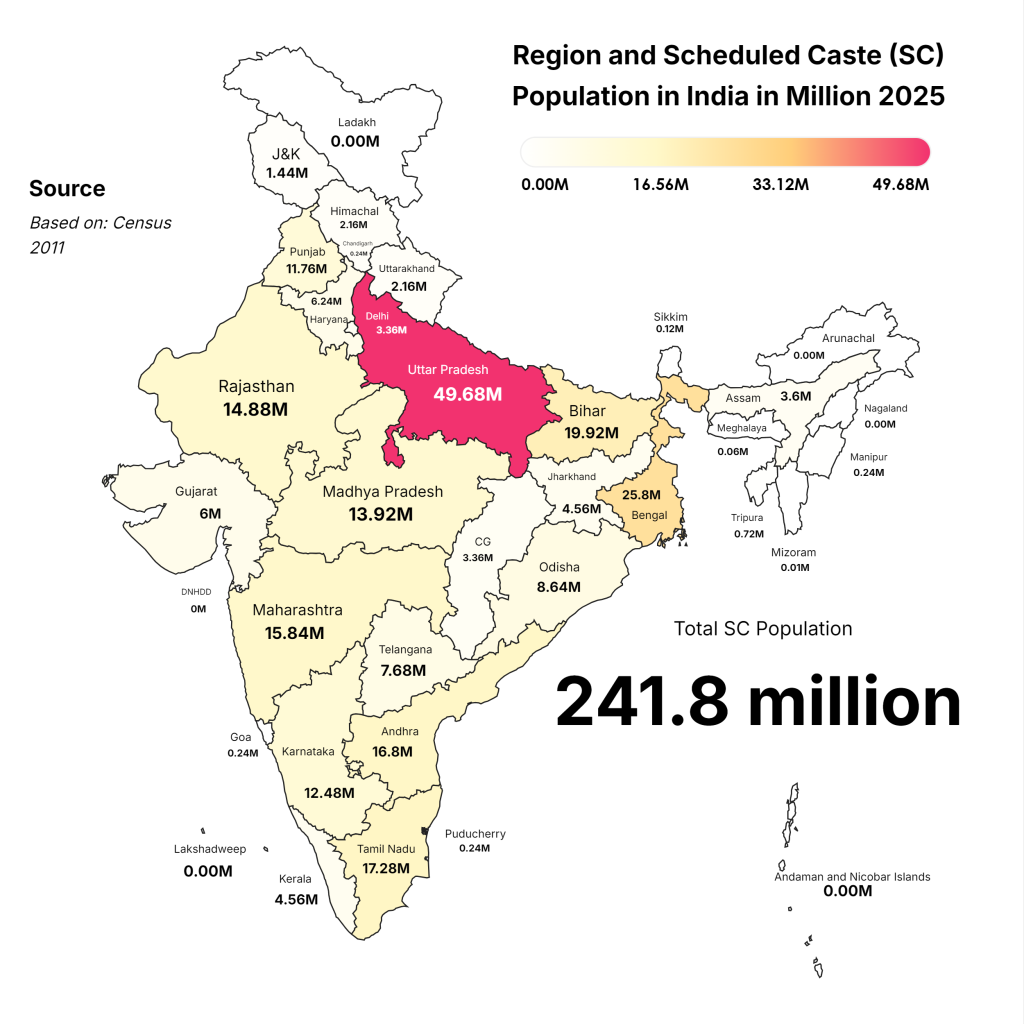
- Northern plains (UP, Bihar, Punjab)
- Southern states (Tamil Nadu, Andhra Pradesh)
- Their condition necessitated affirmative action policies, recognizing caste as a key determinant of social inequality in India.
Scheduled Tribes (STs): Ethnic and Spatial Distinctiveness
- Scheduled Tribes constitute a distinct ethnic component, often regarded as the ‘original inhabitants’, with unique cultural practices, languages and socio-economic systems different from mainstream society.
- Their spatial distribution is highly uneven, largely concentrated in:
- Central tribal belt: Chotanagpur plateau, Bastar, Odisha highlands
- North-Eastern states: Mizoram, Nagaland, Meghalaya, Arunachal Pradesh
- Western India: Rajasthan, Gujarat (Bhil region)
- This pattern reflects their historical preference (or compulsion) to inhabit geographically isolated and ecologically marginal areas such as:
- Forests
- Hills and mountains
- Arid and plateau regions
- Such locations resulted in:
- Relative cultural isolation
- Limited integration with mainstream economy
- Delayed socio-economic development
Socio-Economic Characteristics of Tribal Population
- Tribal communities are predominantly:
- Rural and forest-dependent, engaged in shifting cultivation, hunting, gathering and minor forest produce
- Economically marginalized, with limited access to education, healthcare and infrastructure
- Their marginalization is linked to:
- Geographical isolation
- Colonial forest policies restricting access to resources
- Post-independence development-induced displacement (mining, dams)
- However, they also represent:
- Ecological custodians with sustainable resource practices
- Cultural diversity hotspots preserving indigenous knowledge systems
Interrelationship Between Caste, Tribe and Development
- Both SCs and STs constitute a significant proportion of India’s marginalized population, and their socio-economic backwardness is closely linked to:
- Historical exclusion (SCs)
- Geographical isolation (STs)
- The intersection of caste/tribe with gender, class and region creates multi-dimensional inequality, making these groups particularly vulnerable in development processes.
- Regions with high concentration of SC/ST populations often coincide with:
- Low Human Development Indicators (HDI)
- High poverty and underdevelopment
Constitutional and Policy Framework
- The Indian state has recognized caste and tribe as critical axes of inequality and introduced protective and developmental measures, including:
- Directive Principles (Article 46):
- Mandates promotion of educational and economic interests of SCs and STs
- Emphasizes protection from social injustice and exploitation
- Articles 341 & 342:
- Provide constitutional basis for identification of Scheduled Castes and Scheduled Tribes
- Affirmative Action Policies:
- Reservation in education, employment and political representation
- Targeted welfare schemes (Tribal Sub-Plan, SC Sub-Plan)
Contemporary Transformations
- Recent decades have witnessed gradual changes due to:
- Urbanization:
- Weakening of rigid caste boundaries
- Increased occupational mobility
- Education and Political Awareness:
- Rise of caste-based assertion and identity politics
- Empowerment through democratic participation
- Economic Development:
- Diversification of occupations beyond traditional caste roles
- However, challenges persist in the form of:
- Caste-based discrimination and violence
- Tribal displacement and loss of livelihood
- Regional disparities in development
Scheduled Castes of India: Demography and Spatial Distribution
Data Constraints and Conceptual Context
- A major limitation in analyzing caste composition in India is the absence of detailed caste-wise data after the 1931 Census, as post-independence census exercises deliberately avoided enumeration of individual castes (except Scheduled Castes), making long-term comparative caste analysis difficult.
- Consequently, the study of caste composition is largely restricted to Scheduled Castes (SCs), which are constitutionally recognized groups, enabling systematic demographic and spatial analysis.
Demographic Profile of Scheduled Castes
- Scheduled Castes constituted 16.64% of India’s population in 2011, implying that approximately one out of every six Indians belongs to SC communities, highlighting their significant demographic weight in population composition.
- The SC population is heterogeneous, consisting of more than 1200+ castes, varying across states and regions, which implies that regional socio-economic conditions strongly influence their development outcomes.
- A defining feature of SC demography is their overwhelming rural character, with nearly 79.8% residing in rural areas, reflecting:
- Historical association with agricultural labour and rural occupations
- Limited access to urban opportunities in earlier periods
- Occupationally, SCs are largely engaged in:
- Agricultural wage labour due to high landlessness
- Rural crafts and services traditionally considered low-status
- In urban areas, increasing participation in industrial labour and service sector jobs
Growth Trends of Scheduled Caste Population
- The SC population has shown consistent numerical and proportional increase over time, rising from:
- 64.4 million (1961) → 201.3 million (2011)
- Their share in total population increased gradually:
- 14.67% (1961) → 16.48% (1991) → 16.64% (2011)
- This increase is primarily due to:
- Higher natural growth rate compared to national average
- Marginal inclusion of additional communities into SC list
- The decadal growth rate (2001–2011) of SCs (~20.8%) exceeded the overall population growth (~17%), indicating demographic dynamism among SC communities.
Rural–Urban Distribution and Transition
- Despite their rural dominance, there is a clear trend of urbanization among SCs, reflecting structural changes in the economy:
- Urban share increased from ~20.4% (2001) to ~23.6% (2011)
- Absolute increase in urban SC population exceeded 40% growth during the decade
- This transition is driven by:
- Rural-to-urban migration for employment opportunities
- Growth of industrial and service sectors
- Expansion of urban informal economy absorbing low-skilled labour
- However, even with this trend, SCs remain predominantly rural, indicating partial and uneven urban integration.
Broad Spatial Pattern of Scheduled Castes in India
- The spatial distribution of SC population exhibits clear geographical patterns linked to physical and economic factors:
- High Concentration Regions:
- Indo-Gangetic Plains (Punjab, Haryana, Uttar Pradesh, Bihar, West Bengal)
- Coastal and deltaic plains (Tamil Nadu, Andhra Pradesh)
- These regions support intensive agriculture, which historically required large labour force, leading to concentration of SC communities.
- Low Concentration Regions:
- Hilly and forested areas (North-East India, Chotanagpur plateau)
- Tribal-dominated regions, where Scheduled Tribes are dominant
- These areas are less suitable for intensive agriculture, hence historically fewer SC settlements
- Near Absence Regions:
- States like Nagaland and Arunachal Pradesh
- Island territories such as Lakshadweep and Andaman & Nicobar Islands

Inter-State Variations
- There is sharp inter-state disparity in SC population proportion:
- Very High Concentration:
- Punjab (~31.9%) – highest in India
- Reflects agrarian structure with high dependence on agricultural labour
- High Concentration (20–25%):
- Himachal Pradesh, West Bengal, Uttar Pradesh, Haryana, Tamil Nadu
- Mostly located in fertile plains and deltaic regions
- Moderate Concentration (15–20%):
- Rajasthan, Uttarakhand, Bihar, Andhra Pradesh, Odisha, Karnataka
- Low Concentration (5–10%):
- Kerala, Assam, Gujarat, Jammu & Kashmir
- Very Low / Negligible:
- North-Eastern states (Mizoram, Nagaland, Meghalaya)
- Some Union Territories
Regional Concentration Pattern
- Nearly 50% of India’s SC population is concentrated in just four states:
- Uttar Pradesh (~20.5%)
- West Bengal (~10.7%)
- Bihar (~8.2%)
- Tamil Nadu (~7.2%)
- This indicates a strong regional clustering, especially in:
- Northern plains (Ganga basin)
- Kaveri delta region
- The pattern shows:
- Positive association with fertile agricultural regions
- Negative association with tribal-dominated and rugged terrain regions
Factors Influencing Spatial Distribution
- Agrarian Economy:
- SCs historically associated with agricultural labour, leading to concentration in fertile plains
- Landlessness:
- High levels of landlessness forced dependence on wage labour, reinforcing rural clustering
- Historical Social Structure:
- Caste-based occupational system led to localized settlements and spatial segregation
- Migration and Urbanization:
- Increasing movement towards industrial and urban centres is slowly altering distribution
- Religious Conversion:
- Conversion of lower castes to other religions in certain regions has reduced SC proportion locally, especially in areas with higher Muslim or Christian populations
Scheduled Tribes of India: Demography and Spatial Distribution
Conceptual and Constitutional Framework
- Scheduled Tribes (STs) represent a distinct ethnic component of India’s population, characterized by cultural uniqueness, geographical isolation, and socio-economic marginalization, which differentiates them from caste-based social groups.
- Constitutionally, under Article 366(25) and Article 342, STs are identified based on criteria such as:
- Primitive traits (now termed PVTGs)
- Geographical isolation
- Distinct culture and language
- Economic backwardness
- Despite constituting only 8.6% of India’s population (2011 Census), STs exhibit extraordinary diversity, with over 700 tribal communities, including 75 Particularly Vulnerable Tribal Groups (PVTGs), reflecting high intra-group heterogeneity.
Demographic Characteristics of Scheduled Tribes
- The share of ST population has shown a gradual increase over time, rising from:
- 7.83% (1981) → 7.95% (1991) → 8.2% (2001) → 8.6% (2011)
- This increase is attributed to:
- Relatively higher natural growth rates
- Inclusion of additional communities in ST list
- The decadal growth rate (2001–2011) of ST population (~23.7%) is:
- Higher than Scheduled Castes (~20.8%)
- Higher than overall population (~17.7%)
- A notable feature is their predominantly rural composition, with:
- ~89% residing in rural areas (2011)
- Only ~11% urban population, though increasing
Rural–Urban Transition
- Though largely rural, STs are undergoing rapid urban transition, as seen in:
- Urban ST population growth of ~49.7% (2001–2011) — significantly higher than other groups
- This indicates:
- Accelerated rural-to-urban migration
- Increasing integration into industrial and informal urban economy
- However, their urban presence remains limited due to:
- Low education levels
- Skill constraints
- Continued dependence on natural-resource-based livelihoods
Spatial Distribution Pattern of Scheduled Tribes
- The spatial distribution of ST population shows high clustering and regional concentration, unlike the relatively widespread SC population.
- Core Characteristics of Distribution:
- Strong association with rugged, forested and hilly terrains
- Weak presence in fertile plains and urbanized regions

Major Tribal Regions in India
(A) North-Eastern Tribal Region (Highest Concentration)
- States such as Mizoram (94%), Nagaland (~86%), Meghalaya (~86%), Arunachal Pradesh (~68%) have overwhelming tribal majority.
- Key features:
- Mountainous terrain and geographical isolation
- Preservation of distinct tribal cultures and identities
- Limited penetration of caste system
- Other states:
- Manipur (~40.9%), Tripura (~31.8%), Sikkim (~33.8%) – significant but not majority
- Exception:
- Assam (~12.4%) shows lower tribal concentration due to dominance of river valley plains (Brahmaputra valley)
(B) Central Indian Tribal Belt (Second Major Core Region)
- Extends from Rajasthan → Gujarat → Madhya Pradesh → Chhattisgarh → Jharkhand → Odisha → Maharashtra
- Important states:
- Madhya Pradesh (~21.1%)
- Chhattisgarh (~30.6%)
- Jharkhand (~26.2%)
- Odisha (~22.8%)
- Gujarat (~14.8%)
- Maharashtra (~9.4%)
- This region is often termed the “Tribal Heartland of India”, characterized by:
- Plateau and forested landscapes (Chotanagpur, Bastar, Vindhyas)
- Rich in mineral resources but socio-economically backward
- High concentration of PVTGs
(C) Island and Isolated Regions
- Lakshadweep (~94.8%) – predominantly tribal population
- Dadra & Nagar Haveli (~52%) – significant tribal majority
- Andaman & Nicobar Islands – presence of indigenous tribal groups
(D) Low/Negligible Tribal Regions
- Indo-Gangetic Plains:
- Punjab, Haryana, Uttar Pradesh, Bihar – negligible ST presence
- Southern Plateau:
- Very low share in Tamil Nadu, Kerala (<2%)
- Moderate in Karnataka (~7%)
- These regions are characterized by:
- Fertile plains and intensive agriculture
- Dominance of caste-based agrarian society
Spatial Logic and Determinants
- The distribution of STs is strongly linked to physical geography and historical isolation:
- Relief and Terrain:
- High concentration in hills, plateaus, forests
- Low concentration in plains and river valleys
- Economic Base:
- Dependence on shifting cultivation, forest produce, subsistence agriculture
- Limited integration with market economy historically
- Historical Marginalization:
- Isolation from mainstream socio-political processes
- Limited access to infrastructure and development
Regional Concentration of ST Population
- Nearly 60% of India’s total ST population is concentrated in six states:
- Madhya Pradesh, Chhattisgarh, Maharashtra, Odisha, Gujarat, Rajasthan
- In contrast:
- North-East states, though having high percentage share, contribute only ~12–13% of total ST population
- This distinction highlights:
- Numerical dominance (Central India) vs Proportional dominance (North-East)
District-Level Concentration
- STs often form local majorities even if not state majorities, especially in:
- Bastar (Chhattisgarh)
- Koraput (Odisha)
- Santhal Pargana (Jharkhand)
- Parts of Gujarat, Maharashtra, and Himachal Pradesh
- In several districts, STs constitute more than 50% of population, reflecting micro-level clustering.
Relationship with Other Social Groups
- There exists a clear spatial dichotomy between Scheduled Castes and Scheduled Tribes:
- SCs: Concentrated in fertile plains and agrarian regions
- STs: Concentrated in rugged, forested, and marginal lands
- This reflects:
- Two distinct historical economic systems:
- Agrarian caste economy (SCs)
- Forest/tribal subsistence economy (STs)
- Two distinct historical economic systems:
- Additionally:
- ST distribution shows negative correlation with Muslim population
- Positive association in some regions with Christian population (especially North-East)