Religious Diversity in India

- India represents one of the most religiously diverse societies in the world, where almost all major world religions coexist, making it a classic example of pluralistic cultural geography; with Hinduism (~79.8%) as the dominant religion, yet significant presence of Islam, Christianity, Sikhism, Buddhism, Jainism and Zoroastrianism, the country exhibits a multi-layered religious landscape shaped by historical diffusion, migration and cultural synthesis.
- Alongside organised religions, tribal and folk religious practices continue to exist, especially in central and north-eastern India, highlighting the continuity of indigenous belief systems alongside formal religions.
Concept of Religious Composition
- Religious composition refers to the distribution and proportion of population belonging to different religious faiths, which plays a crucial role in shaping social structure, cultural identity and demographic behaviour.
- Religion acts as a powerful socio-cultural institution influencing human life, as it:
- Defines belief systems, values and norms of behaviour
- Promotes social cohesion and community identity
- Shapes marriage patterns, fertility behaviour and lifestyle choices, thereby affecting demographic indicators
- Despite being a personal belief, religion has collective spatial expression, leading to:
- Clustering and concentration of communities
- Formation of distinct religious landscapes and regions (e.g., Islamic belt, Christian-dominated regions)
- Thus, religion is not only a cultural trait but also a spatial phenomenon influencing settlement patterns, migration and regional identity.
Global Patterns of Religion
- Around 85% of the world’s population is affiliated with some religion, while about 15% is unaffiliated, indicating the continued relevance of religion in global society despite modernization.
- The global religious composition is dominated by a few major religions:
- Christianity (~2.38 billion) – largest
- Islam (~1.91 billion) – second largest
- Hinduism (~1.16 billion)
- Buddhism (~507 million)
- Folk religions (~430 million)
- Unaffiliated (~1.19 billion)
- More than 80% of the global population belongs to Christianity, Islam and Hinduism, indicating high concentration within a few major faiths.

Spatial Distribution of Major Religions
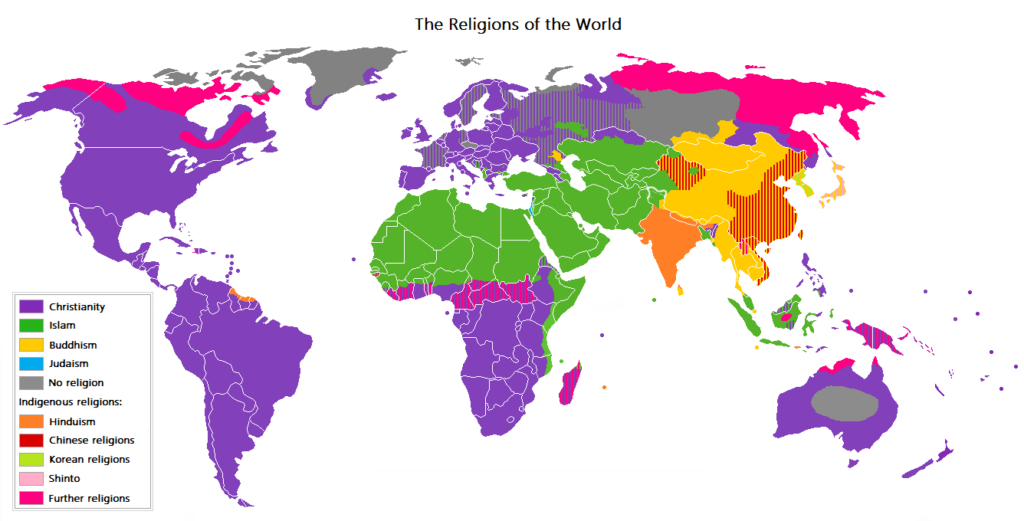
- Christianity:
- Widely dispersed across Europe, Americas, Sub-Saharan Africa and Australia
- Shows maximum spatial spread due to colonial expansion, migration and missionary activities
- Islam:
- Forms a continuous belt from North Africa → West Asia → Central Asia → South Asia → Southeast Asia
- Spread largely through conquests, trade and conversion, resulting in strong spatial contiguity
- Hinduism:
- Highly localized religion, with overwhelming concentration in India and Nepal
- Reflects limited spatial diffusion compared to universal religions
- Buddhism:
- Concentrated mainly in Southeast Asia (Thailand, Myanmar, Laos, Cambodia, Vietnam)
- Also present in East Asia (China, Japan) and Himalayan regions (Bhutan, Mongolia, Sri Lanka)
- Chinese Religious Complex:
- Combination of Confucianism, Taoism and Buddhism, with large proportion of unaffiliated population
- Unaffiliated Population:
- High in countries like China, Japan, North Korea, Czech Republic, Estonia, Hong Kong
- Reflects secularization, modernization and state influence
Processes of Religious Diffusion
- Christianity: Spread mainly through migration and missionary activities, especially during colonial period
- Islam: Spread through military conquests, trade networks and conversions, leading to strong regional belts
- These diffusion patterns explain the present-day spatial clustering and regional dominance of religions
Religious Composition of India
Current Composition (Census 2011)
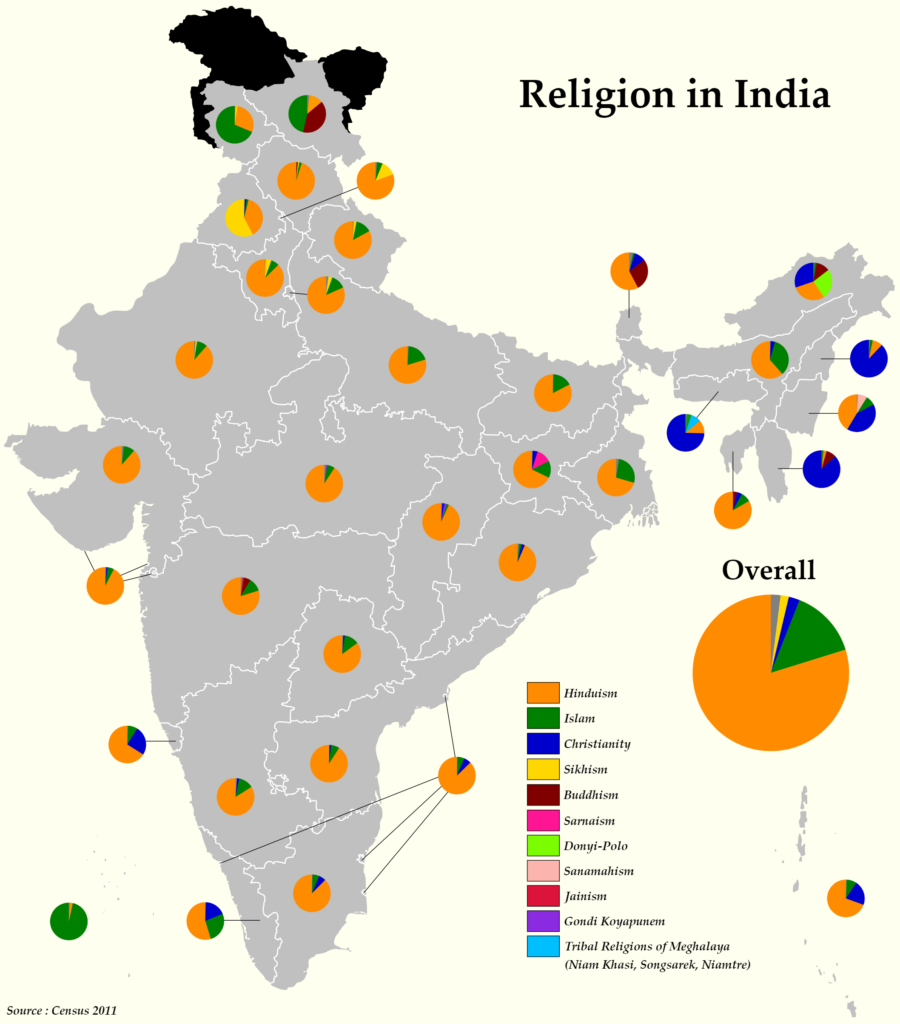
- India’s religious structure reflects dominance with diversity:
- Hindus: ~79.8%
- Muslims: ~14.23% (largest minority)
- Christians: ~2.3%
- Sikhs: ~1.72%
- Buddhists: ~0.70%
- Jains: ~0.37%
- Religious composition includes both:
- Indic religions (indigenous): Hinduism, Buddhism, Jainism, Sikhism
- Extra-Indic religions (external origin): Islam, Christianity, Zoroastrianism

Spatial Diversity in India
- Religious composition varies significantly across regions due to historical diffusion, migration and socio-cultural processes:
- Hindu majority areas:
- Most parts of India, especially central, western and southern regions
- Muslim concentration:
- Jammu & Kashmir, Uttar Pradesh, Bihar, West Bengal, Assam, Kerala
- Reflects historical rule, migration and socio-economic factors
- Christian concentration:
- North-East India (Nagaland, Mizoram, Meghalaya) and parts of Kerala
- Linked to missionary activities and tribal conversions
- Sikh concentration:
- Predominantly in Punjab
- Buddhist concentration:
- Maharashtra (Neo-Buddhists) and Himalayan regions (Ladakh, Sikkim, Arunachal Pradesh)
Temporal Changes in Religious Composition
- Over time, there has been gradual change in relative shares of religious groups:
- Decline in Hindu share:
- From 84.99% (1951) to 79.8% (2011)
- Increase in Muslim share:
- From 9.93% (1951) to 14.23% (2011)
- These changes are attributed to:
- Differential fertility rates
- Socio-economic factors like literacy, income and health
- However, recent trends show:
- Declining growth rate among Muslims (2001–2011)
- Indicating demographic convergence and stabilization
Spatial Pattern in Religious Composition of India
Macro-Level Pattern: Core–Periphery Divide
- The spatial pattern of religious composition in India reflects a distinct core–periphery contrast, where the interior regions (central, western, southern India) are overwhelmingly dominated by Hindus, while peripheral regions (borderlands, coastal belts, and hilly areas) exhibit greater religious diversity and minority concentration.
- This pattern is explained by historical processes such as invasions, trade contacts, missionary activities and migration, which were more intense in frontier regions, making them zones of cultural interaction and religious heterogeneity, unlike the relatively homogeneous interior plains.
Dominance of Hindu Population
- Hindus form the numerical majority in most districts across India, especially in:
- Indo-Gangetic plains (except border districts)
- Peninsular plateau (Maharashtra, Karnataka, Andhra Pradesh, Tamil Nadu)
- Central India (MP, Chhattisgarh)
- The dominance is strongest in the core regions, where historical continuity of Indic civilization and limited external cultural penetration ensured relative homogeneity.
- However, the Hindu dominance is diluted in peripheral and border regions, where other religions have significant presence due to cross-border cultural links and diffusion processes.
Muslim Population: Regional Concentration Patterns
- Muslims, the largest religious minority (~14.23%), show distinct regional clustering rather than uniform distribution:
- North-Western Region:
- Jammu & Kashmir (majority in many districts)
- Reflects historical Islamic rule and proximity to Central Asia
- Eastern India:
- West Bengal (border districts) and Assam (Brahmaputra & Barak valleys)
- Influenced by migration from Bangladesh and historical Bengal Sultanate legacy
- Northern Plains:
- Significant presence in Uttar Pradesh and Bihar, especially in western UP
- Southern India:
- Kerala (Malabar region, especially Malappuram)
- Reflects Arab trade connections and maritime diffusion
- Island Regions:
- Lakshadweep – overwhelmingly Muslim
Christian Population: North-East Concentration
- Christianity is highly concentrated in the North-Eastern hill states, forming a distinct religious region:
- Majority states: Mizoram, Nagaland, Meghalaya
- Significant presence: Manipur, Arunachal Pradesh
- This pattern is attributed to:
- Missionary activities during colonial period
- Conversion among tribal populations
- Relative isolation of hill regions facilitating cultural transformation
- Outside the Northeast, notable presence exists in Kerala, Goa and parts of Tamil Nadu.
Sikh Population: Regional Localization
- Sikhism shows one of the most spatially concentrated patterns among Indian religions:
- Punjab: Core region where Sikhs form majority in most districts
- Adjacent regions: Haryana, Rajasthan (border districts)
- This reflects:
- Historical origin of Sikhism in Punjab region
- Strong regional identity and cultural cohesion
Buddhist Population: Himalayan and Western Clusters
- Buddhists are spatially limited but regionally significant:
- Himalayan region: Ladakh, Sikkim, Arunachal Pradesh
- Western India: Maharashtra (Neo-Buddhist movement led by Dr. B.R. Ambedkar)
- Their distribution reflects both:
- Historical diffusion (Himalayan belt)
- Modern socio-religious movements (conversion in Maharashtra)
Jain and Parsi (Zoroastrian) Distribution
- Jains:
- Numerically small but economically influential urban community
- Concentrated in Rajasthan, Gujarat and Maharashtra
- Parsis (Zoroastrians):
- Highly localized in Mumbai and parts of Maharashtra
- Population is declining due to low fertility and aging
Tribal and Folk Religions
- Found mainly in:
- Central India (Chotanagpur plateau, Bastar region)
- North-East India
- These regions show syncretic religious practices, often blending with Hinduism or Christianity, indicating cultural transition zones.
Urban–Rural Differentiation
- Religious composition also varies by settlement type:
- Urban dominance among minorities:
- Jains (~80% urban)
- Buddhists (~43%), Muslims & Christians (~40%)
- Due to better economic opportunities, trade networks and education
- Rural dominance:
- Sikhs (agricultural base in Punjab)
- Many Hindu populations in agrarian regions
Historical Influence: Partition and Migration
- The Partition of 1947 had a profound impact on India’s religious geography:
- Out-migration of Muslims from North India
- In-migration of Hindus and Sikhs from Pakistan (West & East)
- This led to:
- Regional restructuring of religious composition
- Formation of new demographic clusters, especially in Punjab, Delhi and West Bengal