- Biodiversity conservation is the protection, maintenance, sustainable use and restoration of the variety of life at all three levels: genes, species and ecosystems.
- It aims to keep viable populations of species, the ecological processes that sustain them and the evolutionary potential that lets them adapt.
- Human well-being and the Earth’s ecological balance both depend on the extent and condition of biological diversity. For one to flourish, the other must be nurtured.
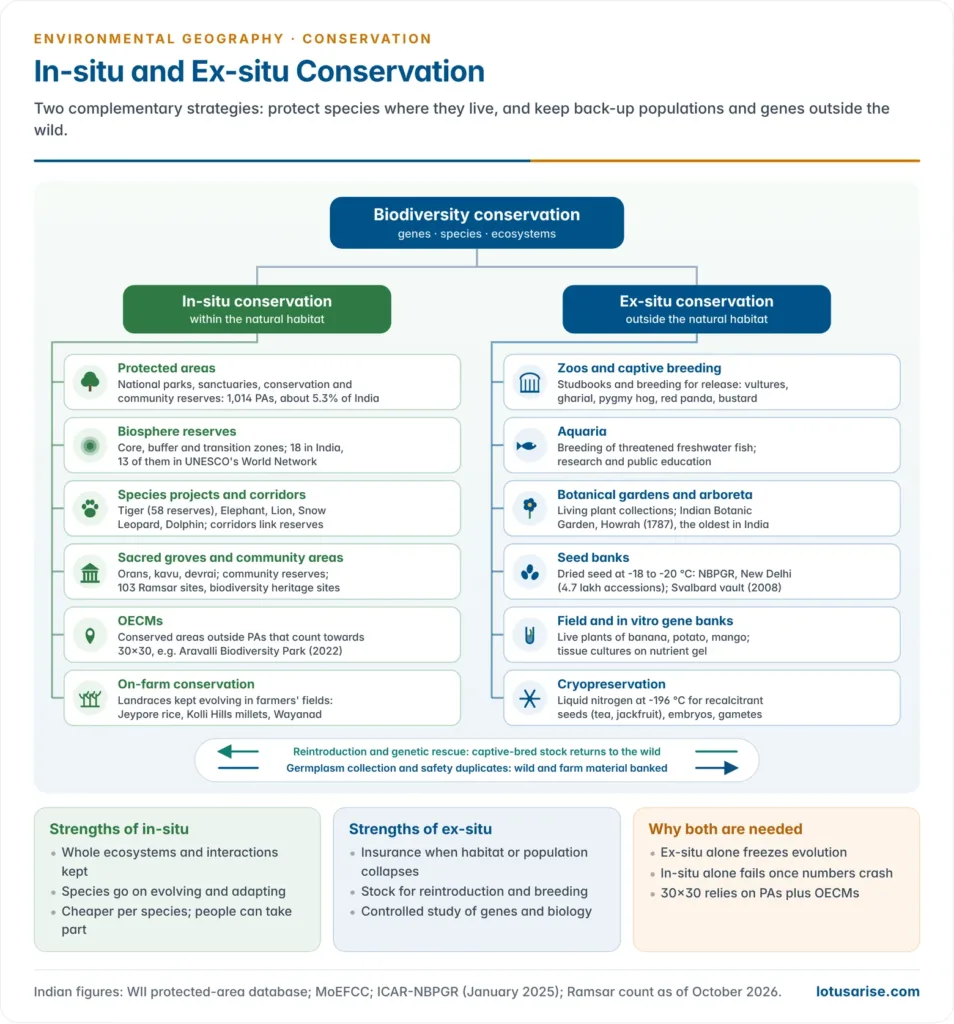
- Conservation measures fall into two complementary strategies:
- in-situ conservation, within the natural habitat;
- ex-situ conservation, outside it.
- Ex-situ methods support and back up in-situ conservation; they never replace it.
- The global target is now set by the Kunming-Montreal Global Biodiversity Framework (2022): its Target 3 (“30×30”) asks countries to conserve 30% of land and 30% of the sea by 2030.
Why Conserve Biodiversity?

Reasons for conservation
- Utilitarian reason: biodiversity supplies food, fibre, fuel, timber and medicines, and the full range of ecosystem services.
- These services include pollination, pest control, climate regulation, flood control and water purification. Every economy and civilisation rests on them.
- Wild genes keep crops and livestock productive; many drugs, from aspirin to the anti-cancer alkaloids of the Madagascar periwinkle, began as plant chemicals.
- Ecological reason: species-rich communities are usually more stable. They resist or recover from natural and human disturbance better and resist invasion by alien species.
- The loss of one species ripples through food webs, because the web of life is seamless.
- Ethical reason: every species has an intrinsic right to exist and to evolve to its full potential, a right no human can take away.
- The present generation holds nature in trust for future generations, a duty of intergenerational equity. Ecocentric thinkers such as Arne Næss built a whole environmental ethic on this claim.
- Crisis reason: biodiversity is declining at an alarming rate.
- The IUCN Red List (October 2025) has assessed 172,620 species, of which 48,646 (about 28%) are threatened with extinction.
- About 41% of amphibians, 26% of mammals, 34% of conifers, 44% of reef-building corals and 11.5% of birds are threatened; 61% of bird species have declining populations.
- Harvests have ignored natural regeneration rates, and industrial and agricultural expansion over the last century has sharply accelerated habitat loss. The drivers of loss, summed up as HIPPO, belong to biodiversity and sustainable development.
Two strategies, one goal
- In-situ conservation protects species where they live, together with their habitat, interactions and evolutionary processes.
- Ex-situ conservation keeps living organisms, seeds, tissues or genes outside the natural habitat, under human care.
- The two are complementary, not competing:
- in-situ conservation is the first line of defence and the only way to keep whole ecosystems working;
- ex-situ conservation is the insurance policy when habitats are lost or populations crash, and the source stock for reintroduction.
- A third, cross-cutting category has grown since 2018: area-based conservation outside formal protected areas, the OECMs, which the 30×30 target now counts alongside protected areas.
Genetic Diversity and Its Conservation
What genetic diversity is
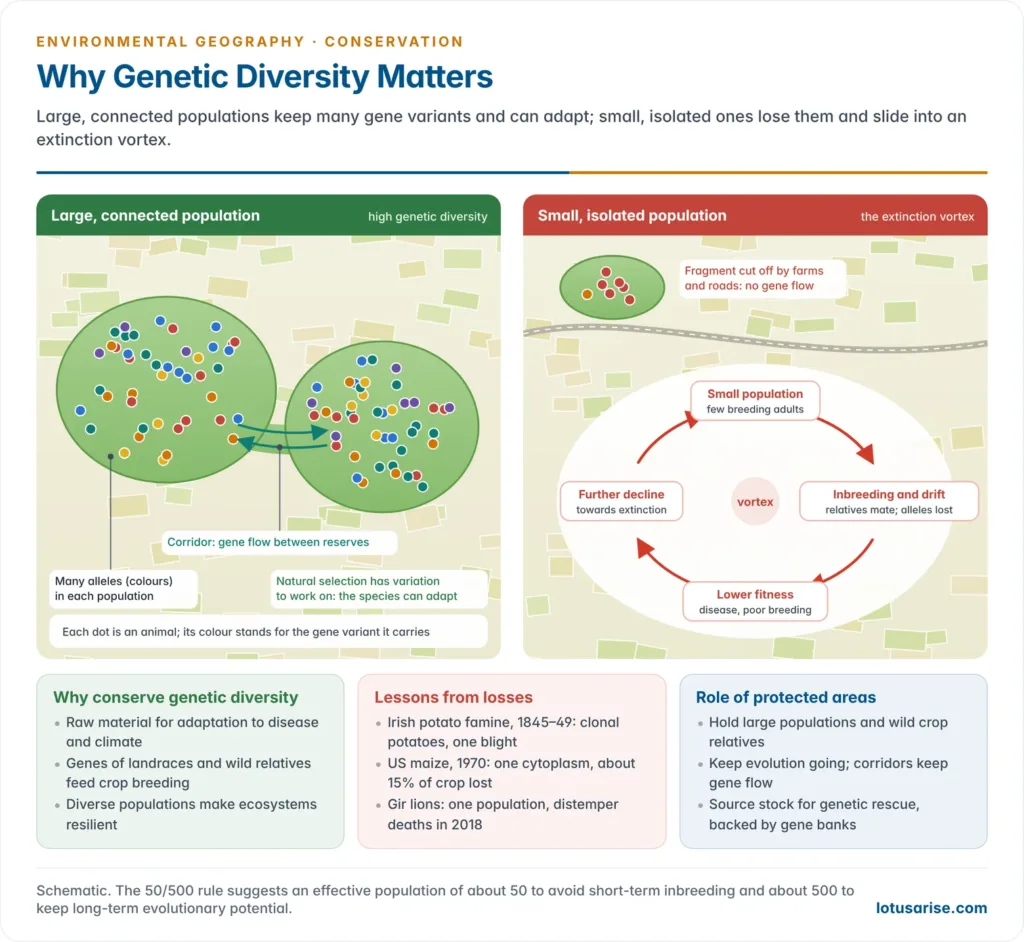
- Genetic diversity is the variation in genes and alleles within a species: between individuals of one population and between populations of the same species.
- It is the most basic of the three levels of biodiversity: species diversity and ecosystem diversity are built on it.
- India’s rice is an example: farmers have bred tens of thousands of distinct landraces, each adapted to a particular soil, water regime or taste.
- It is measured as heterozygosity, the number of alleles per gene and the genetic distance between populations.
- It is lost through small population size (genetic drift), inbreeding, population bottlenecks, habitat fragmentation that isolates populations, and the replacement of many local varieties by a few uniform ones.
Why it is necessary to conserve genetic diversity
- Raw material of adaptation: natural selection can act only on existing variation. A genetically varied species can adjust to new diseases, pests and a warming climate; a uniform one cannot.
- Climate change makes this urgent, because species must either move or adapt in place as their ranges shift.
- Protection against inbreeding depression: in small populations, related individuals mate and harmful recessive genes are expressed.
- Fertility, survival and disease resistance fall, and the population can slide into an extinction vortex, where smallness causes further decline.
- The 50/500 rule of Ian Franklin (1980) and Michael Soulé (1980) puts it simply: an effective population of about 50 avoids short-term inbreeding, and about 500 keeps long-term evolutionary potential.
- Food security: crop and livestock breeding depends on genes from landraces and wild relatives.
- Wild relatives carry resistance to drought, salinity, pests and disease that modern varieties have lost.
- Gene pool centres, the Vavilov centres where crops were domesticated, hold the richest store of this variation.
- Medicine and industry: genetic variants supply new drugs, enzymes and industrial materials; much of this value is still unknown.
- Ecosystem resilience: genetically diverse populations of key species, such as reef-building corals or forest trees, make the whole ecosystem more resilient to stress.
Lessons from loss of genetic diversity
| Case | What happened | Lesson |
|---|---|---|
| Irish potato famine, 1845–49 | Potatoes grown from a few clonal varieties had no resistance to late blight (Phytophthora infestans); about a million people died | Uniform crops fail together |
| Southern corn leaf blight, USA, 1970 | Most hybrid maize shared one male-sterile cytoplasm; blight destroyed about 15% of the national crop | Narrow genetic base is a hidden risk |
| Grassy stunt virus of rice, 1970s | Only one population of the wild rice Oryza nivara from Gonda (Uttar Pradesh) carried resistance; it was bred into IR36 | One wild population can save a staple |
| Cheetah | A severe bottleneck at the end of the last Ice Age left almost no genetic variation | Low variation raises disease and breeding risks |
| Florida panther | Inbred population of a few dozen showed heart defects and poor sperm; eight Texas pumas released in 1995 restored numbers | Genetic rescue works |
| Asiatic lion, Gir | Entire wild population descends from a few dozen survivors; a canine distemper outbreak killed more than 20 lions in 2018 | A single population is one epidemic from disaster |
Do protected areas serve a useful purpose for genetic diversity?
- Yes, in several ways.
- Large, connected populations: protected areas hold populations big enough to resist drift and inbreeding, which captive collections rarely can.
- Continuing evolution: in the wild, species go on co-evolving with pests, pathogens and climate. Genes are kept “alive”, not frozen.
- Wild crop relatives: many protected areas shelter the wild ancestors of crops. The Nokrek Biosphere Reserve (Meghalaya) protects wild citrus such as Citrus indica, and the Western Ghats hold wild pepper, cardamom and mango.
- Many populations of one species: a network of protected areas across a species’ range keeps between-population variation, such as tigers of the Terai, central India and the Sundarbans.
- Source populations for reintroduction and genetic rescue elsewhere.
- But protected areas alone are not enough.
- Many Indian protected areas are small and isolated, so their populations behave as genetic islands. The theory of island biogeography predicts losses in such fragments.
- Corridors are needed to keep gene flow between them, which is why tiger and elephant corridors and landscape connectivity are now planning priorities.
- Agricultural genetic diversity lives on farms, not in parks; it needs on-farm conservation and gene banks.
- Hence the answer is an integrated strategy: protected areas plus corridors, on-farm conservation and ex-situ back-up.
In-situ Conservation
Concept and advantages
- In-situ conservation is the conservation of ecosystems and natural habitats and the maintenance and recovery of viable populations of species in their natural surroundings (Convention on Biological Diversity, Article 2).
- For domesticated or cultivated species, it means conservation in the surroundings where they developed their distinctive properties, that is, on farms.
- Ecologists prefer it because it protects whole habitats, not single species, and with them the web of ecological relationships, evolutionary processes and adaptive capacity.
- In-situ conservation allows organisms to:
- live, multiply and go on evolving in their natural environment;
- keep their ability to withstand environmental stresses such as drought, storms, temperature swings, floods and pathogens;
- flourish together, so that a large number of species is conserved at once;
- keep every trophic level, from producers to top carnivores, in place.
- It is usually cheaper per species than ex-situ care, and local communities can take part.
Protected areas and the IUCN categories
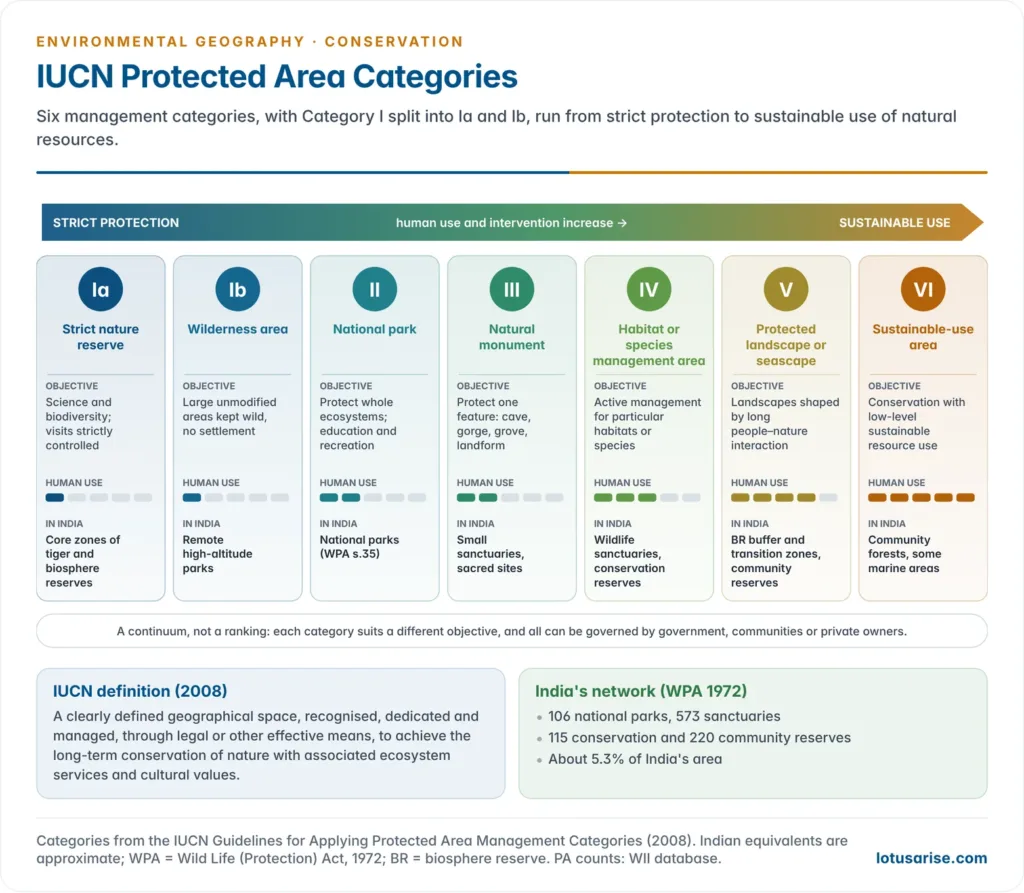
- The IUCN defines a protected area as “a clearly defined geographical space, recognised, dedicated and managed, through legal or other effective means, to achieve the long-term conservation of nature with associated ecosystem services and cultural values”.
- The IUCN classifies protected areas by management objective. The categories give a common language within and between countries and the global standard for recording protected areas.
- They form a continuum from strict protection to sustainable use; no category is “better” than another.
| Category | Name | Main objective | Nearest Indian equivalent |
|---|---|---|---|
| Ia | Strict nature reserve | Science and biodiversity; human visits strictly controlled | Core zones of tiger and biosphere reserves |
| Ib | Wilderness area | Large, unmodified areas without permanent settlement | Remote high-altitude parks |
| II | National park | Protect large ecosystems; allow education and recreation; no extraction | National parks |
| III | Natural monument or feature | Protect a specific feature: a cave, gorge, grove or landform | Some small sanctuaries, sacred sites |
| IV | Habitat or species management area | Active management of habitats or species | Wildlife sanctuaries, conservation reserves |
| V | Protected landscape or seascape | Conserve landscapes shaped by long people–nature interaction | Biosphere reserve buffer and transition zones; community reserves |
| VI | Protected area with sustainable use of natural resources | Conservation with low-level sustainable use | Community-managed forests, some marine areas |
India’s protected area network
- India’s major strength in in-situ conservation is its Protected Area (PA) network, created under the Wildlife (Protection) Act, 1972.
- The Act provides four kinds of protected area: national parks, wildlife sanctuaries, and, since the 2002 amendment (in force 2003), conservation reserves and community reserves.
- Current status (Wildlife Institute of India database):
| Type | Number | Legal basis |
|---|---|---|
| National parks | 106 | Section 35 |
| Wildlife sanctuaries | 573 | Section 18 |
| Conservation reserves | 115 | Section 36A |
| Community reserves | 220 | Section 36C |
| Total | 1,014 PAs, about 1,75,169 km² (5.32% of India) | Wildlife (Protection) Act, 1972 |
- Later notifications have added a few more parks and sanctuaries, but coverage remains only about 5.3% of India’s area, far below the 30×30 goal. That gap is why OECMs matter.
- Overlaid on these are 58 tiger reserves (the 58th, Madhav in Madhya Pradesh, was notified in March 2025), 33 elephant reserves, 18 biosphere reserves and 103 Ramsar sites.
- Eco-sensitive zones (ESZs) cushion protected areas.
- Guidelines (2011) allow ESZs of up to 10 km around a PA.
- The Supreme Court (June 2022) required a minimum 1-km ESZ around every PA; it relaxed this in April 2023 where ESZs were already notified or proposed.
- The Wild Life (Protection) Amendment Act, 2022 (in force April 2023) rationalised the schedules into four, gave legal effect to CITES, and tightened the management of sanctuaries and conservation reserves.
National parks
- National parks are relatively large natural areas little altered by human activity. They protect nature and scenery of national importance for science, education and recreation.
- Under Section 35, a state government may declare an area of ecological, faunal, floral, geomorphological or zoological importance a national park.
- No rights of people are allowed inside once the park is final.
- Grazing of livestock and all destruction, exploitation or removal of wildlife or habitat are prohibited.
- The boundary can be altered only on the recommendation of the National Board for Wildlife.
- Selected examples:
- Keibul Lamjao (Manipur): the world’s only floating national park, on the phumdis of Loktak Lake, home of the sangai (brow-antlered deer).
- Namdapha (Arunachal Pradesh): noted for all four big cats: tiger, leopard, snow leopard and clouded leopard.
- Great Himalayan National Park (Himachal Pradesh): a UNESCO World Heritage Site (2014).
- Marine National Park, Gulf of Kachchh (Gujarat): India’s first marine national park (1982).
- Others: Bandhavgarh (Madhya Pradesh), Bannerghatta (Karnataka), Dibru-Saikhowa (Assam), Kanger Ghati (Chhattisgarh) and Simbalbara (Himachal Pradesh).
Wildlife sanctuaries
- The word sanctuary means a place of protection and safety. A wildlife sanctuary shelters wildlife from hunting and habitat damage.
- Unlike national parks, some human activity is allowed. Settled rights, grazing and the collection of minor forest produce may continue if they do not harm wildlife, and tourism is permitted.
- Like a park, a sanctuary’s boundary can be altered only on the recommendation of the National Board for Wildlife.
- Talchhapar (Rajasthan), a grassland sanctuary for the blackbuck, is a classic small sanctuary.
| Basis | National park | Wildlife sanctuary |
|---|---|---|
| Section of WPA 1972 | 35 | 18 and 26A |
| Human rights inside | None once notified | Some rights allowed if wildlife is not harmed |
| Grazing | Prohibited | May be regulated or permitted |
| Purpose | Whole ecosystem and landscape | Often a species or group of species |
| Upgrading | Can be created from a sanctuary | Can be upgraded to a park |
Selected protected areas of India
| Protected area | State | Key species and fame | Other status |
|---|---|---|---|
| Jim Corbett NP | Uttarakhand | Tiger, elephant, gharial | India’s first national park (1936, as Hailey NP); Project Tiger launched here (1973) |
| Ranthambore NP | Rajasthan | Tiger, leopard, sloth bear | Tiger reserve |
| Bandhavgarh NP | Madhya Pradesh | One of the highest tiger densities; former home of the white tigers of Rewa | Tiger reserve |
| Kanha NP | Madhya Pradesh | Hard-ground barasingha (swamp deer) saved from near-extinction | Tiger reserve |
| Periyar | Kerala | Asian elephant, gaur, Nilgiri tahr | Tiger reserve around Periyar Lake |
| Kaziranga NP | Assam | About two-thirds of the world’s greater one-horned rhinos (2,613 in 2022); wild buffalo | World Heritage Site; tiger reserve |
| Gir NP and Sanctuary | Gujarat | Last wild home of the Asiatic lion | Lions now range across about 35,000 km² of Saurashtra |
| Keoladeo NP | Rajasthan | Wintering waterbirds; once the Siberian crane | World Heritage Site; Ramsar site |
| Sundarban NP | West Bengal | Mangrove tigers, estuarine crocodile, Irrawaddy dolphin | World Heritage Site; tiger reserve; Ramsar site |
| Manas NP | Assam | Pygmy hog, golden langur, hispid hare, Assam roofed turtle | World Heritage Site; tiger and biosphere reserve |
| Bandipur NP | Karnataka | Tiger, elephant, gaur | Tiger reserve; part of Nilgiri Biosphere Reserve |
| Pench NP | Maharashtra | Tiger, gaur, wild dog | Tiger reserve |
Conservation reserves and community reserves
- Conservation reserves (Section 36A): government-owned land, usually adjoining a national park or sanctuary, declared after consulting local communities to protect landscapes, seascapes and corridors between PAs.
- Community reserves (Section 36C): community or private land where the people volunteer to conserve wildlife and habitat, managed by a community reserve management committee.
- They give legal cover to traditions such as sacred groves, the community-protected forests of Nagaland and the bird-nesting villages of the north-east.
- Both soften the “fortress” model of conservation by bringing people inside the system.
Tiger reserves and species reserves
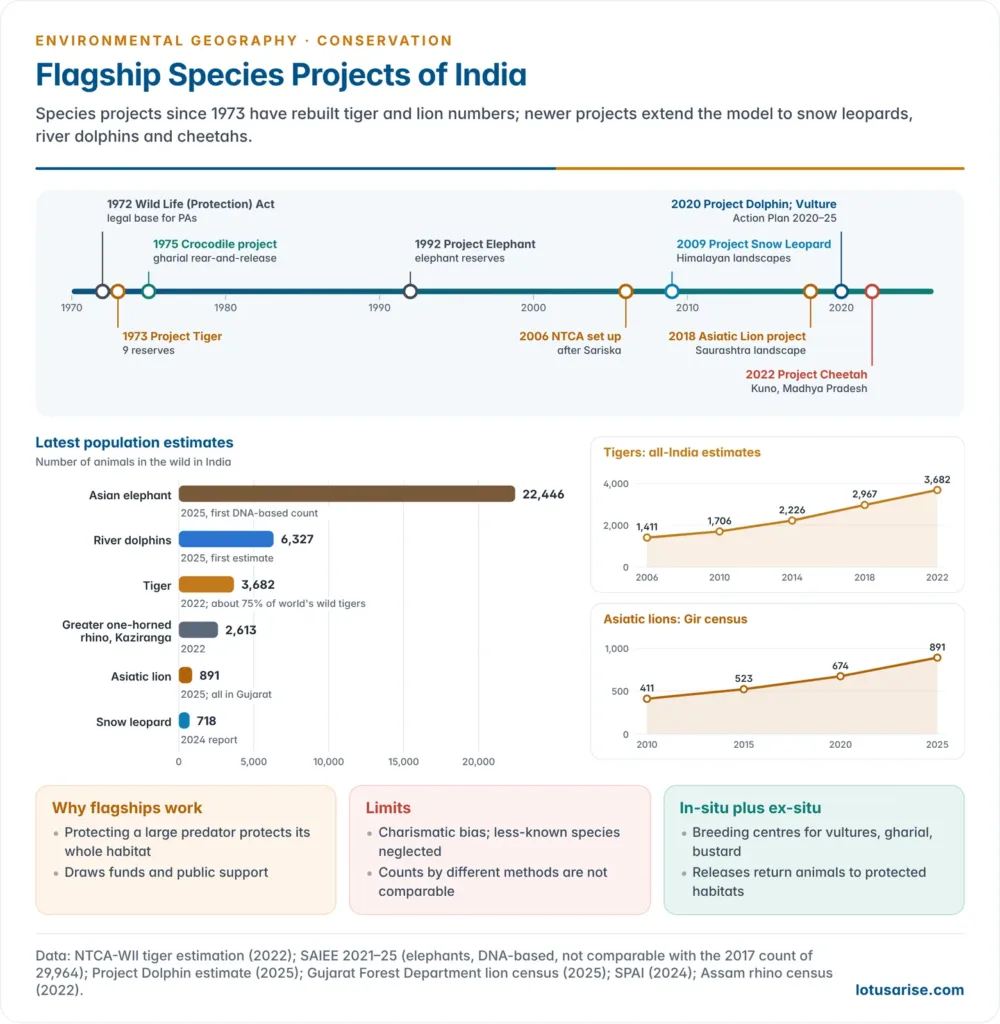
- Project Tiger (1 April 1973) began with nine reserves; there are now 58 tiger reserves, governed under Section 38V by the National Tiger Conservation Authority (2006).
- Each has an inviolate core or critical tiger habitat and a buffer where people and wildlife coexist.
- Elephant reserves under Project Elephant (1992) protect landscapes and corridors for the Asian elephant.
Biosphere reserves
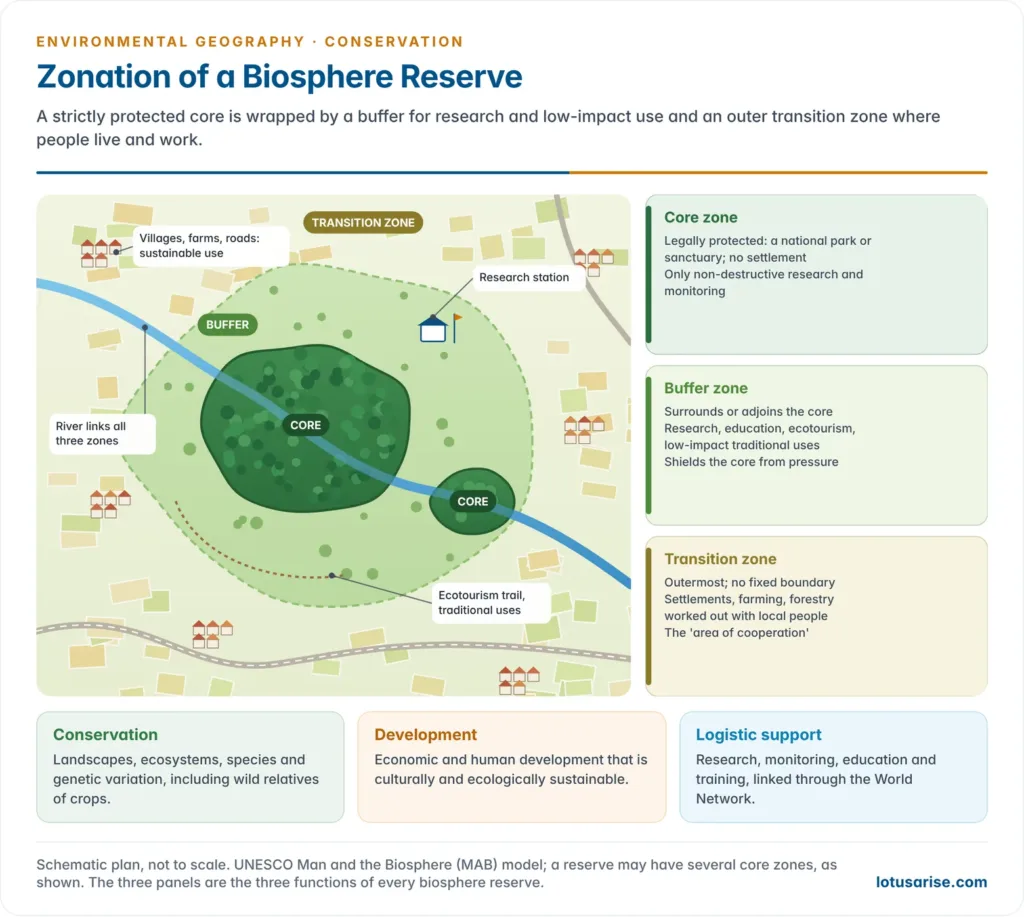
- Biosphere reserves are large areas of terrestrial or coastal ecosystems where people are an integral part of the system.
- They are representative samples of the world’s biomes, internationally recognised by UNESCO for reconciling conservation with sustainable use.
- They come from UNESCO’s Man and the Biosphere (MAB) Programme, launched in 1971. The biosphere-reserve concept was set out in 1974, and the first reserves were designated in 1976.
- The Seville Strategy and Statutory Framework (1995) defined their modern form; the World Network of Biosphere Reserves (WNBR) had 785 sites in 142 countries after the 2025 additions.
- Three functions:
- Conservation of landscapes, ecosystems, species and genetic variation;
- Development that is economically and culturally sustainable;
- Logistic support for research, monitoring, education and training.
Zonation
- The distinguishing feature of a biosphere reserve is its three-zone structure, which allows graded levels of human activity:
| Zone | Status | Activities allowed |
|---|---|---|
| Core zone | Legally protected; often a national park or sanctuary | Only non-destructive research and monitoring; no human settlement |
| Buffer zone | Surrounds or adjoins the core | Research, education, ecotourism, traditional low-impact uses |
| Transition zone | Outermost, no fixed boundary; the “area of cooperation” | Settlements, farming, forestry and other sustainable uses, worked out with local people |
- A reserve may have several core zones, and its transition zone may include towns and farmland. The concentric layout is a model, not a rule.
- Aims:
- preserve genetic diversity in representative ecosystems;
- protect wildlife, the traditional lifestyle of tribal and rural people, and the genetic resources of domesticated plants and animals;
- allow only scientifically managed tourism;
- serve as benchmarks for measuring long-term change in the biosphere.
India’s biosphere reserves
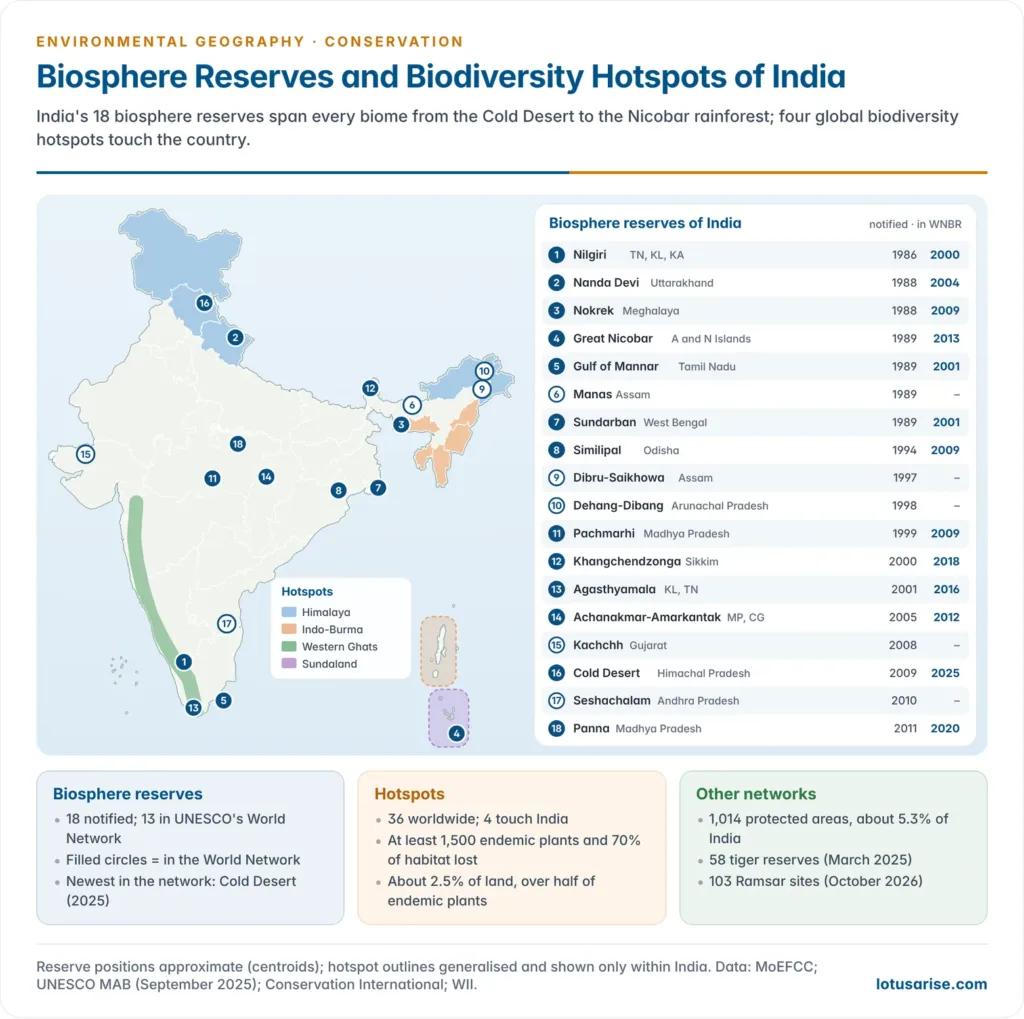
- India has 18 biosphere reserves notified by the Ministry of Environment, Forest and Climate Change, of which 13 are in UNESCO’s World Network.
- The latest addition to the World Network is the Cold Desert Biosphere Reserve (Himachal Pradesh, about 7,770 km² in Lahaul-Spiti), included in September 2025. It covers Pin Valley National Park and the Kibber and Chandratal sanctuaries.
- Nilgiri (1986) was India’s first biosphere reserve; Gulf of Mannar (1989) was the first marine biosphere reserve in South and South-East Asia.
| Biosphere reserve | Year notified | State or UT | Key features | In WNBR |
|---|---|---|---|---|
| Nilgiri | 1986 | Tamil Nadu, Kerala, Karnataka | Mudumalai, Bandipur, Nagarhole, Wayanad, Silent Valley; lion-tailed macaque, Nilgiri tahr | 2000 |
| Nanda Devi | 1988 | Uttarakhand | High Himalaya; snow leopard, Himalayan musk deer | 2004 |
| Nokrek | 1988 | Meghalaya | Red panda, hoolock gibbon; wild citrus | 2009 |
| Great Nicobar | 1989 | Andaman and Nicobar Islands | Tropical island rainforest; leatherback turtle, Nicobar megapode | 2013 |
| Gulf of Mannar | 1989 | Tamil Nadu | Coral reefs, seagrass, dugong | 2001 |
| Manas | 1989 | Assam | Golden langur, pygmy hog | No |
| Sundarban | 1989 | West Bengal | Mangroves; tiger, estuarine crocodile | 2001 |
| Similipal | 1994 | Odisha | Sal forests; tiger, elephant | 2009 |
| Dibru-Saikhowa | 1997 | Assam | Floodplain grassland; feral horses, white-winged duck | No |
| Dehang-Dibang | 1998 | Arunachal Pradesh | Eastern Himalayan forests; Mishmi takin | No |
| Pachmarhi | 1999 | Madhya Pradesh | Satpura range; Satpura tiger reserve, rock shelters | 2009 |
| Khangchendzonga | 2000 | Sikkim | Third-highest peak; snow leopard, red panda | 2018 |
| Agasthyamala | 2001 | Kerala, Tamil Nadu | Southern Western Ghats; endemic plants, Kani tribe | 2016 |
| Achanakmar-Amarkantak | 2005 | Madhya Pradesh, Chhattisgarh | Source of the Narmada and Son; sal forests | 2012 |
| Kachchh | 2008 | Gujarat | Salt desert; wild ass, flamingos | No |
| Cold Desert | 2009 | Himachal Pradesh | Trans-Himalaya; snow leopard, Himalayan ibex | 2025 |
| Seshachalam | 2010 | Andhra Pradesh | Eastern Ghats; red sanders | No |
| Panna | 2011 | Madhya Pradesh | Ken river gorges; tiger | 2020 |
Biodiversity hotspots
- Norman Myers (1988) proposed biodiversity hotspots: regions where conservation money would protect the most species per unit area.
- Criteria (Conservation International): a region must have at least 1,500 endemic vascular plant species and must have lost at least 70% of its original vegetation.
- There are now 36 hotspots. They cover about 2.5% of the Earth’s land but hold more than half of all endemic plant species and about 43% of endemic birds, mammals, reptiles and amphibians.
- India’s four hotspots:
- the Himalaya;
- Indo-Burma (the north-eastern hills south of the Brahmaputra, and the Andaman Islands);
- the Western Ghats and Sri Lanka;
- Sundaland (the Nicobar Islands).
- Hotspots set priorities; they are not legal protection in themselves. Within them, protected areas, community reserves and corridors do the actual conserving.
Ramsar sites and other designations
- Ramsar sites are wetlands of international importance listed under the Ramsar Convention (1971).
- India joined in 1982, with Chilika Lake and Keoladeo as its first sites.
- The network has grown fastest since 2022. With Sukhna Lake (Chandigarh) and Sauj Jheel (Uttar Pradesh) in October 2026, India has 103 Ramsar sites.
- Many Ramsar sites are not protected areas, so the listing brings attention and management plans to wetlands that the Wildlife Act does not cover.
- Biodiversity Heritage Sites (Section 37, Biological Diversity Act 2002) are notified by states for unique, ecologically fragile ecosystems that people still use. The first was the Nallur Tamarind Grove (Karnataka, 2007).
- World Heritage natural sites (Kaziranga, Manas, Keoladeo, Sundarbans, Nanda Devi and Valley of Flowers, Western Ghats, Great Himalayan National Park, Khangchendzonga) add international recognition.
Sacred groves
- A sacred grove is a patch of forest of religious importance to a community, ranging from a few trees to large forests.
- Each grove is usually dedicated to a presiding deity, and all life within it is under the deity’s protection.
- These are among the oldest and most effective community-based conservation systems anywhere.
- Hunting, logging and even the removal of dead wood are forbidden. Community members take turns to guard the grove.
- Groves are thus de facto sanctuaries and gene banks, maintained by faith and custom, not by government agencies.
- Biodiversity value:
- Groves are refugia for species lost from the surrounding landscape, storehouses of rare plants, medicinal herbs and wild relatives of crops.
- They often protect springs and streams that feed village water supplies.
- India may have about 1,00,000 sacred groves, from the Thar to the rainforests of the Western Ghats:
| Region | Local name |
|---|---|
| Karnataka | Devara kadu |
| Kerala | Kavu |
| Maharashtra | Devrai |
| Himachal Pradesh | Deo van |
| Rajasthan | Oran, Dev van, Rundh |
| Jharkhand, Odisha | Sarna |
| Meghalaya | Law kyntang (Mawphlang grove) |
- Threats:
- changing social values and weakening beliefs under modernisation and urbanisation;
- over-exploitation of resources and environmental damage in the surrounding landscape;
- partial clearing for shrines, temples and roads;
- the spread of the market economy, raising demand for timber and forest produce.
- Legal protection:
- Groves can be notified as community reserves under Section 36C.
- In December 2024 the Supreme Court directed Rajasthan to map its orans and sacred groves, classify them as “forests”, declare them community reserves where appropriate, and recognise the communities’ rights under the Forest Rights Act, 2006.
- It also asked the Union environment ministry to frame a national policy for sacred groves and to survey them across the country.
People’s Biodiversity Registers
- People’s Biodiversity Registers (PBRs) document local knowledge of biodiversity: the plants, animals, crop varieties and uses known to a village or ward.
- Objectives:
- to record indigenous knowledge so that those who need it can use it;
- to preserve traditional ecological knowledge for the public good;
- to renew faith in local wisdom and in self-government.
- The idea was first tried in Kerala and Karnataka in the 1990s.
- The problem: freely available knowledge can be taken and patented by outsiders. For PBRs to work, control over the information must rest with local communities and their institutions.
- The Biological Diversity Act, 2002 requires a Biodiversity Management Committee (BMC) in every local body, and each BMC maintains a PBR.
- India now has over 2.77 lakh BMCs and over 2.73 lakh PBRs, though their quality varies greatly. Electronic PBRs are being piloted to keep them updated while leaving control with communities.
- BMCs also have a role in access and benefit-sharing under the Act and the Nagoya Protocol, part of the Convention on Biological Diversity framework.
OECMs and the 30×30 target
- Other effective area-based conservation measures (OECMs) were defined by the CBD in 2018 as areas other than protected areas that are governed and managed in ways that achieve positive and sustained long-term outcomes for the in-situ conservation of biodiversity.
- The test is the outcome, not the purpose: a military range, a well-managed catchment or a sacred grove can qualify if biodiversity thrives there.
- Target 3 of the Kunming-Montreal GBF asks that by 2030 at least 30% of land and inland waters and 30% of coastal and marine areas be effectively conserved through protected areas and OECMs that are ecologically representative, well connected and equitably governed, recognising indigenous and traditional territories.
- Where the world stands (Protected Planet Report, October 2024):
- protected and conserved areas cover 17.6% of land and 8.4% of the ocean;
- less than 5% of land has been shown to be effectively managed;
- only 8.5% of land is both protected and well connected.
- India’s response:
- Criteria for identifying OECMs were developed with UNDP in 2022.
- The Aravalli Biodiversity Park, Gurugram became India’s first OECM on World Wetlands Day, February 2022.
- Candidate sites include sacred groves, agro-biodiversity landscapes such as the Apatani valley and the Kashmir saffron fields, community-protected wetlands and industrial green belts.
- India’s updated NBSAP (2024) carries a national version of the 30×30 target, which can only be met by adding OECMs and community-conserved areas to its 5.3% of formal protected areas.
- Concerns: weak criteria could allow “paper” OECMs that inflate coverage without real protection, and the rights of local communities must not be overridden in the rush to count area.
On-farm conservation of crop genetic resources
- Plant genetic resources for food and agriculture are among the most basic resources on Earth: they underpin food security now and for future generations.
- Agricultural biodiversity, the genetic diversity of domesticated crops, is best conserved not in parks but on working farms.
- On-farm conservation is the conservation of genetic diversity of traditional crops in the surroundings where they developed their distinctive properties.
- It is the sustainable management of locally developed varieties by farmers within traditional agricultural, horticultural or agri-silvicultural systems.
- Two activities:
- On-farm conservation: keeping the genetic diversity within a farming system;
- On-farm management: keeping the traditional farming system itself, whatever happens to individual landraces.
- Threats:
- replacement of landraces by uniform high-yielding varieties and hybrids, which narrows the genetic base of farming;
- habitat destruction and projects that displace traditional farming communities;
- invasion by aggressive exotic plants;
- mechanisation, which favours standard varieties.
Why on-farm conservation matters more than gene banks for crops
- In farmers’ fields, crops keep evolving with local pests, diseases, droughts and floods.
- Seeds frozen in gene banks do not evolve; taken out decades later in a crisis, they may lack adaptation to the conditions of that time.
- On-farm conservation builds up traits suited to particular eco-regions and to the needs of local communities.
- Outcomes:
- continuing evolution and adaptation of crops;
- continued selection by farmers for their own needs and tastes;
- preserved indigenous knowledge, stronger local institutions and farmers’ participation in national programmes;
- a back-up to gene bank collections, and natural laboratories for research.
- It matters especially in a diversity-rich country like India, where small farmers practise low-input farming and rely on traditional varieties and semi-wild species.
- Farmers have done it since farming began, as part of growing crops; women are often the seed keepers of these systems, a role central to gender and biodiversity.
India’s on-farm conservation: community examples
- India is a centre of origin of rice, sugarcane, mango, many cucurbits and pulses, and has thousands of rice landraces and over 1,000 varieties of mango.
- Jeypore tract (Odisha): a major centre of rice diversity, conserved by more than 20 tribal groups and recognised by the FAO as a Globally Important Agricultural Heritage System.
- Kolli Hills (Tamil Nadu): small millets, conserved by the Malayali tribe.
- Wayanad (Kerala): medicinal plants and traditional rice, conserved by the Kurichya, Kuruma and Paniya communities.
- The Irula and Malayali tribes set aside part of every harvest as seed, never to be eaten.
- These belts overlap India’s agro-biodiversity hotspots.
Flagship species conservation projects
- India runs species-focused projects for flagship animals. Protecting a flagship’s habitat protects everything else that lives there, so they are in-situ programmes at heart, with ex-situ breeding where numbers are critical.
- The best known is Project Tiger, now half a century old.
| Project | Launched | Latest status | Key measures |
|---|---|---|---|
| Project Tiger | 1973 | 3,682 tigers (2022 estimate), about 75% of the world’s wild tigers; 58 reserves | Core–buffer reserves, NTCA (2006), anti-poaching, village relocation |
| Crocodile Conservation Project | 1975 | Gharial, mugger and saltwater crocodile recovered from near-extinction | Rear-and-release; Chambal and Bhitarkanika sanctuaries |
| Project Elephant | 1992 | 22,446 elephants (2025, first DNA-based count) | 33 elephant reserves, corridors, conflict mitigation |
| Project Snow Leopard | 2009 | 718 snow leopards (2024 report) | Landscape approach with Himalayan communities |
| Asiatic Lion Conservation Project | 2018 | 891 lions (2025), up from 674 in 2020 | Habitat expansion in Saurashtra, veterinary care |
| Project Dolphin | 2020 | 6,327 river dolphins (2025, first estimate) | River habitat protection, community involvement |
| Project Cheetah | 2022 | Reintroduction in Kuno and Gandhi Sagar | Translocation from Namibia and South Africa |
- The 2025 elephant count used DNA from dung and is not directly comparable with the older 2017 count of 29,964, though it signals real declines in the north-east and central India.
Limitations of in-situ conservation
- Isolation and fragmentation: many PAs are small islands in farmland, so populations lose genetic diversity and cannot move as the climate shifts.
- People–park conflict:
- Strict protection can exclude forest dwellers from land they depended on, and relocation is often poorly compensated.
- Wildlife spilling out of PAs raids crops and kills people and livestock: the human–wildlife conflict now growing round most reserves.
- Poaching and illegal trade in tiger parts, rhino horn, pangolin scales and birds.
- Development pressure: roads, railways, mines, dams and tourism around and through PAs, and frequent de-notification or boundary changes.
- Invasive species such as Lantana camara and Prosopis juliflora choke habitats, and forest fires spread.
- Weak management capacity: vacant frontline posts, too little money and weak science.
- Limited coverage: only about 5.3% of India is formally protected, and grasslands, deserts and freshwater are badly under-represented.
- Remedies: corridors and landscape planning, co-management with communities, compensation and early-warning against conflict, ex-situ back-up for the most threatened species, and wider recognition of community-conserved areas and OECMs. India’s wider environmental conservation movement, from Chipko to the Bishnois, shows how much depends on local people.
Ex-situ Conservation
Concept and when it is needed
- Ex-situ conservation is the conservation of components of biological diversity outside their natural habitats (CBD, Article 2).
- It works through zoos and captive breeding, aquaria, botanical gardens and arboreta, and gene banks: seed banks, field gene banks, tissue culture and cryopreservation.
- It is costlier than in-situ conservation, but indispensable:
- when in-situ conservation is no longer possible because the habitat is gone;
- when a species has fallen to critically small numbers;
- when a rapid response is needed to prevent extinction;
- as back-up collections of genetic material that may disappear from the wild;
- for research, education and public awareness.
Methods of ex-situ conservation
Zoos, captive breeding and aquaria
- Zoos were once menageries for display; today their main role is conservation breeding, education and research.
- The Central Zoo Authority (1992) recognises and regulates India’s zoos and coordinates planned conservation breeding of endangered species.
- Modern programmes keep studbooks to avoid inbreeding and aim to return animals to the wild after a few generations.
- Indian successes:
- Gharial: eggs collected from the Chambal and other rivers were reared and released from the 1970s.
- Pygmy hog: bred in Assam since 1996 and released into Manas and other grasslands.
- Red panda and snow leopard: bred at the Padmaja Naidu Himalayan Zoological Park, Darjeeling.
- Great Indian bustard: breeding centres at Sam and Ramdevra (Jaisalmer) hatch chicks from wild-collected eggs.
- Aquaria were mainly educational; growing threats to freshwater species now make them centres of captive breeding of endangered fish.
Vulture conservation breeding centres
- India’s three resident Gyps vultures (white-rumped, long-billed and slender-billed) fell by more than 97–99% from the 1990s.
- The cause was diclofenac, a veterinary painkiller. Vultures eating carcasses of treated cattle died of kidney failure and visceral gout.
- Policy response:
- veterinary diclofenac banned in 2006;
- ketoprofen and aceclofenac banned for animal use in 2023, and nimesulide at the turn of 2025;
- the Action Plan for Vulture Conservation 2020–2025 for all nine Indian vulture species.
- Why breeding centres are central to the plan:
- Wild numbers are too low for natural recovery to be quick or safe, and the birds breed slowly: one egg a year, first breeding at about five years.
- The centres hold an insurance population, safe from poisoned carcasses, while drugs are removed from the landscape.
- The work began at Pinjore (Haryana) in 2001; others followed at Rajabhatkhawa (West Bengal), Rani (Assam) and Kerwa (Bhopal). Hundreds of birds have now been bred.
- Captive-bred birds are released into Vulture Safe Zones, where carcass and pharmacy surveys show the landscape is free of toxic drugs, and they are satellite-tagged to track survival.
- The programme shows the logic of the whole subject: ex-situ breeding buys time, but recovery happens only when the in-situ threat is removed.
Botanical gardens and arboreta
- Plants are easier to maintain ex-situ than animals: their needs are simpler, and breeding and propagation are easier.
- Botanical gardens keep living collections, propagate rare species and educate the public.
- The Acharya Jagadish Chandra Bose Indian Botanic Garden, Howrah (1787) is the oldest in India; others include the Lalbagh (Bengaluru), Ooty and Lucknow gardens.
Gene banks: seeds, tissues and cryopreservation
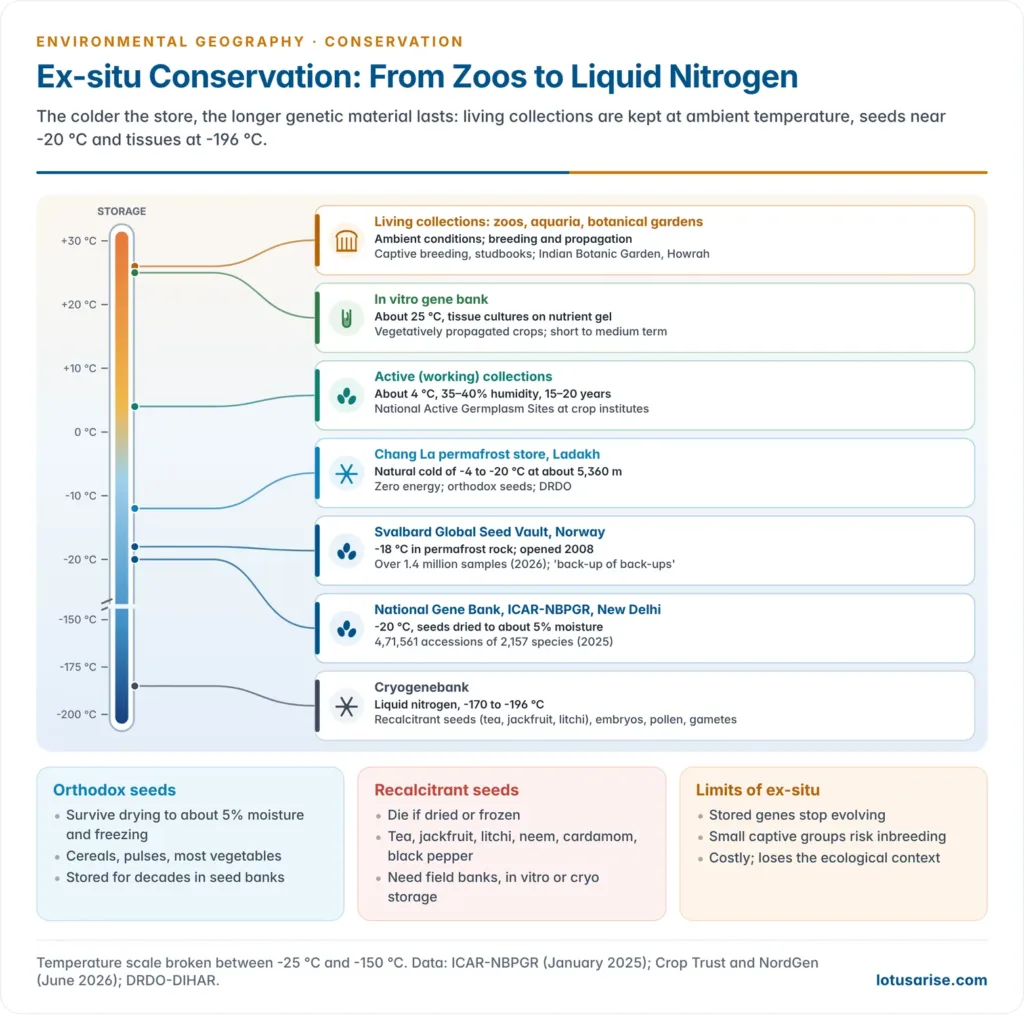
- Seed banks store seeds dried to about 5% moisture and sealed in laminated aluminium foil at −18 to −20 °C.
- Such orthodox seeds of cereals, pulses and many vegetables can stay viable for decades to a century or more.
- Seed banking is a last line of defence when all other options have failed.
- Field gene banks keep living plants of crops that are propagated vegetatively or have short-lived seed: banana, potato, sugarcane, mango, coconut.
- In vitro gene banks hold tissue cultures on nutrient gel for short- to medium-term storage. Tissue culture also multiplies plants rapidly in aseptic conditions.
- Cryopreservation stores tissues in liquid nitrogen at −196 °C, suspending all metabolism.
- It is used for species with recalcitrant seeds, which die if dried or frozen: tea, jackfruit, litchi, neem, almond, black pepper and cardamom.
- It also stores meristems, embryos, pollen, gametes, semen and cell cultures, including those of animals.
- DNA banks keep extracted genetic material for research and identification.
Gene banks: international and Indian initiatives
International: the CGIAR network
- The CGIAR (formerly the Consultative Group on International Agricultural Research), set up in 1971, supports a network of international agricultural research centres such as IRRI (rice, Philippines), CIMMYT (maize and wheat, Mexico) and ICRISAT (dryland crops, Patancheru near Hyderabad).
- Their genebanks together form the world’s largest international ex-situ collection of crop genetic resources, held in trust for all under the International Treaty on Plant Genetic Resources for Food and Agriculture (2001).
- The G-15 group of developing countries agreed to network gene banks for medicinal and aromatic plants, with India as coordinator.
The Svalbard Global Seed Vault
- The Svalbard Global Seed Vault, nicknamed the “Doomsday Vault”, is the world’s back-up of back-ups: insurance against the loss of seeds in national and international gene banks.
- It opened in February 2008 near Longyearbyen on Spitsbergen, Norway, deep inside a sandstone mountain.
- Features:
- chambers cut more than 100 m into permafrost rock, held at −18 °C;
- seeds in sealed foil packets inside sealed boxes;
- run jointly by Norway, the Crop Trust and the Nordic Genetic Resource Centre (NordGen);
- a “black box” arrangement: boxes remain the property of the depositor and are opened only with its permission, protecting sovereign rights.
- It held over 1.4 million seed samples after its June 2026 deposit.
- The value of the system was proved in 2015, when ICARDA withdrew seeds to rebuild its collection lost in the Syrian war.
- India made its first official deposit, pigeon pea samples from ICAR, in 2014; ICRISAT in Hyderabad has duplicated most of its collection there.
India’s National Gene Bank (ICAR-NBPGR)
- India’s National Gene Bank at the ICAR-National Bureau of Plant Genetic Resources (NBPGR), New Delhi, was established in 1996.
- It holds 4,71,561 accessions of 2,157 species (January 2025), making it the second-largest gene bank in the world after Svalbard.
- Features:
- conserves seeds, vegetative propagules, tissue and cell cultures, embryos and gametes;
- seeds in long-term modules at −20 °C, at about 5% moisture, sealed in laminated aluminium foil;
- a cryogenebank (−170 to −196 °C) for recalcitrant species such as tea, jackfruit, litchi, neem, almond, black pepper and cardamom;
- a network of National Active Germplasm Sites at crop institutes, holding working collections at about 4 °C and 35–40% humidity for 15–20 years.
- Other national gene banks cover animal breeds (NBAGR, Karnal), fish (NBFGR, Lucknow), microbes (NBAIM, Mau) and insects (NBAIR, Bengaluru).
- The Union Budget 2025–26 announced a second National Gene Bank to conserve 10 lakh germplasm lines for future food and nutritional security.
Chang La permafrost seed store (DRDO)
- The Defence Institute of High Altitude Research (DIHAR) of the DRDO set up a natural cold store for seeds at Chang La, Ladakh, at about 5,360 m.
- Features:
- natural permafrost keeps it at about −4 to −20 °C, with seeds at 10–20% moisture;
- zero energy cost and no carbon footprint;
- the same black box principle as Svalbard;
- meant for orthodox seeds of food and agricultural crops, and for studying seed storage under natural versus artificial cold.
Community gene banks
- M. S. Swaminathan Research Foundation (MSSRF): a community gene bank linked to its agrobiodiversity work in the Jeypore tract, Kolli Hills and Wayanad.
- Farming communities deposit their own seeds; MSSRF holds them in trust, with a duplicate at the National Gene Bank.
- Village gene–seed–grain banks, school genome clubs and an agrobiodiversity conservation corps of rural youth and women carry the work into villages.
- Gene Campaign’s zero-energy seed banks:
- simple moisture-proof, light-proof, well-aired rooms inside villages;
- managed and controlled by the community, with knowledge recorded at collection;
- focused on rice, millets, pulses, oilseeds and vegetables in diversity-rich regions.
Limitations of ex-situ conservation
- No evolutionary adaptation: frozen seeds and captive animals do not evolve with changing pests and climate, and captive animals may lose wild behaviour.
- Coverage gaps: recalcitrant seeds of many tropical trees cannot be stored conventionally, and crops of regional importance that are little traded are poorly represented.
- Small populations: captive groups suffer inbreeding and genetic drift unless carefully managed.
- High cost: energy, infrastructure and expert staff for decades.
- No ecological context: pollinators, soil microbes and co-evolved partners are left behind.
- Risk of loss: power failures, war, disease or simple neglect can destroy collections, which is why safety duplicates go to Svalbard.
In-situ versus Ex-situ Conservation: an Integrated Strategy
Comparison
| Basis | In-situ | Ex-situ |
|---|---|---|
| Where | In the natural habitat | Outside the natural habitat |
| For wild species | National parks, sanctuaries, biosphere reserves, sacred groves, community reserves | Zoos, aquaria, botanical gardens, seed and tissue banks |
| For crops | On-farm conservation of landraces | Gene banks, seed vaults, tissue culture, cryopreservation |
| Evolution | Continues; species keep adapting | Stops; genetic material is static |
| Ecological context | Whole ecosystem kept | Lost |
| Cost | Lower per species if habitat is secure; high for enforcement | High: infrastructure, energy, expertise |
| Coverage | Broad: all species in the habitat | Narrow: selected species and varieties |
| Indian examples | Project Tiger, Kaziranga, Nilgiri BR, sacred groves | NBPGR, Chang La, MSSRF, Indian Botanic Garden Howrah, vulture breeding centres |
| International examples | Yellowstone (USA, 1872), Serengeti (Tanzania) | Svalbard Global Seed Vault, CGIAR genebanks |
Linking the two
- The strategies are complementary: ex-situ is the insurance when in-situ fails, and in-situ is the only place where conserved species can again live and evolve.
- Reintroduction joins them:
- captive-bred gharials, pygmy hogs and vultures returned to protected habitats;
- cheetahs translocated to Kuno (2022);
- genetic rescue of inbred populations with outside stock.
- Seed banks back up farms, and farmers’ fields keep evolving the varieties the banks store.
- Methods of conserving biodiversity for sustainable development therefore combine:
- protected areas and corridors for wild species;
- community conservation, sacred groves and OECMs to reach beyond the 5% of protected land;
- on-farm conservation and gene banks for agricultural diversity;
- sustainable use and benefit-sharing through the Biological Diversity Act and BMCs, so that conservation pays local people;
- ecosystem restoration of degraded land;
- education and awareness, and international cooperation through the CBD, CITES, Ramsar and the 30×30 target.
Previous Year Questions
2024Conservation and breeding centres are important component of the Action Plan for Vulture Conservation 2020-2025. Why?2019Why is it necessary to conserve genetic diversity of species? Do protected areas serve any useful purpose in this context?2019Discuss the problems of wildlife conservation and management in India.2015Discuss the methods of conserving biodiversity for sustainable development.2014Suggest the measures of wild-life conservation with reference to extinction of rare species.