- Human–wildlife conflict (HWC) arises when the needs or behaviour of wild animals and people collide: animals damage crops, kill livestock, injure or kill people and damage property, and people retaliate against the animals.
- It is a problem of the interface: the forest edge, the farm next to a reserve, the corridor cut by a highway, and the city fringe where leopards hunt stray dogs.
- Conflict is rising worldwide. Wildlife habitat is shrinking, human land use is pushing into it, and some protected species are recovering in landscapes that are now crowded with people.
- India is the sharpest case. It holds about three-quarters of the world’s wild tigers and the largest population of Asian elephants, inside a country of more than 1.4 billion people whose protected areas cover only about 5% of its land.
- Between 2020 and 2024, elephants killed about 2,869 people and tigers 378 in India.
- Elephant attacks alone have killed more than 500 people a year since at least 2019.
- HWC is now treated as a conservation problem, a livelihood problem and a disaster-management problem at once. The answer is increasingly framed as coexistence, not the removal of one side.
Concept and Nature of Human–Wildlife Conflict

Meaning
- The IUCN Species Survival Commission describes HWC as struggles that arise when the presence or behaviour of wildlife poses an actual or perceived, direct and recurring threat to human interests or needs. These struggles lead to disagreements between groups of people and to negative impacts on people, wildlife or both.
- The definition carries two layers:
- Human–wildlife impacts: the material damage itself, such as a raided field, a killed cow or a trampled hut.
- Human–human conflict over wildlife: the dispute between farmers, forest departments, conservationists, courts and politicians over who bears the cost and what should be done.
- Steve Redpath and colleagues (2013) called these conservation conflicts. Francine Madden (2004) had argued that the social layer is often harder to resolve than the damage.
- Perception matters as much as loss. A single leopard attack can make a whole taluka fearful, while larger but slower crop losses to wild boar receive less attention.
- Coexistence is the goal of current policy: a dynamic but sustainable state in which people and wildlife share landscapes, with risks kept tolerable and costs fairly shared.
- Target 4 of the Kunming–Montreal Global Biodiversity Framework (2022) asks countries to manage human–wildlife interactions to minimise conflict for coexistence.
- The IUCN SSC Guidelines on Human–Wildlife Conflict and Coexistence (2023) set out the international approach.
Forms of conflict
| Form | What happens | Main Indian species |
|---|---|---|
| Crop raiding | Animals feed on or trample standing crops and stored grain | Elephant, wild boar, nilgai, monkeys, blackbuck, gaur, deer |
| Livestock depredation | Predators kill cattle, goats, dogs and poultry | Tiger, leopard, wolf, snow leopard, dhole |
| Attacks on people | Death or injury, often by surprise encounter | Elephant, tiger, leopard, sloth bear, crocodile, snakes |
| Property damage | Houses, granaries, fences, water pipes broken | Elephant, monkeys |
| Collisions | Deaths on railways, roads and power lines | Elephant, leopard, deer, birds |
| Disease spill-over | Pathogens pass between wildlife, livestock and people | Bats, rodents, monkeys (zoonoses) |
| Retaliation | Poisoning, snares, live electric wires, killing of “problem” animals | Tiger, leopard, elephant, wild boar |
- Snakebite is the single largest wildlife-related killer in India, at about 58,000 deaths a year on average between 2000 and 2019. It is a public-health problem as much as a conflict problem, and it links HWC to environment and human health.
A geography of interfaces
- HWC is spatially concentrated. It occurs where wildlife habitat meets intensive human land use:
- the forest–farm edge around protected areas;
- corridors and stepping-stone forests that animals must cross between reserves;
- plantation landscapes (tea, coffee, sugarcane) that give cover but little natural food;
- the peri-urban fringe, where garbage and stray animals feed predators.
- In India much large wildlife lives outside protected areas. Elephants range across farmland in Odisha and Assam, and tigers and leopards live in the sugarcane and forest-patch mosaics of Maharashtra and the Terai.
- Protected areas are islands in a sea of farmland, so animals cannot meet their needs without crossing human land.
- The pattern is land sharing by default: wildlife and people use the same land without having planned to share it. Conflict follows wherever sharing is unplanned and unmanaged.
Causes of Human–Wildlife Conflict
- The causes work at two levels:
- Proximate (immediate) causes bring a particular animal and a particular person together: a ripe crop, a blocked path, a garbage dump.
- Ultimate (underlying) causes shape the landscape in which such meetings become frequent: population growth, land conversion, infrastructure, climate change and conservation success itself.
Habitat loss, fragmentation and blocked corridors
- Habitat loss shrinks the area and the food available to wide-ranging animals. Elephants need large home ranges, often hundreds of square kilometres, and move seasonally between forest blocks.
- Habitat fragmentation breaks forest into patches separated by farms, roads and settlements.
- Animals moving between patches must now pass through villages and fields, so a seasonal migration becomes a series of conflicts.
- Corridor blockage: when settlements, fences, resorts or mines close a traditional route, elephant herds detour into farmland or are trapped in small forest islands next to villages.
- The deforestation of the Chotanagpur plateau and the eastern Ghats has left small, isolated herds in central India.
- These herds raid crops most intensely because their natural forage is poorest.
Land-use change at the forest edge
- Farming right up to the forest boundary places the most nutritious food in the landscape within a few metres of wildlife.
- Paddy, sugarcane, maize, bananas, jackfruit and vegetables are richer and easier to eat than wild forage.
- Crop raiding by elephants peaks at harvest time, at night, near forest edges and water.
- Plantations shift the balance further.
- Sugarcane gives leopards dense cover in Maharashtra’s Junnar belt, so many leopards there may never have lived inside a forest.
- Tea and coffee estates in Valparai (Tamil Nadu), Kodagu (Karnataka) and north Bengal are used daily by elephants and leopards.
- Changing cropping patterns can reduce or increase risk. Shifting from millets to paddy or sugarcane under irrigation has made some fringe villages more attractive to raiders.
- Livestock grazing inside forests brings cattle to predators. Collection of fuelwood, fodder, honey, mahua and kendu leaves brings people into the habitat itself.
Recovering wildlife populations and saturated reserves
- Conservation success also produces conflict.
- Tigers numbered 3,682 in the 2022 estimate, up from 1,411 in 2006.
- Leopards numbered about 13,874 in 2022.
- Many tiger reserves are at or near carrying capacity.
- Young dispersing animals, mainly subadult males pushed out by resident adults, leave the reserves and settle in buffer zones, forest patches and farmland.
- The Tadoba–Andhari and Brahmapuri landscape of Chandrapur (Maharashtra) shows this pattern. Maharashtra recorded 218 of India’s 378 tiger-caused human deaths in 2020–2024, including 82 in 2022 alone.
- Generalist and adaptable species thrive at the edge. Wild boar, nilgai, rhesus macaques and leopards have expanded in farm landscapes, while specialists retreat.
Degraded habitat, invasive weeds and prey depletion
- A forest can look intact but feed little.
- Lantana camara has invaded about 40% of India’s tiger habitat, crowding out grasses and native shrubs.
- Fire, overgrazing and timber extraction thin the understorey.
- Monocultures of teak, eucalyptus and acacia provide little forage.
- Prey depletion by bushmeat hunting and competition with livestock forces tigers, leopards and wolves to turn to cattle, goats and dogs.
- Leopards in the Junnar sugarcane belt feed largely on dogs, goats and poultry, which keeps them close to houses.
- Water scarcity in the dry season pulls elephants and gaur to village tanks and irrigation canals.
Linear infrastructure, mining and energy
- Roads, railways and canals cut through corridors and cause collisions. Elephants are killed on railway lines in Assam, north Bengal, Odisha, Uttarakhand and on the Kerala–Tamil Nadu border.
- Trains killed 73 elephants in the five years to 2023–24, out of 528 elephant deaths from unnatural causes.
- Power lines and illegal live wires are the largest killer. Electrocution killed 392 elephants in the same five years, most often from wires laid around crops or from sagging distribution lines.
- Mining and dams remove habitat and push herds out.
- Coal mining in the Hasdeo Arand forests of Chhattisgarh cuts into one of central India’s largest contiguous elephant habitats. Chhattisgarh’s 303 elephant-caused deaths in 2019–2023 came from a small, scattered elephant population. The wider environmental impacts of mining follow the same logic of lost and severed habitat.
- Submergence by reservoirs and new settlements for displaced people shift pressure to the remaining forest.
Urban growth, garbage and stray animals
- Urban sprawl brings housing to the edges of forests such as Sanjay Gandhi National Park (Mumbai), the Aravalli scrub around Gurugram and the hills around Dehradun and Shimla.
- Garbage, open slaughter waste and feral dogs feed leopards, bears, jackals and monkeys, and draw them into towns.
- Feeding of monkeys at temples and highways teaches rhesus macaques to associate people with food. Urban macaque conflict in Shimla, Delhi, Mathura and Vrindavan follows from this.
Climate change and seasonal stress
- Droughts and erratic rainfall reduce forage and water inside forests. They push elephants and herbivores to fields and village water sources, and reduce farmers’ tolerance in bad years.
- Shifting ranges: as climate warms, species move upslope and poleward. Some, such as leopards in the Himalaya and wild boar at higher altitudes, now reach villages that had little experience of them. These climate-driven range shifts create new conflict frontiers.
- Extreme events such as floods in Kaziranga drive animals across highways and into villages for refuge.
Management and behavioural triggers
- Translocation of “problem” animals often moves the conflict instead of ending it.
- Leopards captured in the Junnar region and released elsewhere in the 2000s were linked to a rise in attacks near the release sites, as research led by Vidya Athreya (2011) showed.
- Displaced animals are stressed, unfamiliar with the area and may home back.
- Habituation comes from tourist feeding, garbage and roadside begging. It removes animals’ fear of people.
- Policy gaps worsen the problem:
- delayed or inadequate compensation;
- unclear rights of forest-dwellers;
- weak coordination between forest, revenue, police and railway departments.
- Each delay pushes victims towards retaliation.
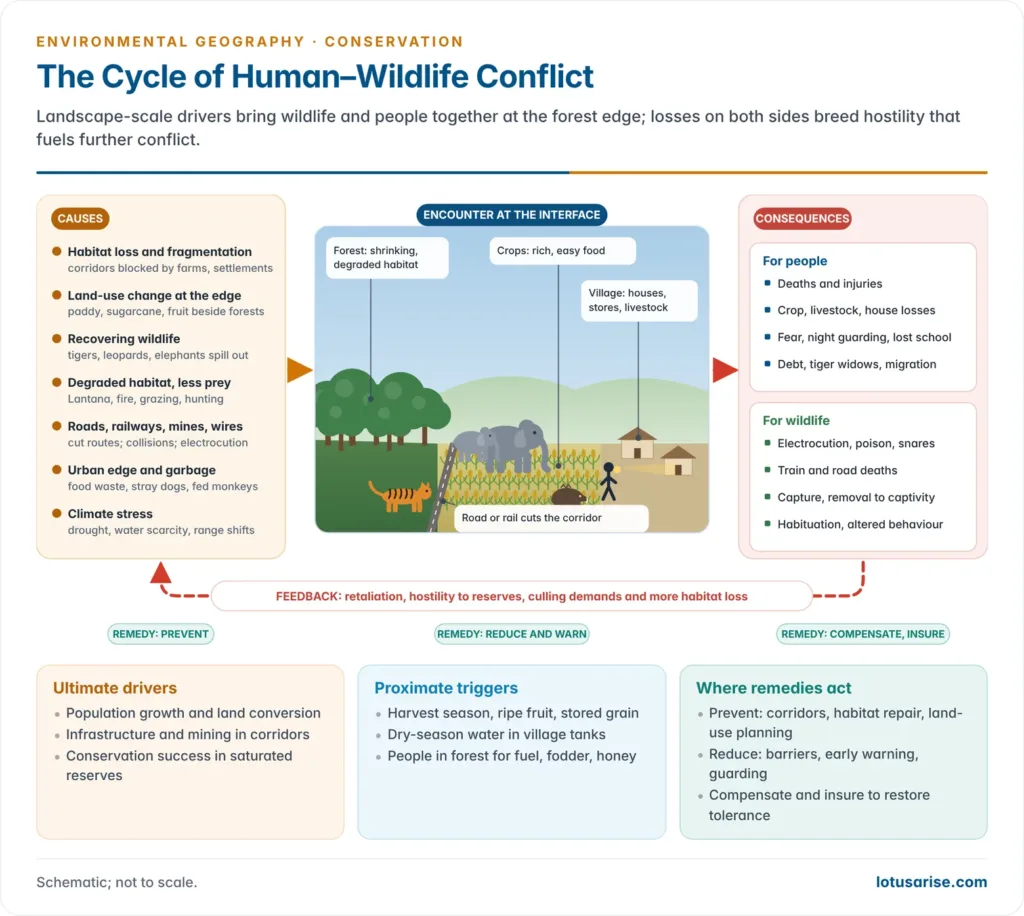
Consequences of Human–Wildlife Conflict
For people
- Loss of life and injury:
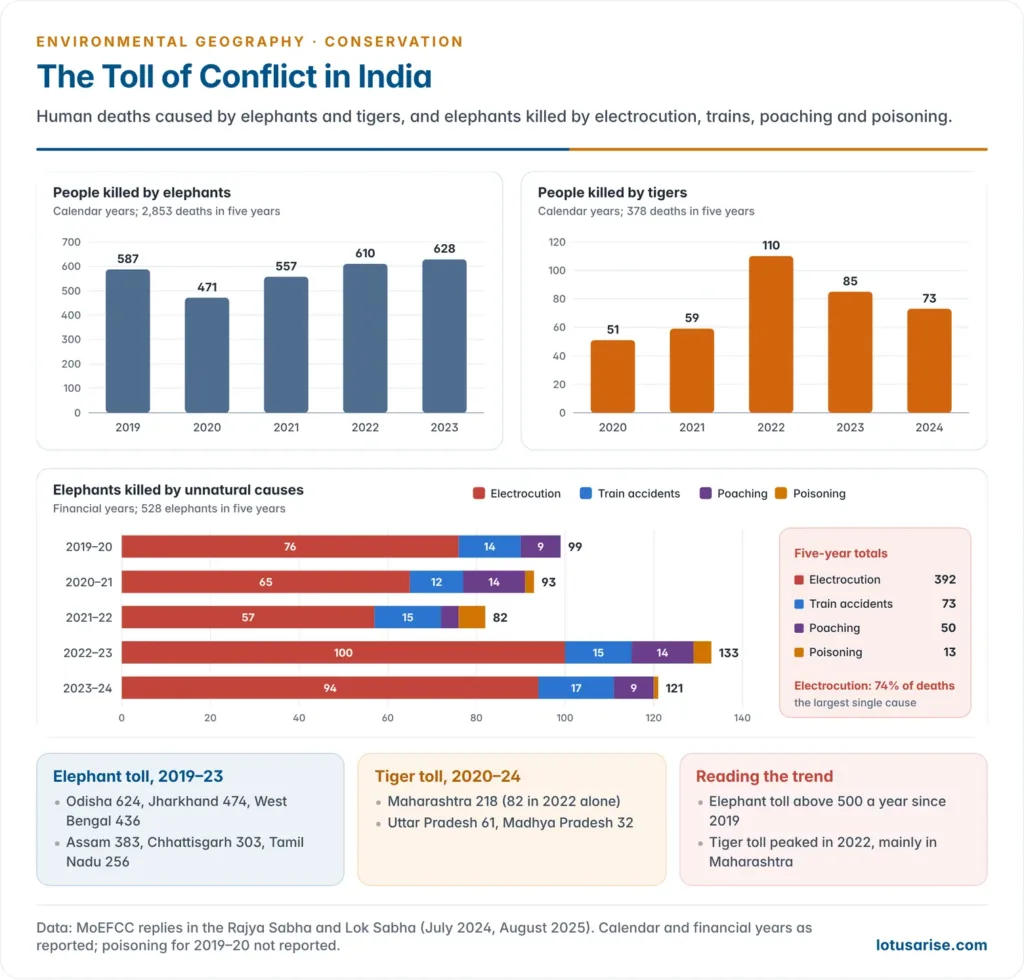
- Elephants killed 587 people in 2019, 471 in 2020, 557 in 2021, 610 in 2022 and 628 in 2023.
- Odisha (624), Jharkhand (474), West Bengal (436), Assam (383) and Chhattisgarh (303) recorded the most deaths in 2019–2023. In 2023–24 alone Odisha lost 154 lives, West Bengal 99 and Jharkhand 87.
- Tigers killed 51 people in 2020, 59 in 2021, 110 in 2022, 85 in 2023 and 73 in 2024. Maharashtra (218), Uttar Pradesh (61) and Madhya Pradesh (32) lead.
- Kerala reported between 88 and 114 deaths a year from all wild animals between 2019–20 and 2023–24, most of them from animals other than elephants and tigers; elephants killed 12–35 a year.
- The geography of these deaths is skewed. Central India and the eastern Ghats hold only about 8% of India’s elephants (1,891), yet Odisha, Jharkhand and Chhattisgarh together accounted for about half of all elephant-caused deaths in 2019–2023.
- Small, stressed, fragmented herds in a densely farmed landscape cause the most conflict per animal.
- Crop and livestock losses are the most frequent form of conflict. They fall hardest on small and marginal farmers with no other income.
- Households near Western Ghats reserves report crop raiding as by far their most common loss. Some fringe villages give up cultivating distant plots altogether.
- Hidden costs:
- night-long crop guarding and lost sleep;
- children kept from school and women from fuelwood and water collection;
- fear of moving after dusk;
- medical debt;
- psychological trauma.
- Gendered and social impacts: the “tiger widows” of the Sundarbans illustrate how conflict deepens poverty.
- Between 1985 and 2009, 789 people were attacked by tigers in the Indian Sundarbans and 666 of them died.
- Locals estimate about 30 deaths a year against the forest department’s 7–8, because many victims entered the core area without a boat licence certificate. Only about 920 such licences cover a forest used by some 600,000 people.
- About 130 tiger widows live in a single gram panchayat (Lahiripur). Most were denied compensation and are often socially stigmatised.
- The Calcutta High Court (January 2024) ordered ₹5 lakh each for two widows, holding that denial of compensation for “illegal” entry was grossly disproportionate. The issue links HWC to gender and biodiversity.
For wildlife
- Retaliatory and preventive killing:
- poisoning of tiger and leopard kills;
- snares for wild boar that also catch leopards;
- illegal live wires around fields;
- mob attacks on leopards that stray into villages.
- Elephant deaths from unnatural causes totalled 528 in the five years to 2023–24: electrocution 392, train accidents 73, poaching 50 and poisoning 13. Electrocution killed most in Odisha, Assam, Karnataka and Tamil Nadu.
- Removal of “problem” animals to zoos and rescue centres takes breeding animals out of the wild. Ten leopards from Junnar’s Manikdoh rescue centre were sent to a private facility in Gujarat in 2024, with approval for 50 more.
- Behavioural change: animals become more nocturnal, avoid good habitat near people or become habituated and bolder. Both changes affect their ecology.
For conservation and governance
- Eroding public support: communities that bear the costs of wildlife without sharing its benefits turn against reserves, corridors and new protected areas.
- Conflict therefore becomes a driver of biodiversity loss in its own right, one of the problems of wildlife that conservation must now manage.
- Political mobilisation: hartals, road blockades and attacks on forest offices follow deaths. HWC has become an electoral issue in Kerala, Odisha, Assam and Maharashtra.
- Legal pressure on conservation law: states seek powers to cull, declare species as vermin or dilute protection. Kerala passed its own amendment to the central Act in 2025.
- Conflict between institutions: forest departments are blamed for animals they cannot control. Revenue, police, railway and power departments often avoid responsibility.
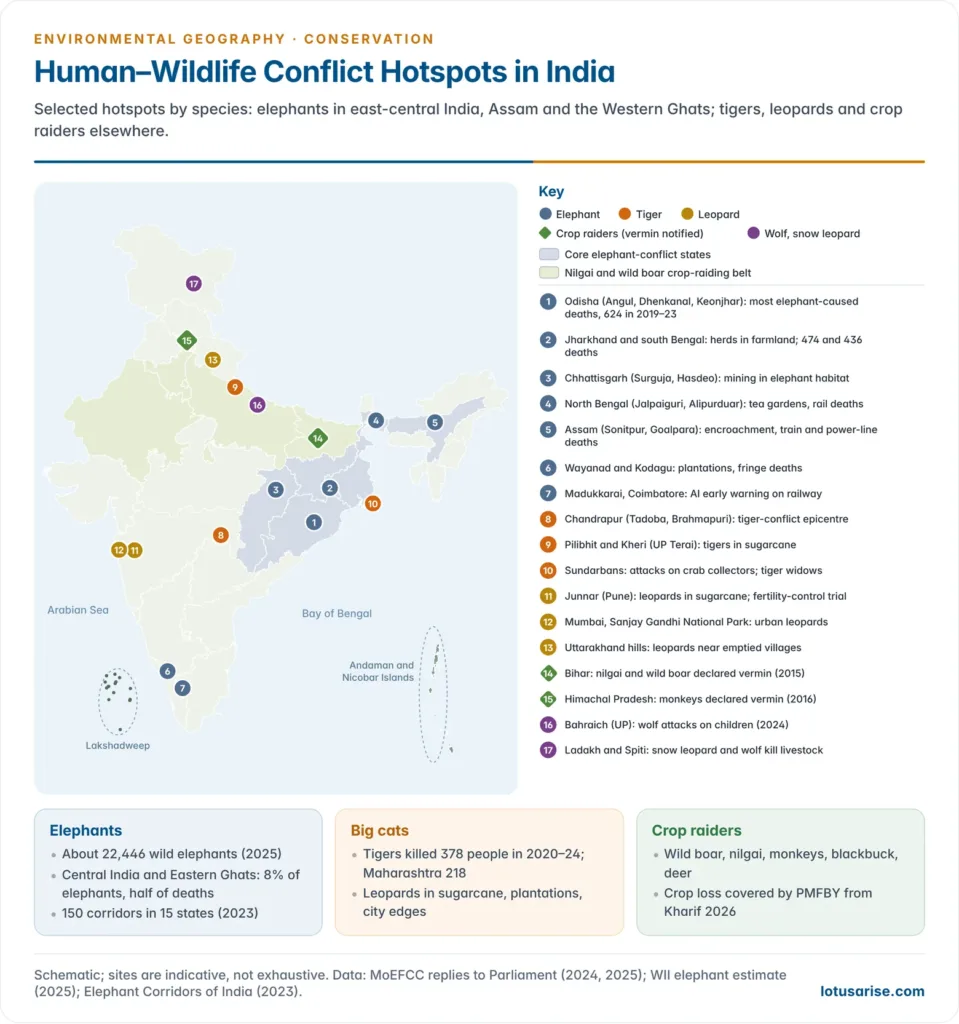
Indian Hotspots and Species
Elephants
- India’s first DNA-based Synchronous All-India Population Estimation of Elephants (2021–25), released by the Wildlife Institute of India in October 2025, estimated about 22,446 wild elephants.
- The figure is not comparable with the 27,312 of the 2017 count, which used a different method.
| Landscape | Elephants (2025) | Conflict character |
|---|---|---|
| Western Ghats | 11,934 (about 53%) | Plantations, corridor fragmentation, Kerala and Karnataka fringe deaths |
| North-East and Brahmaputra plains | 6,559 | Encroachment, tea gardens, rail deaths in Assam and north Bengal |
| Shivalik hills and Gangetic plains | 2,062 | Corridor bottlenecks around Rajaji and Corbett, highways, railways |
| Central India and Eastern Ghats | 1,891 | Small, isolated herds in mining and farming land; highest deaths per elephant |
- Karnataka (6,013), Assam (4,159), Tamil Nadu (3,136) and Kerala (2,785) hold the most elephants.
- The conflict core is east-central India, where herds have spread since the late 1980s into southern West Bengal and northern Chhattisgarh, areas with little recent history of resident elephants.
- The elephant reserves and corridors are central to managing them. The Elephant Corridors of India (2023) report validated 150 corridors in 15 states, up from 88 in 2010; West Bengal (26) has the most.
Tigers
- Maharashtra’s Chandrapur district (Tadoba–Andhari, Brahmapuri) is India’s tiger-conflict epicentre. Tigers there live in forest patches among villages, and people enter forests for firewood and tendu leaves.
- Uttar Pradesh’s Terai (Pilibhit, Dudhwa, Lakhimpur Kheri) has tigers in sugarcane fields outside reserves. It recorded 25 deaths in 2023.
- The Sundarbans is a distinct case. Attacks happen inside the mangrove forest on crab collectors, fishers and honey gatherers, and nylon-net fencing along villages reduces straying.
- Other states: Madhya Pradesh, Uttarakhand and Karnataka (Bandipur and Nagarahole fringes) record smaller numbers.
Leopards
- Leopards are the most adaptable large cat and the most common in human-dominated land.
- Junnar forest division (Pune): sugarcane fields and irrigated orchards hold a dense leopard population. Conflict killed 56 people between 2000 and 2025, and attacks rose sharply after 2020.
- In October 2026 two female leopards there were given an immunocontraceptive vaccine and released: India’s first trial of fertility control for leopards.
- Sanjay Gandhi National Park (Mumbai): about 30 attacks a year around 2004–05 were linked partly to leopards captured elsewhere and released in the park. A city-wide outreach programme, Mumbaikars for SGNP, followed, and attacks have fallen sharply since.
- Uttarakhand and Himachal Pradesh hills: leopards prey on dogs and livestock near villages that are emptied by out-migration and overgrown with scrub.
- Gujarat, Karnataka and Rajasthan (Aravalli hills around Udaipur and Jaipur’s Jhalana) also report frequent conflict.
Crop raiders and other species
- Wild boar: the most widespread crop raider, from Kerala to Uttarakhand. Its numbers have grown with fallow land and the decline of predators.
- Nilgai (blue bull): damages wheat, pulses and vegetables across the Indo-Gangetic plain, Rajasthan, Gujarat and Madhya Pradesh. Blackbuck raids crops in parts of the same belt.
- Rhesus macaques and langurs: crop and orchard damage in Himachal Pradesh and Uttarakhand; urban nuisance in Shimla, Delhi, Agra and Mathura.
- Wild boar, nilgai and monkeys have been declared vermin for limited periods:
- nilgai and wild boar in parts of Bihar (December 2015);
- wild boar in Uttarakhand (February 2016);
- monkeys in Himachal Pradesh (May 2016).
- The Supreme Court refused to stay these notifications in June 2016.
- Sloth bears maul people in Chhattisgarh, Madhya Pradesh, Odisha and Karnataka.
- Wolves killed several people, mostly children, in Bahraich, Uttar Pradesh, in 2024.
- Crocodiles attack people in Gujarat’s Vadodara rivers and Odisha’s Bhitarkanika.
- Gaur clash with people in the Western Ghats.
- Snow leopards and wolves kill livestock in Ladakh and Spiti.
| Species | Main hotspots | Dominant form of conflict |
|---|---|---|
| Asian elephant | Odisha, Jharkhand, south and north Bengal, Chhattisgarh, Assam, Kerala, Tamil Nadu, Karnataka | Deaths, crop and house damage, train and power-line deaths |
| Tiger | Chandrapur (Maharashtra), UP Terai, Sundarbans | Human deaths, cattle kills |
| Leopard | Junnar (Pune), Mumbai, Uttarakhand, Gujarat, Rajasthan | Attacks on children, dogs and goats |
| Wild boar | Kerala, Karnataka, Uttarakhand, Himachal, Bihar | Crop damage |
| Nilgai, blackbuck | Bihar, UP, Rajasthan, Gujarat, MP | Crop damage, road accidents |
| Rhesus macaque | Himachal, Uttarakhand, Delhi, Mathura | Crop and orchard damage, urban injuries |
| Sloth bear | Chhattisgarh, MP, Odisha | Maulings in forest and fields |
| Wolf, snow leopard | UP plains (Bahraich), Ladakh, Spiti | Child attacks, livestock depredation |
Remedial Measures
From conflict to coexistence
- Remedies work best as a sequence, not a menu:
- Understand and map the conflict: hotspots, seasons, species and the social context.
- Prevent encounters by securing habitat and corridors and planning land use.
- Reduce damage with barriers, deterrents, guarding and early warning.
- Respond quickly to incidents with trained teams.
- Compensate and insure the losses that remain, fast and fairly.
- Monitor and adapt, with communities involved throughout.
- No single tool works everywhere. Fences shift conflict to the next village, deterrents lose effect as animals habituate, and compensation without prevention only pays for the problem.
- The approach must fit the species, the landscape and the people. It is an exercise in ecosystem management at the landscape scale.
Landscape and habitat measures
- Secure corridors: notify, purchase or relocate settlements from key corridors.
- The Supreme Court (October 2020) upheld the Sigur plateau elephant corridor in the Nilgiris.
- Voluntary relocation secured the Thirunelli–Kudrakote corridor in Wayanad.
- Wildlife crossings on linear infrastructure:
- nine animal underpasses on NH-44 through the Kanha–Pench corridor, used by tigers and other mammals;
- a 34.5 km elevated corridor on NH-715 through the Kaziranga–Karbi Anglong landscape, approved in October 2025.
- The NTCA and WII’s Eco-friendly Measures to Mitigate Impacts of Linear Infrastructure on Wildlife (2016) sets design standards.
- Improve habitat inside protected areas: remove Lantana, restore grasslands, create water holes and fodder plots, and control fire. These keep herbivores and their predators inside.
- Voluntary relocation of villages from core areas, with fair packages, reduces exposure and frees habitat.
- Land-use planning at the edge: keep a buffer of compatible land use (forest, grass, non-palatable crops) between core habitat and intensive agriculture, and restrict resorts and fencing in corridors.
Barriers and deterrents
| Measure | How it works | Strengths and limits |
|---|---|---|
| Solar-powered electric fences | A pulsed, non-lethal shock deters elephants and boar | Cheap and effective if maintained; elephants learn to break them; illegal mains-power wires kill |
| Elephant-proof trenches and rail fences | Physical barrier along forest edges | Effective locally; trenches erode and fill; steel rail fences are costly |
| Bee-hive fences | Elephants avoid disturbed bees (KVIC’s Project RE-HAB, Kodagu, 2021) | Low-cost; adds honey income |
| Chilli–tobacco ropes and chilli smoke | Irritant deters elephants | Cheap; needs renewal |
| Lights, sirens, firecrackers | Scare animals away | Animals habituate quickly |
| Predator-proof corrals and night shelters | Livestock locked away at night | Very effective against leopards, wolves and snow leopards |
| Nylon-net fencing | Stops tigers swimming from the forest into Sundarbans villages | Needs constant repair |
| Neck guards and safe sanitation | Protect people at work; toilets avoid exposure at dusk | Neck guards little used in Junnar despite distribution |
- Crop choices: grow crops elephants and boar dislike near the forest edge (chilli, turmeric, ginger, lemongrass, citronella, some oilseeds), and keep palatable crops farther back.
- Store grain in raid-proof structures, not in houses at the forest edge, and avoid brewing liquor near elephant routes.
Early warning and technology
- Elephant early-warning systems give people time to move away and let trains slow down.
- Madukkarai (Coimbatore, Tamil Nadu): since February 2024, an AI-enabled system of 12 towers with thermal cameras has watched a 7 km stretch of railway on the Kerala–Tamil Nadu border, where 11 elephants had been killed by trains since 2008. It cost ₹7.24 crore.
- By mid-2026 it had issued over 7,116 real-time alerts, enabling 9,481 safe crossings and 3,821 slowed or halted trains, with no elephant deaths on the track.
- Valparai (Anamalai hills): SMS alerts, local TV scrolls and red warning lights tell plantation workers where herds are.
- Radio collars, camera traps with AI alerts, drones and seismic and infrared sensors track problem animals and herds in Assam, Odisha, Karnataka and West Bengal.
- Railway measures: speed limits in identified elephant zones, cleared sightlines, ramps and underpasses, and coordination between railway and forest staff through joint committees.
- Dedicated 24×7 control rooms and toll-free hotlines connect villages with response teams.
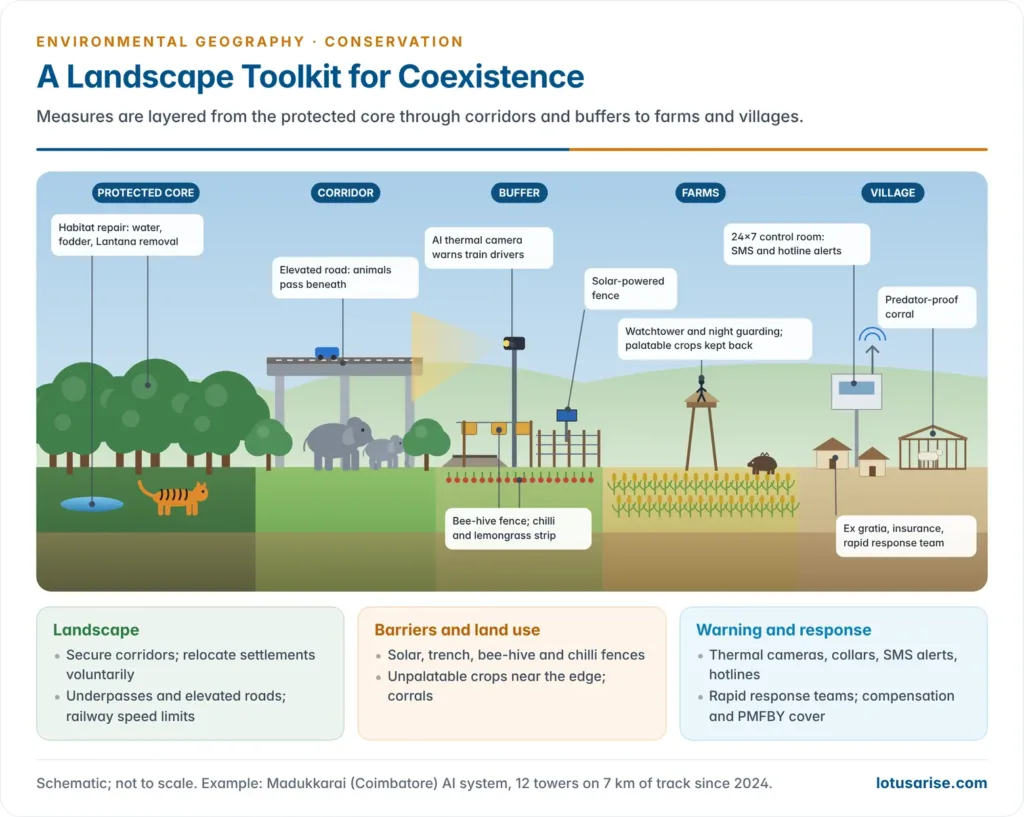
Response, capture and lethal control
- Rapid response teams (RRTs) of forest staff, veterinarians and trained villagers handle straying animals, crowd control and tranquilisation. Kerala adds primary response teams of local volunteers.
- Capture and translocation is a last resort. Research shows that moved leopards and elephants often return or cause conflict elsewhere, so removal to captivity is used for confirmed man-eaters.
- Lethal control under the Wild Life (Protection) Act, 1972:
- Section 11: the Chief Wildlife Warden may permit the hunting of a Schedule I animal that has become dangerous to human life or is diseased or disabled beyond recovery, after ruling out capture or relocation. Officers may permit the killing of other wild animals dangerous to human life or property, including standing crops.
- Section 62 (as amended in 2022): the Central Government may declare any wild animal other than those in Schedule I to be vermin for a specified area and period, after which it can be hunted. The old vermin schedule was removed.
- Kerala has let local-body heads authorise the shooting of crop-raiding wild boar since 2022. Its Wild Life (Protection) (Kerala Amendment) Bill, 2025, passed on 8 October 2025, would let the Chief Wildlife Warden order the immediate killing of animals that attack people in settlements; it needs the President’s assent.
- Culling is contested.
- Supporters: farmers lose crops and lives; populations of boar and nilgai are not threatened.
- Critics: culling rarely reduces damage for long, can disrupt social groups and increase raiding, and risks diluting the protection that brought species back.
- Fertility control is being tried as a non-lethal alternative: surgical sterilisation of rhesus macaques in Himachal Pradesh and immunocontraception of leopards in Junnar.
Compensation, insurance and the disaster approach
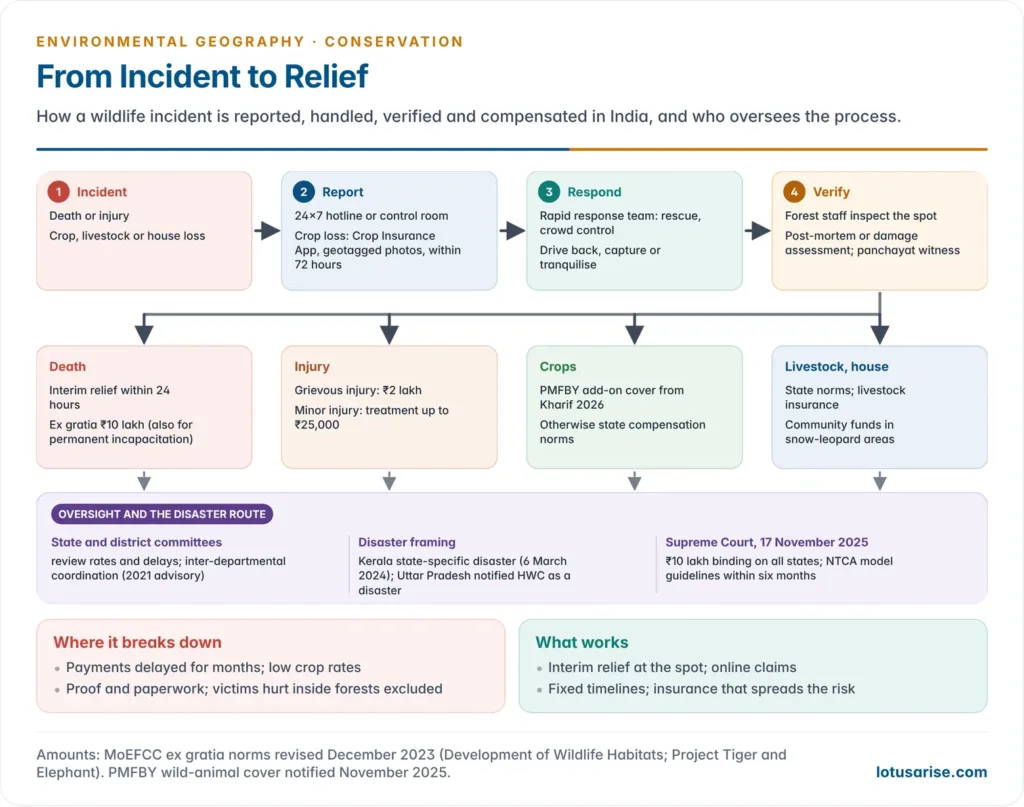
- Ex gratia relief: under the centrally sponsored schemes (Development of Wildlife Habitats; Project Tiger and Elephant), the MoEFCC raised ex gratia in December 2023:
- ₹10 lakh for death or permanent incapacitation (up from ₹5 lakh);
- ₹2 lakh for grievous injury;
- treatment costs up to ₹25,000 for minor injury;
- states set their own norms for crop and property loss.
- The Supreme Court (In Re: Corbett, 17 November 2025):
- directed all states to pay the ₹10 lakh ex gratia for deaths;
- asked states to consider notifying HWC as a natural disaster, as Uttar Pradesh has done;
- directed the National Tiger Conservation Authority to frame model guidelines on HWC within six months, which states must then implement within six months.
- Kerala declared human–wildlife conflict a state-specific disaster on 6 March 2024. This brings in the State Disaster Management Authority, district and local committees, and quicker relief, the kind of response set out in environmental hazards and remedial measures.
- Crop insurance: from Kharif 2026, crop loss due to wild animal attack is covered under the Pradhan Mantri Fasal Bima Yojana:
- It is the fifth add-on cover in the localised risk category.
- States notify the animals (elephants, wild boar, nilgai, deer, monkeys) and the vulnerable insurance units.
- Farmers must report losses within 72 hours through the Crop Insurance App, with geotagged photographs.
- Livestock insurance and community insurance funds, as in snow-leopard landscapes of Ladakh and Spiti, spread the risk of predation.
- Problems with compensation:
- delays of months;
- low crop-loss rates;
- paperwork and proof requirements;
- exclusion of people hurt inside forests, as with the Sundarbans widows;
- corruption.
- Victims who wait too long lose faith and may retaliate. Hence the interim relief within 24 hours recommended in the 2021 advisory.
Institutional and policy framework
- Wild Life (Protection) Act, 1972, as amended in 2022, provides the legal base. The environmental legislation also includes the Forest Rights Act, 2006, which shapes rights in fringe areas.
- MoEFCC advisory on HWC (2021), approved by the Standing Committee of the National Board for Wildlife in January 2021 and issued to states in February 2021:
- empower gram panchayats to deal with problem animals under the Act;
- use the PMFBY add-on cover for crop damage;
- augment fodder and water inside forests;
- pay part of the ex gratia as interim relief within 24 hours;
- set up inter-departmental committees at state and local levels;
- adopt early-warning systems and barriers;
- set up 24×7 control rooms with toll-free hotlines;
- identify hotspots;
- plan stall-feeding of livestock.
- Guidelines for HWC management (June 2022) cover crop damage and suggest using the Disaster Management Act, 2005.
- Species-specific guidelines (March 2023) cover the elephant, gaur, leopard, snake, crocodile, rhesus macaque, wild pig, bear, nilgai and blackbuck. Cross-cutting guidelines cover media coordination, crowd management, staff health and safety, and health risks from conflict.
- Project Tiger and Elephant: the two flagship schemes were merged in 2023 (announced in April, formalised by an order of 23 June 2023) into a single Project Tiger and Elephant Division of the MoEFCC.
- It funds conflict mitigation, corridors and ex gratia in tiger reserves and elephant landscapes.
- Critics worry that the smaller elephant budget will be absorbed by tiger priorities.
- Science and monitoring: the Wildlife Institute of India and the NTCA run population estimation, corridor mapping and conflict research. States are building HWC databases and hotspot maps.
Community-based approaches
- Tolerance is the scarce resource. People accept wildlife when risks are low, losses are paid quickly and they share the benefits of conservation.
- Eco-development committees around reserves (Periyar, Kerala, is the model) give fringe villages income from tourism, guiding and forest protection.
- Mumbaikars for SGNP brought together the forest department, scientists, residents, police and the media in Mumbai. Its tools were awareness, garbage control, street lighting and calm crowd management when leopards are sighted.
- Local early-warning networks: WhatsApp groups, village volunteers and “elephant friends” in Assam, Odisha and Valparai track herds and warn neighbours.
- Traditional coexistence: many communities have long revered and tolerated wildlife: the Bishnois protect blackbuck and chinkara, and the Maldhari pastoralists share Gir with lions. Such traditions show how perception, attitudes and values sustain coexistence, the core of the PAVE approach to environmental management.
- Livelihood diversification: apiculture, eco-tourism, non-timber forest produce processing and stall-fed dairy reduce dependence on the forest and on raid-prone crops.
Evaluation
- Prevention outperforms compensation. Most spending still goes to relief after the event, while corridors, habitat repair and land-use planning remain under-funded.
- Barriers and translocation displace conflict. A fence or a moved leopard often shifts the problem to the next village.
- Data are thin and inconsistent. Different sources count by calendar or financial year, revise figures and leave out crop loss and injuries. The national HWC database is still being built.
- Rights and justice: forest-dwellers and Adivasis, the poorest and most exposed, are least likely to receive compensation. Linking the Forest Rights Act with conflict management remains unfinished.
- Conservation versus local politics: state demands for culling and vermin declarations, such as Kerala’s amendment, test the national consensus behind the Wild Life (Protection) Act.
- The way forward is landscape-level coexistence planning:
- map hotspots and corridors;
- integrate forest, agriculture, railway, road and disaster agencies;
- pay fast, fair compensation and insurance;
- invest in early warning;
- give communities a real share in the benefits of wildlife.
- These make tolerance rational and keep India’s conservation gains secure.