

Urban Sprawl: Definition and Concept

- Urban sprawl refers to the unplanned, uncoordinated and disproportionate outward expansion of cities into their peripheral rural areas, without adequate concern for environmental sustainability, infrastructure efficiency, or social integration.
- While urban growth is a natural outcome of population increase and economic expansion, urban sprawl is a specific form of growth, characterised by horizontal spreading rather than compact vertical development.
- It is often described as “horizontal spreading” or “dispersed urbanisation”, where the city expands spatially faster than its population grows, resulting in inefficient land use.
- Urban sprawl involves the extension of low-density residential, commercial, and industrial developments into the countryside, frequently in a fragmented and ribbon-like pattern along highways and transport corridors.
- Unlike planned suburbanisation, sprawl lacks a coherent spatial structure, resulting in scattered settlements with weak functional linkages to the urban core.

Key Characteristics of Urban Sprawl
- Excessive land consumption, where a large amount of land is used to accommodate relatively small population increases, leading to rapid conversion of agricultural land and open spaces.
- Low population densities at city peripheries, in contrast to older, compact urban cores, making service delivery costly and inefficient.
- Fragmented and discontinuous development, marked by leapfrog growth, wide gaps between built-up areas, and isolated housing clusters.
- Functional segregation of land uses, with residential, commercial, industrial and recreational activities spatially separated, increasing dependence on daily commuting.
- High dependence on private motorised transport, due to limited public transport options and poor walkability, resulting in traffic congestion and air pollution.
- Uniform and repetitive built forms, such as single-storey housing and large commercial complexes surrounded by parking spaces.
- Inadequate public spaces and community centres, weakening social interaction and neighbourhood cohesion.
Forms and Spatial Patterns
- Ribbon development along highways and arterial roads, extending urban influence deep into rural landscapes.
- Edge cities and peripheral commercial hubs, often automobile-oriented, functionally disconnected from the traditional city centre.
- Leapfrog development, where new developments skip vacant land, creating patchy urban landscapes.
- Scattered suburban residential colonies, particularly common in metropolitan regions.
Urban Sprawl as a Land-Use Phenomenon
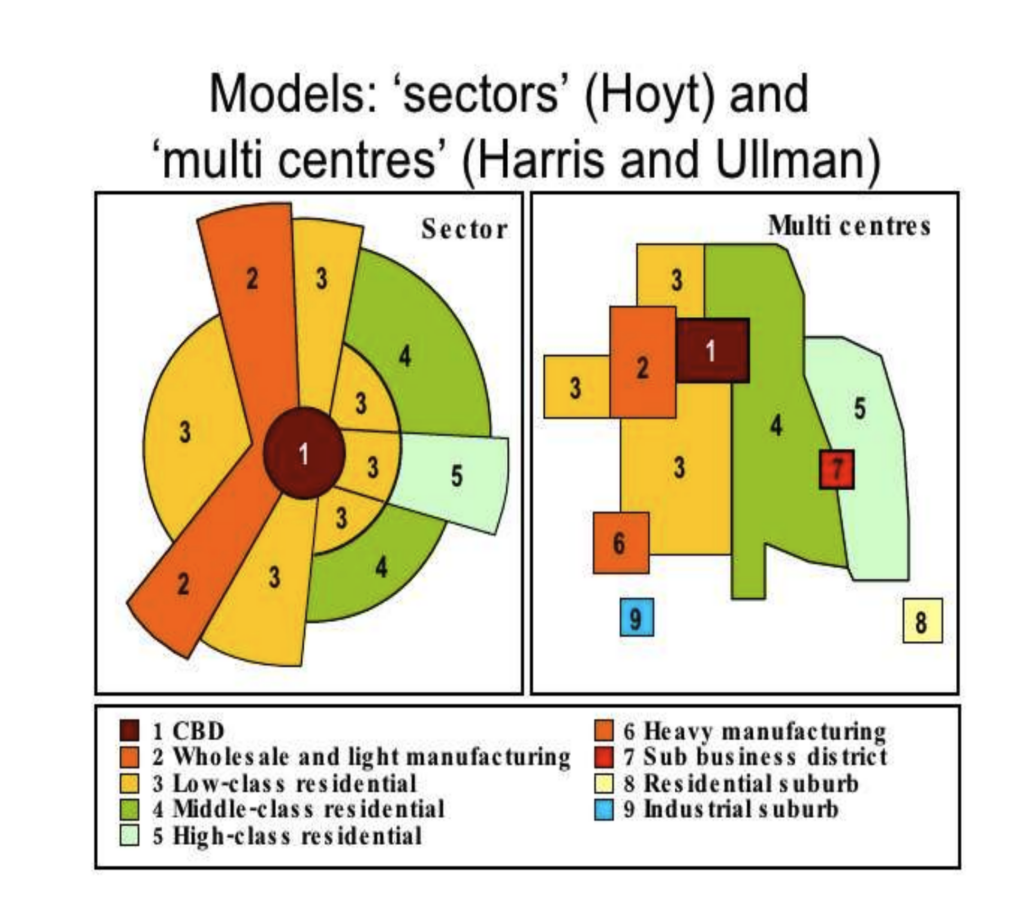
- Urban sprawl is primarily a land-use issue, where spatial expansion occurs faster than demographic growth, leading to declining urban compactness.
- It reflects a mismatch between population growth and spatial planning, often aggravated by weak zoning regulations and speculative real estate development.
- Attempts to mathematically define sprawl using compactness indices have often failed, highlighting the conceptual and multidimensional nature of the phenomenon.
Developed vs Developing Countries Perspective
- In developed countries, urban sprawl is largely choice-driven, associated with higher incomes, preference for suburban living, and automobile dependence.
- In developing countries, sprawl is often necessity-driven, resulting from rural–urban migration, housing shortages, and informal settlements beyond city limits.
- Although the causes differ, the spatial outcomes—low density, fragmentation, and infrastructure stress—are often similar.
Debates and Perspectives
- One view considers urban sprawl as environmentally damaging, socially inefficient and economically unsustainable.
- Another perspective argues that sprawl is inevitable in a growing urban economy and can provide affordable housing and living space if properly managed.
- Modern planning discourse increasingly views sprawl as a policy-induced outcome, rather than merely a result of population growth.
Causes of Urban Sprawl
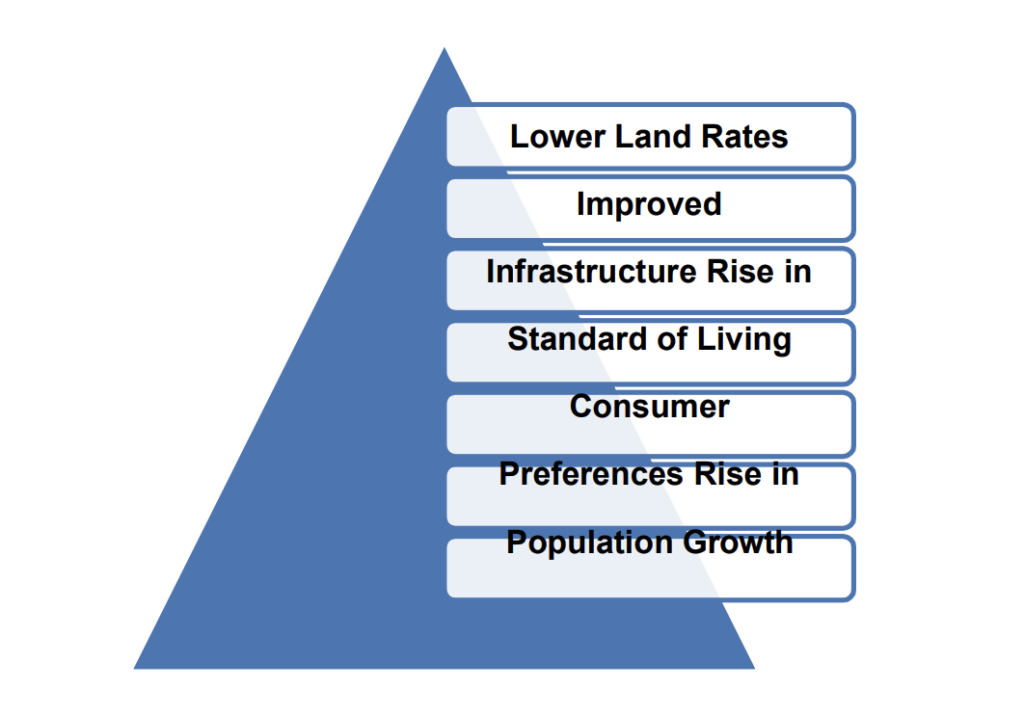
1. Population Growth and Urban Migration
- Rapid population growth, combined with rural–urban migration, increases pressure on existing urban space, forcing cities to expand beyond their administrative and infrastructural capacity.
- As the population exceeds the carrying capacity of the urban core, residential and commercial activities spill over into peri-urban and rural areas.
- Indian context: India’s urban population increased sharply between 2001 and 2011, reflecting accelerated urbanisation, which directly fuelled outward expansion of cities.
2. Lower Land and Housing Costs at the Periphery
- Land and housing prices are significantly lower in suburban and peri-urban areas compared to congested city centres, making them attractive for middle- and lower-income groups.
- High land values, overcrowding, and declining environmental quality in central areas push households outward, encouraging spatial spread.
- Developers also prefer peripheral land due to lower acquisition costs and fewer regulatory constraints.
3. Rise in Standard of Living and Household Incomes
- Rising incomes improve people’s ability to commute longer distances, reducing dependence on proximity to workplaces.
- Higher purchasing power enables households to seek larger houses, better living environments, and private open spaces, which are rarely available in dense urban cores.
- This factor is particularly dominant in developed countries, where sprawl is largely choice-driven.
4. Changing Consumer Preferences and Lifestyle Aspirations
- Urban residents increasingly prefer low-density residential environments, larger homes, multiple bedrooms, balconies, lawns, and gated communities.
- Such lifestyle preferences cannot be met within congested inner cities, leading to suburbanisation and dispersed settlement patterns.
- The demand for privacy, exclusivity, and perceived safety reinforces outward urban expansion.
5. Improved Transportation and Infrastructure Development
- Expansion of road networks, highways, flyovers, and expressways enhances accessibility of peripheral areas, making them viable for residential and commercial development.
- Investment in electricity, water supply, and communication infrastructure reduces the disadvantages of living away from the urban core.
- In India, rapid expansion of national and state highways has made peri-urban land more attractive, directly contributing to ribbon development and edge cities.
6. Inadequate and Weak Urban Planning
- Absence of comprehensive master plans, weak enforcement of land-use regulations, and fragmented governance allow haphazard and uncoordinated growth.
- Congestion, traffic jams, loss of green cover, and deteriorating infrastructure in city centres push residents to relocate outward.
- In India, only a small proportion of cities have effective development plans, resulting in unplanned urban expansion.
7. Land Market Dynamics and Conversion of Agricultural Land
- Rising demand for urban land encourages conversion of agricultural and common lands into built-up areas, especially at city fringes.
- Speculative real estate activity accelerates land fragmentation and leapfrog development.
- Declining share of agricultural land ownership reflects the increasing dominance of urban land use over rural landscapes.
8. Government Policies and Institutional Factors
- Certain housing finance policies, zoning regulations, and development incentives unintentionally promote low-density peripheral growth.
- Establishment of industrial estates, SEZs, and large infrastructure projects on city outskirts attracts population and commercial activities, triggering sprawl.
- Road-centric development policies reinforce automobile dependence and dispersed settlement patterns.
9. Differential Causes in Developed and Developing Countries
- In developed countries, urban sprawl is primarily income-driven and preference-based, supported by automobile ownership and suburban housing markets.
- In developing countries, sprawl is largely necessity-driven, resulting from poverty, informal housing, migration, and inability of cities to absorb population within planned limits.
- Despite differing causes, both contexts produce low-density, fragmented urban landscapes.
10. Technological and Spatial Enablers
- Advances in GIS, satellite imagery, and remote sensing reveal extensive land-use change and help quantify sprawl, but they also reflect how fast cities are expanding spatially.
- Modelling approaches (e.g., cellular automata, agent-based models) show that transport networks, population growth, and policy choices jointly drive outward expansion.
Impacts of Urban Sprawl in India
Urban sprawl in India has far-reaching environmental, social, and economic consequences, as cities expand beyond planned limits into peri-urban and rural areas. These impacts are interlinked and cumulatively affect sustainability, equity, and long-term urban resilience.
1. Environmental Impacts of Urban Sprawl
- Urban sprawl leads to the large-scale conversion of fertile agricultural land into built-up areas, reducing food-producing capacity and increasing dependence on food imports. The loss of cropland at urban fringes poses a serious challenge to food security in an agrarian economy like India.
- The destruction of green spaces, forests, wetlands, and vegetation cover reduces carbon sequestration, intensifies climate change impacts, and disrupts local ecological balance.
- Sprawling development places severe pressure on natural resources, especially groundwater, as peri-urban areas rely heavily on borewells and informal extraction. Over-extraction leads to falling water tables and local water scarcity.
- Water bodies and rivers are increasingly polluted due to the discharge of untreated sewage and industrial effluents from expanding urban settlements, adversely affecting aquatic ecosystems and public health.
- Increased dependence on private vehicles in sprawled cities results in higher emissions of particulate matter, nitrogen oxides (NOx), and volatile organic compounds, leading to deteriorating air quality and rising respiratory illnesses.
- Urban sprawl intensifies the Urban Heat Island (UHI) effect, as concrete surfaces replace natural landscapes, raising local temperatures, increasing energy demand for cooling, and aggravating heat-related health risks.
- Habitat fragmentation caused by sprawl leads to loss of biodiversity, displacement of wildlife, disruption of pollination processes, and weakening of natural pest-control mechanisms, making ecosystems more vulnerable to invasive species and diseases.
- Rapid expansion generates large volumes of solid waste, while inadequate waste management systems in peri-urban areas result in land, water, and air pollution, further degrading environmental quality.
2. Social Impacts of Urban Sprawl
- Urban sprawl exacerbates housing shortages and affordability crises, particularly for low-income groups. Rising land prices in urban cores push marginalized populations to the city periphery, leading to the growth of informal settlements and slums with substandard living conditions.
- The outward expansion of cities creates unequal access to basic services and infrastructure, such as drinking water, sanitation, healthcare, education, and public transport. Peri-urban populations often face service deficits, reinforcing social exclusion.
- Large-scale urban expansion frequently results in the displacement of local communities, especially farmers and peri-urban residents. Forced relocation disrupts livelihoods, social networks, and cultural identities, increasing vulnerability and poverty.
- The low-density, car-dependent nature of sprawl reduces social interaction and community cohesion. Long commuting distances, lack of public spaces, and weak neighbourhood ties contribute to social isolation and declining mental well-being.
- Urban sprawl reinforces socio-economic segregation, with affluent groups concentrated in gated communities at the urban fringe, while poorer populations remain confined to poorly serviced settlements. This spatial segregation deepens inequality and limits upward social mobility.
- Public health is adversely affected due to sedentary lifestyles, limited walkability, air pollution, inadequate sanitation, and lack of recreational spaces, leading to rising cases of obesity, lifestyle diseases, and stress-related disorders.
3. Economic Impacts of Urban Sprawl
- Urban sprawl significantly increases the cost of infrastructure and service provision, as governments must extend roads, water supply, sanitation, electricity, healthcare, and education services over larger areas, placing a heavy financial burden on urban local bodies.
- Dispersed settlement patterns result in higher transportation costs for households due to longer commuting distances, increased fuel consumption, vehicle maintenance costs, and loss of productive time.
- The conversion of agricultural land into urban uses leads to a decline in agricultural productivity, raising food prices and increasing vulnerability to food inflation, which affects both urban and rural populations.
- Urban sprawl widens economic disparities, as rising property values in peripheral areas make housing unaffordable for low-income groups, pushing them further away from employment opportunities.
- The expansion of cities often disrupts small and informal enterprises, such as street vendors and local shops, due to competition from large commercial establishments, eviction, or relocation, undermining livelihood security.
- Environmental degradation caused by sprawl imposes hidden economic costs, including increased healthcare expenditure due to pollution-related diseases, costs of climate adaptation, and loss of ecosystem services essential for economic stability.
4. Spatial and Planning Consequences
- Uncoordinated and Inefficient Land Use
- Sprawl is characterized by leap-frog development, ribbon growth along highways, and fragmented land-use patterns.
- This undermines compact city planning and efficient resource utilization.
- Weak Urban Governance
- Rapid expansion often outpaces planning capacity and institutional coordination.
- Overlapping jurisdictions between urban local bodies and peri-urban authorities complicate governance.
Positive Perspectives on Urban Sprawl
- Some planners view sprawl as a sign of economic vitality, reflecting growth in income, housing choice, and decentralization of employment.
- Decentralization can reduce congestion in core city areas and provide larger housing units with better living conditions.
- In low-density settings, access to private open spaces may improve perceived quality of life.
However, most scholars agree that without effective planning and regulation, the long-term negative impacts of urban sprawl outweigh its short-term benefits, particularly in developing countries.
Sustainable Urban Development and Sprawl Management in India
Sustainable management of urban sprawl in India requires an integrated, multi-dimensional approach that balances economic growth, social equity, and environmental protection while improving urban efficiency and liveability.
1. Integrated Urban Planning
- Sustainable urban development requires integrated planning frameworks that simultaneously address land use, housing, transportation, infrastructure, environment, and social needs.
- Comprehensive land-use planning and zoning regulations help guide urban growth in a compact and orderly manner.
- Integration of transport corridors with residential and commercial development promotes well-connected, efficient urban systems and prevents haphazard expansion.
2. Compact and Mixed-Use Development
- Promoting compact city forms reduces excessive outward expansion and minimizes land consumption.
- Mixed-use development—integrating residential, commercial, institutional, and recreational functions—reduces the need for long-distance commuting.
- Such designs enhance walkability, accessibility, and efficient service delivery, improving overall urban sustainability.
3. Efficient and Sustainable Public Transportation
- Expanding mass public transport systems such as metros, buses, BRTS, and suburban rail reduces dependence on private vehicles.
- Improved public transport lowers traffic congestion, fuel consumption, air pollution, and carbon emissions.
- Affordable and well-connected transport networks improve mobility and social inclusion, especially for low-income populations.
4. Preservation of Green Spaces and Agricultural Land
- Protection of urban green spaces, wetlands, and peri-urban agricultural land is essential for ecological balance and climate resilience.
- Green areas act as carbon sinks, regulate urban temperatures, support biodiversity, and enhance quality of life.
- Preserving agricultural land around cities safeguards food security and local livelihoods.
5. Affordable Housing and Slum Upgradation
- Sustainable urban development must prioritize inclusive housing policies, especially for economically weaker sections.
- Affordable housing schemes, slum redevelopment, and in-situ upgradation reduce informal sprawl and improve living conditions.
- Ensuring access to basic services such as water, sanitation, electricity, and healthcare strengthens urban social equity.
6. Revitalization of Existing Urban Areas
- Instead of continuous outward expansion, cities should focus on redevelopment of underutilized, degraded, or brownfield areas.
- Urban renewal improves infrastructure, housing quality, and service access within existing city limits.
- Revitalization helps preserve cultural heritage, improves land-use efficiency, and stimulates local economic growth.
7. Stakeholder Engagement and Participatory Governance
- Active involvement of local communities, civil society, and other stakeholders is essential for sustainable urban planning.
- Participatory planning ensures that local knowledge is incorporated and diverse needs are addressed.
- Community engagement builds social ownership, cohesion, and long-term policy acceptance.
8. Smart Growth Strategies
- Smart growth emphasizes efficient land use, compact development, transit-oriented planning, and technological integration.
- Use of GIS, remote sensing, spatial modelling, and data-driven decision-making improves planning accuracy.
- Smart growth helps optimize resource use, reduce carbon footprints, and guide sustainable urban expansion.
9. Policy and Regulatory Frameworks
- Effective management of urban sprawl requires strong policy enforcement and regulatory mechanisms.
- Instruments such as urban growth boundaries, land-use controls, green building norms, and environmental impact assessments are crucial.
- Incentive-based policies can promote sustainable practices while discouraging sprawl-inducing development.
10. Monitoring, Evaluation, and Adaptive Management
- Continuous monitoring of urban development indicators—land use, transport efficiency, housing, environmental quality, and social well-being—is essential.
- Periodic evaluation helps assess policy effectiveness and enables course correction.
- Evidence-based monitoring supports adaptive and resilient urban governance.
Case Studies
Indian cities provide several replicable models demonstrating how urban sprawl can be managed through integrated planning, transport reforms, housing inclusion, and ecological regeneration.
1. Ahmedabad – Sabarmati Riverfront Development
- The Sabarmati Riverfront Development Project represents a successful model of urban regeneration and sustainable waterfront development.
- The project transformed a previously neglected and encroached riverfront into a multifunctional urban public space.
- Key features include:
- Creation of public promenades, parks, recreational and cultural spaces
- Integration of rainwater harvesting, wastewater treatment, and solar energy use
- The project improved urban aesthetics, environmental quality, and public accessibility, while reducing pressure on peripheral land expansion.
- It demonstrates how inner-city revitalisation can reduce sprawl by enhancing the livability of core urban areas.
2. Chennai – Mass Rapid Transit System (MRTS)
- Chennai’s MRTS illustrates the role of sustainable transport infrastructure in controlling urban sprawl.
- The suburban rail-based MRTS:
- Connects peripheral and core urban areas
- Provides an eco-friendly, reliable alternative to private vehicles
- Impacts include:
- Reduction in traffic congestion and vehicular emissions
- Lower carbon footprint and improved air quality
- Promotion of transit-based urban growth
- The case highlights how investment in public transport can shape compact urban forms and improve overall mobility efficiency.
3. Surat – Slum Upgrading and Affordable Housing
- Surat provides a notable example of inclusive urban development through slum rehabilitation and affordable housing initiatives.
- The Surat Slum Rehabilitation and Affordable Housing Program focused on:
- Upgrading basic services such as water supply, sanitation, and electricity
- Improving housing quality and constructing affordable dwelling units
- Outcomes include:
- Enhanced living conditions for low-income communities
- Strengthened social inclusion and community participation
- The case demonstrates that addressing housing needs within the city can reduce informal peripheral expansion and socio-spatial segregation.
4. Pune – Transit-Oriented Development (TOD)
- Pune’s adoption of Transit-Oriented Development (TOD) reflects a proactive approach to sprawl management.
- The city has promoted:
- High-density, mixed-use development around major transit corridors
- Integration of land use with public transport planning
- Key benefits observed:
- Reduced dependence on private vehicles
- Improved accessibility and reduced commuting distances
- Enhanced quality of urban public spaces
- Pune’s TOD model illustrates how planned densification can create compact, efficient, and livable cities.
Overall Significance of Case Studies
- These case studies collectively demonstrate that:
- Urban sprawl is not inevitable, but can be managed through policy, planning, and investment choices
- Integrated land-use planning, public transport, affordable housing, and urban renewal are key instruments
- The experiences of Ahmedabad, Chennai, Surat, and Pune provide replicable best practices for other Indian cities facing rapid urban expansion.
Conclusion
Urban sprawl in India poses serious environmental, social, and economic challenges, including loss of agricultural land, rising infrastructure costs, transport inefficiencies, and social inequality. However, sustainable urban development strategies—such as compact and mixed-use planning, efficient public transportation, preservation of green spaces, and inclusive housing—offer viable solutions.
Case studies from Ahmedabad, Chennai, Surat, and Pune illustrate that well-planned urban interventions can simultaneously enhance livability, equity, and environmental sustainability. Effective sprawl management ultimately depends on strong policy frameworks, participatory governance, and coordinated action among governments, planners, and communities.





Good 😊👍