

- Gene pool centres are the regions of the Earth where important crop plants and domestic animals originated and where their wild relatives and traditional varieties are still concentrated.
- Nikolai Ivanovich Vavilov mapped them in the 1920s and 1930s. His mature scheme of eight main centres and three sub-centres (1935) remains the classical framework, later enlarged by Zhukovsky’s megacentres and recast by Harlan’s centres and non-centres.
- The concept now sits at the heart of conservation. These centres hold the genetic raw material for breeding crops that resist new diseases and a warming climate, so they are protected in situ and backed up in gene banks such as the Svalbard Global Seed Vault.
Gene, Gene Pool and Centres of Origin

From gene to gene pool
- The biology begins at the level of the gene, and the conservation argument rests on a single scale-up: gene → genome → individual → population → gene pool → centre of diversity.
- A gene is the basic physical unit of inheritance. Genes pass from parents to offspring and carry the information that specifies traits.
- Genes are arranged one after another on chromosomes. A chromosome holds a single long DNA molecule, only a small portion of which corresponds to any one gene.
- Humans have about 20,000 protein-coding genes. Current genome-annotation projects such as GENCODE place the count at roughly 19,000–20,000, a range refined as sequencing methods improve.
- The different forms of a gene are its alleles. Variation in alleles between individuals is the genetic diversity that selection, and plant breeders, work on.
Gene pool and gene pool centres
- A gene pool is the sum of a population’s genetic material at a given time: the collection of all genes and gene combinations (all the alleles) in an interbreeding population.
- The term normally refers to individuals of the same species, so a gene pool represents the complete genetic diversity of that population or species.
- The idea was first set out in the 1920s by the Russian geneticist Alexander Serebrovsky as genofond (“gene fund”); Theodosius Dobzhansky carried it into English as “gene pool”.
- Gene pool centres are areas where important crop plants and domestic animals originated.
- They hold an extraordinary range of the wild counterparts of cultivated plant species and of useful tropical plants, together with many subtropical and temperate species.
- They are reservoirs not just of the domesticated crop but of the entire genetic lineage from which it was drawn: its wild progenitor, weedy forms and landraces (traditional farmers’ varieties).
Related terminology
| Term | Meaning |
|---|---|
| Population | All the members of an interbreeding species living in a particular place at a particular time |
| Natural selection | The process by which organisms adapted to their environment survive and reproduce, while those that cannot adapt do not |
| Genotype | The genetic make-up of an individual organism |
| Phenotype | The observable characteristics of an individual, the product of its genotype interacting with the environment |
| Landrace | A locally adapted traditional crop variety, genetically variable and selected by farmers over generations |
| Crop wild relative | A wild species closely related to a crop, including its wild ancestor |
| Germplasm, accession | Living genetic material (seed, tissue, pollen); one distinct sample of it held in a gene bank |
| Genetic erosion | The loss of genetic diversity, as when landraces are replaced by a few uniform varieties |
Primary, secondary and tertiary gene pools
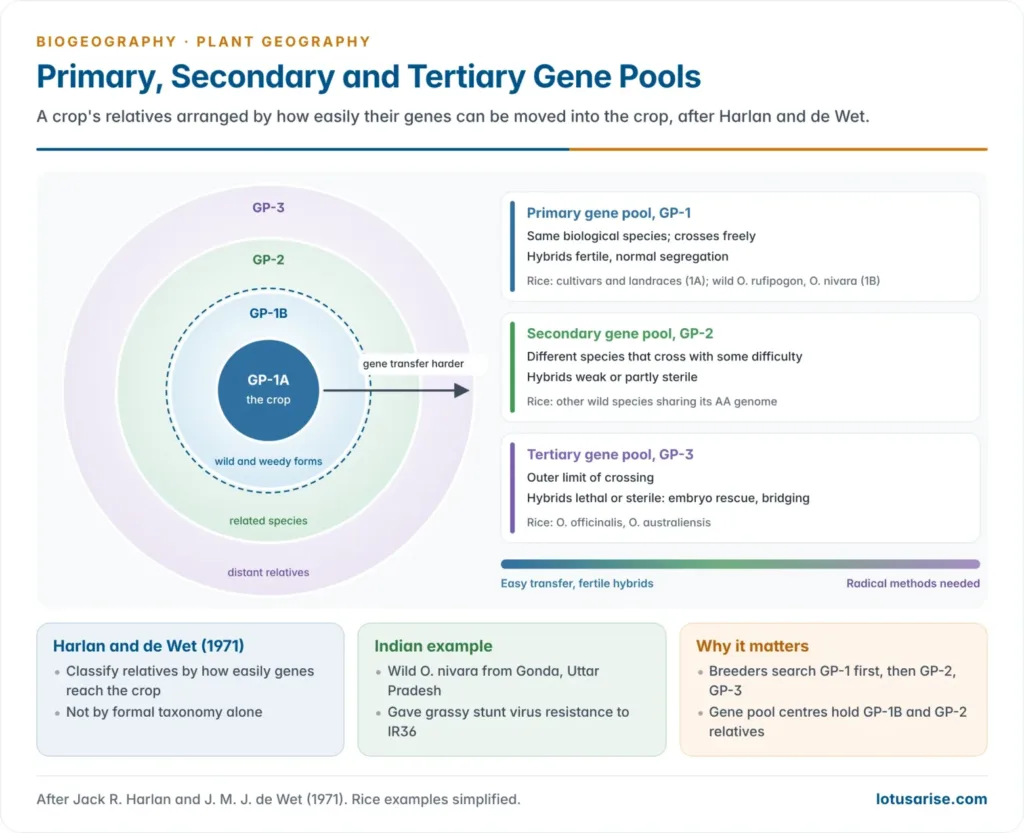
- Jack Rodney Harlan and Jan M. J. de Wet (1971) proposed classifying each crop and its relatives by how easily genes can be moved into the crop, rather than by formal taxonomy alone.
- Primary gene pool (GP-1): the crop and the forms that cross freely with it, usually the same biological species.
- Hybrids are fertile, chromosomes pair well and gene transfer is easy.
- It is split into GP-1A, the cultivated forms and landraces, and GP-1B, the wild and weedy forms of the same species.
- Secondary gene pool (GP-2): closely related different species that cross with the crop with some difficulty.
- Hybrids are often weak or partly sterile, but genes can be transferred if the breeder is willing to make the effort.
- Tertiary gene pool (GP-3): the outer limit of the crop’s relatives.
- Hybrids are lethal or completely sterile, so gene transfer needs radical techniques such as embryo rescue, bridging crosses through a GP-2 species or chromosome doubling.
- Example from India: a single accession of the wild rice Oryza nivara, collected in Gonda district, Uttar Pradesh, gave the gene for resistance to grassy stunt virus.
- Bred into IRRI varieties in the 1970s, it reached IR36, once the most widely planted rice in the world. A wild relative from a gene pool centre thus protected rice harvests across Asia.
Why a large gene pool matters for survival
- A large gene pool means extensive genetic diversity, which goes with robust populations that can survive bouts of intense selection: disease outbreaks, extreme weather or rapid environmental change.
- Low genetic diversity reduces biological fitness and raises the chance of extinction.
- A genetically uniform population is far less likely to contain, by chance, the variants needed to survive a new stress.
- Diversity is insurance against an unpredictable future. This one principle connects the historical half of the topic (Vavilov’s centres) with its applied half (conservation): it explains why gene pool centres matter, not just where they are.
- Uniform crops have failed before:
- The Irish potato famine (1845–49): most of Ireland grew one clonal variety, which had no resistance to late blight.
- The southern corn leaf blight (1970) in the United States: most hybrid maize carried the same “Texas” male-sterile cytoplasm, which made it uniformly susceptible.
The concept of “centre of origin”
- A centre of origin is a geographical area where a group of organisms, domesticated or wild, first developed its distinctive properties.
- Centre of diversity: the region where a crop shows its greatest variability. Vavilov assumed that the two coincide.
- Many scientists argue that reliable information on the origin of some crops is almost impossible to assemble, because the evidence dims and fades with time.
- Domestication happened thousands of years ago, and the wild populations from which many crops were drawn have since been altered, displaced or lost.
- Primary and secondary centres of diversity:
- Primary centres are the presumed original homes of a crop, often uncultivated hills, mountains and river valleys, rich in wild forms.
- Secondary centres are regions to which a crop spread and where it diversified further, sometimes showing even more variation than the primary centre. Ethiopia is a secondary centre for barley and emmer wheat: it holds huge diversity of both but none of their wild ancestors.
- Microcentres, identified by Jack Harlan in Turkey (1951), are small areas within a centre where variation is especially dense and evolution is still rapid.
- “Centre of origin = centre of diversity” is a working assumption, not a law.
- Modern molecular-marker studies have, in several cases, found secondary centres with more genetic variation than the presumed primary centre.
- Diversity can also arise from varied environments, which is why centres cluster in mountains, or where two populations of a crop meet and cross.
From de Candolle to Vavilov
A brief history
- The first person to pose the question of the geographic origin of cultivated plants systematically was the Swiss botanist Alphonse de Candolle, in Origine des plantes cultivées (1882).
- He combined botany, archaeology, history and linguistics to trace where each crop’s wild ancestor grew.
- Charles Darwin, in The Variation of Animals and Plants under Domestication (1868), had shown how selection by people transforms wild species.
- Building on Darwin’s evolutionary ideas, and taking de Candolle’s findings as his point of departure, the Russian scientist Nikolai Ivanovich Vavilov (1887–1943) developed his hypotheses on the centres of origin of cultivated plants in the early 1920s.
- As head of the All-Union Institute of Plant Industry in Leningrad, he led more than 100 collecting expeditions between 1920 and 1940 across five continents and built the world’s largest seed collection of its time.
- His law of homologous series in variation (1920, published 1922) held that related species vary in parallel ways, so a trait found in one species can be sought in its relatives.
- During the siege of Leningrad (1941–44) his staff guarded the collection, and some starved to death rather than eat the seeds.
- Vavilov himself, opposed by Trofim Lysenko, was arrested in 1940 and died in Saratov prison in 1943.
- Vavilov’s working assumptions:
- Most of the main agricultural species can be traced back to one particular region, which forms its centre of origin.
- These centres are common to a range of crops.
- Such regions are universal centres of origin and of type formation, that is, of genetic diversification more broadly.
Vavilov’s method: primary and secondary crops, foci of diversity
- Vavilov’s differential phytogeographic method mapped the variation of each crop, variety by variety, and looked for the region where variation peaked.
- He distinguished primary and secondary groups of cultivated plants:
- Primary crops: the basic, ancient cultivated plants, known only in their cultivated state, such as wheat, barley, rice, soybean, flax and cotton.
- Secondary crops: plants that began as weeds infesting primary-crop fields and were later found useful in their own right, such as rye, oats and false flax (Camelina). Rye and oats followed wheat and barley north and up into colder lands, where they outgrew the crop they had infested.
- The region of maximum variation identifies the centre of origin.
- Such centres are marked by many endemic types and traits, sometimes by the characteristic diversity of whole genera.
- Vavilov also held that a primary centre shows a high frequency of dominant alleles, while recessive forms accumulate at the periphery. Later work on wheat, maize and the faba bean failed to confirm this.
- Within each centre he identified foci of type formation: the “hearts” of the centres, the most concentrated pockets of variability within an already diverse region.
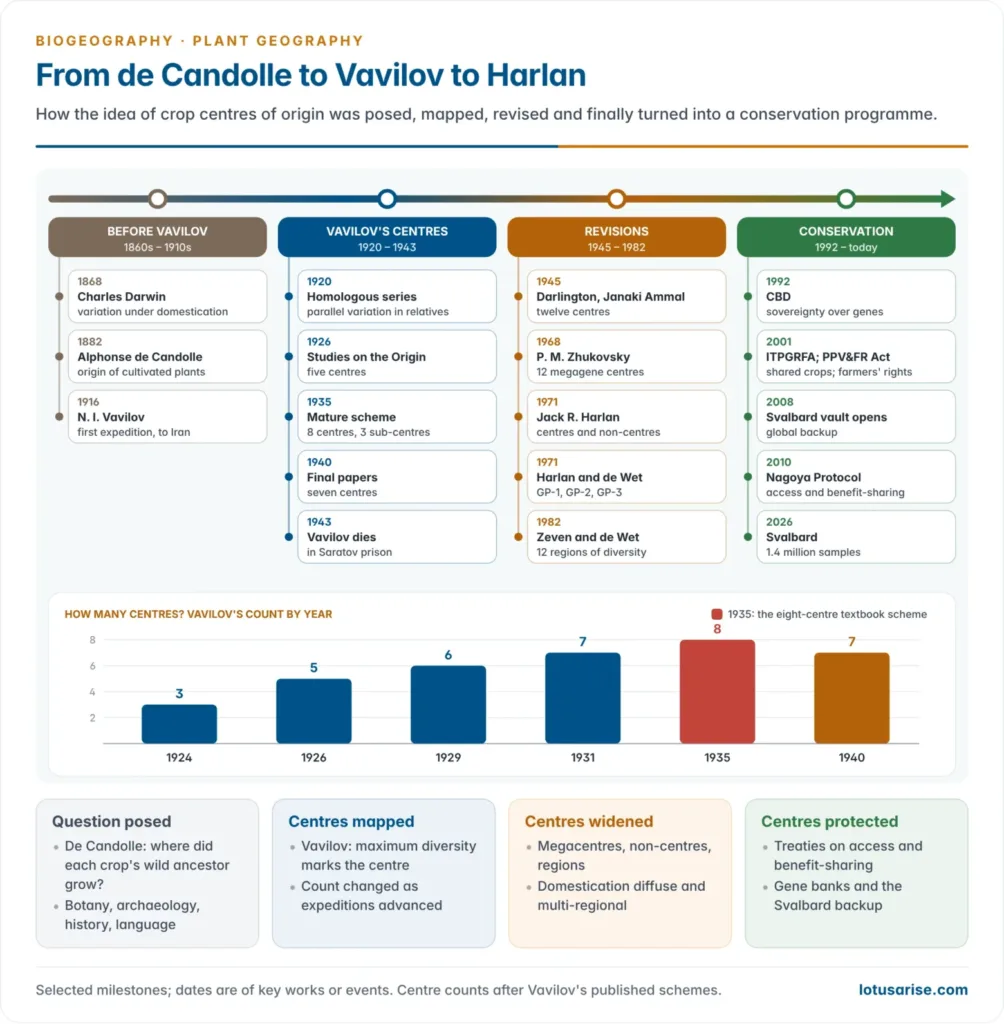
The shifting count: three centres to eight, back to seven
- Vavilov’s underlying principles grew stronger as his fieldwork advanced, but the number and borders of his centres changed continuously as new evidence came in. The scheme was a living hypothesis, not a single fixed pronouncement.
| Year | Centres | Note |
|---|---|---|
| 1924 | 3 | First scheme |
| 1926 | 5 | Studies on the Origin of Cultivated Plants |
| 1929 | 6 | |
| 1931 | 7 | |
| 1935 | 8 | Eight main centres plus three sub-centres; the standard textbook scheme |
| 1940 | 7 | Final papers; seven major centres with minor additions |
- The 1926 book set out the core principle: each crop has a characteristic primary centre of diversity, which is also its centre of origin. It recognised five centres.
- The eight-centre scheme of 1935 is the one most widely cited. Vavilov later added secondary centres of diversity for certain crops, regions to which a crop had spread and diversified further.
Vavilov’s Eight Centres of Origin
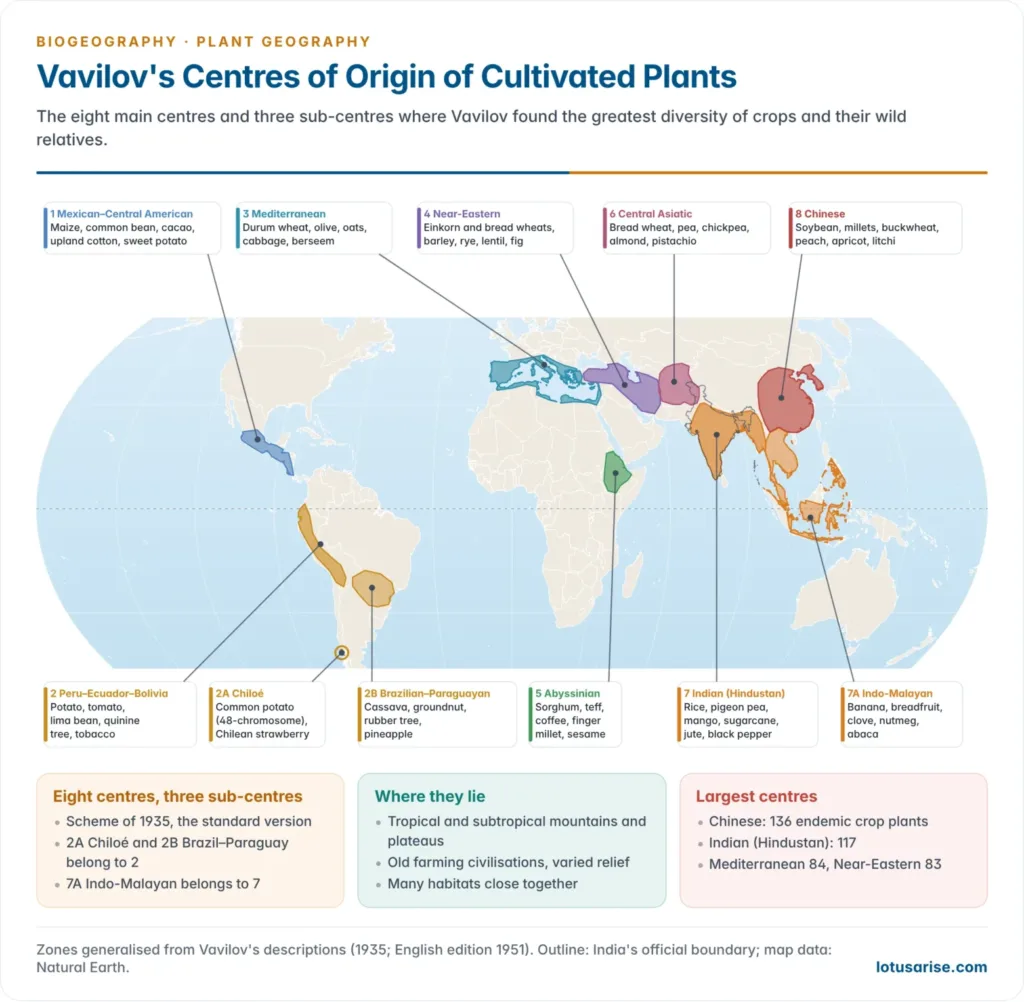
- The eight centres are listed below in the order most textbooks use. Vavilov’s own list ran the other way, beginning with China.
- Common features: most lie in tropical and subtropical mountains and plateaus or their foothills, in regions of ancient settled farming and varied relief, where many habitats sit close together.
| No. | Centre | Area covered | Plants listed |
|---|---|---|---|
| 1 | South Mexican and Central American | Southern Mexico, Guatemala, El Salvador, Honduras, Costa Rica | |
| 2 | South American: Peruvian–Ecuadorean–Bolivian | Andean highlands of Peru, Ecuador and Bolivia | 62 (whole centre) |
| 2A | Chiloé sub-centre | Island off the coast of southern Chile | |
| 2B | Brazilian–Paraguayan sub-centre | Lowland South America east of the Andes | |
| 3 | Mediterranean | Lands bordering the Mediterranean Sea | 84 |
| 4 | Near-Eastern (Middle East) | Interior Asia Minor, Transcaucasia, Iran, highlands of Turkmenistan | 83 |
| 5 | Abyssinian (Ethiopian) | Ethiopia, Eritrea, part of Somaliland | 38 |
| 6 | Central Asiatic | North-west India (Punjab, North-West Frontier, Kashmir), Afghanistan, Tajikistan, Uzbekistan, western Tian Shan | 43 |
| 7 | Indian (Hindustan): main centre | Most of the Indian subcontinent with Assam, Bangladesh and Burma, but not north-west India | 117 |
| 7A | Indo-Malayan (Siam–Malaya–Java) sub-centre | Indo-China and the Malay Archipelago | 55 |
| 8 | Chinese | Mountainous central and western China and adjacent lowlands, with Korea | 136 |
World centres of origin: the crop inventory
- Each centre was documented with an exhaustive plant inventory. Naming two or three specific crops per centre turns a list of regions into an argument.
| Centre | Key crop groups and representative species |
|---|---|
| 1. South Mexican and Central American | Grains and legumes: maize, common bean, lima bean, tepary bean, jack bean, grain amaranth · Gourds: Malabar gourd, winter pumpkin, chayote · Fibre: upland cotton, bourbon cotton, henequen (sisal) · Others: sweet potato, arrowroot, chilli pepper, papaya, guava, cashew, cacao, cherry tomato |
| 2. Peruvian–Ecuadorean–Bolivian | Tubers: Andean potato and 14 or more other endemic potato species (chromosome numbers 24 to 60), edible nasturtium (mashua), edible canna · Grains and legumes: starchy maize, lima bean, common bean · Vegetables: pepino, tomato, ground cherry, pumpkin, pepper · Fibre: Egyptian (sea-island) cotton · Others: cocoa, passion flower, guava, quinine tree (Cinchona), tobacco, cherimoya, coca |
| 2A. Chiloé | Common potato (48-chromosome form), Chilean strawberry |
| 2B. Brazilian–Paraguayan | Manioc (cassava), groundnut, rubber tree (Hevea), pineapple, Brazil nut, cashew, purple granadilla (passion fruit); yerba maté (Ilex paraguariensis) |
| 3. Mediterranean | Cereals and legumes: durum wheat, emmer, Polish wheat, spelt, Mediterranean oats, canary grass, grass pea, pea, lupin · Forage: Egyptian clover (berseem), white clover, crimson clover, serradella · Oil and fibre: flax, rape, black mustard, olive · Vegetables: beet, cabbage, turnip, lettuce, asparagus, celery, chicory, parsnip, rhubarb · Spice and aromatic: caraway, anise, thyme, peppermint, sage, hop |
| 4. Near-Eastern | Cereals and legumes: einkorn, durum, poulard, common, oriental and Persian wheats (nine wheat species in all), two-row barley, rye, oats, lentil, lupin · Forage: alfalfa (lucerne), Persian clover, fenugreek, vetch, hairy vetch · Fruits: fig, pomegranate, apple, pear, quince, cherry, hawthorn |
| 5. Abyssinian | Cereals and legumes: Abyssinian hard wheat, poulard wheat, emmer, Polish wheat, barley (great diversity), grain sorghum, pearl millet, finger millet (ragi), cowpea, flax, teff · Others: sesame, castor bean, garden cress, coffee (Coffea arabica), okra, myrrh, indigo |
| 6. Central Asiatic | Cereals and legumes: common wheat, club wheat, shot wheat, pea, lentil, horse bean, chickpea, mung bean, Indian mustard, flax, sesame · Fibre: hemp, cotton (Gossypium herbaceum) · Vegetables: onion, garlic, spinach, carrot · Fruits: pistachio, pear, almond, grape, apple |
| 7. Indian (Hindustan) | Cereals and legumes: rice, chickpea, pigeon pea, urd, mung bean, rice bean, cowpea · Vegetables and tubers: brinjal, cucumber, radish, taro, yam · Fruits: mango, orange, tangerine, citron, tamarind · Sugar, oil and fibre: sugarcane, coconut, sesame, safflower, tree cotton, oriental cotton, jute, sunn hemp (Crotalaria), kenaf · Spices and others: hemp, black pepper, gum arabic, sandalwood, indigo, cinnamon, croton, bamboo |
| 7A. Indo-Malayan | Cereals and legumes: Job’s tears, velvet bean · Fruits: pummelo, banana, breadfruit, mangosteen · Oil, sugar, spice and fibre: candlenut, coconut, sugarcane, clove, nutmeg, black pepper, Manila hemp (abaca) |
| 8. Chinese | Cereals and legumes: broomcorn millet, foxtail (Italian) millet, Japanese barnyard millet, kaoliang sorghum, buckwheat, hull-less barley, soybean, adzuki bean, velvet bean · Roots and vegetables: Chinese yam, radish, Chinese cabbage, onion, cucumber · Fruits and nuts: pear, Chinese apple, peach, apricot, cherry, walnut, litchi · Sugar, drug and fibre: sugarcane, opium poppy, ginseng, camphor, hemp |
- The Chinese centre is the largest independent centre, with 136 endemic cultivated plants. It gave the world the soybean, the millets of the north and many temperate fruits.
- Rice appears in Vavilov’s list under the Indian centre, which he regarded as its main home.
- Modern archaeology and genomics place the first domestication of japonica rice in the Yangtze valley of China about 9,000 years ago; the indica rice of South Asia drew on local wild rice as well. Both centres were therefore vital to the crop.
- Several crops have more than one centre. Sugarcane, sesame, flax, black pepper and coconut appear in two lists each, reflecting either independent domestication or a primary and a secondary centre.
After Vavilov: Later Revisions
- Vavilov’s scheme, though foundational, was not the last word on crop origins. The field has moved from one elegant model to a more pluralistic understanding of domestication geography.
Darlington and Janaki Ammal (1945)
- Cyril Dean Darlington and the Indian botanist E. K. Janaki Ammal, in their Chromosome Atlas of Cultivated Plants (1945), recast Vavilov’s map as twelve centres of origin.
- They replaced the island of Chiloé with continental Chile and added the Brazil–Paraguay and United States centres.
- They treated the Mediterranean as a diffuse centre, a route of exchange more than a cradle of wild crops.
Zhukovsky’s megacentres (1968, 1970)
- Pyotr Mikhailovich Zhukovsky, Vavilov’s colleague and successor, found that too many crops originated outside Vavilov’s compact centres. In 1968 he enlarged them into twelve “megagene centres” (megacentres) that cover much of the world’s land surface.
- Nine (1, 2, 4, 5, 6, 7, 8a, 10 and 11) are much-enlarged Vavilov centres.
- Three were new: Australia–New Zealand, the whole of Africa, and Europe–Siberia, a centre for apples, pears and plums. North America had earlier been proposed by Darlington and Janaki Ammal.
- In 1970 he redrew some boundaries, separating the Indian subcontinent from Indo-China and Central Asia from West Asia.
- A. C. Zeven and J. M. J. de Wet (1982) used the same twelve units as regions of diversity, preferring “region” to “centre”.
| No. | Zhukovsky’s megacentre | No. | Zhukovsky’s megacentre |
|---|---|---|---|
| 1 | China | 7 | Mediterranean coast and adjacent lands |
| 2 | Indochina–Indonesia | 8 | Africa (8a: Ethiopia) |
| 3 | Australia–New Zealand | 9 | Europe–Siberia |
| 4 | Indian subcontinent | 10 | Central America |
| 5 | Central Asia | 11 | Bolivia–Peru–Chile |
| 6 | West Asia | 12 | North America |
Harlan’s centres and non-centres (1971)
- Jack Rodney Harlan, an American agronomist, offered an influential alternative in Science (1971): “centres and non-centres”.
- Not all crops arose in small, discrete Vavilovian centres. Agriculture began independently in three centres, each paired with a vast non-centre where many crops were domesticated diffusely over large areas, with no tight focus.
| Region | Centre | Non-centre | Non-centre crops (examples) |
|---|---|---|---|
| A. Near East–Africa | A1 Near Eastern (Fertile Crescent) | A2 African (savanna belt south of the Sahara) | Sorghum, pearl millet, African rice, cowpea, yam |
| B. East Asia | B1 North Chinese | B2 South-East Asian and South Pacific | Banana, taro, yam, sugarcane, coconut |
| C. Americas | C1 Mesoamerican | C2 South American | Potato, cassava, groundnut, lima bean |
- Harlan’s work is a useful corrective to place beside Vavilov’s. A “centre” may simply mark where farming began and where crops from the surrounding non-centre were later concentrated.
Molecular phylogeography
- DNA-based tracing of domestication has both confirmed Vavilov’s broad centres and revised their details.
- It confirms wheat and barley domestication in the Fertile Crescent (Near-Eastern centre) about 10,000–11,000 years ago, and maize from the wild grass teosinte in the Balsas valley of southern Mexico about 9,000 years ago.
- It pins domestication to more precise spots within a Vavilov region, and shows multiple independent domestications of some crops, such as rice, barley and common bean.
- The current view: domestication was a protracted, multi-regional process over thousands of years, not a single event in a single centre. Vavilov’s centres survive as centres of crop diversity, the most useful places to search for genes.
Gene Pool Centres and Conservation
Importance of preserving the gene pool
- Each gene has a specific purpose, such as giving a plant a particular characteristic, resistance to a disease or tolerance of a harsh climate.
- A population with greater genetic diversity is better prepared for disease outbreaks or extreme environmental change, because it most likely already carries the genes that protect it.
- Populations with small gene pools are more susceptible. They may become endangered or extinct, and face heightened risk of genetic disease, deformity and infertility.
- Genetic erosion is severe. The FAO estimates that about 75% of crop genetic diversity was lost during the twentieth century, as farmers worldwide switched to genetically uniform, high-yielding varieties and abandoned their many local landraces.
- In India, the spread of high-yielding wheat and rice under the Green Revolution displaced thousands of traditional rice varieties.
- Stored diversity pays off decades later. A variety of Turkish wheat, collected by Jack Harlan in 1948 and stored in a gene bank, was rediscovered in the 1980s carrying genes for resistance to many disease-causing fungi, including stripe rust and bunt.
- Plant breeders now use those genes in wheat varieties resistant to a range of diseases. “Obsolete” landraces in long-term storage can become strategically invaluable.
- Climate change raises the stakes. Crop wild relatives that grow in deserts, salt marshes and high mountains carry heat, drought, flood and salt tolerance that modern varieties lack.
- Medicine: many medicines come from plant and animal sources, such as neem oil and quinine from the Cinchona tree (used to prevent and treat malaria), both drawn from wild or semi-wild plant genetic resources.
- Gene pool conservation therefore matters for the pharmacological future of humanity as well as for crop resilience, and is a pillar of sustainable development.
Gene pool centres as “Good Hope” for biodiversity conservation
- They concentrate irreplaceable diversity. Crop wild relatives, landraces and the knowledge of farming communities are packed into a few regions, so protecting them protects the genetic base of world food supply.
- They keep evolving. In situ, wild relatives and landraces continue to co-evolve with pests, diseases and a changing climate, producing new adaptations that a frozen seed sample cannot.
- They overlap with biodiversity hotspots. Most Vavilov centres lie in or beside biodiversity hotspots such as the Mediterranean Basin, the Caucasus, the Tropical Andes, Mesoamerica, the Himalaya, Indo-Burma and the Western Ghats, so one investment conserves both wild and agricultural diversity.
- They are under pressure. Habitat loss, uniform commercial varieties, overgrazing, conflict and warming are eroding the very areas the world depends on. Most crop wild relatives are poorly represented in both protected areas and gene banks.
The conservation pipeline: in situ and ex situ
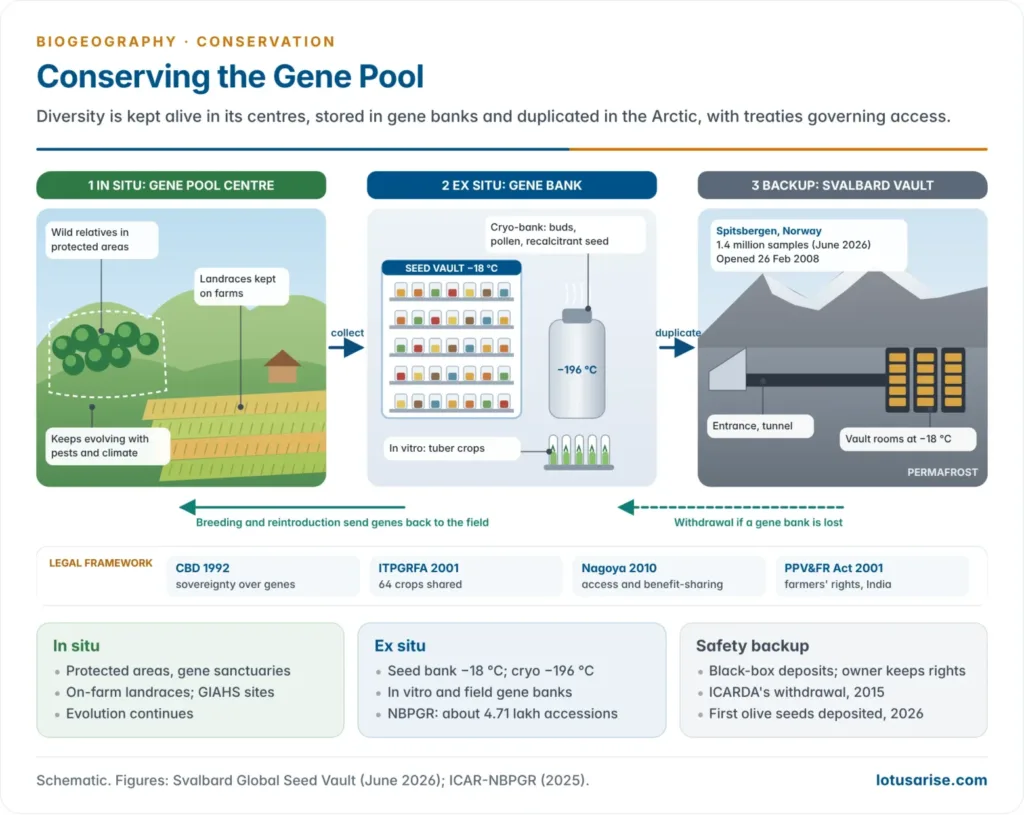
- In-situ conservation keeps diversity where it evolved:
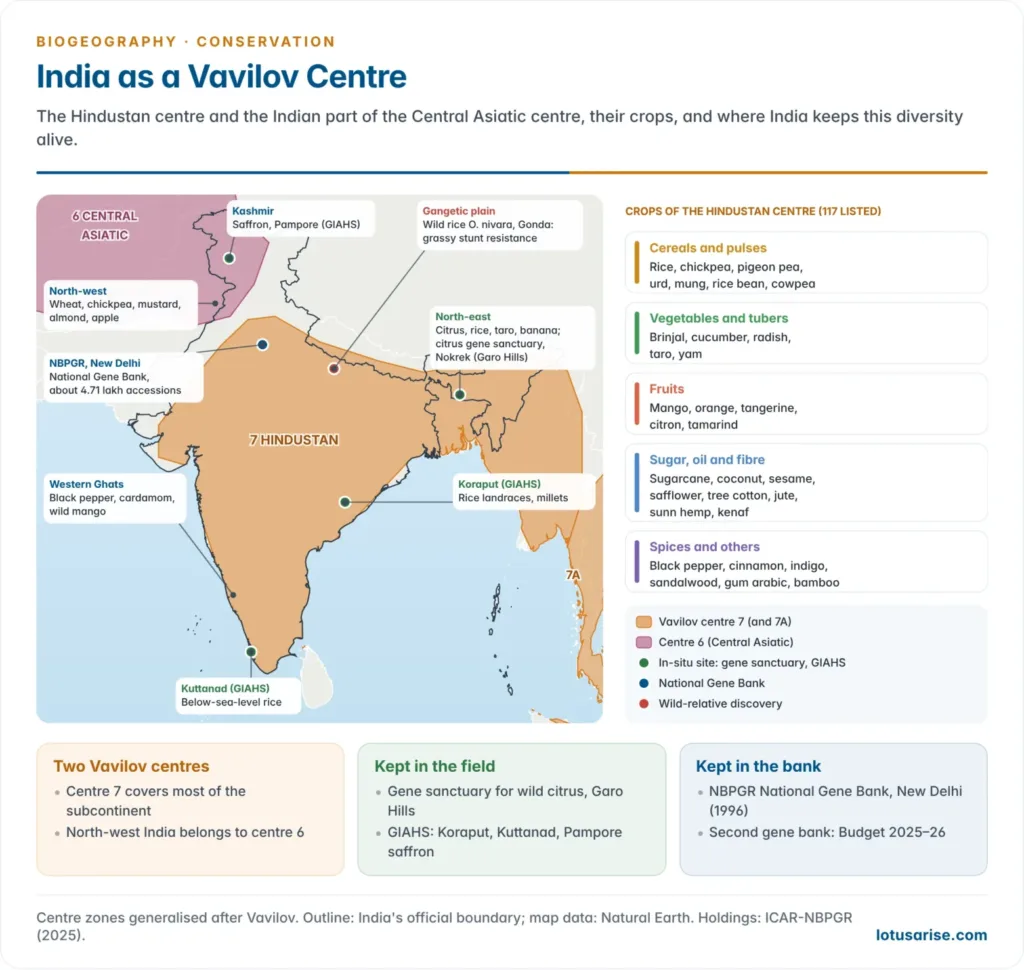
- Protected areas and gene sanctuaries. India’s first gene sanctuary, for wild Citrus, was set up in the Garo Hills of Meghalaya (Nokrek), in the Hindustan centre.
- On-farm conservation by farmers who keep growing landraces, recognised through FAO’s Globally Important Agricultural Heritage Systems (GIAHS): in India, the Koraput tribal farming system of Odisha (2012), Kuttanad below-sea-level farming in Kerala (2013) and saffron farming at Pampore in Kashmir (2011).
- The PPV&FR Authority has mapped 22 agro-biodiversity hotspots in India, from the cold desert of Ladakh to the Malabar coast and the islands.
- Ex-situ conservation keeps samples outside their natural habitat:
- Seed gene banks store dried seed at about −18 °C for long-term conservation.
- Field gene banks keep living plants of crops that are propagated vegetatively or have short-lived seed, such as mango, coconut and banana.
- In-vitro gene banks hold tissue cultures, and cryo-gene banks store seeds, buds and pollen in liquid nitrogen at about −196 °C.
- Safety duplication: a copy of each gene bank’s seed is sent to a second site. The Svalbard Global Seed Vault is the final backup.
- The two approaches are complementary: in situ keeps evolution going; ex situ provides secure storage and ready access for breeders. Wider conservation measures for biodiversity follow the same logic.
Modern gene bank infrastructure
- The practical response to the loss of three-quarters of crop diversity has been a global network of ex-situ gene banks that conserve seeds, tissue, pollen and DNA. Three tiers stand out.
1. Svalbard Global Seed Vault: the “backup of backups”
- The vault is cut deep into the permafrost of a mountain near Longyearbyen on Spitsbergen, Norway, about 1,300 km from the North Pole. It opened on 26 February 2008.
- It is managed jointly by the Norwegian Government, the Nordic Genetic Resource Center (NordGen) and the Crop Trust.
- It has room for about 4.5 million seed samples, kept at −18 °C; the permafrost keeps them frozen even if the power fails.
- After its 70th deposit event (June 2026) the vault held more than 1.4 million seed samples (1,401,285), sent by gene banks in nearly every region of the world.
- The first deposit of 2026 brought the vault’s first olive seeds and new depositors from Guatemala and Niger; Burkina Faso followed in June.
- Its purpose is not to replace national gene banks but to be a secure, free insurance backup for collections held elsewhere, hence the nickname “Doomsday Vault”.
- It works as a “black box”: the depositing gene bank keeps ownership, and only it can withdraw its seeds.
- It has already proved its worth. During the Syrian civil war, the International Center for Agricultural Research in the Dry Areas (ICARDA), whose gene bank was at Aleppo, made the first-ever withdrawal (2015) to rebuild its collection in Lebanon and Morocco, and has since re-deposited the regenerated seed.
- Recent priority deposits have come from gene banks hit by conflict and disaster, such as Sudan’s crop gene bank during its civil war and the Philippines’ national gene bank after typhoons and a fire.
2. India’s National Gene Bank (ICAR-NBPGR)
- India’s National Gene Bank was set up in 1996 at the ICAR-National Bureau of Plant Genetic Resources (NBPGR), New Delhi, which works through regional stations across the country’s agro-climatic zones.
- It holds about 4.71 lakh (471,561) accessions of over 2,150 species (2025), making it the second-largest gene bank in the world after Svalbard.
- Holdings by crop group include cereals (about 1.7 lakh accessions), legumes (over 69,000), oilseeds (over 63,500), millets (over 60,000) and vegetables (nearly 30,000).
- Beyond the seed gene bank, NBPGR maintains an in-vitro gene bank for vegetatively propagated and tuber crops that cannot be stored as seed, and a cryo-gene bank for species with recalcitrant seeds that do not survive drying and freezing.
- The Union Budget 2025–26 announced a second National Gene Bank to conserve 10 lakh (1 million) germplasm lines, under its “Investing in Innovation” theme.
3. The CGIAR gene bank network
- The international CGIAR (formerly the Consultative Group on International Agricultural Research) runs eleven gene banks that together conserve more than 700,000 accessions of over 3,000 plant species.
- They include ICRISAT (Patancheru, Hyderabad: sorghum, pearl millet, chickpea, pigeon pea, groundnut), IRRI (Philippines: rice), CIMMYT (Mexico: wheat and maize) and ICARDA (dryland cereals and legumes).
- They are the main international source of germplasm for public plant-breeding programmes, shared free under the Plant Treaty.
International and Indian legal framework
| Instrument | Year (in force) | What it does |
|---|---|---|
| Convention on Biological Diversity (CBD) | 1992 (1993) | Establishes national sovereignty over genetic resources and three objectives: conservation, sustainable use and fair and equitable benefit-sharing |
| ITPGRFA (International Treaty on Plant Genetic Resources for Food and Agriculture, the “Plant Treaty”) | 2001 (2004) | Under the FAO, sets up a Multilateral System of facilitated access and benefit-sharing for 64 major food and forage crops (Annex I), and recognises Farmers’ Rights; 155 contracting parties, India among them |
| Nagoya Protocol on Access and Benefit-Sharing | 2010 (2014) | A supplementary agreement to the CBD with detailed access and benefit-sharing (ABS) rules: prior informed consent and mutually agreed terms; 142 parties (2025) |
| Kunming–Montreal Global Biodiversity Framework | 2022 | Target 4 calls for maintaining the genetic diversity of wild and domesticated species; Target 13 for benefit-sharing, including from digital sequence information |
| India: Protection of Plant Varieties and Farmers’ Rights (PPV&FR) Act | 2001 | Recognises both breeders’ rights and farmers’ rights, including the right to save, use, exchange and sell farm seed (but not branded seed of a protected variety) |
| India: Biological Diversity Act | 2002 (amended 2023) | Implements the CBD and ABS through the National Biodiversity Authority, state boards and local Biodiversity Management Committees |
- The ITPGRFA is the legal backbone that lets international seed banks like the CGIAR centres and Svalbard function, by making the key crops a shared pool.
- The Nagoya Protocol answers “biopiracy”, where genetic material from a gene pool centre is commercialised without benefit flowing back to the country or community of origin.
- Since gene sequences can now be used without the physical sample, the CBD’s COP-16 (Cali, 2024) set up the Cali Fund for benefit-sharing from digital sequence information.
- The PPV&FR Act balances innovation incentives against the interests of traditional farming communities who maintain much of India’s crop diversity.
- It rewards farmer-conservers through the Plant Genome Saviour awards.
- In 2021 the PPV&FR Authority revoked PepsiCo’s registration of the FL-2027 potato variety, after the company had sued Gujarat farmers for growing it.
Case study: India as a Vavilov centre
- Indian territory falls within two of Vavilov’s eight centres:
- Centre 6 (Central Asiatic) covers north-west India, that is Punjab, the former North-West Frontier Province and Kashmir. It contributed common wheat, pea, lentil, chickpea, mung bean, Indian mustard and sesame, and fruits such as pistachio, almond, grape and apple.
- Centre 7 (Indian or Hindustan) covers the rest of the subcontinent, the Gangetic plain, the peninsula and Assam, together with Bangladesh and Burma. Its 117 recorded species include rice, pigeon pea, urd, mung bean, brinjal, cucumber, taro, yam, mango, citrus fruits, sugarcane, tree cotton, jute, black pepper and cinnamon.
- India today holds about 811 cultivated plant species and over 900 crop wild relatives.
- North-east India is a centre of citrus, banana, rice and taro diversity; the Western Ghats of black pepper, cardamom and wild mango; the Himalaya of temperate fruits, millets and buckwheat; the Kuttanad and Koraput systems keep traditional rice landraces alive.
- This dual heritage is why India is at once a Vavilov centre of crop origin and home to four of the world’s 36 biodiversity hotspots: the Himalaya, Indo-Burma, the Western Ghats and Sri Lanka, and Sundaland (Nicobar Islands).
- The same combination of ancient geological stability, steep climatic gradients and long agricultural history that produces exceptional wild biodiversity also produces exceptional crop genetic diversity.
- India’s 4.71-lakh-accession National Gene Bank is therefore not merely a technical facility but the custodian of a globally significant genetic inheritance, and the gene sanctuaries, GIAHS sites and farmers’ rights law extend that custody to the field.




You’re doing great works. Keep posting!! Blessing from Kolkata
Thanks for your kind words
blessing from Afghanistan
THANK YOU SO MUCH……
really notes are helpfull
elucidated well.very thankfull.
thank you.
I really dont know who you are. But I definitely know what you are doing. You are the greatest. Really helpful. Thanks a lot!
Thanks for your very kind words