

- Population – A population is defined as a group of individuals of the same group or species living and interbreeding within a given area. Members of a population often rely on the same resources, are subject to similar environmental constraints, and depend on the availability of other members to persist over time.
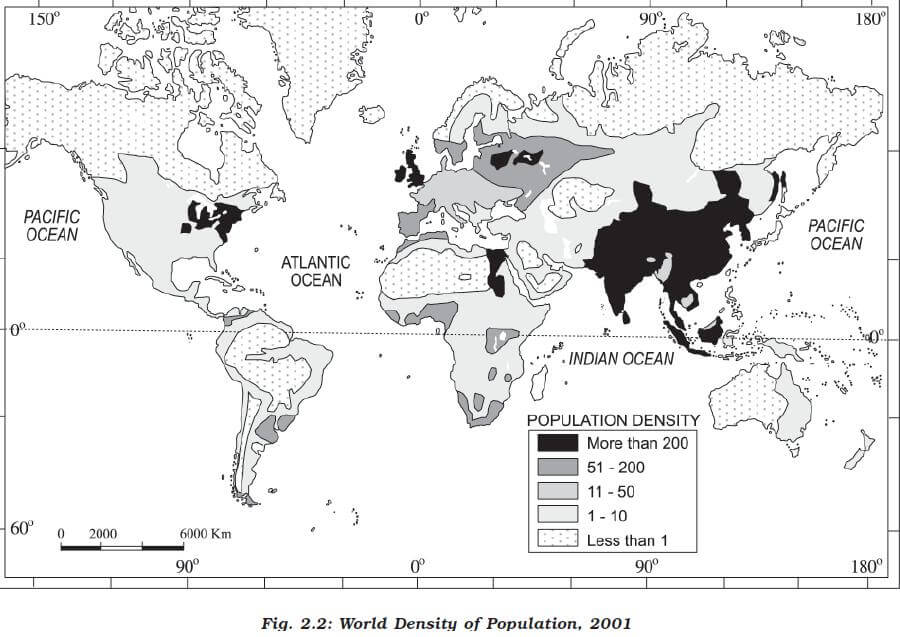
- Population Geography – Population geography is a branch of human geography that is focused on the scientific study of people, their spatial distributions, and their density.
- To study these factors, population geographers examine the increase and decrease in population, people’s movements over time, general settlement patterns, and other subjects, such as occupation and how people are affected by the geographic character of a place.
- Population geography is closely related to demography (the study of population statistics and trends).
- Population Growth – Population growth is loosely defined as the change in the number of individuals in a population in an area over time.
- To find the growth rate of a population, we take the number of individuals moving into an area and subtract the number of individuals moving out of an area by taking the birth rate, adding the immigration rate, and subtracting the death rate and emigration rate.
- Growth rate = Birth rate – Death rate + Immigration rate – Emigration rate
- To find the growth rate of a population, we take the number of individuals moving into an area and subtract the number of individuals moving out of an area by taking the birth rate, adding the immigration rate, and subtracting the death rate and emigration rate.
Growth of World Population

- Growth of world population refers to the change in the total number of people inhabiting the earth over time, governed primarily by the interplay of:
- Fertility (birth rates)
- Mortality (death rates)
- Migration (at regional scale)
- It is one of the most fundamental themes in population geography because:
- It reflects human–environment interaction,
- Determines resource use and economic development,
- Shapes social, political, and ecological dynamics globally.
- The growth of population has been uneven and stage-wise, characterized by long periods of stagnation followed by phases of rapid expansion, especially after the Industrial Revolution.
Phases of World Population Growth
- The analysis of world population growth is generally traced back to about 10,000 years before present (8000 BC), which marks:
- The completion of evolution of Homo sapiens and beginning of organized human culture, and
- The transition from hunting–gathering to settled life, making systematic interpretation of population growth possible.
- Over this long historical period, population growth has not been uniform but has undergone distinct phases influenced by technological revolutions, socio-economic transformations, and demographic transitions, especially:
- Agricultural Revolution (~8000 BC)
- Industrial Revolution (18th century)
- Technological and Medical Revolutions (20th century onwards)
Phase I: Primitive Stagnation and Early Agrarian Phase (10,000 BC – 1650 AD)
- Around 8000 BC, the total world population is estimated to be:
- Approximately 5 million, with extremely low population density of about 4 persons per sq. km, indicating vast unoccupied land and limited human control over nature.
- The socio-economic structure of society was:
- Based on hunting and gathering, where:
- Men were primarily engaged in hunting animals
- Women contributed through gathering plant-based food
- Population mobility was high, and settlements were temporary in nature.
- Based on hunting and gathering, where:
- Demographic characteristics of this phase were marked by:
- Very high birth rates, due to lack of contraception and need for survival
- Very high death rates, caused by:
- Epidemics, famines, harsh climatic conditions, and conflicts
- Resulting in:
- Near-zero or extremely slow population growth
- It is also believed that:
- Population size was often deliberately or naturally controlled to remain within the carrying capacity of the territory, especially in hunting-gathering societies where resources were limited.
Impact of Agricultural Revolution (~8000 BC)
- The Agricultural Revolution marked a fundamental turning point as humans:
- Began domestication of plants and animals, leading to sedentary life.
- Its demographic consequences were profound:
- Improved food supply and nutrition, which led to:
- Decline in death rates
- Increased longevity
- Reduction in nomadic movement:
- Earlier, mothers could carry only one child → natural birth spacing
- With settled life, child spacing constraints disappeared, leading to higher fertility
- Agriculture created a new economic logic:
- Children became economic assets, as they:
- Provided labour in farms
- Ensured support for parents in old age
- Children became economic assets, as they:
- Improved food supply and nutrition, which led to:
- Thus, agriculture and high natality became closely linked, leading to:
- Gradual increase in population, though still constrained by high mortality.
Population Trends till 1650
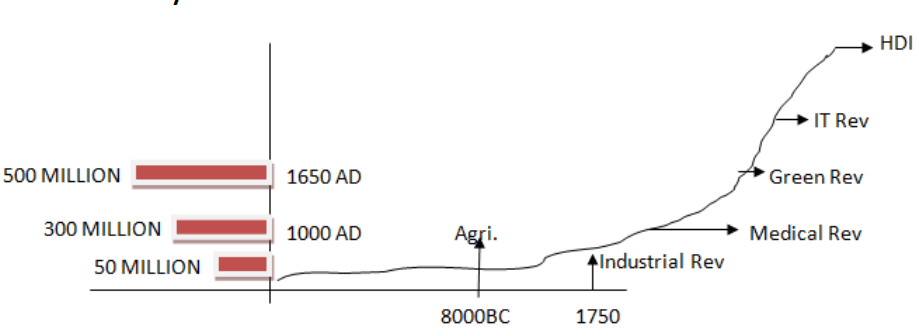
- Population increased slowly over millennia:
- Around 200–300 million at the time of Christ
- About 500 million by 1650 AD
- This entire phase corresponds to:
- Stage I of Demographic Transition (High stationary stage)
- Characterized by:
- Balance between high birth and death rates
- Low growth rate
Phase II: Early Expansion and Industrial Transition (1650 – 1950)
- This phase marks the beginning of sustained population growth, as:
- Death rates began to decline while birth rates remained relatively high.
Medieval Developments and Proto-Industrial Changes
- During the medieval period:
- Expansion of trade and commerce led to:
- Growth of towns and cities
- Increasing demand for consumer goods
- Expansion of trade and commerce led to:
- Agricultural changes:
- Landowners sought to expand agricultural production, leading to:
- Intensification of agriculture
- Emergence of agriculture as a commercial activity
- Landowners sought to expand agricultural production, leading to:
- These changes contributed to:
- Improved food availability
- Gradual stabilization of population growth
Impact of Industrial Revolution (18th–19th Century)
- The Industrial Revolution fundamentally transformed population dynamics by:
- Introducing machine-based production using fossil fuels
- Increasing productivity and output per capita
- Leading to accumulation of wealth and expansion of:
- Secondary (industry) and tertiary (services) sectors
- Demographic impacts:
- Improved food production and distribution
- Better transport systems (railways, ships)
- Initial improvements in public health
- However, industrialization also created:
- Rapid rural-to-urban migration, leading to:
- Overcrowded cities
- Poor sanitation and living conditions
- High incidence of diseases such as:
- Cholera and other epidemics
- Socio-economic problems due to:
- Migration of unskilled rural population into urban centres
- Rapid rural-to-urban migration, leading to:
Population Growth Pattern
- Growth during this phase was:
- Gradual but accelerating
- Population increased from:
- ~500 million (1650) → ~2.5 billion (1950)
- This phase corresponds to:
- Stage II of Demographic Transition (Early expanding stage)
Phase III: Population Explosion and Technological Era (1950 – Present)
- The period after 1950 marks the most dramatic phase in human demographic history, characterized by an unprecedented acceleration in population growth, often termed as population explosion.
- The global population increased from about 2.5 billion in 1950 to over 8 billion today, representing the fastest growth ever recorded.
Key Drivers of Population Explosion
- The most critical factor behind this rapid growth was the sharp decline in death rates, while birth rates remained relatively high, especially in developing countries:
- Medical Revolution played a decisive role:
- Introduction of antibiotics, vaccines, and improved healthcare systems drastically reduced mortality.
- Control of epidemics such as smallpox, cholera, and malaria significantly improved survival rates.
- Public health measures:
- Improved sanitation, safe drinking water, and nutrition reduced infant and maternal mortality.
- Agricultural transformation (Green Revolution):
- High-yielding variety (HYV) seeds, irrigation, and fertilizers increased food production.
- Countries like India and Mexico avoided large-scale famines and supported growing populations.
- Technological advancements:
- Mechanization, transport networks, and globalization improved food distribution and economic opportunities.
- Medical Revolution played a decisive role:
J-Curve Pattern of Population Growth
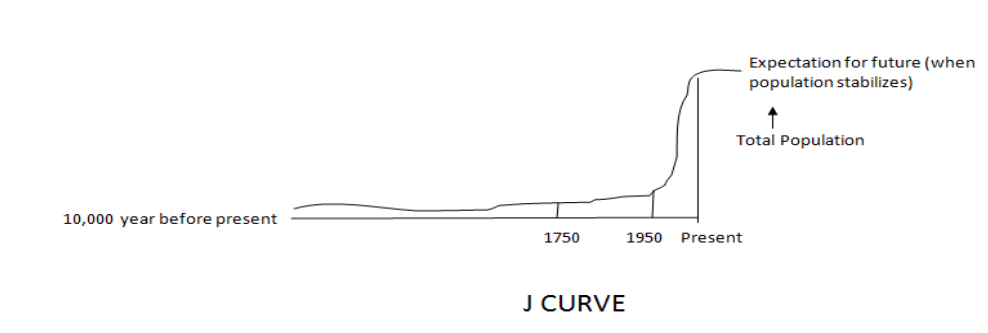
- The population growth in this phase is best represented by a J-shaped curve, which indicates:
- Slow growth for a long period, followed by a sudden and sharp exponential rise.
- Explanation:
- When death rates decline rapidly but birth rates remain high, the gap between births and deaths widens, causing population to increase exponentially.
- This creates a steep upward curve resembling the letter “J”.
- Example / Case Study:
- India (1950–1980):
- Death rates declined rapidly due to healthcare improvements.
- Birth rates remained high due to socio-cultural factors.
- Result: Rapid population growth → classic J-curve pattern.
- Sub-Saharan Africa (present):
- Many countries still exhibit high fertility with declining mortality → continuing J-curve growth.
- India (1950–1980):
Regional Dimensions of Population Explosion
- Population explosion has been spatially uneven:
- Developed countries experienced it earlier (18th–19th century), but later stabilized.
- Developing countries experienced it later (post-1950), leading to:
- High population pressure on resources
- Urban congestion, unemployment, and environmental stress
- Currently:
- Nearly 75% of the world’s population resides in developing regions, especially in Asia and Africa.
Socio-Cultural Factors Sustaining High Growth
- Despite technological progress, fertility remained high due to:
- Cultural norms favoring large families
- Economic utility of children in agrarian economies
- Low levels of female literacy and empowerment
- Limited access to family planning
- Thus, population growth is not merely biological but deeply embedded in social structures and cultural practices.
Emerging Trends (Late 20th Century onwards)
- Gradual decline in fertility rates in many regions due to:
- Urbanization
- Female education and workforce participation
- Government population policies (e.g., China’s One Child Policy)
- However, the global population still continues to grow, though at a decelerating rate.
S-Curve Interpretation and Contemporary Stabilization
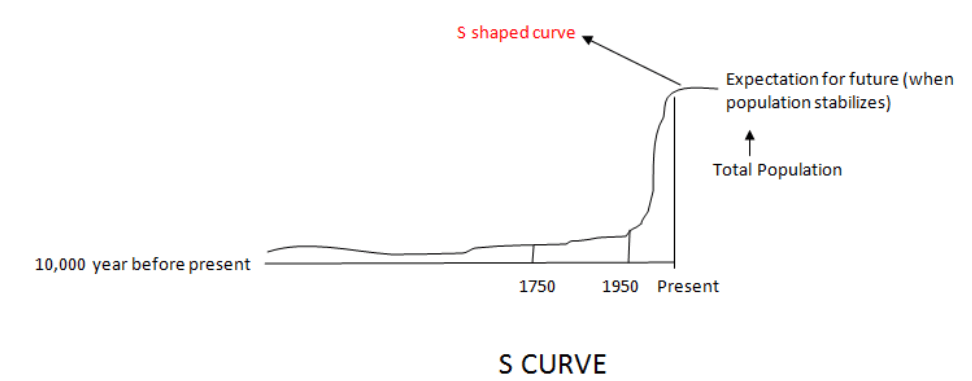
- While the J-curve explains short-term exponential growth, a more comprehensive long-term understanding of population growth is provided by the S-Curve (Sigmoid Curve).
What is S-Curve Growth?
- The S-curve represents a logistic growth pattern, where:
- Population growth starts slowly → becomes rapid → then slows down and stabilizes.
- It consists of three major phases:
- Initial Phase (Lag Phase):
- Slow growth due to limited technology and resources
- Exponential Phase:
- Rapid growth due to technological and economic advancements
- Plateau Phase (Equilibrium):
- Growth slows as limits of resources and social controls emerge
- Initial Phase (Lag Phase):
Conceptual Explanation
- Unlike the J-curve (which assumes unlimited growth), the S-curve:
- Recognizes that environmental limits, resource constraints, and social adjustments eventually restrict growth.
- Thus, population stabilizes around a carrying capacity.
- This idea is closely related to:
- Neo-Malthusian perspective, which emphasizes limits to growth and ecological balance.
Technological Feedback Mechanism
- The S-curve reflects a feedback relationship between population and technology:
- Population growth → stimulates technological innovation
- Technological innovation → supports further population growth
- Thus, each phase of growth is both:
- Cause and consequence of technological progress
Three Major Post-1950 S-Curve Phases
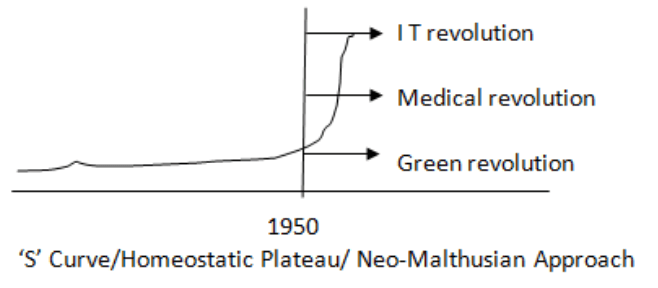
- Since 1950, global population growth can be interpreted as a series of mini S-curves, driven by successive technological revolutions:
1. Green Revolution Phase (1950s–1970s)
- Increased food production through:
- HYV seeds, irrigation, fertilizers
- Supported rapid population growth, especially in Asia
- Example:
- India transformed from food-deficit to food-surplus economy
2. Medical Revolution Phase (1960s–1990s)
- Expansion of healthcare systems and disease control
- Sharp decline in death rates globally
- Example:
- Latin America and Southeast Asia witnessed rapid population growth due to falling mortality
3. ICT and Knowledge Revolution (1990s–Present)
- Spread of education, awareness, and communication technologies
- Increased adoption of:
- Family planning
- Small family norms
- Result:
- Gradual decline in fertility rates and movement towards stabilization
- Example:
- South Korea and Thailand:
- Rapid fertility decline due to education and awareness
- South Korea and Thailand:
Homeostatic Plateau (Population Stabilization)
- The final stage of S-curve is known as:
- Homeostatic equilibrium or plateau, where:
- Birth rates ≈ Death rates
- Population growth stabilizes
- Homeostatic equilibrium or plateau, where:
- This corresponds to:
- Stage IV and V of Demographic Transition
- Example:
- Western Europe and Japan:
- Very low fertility rates
- Ageing population
- Near-zero or negative growth
- Western Europe and Japan:
Contemporary Global Scenario
- The world today shows:
- Mixed population patterns:
- Developed countries → S-curve plateau (stagnation or decline)
- Developing countries → transitioning from J-curve to S-curve
- Mixed population patterns:
- Emerging concern:
- Transition from population explosion to population ageing in many regions
- The transition from J-curve (explosive growth) to S-curve (stabilized growth) reflects:
- The shift from uncontrolled demographic expansion to regulated and sustainable population dynamics.
- The future of world population will depend on:
- Technological innovation,
- Policy interventions, and
- Socio-cultural transformations,
ensuring a balance between population, resources, and environment.

Present Trend of World Population Growth
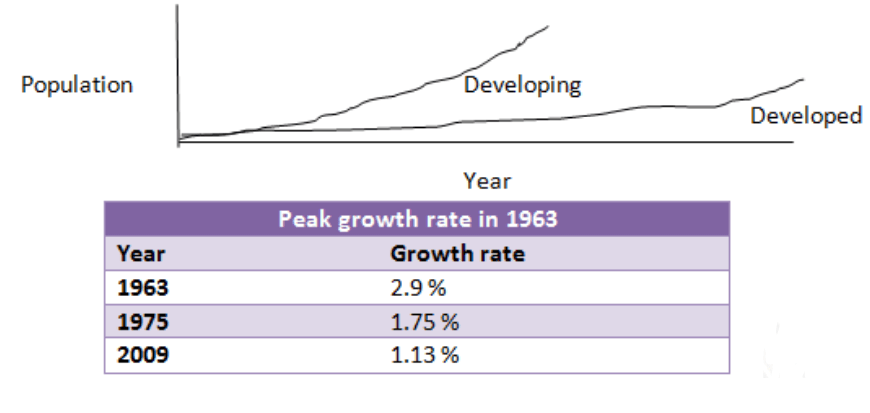
- The present trend of world population growth is characterized by high spatial variability and demographic divergence, where:
- Some regions are still experiencing rapid population growth,
- While others are facing population stagnation or decline.
- As per recent estimates (United Nations Population Fund / UN DESA):
- World population has crossed 8 billion (2022–23)
- Global growth rate has declined to about ~0.8–1% per annum, compared to ~2% in the 1960s
- Thus, the current phase reflects a transition:
- From population explosion → population slowdown and stabilization
Global Overview of Present Population Trends
- The contemporary population scenario is marked by:
- Declining global growth rate, despite increasing absolute numbers
- Increasing regional disparities in growth rates
- Emergence of new demographic challenges such as:
- Ageing population
- Migration pressures
- Urban concentration
- The world is currently passing through:
- Late Stage III and Stage IV of Demographic Transition, with some countries even entering Stage V.
Regional Variability in Population Growth
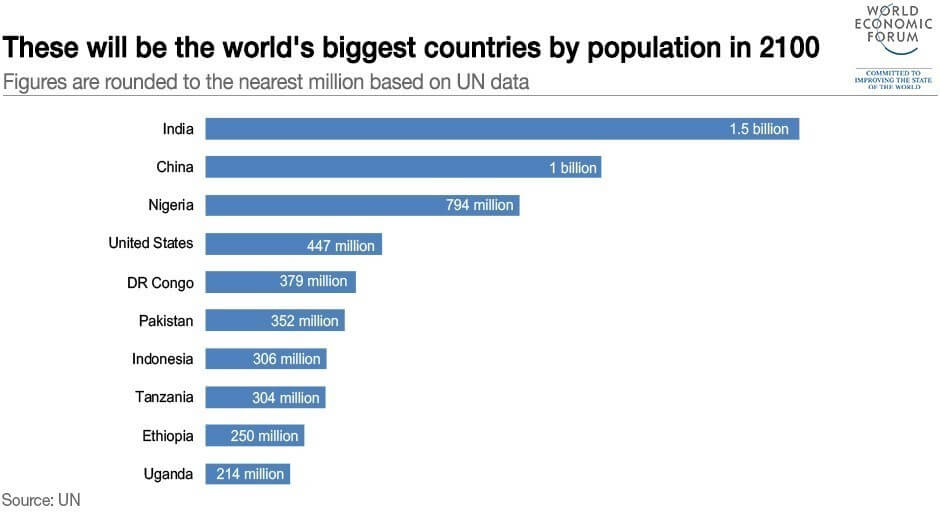
- High Growth Regions (Developing World)
- Several countries, particularly in Sub-Saharan Africa, continue to exhibit:
- Very high growth rates (>2–3% per annum)
- Key reasons include:
- Persistently high fertility rates
- Declining mortality due to improved healthcare
- Young population structure (population momentum)
- Low levels of female education and employment
- Examples:
- Niger, Nigeria, DR Congo, Uganda
- Implications:
- Rapid increase in population pressure on:
- Land, water, and resources
- Challenges of:
- Poverty, unemployment, food insecurity
- Rapid increase in population pressure on:
- Several countries, particularly in Sub-Saharan Africa, continue to exhibit:
- Moderate Growth Regions (Transitional Economies)
- Countries in South Asia, Southeast Asia, and Latin America are experiencing:
- Moderate but declining growth rates
- Features:
- Fertility rates are declining but still above replacement level
- Rapid urbanization and socio-economic changes
- Examples:
- India, Indonesia, Brazil
- India (case):
- Recently became the most populous country (~1.43 billion)
- Growth rate declining due to:
- Education
- Family planning
- Urbanization
- Countries in South Asia, Southeast Asia, and Latin America are experiencing:
- Low or Negative Growth Regions (Developed World)
- Many developed countries are experiencing:
- Very low growth or negative growth rates
- Key examples:
- Romania, Russia, Hungary, Latvia, Japan, Germany
- Causes:
- Very low fertility rates (below replacement level ~2.1)
- Ageing population
- Delayed marriage and childbearing
- Changing lifestyle and career priorities
- Implications:
- Shrinking workforce
- Increasing dependency ratio
- Need for immigration policies
- Many developed countries are experiencing:
Continental Distribution of Population
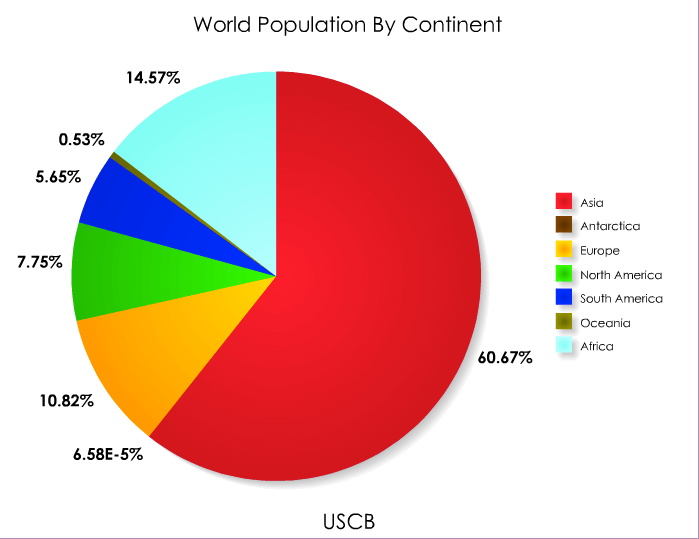
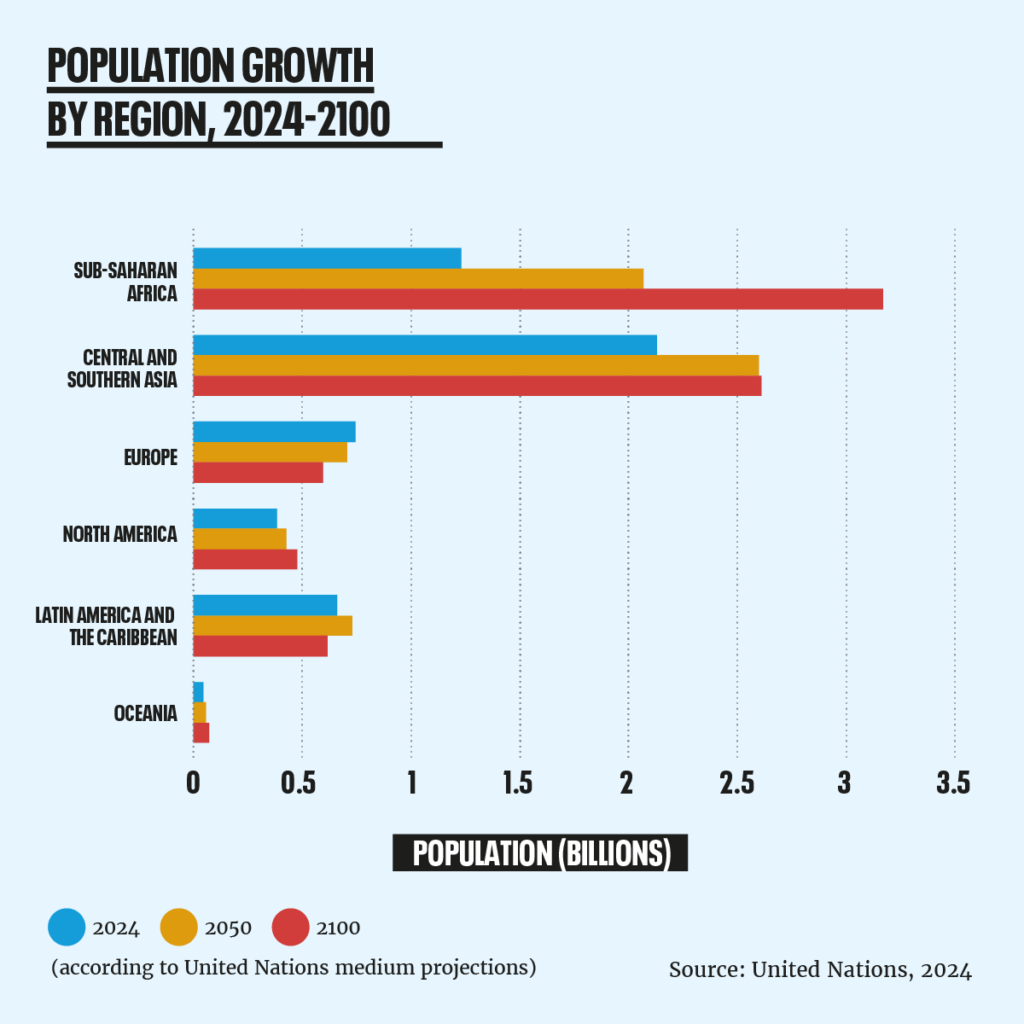
- According to United Nations Population Fund, the distribution of population across continents shows:
- Asia:
- Accounts for about ~59–60% of world population
- Dominated by:
- India and China
- Africa:
- About ~17–18%, but fastest growing continent
- Expected to contribute most to future population growth
- Europe:
- About ~9–10%, with stagnant or declining population
- Latin America & Caribbean:
- Around ~8%, with moderate growth
- North America:
- Around ~5%, relatively stable due to migration
- Oceania:
- Less than 1%, sparsely populated
- Asia:
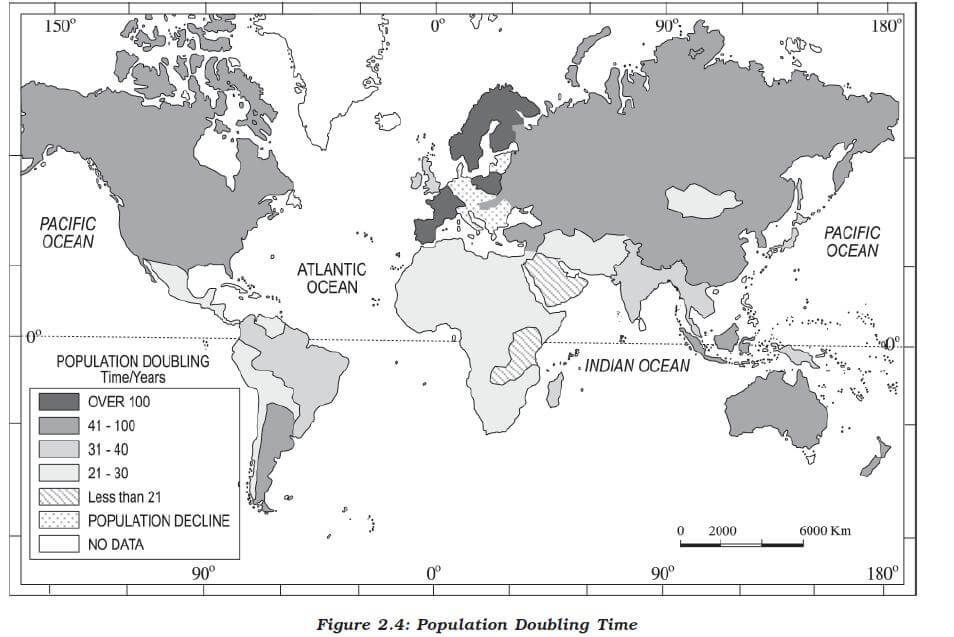
Population Doubling Time (Indicator of Growth)
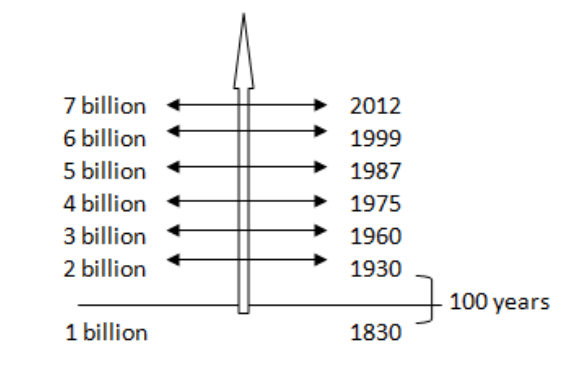
- Population growth can be effectively understood through:
- Doubling time, i.e., the time taken for population to double in size
- Key trends:
- Global doubling time:
- 1650–1850 → ~200 years
- 1850–1950 → ~100 years
- 1950–2000 → ~50 years
- Global doubling time:
- Present scenario:
- Doubling time is increasing again due to:
- Declining growth rates
- 👉 Indicates transition from:
- Rapid growth → slowing growth
- Doubling time is increasing again due to:
Regional Pattern of Population Growth in Developed Countries
- The population growth pattern in developed countries is characterized by a transition from expansion to stagnation and decline, reflecting their advanced stage in the Demographic Transition Model (Stage IV–V).
- Unlike developing regions, these countries are experiencing a demographic slowdown, where:
- Growth rates are very low, often below replacement level,
- And in several cases, population is shrinking despite high standards of living.
General Trend of Population Growth in Developed Countries
- Population growth in developed countries is extremely slow and in many cases negative, with:
- Annual growth rates generally below 1%, and in many European countries even below 0% (negative growth).
- The replacement level fertility (~2.1 children per woman) is not being met; instead:
- Many countries have fertility rates between 1.2–1.7, which is insufficient to maintain population size.
- Growth rates have been:
- Sharply declining since the late 20th century, reflecting deep socio-economic transformations.
- Migration has become:
- The primary contributor to population growth, especially in countries like:
- USA, Canada, Australia, Germany
- Without immigration, several developed countries would experience:
- Rapid population decline
- The primary contributor to population growth, especially in countries like:
- The population structure is:
- Ageing rather than youthful, meaning:
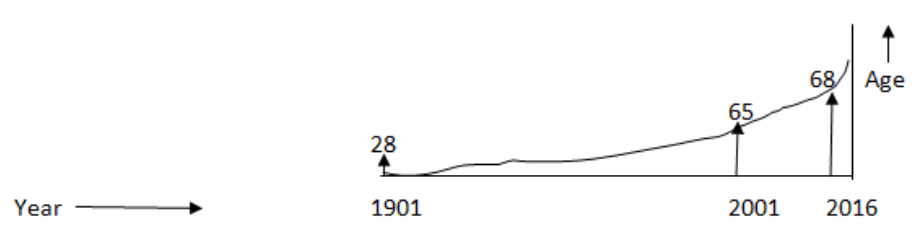
- Increasing proportion of elderly (65+)
- Declining share of young population
- Ageing rather than youthful, meaning:
- Wilbur Zelinsky and other scholars interpret this stage as:
- A post-transitional phase of demographic maturity
- Colin Clark described this stage as:
- “Race suicide stage”, where:
- Fertility declines below replacement level, leading to long-term population decline.
- “Race suicide stage”, where:
Specific Regional Patterns within Developed Countries
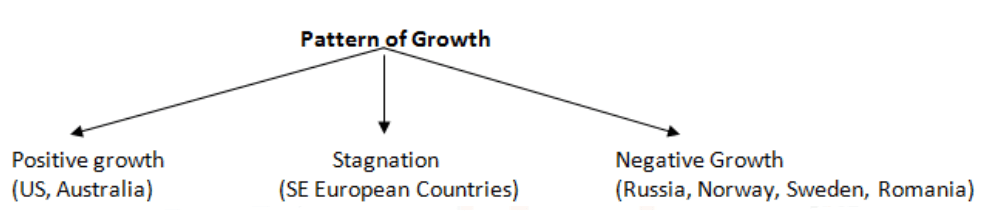
- Developed countries do not show uniform trends; rather, they exhibit three distinct patterns of population growth:
- Positive but Low Growth Countries
- Countries where population is still increasing slightly, mainly due to:
- Immigration rather than natural increase
- Examples:
- USA, Canada, Australia
- Characteristics:
- Fertility slightly higher than Europe but still near replacement level
- Growth sustained by in-migration of skilled and unskilled labour
- Countries where population is still increasing slightly, mainly due to:
- Stagnant Population Countries
- Countries where population growth is:
- Near zero or fluctuating
- Examples:
- France, UK, Netherlands
- Features:
- Low fertility but partially offset by:
- Welfare policies
- Migration
- Low fertility but partially offset by:
- Countries where population growth is:
- Negative Growth Countries
- Countries experiencing:
- Declining population size
- Examples:
- Japan, Germany, Italy, Hungary, Latvia, Romania
- Features:
- Very low fertility (often <1.5)
- High ageing population
- Net population loss without immigration
- Countries experiencing:
- Positive but Low Growth Countries
Factors Responsible for Low Population Growth
- The primary reason for low population growth lies in the deep socio-economic transformation of developed societies, which has fundamentally altered demographic behaviour:
- A. Changing Family and Social Structure
- Shift from:
- Joint family → Nuclear and individualistic family system, reducing family size preferences
- Marriage patterns have changed significantly:
- Delayed marriages due to education and career priorities
- Rising average age at marriage (e.g., ~30 years in many European countries like Switzerland)
- Increasing:
- Divorce rates
- Cohabitation (live-in relationships)
- Single-parent households
- 👉 Result:
- Decline in fertility and weakening of traditional family institutions
- Shift from:
- B. Role of Women and Workforce Participation
- High levels of:
- Female literacy and employment
- Women prioritize:
- Career development
- Financial independence
- 👉 Leads to:
- Delayed childbirth
- Fewer children
- High levels of:
- C. Urbanization and Lifestyle Changes
- Highly urbanized societies experience:
- High cost of living
- Limited living space
- Children are seen as:
- Economic burden rather than asset
- 👉 Leads to:
- Preference for smaller families
- Highly urbanized societies experience:
- D. Economic and Cultural Factors
- Developed countries are characterized by:
- High income levels
- Social security systems
- Scientific and rational outlook
- Reduced dependence on children for:
- Old age support
- 👉 This reduces incentive for large families
- Developed countries are characterized by:
Characteristics of Developed Societies
- These societies exhibit:
- High literacy and near-universal education
- High female participation in workforce
- Advanced industrial and service economies
- High level of urbanization
- Low poverty levels
- Secular and rational outlook towards life
- 👉 All these factors collectively contribute to low fertility and low population growth.
Problems Associated with Low Population Growth in Developed Countries
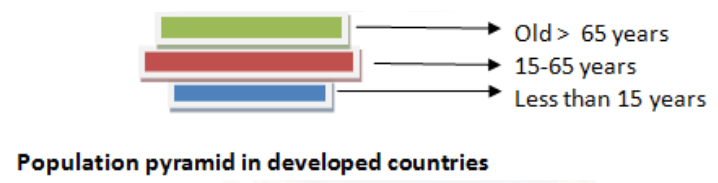
- The most serious consequence of low population growth is the structural distortion of age composition, where declining fertility and increasing life expectancy together lead to an inverted population pyramid, resulting in a disproportionately large elderly population (65+) compared to the shrinking youth population (<15), as seen in countries like Japan (≈29% elderly) and Italy, which creates long-term demographic imbalance and reduces generational replacement.
- A direct economic implication of ageing is the shrinking labour force, where the working-age population (15–64 years) declines, leading to:
- Acute labour shortages in manufacturing, healthcare, and service sectors,
- Rising dependency on migrant labour, and
- Declining productivity and economic dynamism, particularly in countries like Germany and Japan, where job vacancies often exceed available workforce.
- The fiscal burden on the state increases significantly as ageing populations demand:
- Higher public expenditure on pensions, healthcare, and social security systems,
- Increased taxation pressure on the working population, and
- Reallocation of government budgets from productive investment (infrastructure, innovation) to welfare-oriented spending, thereby affecting long-term economic growth.
- Low fertility and declining youth population lead to institutional and social adjustments, such as:
- Closure or consolidation of schools and educational institutions due to falling enrolment,
- Decline in innovation and entrepreneurship potential due to fewer young individuals, and
- Weakening of intergenerational support systems, which traditionally ensured social stability.
- Another major issue is the problem of population momentum reversal, where even if fertility slightly increases, the already reduced base of young population limits future growth, leading to:
- Long-term demographic stagnation or decline, and
- Difficulty in reversing ageing trends once established.
- Social consequences include the emergence of ageing societies characterized by isolation and changing family structures, where:
- Single-person households increase,
- Elderly care becomes institutional rather than family-based, and
- Traditional family bonds weaken due to individualistic lifestyles.
- To compensate for demographic decline, many developed countries encourage immigration, which leads to the formation of multicultural and pluralistic societies, but this creates:
- Challenges of social integration,
- Identity conflicts and rise of xenophobia,
- Political tensions over immigration policies, as observed in countries like France, Germany, and the UK.
Steps Taken by Developed Countries to Address Low Population Growth
- Developed countries have increasingly adopted pro-natalist policies aimed at encouraging higher fertility, which include:
- Direct financial incentives such as child benefits, tax rebates, housing subsidies, and cash transfers,
- Indirect incentives like paid maternity and paternity leave, job security, and flexible working conditions,
- Promotion of work-life balance to make child-rearing compatible with professional aspirations.
- Governments have strengthened family support systems and childcare infrastructure, including:
- Establishment of state-funded daycare centres and early childhood education facilities,
- Subsidized childcare services to reduce the economic burden of raising children, and
- Institutional support for working mothers to ensure continuity in employment.
- Legal and social reforms have been introduced to redefine family norms and encourage childbearing outside traditional frameworks, such as:
- Legal recognition of children born outside marriage,
- Acceptance of single parenthood and cohabitation, and
- Reduction or removal of rigid marriage regulations in some regions, reflecting changing social values.
- Policies promoting adoption and assisted reproduction have gained importance, where:
- Adoption of children, including international adoption, is encouraged,
- Advanced reproductive technologies (IVF, surrogacy) are supported,
- Countries like Norway and Sweden have well-developed adoption and childcare systems.
- Many developed countries are increasingly relying on controlled and selective immigration policies to offset labour shortages and demographic decline, which include:
- Encouraging skilled and semi-skilled migration,
- Relaxation of restrictive immigration laws (e.g., changes in Australia’s earlier “White Australia Policy”),
- Integration policies to assimilate migrants into the workforce and society.
- Some countries have attempted institutional innovations to promote family formation, such as:
- Incentives linked to childbirth (salary increments, promotions, housing benefits),
- Campaigns to encourage early marriage and childbirth, and
- Social awareness programs promoting family values.
- Despite these efforts, the effectiveness of such policies remains limited and uneven, because:
- Deep-rooted socio-economic changes like urbanization, individualism, and gender equality continue to suppress fertility,
- High cost of living and career priorities discourage large families, and
- Thus, developed countries continue to rely on a combination of pro-natalist policies and immigration strategies to manage demographic decline.
Regional Pattern of Population Growth in Developing Countries
- Developing countries today represent the core zone of global population growth, as they collectively account for:
- Nearly 80% of the world’s population, and
- Almost the entire share of future population increase, especially in regions like Sub-Saharan Africa and South Asia.
- These countries are largely situated in:
- Stage II and Stage III of the Demographic Transition Model, where:
- Death rates have declined rapidly due to medical and technological diffusion,
- But birth rates remain relatively high due to socio-cultural and economic factors,
- Resulting in high natural increase and population momentum.
- Stage II and Stage III of the Demographic Transition Model, where:
Characteristics of Population Growth in Developing Countries
- Developing countries are characterized by rapid and often uncontrolled population growth, driven by:
- A persistent gap between high birth rates and declining death rates,
- A large base of young population, which ensures continued growth even when fertility declines (population momentum),
- Socio-economic conditions where children are still viewed as:
- Economic assets (labour support in agriculture),
- Social security for old age.
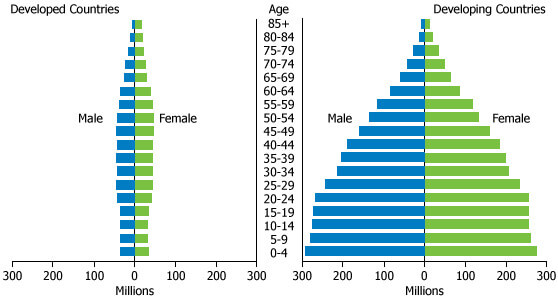
- The demographic structure typically shows:
- A broad-based population pyramid, indicating:
- High proportion of children and youth,
- Expanding working-age population (demographic bulge),
- This “bulge” represents both:
- An opportunity (demographic dividend) and
- A challenge (unemployment, resource pressure).
- A broad-based population pyramid, indicating:
- Ashok Mitra aptly observed that:
- “The real problem of developing countries lies in the expanding fertile age group population,”
- Meaning that even with declining fertility rates, the large number of people in reproductive age sustains high growth.
Regional Patterns of Growth within Developing Countries
- Developing countries do not show uniform growth; instead, they exhibit four distinct patterns based on growth rate (GR):
A. Explosive Growth (GR > 3% per annum)
- This pattern is observed mainly in Sub-Saharan Africa, where population growth remains extremely high due to:
- Persistently high fertility rates (often >4–5 children per woman),
- Declining mortality due to improved healthcare,
- Low levels of education, especially female literacy,
- Limited access to family planning services.
- Countries such as:
- Nigeria, Uganda, Niger
- These countries are experiencing:
- True population explosion, with doubling time often less than 25–30 years,
- Severe pressure on:
- Food supply, employment, and infrastructure.
B. Rapid Growth (GR: 2–3% per annum)
- Found in countries transitioning from Stage II to Stage III of demographic transition, where:
- Fertility is still relatively high,
- But awareness and control measures are gradually emerging.
- Examples:
- Pakistan, Nepal, Maldives
- Characteristics include:
- High population momentum,
- Rapid urbanization and migration,
- Increasing pressure on education, health, and housing systems.
C. Moderate Growth (GR: 1–2% per annum)
- These countries are experiencing declining fertility but still growing populations, due to:
- Improved literacy and urbanization,
- Expansion of family planning programs,
- Economic transformation.
- Examples:
- India, Egypt, Indonesia
- India (case):
- Growth rate declining (TFR near replacement level ~2.0),
- Yet large absolute increase due to:
- Huge population base
- Population momentum
D. Slow Growth (GR: 0–1% per annum)
- Countries approaching demographic maturity, where:
- Fertility has declined significantly,
- Growth is slowing but not yet negative.
- Examples:
- China, Argentina, Brazil
- China (case):
- Strict population control policies (One Child Policy) led to:
- Rapid fertility decline
- Current concerns of ageing and workforce decline
- Strict population control policies (One Child Policy) led to:
Absolute Growth vs Growth Rate Paradox
- A crucial feature of developing countries is that:
- Even when growth rates decline, absolute population increase remains very high, due to:
- Large population base
- Even when growth rates decline, absolute population increase remains very high, due to:
- Examples:
- India, Indonesia, Nigeria, Bangladesh, Brazil
- This creates a paradox:
- Low growth rate but high numerical addition, leading to:
- Continued pressure on resources
- Challenges in development planning
- Low growth rate but high numerical addition, leading to:
Population Structure and Demographic Bulge
- Developing countries exhibit a youth-dominated population structure, characterized by:
- A wide base and expanding middle segment in the population pyramid,
- Large proportion of people in:
- Reproductive age group (15–49 years),
- Working-age group (15–64 years).
- This demographic bulge leads to:
- High potential for demographic dividend, if:
- Employment opportunities are created
- Otherwise, it results in:
- Unemployment, social unrest, and migration pressures
- High potential for demographic dividend, if:
Contribution to Global Population Growth
- Developing countries are the primary contributors to global population increase, because:
- Developed countries have already stabilized or are declining,
- Growth is concentrated in:
- Africa and parts of Asia
- This is why:
- Population explosion in the modern era is largely a developing world phenomenon,
- Earlier, Europe experienced this during the Industrial Revolution, but now:
- The epicentre has shifted to Africa and South Asia.
Key Factors Driving High Growth in Developing Countries
- Socio-cultural factors:
- Preference for large families
- Early marriage
- Religious and traditional beliefs
- Economic factors:
- Children as economic assets in agrarian economies
- Lack of social security systems
- Educational factors:
- Low literacy, especially female literacy
- Healthcare improvements:
- Reduced mortality without corresponding decline in fertility
Factors responsible for present situation of population growth
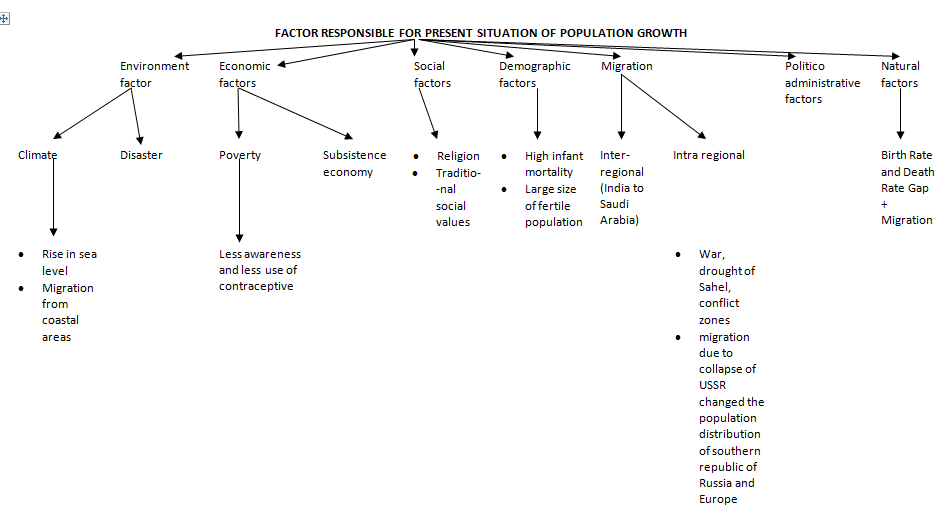
- Environmental factors
- Climate:
- Equatorial and tropical climates are also called as “land of sickness” as these areas are prone to diseases
- An area with a monsoon climate is called as ‘land of slackness’ due to the humid climate.
- Sick and slack societies cannot develop and this causes an in-looking social system.
- Couples in these areas live together for most of the time.
- It leads to a subsistence economy and traditional society.
- Disasters:
- It brings down development and thus leads to social factors for population growth.
- Climate:
- Economic factors
- Developed society has slower population growth. There is an inverse relationship between income and population.
- Poverty:
- Poverty is a major factor for population growth. As per Adam Smith, “Poverty creates an ideal atmosphere for high mortality rate for the poor. Kids for them are assets, not a liability”.
- For over 1 billion people of the world, per day earning is below 1 $, out of this nearly half are in South Asia.
- Subsistence economy:
- All developing countries particularly monsoonal countries or paddy cultivating countries have labour intensive subsistence economies.
- Paddy cultivation and plantation agriculture need more labour. Also, female worker is needed at the time of transplantation. This agriculture economy minimizes living apart of couple thus having more children and more hands for work.
- Social factors:
- Religion:
- Sociologists and anthropologists believe that religion is both promoting as well as the de-motivating factor for population growth.
- In most developing countries religion is a promoting factor.
- Clark said “all Islamic countries have very rapid growth and main factor is religion”, on the other hand in Thailand, religion acted as a de-motivating factor. In Thailand, contraceptives were distributed by the hands of monks.
- In Islamic, Hindu, and Anemist societies, there is a rapid growth of population.
- Traditional social values:
- Early marriage and child marriage leads to repeated and unwanted pregnancies.
- Attraction for the male child
- Joint family system
- Illiteracy especially female illiteracy.
- Lack of job opportunities for females.
- Religion:
- Demographic factors:
- High IMR: It is common in African countries where couples are not sure of kids survival, therefore, goes for more child.
- Large-sized fertile group of population: It can be seen in large-sized countries with large populations like India and China.
- Politico- administrative factor:
- Countries having politico-administrative determination have been able to bring down the population e.g. China, Thailand, Indonesia, Egypt, and Bangladesh.
- In Thailand political will could promote religion as a de-motivating factor for population growth.
- China’s one-child policy is an example of an administrative factor.
- Partition and post-war outmigration of Jews are examples of a politico-administrative factor of population growth.
- Lack of health facilities and HIV-related deaths in countries like Botswana affects the population growth of the country.
- Emigration of people from Spain and Portugal to South America.
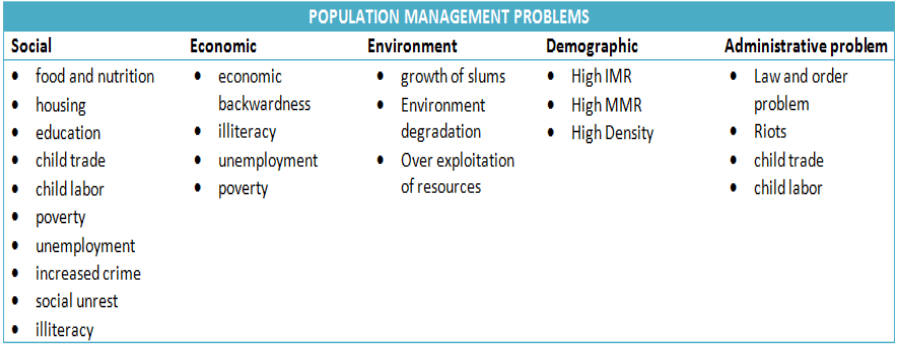
Problems of Rapid Growth of Population
- Proper education, food, housing is a big problem. This may lead to the genetic deterioration of humankind. It leads to a poor and unhealthy society, child trade, and child labour.
- Increasing the workforce would lead to an increase in the growth of unemployment which will increase poverty, illiteracy and subsistence economy. This further increases social menace, increased crime, increase mental retardation, increased political instability, insurgency.
- The rise in dependent population is the major problem. Most income is spent on health, housing and education.
- Food and nutrition problems: World has enough food to support the population for survival but not enough food for healthy survival and therefore the world is facing a hidden hunger problem.
- Economic backwardness, illiteracy, unemployment.
- Rapid growth of urbanization and slums
- Environment degradation and over-exploitation of resources.
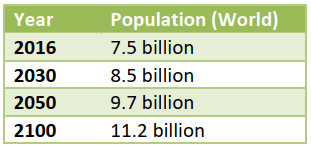
- According to UNFPA, as per current trends, the human population has reached greater than 7 billion marks and still growing at the rate of 26 thousand live births per day.
- The projected year for global population stability is 2150.
- By 2020, India is expected to surpass China.





thank you so much for this wonderful notes . no other coaching institutes have given this kind of comprehensive notes . definitely a game changer
thanku very much again from bottom of my heart
Very helpful for mains preparation. I’m indebted to you.
Thanks team.
I have bought pdf notes but they are not opening
Please contact here: @LotusArise.com">support@LotusArise.com
Very helpful n well organized thnku very much!
Sir in J-curve and S-curve I can’t be able to understand the difference between the two because both are same curve
The J curve is the present situation(2000s). The population growth graph looks like a ” j ” curve.
The S curve is the population graph which includes future prediction(2100) ie flat lining and stabilizing of the population growth which makes the graph looks like a ” S ”
Adoption of babies in encouraged. E.g. Thailand is the biggest child market for developed countries. Norway and Sweden adapt maximum babies.
The info about Thailand part seems very questionable. please fact check this