- Dispersal is the movement of organisms or their propagules away from their place of origin. It is how every species reaches the places where it lives today.
- Plants are fixed and move only as seeds, spores and vegetative fragments; animals move themselves, but their vagility (capacity to move) ranges from snails to migratory birds.
- Where a species ends up depends on three things: how it travels (means), which way is open (routes) and what blocks it (barriers). Arrival is not success: the newcomer must establish, colonise and escape extinction.
Dispersal: Concepts and Means

Dispersal, migration and range expansion
- Dispersal is a one-way movement of individuals or propagules from the birthplace to a new site, where they may settle and breed.
- Natal dispersal (young leaving the parents’ home range) is the commonest form; it lowers crowding and inbreeding.
- Migration is a periodic, two-way movement between regions, usually seasonal, with a return to the starting area.
- Range expansion is the population-level outcome when dispersal is followed by establishment, so a species’ geographic limits move outward.
- The cattle egret spread naturally from Africa to South America in the late nineteenth century and reached the United States by the 1940s–50s.
- The Eurasian collared dove spread from the Balkans across Europe between the 1930s and 1950s, reaching Britain in 1955.
- Colonisation is the founding of a breeding population in a new area; it ends with the newcomer part of the local community.
| Process | Direction | Scale | Example |
|---|---|---|---|
| Dispersal | One-way, away from origin | Individual | Wind-blown seed; young tiger leaving its mother |
| Migration | Two-way, periodic | Population, seasonal | Bar-headed geese wintering in India |
| Range expansion | Outward shift of range limits | Species, decades to millennia | Cattle egret in the Americas |
| Colonisation | Founding a breeding population | Local population | Plants and birds on Krakatau after 1883 |
- Why organisms disperse:
- Escape from crowding and competition, including competition with the parent.
- Escape from enemies: seeds that fall under the parent tree are found first by its specialist pests and pathogens, so survival rises with distance (the Janzen–Connell effect, after Daniel Janzen, 1970 and Joseph Connell, 1971).
- Gene flow between populations, which keeps them from inbreeding and spreads useful genes.
- Tracking change: reaching new or newly suitable habitat as climate shifts, glaciers retreat or volcanic land appears.
- The dispersal kernel: most seeds and young animals settle close to their origin, while a long, thin tail of rare long-distance movers travels far. That tail, not the average, sets how fast a species can spread and whether it can cross a barrier.
- A dispersal event succeeds only in stages: departure, transfer across unsuitable ground, arrival, establishment (survival and breeding) and spread.
- The tolerance factor decides the last steps: a newcomer survives only where conditions lie within its range of tolerance, the idea behind Shelford’s law of tolerance.
Types of animal dispersal by pace and cause
| Type | Nature | Examples |
|---|---|---|
| Gradual (secular) | Slow spread over geological time; covers whole continents | Spread of mammals across the Holarctic lands |
| Rapid (irruptive) | Sudden mass exodus; most migrants fail to settle | Lemming irruptions, desert locust swarms, butterflies, dragonflies |
| Seasonal | Regular two-way movement to escape seasonal extremes | Arctic and Siberian birds wintering in the tropics |
| Forced | Flight from catastrophes that destroy food and shelter | Droughts, floods, forest fires, volcanic eruptions |
| Density-driven | Overcrowding and lack of breeding sites push animals out | Rodent and locust outbreaks |
| Anthropogenic | Transport by people, deliberate or accidental | Rabbits and red deer in New Zealand; rats on ships |
- Lemmings do not migrate to commit mass suicide. At population peaks they disperse in large numbers, and some drown crossing rivers and fjords; the “suicide” story is a myth.
- Desert locusts turn gregarious in wet years; the 2019–21 upsurge spread from the Horn of Africa and Arabia to south-west Asia, and swarms reached Rajasthan, Gujarat and central India in 2019–20.
Dispersal of plants
- Plants spread by vegetative propagation (runners, rhizomes, fragments) or by seeds and spores.
- Vegetative spread is slow and local, and its offspring are genetic copies, poorly suited to new habitats. Seed dispersal carries genetic variety over long distances.
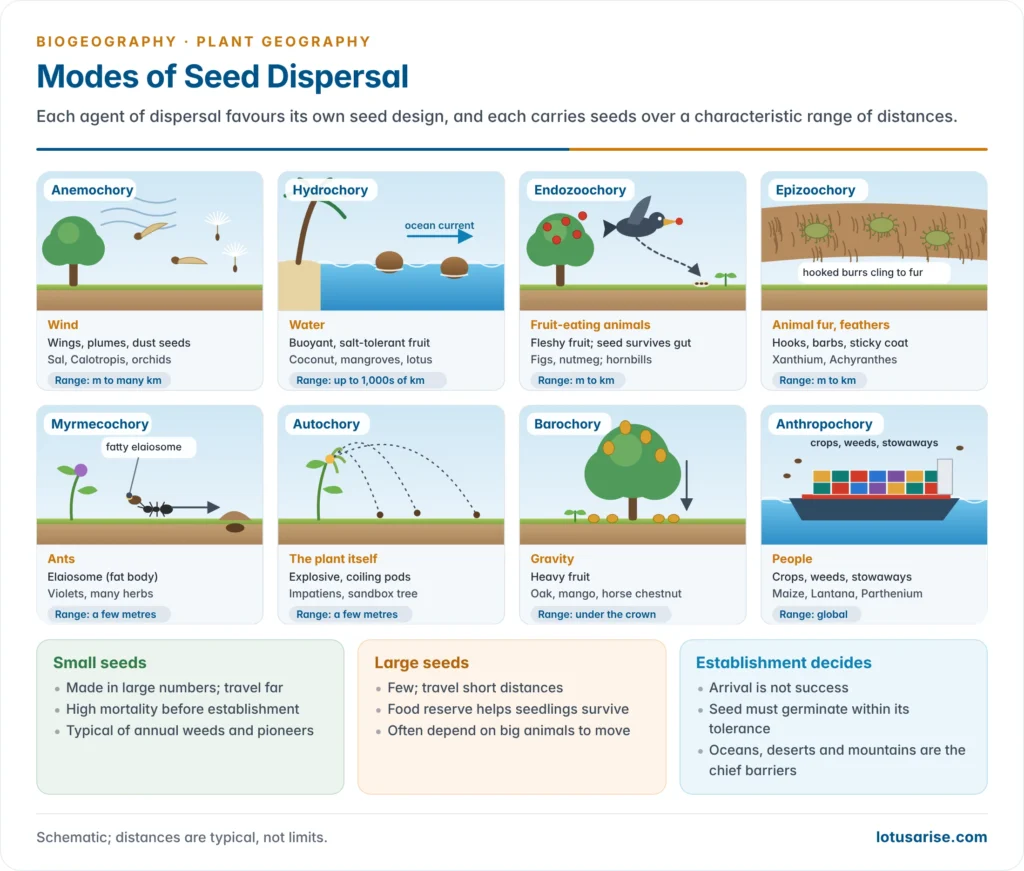
- Properties that aid dispersal: buoyancy in air (wings, plumes, dust-like seeds), hooks and sticky coats that cling to animals, fleshy fruits that animals eat, floating seeds that resist salt water, and high seed output.
- Trade-offs in seed size:
- Small, light seeds travel far but most die before they establish; annual weeds produce millions of them.
- Large seeds travel short distances but carry food reserves, so seedlings survive shade and drought; many perennials and forest trees follow this path.
| Mode | Agent | Adaptation | Examples |
|---|---|---|---|
| Anemochory | Wind | Wings, plumes, dust-like seeds | Sal and other dipterocarps, Calotropis, dandelion, orchids |
| Hydrochory | Water, ocean currents | Buoyant, salt-tolerant fruits; floating propagules | Coconut, mangrove propagules (Rhizophora), lotus |
| Endozoochory | Animals that eat fruit | Fleshy fruit; seed passes through the gut | Figs and nutmeg spread by hornbills and bulbuls; elephant apple (Dillenia) by elephants |
| Epizoochory | Animal fur and feathers | Hooks, barbs, sticky coats | Xanthium, Achyranthes, Bidens |
| Myrmecochory | Ants | Fat-rich appendage (elaiosome) | Violets and many dry-country herbs |
| Autochory | The plant itself | Explosive or squirting fruits | Impatiens, squirting cucumber, sandbox tree |
| Barochory | Gravity | Heavy fruit falls near the parent | Oak acorns, mango |
| Anthropochory | People | Crops, weeds, ornamentals | Maize, potato, Lantana, Parthenium |
- Birds are effective carriers because they fly far and fast, but they carry only small seeds, and seeds dropped in unsuitable places die.
- Ocean currents carry seeds slowly and few land seeds survive long immersion in salt water. Oceans are therefore the most formidable barrier to plants, followed by high mountains and wide deserts.
- Long-distance dispersal is rare but decisive. Oaks and other trees spread back into northern Europe after the last glaciation far faster than ordinary acorn fall allows (Reid’s paradox, after Clement Reid, 1899). Occasional transport by jays and other birds explains it.
Dispersal of animals: active and passive
- Active dispersal depends on the animal’s own vagility: walking, running, burrowing, climbing, swimming, flying.
- It is generally slow and gradual, but over geological time it has spread animal groups across whole continents.
- Passive dispersal is carriage by an outside agent:
- Aeolian (anemochore): air currents lift insects, spiders and micro-organisms. Spiderlings balloon on silk threads; aphids and locusts ride winds. Storms and cyclones also sweep up gliding animals (chance dispersal).
- Aquatic (hydrochore): waves, tides and ocean currents carry animals, often on natural rafts of uprooted trees and vegetation.
- In 1995, after Hurricanes Luis and Marilyn, green iguanas rafted about 320 km on a mat of uprooted trees from Guadeloupe to Anguilla, where they began breeding.
- Organismic (biochore): one animal carries another, ectozoically (snail eggs and small invertebrates stuck to the feet and feathers of ducks and waders) or endozoically (parasites, viruses and eggs carried inside a host).
- Anthropochore: people carry animals deliberately (game, pets, livestock, biological control) or accidentally (rats in ships, insects in cargo, larvae in ballast water).
People as agents of dispersal
- People are now the most powerful agents of dispersal. Ships and aircraft have breached every ocean, mountain and desert barrier that once confined species to one continent.
- Creation of disturbed (hybrid) habitats: clearings, fields, roadsides and towns favour camp-follower plants (weeds such as plantain, chickweed and shepherd’s purse) that tolerate disturbance and seed heavily.
- Cultigens (crops) spread with farming from their centres of domestication, the gene pool centres first mapped by Nikolai Vavilov.
- After 1492 maize, potato and tobacco reached the Old World; wheat, rice, sugarcane and cattle reached the Americas.
- Para rubber seeds were taken from Brazil to Kew in 1876 and then to Sri Lanka and Malaya; cinchona was planted in the Nilgiris from the 1860s.
- Eucalyptus has been carried from Australia to every continent; in India it lines roads and railways and fills farm woodlots. Cape bulbs and heaths such as freesias and ericas reached European gardens with colonial trade.
- Many cultigens cannot survive without people; their range is set by farmers, not by nature.
- Intentional dispersal brings plants and animals for food, fodder, ornament, erosion control or sport. Unintentional dispersal moves weeds in seed grain, pests in timber and organisms in ballast water.
Invasive alien species
- An invasive alien species is an introduced species that establishes, spreads and harms native biodiversity, economies or health.
- The IPBES assessment (September 2023) counted over 37,000 established alien species, of which more than 3,500 are harmful invaders.
- They were a major factor in 60% of recorded global extinctions and the sole cause in 16%, and they drive about 90% of extinctions on islands.
- Their yearly cost exceeded US$ 423 billion in 2019, and costs have quadrupled every decade since 1970.
| Invader | Origin → area invaded | Introduced | Effect |
|---|---|---|---|
| European rabbit | Europe → Australia | 1859, for sport | Grassland stripped, soil erosion, native mammals displaced |
| Prickly pear | Americas → Australia | 19th century, as fodder and hedges | Millions of hectares lost to pasture; checked by the Cactoblastis moth from 1926 |
| Cane toad | South America → Australia | 1935, against cane beetles | Poisons native predators |
| Kudzu | East Asia → USA | 1876, later planted against erosion | Smothers forest edges in the south-east |
| Rabbits and red deer | Europe → New Zealand | 19th century | Overgrazing, gully erosion |
| Lantana camara | Tropical America → India | 1807, Calcutta botanic garden | Dense thickets in forests and tiger reserves |
| Prosopis juliflora | Central and South America → India | 19th century, for fuel and dune control | Takes over grasslands of Kachchh (Banni) and dry Tamil Nadu |
| Water hyacinth | Amazon basin → India | Late 19th century, as an ornamental | Chokes lakes and rivers |
| Parthenium (congress grass) | Tropical America → India | Noticed in the 1950s, probably with imported grain | Crop loss, allergies, livestock poisoning |
- Most introductions fail; the few that succeed share wide tolerance, fast breeding and absence of natural enemies, the “enemy release” that lets them outcompete natives. Their wider role in reshaping distributions is part of the human impacts on biogeographic patterns.
Barriers and Dispersal Routes
Barriers to dispersal
- A barrier is any feature that stops or slows the spread of a species. What is a barrier for one group is a highway for another: the sea isolates land mammals but links marine fish.
| Type | Barrier | Effect and examples |
|---|---|---|
| Physical: water | Oceans, seas, large lakes and rivers | Land animals and most seeds cannot cross wide oceans; Alfred Russel Wallace (1852) noted that different monkeys live on opposite banks of the Amazon’s big tributaries |
| Physical: land | Continents and isthmuses | Marine and freshwater animals; the Isthmus of Panama split Caribbean and Pacific marine life |
| Topographic | High mountains, deep gorges, wide valleys | The Himalaya separates Palaearctic and Oriental faunas; the Andes and Rockies divide east from west |
| Climatic | Temperature and aridity belts | The Sahara and Thar block forest species; the tropics block cold-adapted species |
| Edaphic and chemical | Salinity, toxic soils, fresh lava, bare sand and ice | Freshwater fish cannot cross salt water; lava fields stay empty for years |
| Biological | Competitors, predators, disease, lack of food plants or hosts | Specialist insects stop where their host plant ends |
| Behavioural | Reluctance to cross open ground or water | Many rainforest birds will not cross even narrow gaps |
- Indian examples:
- The Himalaya and Tibetan plateau form the barrier and transition between the Palaearctic and Oriental realms.
- The Palghat Gap, a 30–40 km break in the Western Ghats, has split populations of elephants, shortwing birds and frogs into distinct northern and southern lineages.
- The Thar Desert limits moist-forest species, and the sea isolates the Andaman and Nicobar fauna.
- Barriers are not permanent. Mountains rise and wear down; oceans open and close with plate movement; ice sheets advance and melt; sea level falls and exposes land bridges.
- An ocean on the site of the Atlantic (the Iapetus Ocean) closed in the Palaeozoic, and the present Atlantic opened in the Mesozoic. Each change first joined and then split land faunas.
- Barriers are relative, too: a mountain may be crossed by a pass when the climate on both sides is similar.
- Distance acts with the barrier: over uniform terrain and climate a species spreads far; where conditions change over short distances, dispersal stops early.
Simpson’s three dispersal routes
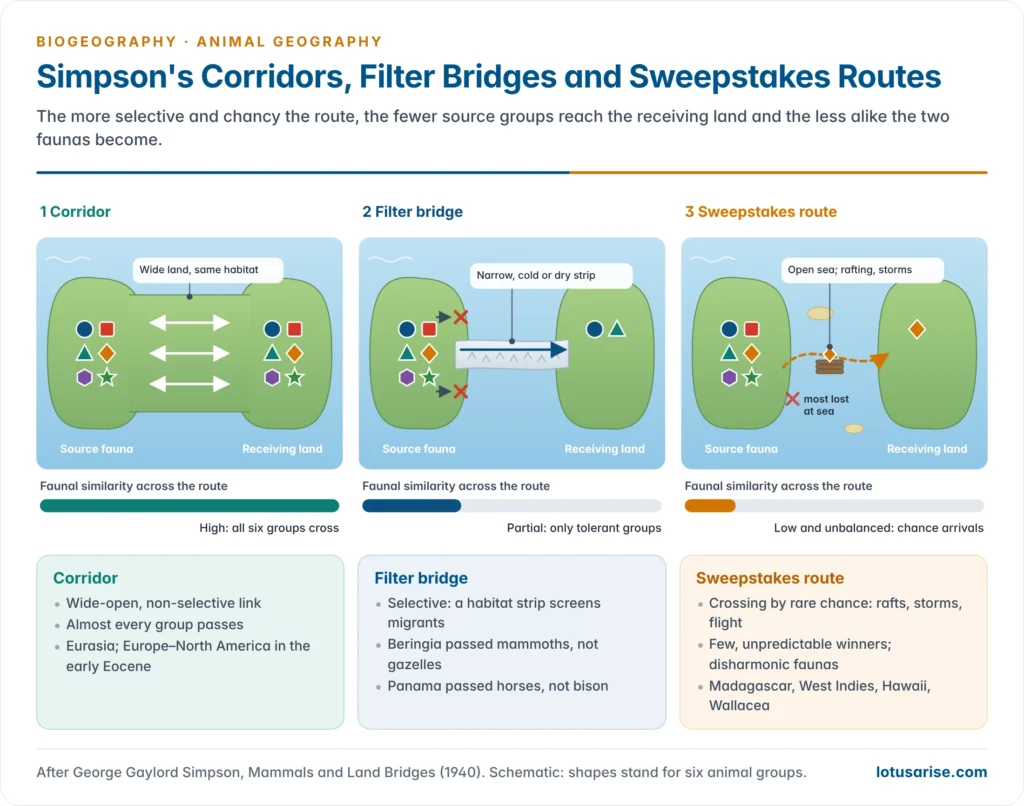
- George Gaylord Simpson (1940), in Mammals and Land Bridges, classified routes by how selective they are and how predictable crossing is.
| Route | Nature | Who crosses | Result | Examples |
|---|---|---|---|---|
| Corridor | Wide, continuous land with similar habitat | Almost all groups, freely | Faunas on both sides become very similar | Europe–Asia across Eurasia; Europe–North America in the early Eocene |
| Filter bridge | Connection with a narrow or contrasting habitat (cold, dry or forested strip) | Only species tolerant of that habitat | Partial similarity; the “filter” screens out the rest | Beringia let mammoths through but not gazelles; Panama let horses through but not bison |
| Sweepstakes route | Open sea or wide barrier crossed only by rare chance (rafting, storms, flight) | A few lucky, good dispersers, unpredictably | Unbalanced (“disharmonic”) faunas, often with radiations | Madagascar, West Indies, Hawaii; Asia to Australia across Wallacea |
- Sweepstakes in action:
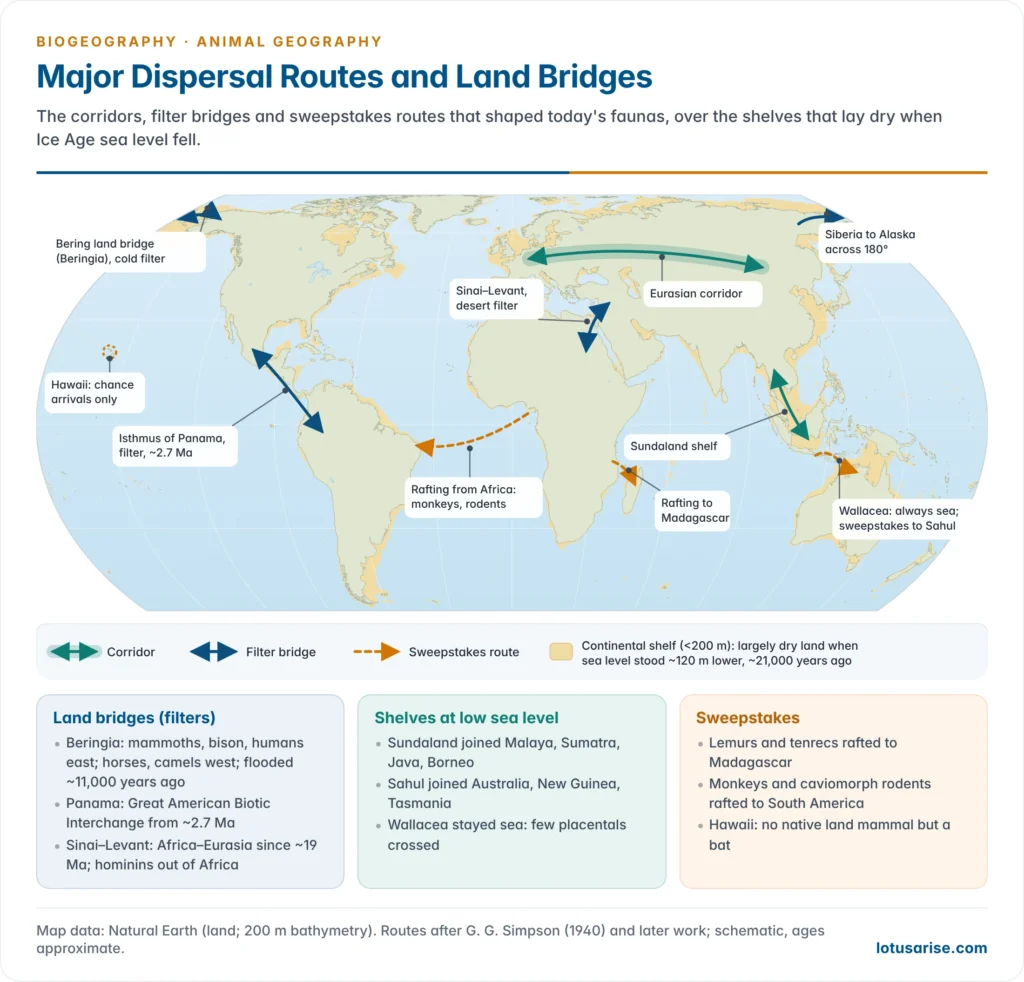
- Lemurs reached Madagascar from Africa on rafts, probably over 50 million years ago; tenrecs, rodents and carnivores arrived later the same way.
- New World monkeys and caviomorph rodents (guinea pigs, capybaras) crossed the then-narrower South Atlantic from Africa in the Eocene, roughly 35–45 million years ago.
- Hawaii, never joined to any continent, has no native land mammals except one bat, and no native amphibians or freshwater fish.
- Evaluation: the scheme is a continuum, not three boxes, and the same route can change class as sea level and climate change. It still explains why faunal similarity falls from corridor to sweepstakes.
Land bridges and the great faunal interchanges
- Pleistocene glaciations locked water in ice sheets and lowered sea level by about 120 m at the Last Glacial Maximum, about 21,000 years ago. Shallow continental shelves became dry land bridges, a central theme of Quaternary glaciation.
Beringia: Asia and North America
- The Bering Land Bridge was a broad, treeless lowland joining Siberia and Alaska whenever sea level fell; it acted as a cold filter bridge.
- Into North America: mammoths, bison, deer, moose, saiga, musk oxen and, about 14,000 years ago or earlier, humans.
- Into Asia: horses and camels, which evolved in North America, and beavers.
- Rising seas cut the link about 11,000 years ago, opening the Bering Strait.
- This exchange explains why the Palaearctic and Nearctic faunas are so alike that they are often joined as the Holarctic realm.
The Isthmus of Panama and the Great American Biotic Interchange
- South America was an island continent for most of the Cenozoic. The Isthmus of Panama completed a land connection about 2.8–2.7 million years ago, and mammals poured across in both directions: the Great American Biotic Interchange (GABI).
- North to south: cats, dogs, bears, raccoons, horses, tapirs, deer, llamas and camels, and mastodon-like gomphotheres.
- South to north: armadillos, glyptodonts, ground sloths, porcupines, capybaras, opossums and the giant terror birds.
- The exchange was lopsided. Northern immigrants diversified in the south and displaced many native South American mammals; few southern groups survived far north.
- Survivors that still live in North America include the Virginia opossum, the nine-banded armadillo and the North American porcupine.
- Ground sloths had already island-hopped north by about 9 million years ago: a sweepstakes stage before the filter bridge.
Sinai and the Levant: Africa and Eurasia
- When Afro-Arabia collided with Eurasia in the early Miocene, about 19–20 million years ago, a land bridge closed the Tethys sea. Proboscideans (elephant relatives) left Africa, and Eurasian carnivores and hoofed mammals entered it.
- The Sinai–Levant route has since acted as a desert filter, open to most species only in wetter phases. It was the gateway for hominins leaving Africa, Homo erectus by about 1.8 million years ago and modern humans in the last 100,000 years.
Sunda, Sahul and Wallacea
- At low sea level the Sunda Shelf joined the Malay Peninsula, Sumatra, Java, Bali and Borneo into Sundaland, and the Sahul Shelf joined Australia, New Guinea and Tasmania into Sahul.
- Between them, deep straits around Sulawesi, Lombok and Timor stayed water even at the lowest sea levels. This is Wallacea, a sweepstakes zone; Wallace’s and Weber’s lines mark the sharp faunal break at its edges.
- Placental mammals spread freely across Sundaland, but few crossed Wallacea, so Australia kept its marsupials and monotremes.
- Humans made the sea crossings and reached Sahul by about 50,000–65,000 years ago. New Guinea separated from Australia about 8,000 years ago and Tasmania about 6,000 years ago.
Gondwana, drift and vicariance
- Over longer time spans the continents themselves moved. The Permian–Triassic fossils Glossopteris (a seed fern), Mesosaurus, Cynognathus and Lystrosaurus lie scattered across South America, Africa, Antarctica, India and Australia, evidence of the united Gondwana used in continental drift theory.
- Flowering plants appeared in the Cretaceous, probably in western Gondwana, and spread while the southern continents were still close together.
- Two explanations compete for disjunct ranges:
- Dispersal: the group crossed an existing barrier.
- Vicariance: the group was in place first and a new barrier (a widening ocean, a rising mountain) split its range. The southern beech (Nothofagus) of South America, New Zealand, Australia, New Guinea and New Caledonia is the classic case.
- India as a drifting raft: after leaving Gondwana, India carried Gondwanan lineages north and docked with Asia about 50 million years ago, letting some of them spread “out of India” and Asian groups spread in.
- The purple frog (Nasikabatrachus sahyadrensis) of the Western Ghats, described in 2003, has its closest relatives in the Seychelles, a split that dates to the separation of India and the Seychelles.
- Molecular dating now shows that both operate: many supposed vicariant groups are too young to predate the break-up and must have crossed water.
Colonisation, establishment and extinction
- When migrants reach a new habitat, there are several possible outcomes:
- they outcompete the residents and take over the habitat;
- they fail to compete or to adapt, and die out;
- they and the residents coexist;
- they fill vacant niches and colonise gradually;
- they interbreed with related residents and form hybrids;
- in empty, favourable habitat they spread rapidly, as invasive species do.
- Extinction is the complete loss of a species. Speciation, dispersal and extinction are in a natural dynamic balance, the balance that island biogeography models as immigration against extinction.
- Causes of extinction:
- Environmental change faster than adaptation. The end-Cretaceous extinction, about 66 million years ago, which ended the non-avian dinosaurs, was triggered by the Chicxulub asteroid impact, worsened by Deccan Traps volcanism.
- Disease and new pests that follow environmental change.
- Catastrophes: the 1883 eruption of Krakatau sterilised the island.
- Hunting: Paul S. Martin (1967) proposed “prehistoric overkill” of the Ice Age megafauna by human hunters, against rival climatic and ecological explanations.
- Competition with stronger or newly arrived species.
- Human transformation of habitats, pollution and invasive species, now the dominant drivers of the loss covered under wildlife conservation.
- Small, isolated and specialised populations are most at risk: island species such as the dodo (last seen in 1662) and the passenger pigeon (last bird died in 1914).
Migration and Animal Adaptations to Climate
Animal migration
- Migration is a regular, often seasonal, round trip in pursuit of food, breeding sites or a tolerable climate.
- Triggers: changing day length (photoperiod), temperature and food supply, which set off hormonal changes and fat storage.
- Navigation: sun and star compasses, the Earth’s magnetic field, landmarks and smell.
| Type | Pattern | Examples |
|---|---|---|
| Latitudinal | Poleward in summer, towards the tropics in winter | Arctic tern, waders, ducks and cranes wintering in India |
| Altitudinal | Up the mountains in summer, down in winter | Himalayan monal and many Himalayan birds; snow leopard following its prey |
| Terrestrial mass movement | Following rains and grass | About 1.3 million wildebeest circling the Serengeti and Maasai Mara |
| Anadromous and catadromous | Sea to river to breed, or river to sea | Salmon and hilsa upstream; eels downstream to the Sargasso Sea |
| Oceanic | Between feeding and breeding waters | Olive ridley turtles nesting en masse at Gahirmatha and Rushikulya, Odisha; whales |
| Insect | Multi-generation or swarm movement | Monarch butterflies in North America; desert locusts |
- Record journeys:
- The Arctic tern flies an average of about 70,900 km a year between the Arctic and the Antarctic, the longest regular migration known.
- A bar-tailed godwit flew 13,560 km non-stop from Alaska to Tasmania in 11 days in October 2022.
- The blackpoll warbler, a bird of about 12 g, crosses the western Atlantic non-stop from north-eastern North America to South America, about 2,500 km in two to three days.
- Amur falcons stop in their thousands at Doyang in Nagaland and in Manipur on the way from breeding grounds in north-east Asia to southern Africa. A bird tagged in Manipur in November 2025 flew about 6,000 km non-stop in six days, crossing the Arabian Sea.
- Flyways are the broad aerial routes that link breeding and wintering grounds. India lies mainly on the Central Asian Flyway, from Siberia and Central Asia to the Indian subcontinent, with its east also on the East Asian–Australasian Flyway.
- Costs of migration: high energy use, storms, predators and the loss of any one stopover site; a single drained wetland or hunted roost can break the chain. Amur falcons were netted in large numbers at Doyang until community protection began in 2013.
- India and the Central Asian Flyway: bar-headed geese crossing the Himalaya, demoiselle cranes at Khichan (Rajasthan), greater flamingos in the Rann of Kachchh, and ducks and waders at Chilika and Keoladeo. The western population of the Siberian crane last reached Keoladeo in 2002.
- Conservation:
- The Convention on Migratory Species (CMS, Bonn, 1979) protects migrants across borders; India hosted its COP13 at Gandhinagar (2020).
- India’s National Action Plan for the Conservation of Migratory Birds and their Habitats along the Central Asian Flyway (2018–2023) focused on wetland stopovers and community protection.
- CMS’s first State of the World’s Migratory Species report (2024) found 44% of listed populations declining and 22% of listed species threatened. An update in March 2026 raised these to 49% and 24%.
- COP15 at Campo Grande, Brazil (March 2026) added or uplisted about 40 taxa and asked Parties to build migration corridors into climate-adaptation plans.
How animals cope with variations in climate
- Endotherms (birds and mammals) keep a steady body temperature by metabolism; ectotherms (reptiles, amphibians, fish, insects) take on the temperature of their surroundings and must avoid extremes by behaviour.
- Animals cope by escaping in space (migration) or time (dormancy), or by tolerating through body form and physiology. These are the climatic side of ecological adaptation.
Ecogeographic rules
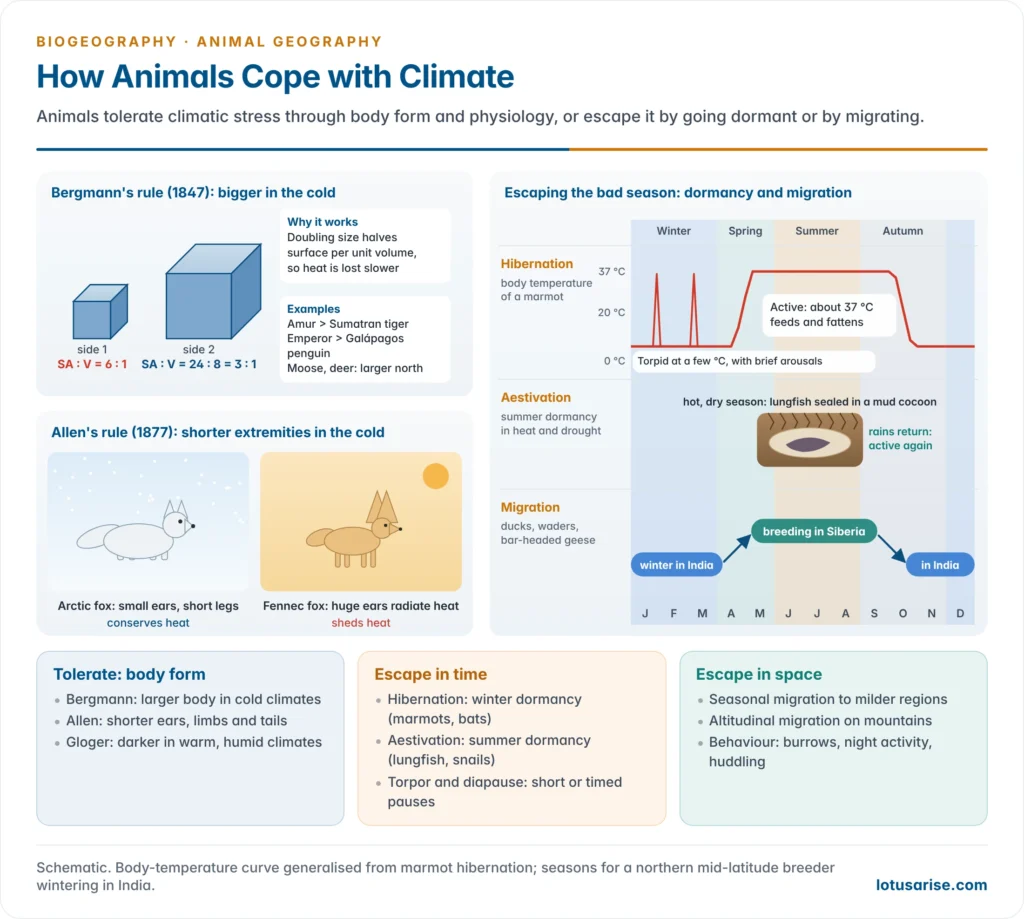
- Bergmann’s rule (Carl Bergmann, 1847): within a widespread group of endotherms, larger body size occurs in colder regions.
- A larger body has less surface area per unit volume, so it loses heat more slowly.
- Examples: the Siberian (Amur) tiger is larger than the Sumatran tiger; moose and deer grow bigger towards the north; the emperor penguin of Antarctica dwarfs the Galápagos penguin.
- Allen’s rule (Joel Asaph Allen, 1877): endotherms of cold climates have shorter ears, limbs, tails and snouts, those of hot climates longer ones.
- Examples: the small-eared Arctic fox against the large-eared fennec fox of the Sahara; the long ears of desert hares radiate heat.
- Gloger’s rule (Constantin Gloger, 1833): darker pigmentation in warm, humid regions, paler colours in dry ones.
- These are tendencies, not laws. Many species break them, and some are now shrinking with warming, which supports the thermal reasoning.
Dormancy: hibernation, aestivation and torpor
- Hibernation is winter dormancy: body temperature, heartbeat and breathing fall sharply and the animal lives on stored fat for weeks or months.
- True hibernators: marmots (including the Himalayan marmot of Ladakh), ground squirrels, hedgehogs and many bats.
- Bears, including the Himalayan brown bear, enter a lighter winter sleep and wake easily.
- Ectotherms such as snakes, lizards and frogs brumate in burrows below the frost line.
- Aestivation is summer dormancy to escape heat and drought.
- The African lungfish seals itself in a mucus cocoon in dried mud and can survive for years; desert snails seal their shells; spadefoot toads and some frogs wait underground for rain.
- Torpor is a short, daily drop in temperature and metabolism, used by hummingbirds and some bats on cold nights. Diapause is a timed pause in insect development through winter or drought.
Other behavioural and physiological strategies
| Strategy | Climatic stress | Mechanism | Examples |
|---|---|---|---|
| Migration | Seasonal cold, drought, food shortage | Move to a better climate and return | Siberian ducks, Arctic tern, wildebeest |
| Insulation | Cold | Thick fur or feathers, fat (blubber) | Yak, polar bear, seals, snow leopard |
| Counter-current heat exchange | Cold | Warm arteries heat returning veins in the limbs | Penguin feet, Arctic fox legs |
| Huddling and sheltering | Cold and wind | Shared warmth, burrows, snow dens | Emperor penguins, pikas |
| Seasonal moult and colour change | Snow cover | White winter coat for warmth and camouflage | Arctic fox, stoat, snowshoe hare |
| Nocturnality and burrowing | Heat and aridity | Active in cool night; shelter in humid burrows | Desert gerbils and jirds, spiny-tailed lizard of the Thar |
| Water economy | Aridity | Concentrated urine, water from metabolism, tolerance of dehydration | Camel, kangaroo rat, chinkara |
| Heat loss | Heat | Panting, sweating, large ears and blood vessels near the skin | Dogs, elephants, fennec fox |
- Climate change now tests these strategies. Birds arrive earlier in spring, hibernators wake earlier, and many species are moving poleward and upslope, the range shifts that depend on dispersal ability and open routes.