- Biogeography is the branch of physical geography most closely allied to biology, since both study plants and animals. It is the study of the distribution of organisms and ecosystems across geographical space and through geological time.
- Organisms are spread unevenly over the Earth’s land and water. Biogeography describes these spatial patterns of flora and fauna and explains the processes behind them.
- It draws on biology, geography, ecology, geology and evolutionary science, and links life to its environment.
- Its roots reach back to ancient Greece, where Aristotle first noted regularities in where animals and plants live. It became a systematic science only in the nineteenth century:
- Alexander von Humboldt traced the climatic logic of plant zonation;
- Charles Darwin and Alfred Russel Wallace supplied the evolutionary mechanism that explains why related species differ from place to place.
- Two threads run through the whole field:
- ecological explanation answers “why here, now?”: present climate, soil and species interactions;
- historical explanation answers “why here and not elsewhere, given the past?”: continental drift, glaciations, dispersal, speciation and extinction.
Definition, Nature and Scope of Biogeography

How scholars have defined it
- Geographers arrived at the same idea from different angles:
| Scholar | Definition | Emphasis |
|---|---|---|
| Laurence Dudley Stamp | “The science of geographical distribution of living things, animals and vegetation” | Distribution |
| Francis John Monkhouse | “The study of geographical aspects of plant and animal life, especially in terms of areal distribution” | Areal (spatial) pattern |
| A classical definition | “The science dealing with the geographical distribution of plants and animals over the earth” | Global scale |
| Joy Tivy (1982) | Both a biological and a geographical science, whose field is “the biologically inhabited part of the lithosphere, atmosphere and hydrosphere”, that is, the biosphere | The biosphere as its field |
| Margaret Swainson Anderson | The “biological relations between man (considered as animal) and the whole of his animate and inanimate environment” | Man–environment relations |
| Modern definition | The study of the distribution of species and ecosystems in geographic space and through geological time | Space and time together |
- A fuller modern statement makes biogeography the study of spatial diversity of organisms and their distribution patterns, together with species origin, geographical and ecological variation, dispersal (diffusion) of species and processes such as extinction.
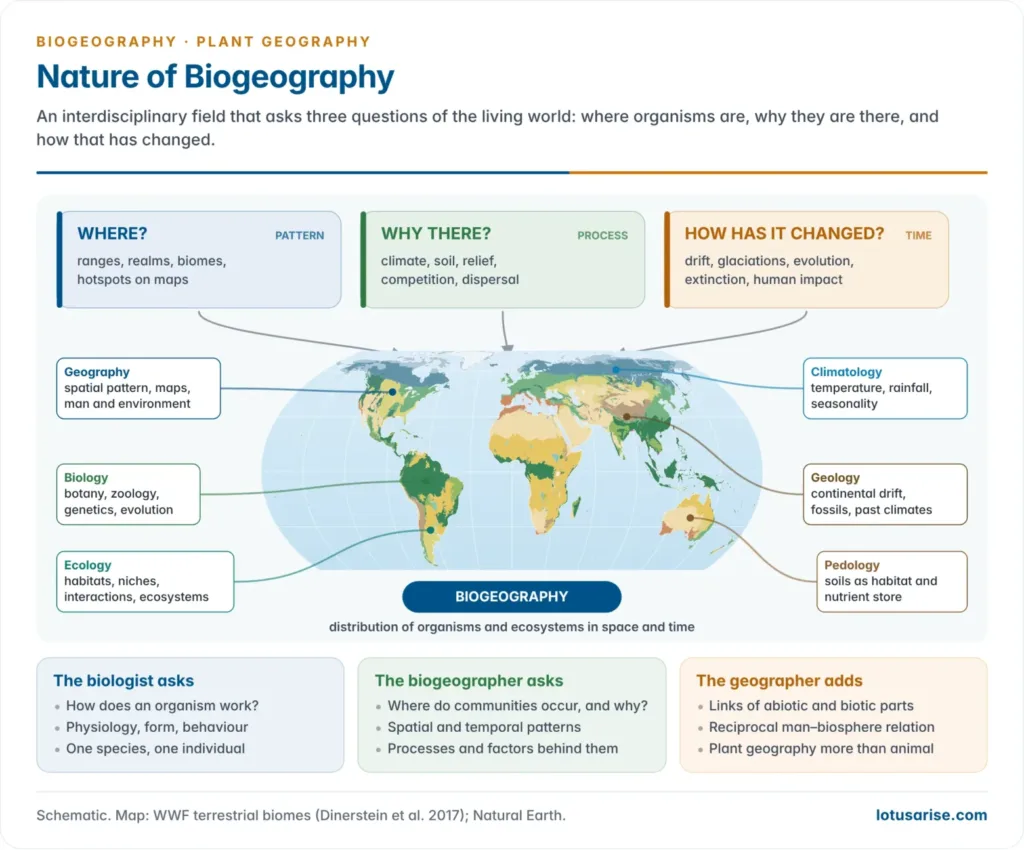
- Taken together, the definitions converge on three questions: where organisms live, why they live there, and how that distribution has changed through time.
The biosphere: the field of biogeography
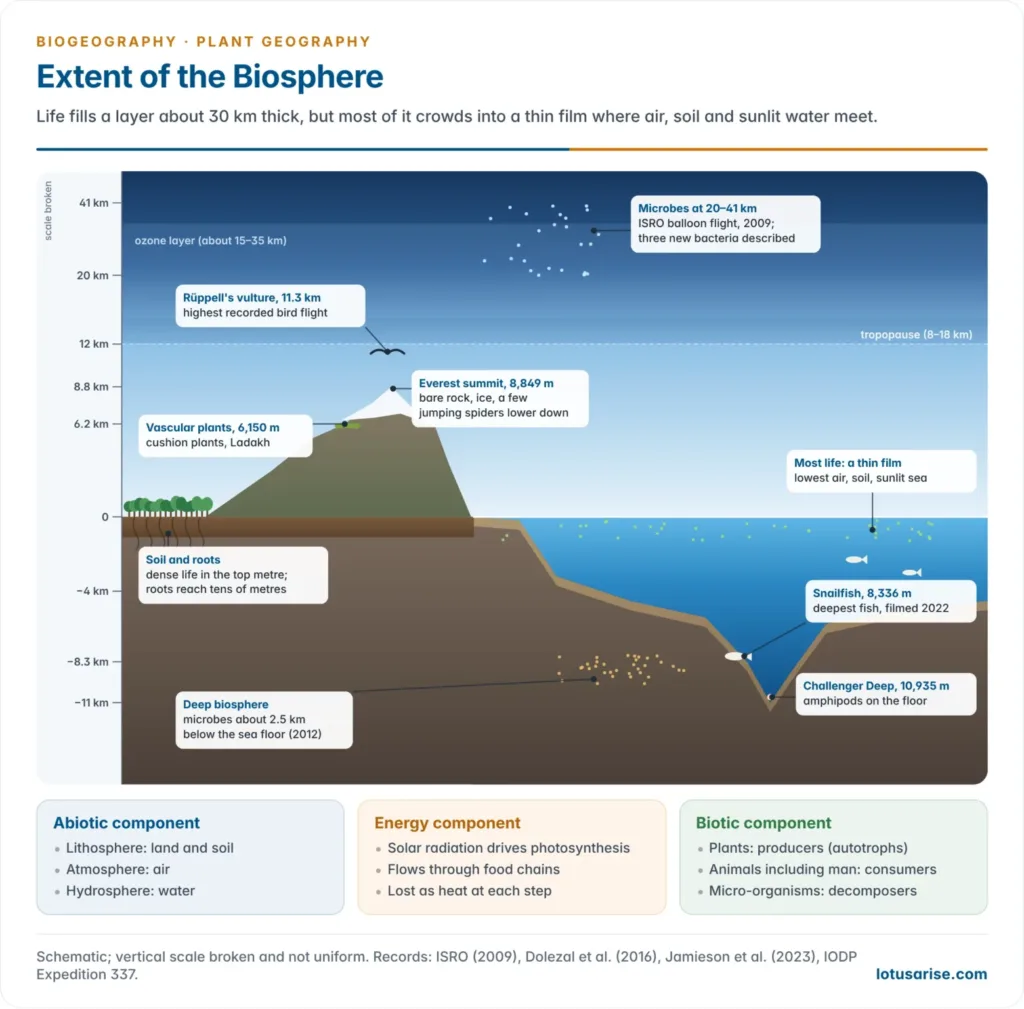
- The biosphere, one of the four domains of the Earth, is the life-supporting layer around the planet: the biologically inhabited soil, air and water. Its study is biogeography.
- It has three components, the same as those of an ecosystem viewed at the global scale:
- abiotic (physical): the lithosphere (land and soil), the atmosphere (air) and the hydrosphere (water);
- energy, chiefly solar radiation;
- biotic (organic): plants, animals including humans, and micro-organisms.
- Its extent:
- The layer is commonly taken as about 30 km thick. Its upper limit is set by falling oxygen, moisture, temperature and air pressure; its lower limit by the availability of oxygen and light.
- Most organisms live in a thin film from the lowest few hundred metres of air down to the soil and the sunlit upper ocean. On land the floor is the depth of the deepest roots and burrowers; in the sea, life reaches the deepest trenches.
- Modern records stretch both limits:
- An Indian ISRO balloon flight (2009) collected bacteria at 20–41 km in the stratosphere and described three new species, among them Bacillus isronensis.
- Vascular plants grow up to about 6,150 m on Mount Shukule II in Ladakh, the highest known.
- A snailfish filmed in 2022 at 8,336 m off Japan is the deepest fish on record; amphipods live on the floor of the Challenger Deep (about 10,935 m).
- Ocean drilling (2012) found microbes about 2.5 km below the sea floor off Japan, a deep biosphere without sunlight.
- Sub-systems: the terrestrial biome system (plant, animal and soil sub-systems) and the aquatic biome system (plant, animal and nutrient sub-systems), each linked by cyclic pathways of energy and matter, as the principles of ecology describe.
- Modifiers alter the biosphere directly or through climate: physical (temperature change, fire, mining, construction), chemical (changed composition of air, water and soil) and biological (cropping patterns, population change, manipulation of species and genes).
Nature of biogeography
- Interdisciplinary. Botany, zoology, genetics, geology, climatology, pedology and geomorphology all work parts of the same field; none owns it exclusively.
- The geographer’s approach differs from the biologist’s:
- the biologist studies the physiology, form, behaviour and function of individual organisms;
- the geographer studies the distribution of communities in space and time, and the processes and factors behind it;
- the geographer adds two more emphases: the interrelationship of abiotic and biotic components, and the reciprocal relationship between man and the biosphere.
- Spatial and temporal, at every scale from a habitat to the globe and from a season to hundreds of millions of years.
- Holistic: organisms are its core, but the abiotic land, air and water of their habitats are studied too.
Plant geography and animal geography
- The two classical divisions are plant geography (phytogeography) and animal geography (zoogeography).
- Plant geography studies the classification of plants, their spatial distribution, origin and development, dispersal, extinction and functions.
- Zoogeography studies the classification, evolutionary history and spatial distribution of animals.
- In geography, plant geography receives more attention. Plants are easier to map and more closely tied to the physical environment:
| Basis | Plants | Animals |
|---|---|---|
| Mobility | Static; grouped in fixed communities | Mobile; ranges shift by season and day |
| Nutrition | Autotrophs, the primary producers | Heterotrophs (consumers) |
| Share of biomass (2018 census) | About 80% of living carbon (450 of 550 gigatonnes) | Under 1% |
| Tie to environment | Directly controlled by climate and soil, and modify both | Depend on vegetation and on other animals |
| Ease of study | Visible, countable vegetation cover | Many are tiny, secretive, or variable in behaviour |
Core concepts in biogeography
- Species distribution is the spatial and temporal pattern of where a species occurs: the central subject matter of the discipline.
- Endemism means restriction of a species to a particular area, often an island, an isolated mountain range or a unique ecosystem, as with the lemurs of Madagascar and the Nilgiri tahr of the Western Ghats.
- Palaeoendemics are ancient species surviving in a relict area, the “living fossils”.
- Neoendemics are recently evolved species with a small range, often the product of adaptive radiation.
- Habitat is the natural environment of an organism, made of biotic (plants, animals, microbes) and abiotic (climate, soil, water, terrain) components.
- Biomes are large-scale ecological communities (forests, deserts, grasslands, tundra) defined by characteristic climate and vegetation.
- They are the largest recognisable terrestrial ecological units, often called the “major life zones”.
Theories and models
Wallace’s Line and Wallacea
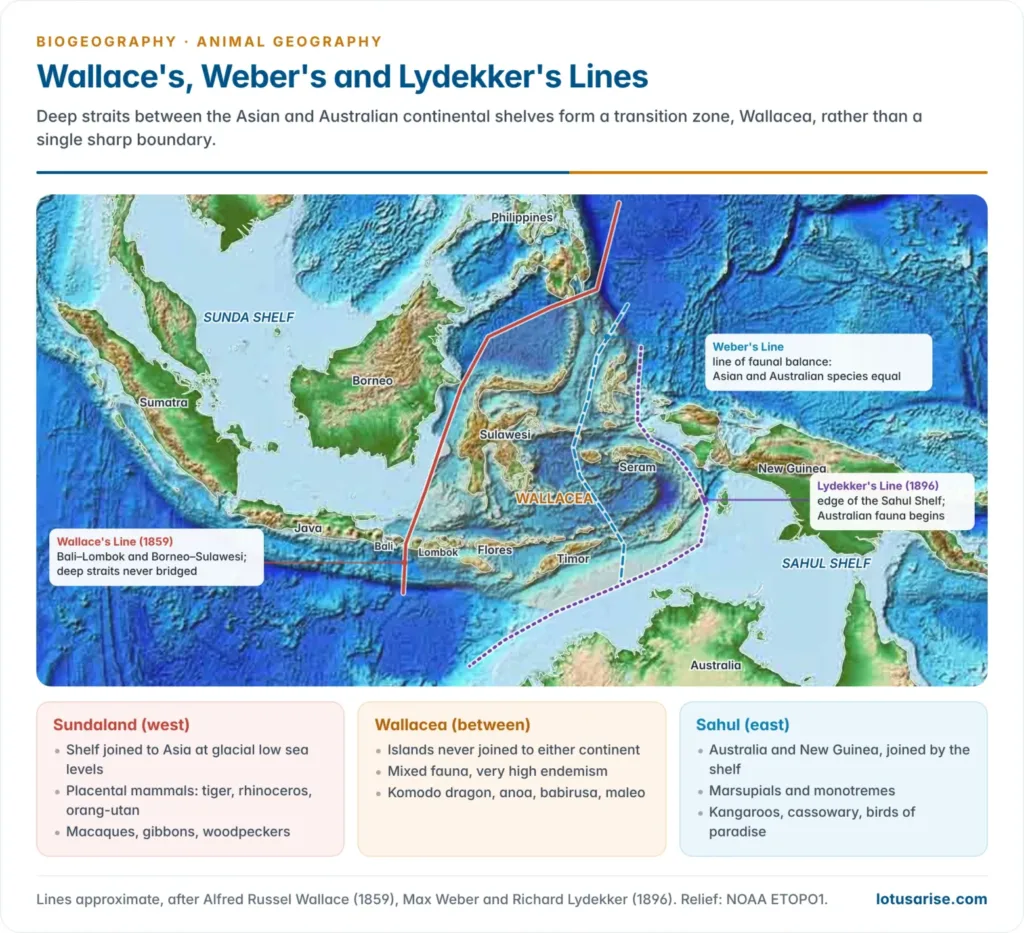
- Alfred Russel Wallace first described a faunal boundary through the Malay Archipelago in 1859. It runs between Bali and Lombok and between Borneo and Sulawesi, and separates Asian (Oriental) fauna from Australian fauna.
- Bali and Lombok are only about 35 km apart, yet the deep Lombok Strait stayed open even when glacial low sea levels joined the western islands to Asia. A narrow but deep strait can thus be an effective dispersal barrier.
- Thomas Henry Huxley named it Wallace’s Line in 1868.
- Later biologists refined rather than replaced it:
- Weber’s Line, after Max Weber of the Siboga Expedition, runs farther east. It marks the line of faunal balance, where Asian and Australian species are about equal; many zoogeographers treat it as the truer transition.
- Lydekker’s Line, drawn by Richard Lydekker (1896) along the edge of the Sahul Shelf, marks where distinctly Australian fauna begins.
- Wallacea is the belt of islands between Wallace’s and Lydekker’s lines of the faunal realms, mainly Sulawesi, Lombok, Flores, Timor and the Moluccas. It is neither fully Asian nor fully Australian, and is among the most distinctive, high-endemism regions on Earth: the Komodo dragon, anoa, babirusa and maleo live there.
Biogeographic realms
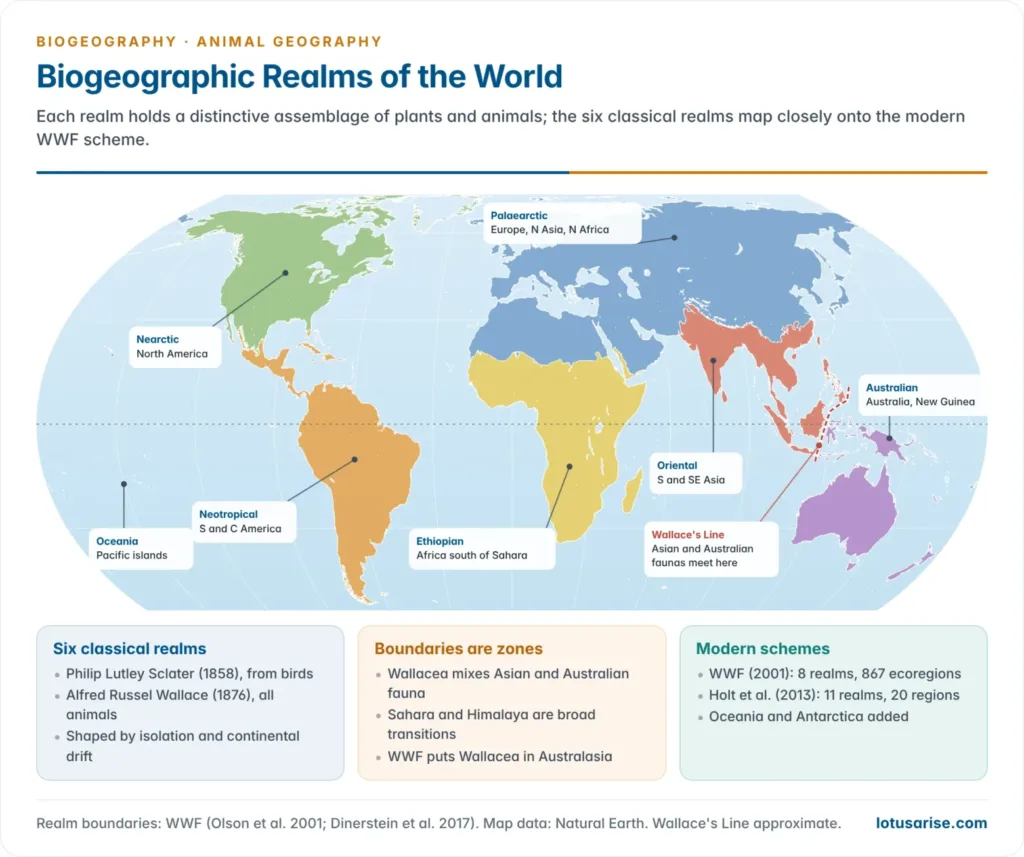
- Biogeographic realms are major world regions, each with a distinctive assemblage of plants and animals shaped by long isolation and continental drift. Philip Lutley Sclater (1858) proposed six from the distribution of birds; Wallace (1876) extended them to all animals:
| Realm | Extent | Characteristic fauna |
|---|---|---|
| Nearctic | North America to the Mexican highlands, Greenland | Bison, moose, beaver, pronghorn |
| Palaearctic | Europe, Asia north of the Himalaya, North Africa | Wolf, red deer, lynx, wild boar; the largest realm by area |
| Neotropical | South and Central America, from southern Mexico | Jaguar, sloths, capybara, hummingbirds; the richest in species |
| Ethiopian (Afrotropical) | Africa south of the Sahara, Madagascar | Elephant, lion, zebra, giraffe, gorilla; lemurs in Madagascar |
| Oriental (Indomalayan) | Indian subcontinent, South-East Asia west of Wallacea | Tiger, Asian elephant, gibbons, rhinoceros |
| Australian (Australasian) | Australia, New Guinea, New Zealand | Kangaroo, koala, platypus, cassowary |
- Realm boundaries are zones, not sharp lines, as Wallacea shows. Modern schemes of biogeographic realms and regions add Oceania and Antarctica: eight realms for the WWF (2001), eleven for Ben Holt and colleagues (2013).
Island biogeography theory
- Robert MacArthur and Edward O. Wilson (1963, 1967) explained species richness on an island as a balance of two rates:
- an immigration rate, which falls with distance from the mainland source pool;
- an extinction rate, which falls as island area increases, because larger islands hold larger, more stable populations.
- Where the two curves cross gives the equilibrium number of species an island can be expected to hold.
- The idea is often summarised through the species–area relationship, S = cAᶻ, where S is the number of species, A the area, and c and z are constants.
- It is a load-bearing idea of conservation planning. Reserves surrounded by farmland behave like islands, hence the long SLOSS debate: is conservation better served by a Single Large or Several Small reserves?
Factors influencing biogeography
- Geological processes, plate tectonics and continental drift, have reshaped continents and islands over geological time and drive distribution in two ways:
- Vicariance: a once-continuous population is split by a new barrier, such as a rift or a widening ocean.
- Dispersal: species cross an existing barrier by active or passive movement, on wind or ocean currents or rafting on debris.
- Darwin and Wallace both favoured dispersal. The two are now seen as complementary: vicariance explains deep, ancient splits between lineages on separate continents; dispersal explains recent, one-off colonisations, such as an oceanic island gaining its first reptile.
- An Indian example: the purple frog (Nasikabatrachus sahyadrensis) of the Western Ghats, described in 2003, has its closest relatives in the Seychelles, a relic of their union in Gondwana.
- Climate, through temperature, precipitation and seasonality, sets the outer limits of where a species can survive.
- Steady warmth and humidity help explain the richness of tropical rainforests; deserts and polar regions support fewer, more specialised species.
- Pleistocene glaciations pushed species into refugia, from which they later spread.
- Evolution, through speciation, adaptive radiation and extinction, continuously reworks these patterns, acting together with climatic and geological change.
- Ecological interactions, such as predation, competition and mutualism, shape populations at a finer grain, sometimes excluding a species from a habitat that would otherwise suit it.
- Human activity, through land-use change, introduced species and climate change, is now one of the factors influencing the distribution of plants and animals in its own right.
Methods in biogeography
| Method | What it does | Example |
|---|---|---|
| Field surveys | Direct observation and recording of organisms in their habitats; the foundation of the discipline | Plot and transect surveys of forests |
| Museum, herbarium and fossil records | Show past and present ranges; fossils and pollen (palynology) record distributions through time | Pollen cores tracing post-glacial forest spread |
| Remote sensing and GIS | Track environmental change and its effect on ranges, at scales no field team could cover | Satellite mapping of forest loss |
| Genetic analysis (phylogeography) | Reads variation among populations to reconstruct migration and divergence: a molecular record of where a lineage has been | Dating the split of Gondwanan lineages |
| Modelling (species distribution models) | Turns the other methods’ data into testable forecasts of range shifts, for example under climate change | Projected upslope shift of Himalayan species |
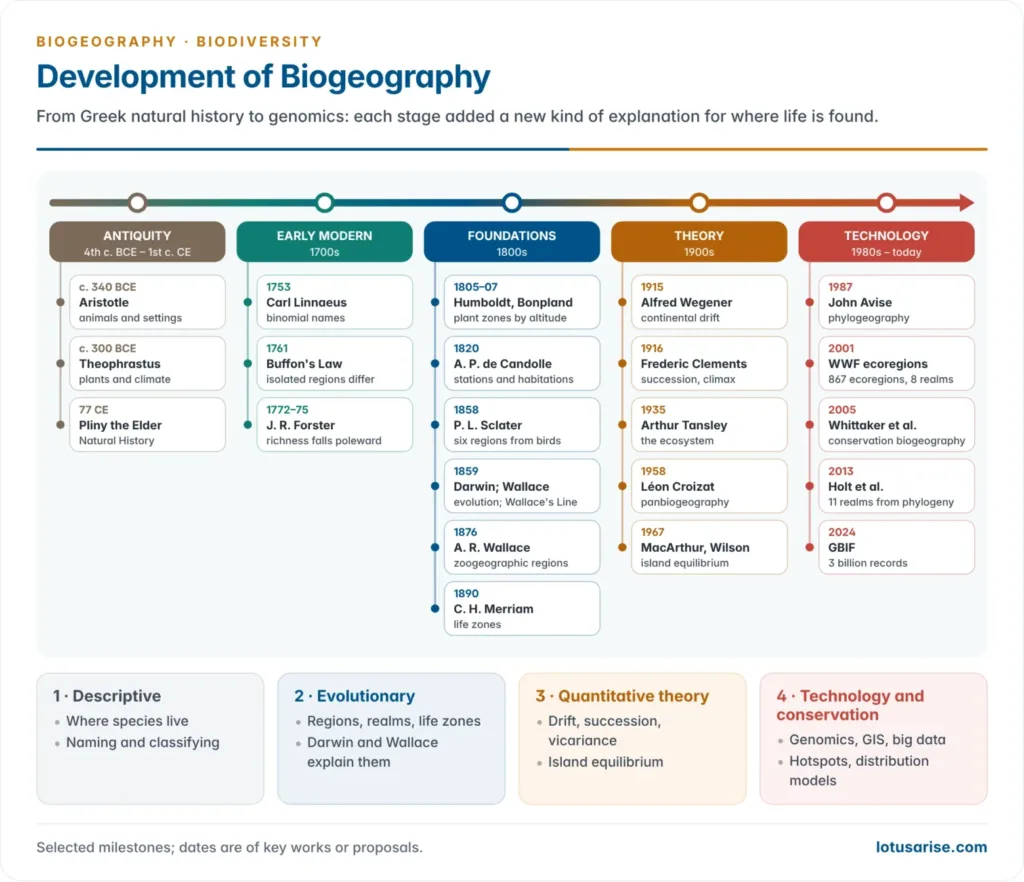
- Biodiversity informatics now pools these records. The Global Biodiversity Information Facility (GBIF), set up in 2001, passed 3 billion occurrence records in 2024. Environmental DNA (eDNA), traces of DNA in water or soil, now detects species without seeing them.
Applications of biogeography
- Conservation biology: biogeography identifies biodiversity hotspots and designs protected-area networks, such as India’s biosphere reserves, with real ecological logic rather than convenience.
- Restoration ecology: it guides the choice of ecologically appropriate native species when a degraded habitat is rebuilt.
- Invasive species management: dispersal and niche models let managers predict and get ahead of the spread of non-native species.
- In India, Lantana camara covered about 154,000 km², over 40% of the forest in the tiger range, by 2020, and a further 300,000 km² was modelled as at risk. Nearly 60% of its occurrences lay outside the climate of its native Central America.
- Agriculture and genetic resources: the search for the centres of origin of crops, begun by Alphonse de Candolle and Nikolai Vavilov, rests on biogeography.
Current challenges and future directions
- Climate change is already shifting species ranges and biome boundaries. Biogeography’s main contribution is anticipation: modelling the shifts before they arrive rather than only recording them afterwards.
- Habitat loss through deforestation, urbanisation and land-use change keeps fragmenting ranges and cutting the connections between habitats.
- The resulting biodiversity loss makes understanding why species are disappearing a precondition for any conservation response.
Scope of Biogeography: Sub-fields
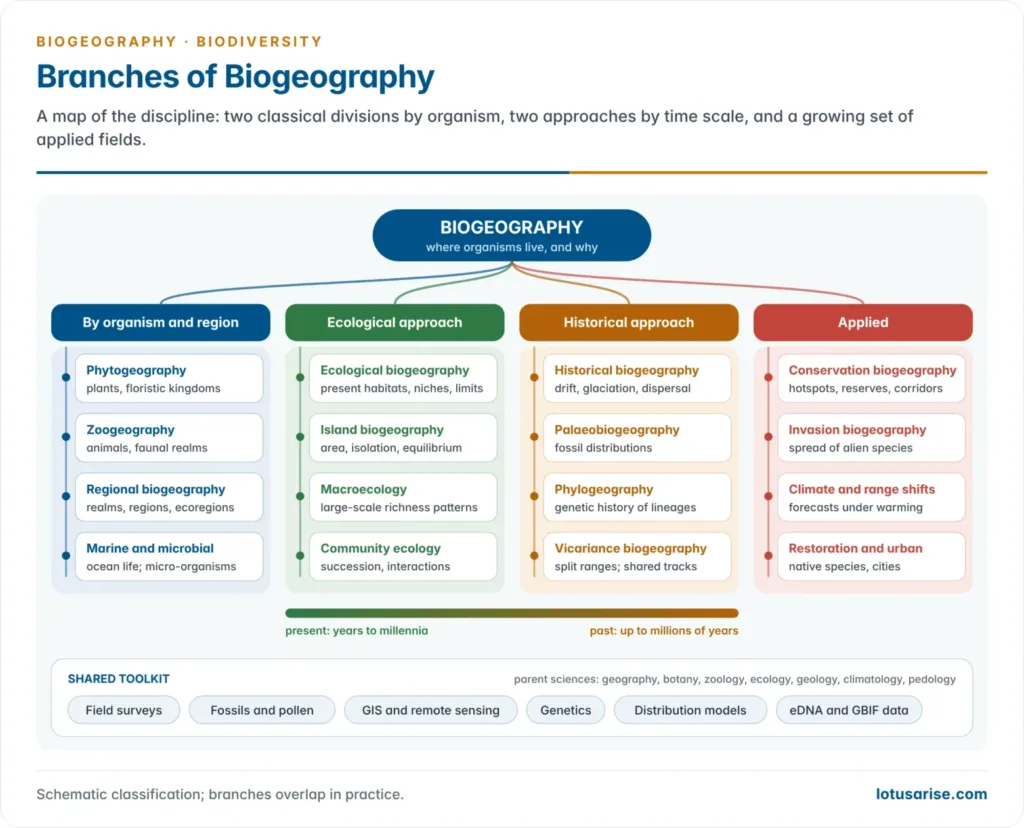
- Biogeography has grown a family of sub-disciplines, each asking where organisms live and why through a different lens:
| Sub-field | Focus | Example |
|---|---|---|
| Phytogeography | Distribution of plants and vegetation | Floristic kingdoms; altitudinal vegetation belts of the Himalaya |
| Zoogeography | Distribution of animals | Faunal realms; the Nearctic fauna |
| Ecological biogeography | Present-day distribution across habitats; niches, community interactions and environmental controls | Why the Thar has xerophytes and the Western Ghats evergreen forest |
| Historical biogeography | How tectonics, past glaciations, speciation and extinction shaped today’s patterns; links Earth history with the history of life | Gondwanan relics in peninsular India |
| Palaeobiogeography | Distributions of past geological periods, from fossils | Glossopteris flora across the southern continents |
| Island biogeography | Species–area relations, isolation and the high endemism of islands; their vulnerability to invasive species | Galápagos finches, Hawaiian honeycreepers, Andaman and Nicobar endemics |
| Regional biogeography | Division of the world into realms, regions and ecoregions on climate, vegetation and species composition | Palaearctic, Afrotropical, Neotropical, Nearctic, Australasian and Antarctic realms |
| Evolutionary biogeography and phylogeography | Adaptive radiation and the genetic and geographic history of lineages | Darwin’s Galápagos finches |
| Macroecology | Large-scale statistical patterns of richness, range size and body size | The latitudinal diversity gradient |
| Conservation biogeography | Applying biogeographic principles to protect biodiversity: hotspots, reserves, corridors | Western Ghats–Sri Lanka, Himalaya and Indo-Burma hotspots |
| Applied biogeography | Restoration ecology, urban biogeography, sustainable agriculture, forestry and land-use planning | How cities reshape species distributions |
| Marine and microbial biogeography | Distribution of ocean life and of micro-organisms | Coral Triangle diversity |
- Theoretical and methodological approaches (distribution models, GIS, genetic and statistical methods) are the technical backbone of every sub-field.
- Interdisciplinary connections run to climate science (range-shift data), geology and palaeontology (the fossil record), soil science, and to sociology and anthropology, which show how human activity reshapes ranges and conservation outcomes.
- Future directions: global change and distributions, biodiversity informatics such as GBIF, and connectivity-based conservation. Biogeography thus bridges the past, present and future of life on Earth.
Historical Development of Biogeography
- The discipline’s history moves through four broad stages: descriptive natural history, evolutionary explanation, quantitative theory, and today’s technology-driven conservation science.
Ancient observations and the age of exploration
- Aristotle (384–322 BCE) studied animal dispersion and adaptation to different settings in his History of Animals, the earliest groundwork for linking organisms to environments.
- Theophrastus (about 371–287 BCE), the “father of botany”, described plant distribution and climatic adaptation in his Enquiry into Plants.
- Pliny the Elder (23–79 CE) compiled in his Natural History one of the first systematic accounts of species across regions.
- Voyages of the 15th–18th centuries (Columbus, Magellan, Cook) reported new species and ranges. Johann Reinhold Forster, on Cook’s second voyage (1772–75), noted that plant diversity falls from the tropics toward the poles.
Early modern biogeography
- Carl Linnaeus (1707–1778) created binomial nomenclature, the taxonomic scaffolding needed to compare distributions systematically.
- He explained distribution by dispersal from a single mountain on which all species first lived.
- Georges-Louis Leclerc, Comte de Buffon (1707–1788), in his Histoire naturelle, argued that environment shapes distribution and adaptation.
- Buffon’s Law (1761): regions with similar climates but long isolated carry different species, as with the mammals of the Old and New World tropics.
The nineteenth century: foundations
- Alexander von Humboldt (1769–1859) explored the Americas (1799–1804) and, with Aimé Bonpland, wrote the Essay on the Geography of Plants (1805–07).
- Its profile of Chimborazo linked climate and altitude to plant zonation; Humboldt is regarded as the father of plant geography, and his Kosmos (1845–62) treated nature as one connected whole.
- Augustin Pyramus de Candolle (1820) separated stations (local habitats, explained by present environment) from habitations (regions, explained by history). This is the origin of the ecological and historical approaches; he also stressed competition, “nature’s war”, between plants.
- Philip Lutley Sclater (1858) divided the world into six zoological regions from the distribution of birds.
- Charles Darwin (1809–1882), in On the Origin of Species (1859), devoted two chapters to geographical distribution and gave biogeography its evolutionary engine.
- His Galápagos observations (1835) remain the classic demonstration of adaptive radiation and speciation.
- Joseph Dalton Hooker (1817–1911) advanced plant geography through his southern-hemisphere floras and his work on the flora of India.
- With Thomas Thomson he divided India into botanical provinces in Flora Indica (1855). His Flora of British India (1872–97) followed.
- Alfred Russel Wallace (1823–1913), co-discoverer of natural selection, identified Wallace’s Line (1859).
- His The Geographical Distribution of Animals (1876) and Island Life (1880) founded zoogeography.
- Adolf Engler (1879–82) divided the world into floristic kingdoms from the history of plant lineages.
- Ecological plant geography took shape with August Grisebach (1872), Eugenius Warming (1895) and Andreas Schimper (1898), who explained vegetation by climate, soil and plant physiology.
- Clinton Hart Merriam recognised life zones, altitudinal belts of plants and animals, on the San Francisco Peaks of Arizona (1889–90). In 1894 he tied range limits to temperature.
The twentieth century: ecology, drift and quantitative theory
- Ecology joins in:
- Frederic Clements (1916) set out succession toward a climatic climax, and Henry Gleason (1926) countered with the individualistic view;
- Arthur Tansley (1935) coined the ecosystem.
- Alfred Wegener proposed continental drift (1912, 1915). Rejected at first, it was vindicated by plate tectonics in the 1960s, which gave historical biogeography its physical basis.
- Ronald Good (1947) produced a classic floristic regionalisation of the world, and Philip Darlington (1957) a synthesis of animal distribution.
- Léon Croizat (1958) founded panbiogeography, mapping shared distribution “tracks”. With Willi Hennig’s cladistics it led to vicariance biogeography in the 1970s–80s.
- Robert MacArthur (1930–1972) and Edward O. Wilson (1929–2021) published The Theory of Island Biogeography (1967).
- Its quantitative model linking island size and distance to species richness revolutionised biogeography and conservation planning.
- Daniel Simberloff and Wilson (1969) tested it by defaunating small mangrove islands in the Florida Keys and watching them recolonise.
- Miklos Udvardy (1975) mapped the biogeographic provinces of the world for UNESCO’s Man and the Biosphere programme.
Contemporary biogeography
- New sub-fields:
- phylogeography, named by John Avise (1987);
- macroecology, by James Brown and Brian Maurer (1989);
- conservation biogeography, defined by Robert J. Whittaker and colleagues (2005).
- New maps: the WWF’s 867 terrestrial ecoregions in 8 realms (2001), and an updated scheme of 11 realms built from the evolutionary relationships of vertebrates (2013).
- GIS, remote sensing and molecular biology now handle datasets earlier naturalists could not have imagined, while climate change and conservation have driven species distribution models and the mapping of hotspots worldwide.
- Development in India:
- the Botanical Survey of India (1890) and Zoological Survey of India (1916) inventory the country’s flora and fauna;
- Ecology and Biogeography in India (1974), edited by M. S. Mani, was the first national synthesis;
- W. A. Rodgers and H. S. Panwar (1988) divided India into ten biogeographic zones, revised in 2002.
- Present-day biogeography combines ecological, evolutionary and climatic data, with global change research running through it: tracking how climate change, land use and pollution reshape distributions, the natural continuation of a discipline that began with Aristotle watching where animals turned up.
| Stage | Period | Key figures | Contribution |
|---|---|---|---|
| Descriptive natural history | Antiquity to the 18th century | Aristotle, Theophrastus, Pliny, Linnaeus, Buffon | Records of where species live; naming; Buffon’s Law |
| Foundations and evolution | 19th century | Humboldt, de Candolle, Sclater, Darwin, Hooker, Wallace, Merriam | Plant zonation, faunal regions, evolution, life zones |
| Ecology, drift and theory | 1900s–1980s | Clements, Tansley, Wegener, Good, Croizat, MacArthur and Wilson | Succession, ecosystem, vicariance, island equilibrium |
| Technology and conservation | 1980s to present | Avise, Brown, Whittaker; GBIF | Phylogeography, macroecology, distribution models, conservation biogeography |
Previous Year Questions
- No direct PYQ has been asked on this sub-topic yet.