📥 Geography Optional Toppers Answer Copies – Free PDF Download
Every Geography Optional aspirant eventually goes looking for the same thing: a topper’s actual answer sheet. Not a strategy article, not a book list — the real pages, in real handwriting, that a UPSC examiner gave marks to. This page collects the Geography Optional toppers’ answer copies we have, free to download, and then does the part almost nobody does: explains exactly what you can learn from them, and what you cannot.
Read the second half carefully. Most aspirants download four topper copies, feel motivated for a day, and go back to reading Leong and Husain. The difference between that and actually improving your score is in how you use them.
Geography Optional Toppers 2025 — Answer Copies (Free PDF)
Geography Optional Toppers from Himanshu Sir (LotusArise IAS) in 2025
Geography Optional Toppers 2025: Rank 50 Ishitwa Anand Answer Copies (Download PDF)
Geography Optional Toppers 2025: Rank 197 Seshan M. S. Answer Copies (Download PDF)
Geography Optional Toppers 2025: Rank 217 Ankit Agrawal Answer Copies (Download PDF)
Geography Optional Toppers 2025: Rank 224 Rahul Patil Answer Copies (Download PDF)
Geography Optional Toppers 2025: Rank 225 Muthurasi M Answer Copies (Download PDF)
Geography Optional Toppers 2025: Rank 233 Akash Deep Answer Copies (Download PDF)
Geography Optional Toppers 2025: Rank 237 Nitish Kumar Answer Copies (Download PDF)
You now have the copies. Here is what they cannot give you.
Seven toppers, roughly twenty answers each — and every one of them written on the units they were strong in. Your weakest unit is almost certainly not in any of these copies. That is not a flaw in the copies; it is what a topper copy is.
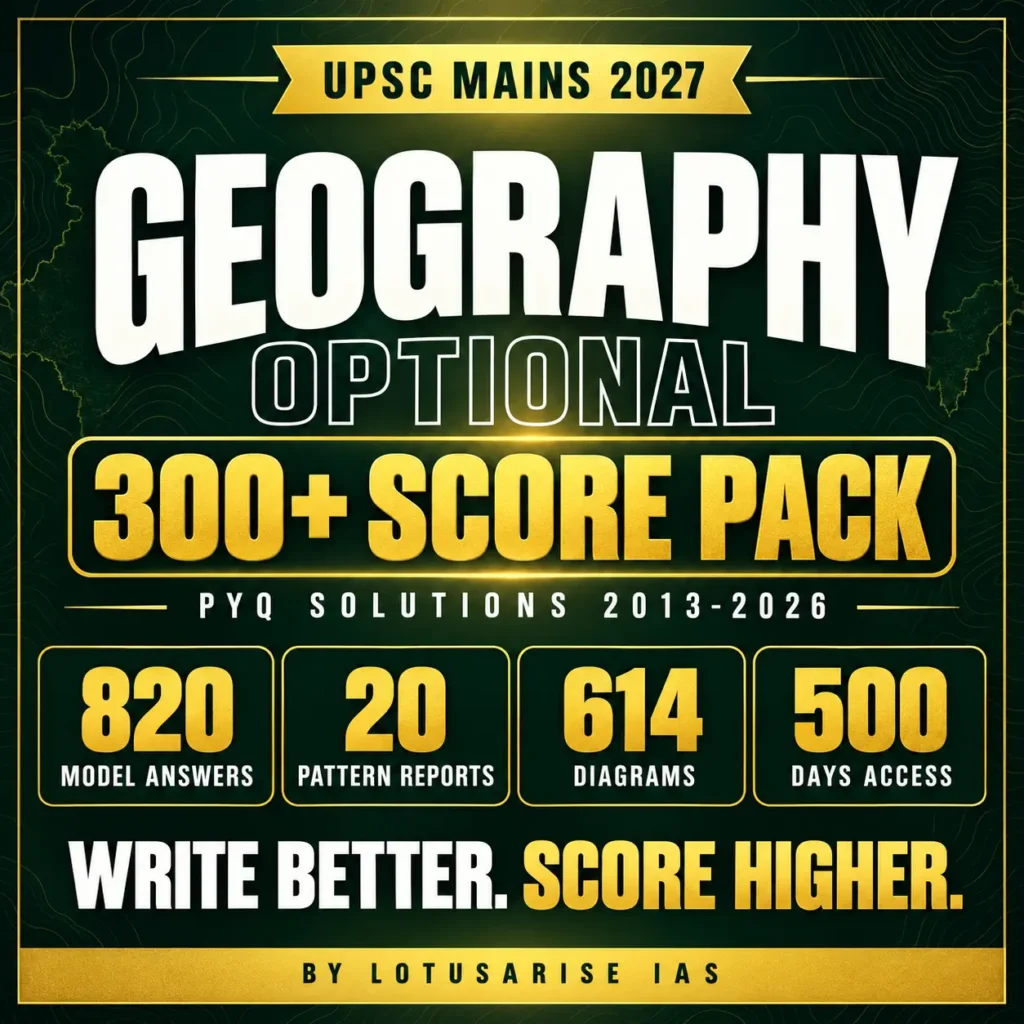
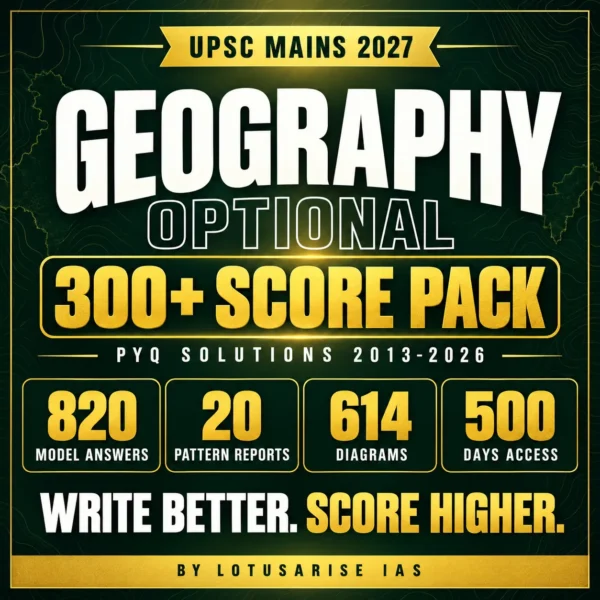
The Geography Optional 300+ Score Pack covers every question UPSC has actually asked since 2013 — including the ones no topper copy shows you.
- 820 solved PYQ model answers (2013–2026), topic-wise across all 20 units, Paper I and Paper II
- Word-budgeted for 10-mark and 20-mark formats, with the diagram placed where you would actually draw it
- ₹1,770 once, 500 days of access — against ₹15,000–₹60,000 for a Geography Optional coaching course
These are the candidates who cleared CSE 2025 with Geography Optional. Answer copies are added as we receive and verify them — if a copy is not yet listed as available, it has not been released, and we would rather say so than put up a broken link.
Rank 50 Ishitwa Anand — Geography Optional Answer Copies (Download PDF)
The most complete Geography Optional answer copy set from CSE 2025. Worth studying for how consistently a diagram appears in the Paper I answers, and for how short the introductions are — most run to two lines and then move straight into the body.
Pratham Kaushik — Geography Optional Answer Copy
Pratham Kaushik scored 327 marks in Geography Optional, and his copy is the one most aspirants ask for by name. What stands out is discipline rather than brilliance: consistent answer length, a diagram wherever a diagram is possible, and conclusions that add a forward-looking line instead of restating the introduction.
Deepti Rohilla — Geography Optional Answer Copy
Useful mainly for Paper II. Her India-map usage is heavier than most, and she interlinks Paper I theory with Paper II examples more openly than other copies — a habit that is easy to copy once you have seen it done.
What a topper’s answer copy actually teaches you
A topper copy is not a content source. You will not learn climatology from it. What it gives you is something books cannot: proof of what a scoring answer physically looks like on a UPSC sheet, written under time pressure by someone who was not a genius, just prepared.
The four things worth studying in every copy
1. How short the introduction really is
Almost every aspirant writes introductions that are too long. In topper copies the introduction is usually two to three lines: a definition, occasionally a thinker’s name, and then straight into the body. Time the difference — three saved lines per answer across twenty answers is an entire extra question attempted.
2. Where the diagram sits
Notice that diagrams almost never appear at the end as decoration. They sit at the point in the argument where the explanation becomes hard to express in words. That placement is the skill — drawing the diagram is the easy part.
3. What gets underlined
Toppers underline syllabus keywords, thinker names and technical terms — not whole sentences. An examiner scanning at speed is looking for exactly those words. Underlining everything is the same as underlining nothing.
4. What the conclusion adds
The weakest habit in average answer sheets is a conclusion that repeats the introduction in different words. In high-scoring copies the conclusion introduces something new — a policy link, a contemporary example, a limitation. It earns its two lines.
The honest limits of learning from answer copies
This is the part that gets left out of every other page on this topic. Topper copies are genuinely valuable, and they are also genuinely incomplete as a preparation tool. Three reasons why.
A copy shows you about twenty answers. The syllabus has hundreds of questions
One candidate’s Paper I and Paper II copies together contain roughly twenty answers — the questions that candidate chose to attempt. UPSC has asked well over eight hundred Geography Optional questions since 2013. Twenty samples cannot tell you how to frame the other seven hundred and eighty.
You get the topper’s strong units, not your weak ones
Every candidate attempts the questions they are confident about. So a topper copy is, by definition, a record of their best units. If your gap is Models and Theories or Regional Planning, and the topper skipped those questions, the copy has nothing for you exactly where you needed it most.
Handwriting under pressure is not a model to copy
A topper copy is a high-scoring answer, not an ideal one. Written in three hours under exam stress, it will have compressed arguments, half-finished diagrams and omitted examples. That is fine — it still scored. But you cannot reverse-engineer a repeatable structure from something the writer themselves would improve given ten more minutes.
What fills the gap: 820 solved PYQ model answers
Topper copies show you what a scoring answer looks like for twenty questions. The Geography Optional 300+ Score Pack does it for every question UPSC has asked since 2013 — including the units the toppers skipped and you are weakest in.
- 820 solved PYQ model answers (2013–2026) — topic-wise across all 20 units, Paper I and Paper II
- 20 PYQ pattern & strategy reports — one per unit: what repeats, what is due, what UPSC rewards
- Diagrams and maps inside the answers, at the exact point where you would draw them
- 500 days of access from your enrolment date — covered right through Mains 2027
₹1,770 (regular ₹2,500) — that is ₹2.16 per model answer. One-time payment, no subscription.
How to use a topper’s answer copy properly
Downloading the PDF is not studying it. Here is the drill that actually converts a topper copy into a change in your own writing. It takes about a week per copy.
- Attempt first, read second. Pick a question from the copy. Write your own answer in full, under time, before you look at theirs. Comparing without writing teaches you nothing — you will always feel you could have written it.
- Mark the four differences. Put both answers side by side and mark only: introduction length, diagram presence and placement, examples used, and what the conclusion adds. Ignore handwriting and neatness.
- Extract the skeleton, not the content. Write down the topper’s answer as a five-line outline. That outline — not the prose — is what you are trying to learn.
- Rewrite your answer using their skeleton. Same question, your content, their structure. This is the step almost everyone skips, and it is the only one that changes anything.
- Repeat on a question they did not attempt. Take a PYQ from your weakest unit and apply the same skeleton unaided. If you can, the copy has done its job.
What to look for, paper by paper
Geography Optional Paper I — physical and human geography
Covers Geomorphology, Climatology, Oceanography, Biogeography, Environmental Geography, Perspectives in Human Geography, Economic Geography, Population and Settlement Geography, Regional Planning, and Models, Theories and Laws.
- Watch how a thinker’s name is introduced — usually in the first two lines, never as a separate paragraph
- Count the diagrams. In strong Paper I copies, roughly two answers in three carry one
- Notice how process questions are answered as sequences rather than descriptions
Geography Optional Paper II — Indian geography
Covers Physical Setting, Resources, Agriculture, Industry, Transport and Trade, Cultural Setting, Settlements, Regional Development and Planning, Political Aspects, and Contemporary Issues.
- India outline maps appear far more often than aspirants expect — and they are drawn quickly and roughly, not carefully
- Look for where a Paper I theory is used to explain a Paper II example. That interlinking is what separates 250 from 300+
- Current affairs appear as one specific scheme, report or figure — never as a general paragraph about relevance
From reading topper copies to writing your own answers
If you have read this far, you already have the content. You have been through the books, possibly more than once. What is missing is a model of the finished product — the shape of a scoring answer, seen often enough that your hand produces it under pressure without you thinking about it.
Four topper copies give you twenty examples of that shape. That is a start, and it is not enough to build a habit on.
Geography Optional 300+ Score Pack — Solved PYQs for Mains 2027
820 model answers to every Geography Optional question UPSC has asked since 2013, written the way they should appear on the sheet — word-budgeted for 10-mark and 20-mark formats, with the scholars, models and Indian examples already integrated, and the diagram drawn at the point in the answer where you would draw it.
A Geography Optional coaching course runs ₹15,000–₹60,000. A dedicated optional test series alone is upwards of ₹14,000. This is ₹1,770, once, with 500 days of access from the day you enrol.