

- A conglomerate is a multi-industry company: one group oversees several business entities in entirely different industries.
- Industrial houses (business groups) are public or private structures that bring together companies in different segments. They are an important part of the national economy and a major contributor to its GDP.
- Business groups mark the industrial scene of many developing economies.
- In India about 90% of businesses are family-owned, and they have played a crucial part in development.
- India is a mixed economy, in which public and private players both take part. So industrial complexes and houses are of two types by ownership:
- Public industrial houses and complexes.
- Private industrial houses and complexes, such as the Tata and Birla houses.
Rise of Industrial Houses
Background
- Some houses played a pivotal part in industrialising a country that stayed mainly agrarian until the mid-20th century. Many date from before Independence, and others arose afterwards with a praiseworthy role in industrial development.
- The economy has gone through a roller-coaster ride since 1947.
- In 1947, India was an open economy.
- By the mid-1950s, big business had become a bad word, regulatory limits came on large firms, and public sector firms stood at the centre.
- In 1991, the P. V. Narasimha Rao government brought reforms. Big business and foreign capital became objects of desire, not derision.
- One feature has stayed the same: the dominance of family-owned enterprises. Fifteen of the top 20 groups were family-owned in the 2016 ranking.
Early Inquiries into Concentration
- Monopolies Inquiry Commission (1965), under K. C. Das Gupta, found 75 houses controlling 1,536 companies.
- Industrial Licensing Policy Inquiry Committee (1969), under Subimal Dutt, accepted the idea of the industrial house and listed 20 larger houses.
- R. K. Hazari studied the corporate private sector and showed how big firms used licensing to their advantage.
- The MRTP Act (1969), in force from June 1970, set an asset limit of ₹20 crore, raised to ₹100 crore in 1985. After 1991 the aim moved from approving expansion to curbing unfair and restrictive practices.
The Churn
- Beneath the apparent status quo lies a big churn. Most family groups, with few exceptions, have fallen by the wayside, while many of the top groups of today were very small in the early 1950s or arose after Independence.
- Only three groups in the top 20 of 1951 were still there in 2016: Tata, Birla (AV) and Mahindra. Among the Birlas, only one branch kept its place.
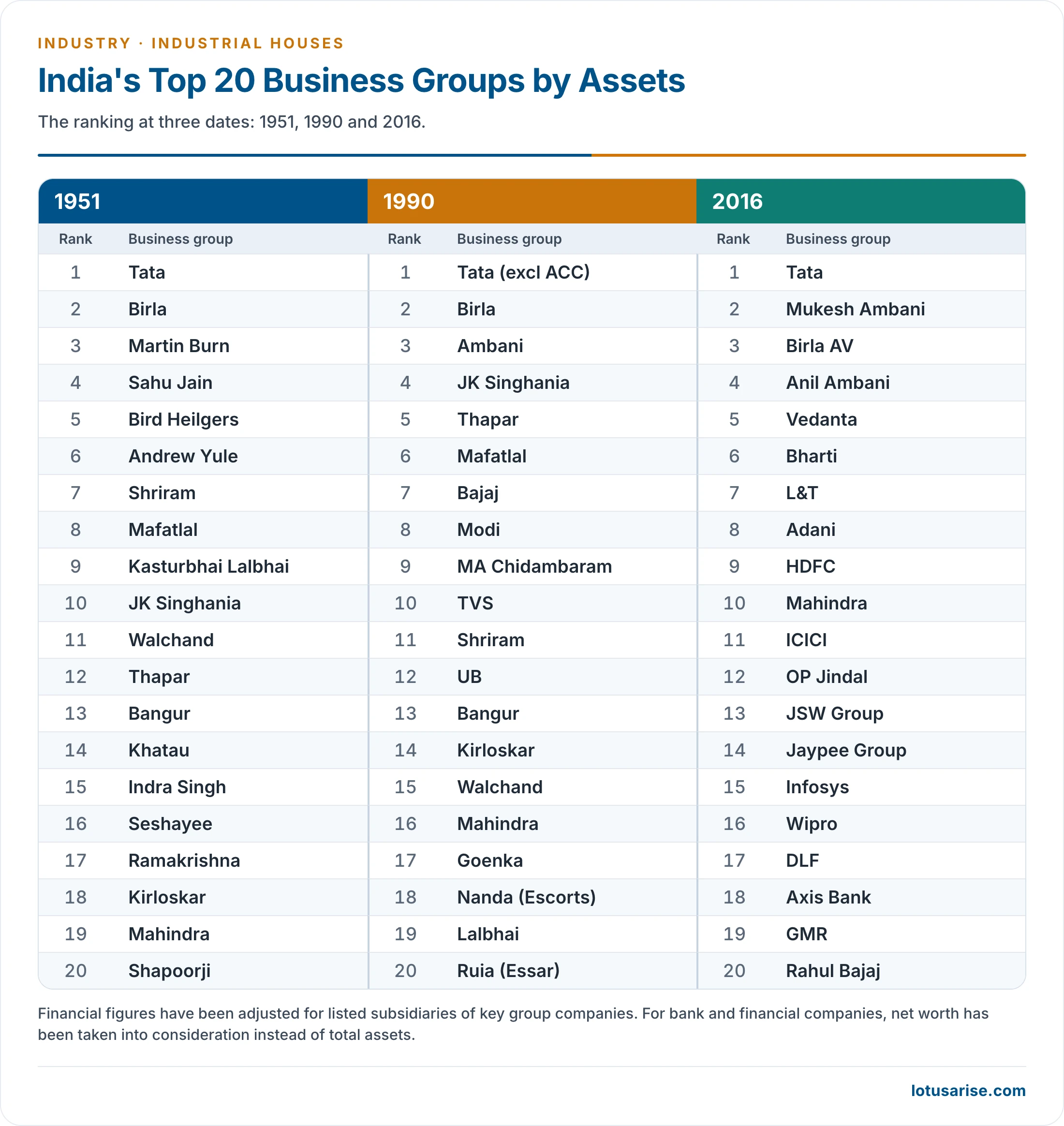
- The chart shows this churn across three dates:
- Gone by 1990: Martin Burn, Sahu Jain, Bird Heilgers, Andrew Yule, Khatau, Indra Singh, Seshayee, Ramakrishna, Shapoorji.
- Risen by 1990: Ambani, Bajaj, Modi, MA Chidambaram, TVS, UB, Goenka, Nanda (Escorts), Ruia (Essar).
- Risen by 2016: Vedanta, Bharti, L&T, Adani, HDFC, ICICI, OP Jindal, JSW, Jaypee, Infosys, Wipro, DLF, Axis Bank, GMR. The Ambani house by then ranked as two groups, under Mukesh and Anil.
- Adaptability is the usual explanation for the churn. Groups that adjusted to the 1956 licensing regime or the post-1991 market kept growing, and others dropped from view.
- The 1969 MRTP Act limited big business and directly hit prominent family groups.
- It made room for newcomers such as the Om Prakash Jindal group, which used the curbs on incumbents such as Tata Steel (then TISCO).
- Many of today’s cement barons also owe their rise to it.
- The 1970s saw the rapid rise of the Dhirubhai Ambani group, through sectors where old money was hardly present: synthetic textiles and their whole chain from petrochemicals to crude oil refining.
- Sixteen of the top 20 groups of 2016 were products of post-Independence growth. They held two-thirds of combined assets and nearly 70% of combined revenue of the top 20.
- The 1991 reforms speeded this up. Nine of the 2016 top 20 owed their rise to them.
- The openings were the abolition of industrial licensing, free movement of capital, and entry into banking, infrastructure and telecom.
- Bharti, Adani, GMR, HDFC and Jaypee grew in this way.
- The software boom took Infosys and Wipro to 15th and 16th place in 2016. Tata Consultancy Services was the Tata group’s most profitable and valuable company, and Tech Mahindra the Mahindra group’s second-largest business after farm equipment and automotive.
- Current ranking by family value: at 30 June 2026 the leading family businesses were Ambani, Birla, Jindal, Bajaj and Mahindra, with the Ambani family at about ₹25.8 lakh crore. Adani led first-generation families in the 2025 list.
Major Private Houses
Steel, Automobile and Engineering Houses
- The Tata: among the oldest houses, active for over a century, with iron and steel and heavy automobiles as its traditional fields.
- Jamsetji Tata laid its base with India’s first large integrated steel works, set up in 1907 at Sakchi, now Jamshedpur in Jharkhand.
- It diversified into pharmaceuticals, cement, publishing, power, finance, hotels, insurance, software, refrigeration, air-conditioning, telecommunication, soft drinks and consumer goods.
- Tata Consultancy Services, in software development and export, is the largest software services company in the country.
- It made world news with the Nano, a car of about US$ 2,500 launched in 2009, which fell short of buyers’ expectations.
- Air India came to the group in January 2022.
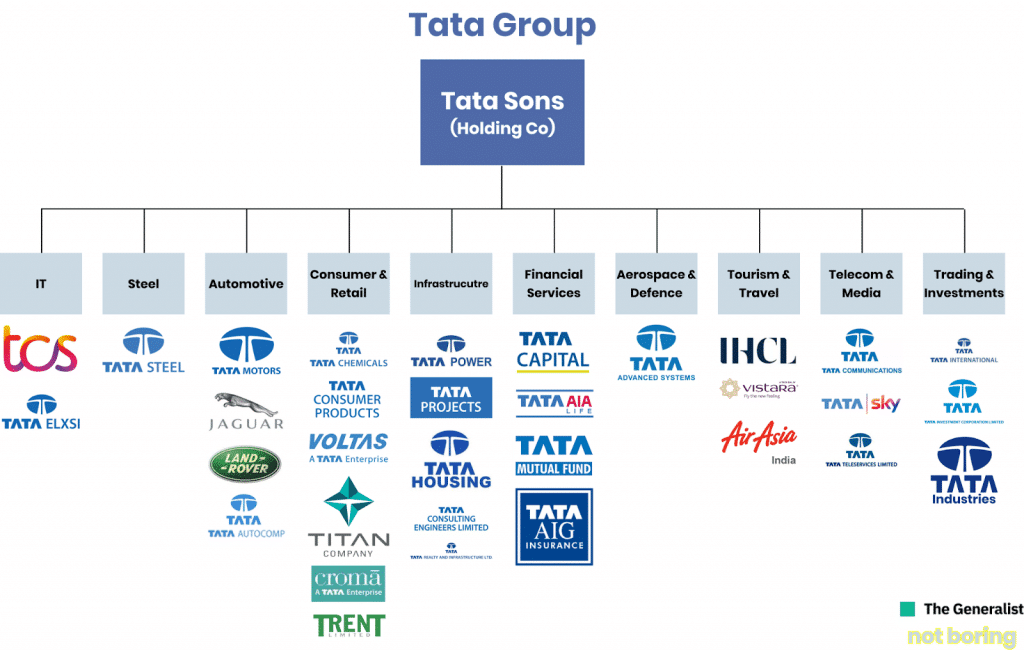
- The chart above is dated: Vistara merged into Air India in November 2024, AirAsia India was absorbed into Air India Express in October 2024, and Tata Motors split in two in October 2025.
- The Birla: among the oldest houses along with the Tatas, though it has since divided into branches. Seth Shiv Narayan Birla began with cotton trade at Pilani, Rajasthan, in 1857.
- Traditional fields are textiles, paper, viscose, cement, aluminium and automobiles.
- It later moved into machine tools, pharmaceuticals, telecommunications, and consumer durables and non-durables.

- The Bajaj: among the oldest business families, known around the world for the Bajaj Scooter, which could face international competition.
- It moved into motorcycles, and also electrical and home appliances and entertainment.
- It announced plans for one of the cheapest cars, after the Nano.
- Petrol scooter output ended around 2009, and the electric Chetak came in January 2020.

- The Escorts: among the oldest houses, popular for the Rajdoot motorcycle, a heart hospital and tractors. Tractors have been its main traditional line.
- Eicher was a separate firm, which sold its tractor business to TAFE in 2005.
- The Escorts Heart Institute was sold to Fortis in September 2005.
- Kubota now holds a majority, and the company is Escorts Kubota Limited.
- The Firodias: among the oldest houses, specialising in four-wheelers, two-wheelers and generator sets.
- The Kirloskars: founded in 1888 and famed for heavy and light machine tools, with a place of pride in locomotion.
- Older accounts credit the house with India’s first diesel pump set and first tractor, and with a revolution in farm mechanisation. Its compressors are known for quality.
- Toyota Kirloskar Motor (1997, Bidadi near Bengaluru) makes cars with Toyota, which holds 89%.
- Mahindra Group: founded in 1945 and headquartered in Mumbai, with operations in over 100 countries.
- Fields include aerospace, agribusiness, aftermarket, automotive, components, construction equipment, defence, energy, farm equipment, finance and insurance, industrial equipment, IT, leisure and hospitality, logistics, real estate, retail and two-wheelers.
- One of the most reputable houses, it leads in utility vehicles and tractors in India.
- It was divided into six strategic units: Automotive, Farm Equipment, Infrastructure, Trade and Financial Services, Information Technology, and Automotive Components (Systech).

- SsangYong in this collage has left the group: a consortium led by KG Group took over in 2022, and it now runs as KG Mobility.
- TVS Group: founded in 1911 by T. V. Sundaram Iyengar at Madurai, its headquarters.
- India’s leading supplier of automotive components and among its most respected groups, with over 50 companies.
- Fields range from two-wheelers and components to dealerships, finance and electronics.

Textile, Paper and Consumer Houses
- The Goenka: among the oldest houses, in power generation and distribution, textiles, pharmaceuticals, machine tools and entertainment.
- The family’s RPG empire divided in 2010-11 between RPG Enterprises (CEAT, KEC) under Harsh Goenka and the RP-Sanjiv Goenka Group (CESC, Saregama).
- The Godrej: among the top, oldest and most reputed houses, with locks, almirahs, furniture, refrigerators, air-conditioners and detergents made to high standards.
- The family split the group on 30 April 2024 into the Godrej Industries Group and the Godrej Enterprises Group.
- The Thapars: known for paper, sugar and allied industries, and for a contribution to education.
- The Jagatjit Group: known for textiles, sugar and distilleries.
- Bombay Dyeing: Bombay Dyeing & Manufacturing Company Limited is the flagship of the Wadia Group, chiefly in textiles and among India’s largest producers. Bed sheets and towels are its best-known goods.
- The Arvind Mills: Arvind Limited, formerly Arvind Mills, is a textile maker and flagship of the Lalbhai Group. It is among the largest producers of denim for jeans, which it supplies to major brands worldwide.
- The Modi: founded by Gujarmal Modi, among the oldest houses. The town of Modinagar in Uttar Pradesh grew up around it.
- Fields: textiles, garments, carpets, sugar, medicines, tyres and hospitality.
- The Sriram: a wide spread across cloth and garments, fertilizers, power, home appliances, generator sets, medicines and hotels.
- The Singhania: among the oldest houses, in cloth, medicines, machine tools, tyres and entertainment.
- The UB Group: among the oldest and leading houses, with alcoholic drinks as its traditional field. It later spread into airlines, infrastructure, hospitality and real estate.
Petroleum, Telecom and Software Houses
- The Ambanis (Reliance): a rags-to-riches story that stands for a new entrepreneurial class. Dhirubhai Ambani built it, and it was later divided between Mukesh and Anil Ambani.
- Traditional fields are synthetic yarn and petrochemicals.
- It has spread into more than a dozen fields: power, petroleum, textiles, garments, hospitality, telecommunication, pharmaceuticals, software, banking and insurance.
- The Jamnagar complex in Gujarat is the world’s largest single-site refinery, at about 68 million tonnes a year.

- In this wheel, the inner ring shows Reliance’s own brands, and the outer ring shows firms that compete with them in each market.
- The Infosys: a well-reputed house in electronics and software, which also contributes to education and social work.
- The Wipro: a doyen of the sunrise industries, in software development and export, computer peripherals and business process outsourcing.
- It began in 1945 at Amalner, Maharashtra, as Western India Vegetable Products, a cooking oil maker. Its consumer lines, shown below, keep this older side alive.

- The Bharti: Bharti Enterprises was founded by Sunil Bharti Mittal in 1976, with headquarters in New Delhi.
- It works in telecommunications, agribusiness, financial services and manufacturing, with telecom giving the largest revenue.
- It was once in 16 countries across Africa and Asia. In April 2026 Airtel served over 650 million customers in 15 countries across India and Africa.
- Singtel, IBM, Ericsson, Nokia Siemens and Alcatel-Lucent were listed as key telecom partners.
- The Bharti Foundation reached 2,40,000 students and 8,000 teachers across 13 States in older counts.

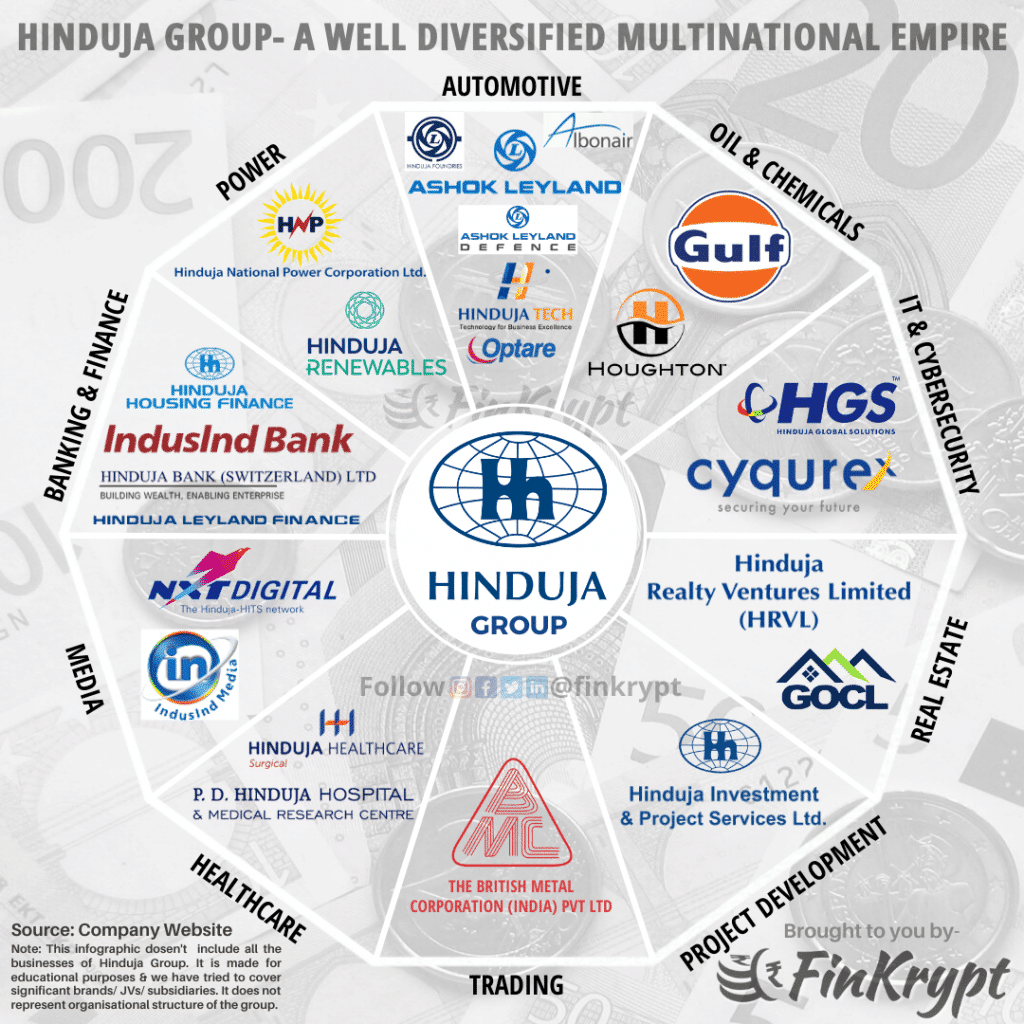
- Hinduja Group: founded in 1914 by Parmanand Deepchand Hinduja, who moved from Shikarpur in Sindh to Bombay, with a first overseas office in Iran in 1919. It has long been run from London.
- Products include oil and gas, media and telecom, financial services and IT-enabled services.
- Activities also include foundries, import-export, trading, motor vehicles, banking, call centres and healthcare.
- It was then counted among the top 10 business groups in India.
Drugs, Medicine and Seed Houses
| House | Field | Key fact |
|---|---|---|
| Biocon | Biotechnology | Founded by Kiran Mazumdar-Shaw in 1978 |
| Ranbaxy | Drugs and pharmaceuticals | Merged into Sun Pharma in March 2015, after Daiichi Sankyo held the majority |
| Sarabhais | Drugs and pharmaceuticals | Renowned worldwide |
| Hamdard | Unani medicine | Delhi, 1906; Rooh Afza from 1907 |
| Dabur | Ayurvedic medicine, later juices and toiletries | Kolkata, 1884, S. K. Burman |
| Baidyanath | Ayurvedic medicine | Well known in this field |
| Arya Vaidya Sala | Ayurveda and naturopathy | Kottakkal, Kerala, 1902, P. S. Varier; a charitable trust |
| Pioneer | Hybrid seed, pesticides, herbicides | Now under Corteva; in India since 1972 |
| Pantnagar | Better seed | G. B. Pant University (1960); Tarai Development Corporation (1969) |
- Biocon, a comparative newcomer, has carved out a clear niche.
- Ranbaxy was an inspiration to many new drug makers, with a reputation of international standards.
- Hamdard has done pioneering work in the Unani tradition, preserving and spreading this stream of medicine. After Partition it split into Delhi and Karachi branches.
- Dabur has earned its name through Ayurvedic medicines, and Baidyanath likewise preserves and spreads them.
- Arya Vaidya Sala is known as a harbinger of the Ayurvedic tradition, and runs a hospital for Ayurvedic treatment and naturopathy.
- Pioneer has done pioneering work in high-yielding seeds, promotes hybrid-seed farming, and also makes pesticides and herbicides. The brand was founded in the USA in 1926, so its Indian arm is a multinational unit.
- Pantnagar seeds became a symbol of the Green Revolution. They come from the G. B. Pant University of Agriculture and Technology at Pantnagar and its seed body, now Uttarakhand Seeds and Tarai Development Corporation. Older accounts add pesticides and herbicides to its range.
Services and Construction Houses
- Manipal Group: founded in 1953, it provides education and healthcare in India and abroad through subsidiaries, and has run education for over six decades.
- Manipal Healthcare then managed 11 hospitals, 8 of them teaching hospitals, and was billed as Asia’s largest healthcare management group.
- MNE Technologies Pvt Ltd was described as the only Asian group dedicated solely to integrated biomedical equipment maintenance.
- Manipal Hospitals had 49 hospitals and 13,037 beds on 31 March 2026, and listed on the exchanges in August 2026.
- The Oberois: known for hospitality, with high-class hotels across India and abroad.
- The Jaypee: a major real estate and construction company, reputed for building major roads and bridges on time.
- Jaiprakash Associates went into insolvency, and Adani Enterprises’ resolution plan was approved on 17 March 2026.
- The Ansals: among the largest and oldest real estate developers, active in most Indian cities.
- Ansal Properties was admitted to insolvency in February 2025. A January 2026 appeal order limited the process to specific projects.
- The ACC: the Associated Cement Companies, formed on 1 August 1936 by a merger of cement companies. Its high-quality cement has boosted construction across the country.
- Adani bought Holcim’s stakes in Ambuja and ACC in September 2022.
Public Sector Undertakings
- A public sector undertaking (PSU) is an enterprise whose paid-up capital is at least 51% government-held, by the Centre, a State, or both.
- Before 1947 there were few: the railways, posts and telegraphs, port trusts, ordnance and aircraft factories, and State salt and quinine factories.
- The Industrial Policy Resolution of 1956 made public firms strategic, as private capital then lacked the finance and willingness for large, long-gestation projects.
| Year | Central enterprises operating | Investment (₹ crore) |
|---|---|---|
| 1951 | 5 | 29 |
| 1961 | 47 | 950 |
| 1980 | 179 | 18,150 |
| 1990 | 233 | 99,330 |
| 2001 | 234 | 2,74,198 |
| 2011 | 220 | 6,66,848 |
| 2024-25 | 291 | 31,65,000 (about ₹31.65 lakh crore) |
- Objectives: rapid growth through infrastructure, financial resources for development, redistribution of income, jobs, balanced regional development, support to small and ancillary units, and both exports and import substitution.
- Industrial base: Durgapur, Rourkela, Bhilai and Bokaro steel plants, Hindustan Machine Tools, and locomotive works at Chittaranjan and Varanasi show the contribution.
- Regional dispersal: central enterprises went to backward areas by design, as with the three steel plants of the 1950s.
- Employment: the public sector gave 191 lakh jobs in 2001 against 87 lakh in the private sector. Its share of organised jobs fell from 71.2% in 1991 to 62.4% in 2010.
- Shortcomings:
- Mounting losses and over-capitalisation.
- Political interference in siting.
- Delays in completing projects.
- Prices fixed for public interest and not profit.
- Excess manpower, and flight of skilled staff.
- Under-used capacity and inefficient management.
- Latest: 272 operating enterprises in 2023-24, of which 212 made profits, and 291 in 2024-25.
Previous Year Questions
- No direct PYQ has been asked on this sub-topic yet.





Excellent notes… Thank you sir