

Marxian Theory of Population

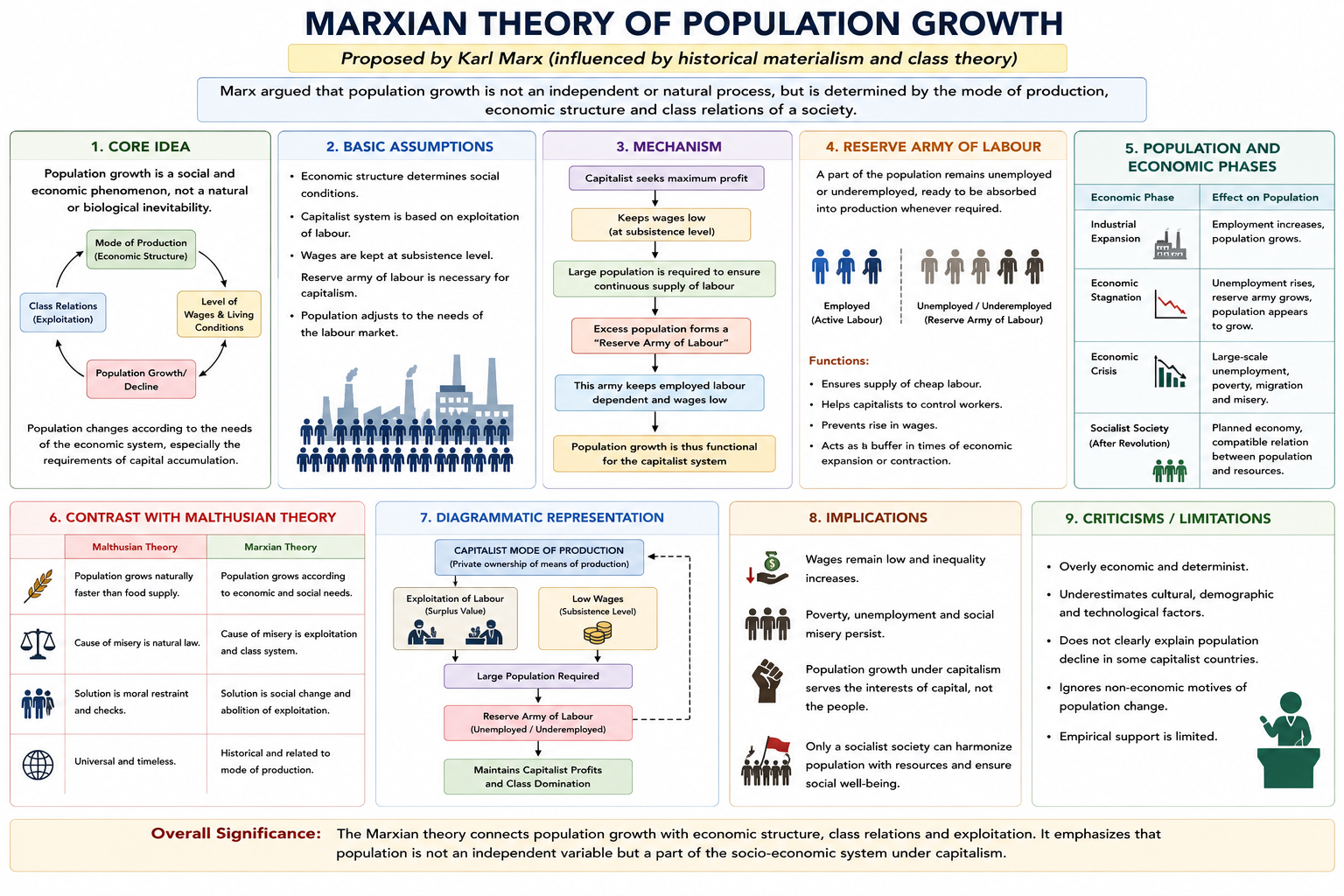
- The Marxian theory of population growth is an important critique of the Malthusian theory. Unlike Malthus, Karl Marx did not write a separate and formal theory of population. His ideas on population are derived from his larger theory of capitalism, class struggle, surplus value and historical materialism.
- Malthus argued that poverty, hunger and misery arise because population grows faster than food supply. Marx rejected this view. According to Marx, poverty and unemployment are not caused by natural population growth but by the capitalist mode of production, unequal distribution of wealth and exploitation of labour.
- In simple words:
- Malthus: Poverty is caused by overpopulation.
- Marx: Poverty is caused by capitalism and unequal distribution.
- Thus, Marxian population theory is not a biological theory of fertility. It is a socio-economic theory of population, unemployment and poverty.
Background: Debate With Malthus
- The debate on population became very important after Malthus published An Essay on the Principle of Population in 1798. Malthus argued that population increases geometrically while food supply increases arithmetically. Therefore, unchecked population growth produces famine, disease, poverty and misery.
- Many economists, including J. S. Mill and J. M. Keynes in different ways acknowledged the importance of Malthusian concerns. However, socialists and sociologists strongly criticised Malthus. They argued that the poverty of workers was not caused by an eternal law of nature but by the defective organisation of society.
- Karl Marx went further. He argued that starvation, poverty and unemployment are products of:
- Unequal distribution of wealth
- Exploitation of labour
- Private ownership of means of production
- Capitalist accumulation
- Technological displacement of workers
- Creation of an industrial reserve army
- For Marx, the population problem is not a natural problem. It is a historical and social problem created by a specific economic system.
Karl Marx: Brief Profile
- Karl Marx lived from 1818 to 1883. He was a German philosopher, economist, historian, sociologist and revolutionary thinker. He is regarded as the father of modern communism.
- His major works include:
- The Communist Manifesto (1848), written with Friedrich Engels
- Das Kapital, Volume I (1867)
- Critique of Political Economy
- Critique of the Gotha Programme
- Marx did not produce an independent demographic theory like Malthus. His population ideas are found mainly in his discussion of capital accumulation, surplus value, unemployment and relative surplus population in Das Kapital.
Theoretical Foundation of Marxian Population Thought
Marx’s theory of population is based on his broader interpretation of society and history.
1. Historical Materialism
- Marx believed that the history of society is shaped by material conditions, especially the mode of production. The way people produce goods determines social relations, class structure, politics and ideology.
- Mode of production -> Class relations -> Social structure -> Population condition
- Therefore, population cannot be understood separately from the economic system.
2. Class Struggle
- According to Marx, capitalist society is divided into two main classes:
- Bourgeoisie
- Proletariat
- The bourgeoisie earns profit by exploiting the labour of the proletariat.
| Class | Meaning |
|---|---|
| Bourgeoisie | Owners of means of production, such as factories, machines, land and capital |
| Proletariat | Workers who do not own means of production and sell their labour power for wages |
3. Surplus Value
- Surplus value is the core of Marxian economics. Workers produce more value than they receive as wages. The difference between the value produced by labour and the wage paid to labour is appropriated by the capitalist as profit.
- Value produced by worker – Wage paid to worker = Surplus value
- This exploitation is central to the Marxian explanation of poverty and unemployment.
Core Idea of Marxian Theory of Population
- Marx rejected the idea that population growth naturally causes poverty. According to him, every mode of production has its own law of population.
- This means:
- Feudal society has one population pattern.
- Capitalist society has another population pattern.
- Socialist society would have a different population pattern.
- There is no universal law of population applicable to all societies at all times. Therefore, Marx rejected Malthus’s claim that population pressure is a natural and eternal law.
- The Marxian view may be summarized as:
- Population problem is not biological. The population problem is socio-economic.
- For Marx, unemployment and poverty are not caused by too many people. They are caused by the capitalist system, which produces a surplus population for its own benefit.
Theory of Surplus Population
- Marx’s population theory is also called the Theory of Surplus Population or the theory of Relative Surplus Population.
- Surplus population does not mean that there are absolutely too many people in relation to food. It means that there are more workers than capitalists are willing to employ at a given wage and under a given organisation of production.
- Thus, surplus population is relative to the needs of capital.
- Surplus population = Labour force not absorbed by capitalist production
- For example, a country may have enough food, resources and productive capacity, yet millions may remain unemployed because the capitalist system does not employ labour unless it is profitable.
- This is why Marx called surplus population a product of capitalist accumulation.
Industrial Reserve Army of Labour
- The most important Marxian concept related to population is the industrial reserve army of labour.
- It refers to the unemployed or underemployed workers who are available for work but not regularly employed. This reserve army is useful for capitalists because it keeps wages low and provides labour whenever capital expands.
- Capital accumulation -> Mechanization -> Labour displacement -> Unemployment -> Reserve army of labour -> Wage suppression -> Higher surplus value
- According to Marx, capitalism creates unemployment not by accident but as a normal feature of its functioning.
Functions of Reserve Army
- The reserve army performs several functions for capitalism:
- Keeps wages low
- Unemployed workers compete with employed workers, reducing workers’ bargaining power.
- Provides flexible labour
- During expansion, industries can quickly hire workers from the reserve army.
- Disciplines employed workers
- Fear of unemployment forces workers to accept low wages and poor working conditions.
- Supports capital accumulation
- Low wages and high exploitation increase surplus value.
- Maintains class domination
- Workers remain dependent on capitalists for livelihood.
- Keeps wages low
- Thus, for Marx, unemployment is not simply a demographic condition; it is a structural requirement of capitalism.
Forms of Surplus Population
- Marx identified different forms of relative surplus population. These categories are useful in modern geography also because they explain rural-urban migration, informal labour, unemployment and regional inequality.
- Floating Surplus Population
- This includes workers who are temporarily unemployed due to changes in industrial demand, business cycles, mechanization or closure of factories.
- Example:
- Factory workers laid off during recession
- Construction workers unemployed after project completion
- Gig workers without regular work
- Latent Surplus Population
- This refers to workers who are not yet fully part of the industrial labour force but may be drawn into it when needed. Marx particularly associated this with rural populations displaced by capitalist agriculture.
- Example:
- Rural workers moving to cities in search of work
- Agricultural labourers becoming industrial or construction workers
- Women entering the labour market due to household economic pressure
- Stagnant Surplus Population
- This includes irregularly employed, underemployed and poorly paid workers. They are part of the labour force but live in unstable conditions.
- Example:
- Casual labourers
- Street vendors
- Domestic workers
- Informal-sector workers
- Seasonal migrants
- Pauperized Population
- This includes the most vulnerable sections who are unable to participate regularly in production.
- Example:
- Destitute people
- Beggars
- Disabled poor
- Homeless population
- Chronically unemployed workers
- These categories show that Marx’s theory is not only about population growth but also about the structure of employment and social inequality.
Marxian Theory of Population Growth: Mechanism
- Marx’s argument may be explained through the following sequence:
- Step 1: Capitalist owns means of production
- Factories, machines, land, raw material and capital are owned by the capitalist class.
- Step 2: Worker sells labour power
- The worker has no independent means of production and must sell labour power in exchange for wages.
- Step 3: Capitalist extracts surplus value
- The worker produces more value than the wage received. The extra value becomes profit for the capitalist.
- Step 4: Capitalist introduces machines
- To increase profit, the capitalist introduces labour-saving technology and mechanization.
- Step 5: Workers become unemployed
- Machines reduce the demand for labour. A portion of workers becomes unemployed or underemployed.
- Step 6: Surplus population emerges
- This unemployed labour force becomes the reserve army of labour.
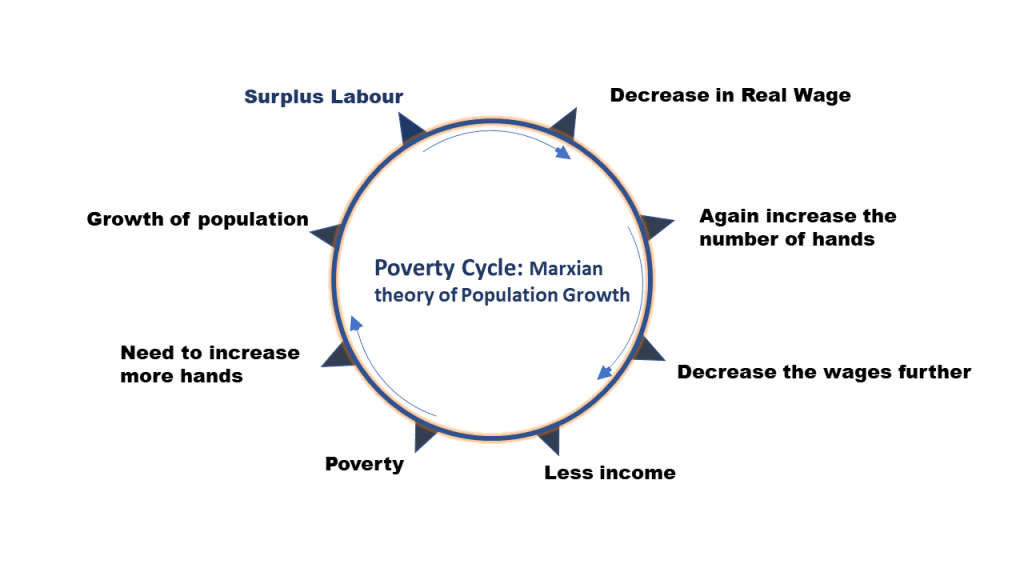
- Step 7: Wages fall
- Because many workers are available for limited jobs, wages remain low.
- Step 8: Poverty increases
- Low wages, unemployment and exploitation create poverty and misery.
- Step 9: Capitalism blames population
- The system presents poverty as a population problem, while Marx argues that it is actually a class and distribution problem.
- Step 1: Capitalist owns means of production
- Capitalism -> Exploitation -> Mechanization -> Unemployment -> Reserve army -> Low wages -> Poverty
Marxian Critique of Malthus
- Marx strongly criticised the Malthusian theory. His objections may be summarised as follows:
- Poverty Is Not Natural
- Malthus considered poverty and misery as natural results of population pressure. Marx argued that poverty is produced by social and economic organization.
- No Universal Law of Population
- Malthus proposed a universal law of population. Marx argued that every historical mode of production has its own population law.
- Food Scarcity Is Not the Main Cause
- Malthus focused on food scarcity. Marx focused on unequal distribution and capitalist ownership.
- Workers Are Producers, Not Mere Consumers
- Malthus saw population mainly as mouths to be fed. Marx saw workers as producers of wealth whose labour is exploited.
- Capitalism Creates Artificial Scarcity
- Marx argued that capitalism can create poverty even in the presence of abundance because production is organized for profit, not need.
- Unemployment Is Structural
- For Malthus, unemployment and poverty result from excess population. For Marx, unemployment is created and maintained by capitalism as a reserve army of labour.
- Population Control Is Not the Main Solution
- Malthus supported moral restraint. Marx argued that the real solution lies in transforming the economic system and ending exploitation.
- Poverty Is Not Natural
Marxian Theory as a Socio-Economic Model
- Marxian population theory may be called a socio-economic model of population because it explains population conditions through:
- Class relations
- Ownership of resources
- Distribution of wealth
- Labour exploitation
- Capital accumulation
- Technological change
- Employment structure
- Poverty and inequality
- It does not treat population growth as an independent biological variable. Instead, it treats fertility, mortality, migration and unemployment as products of social and economic organization.
- For Marx, in a socialist society, reproductive behaviour would become more harmonious because production would be organized for social need rather than private profit.
Geographical Interpretation
- Marxian population theory is significant for geography because population problems are spatially expressed through unemployment, poverty, migration, slums, informal settlements and regional inequality.
- Population and Economic Structure
- Marxian theory helps geographers understand that population pressure is not merely numerical. A region may appear overpopulated because its economic structure fails to provide employment and equitable access to resources.
- Rural-Urban Migration
- Capitalist agriculture and rural poverty push people out of villages. Industrial and urban centres pull them as cheap labour. This produces migration streams and urban informal settlements.
- Rural dispossession -> Migration -> Informal labour -> Urban poverty
- Capitalist agriculture and rural poverty push people out of villages. Industrial and urban centres pull them as cheap labour. This produces migration streams and urban informal settlements.
- Urban Slums
- Slums can be interpreted as spatial expressions of surplus population. People are not necessarily surplus in biological terms; they are surplus to formal capitalist employment.
- Regional Inequality
- Capitalist investment is uneven. Some regions become centres of accumulation, while others become labour-supplying peripheries.
- Example:
- Industrial regions attract capital and labour.
- Backward agrarian regions supply migrant workers.
- Informal Sector
- The informal sector represents a modern form of stagnant surplus population. Workers remain economically active but lack security, regular wages and social protection.
- Population and Economic Structure
Indian Examples:
- Rural Labour Surplus
- In many parts of India, land fragmentation, disguised unemployment and low agricultural productivity create a latent surplus population. These workers migrate seasonally to cities.
- Informal Urban Labour
- A large share of India’s urban labour force works in informal jobs such as construction, domestic work, street vending, transport, delivery services and small manufacturing. This reflects the stagnant surplus population described by Marx.
- Migrant Workers During COVID-19
- The reverse migration of workers during the COVID-19 lockdown exposed the vulnerability of India’s reserve army of labour. Millions of workers were essential to urban production but lacked secure employment, housing and social protection.
- Mechanization in Agriculture
- Mechanization reduces demand for agricultural labour in some regions, forcing labourers to seek work in construction, services and informal urban sectors.
- Gig Economy
- Platform-based delivery and ride-hailing workers represent a contemporary form of flexible labour. They are employed when needed but lack traditional employment security. This has similarities with the Marxian idea of a reserve army and precarious labour.
- Regional Labour Flows
- Migration from Bihar, eastern Uttar Pradesh, Odisha, Jharkhand and Rajasthan to Delhi NCR, Punjab, Maharashtra, Gujarat and southern cities reflects uneven development and spatial movement of surplus labour.
Applicability of Marxian Theory
Applicability to Capitalist Societies
- The theory is most applicable to capitalist societies where private ownership, wage labour, profit maximization and class inequality are dominant.
- It explains:
- Labour exploitation
- Wage suppression
- Unemployment
- Informalization
- Economic inequality
- Uneven regional development
Applicability to Developing Countries
- Marxian theory has strong relevance in developing countries because many of them show:
- High inequality
- Surplus labour
- Informal employment
- Rural-urban migration
- Slums and squatter settlements
- Regional imbalance
- Low wages
- Weak labour rights
- However, not all population problems in developing countries can be explained only by capitalism. Fertility behaviour, culture, religion, patriarchy, health care, education and state policy also matter.
Applicability to Socialist Societies
- Marx believed that under socialism, population problems would be resolved through social ownership and equitable distribution. However, historical socialist countries also adopted family planning and population policies.
- This shows that population management may be required even in non-capitalist systems.
Contemporary Relevance
- Marxian theory remains relevant in the age of:
- Automation
- Artificial intelligence
- Gig economy
- Contract labour
- Informalization
- Global supply chains
- Labour migration
- Urban inequality
- Platform capitalism
- Today, labour-saving technology can increase production while reducing secure employment. This resembles Marx’s argument that technological progress under capitalism may create surplus labour.
Criticism of Marxian Theory
Marxian theory has also been criticized on several grounds.
Too Much Emphasis on Capitalism
- Marx explained population problems mainly through capitalism. But population growth and poverty may also occur in non-capitalist societies.
Neglect of Biological and Demographic Factors
- Marx did not give sufficient attention to fertility, mortality, age structure, marriage patterns and reproductive behaviour.
Economic Determinism
- The theory gives primary importance to economic structure. Critics argue that religion, culture, education, gender norms and family values also shape population growth.
Population Growth Does Not Always Reduce Wages
- An increase in population does not necessarily reduce wages. If economic growth, education and skill development are strong, a large population can become productive human capital.
Socialist Countries Also Needed Population Control
- Marx believed that socialism would resolve population problems. But even socialist and communist countries adopted family planning, contraception and birth-control policies.
Technology Can Create Jobs Also
- Marx emphasized labour displacement by machines. However, technology can also create new sectors, jobs and skills.
Class Analysis Is Not Enough
- Modern population issues also involve gender, caste, ethnicity, environment, state policy and global geopolitics. Class is important, but it is not the only factor.
Underestimates Individual Agency
- Fertility decisions are influenced by aspirations, education, health, women empowerment and family preferences. These cannot be reduced entirely to capitalist exploitation.
Merits of Marxian Theory
- Despite criticism, the Marxian theory has several strengths.
- It exposes inequality
- It shows that poverty may exist even where resources are sufficient.
- It highlights distribution
- Food and wealth distribution are as important as production.
- It explains unemployment structurally
- Unemployment is not merely an individual failure but may be produced by the economic system.
- It connects population with class
- It explains how labouring populations are shaped by class relations.
- It is relevant to migration
- Rural-urban migration and informal labour can be explained through surplus population.
- It supports welfare and labour rights
- It emphasizes social justice, equitable distribution and protection of workers.
- It is useful for urban geography
- Slums, informal settlements and precarious labour can be analysed through Marxian concepts.
- It exposes inequality
Comparison Between Malthusian and Marxian Theories
| Basis | Malthusian Theory | Marxian Theory |
|---|---|---|
| Main thinker | Thomas Robert Malthus | Karl Marx |
| Nature | Biological and resource-based | Socio-economic and class-based |
| Main cause of poverty | Overpopulation | Capitalist exploitation and unequal distribution |
| Population law | Universal law | Historically specific law |
| View of workers | Consumers of food | Producers of value |
| Food scarcity | Central problem | Distribution and ownership are central |
| Unemployment | Result of excess population | Product of capitalism and reserve army |
| Solution | Moral restraint, late marriage, population control | End exploitation, social ownership, distributive justice |
| Attitude | Pessimistic and deterministic | Revolutionary and structural |
| Relevance | Resource pressure and carrying capacity | Inequality, unemployment, labour migration and informalization |
Marxian Theory and Demographic Transition Theory
Marxian theory and Demographic Transition Theory explain population change differently.
| Basis | Marxian Theory | Demographic Transition Theory |
|---|---|---|
| Focus | Class, capitalism, unemployment | Birth rate and death rate |
| Method | Political economy | Demographic-historical model |
| Main variable | Mode of production | Modernization |
| Problem explained | Surplus population and poverty | Population growth and decline |
| Solution | Structural transformation | Development, education, health, urbanization |
| Limitation | Less demographic detail | Less attention to class and inequality |
Both are useful in Geography Optional. Demographic Transition Theory explains fertility and mortality trends, while Marxian theory explains inequality, labour surplus and capitalist spatial development.
Marxian Theory and Sustainable Development
- Marxian theory is also relevant to sustainable development because it questions the organization of production and consumption.
- Modern ecological Marxists argue that capitalism creates a “metabolic rift” between society and nature by exploiting both labour and environment.
- In population geography, this means that environmental crisis is not caused only by the number of people, but also by:
- Unequal consumption
- Profit-driven production
- Wasteful resource use
- Corporate control over resources
- Displacement of communities
- Unequal ecological burden
- Thus, Marxian theory shifts the question from:
- How many people are there?
- to:
- Who controls resources, who consumes them, and who suffers the consequences?
- This is highly relevant for questions on climate justice, food security, urban inequality and resource conflicts.





 History Optional PYQ Master Pack: Topic-wise Model Answers (1985–2025) by LotusArise IAS
thanks for it
This is bullshit and marxist ideology will NOT be tolerated in the US. Marxists will be eliminated, and that’s a worthwhile population control!
gambheeram mwona
Let’s keep the discussion focused on the academic analysis of geographic and demographic theories. Diverse perspectives are welcome, but threats and violent rhetoric are not.