

- The Marxian theory of population holds that poverty and unemployment arise not from too many people but from the capitalist mode of production, which creates a relative surplus population for its own needs.
- Karl Marx (1818–1883) wrote no separate theory of population. His ideas come from his wider analysis of capitalism, above all in Capital, Volume I (1867).
- It stands as the main critique of the Malthusian theory. Thomas Robert Malthus says poverty is caused by overpopulation; Marx says apparent overpopulation is caused by capitalism.
- It is therefore not a biological theory of fertility but a socio-economic theory of population, unemployment and poverty, also known as the theory of surplus population.
The Theory

Background: The Debate With Malthus
- After 1798 the debate on population spread widely. John Stuart Mill and John Maynard Keynes, in different ways, took Malthus’s concerns seriously. Socialists and many sociologists held that the misery of workers came from the organisation of society, not an eternal law of nature.
- Friedrich Engels (1844) struck first, in Outlines of a Critique of Political Economy.
- He called Malthus’s doctrine a “vile, infamous theory”.
- He answered the food ratio directly: science grows at least as fast as population, so the productive power of land has no such fixed limit.
- Marx went further and turned the question round. Starvation and unemployment were products of:
- unequal distribution of wealth;
- exploitation of labour;
- private ownership of the means of production;
- capital accumulation and the displacement of workers by machines.
- Marx’s attack on the iron law of wages in the Critique of the Gotha Programme (1875) kept to the same line. If Malthus were right, poverty would govern every social system and socialism could not abolish it.
- Marx’s chief works are The Communist Manifesto (1848, with Engels), A Contribution to the Critique of Political Economy (1859), Capital, Volume I (1867) and the Critique of the Gotha Programme. The population argument sits in chapter 25 of Capital, “The General Law of Capitalist Accumulation”.
Theoretical Foundations
- Historical materialism: history is moved by changes in the mode of production, the set of productive forces (labour, tools, materials) and the social relations in which they are used.
- Mode of production shapes class relations, which shape the social structure and the condition of the population.
- Societies moved from hunting and herding through settled farming to industry, and each had its own demography.
- Class struggle: capitalist society divides into two main classes with opposed interests.
| Class | Position | Income |
|---|---|---|
| Bourgeoisie | Owns factories, machines, land and capital | Profit from surplus value |
| Proletariat | Owns only its labour power and must sell it | Wages near subsistence |
- The owner hires and fires at will and judges the worker’s usefulness, while the worker, having no other means of life, cannot refuse the terms. Marx saw this as the relation of exploiter and exploited.
- Surplus value: workers produce more value than they receive as wages.
- Value produced by the worker minus the wage paid equals surplus value, which the capitalist keeps as profit and reinvests.
The Core Idea: No Universal Law of Population
- Marx’s key claim: “every special historic mode of production has its own special laws of population.” An abstract law, he added, holds only for plants and animals, so far as humans have not interfered.
- So population behaves differently in nomadic, feudal, industrial and (he expected) socialist societies.
- Growth among nomads differs from that among settled cultivators, and an urban-industrial society differs from an agrarian one.
- Malthus’s “natural law” is thus a false generalisation of one historical condition. For Marx, the population problem is social and not biological.
Relative Surplus Population
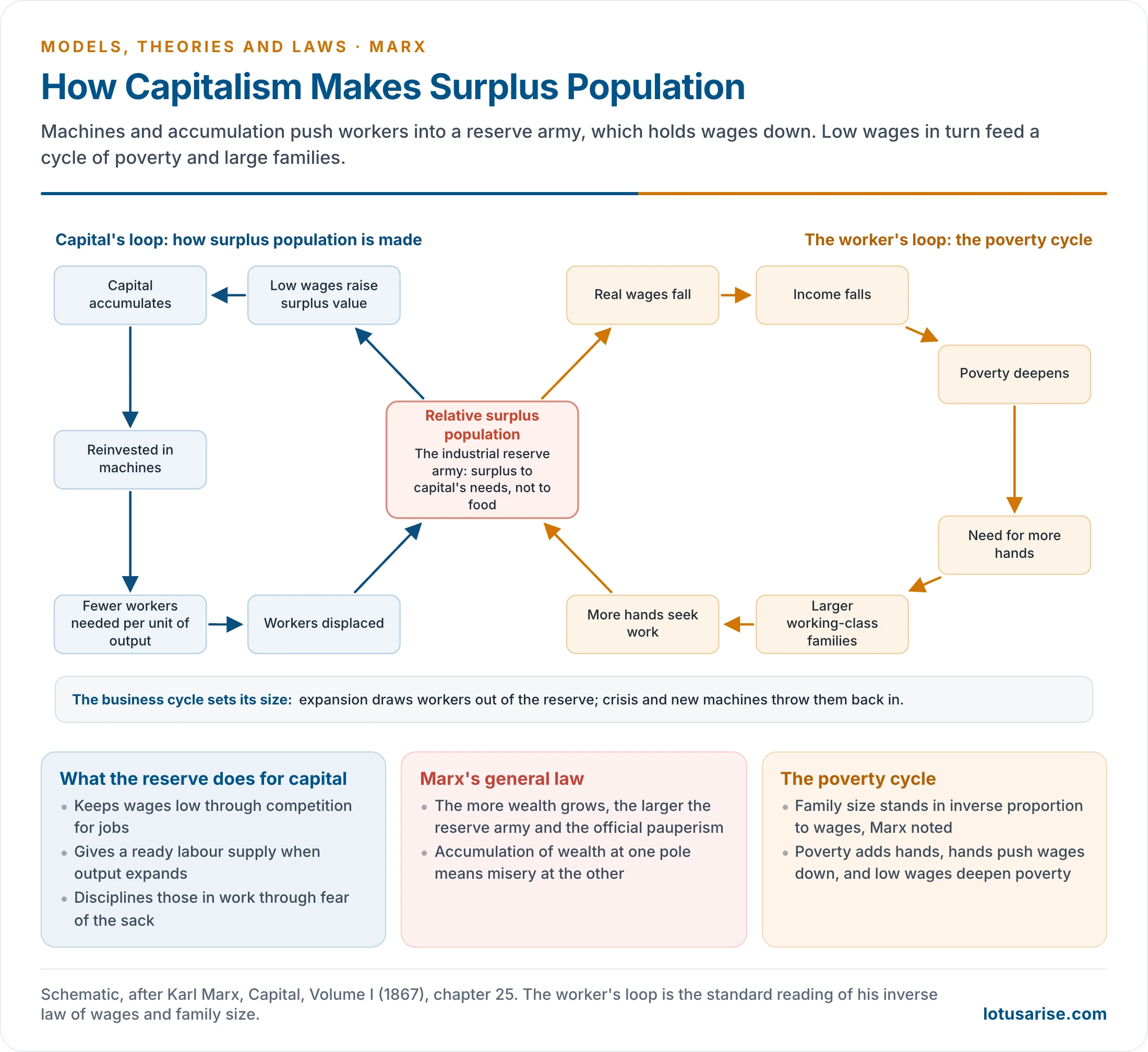
- Surplus population does not mean too many people for the available food. It means more workers than capital wishes to employ at a given wage and under a given organisation of production.
- A country can have enough food and productive capacity and still have millions unemployed, because labour is hired only when it is profitable.
- How it arises:
- Competition forces capitalists to invest in machinery. Constant capital (machines, materials) grows faster than variable capital (wages), so the organic composition of capital rises.
- The demand for labour falls relative to total capital, even as the number of workers grows.
- In Marx’s words, the working population itself produces the means by which it is made relatively superfluous.
The Industrial Reserve Army
- The industrial reserve army of labour is the mass of unemployed and underemployed workers available to capital whenever it needs them. It is a normal feature of capitalism, not an accident.
- Its functions for capital:
- Keeps wages low: the unemployed compete with those in work, weakening their bargaining power. Marx held that general wage movements are regulated by the expansion and contraction of this reserve.
- Gives a flexible supply: expanding industries can hire at once, and shed labour in a slump.
- Disciplines workers: fear of the sack forces acceptance of poor pay and conditions.
- Supports accumulation: low wages raise surplus value.
- Maintains class domination: workers remain dependent on capital for a livelihood.
- The absolute general law: the greater social wealth and capital, the larger the reserve army and official pauperism. Wealth accumulates at one pole and misery at the other.
- The reserve grows and shrinks with the business cycle. Expansion draws workers out of it and crisis throws them back, so the supply of labour tends to run ahead of jobs under capitalism.
- A mainstream parallel: W. Arthur Lewis (1954) described “unlimited supplies of labour” in farm-heavy economies, which keep industrial wages low. He read it as a stage of development, whereas Marx read it as a condition that capitalism itself reproduces.
The Mechanism Step by Step
- The capitalist owns the factories, machines, land, materials and capital.
- The worker sells labour power, having no independent means of production.
- Surplus value is extracted: the worker produces more than the wage received.
- Machines are introduced to raise profit and meet competition.
- Workers are displaced, and some become unemployed or underemployed.
- A surplus population emerges as the reserve army.
- Wages are held down, since many workers chase limited jobs.
- Poverty deepens through low wages and insecurity.
- Population is blamed: the system presents a class and distribution problem as a population problem.
The Poverty Cycle
- Marx also tied the working family to this process. Among the most irregularly employed, he observed, births, deaths and the absolute size of families stand in inverse proportion to wages.
- This produces a vicious circle on the worker’s side:
- Surplus labour pushes real wages down, and low income deepens poverty.
- Poor households need more hands to earn, so families stay large.
- The poor grow fastest, adding to surplus labour and pushing wages down again.
- Fertility is therefore a result of class position and not an independent cause. Under a socialist order, he expected, reproductive behaviour would come into harmony with social needs.
Forms of the Surplus Population
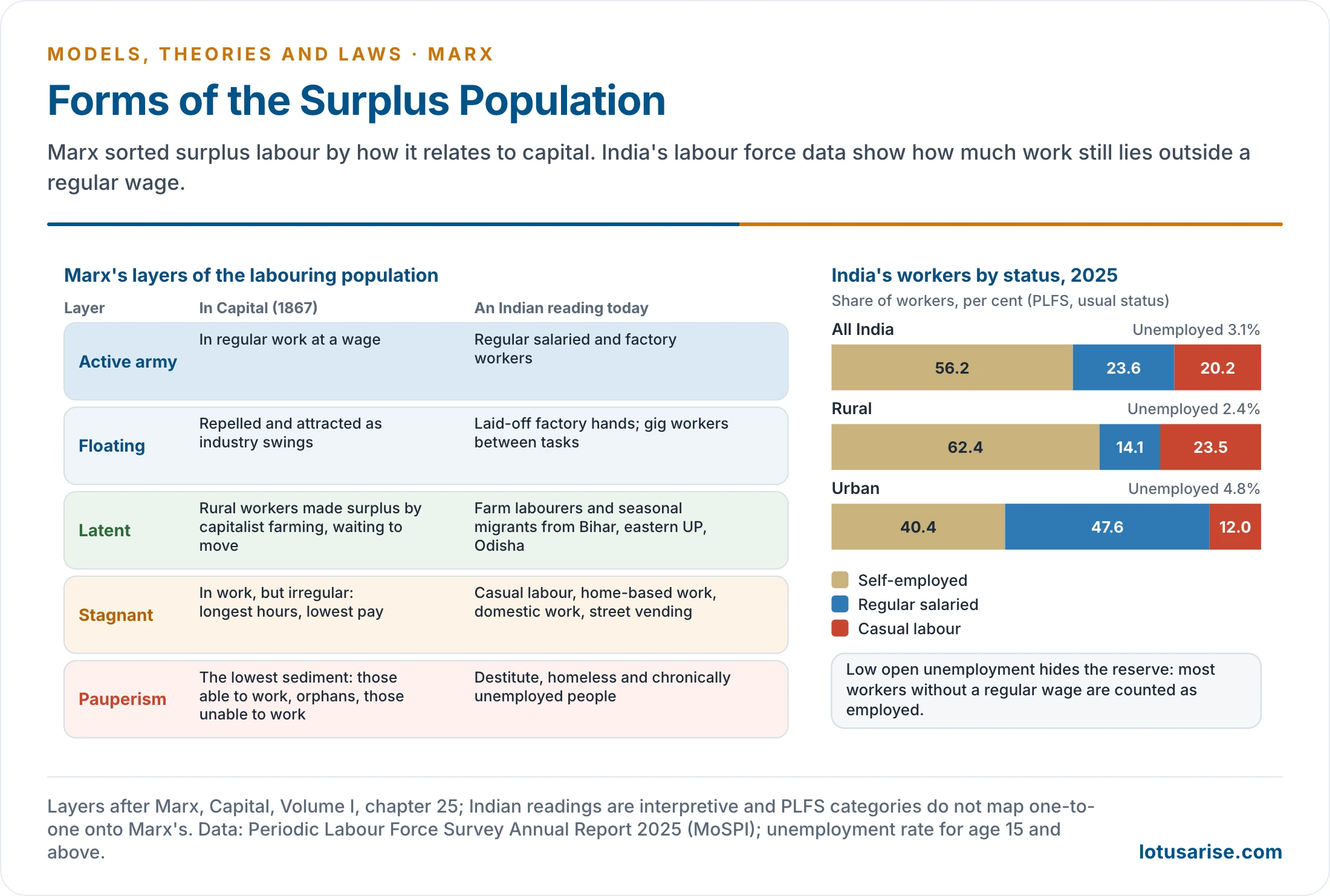
| Form | Marx’s meaning | Indian reading today |
|---|---|---|
| Floating | Workers repelled and attracted as industry swings | Laid-off factory hands; construction workers between projects; gig workers without steady tasks |
| Latent | Rural labour made surplus as capital enters farming, ready to move to towns | Disguised unemployment on small farms; seasonal migrants; women drawn into work by household need |
| Stagnant | Part of the active army, but irregular: longest hours, lowest pay | Casual labourers, home-based workers, domestic workers, street vendors |
| Pauperism | The lowest sediment: those able to work, orphans and pauper children, and those unable to work | Destitute, homeless and chronically unemployed people |
- These categories show that the theory concerns the structure of employment and inequality, not simply growth of numbers.
The Critique of Malthus
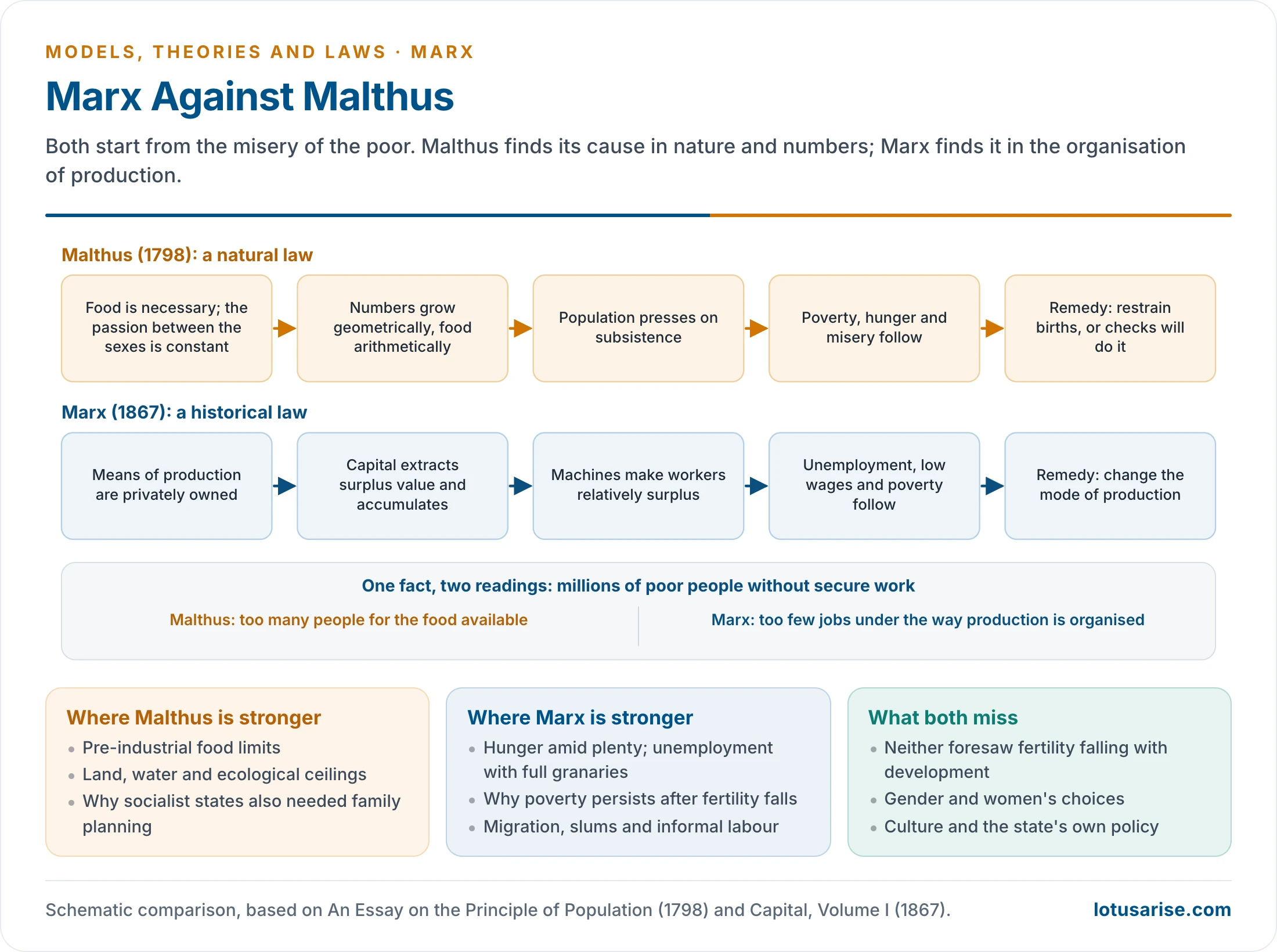
- Poverty is made, not natural. It is produced by social and economic organisation.
- There is no universal law. Each mode of production has its own population law.
- Food scarcity is not the main cause. Unequal distribution and ownership are.
- Workers are producers, not mouths. They create the wealth that is taken from them.
- Capitalism can create scarcity amid abundance, since production is organised for profit rather than need.
- Unemployment is structural. It is created and maintained as a reserve army.
- Population control is not the main remedy. Moral restraint leaves exploitation in place, and the real solution is to change the economic system.
A Socio-Economic Model
- The theory explains population through class relations, ownership, distribution, exploitation, accumulation, technology, employment and inequality.
- It treats fertility, mortality, migration and unemployment as products of social organisation, not independent biological variables.
- It links five things that are usually studied apart: capital accumulation, demand for labour, surplus population, wage levels and the standard of living.
Geography of the Surplus Population
Geographical Interpretation
- Population and economic structure: pressure is not only numerical. A region may look overpopulated because its economy fails to provide jobs and fair access to resources.
- Rural-urban migration: capitalist farming and rural poverty push people out of villages, while industrial and urban centres pull them in as cheap labour. Rural dispossession leads to migration, informal work and urban poverty.
- Urban slums can be read as the spatial form of surplus population: people surplus not to food but to formal employment.
- Regional inequality: capital investment is uneven. Some regions become centres of accumulation and others labour-supplying peripheries.
- The informal sector is a modern form of the stagnant surplus: economically active, but without security, regular wages or social protection.
- These ideas later fed the radical approach in geography, including David Harvey’s work on uneven development.
Indian Evidence
- Low open unemployment, much insecure work (PLFS 2025):
- The unemployment rate was only 3.1%, but 56.2% of workers were self-employed and 20.2% casual labour. Just 23.6% had a regular wage or salary.
- Youth unemployment was 9.9%, and 13.6% among urban youth. A quarter of people aged 15–29 were not in employment, education or training.
- Female labour force participation was 40.0% against 79.1% for men, which suggests a large latent reserve.
- Migrant workers in the 2020 lockdown: official figures counted about 1.04 crore workers returning home, 32 lakh of them to Uttar Pradesh and 15 lakh to Bihar. Essential to urban production, they had no secure work, housing or protection. That is the reserve army made visible.
- Regional labour flows: migration from Bihar, eastern Uttar Pradesh, Odisha, Jharkhand and Rajasthan to Delhi NCR, Punjab, Maharashtra, Gujarat and the southern cities reflects uneven development.
- Rural labour surplus: land fragmentation, disguised unemployment and farm mechanisation press labourers towards construction, services and informal urban work.
- Gig work:
- NITI Aayog put gig workers at 77 lakh in 2020–21 and projects 2.35 crore by 2029–30. Delivery and ride-hailing workers are hired by the task, with little security.
- The Code on Social Security, 2020, in force from 21 November 2025, recognises gig and platform workers for the first time, which is a partial answer to such precarity.
- Coverage remains thin: about 5.12 lakh platform workers had registered on the e-Shram portal by December 2025.
- Regional and caste segmentation: the reserve is not uniform. Dalit and Adivasi households, women and migrants are concentrated in its most insecure layers, which adds social hierarchy to the class analysis.
Evaluation
Applicability
- Taken as a whole, the theory explains labour exploitation, wage suppression, unemployment, informalisation, inequality and uneven regional development better than it explains birth rates.
| Setting | Fit | Reason |
|---|---|---|
| Capitalist societies | Strong | Private ownership, wage labour, profit motive, wage pressure, informalisation and uneven regional development |
| Developing countries | Strong but partial | Inequality, surplus labour, slums and weak labour rights fit, yet fertility also reflects culture, patriarchy, health and education |
| Socialist states | Weak | Family planning and pro-natal policy were both needed |
| Feudal or hunter-gatherer societies | Not designed for them | The analysis is of capitalism; other modes have other laws |
The Record of Socialist States
- Marxist states rejected Malthus in doctrine, yet managed population heavily in practice.
- Soviet Union: abortion was legalised in 1920 and banned in 1936, with pro-natal awards such as Mother Heroine (1944) for ten or more children. It was legalised again in 1955.
- China:
- Ma Yinchu’s warning on population (1957) was condemned, and numbers were at first treated as a strength.
- The state then swung to the one-child policy from 1979, later relaxed to two children (2016) and three (2021).
- The population has now fallen for four years, to 1.405 billion in 2025, with only 7.92 million births.
- Romania: Decree 770 of 1966 banned most abortions. Fertility almost doubled at first and then fell back.
- What this shows: ending private ownership did not end population questions. It also shows that state power can coerce fertility in either direction.
Contemporary Relevance
- Automation and artificial intelligence: labour-saving technology can raise output while reducing secure jobs. The ILO and NASK (2025) find 25% of world employment potentially exposed to generative AI, though they expect transformation more than replacement.
- Platform capitalism and contract labour fit the idea of flexible labour available on call.
- Global supply chains and labour migration spread the reserve army across borders, as capital moves to low-wage regions.
- Inequality: poverty alongside rising output keeps the distribution question alive.
Criticism
- Too much rests on capitalism. Population growth and poverty also occur in non-capitalist societies.
- Demography is neglected. Fertility, mortality, age structure and marriage patterns get little attention. Rapid twentieth-century growth came chiefly from falling death rates through medicine, not from low wages.
- Economic determinism. Religion, culture, education, gender norms, family values and the physical environment also shape growth. Prosperous religious groups, such as Israel’s Haredi community, can have very large families.
- Population growth need not cut wages. Wages depend on many social, political and economic factors. With education and growth, more people can become productive human capital.
- Socialist states also needed population policy, as their record shows.
- Technology also creates jobs, sectors and skills, as well as displacing workers.
- Class is not enough. Gender, caste, ethnicity, environment, state policy and geopolitics matter too.
- Individual agency is underrated. Aspirations, women’s status and health shape fertility. Arsène Dumont (1890) argued that families limit births to climb socially, which he called social capillarity.
- Falling fertility under capitalism weakens the expected link: most capitalist countries now have below-replacement fertility and labour shortages rather than ever-growing numbers.
- Immiseration did not follow in the industrial West. Real wages rose, and unions and welfare states softened the cycle, although he allowed that the law is modified by circumstances.
- It is limited in scope. It rests largely on evidence from capitalist Britain, so a universal model cannot be built from it. Growth in any region reflects physical, socio-cultural and economic conditions together.
Merits
- It exposes inequality, showing that poverty may exist where resources are sufficient.
- It puts distribution alongside production, since access to food and wealth counts as much as output.
- It treats unemployment as structural, not as individual failure.
- It connects population with class, explaining how labouring populations are shaped by their relation to capital.
- It explains migration and informal labour through surplus population.
- It supports welfare and labour rights, social justice and protection for workers.
- It is useful in urban geography for slums, informal settlements and precarious work.
Is Marx’s View More Humanistic?
| Grounds for | Grounds against |
|---|---|
| Does not blame the poor for their poverty | Reduces people to class positions and neglects personal choice |
| Treats workers as producers of wealth rather than excess mouths | States in his name used coercion: Romania, China’s one-child policy |
| Sees misery as changeable by human action, not fixed by nature | Offers revolution rather than reform, and little on women’s reproductive rights |
| Seeks a remedy in justice, not in restraint imposed on the poor | Malthus too began from concern for the poor, and wanted them educated |
- On balance: Marx is more humanistic in his diagnosis and aim, because he moves the blame from the poor to the system and sees people as makers of history. The claim is weaker for the practice of states that claimed his name.
Marx, Malthus and Transition Theory
| Basis | Malthus | Marx |
|---|---|---|
| Cause of poverty | Overpopulation | Exploitation and unequal distribution |
| Law of population | Universal and natural | Specific to each mode of production |
| View of workers | Consumers of food | Producers of value |
| Unemployment | Result of excess population | Product of capitalism and the reserve army |
| Remedy | Moral restraint | Social ownership and distributive justice |
- Transition theory explains the trend in birth and death rates, and Marx explains who benefits and who is left out. A country can enter the low-fertility stages and still have informal labour, regional inequality and urban poverty.
- The three-way comparison of Malthus, Marx and transition theory sets out where each is strongest.
Population, Environment and Sustainability
- Later ecological Marxists argue that capitalism opens a metabolic rift between society and nature, exploiting both labour and environment. The idea is developed in the Marxian view on the environment.
- For population geography, the environmental crisis then comes not from numbers alone but from unequal consumption, profit-driven production, corporate control of resources and displacement of communities.
- The question shifts from “how many people are there?” to “who controls resources, who consumes them and who bears the cost?” That framing runs through debates on climate justice, food security and resource conflict.
Summary
| Category | Details |
|---|---|
| Thinker | Karl Marx (1818–1883), with Friedrich Engels |
| Source | Capital, Volume I (1867), chapter 25 |
| Core claim | Each mode of production has its own law of population |
| Key concepts | Relative surplus population, industrial reserve army, surplus value |
| Forms | Floating, latent, stagnant, pauperism |
| Remedy | End of capitalist ownership and exploitation |
| Main critique | Neglects demography and culture; socialist states needed population policy too |
| Value today | Informal labour, gig work, automation, migration and inequality |





 History Optional PYQ Master Pack: Topic-wise Model Answers (1985–2025) by LotusArise IAS
 History Optional Mains Master Kit 2027 Complete Self-Study System — Notes, Mapping & Premium Articles by LotusArise IAS
thanks for it
This is bullshit and marxist ideology will NOT be tolerated in the US. Marxists will be eliminated, and that’s a worthwhile population control!
gambheeram mwona
Let’s keep the discussion focused on the academic analysis of geographic and demographic theories. Diverse perspectives are welcome, but threats and violent rhetoric are not.