

Demographic Transition Theory

- Demographic Transition Theory explains the relationship between economic development and population growth. It studies how birth rate, death rate and population growth change as a society moves from a rural, agrarian and illiterate stage to an urban, industrial and literate stage.
- Demographic Transition Theory is different from Malthusian and Marxian theories because it is not mainly a theory of crisis or exploitation. It is a historical and empirical model that describes how societies move from high birth rate and high death rate to low birth rate and low death rate through the process of socio-economic development.
- In simple words:
- Traditional society -> High birth rate + High death rate Modern society -> Low birth rate + Low death rate
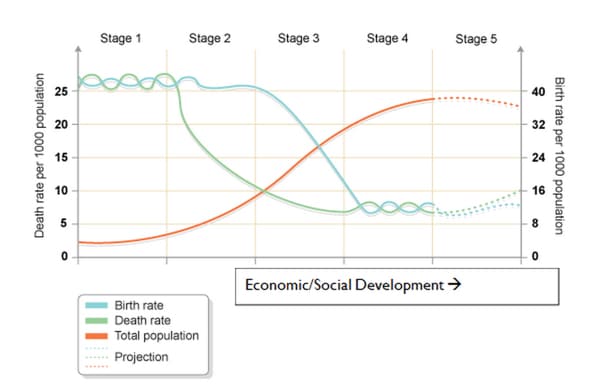
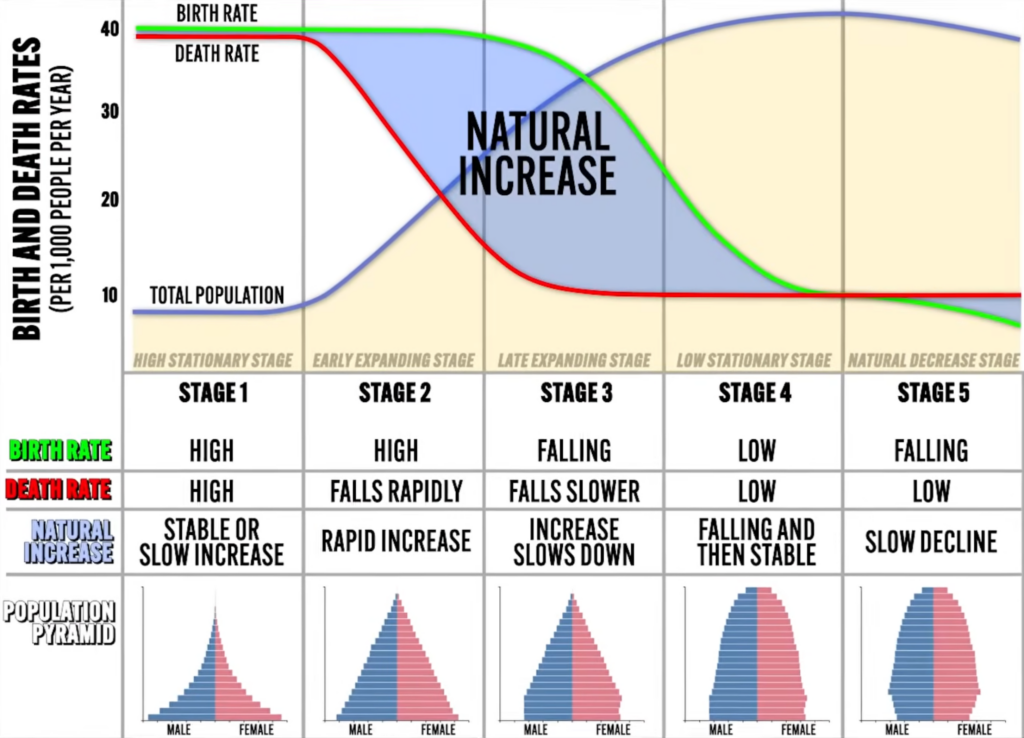
- These changes occur in stages which are collectively known as the demographic cycle. There are four stages of demographic transition related to the state of economic development.
Meaning and Definition
- Demographic transition refers to the shift from a demographic regime of high fertility and high mortality to a demographic regime of low fertility and low mortality.
- According to E. G. Dolan:
- Demographic transition refers to a population cycle that begins with a fall in the death rate, continues with a phase of rapid population growth and concludes with a decline in the birth rate.
- The theory shows that population growth is not constant. It changes with economic development, urbanization, literacy, public health, medical facilities, women empowerment, industrialization and changing social values.
- Thus, demographic transition studies:
- Birth rate
- Death rate
- Natural growth rate
- Fertility decline
- Mortality decline
- Population structure
- Economic and social modernization
Origin and Development
- The term demographic transition was first associated with Warren S. Thompson in 1929. Later, Frank W. Notestein in 1945 gave a more systematic explanation of the theory.
- The theory was based mainly on the demographic experience of European and North American societies, where population change followed a broad historical sequence:
- High birth and death rates in pre-industrial society
- Decline in death rate due to better food, sanitation and medicine
- Decline in birth rate due to modernization and social change
- Stabilization at low birth and death rates
- It should not be treated as a universal law of population growth. It is better understood as an empirical generalisation based on the demographic history of industrialised societies.
Core Argument of the Theory
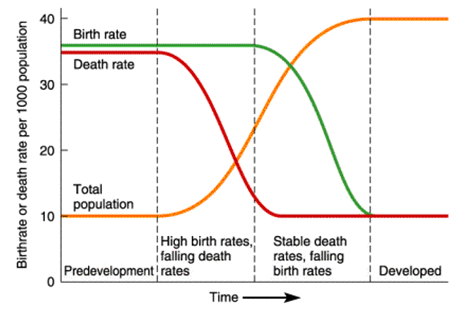
- The theory postulates that as a society develops economically and socially, both mortality and fertility decline, but not at the same time.
- The usual sequence is:
- Death rate declines first.
- Birth rate remains high for some time.
- Population grows rapidly due to the gap between birth and death rates.
- Birth rate later declines.
- Population growth slows down.
- Finally, both birth rate and death rate become low.
- This can be represented as:
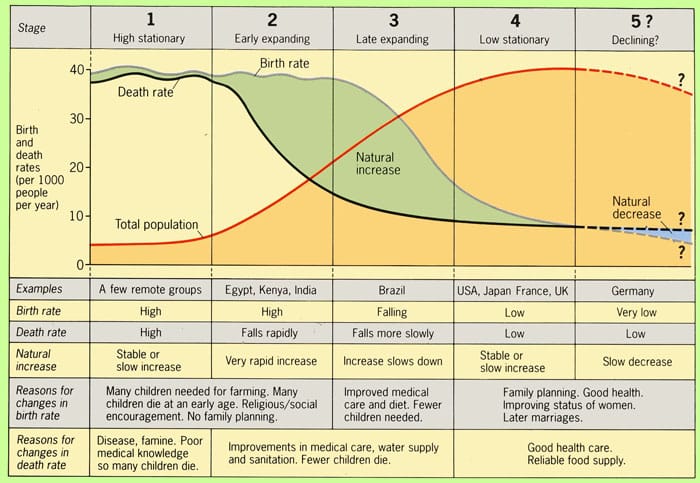
- High BR + High DR -> High BR + Falling DR -> Falling BR + Low DR -> Low BR + Low DR
- Here, BR means birth rate, and DR means death rate.
- High BR + High DR -> High BR + Falling DR -> Falling BR + Low DR -> Low BR + Low DR
Assumptions of Demographic Transition Theory
- The theory is based on the following assumptions:
- Economic development changes demographic behaviour.
- Mortality decline generally precedes fertility decline.
- Industrialization, urbanization and literacy reduce birth rates.
- Better medical facilities, sanitation and nutrition reduce death rates.
- Fertility eventually declines to match low mortality.
- Demographic transformation occurs along with socio-economic transformation.
- Different countries may be at different stages of transition at the same time.
Stages of Demographic Transition
- Although the theory was originally presented in a three-stage form, many scholars use a four-stage or five-stage model.
- Pre-transition stage – High and fluctuating birth and death rates with little population growth.
- Stage I: High birth rates and declining death rates with rapid population growth.
- Stage II: Low birth and death rates with slow population growth.
- Stage III: Birth and death rates both decline appreciably leading to zero population growth. The theory holds that pre-industrial societies were characterized by stable populations that had both a high death rate and birth rate. It postulates a little and slows population growth. The theory states that the high mortality rates characteristic of undeveloped areas will decline before fertility rates which are also high.
Stage I: High Birth Rate and High Death Rate
- Stage I is the pre-transition or pre-industrial stage of demographic transition. In this stage, society is mainly rural, agrarian, traditional and technologically backward. Agriculture is the dominant occupation, and most production is for subsistence rather than market surplus. Because of poor medical facilities, poor sanitation, limited transport, low food security and frequent epidemics, the death rate remains very high.
- At the same time, the birth rate is also very high. Large families are preferred because children are considered economic assets in agriculture, old-age security for parents and a response to high infant and child mortality. Religious beliefs, early marriage, illiteracy and lack of contraception also support high fertility.
- Thus, Stage I is marked by demographic balance at a low level of development. Births are high, but deaths are also high, so the population grows very slowly. Population may even fluctuate due to famine, epidemics, droughts, wars and natural calamities.
Demographic Features
- High birth rate
- High death rate
- Low, stagnant or fluctuating population growth
- High infant mortality
- Low life expectancy
- High fertility rate
- Large number of children
- Very few elderly people
- Expanding population pyramid at the base, but high mortality reduces survival
Socio-Economic Features
- Agriculture is the main occupation.
- Subsistence economy dominates.
- Medical facilities are poor.
- Sanitation and nutrition are weak.
- Epidemics, famines and wars are common.
- Education levels are low.
- Religious and traditional values favour large families.
- Children are considered economic assets in agriculture.
Population Growth
- Population growth is slow because high birth rate is balanced by high death rate.
- High BR – High DR = Low natural increase
Examples
- Two hundred years ago, almost all countries of the world were in this stage. Today, very few societies are fully in Stage I. Some fragile and conflict-affected regions may show Stage I-like features, but most countries have moved beyond it due to medical and public health diffusion.
- Examples often cited in textbooks include parts of least developed countries facing conflict, famine or severe health insecurity.
Interpretation
- Stage I reflects the demographic condition of a traditional agrarian society where human control over death is weak. Population growth is not low because people voluntarily restrict fertility; it is low because mortality is very high.
Stage II: High Birth Rate and Declining Death Rate
- Stage II is the early expanding stage of demographic transition. It is also called the stage of population explosion because death rate declines sharply while birth rate remains high. The decline in death rate is usually the first major demographic change in the transition process.
- This stage begins when society experiences improvements in food supply, sanitation, transport, public health and medical facilities. Vaccination, control of epidemics, clean drinking water and better nutrition reduce mortality, especially infant and child mortality. Famines also become less frequent or less severe because transport and trade improve food distribution.
- However, birth rate does not decline immediately. Social attitudes change slowly. People continue to prefer large families because of tradition, son preference, agricultural labour needs, low female education and limited access to family planning. Hence, the gap between birth rate and death rate becomes very wide.
Demographic Features
- High birth rate
- Rapidly declining death rate
- High natural increase
- Rapid population growth
- Decline in infant mortality
- Rising life expectancy
- Large young population
- Rapidly expanding population pyramid
- High child dependency ratio
Causes of Decline in Death Rate
- Death rate falls due to:
- Better medical facilities
- Vaccination
- Control of epidemics
- Improved sanitation
- Clean drinking water
- Better transport of food
- Improved nutrition
- Public health measures
- Decline in famine mortality
Why Birth Rate Remains High
- Birth rate remains high because:
- Social customs favour large families.
- Children are seen as economic assets.
- Female education is low.
- Contraceptive use is limited.
- Infant mortality decline is not immediately reflected in fertility behaviour.
- Patriarchal values and son preference persist.
Population Growth
- This is the stage of maximum population growth because the gap between birth rate and death rate is wide.
- High BR – Falling DR = Very high natural increase
Examples
- Many Sub-Saharan African countries have experienced Stage II or early Stage III features, where death rates have declined but fertility remains relatively high.
- Historically, many Asian and Latin American countries passed through this stage during the twentieth century when modern medicine reduced deaths before fertility declined.
Interpretation
- Stage II is crucial for understanding rapid population growth in developing countries. It shows that population explosion is not caused only by high birth rate; it is caused by the combination of high birth rate and rapidly falling death rate.
Stage III: Declining Birth Rate and Low Death Rate
- Stage III is the late expanding stage of demographic transition. In this stage, death rate is already low, but birth rate begins to decline significantly. Population continues to grow, but the rate of growth slows down because the gap between birth rate and death rate narrows.
- The decline in birth rate is linked with socio-economic modernization. As society becomes more urban, industrial and literate, the economic value of children changes. In rural agrarian society, children are often seen as workers and old-age support. In urban-industrial society, children become economically costly because of education, health, housing and employment aspirations.
- Female education, women empowerment, delayed marriage, access to contraception and expansion of family planning accelerate fertility decline. Parents begin to prefer a small family with better quality of life rather than a large family with low investment per child.
Demographic Features
- Birth rate declines rapidly
- Death rate remains low
- Population growth slows down
- Fertility rate declines
- Infant mortality declines
- Life expectancy rises
- Share of working-age population increases
- Population pyramid becomes more stationary
- Dependency ratio begins to decline
Causes of Declining Birth Rate
- Birth rate declines due to:
- Urbanization
- Industrialization
- Female education
- Women empowerment
- Higher cost of child-rearing
- Decline in child labour utility
- Expansion of family planning
- Increased age at marriage
- Smaller family norm
- Decline in infant mortality
- Shift from quantity of children to quality of children
Population Growth
- Population still grows, but at a decreasing rate.
- Falling BR – Low DR = Declining natural increase
India and Stage III
- India is generally placed in Stage III or late Stage III of demographic transition. Death rate has declined significantly, life expectancy has improved and fertility has fallen sharply. NFHS-5 reported India’s total fertility rate at 2.0, below replacement level of 2.1.
- However, India continues to experience population growth because of population momentum: a large proportion of people are in reproductive age groups due to earlier high fertility.
Demographic Dividend Link
- Stage III often creates conditions for demographic dividend. As fertility falls, the proportion of children declines and the proportion of working-age population rises. If this working-age population receives education, skills and employment, it can accelerate economic growth.
- Falling fertility -> Lower child dependency -> Larger working-age share -> Demographic dividend
Interpretation
- Stage III is the most important stage for India. It explains why India has falling fertility but still rising absolute population. It also explains why employment generation, skill development, women workforce participation and health investment are crucial for converting demographic change into demographic dividend.
Stage IV: Low Birth Rate and Low Death Rate
- Stage IV is the low stationary stage of demographic transition. In this stage, both birth rate and death rate are low. Population growth becomes very slow, stable or nearly stationary. Society is generally urbanized, industrialized, literate and technologically advanced.
- Death rate remains low because of advanced medical facilities, good nutrition, public health systems, sanitation and high standard of living. Birth rate remains low because family size is deliberately controlled. People prefer fewer children due to high cost of living, higher education costs, women’s employment, individualistic lifestyles and the desire to maintain a better quality of life.
- In this stage, fertility is usually close to or below replacement level. The age structure begins to change: the proportion of children declines and the proportion of elderly population rises. Therefore, the main demographic concern shifts from population explosion to ageing, social security and labour-force balance.
Demographic Features
- Low birth rate
- Low death rate
- Low natural increase
- Stable or slowly increasing population
- High life expectancy
- Low infant mortality
- Fertility near or below replacement level
- High share of elderly population
- Contracting or nearly stationary population pyramid
- Slow population growth or population stabilization
Socio-Economic Features
- Urban-industrial economy
- High literacy
- High income
- Advanced health care
- Strong social security
- Women participation in workforce
- High cost of living
- Individualistic lifestyle
- Preference for small families
Examples
- Many developed countries such as the United States, Canada, France, the United Kingdom and Australia show Stage IV characteristics, though their fertility and population trends differ due to migration and policy.
- Some Indian states such as Kerala, Tamil Nadu and parts of southern and western India show Stage IV-like tendencies because fertility has fallen below replacement level and ageing has become an emerging concern.
Interpretation
- Stage IV shows that development changes the meaning of population problem. The concern is no longer simply “too many people”; it becomes ageing, dependency, labour shortage, pension burden and regional imbalance.
Stage V: Declining Population Stage
- Some scholars add Stage V to explain the demographic condition of very advanced societies where birth rate falls below death rate. This leads to natural decrease in population. In this stage, fertility remains extremely low for a long period, and the population begins to age and shrink.
- Stage V is not part of the classical demographic transition model, but it has become important because several developed countries now face ultra-low fertility and ageing. In such societies, marriage may be delayed, childbearing may be postponed, and many couples may choose to have one child or no child. High cost of housing, career aspirations, work-life imbalance, individualism and gender-role conflicts contribute to fertility decline.
- Unlike Stage II, where the state worries about rapid population growth, Stage V creates the opposite concern: how to maintain workforce size, support the elderly and finance pension and health systems.
Features
- Very low fertility
- Birth rate below death rate
- Ageing population
- Shrinking working-age population
- High dependency ratio
- Labour shortage
- Increased burden on pension and health systems
- Need for immigration or pro-natalist policy
- Possible population decline
Examples
- Countries such as Japan, Germany, Italy, South Korea and parts of Eastern Europe show Stage V-like features with low fertility and ageing. Some countries rely on immigration or family-support policies to reduce demographic decline.
- Stage V shows that demographic transition does not always end in stable population; it may produce ageing and population decline.
Policy Responses
Countries in Stage V may adopt:
- Pro-natalist policies
- Childcare support
- Paid parental leave
- Tax benefits for families
- Immigration policy
- Raising retirement age
- Automation and productivity improvement
- Elderly care and pension reforms
Interpretation
- Stage V is important for contemporary population geography because it shows the post-transition challenge. The demographic question shifts from fertility control to population ageing, labour scarcity and social security.
Population Pyramids and Demographic Transition
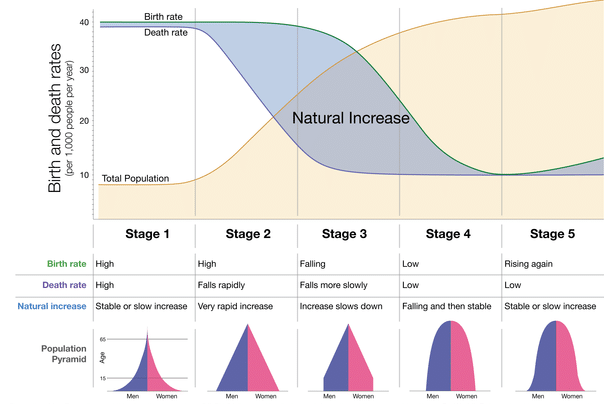
- Population pyramids help visualise demographic transition because they show the age-sex structure of a population. The shape of the pyramid reflects fertility, mortality, life expectancy and ageing.
- Therefore, a population pyramid is not just a diagram; it is a compact summary of the demographic stage of a region.
Stage I Pyramid
- Broad base and narrow top indicate high birth rate and high death rate.
- Many children are born, but fewer people survive to older ages due to disease, famine, poor nutrition and weak medical facilities.
- This shape represents a traditional society with low life expectancy and limited demographic stability.
Stage II Pyramid
- Very broad base indicates high birth rate, while more people survive due to falling death rate.
- The pyramid expands rapidly because children and young adults form a very large share of the population.
- This shape is associated with population explosion and high child dependency.
Stage III Pyramid
- Base begins to narrow because birth rate declines. At the same time, the working-age population expands because earlier large birth cohorts survive into adulthood.
- This pyramid is important for understanding demographic dividend, as the dependency ratio begins to fall and the economically productive age group becomes large.
Stage IV Pyramid
- Nearly stationary structure indicates low birth and death rates. The base, middle and upper portions become more balanced because fertility is low and life expectancy is high.
- Population growth is slow, and the society begins to face ageing-related challenges.
Stage V Pyramid
- Narrow base and wider middle/upper age groups show ageing and very low fertility. Fewer children are born, while a large share of the population survives to older ages.
- This shape indicates population decline, labour shortage and rising old-age dependency.
Demographic Dividend
- Demographic dividend is a benefit that may arise during Stage III when the share of working-age population becomes large and dependency ratio declines.
- Falling fertility -> Fewer children -> Larger working-age share -> Economic potential
- However, demographic dividend is not automatic. It requires:
- Education
- Skill development
- Employment generation
- Health care
- Women workforce participation
- Industrial growth
- Good governance
- India is often described as being in a demographic dividend phase, but its benefit depends on converting population into productive human capital.
India and Demographic Transition
India’s demographic transition has been uneven across regions.
National Level
- India has moved from high fertility and high mortality toward low mortality and declining fertility. Death rate declined due to medical advancement, vaccination, food security, public health and improved sanitation. Birth rate declined due to education, urbanization, contraception, later marriage and changing aspirations.
- NFHS-5 recorded India’s total fertility rate at 2.0, indicating below-replacement fertility at the national level. This places India broadly in late Stage III, moving toward Stage IV.
Regional Variation
- India’s demographic transition is not uniform.
- States such as Kerala, Tamil Nadu, Andhra Pradesh, Telangana, Karnataka, Maharashtra, Punjab and West Bengal are closer to Stage IV. Some northern and central states have had slower fertility decline, though they too are moving downward.
Population Momentum
- Even when fertility falls to replacement level, population may continue to grow because of a young age structure.
- Past high fertility -> Large young population -> More future parents -> Continued growth
- This explains why India can have below-replacement fertility but still experience population increase for some time.
Emerging Concerns
- India’s demographic transition creates both opportunities and challenges:
- Demographic dividend
- Need for employment
- Ageing in southern states
- Migration from high-fertility to low-fertility regions
- Urbanization pressure
- Gender imbalance
- Health and pension planning
- Regional policy differentiation
Geographical Significance
- Demographic Transition Theory is important in geography because it links population processes with space, economy and society.
- Population Distribution
- Different regions are at different stages of transition, creating variation in population density, growth rate and age structure.
- Migration
- Stage II and Stage III societies often produce migration due to rapid population growth, rural pressure and expanding urban opportunities.
- Urbanization
- Urbanization is both a cause and consequence of demographic transition. It reduces fertility by changing family size preferences and increasing the cost of raising children.
- Regional Planning
- Regions in early transition need maternal health, child health and education. Regions in late transition need employment, ageing care and social security.
- Population Policy
- The theory helps governments design policies according to demographic stage rather than applying one uniform population policy everywhere.
- Resource Pressure
- Rapid population growth in Stage II can create pressure on land, water, food, housing and employment.
- Population Distribution
Criticism of Demographic Transition Theory
- Although Demographic Transition Theory is widely used in population geography, it has several limitations. Many scholars argue that it is more a descriptive model than a complete explanatory theory. It tells us what happened in many industrialized countries, but it does not always explain why the same process occurs differently in different societies.
Based on Western Experience
- The theory is mainly based on the historical experience of Europe, North America and other industrialized societies. In these regions, mortality and fertility declined gradually along with industrialization, urbanization and rising literacy.
- However, the experience of Asia, Africa and Latin America has been different. Many developing countries experienced a rapid fall in death rate due to imported medical technology, vaccination and international public health programmes, even before full industrialization. Therefore, the Western sequence cannot be mechanically applied to all regions.
Not a Universal Law
- Demographic Transition Theory should not be treated as a universal law of population growth. It is an empirical generalization. Countries may not pass through the same stages in the same order, at the same speed or with the same social consequences.
- For example, some oil-rich countries achieved low death rates without passing through a long industrial stage, while some poorer countries continue to have high fertility despite improvements in health care.
No Fixed Time Frame
- The theory does not specify how long a country will remain in each stage. Some European countries took more than a century to complete the transition, while some Asian countries experienced much faster fertility decline due to state policy, education and family planning.
- This makes the theory weak as a predictive model. It can indicate a broad direction, but it cannot precisely predict the timing of demographic change.
Weak Explanation of Fertility Decline
- The theory describes fertility decline but does not fully explain why fertility declines. It broadly links fertility decline with modernization, but modernization itself includes many variables: income, education, urbanization, female employment, contraception, media exposure, child survival, social security and changing family values.
- Different countries may experience fertility decline for different reasons. Therefore, the theory is better at describing the pattern of fertility decline than explaining its precise causes.
Ignores Cultural and Religious Factors
- Fertility behaviour is strongly influenced by religion, patriarchy, son preference, caste, ethnicity, family norms and gender relations. These factors may delay or accelerate fertility decline independently of economic development.
- For example, two regions with similar income levels may show different fertility rates because of differences in female education, marriage age, son preference and cultural acceptance of contraception.
Limited Role of Migration
- The theory focuses mainly on birth and death rates. Migration, which strongly affects population change in many regions, receives less attention.
- This is a major limitation in contemporary geography. Gulf countries, North America, Western Europe and many metropolitan regions have population structures deeply shaped by migration. A country may have low fertility but still grow due to immigration, or it may lose young workers due to emigration.
Developing Countries Experienced Different Transition
- Many developing countries experienced rapid mortality decline due to imported medical technology, even without full industrialization. This produced unprecedented population growth because death rates declined quickly while birth rates remained high.
- Thus, the demographic transition of developing countries was often compressed and externally influenced. It did not always follow the slow internal development path seen in Europe.
Stage Reversal Is Possible
- The theory assumes a broad forward movement from high birth and death rates to low birth and death rates. However, stage reversal is possible. Some post-socialist countries experienced rising death rates after the collapse of welfare and health systems. Wars, pandemics, economic crises and state failure can also disturb demographic progress.
- This shows that demographic transition may not always be linear or irreversible.
Stage V Problem
- The original theory did not adequately anticipate ultra-low fertility, ageing and population decline in countries like Japan, South Korea and parts of Europe. Classical theory assumed that transition would end in a stable low birth-low death equilibrium.
- However, many advanced societies now face fertility far below replacement level, shrinking labour force and rising old-age dependency. This has required the addition of a fifth stage, which was not part of the original model.
Neglect of Gender Relations
- The theory recognizes fertility decline but does not sufficiently explain the role of women’s status. Female literacy, reproductive rights, employment, property rights and decision-making power are crucial in fertility behaviour.
- In many societies, fertility decline occurs only when women gain greater control over marriage, contraception, education and employment. Hence, gender relations should be placed at the centre of demographic explanation.
Ignores State Policy and Institutions
- The theory underestimates the role of state policy. Family planning, public health, vaccination, social security, education, maternity benefits and population laws can strongly influence demographic transition.
- For example, China’s one-child policy, India’s family planning programme and European pro-natalist policies show that demographic behaviour is shaped not only by development but also by state intervention.
Inadequate for Internal Regional Variation
- The theory often treats a country as a single demographic unit. In reality, large countries show major internal variations.
- India is a good example. Some southern and western states are closer to Stage IV, while some northern and central states moved more slowly through Stage III. Therefore, the theory must be applied at regional and sub-regional scales.
Environmental and Resource Factors Are Underplayed
- Demographic Transition Theory focuses on socio-economic development but gives less attention to environmental stress, carrying capacity, climate change, water scarcity and ecological degradation.
- In the contemporary world, population change cannot be studied separately from climate vulnerability, food security, urban ecological footprint and resource pressure.
Relevance of Demographic Transition Theory
Despite criticism, Demographic Transition Theory remains highly useful.
- It provides a macro-framework
- It explains long-term demographic change from traditional to modern society.
- It helps classify countries
- Countries can be compared according to fertility, mortality and age structure.
- It supports population projection
- It helps estimate future population trends.
- It links demography with development
- It connects birth and death rates with health, education, income and urbanization.
- It is useful for planning
- Different stages require different policy priorities.
- It explains demographic dividend
- Stage III creates a working-age bulge that can support economic growth.
- It highlights ageing
- Stage IV and Stage V help explain old-age dependency and population decline.
Comparison With Malthusian and Marxian Theories
- Malthusian, Marxian and Demographic Transition theories explain population growth from three different standpoints.
- Malthus explains population growth through the relationship between population and food supply.
- Marx explains population problems through capitalist exploitation and unequal distribution.
- Demographic Transition Theory explains population change through the changing relationship between birth rate, death rate and socio-economic development.
- Thus, the three theories should not be seen as mutually exclusive. They answer different questions:
- Malthus asks: Can population outrun food and resources?
- Marx asks: Who controls resources and why does poverty exist?
- Demographic Transition Theory asks: How do birth and death rates change with development?
| Basis | Malthusian Theory | Marxian Theory | Demographic Transition Theory |
|---|---|---|---|
| Main focus | Population vs food | Population vs capitalism | Birth rate, death rate and development |
| Nature | Pessimistic and resource-based | Socio-economic and class-based | Empirical and evolutionary |
| Cause of population problem | Overpopulation | Exploitation and unequal distribution | Transitional gap between BR and DR |
| Role of development | Limited | Linked to mode of production | Central factor |
| Role of technology | Underestimated | Seen through capitalism | Reduces mortality and later fertility |
| Solution | Moral restraint / checks | Social transformation | Development, education, health and family planning |
| Geography relevance | Carrying capacity | Inequality and migration | Stages, regions, planning and projections |
Malthusian Theory and Demographic Transition Theory
- Malthusian theory is concerned with the danger of population growing faster than food supply. It is pessimistic because it assumes that unchecked population growth will lead to famine, disease, war and misery. Demographic Transition Theory is more evolutionary and empirical. It shows that with development, societies can reduce both mortality and fertility.
- In this sense, Demographic Transition Theory partly answers Malthus. It shows that population growth does not continue indefinitely because fertility eventually declines with urbanization, education, women empowerment and family planning.
- However, Malthusian concerns remain relevant during Stage II, when death rate declines but birth rate remains high, causing population explosion and pressure on resources.
Marxian Theory and Demographic Transition Theory
- Marxian theory argues that poverty is not caused by overpopulation but by unequal ownership of resources and exploitation under capitalism. Demographic Transition Theory, on the other hand, does not focus on class conflict. It studies how demographic rates change with modernization.
- The limitation of Demographic Transition Theory is that it may describe fertility and mortality trends without asking who benefits from development and who remains excluded. Marxian theory fills this gap by highlighting inequality, labour exploitation, unemployment, migration and slum formation.
- For example, a country may enter Stage III with falling fertility and mortality, but still have large informal labour, regional inequality and urban poverty. These conditions are better explained by Marxian theory.





Best resource for Models and Theories! Thank you.
better than any other reference book.
thanks
thankyou sir
The relevance of the demographic transition theory in explaining population process in developing countries
jThe relevance can be shown by explaining the assumption of theory may be stages of demographic transition theory relate with population process in developing countries..
Very well explaination
Thanx
Very helpful for preparing notes