UPSC Prelims 2026 GS Paper 1 Detailed Analysis: Subject-Wise Review, Difficulty Level and Key Trends
The UPSC Prelims 2026 GS Paper 1 was conducted on 24 May 2026 and turned out to be a Moderate to Difficult paper. It was not a paper that could be comfortably handled through static reading alone. UPSC tested a wider range of themes, mixed factual depth with conceptual reasoning, and pushed candidates to apply elimination carefully under pressure.
The broad nature of the paper can be summarised in one line: current-linked, factual-depth oriented, statement-heavy and analytically demanding.
Unlike some previous years where certain subjects had predictable dominance, UPSC Prelims 2026 distributed difficulty across the paper. History-Culture, Geography-Environment, Economy, Science-Tech, Polity, Governance, International Relations and Security all had meaningful representation. However, the internal nature of each section varied sharply.
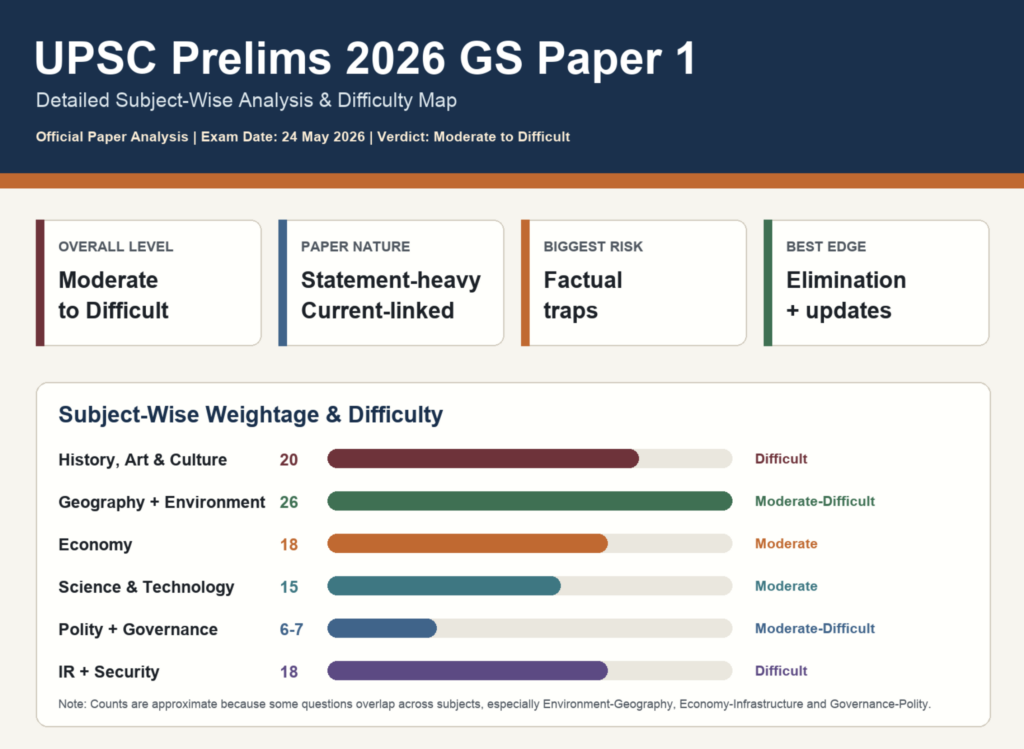
UPSC Prelims 2026 GS Paper 1: Overall Difficulty Level
| Parameter | Assessment |
|---|---|
| Overall difficulty | Moderate to Difficult |
| Paper nature | Statement-heavy and current-linked |
| Most difficult areas | History-Culture, International Relations, Security, some Polity |
| Most manageable area | Science and Technology |
| Biggest challenge | Factual precision and elimination |
| Best scoring opportunity | Updated current affairs plus conceptual clarity |
| Risk factor | Over-attempting factual questions |
The paper rewarded candidates who had prepared beyond routine coaching notes. A candidate needed strong static fundamentals, but the decisive edge came from contextual current affairs, institutional details, and the ability to identify extreme or incorrect statements.
Subject-Wise Distribution of UPSC Prelims 2026 GS Paper 1
| Subject Area | Approx. Questions | Difficulty Level | Nature of Questions |
|---|---|---|---|
| History, Art & Culture | 20 | Difficult | Academic, factual and analytical |
| Geography + Environment | 25-26 | Moderate-Difficult | Factual, map/current-linked, species and places |
| Economy | 16-18 | Moderate | Static plus current, lengthy but doable |
| Science & Technology | 14-15 | Moderate | Accessible, initiative-based and logical |
| Polity + Governance | 6-7 core Polity, more if governance caselets included | Moderate-Difficult | Low volume but deep and conceptual |
| International Relations + Security | 16-18 | Difficult | Specific, acronym-heavy, treaty/convention based |
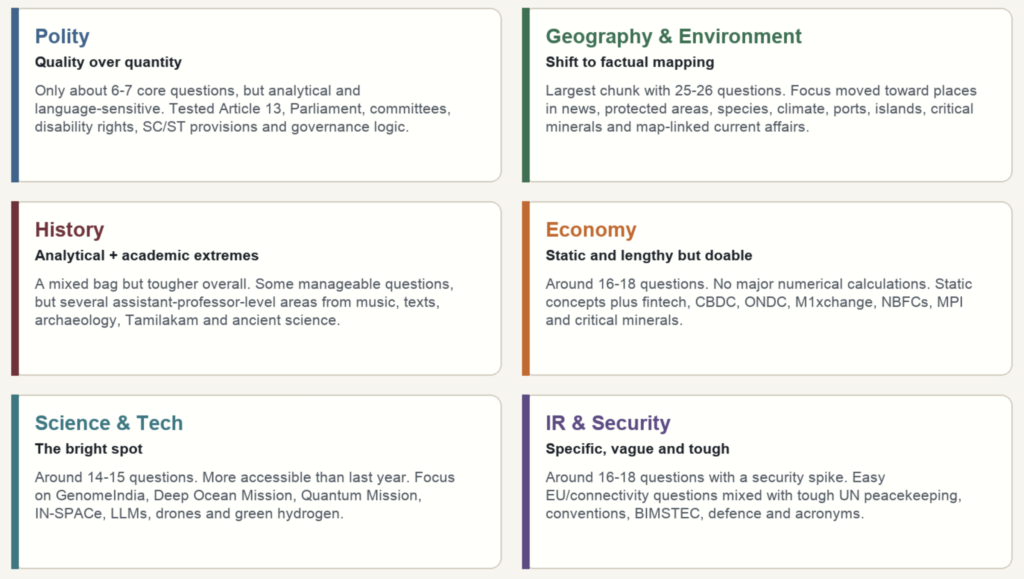
Polity: Quality Over Quantity
Polity was one of the most interesting sections of UPSC Prelims 2026. In terms of direct question count, it was lower than expected. There were roughly six to seven core Polity questions, depending on how one classifies governance and law-based questions.
However, this lower number should not be mistaken for lower importance. The Polity questions were not easy one-liners from standard books. They demanded careful reading, structural understanding and logical interpretation.
Key Features of Polity in 2026
- Fewer direct questions compared to many previous years
- More emphasis on conceptual clarity than rote memory
- Language of the statements was important
- Options required careful logical comparison
- Governance, law and social justice overlapped with Polity
Questions on Article 13, constitutional interpretation, parliamentary questions, SC/ST provisions, disability rights, committees and legal developments showed that UPSC expected candidates to understand the spirit and structure of constitutional governance.
Polity Difficulty
| Component | Difficulty |
|---|---|
| Direct constitutional provisions | Moderate |
| Legal interpretation questions | Difficult |
| Parliament and committee-based questions | Moderate-Difficult |
| Social justice-linked polity | Moderate |
The major takeaway is clear: Polity in 2026 was about quality over quantity. Candidates who had only memorised Articles without understanding institutional logic would have struggled.
Geography & Environment: A Shift to the Factual
Geography and Environment together formed one of the largest blocks of the paper, with approximately 25 to 26 questions. This was a high-impact section because even a few mistakes here could significantly affect the final Prelims score.
The most noticeable trend was the shift away from purely conceptual physical geography toward localized, factual Indian geography, current affairs mapping and environment-specific factual details.
What UPSC Asked
The paper included questions on:
- Tungurahua Volcano
- Madhav National Park
- Andaman and Nicobar climate
- Peninsular Block of India
- Sagarmala Programme
- Rhynchostylis retusa / Foxtail orchid
- FAO Blue Transformation
- Lake Turkana
- REDD+ projects
- India’s climate policy
- Western Hoolock Gibbons
- Mangrove ecosystems
- Vizhinjam International Seaport
- River identification
- Amur Falcons
- Rainfed Area Development
What Worked for Candidates
Candidates who had tracked current affairs through maps and locations would have performed well. Questions on Vizhinjam Port, Andaman and Nicobar climate, critical minerals, Madhav National Park, and Amur Falcons show that UPSC expected aspirants to connect news items with geographical and environmental fundamentals.
The Challenge
Environment leaned heavily into facts. Species, locations, protected areas, institutional details and recent declarations were prominent. This increased the risk of negative marking because many questions looked familiar but required precise knowledge.
Geography-Environment Difficulty
| Area | Difficulty |
|---|---|
| Physical geography | Moderate-Difficult |
| Indian geography | Moderate |
| Places in news | Moderate |
| Environment species and protected areas | Difficult |
| Climate and international environmental initiatives | Moderate-Difficult |
Overall, Geography and Environment were Moderate to Difficult, with factual precision being the deciding factor.
History: Analytical Innovations and Extreme Extremes
History, including Art and Culture, was one of the toughest parts of the paper. It was a mixed bag, but on balance it was more difficult than a standard predictable History section.
The section had a wide spectrum. Some questions were manageable, while others were highly academic and likely beyond the comfort zone of candidates who relied only on standard books.
Areas Asked in History-Culture
- Pleistocene river systems and ancient evidence
- Early Buddhist iconography
- Ancient and modern river names
- Amaravati Stupa
- Early historical Tamilakam
- Forward Bloc
- Awadh after annexation
- Montagu-Chelmsford Reforms
- Classical music traditions
- Ancient texts and terminology
- Temple architecture
- Jainism
- Bagh Caves
- Place-value system
- Harappan archaeology
- Eka Movement and Bardoli Satyagraha
- Rigvedic agriculture
The Innovation in Question Design
One of the most important innovations was the use of questions where candidates had to evaluate whether multiple statements collectively indicated a broader historical trend or movement. This was visible in questions comparing movements such as Eka Movement and Bardoli Satyagraha and inference-based questions from archaeological or textual evidence.
This format reduced the value of rote learning. A candidate needed historical context, not just isolated facts.
Extremes in the History Section
Some questions were fairly manageable for a well-prepared aspirant, such as questions on known modern history themes or cultural sites in news. But others were extremely academic, involving narrow textual references, ancient scientific developments, music traditions and specific cultural symbolism.
This is why History-Culture acted as a score differentiator in 2026.
History Difficulty
| Area | Difficulty |
|---|---|
| Ancient history | Difficult |
| Art and culture | Difficult |
| Modern history | Moderate-Difficult |
| Archaeology and textual evidence | Difficult |
| Movement comparison questions | Moderate-Difficult |
The main lesson: UPSC is increasingly testing history as interpretation, not just chronology.
Economy: Static and Lengthy but Doable
Economy had around 16 to 18 questions depending on classification. It was not as brutal as History or IR, but it required patience because several questions were lengthy.
Unlike some years, there were no major numerical calculation-based problems. The focus was on static concepts, contemporary economic developments and institutional awareness.
Key Economy Themes
- Sagarmala and infrastructure
- Vizhinjam Port
- Oeko-Tex certification and Eri Silk
- ONDC
- UPI and Digital Rupee
- Real-world asset tokenisation
- Sustainability bonds
- M1xchange
- Crowding out effect
- Rare earth elements and critical minerals
- Aviation insurance
- Crowdfunding
- Economic committees
- NBFCs
- Multidimensional Poverty Index
What Made Economy Manageable
The static fundamentals were useful. A candidate who had revised standard Economy concepts could handle questions on crowding out, bonds, financial inclusion, NBFCs and MPI. Current affairs helped in questions on digital commerce, fintech and critical minerals.
What Made Economy Challenging
The challenge was not calculation. The challenge was length and precision. Slower readers may have lost time, especially in questions involving fintech, insurance and institutional details.
Economy Difficulty
| Area | Difficulty |
|---|---|
| Static economy concepts | Easy-Moderate |
| Fintech and digital economy | Moderate |
| Institutions and committees | Difficult |
| Schemes and current affairs | Moderate |
Overall, Economy was Moderate. A well-prepared candidate could reasonably manage 8 to 9 questions with confidence.
Science & Technology: The Bright Spot
Science and Technology was arguably the most accessible section of the paper. It had around 14 to 15 questions, and most of them could be approached through a mix of basic conceptual understanding and updated current affairs.
Major Themes in Science-Tech
- DHRUV64 microprocessor
- Bharat Forecast System
- Blockchain
- Real-world asset tokenisation
- Genetic medicine
- Large Language Models
- Stealth technology
- Black boxes in aircraft
- Green Hydrogen
- IN-SPACe and private space sector
- Drone swarms
- GenomeIndia Project
- National Quantum Mission
- Deep Ocean Mission
Why Science-Tech Was More Accessible
The questions were not deeply technical in a specialised scientific sense. They tested whether candidates understood the basic idea behind major technologies and national initiatives. For example, questions on LLMs, blockchain, genetic medicine and green hydrogen could be solved through rational elimination if the candidate understood the core concept.
Science-Tech Difficulty
| Area | Difficulty |
|---|---|
| National missions | Moderate |
| Emerging technology | Moderate |
| Defence technology | Moderate |
| Biotechnology | Moderate |
| AI and digital technology | Easy-Moderate |
Science-Tech was the bright spot of the paper because it rewarded updated and conceptually alert candidates.
International Relations & Security: Vague and Tough
International Relations and Security saw a clear rise in importance. Depending on classification, this section had around 16 to 18 questions, with Security-specific questions increasing to about five.
This section was among the toughest because many questions were highly specific. Some were straightforward, but several required very narrow factual knowledge.
Key Areas Asked
- INTERPOL notices
- Germany Chancellor visit outcomes
- Strait of Hormuz
- International conventions not ratified by India
- India-ASEAN connectivity projects
- India-supported projects in neighbouring countries
- UN organisations and Nobel Prize
- UN peacekeeping operations and periods
- BIMSTEC centres and locations
- European Union membership
- Defence hardware manufactured in India
- Indian Army Corps and headquarters
- Mission Sudarshan Chakra
- River bridges with neighbouring countries
Why This Section Was Difficult
Some questions were simple, such as EU membership and regional connectivity projects. But many others were very specific. The UN peacekeeping question, for example, expected knowledge of mission acronyms and exact operation periods. Similarly, questions on conventions, BIMSTEC centres and defence headquarters were fact-heavy.
IR-Security Difficulty
| Area | Difficulty |
|---|---|
| Neighbourhood projects | Moderate |
| International organisations | Difficult |
| UN peacekeeping and conventions | Difficult |
| Defence and security | Moderate-Difficult |
| Map-linked IR | Moderate |
Overall, IR and Security were Difficult, especially for candidates who did not revise institutional and treaty-based current affairs.
Detailed Subject-Wise Takeaways
1. Static Knowledge Alone Was Not Enough
The paper demanded standard static preparation, but static knowledge had to be linked with current affairs. For example, knowing ports, biodiversity, constitutional bodies or economic terms was useful only when combined with recent developments.
2. Current Affairs Was Not Newspaper Headline-Based
UPSC did not merely ask direct current affairs. It asked background, institutional meaning, locations, objectives and implications.
3. Factual Precision Became More Important
Many questions looked familiar but required exact knowledge. This was particularly true in Environment, IR, Culture and Economy.
4. Elimination Was Essential
The paper had many statement-based questions where one statement could be eliminated if the candidate noticed an extreme expression, wrong institution, wrong geography or impossible claim.
5. Reading Speed Mattered
Several Economy, Governance and IR questions were lengthy. Candidates with slower reading speed may have faced time pressure.
Was UPSC Prelims 2026 Tougher Than Last Year?
Based on the nature of GS Paper 1, the 2026 paper can be considered slightly tougher in History-Culture and IR-Security, but more manageable in Science-Tech. The economy was balanced and doable. Geography-Environment was high in volume but fact-heavy.
Thus, the paper was not uniformly difficult. It was uneven:
- Easy to moderate in some conceptual areas
- Moderate in Economy and Science-Tech
- Moderate-Difficult in Geography-Environment
- Difficult in History-Culture and IR-Security
Expected Good Attempts in UPSC Prelims 2026 GS Paper 1
Good attempts depend on accuracy, not only number of questions attempted. Since the paper had factual traps and one-third negative marking, a cautious but confident attempt strategy was important.
| Candidate Type | Likely Attempt Range | Comment |
|---|---|---|
| Very strong candidate | 85-90 | Only if accuracy is high |
| Serious prepared candidate | 75-85 | Balanced attempt range |
| Risk-averse candidate | 65-75 | Safer if accuracy is strong |
| Over-attempting candidate | 90+ | High risk due to factual traps |
For this paper, accuracy mattered more than aggression.
What UPSC Prelims 2026 Means for Future Aspirants
Future aspirants should draw five lessons from this paper:
- Prepare History-Culture beyond basic summaries.
- Study Environment with maps, species, protected areas and current developments.
- Read Economy conceptually, but track fintech and government institutions.
- Treat Science-Tech as a scoring area if prepared consistently.
- For IR, do not ignore organisations, conventions, neighbourhood projects and defence-linked facts.
Final Verdict
The UPSC Prelims 2026 GS Paper 1 was a balanced but demanding paper. It rewarded candidates who had breadth, patience and elimination skill. The paper was not impossible, but it was unforgiving for selective preparation.
The strongest message from UPSC Prelims 2026 is this: the examination is moving toward integrated awareness, where static knowledge, current affairs, institutions, technology and geography must be studied together rather than in isolated compartments.
For serious UPSC aspirants, this paper should be treated as a roadmap for future preparation.