Urbanization: Meaning and Concept

- Urbanization refers to a comprehensive socio-economic and spatial transformation process whereby the functional character of a settlement shifts from predominantly agricultural to non-agricultural activities through the expansion of industries, trade, commerce, transport, communication, and urban infrastructure, resulting in increased concentration of population and economic activities in towns and cities.
- It is not merely a demographic phenomenon but a structural transformation of economy, society, and landscape, involving:
- Sectoral shift from primary to secondary and tertiary activities
- Occupational diversification
- Physical expansion and morphological changes in settlements
- Intensification of economic linkages and spatial interactions
- In simple terms, urbanization can be understood as the process of transformation of rural settlements into urban centres, accompanied by rapid changes in land use, built environment, lifestyle, and socio-economic relations.
- However, defining urbanization precisely is complex due to variations in criteria across countries. In India, as per the Census of India, an urban area is identified based on:
- Minimum population of 5,000 persons
- Population density of at least 400 persons per sq. km
- At least 75% of male main workers engaged in non-agricultural activities
- Additionally, settlements with statutory status (municipality, corporation, cantonment board) are classified as urban
- Faster the process of urbanization, greater is the increase in urban population due to migration and natural growth, and correspondingly, the relative share of rural population declines, indicating a transition in settlement hierarchy and economic structure.
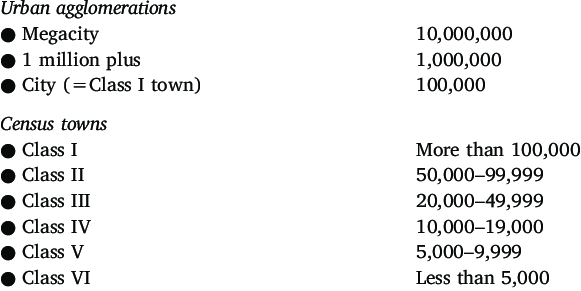
Classification of Towns in India (Population-Based Hierarchy)
- Urban centres in India are classified based on population size, reflecting urban hierarchy and functional importance:
- Class I: Population ≥ 1 lakh (major cities and metropolitan centres)
- Class II: 50,000 – 99,999
- Class III: 20,000 – 49,999
- Class IV: 10,000 – 19,999
- Class V: 5,000 – 9,999
- Class VI: < 5,000
- This classification helps in understanding urban concentration, planning priorities, and service provisioning, with Class I cities acting as growth poles and economic hubs.
Functional Classification of Towns
- Towns can also be classified based on their dominant functions, reflecting economic specialization and spatial organization:
- Industrial towns (e.g., Jamshedpur, Bhilai)
- Commercial towns (e.g., Mumbai, Ahmedabad)
- Administrative towns (e.g., New Delhi, Chandigarh)
- Religious towns (e.g., Varanasi, Tirupati)
- Tourist towns (e.g., Goa, Shimla)
- Residential/suburban towns (peri-urban areas around metros)
- This functional differentiation is crucial in urban geography for analyzing urban networks, central place functions, and regional development patterns.
Measures of Urbanization
- Urbanization is measured through multiple quantitative and spatial indicators, which help in understanding extent, intensity, and pattern of urban growth:
- Percentage share of urban population in total population
- Urbanization level (ratio of urban to total population)
- Growth rate of urban population
- Urban primacy index (dominance of largest city)
- Rank-size rule (distribution of city sizes)
- Location quotient (functional specialization)
- Gini’s concentration ratio (inequality in urban distribution)
- These measures enable comparative analysis across regions and time, and are widely used in urban planning and policy formulation.
Components of Urban Population Growth
- Urban population growth is a composite outcome of multiple processes:
- Natural increase, resulting from higher birth rates relative to death rates in urban areas, particularly in developing countries
- Rural–urban migration, driven by push factors (agrarian distress, unemployment) and pull factors (employment opportunities, better services)
- Reclassification of settlements, where rural areas acquire urban characteristics and are designated as towns
- Spatial expansion of cities, including urban sprawl, peri-urban growth, and incorporation of surrounding rural areas
Processes of Urbanization
- Urbanization occurs through interconnected and cumulative processes:
- Economic transformation, involving industrialization and service sector growth
- Infrastructure development, especially transport networks, communication systems, and utilities
- Agglomeration economies, where clustering of activities reduces costs and increases productivity
- Migration dynamics, leading to demographic concentration in urban centres
- State intervention and planning, including industrial policies, smart cities, and urban missions
Factors Influencing Urbanization
- Economic Factors
- Structural transformation of economy from agrarian to industrial and service-based
- Commercialization and mechanization of agriculture reducing labour demand
- Expansion of industries and tertiary sector activities
- Development of transport and communication infrastructure facilitating mobility
- Globalization integrating cities into global production and trade networks
- Social Factors
- Rising aspirations and modernization of lifestyle
- Increasing literacy and educational attainment
- Decline of traditional joint family system and rise of nuclear families
- Social mobility and weakening of caste and community restrictions
- Cultural diffusion through media and communication
- Demographic Factors
- High population growth creating pressure on rural resources
- Youthful population structure encouraging migration
- Differential fertility and mortality patterns
- Large-scale rural–urban migration leading to urban expansion
- Political and Institutional Factors (Advanced Value Addition)
- Government policies on industrial location and regional development
- Urban planning initiatives such as Smart Cities Mission, AMRUT
- Administrative decisions such as establishment of capitals and special economic zones
- Welfare schemes improving urban infrastructure and services
Trend of Urbanisation: Global and Indian Perspective
Global Trend of Urbanization
- The growth of urban population has historically been consistently faster than rural population, reflecting the transition from agrarian to industrial and post-industrial economies, and resulting in a steady increase in the share of urban population globally.
- Over the last six decades (1960–2020), the world has witnessed a significant rise in urbanization level from about 34% to over 56%, indicating a rapid transformation of human settlements and economic structures, driven by industrialization, technological advancement, and globalization.
- The growth has not been uniform but shows distinct temporal phases:
- Early phase (1960–1980): Rapid urban expansion due to industrial growth and rural–urban migration
- Intermediate phase (1980–2000): Continued growth with increasing role of services
- Recent phase (2000–2025): Moderation in growth rate, especially in developed countries
- The annual growth rate of the urban population globally has declined from about 2.84% (1960–70) to around 1.99% (2010–2025), reflecting:
- Saturation of urbanization in developed regions
- Decline in migration rates
- Suburbanization and counter-urbanization trends
- Despite slowing growth rates, the absolute increase in urban population remains very high, especially in developing regions, making urbanization a continuing global phenomenon.
- Future projections indicate that:
- By 2030, about 60% of the world population will be urban
- By 2050, urbanization is expected to reach around 68–70%, signifying near-complete urban transition

Drivers of Global Urbanization
- Industrialization and economic diversification
- Expansion of global trade and service economy
- Technological advancements in transport and communication
- Rural distress and agrarian stagnation in developing countries
- Agglomeration economies and urban productivity advantages
Indian Trend of Urbanization
- India has experienced a gradual but accelerating trend of urbanization, though still lower than the global average, reflecting its status as a developing economy with a large agrarian base.
- The level of urbanization in India increased from:
- 17.9% in 1960
- To about 35% in 2020
- indicating a near doubling over six decades, though still moderate compared to developed nations.
- The annual growth rate of urban population in India has remained relatively high (around 2.5–3%), primarily due to:
- Large-scale rural–urban migration
- Natural population increase
- Reclassification of settlements into urban categories
- Unlike developed countries, India is still in the accelerating phase of urban transition, where:
- Urban population is growing rapidly
- Urban infrastructure often lags behind growth
- Projections suggest that:
- India will cross 40% urbanization by 2030
- It may exceed 50% urbanization by 2050, marking a major demographic shift
Distinctive Features of Urbanization in India
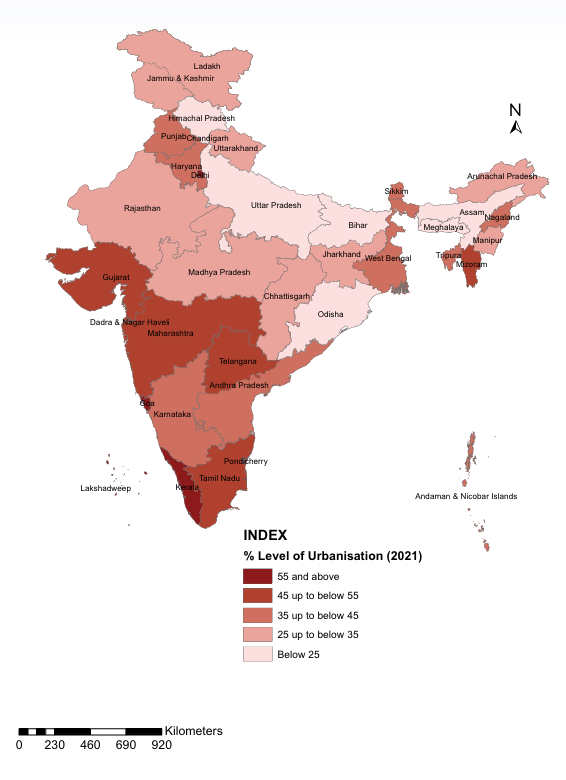
- Urban growth is highly uneven and regionally differentiated, with higher urbanization in:
- Western and Southern states (Maharashtra, Gujarat, Tamil Nadu)
- Lower levels in Eastern and central regions (Bihar, Odisha)
- Urbanization is migration-driven rather than industrialization-driven, leading to:
- Growth of informal sector
- Expansion of slums and peri-urban areas
- Presence of large metropolitan cities and emerging megacities, such as:
- Delhi, Mumbai, Bengaluru, Kolkata
- Increasing trend of census towns, indicating transformation of rural settlements without corresponding urban governance

Global Pattern of Urbanization
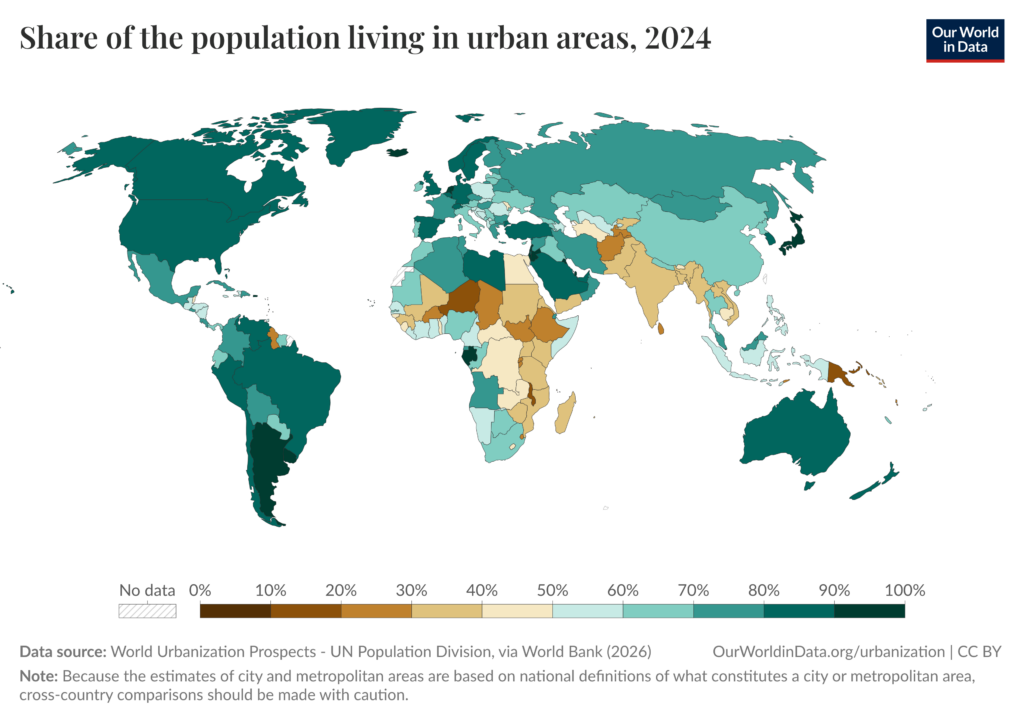
- The level of urbanization across the world (≈56% in 2020) is highly uneven spatially, reflecting differences in historical evolution, industrialization, economic structure and demographic transition.
- A clear core–periphery pattern is visible:
- Highly urbanized regions → North America, Europe, Latin America
- Moderately urbanized → Asia
- Low urbanization → Africa
- This unevenness highlights that urbanization is not merely demographic, but deeply linked with economic development and structural transformation.
🧭 Continental Pattern of Urbanization
Highly Urbanized Regions (Above World Average)
- North America (~83%)
- Represents one of the most urbanized regions due to early industrialization, high income levels, and advanced service economy
- Urbanization is near saturation with prevalence of metropolitan corridors
- Latin America & Caribbean (~82%)
- High urbanization despite being developing → due to primate city dominance and migration-led urbanization
- Countries like Brazil, Mexico show very high urban shares
- Europe (~75%)
- Mature urban system with balanced city hierarchy
- Characterized by planned urbanization and strong regional networks
Moderately Urbanized Regions
- Oceania (~68%)
- High urbanization in Australia and New Zealand, but low population concentration overall
- Urbanization concentrated in coastal cities
- Asia (~51%)
- Shows sharp internal contrasts:
- Highly urbanized: Japan, South Korea, Gulf countries
- Moderately urbanized: China, Indonesia
- Low urbanization: India, Afghanistan
- Shows sharp internal contrasts:
- Asia represents the largest contributor to global urban growth in absolute terms
Low Urbanized Regions
- Africa (~44%)
- Lowest level of urbanization due to:
- Predominance of agrarian economy
- Low industrial base
- Infrastructure constraints
- Lowest level of urbanization due to:
- However, Africa shows fastest urban growth rates, indicating future transformation
🌐 Country-Level Variations
- Among major populous countries:
- Very high urbanization → Brazil (~87.6%), Mexico (~83.8%), USA (~82.8%)
- Moderate urbanization → China (~60%), Indonesia (~56%)
- Low urbanization → India (~35%), Pakistan (~35%), Bangladesh (~39%)
- This variation reflects:
- Stage of economic development
- Nature of industrialization
- Demographic transition stage
🏙️ Urbanization Extremes (Special Cases)
- Some small or city-state economies exhibit near-total urbanization (~100%):
- Singapore, Monaco, Qatar, Kuwait, Hong Kong
- Reasons:
- Small territorial size
- Fully urban economic base
- Absence of rural hinterland
- Conversely, some territories show very low urbanization, reflecting isolation or subsistence economies
🌆 Megacity Concentration and Urban Hierarchy
- The global urban system is increasingly dominated by megacities (>10 million population)
- Top metropolitan regions include:
- Tokyo, Delhi, Shanghai, São Paulo, Mexico City, Cairo, Dhaka, Mumbai, Beijing, Osaka
- Key observation:
- 7 out of top 10 megacities are located in Asia, indicating shift of urban growth centre toward developing world
- These cities together account for a significant share of global urban population, reflecting agglomeration economies and spatial concentration
📊 Determinants of Global Urbanization Pattern
- Economic Factors
- Level of industrialization and diversification
- Growth of tertiary sector
- Employment opportunities in urban areas
- Historical Factors
- Early industrial revolution (Europe, North America)
- Colonial legacy shaping urban networks (Latin America, Africa)
- Demographic Factors
- Population growth rates
- Rural–urban migration intensity
- Physical Factors
- Climate, relief and resource base influencing settlement patterns
- Political & Institutional Factors
- Urban planning policies
- Governance and infrastructure development
🔄 Emerging Trends in Global Urbanization
- Shift of urban growth from developed → developing world
- Increasing importance of secondary cities and urban corridors
- Expansion of peri-urban and metropolitan regions
- Rise of informal urbanization (slums) in developing countries
- Growing emphasis on sustainable and smart urbanization