Concept of Age Composition

- Age composition (age structure) refers to the distribution of population according to different age groups.
- It is one of the basic demographic characteristics and is crucial for understanding population dynamics.
- The study of age composition helps in analysing:
- Growth of population
- Work participation and employment pattern
- Age at marriage
- Educational structure of population
- The age structure of a population is primarily determined by three interrelated factors:
- Fertility
- Mortality
- Migration
- As pointed out by Clarke (1972):
- These three determinants are interdependent, and
- Change in one leads to corresponding changes in others, thereby influencing overall age structure
⚙️ Determinants of Age Composition
1. Fertility
- Fertility rate determines the proportion of population in different age groups, especially the young population (0–14 years).
- Areas with high fertility:
- Have a large share of young population
- Result in high dependency ratio
- Consequences of high fertility:
- High natural growth of population
- Increased unemployment
- Lower age at marriage
- Inadequate educational attainment
- Impact dimension:
- These effects are more pronounced on the physical and socio-economic condition of women, especially in less developed countries
🌍 Global Pattern (Based on Fertility & Life Expectancy)
- Countries in Africa, Asia and Latin America:
- High birth rates
- Large proportion of population in young age group
- Often ~40% population below 15 years
- Due to low life expectancy:
- Proportion of elderly population remains relatively small
- In contrast, developed countries (Europe, North America, etc.):
- Have low fertility rates
- Exhibit higher proportion of elderly population
- This reflects:
- Downward trend in fertility
- Upward trend in ageing population
2. Mortality
- Age structure is also influenced by mortality rates, especially age-specific mortality
- In developed countries:
- Low mortality across all age groups
- Leads to increase in higher age groups (ageing population)
- In less developed countries:
- Sharp decline in mortality in younger age groups
- Results in increase in young population
3. Migration
- Migration has a selective impact on age composition, though less predictable than fertility and mortality
- It affects both:
- Source region
- Destination region
- Key pattern:
- Migration usually involves specific age groups (e.g., 25–35 years)
- Effects:
- Out-migration → decline in working-age population in source region
- In-migration → increase in working-age population in destination region
- Thus, migration leads to redistribution of age groups across regions
Age-related Data: Age Grouping, Age Indices, Age Pyramid
- Age data of population can be analysed and presented in multiple ways for proper understanding and interpretation.
- The major methods include:
- Age Grouping
- Age Indices
- Age Pyramids
📊 Age Grouping
- Although age is collected as single-year data, it is generally presented in 5-year age groups, such as:
- 0–4, 5–9, 10–14, 15–19, 20–24, 25–29, 30–34, 35–39, 40–44, 45–49, 50–54, 55–59, 60–64, 65–69, 70–74, 75–79, 80+
- Age is recorded in completed years:
- Infant below 1 year → recorded as 0
- Child completing 1 year → recorded as 1
- Interpretation:
- 0–4 → population below 5 years
- 80+ → population aged 80 and above
- Significance:
- Facilitates regional and temporal comparison
- Simplifies demographic analysis
Broad Age Groups
- For simplification, population is grouped into:
- 0–14 years (Young / Children)
- 15–59 years (Adult / Active)
- 60+ years (Aged / Old)
Demographic Significance of Age Groups
(a) 0–14 Age Group
- Indicates fertility level and stage of demographic transition
- Interpretation:
- Above 35% → High fertility; Stage II/III (less developed countries)
- Below 20% → Low fertility; Final stage (developed countries)
(b) 15–59 Age Group
- Considered:
- Biologically most reproductive
- Economically most productive
- Demographically most mobile (Trewartha, 1969)
- Role:
- Supports other age groups in:
- Food
- Clothing
- Education of children
- Care of elderly
- Supports other age groups in:
- Hence, known as economically independent population
- Variation:
- Does not vary significantly globally
- Slightly higher in developed countries due to lower fertility
- In developed countries:
- Often extended to 15–64 years due to higher life expectancy
(c) 60+ Age Group
- Represents aged population / senior citizens
- Characteristics:
- Economically non-productive
- Biologically non-reproductive
- Demographically least mobile
- Hence, economically dependent group
- Pattern:
- Higher proportion in developed countries due to:
- Low fertility
- High life expectancy
- Higher proportion in developed countries due to:
- Gender aspect:
- Higher proportion of females due to higher mortality among aged males

📐 Age Indices
- Age composition can be analysed using quantitative indices
- Importance:
- Helps in understanding demographic implications
- Enables regional comparison
(a) Dependency Ratio
- Defined as:
- Ratio of young (0–14) + aged (60+/65+) population
- To adult (15–59/64) population
- Expressed in percentage
- Pattern:
- High in less developed countries due to high fertility
(b) Ageing Index
- Defined as:
- Ratio of aged population (60+/65+)
- To young population (0–14)
- Expressed in percentage
- Pattern:
- High in developed countries due to:
- Low fertility
- High life expectancy
- High in developed countries due to:
🔺 Age Pyramid (Age–Sex Pyramid)
- The graphical representation of age data of population on 5-year age groups in the form of horizontally arranged bars according to proportion of population is known as Age Pyramid.
- It is commonly called Age–Sex Pyramid, because proportion or absolute number of population under different 5-yearly age groups is shown separately for males and females in the same framework.
- The age-groups are arranged on the vertical axis in sequence:
0–4, 5–9, 10–14, 15–19, 20–24, 25–29, 30–34, 35–39, 40–44, 45–49, 50–54, 55–59, 60–64, 65–69, 70–74, 75–79 and 80+. - Each age group is represented by a horizontal bar:
- Left side → Female population
- Right side → Male population
- Under normal circumstances, the size of population gradually decreases from younger to older age groups, giving it a pyramidal shape.
🔍 Types of Population Pyramids
- Depending on variations in fertility, mortality and life expectancy, three types of pyramids are observed:
1. Expansive Population Pyramid
- Depicts population with a large proportion in younger age groups.
- Characteristics:
- High fertility rates
- Low life expectancy
- Example:
- Less developed countries like India, Bangladesh, Angola, etc.
- Indicates:
- Youthful population
2. Constrictive Population Pyramid
- Named so because the pyramid is narrow at the base due to lower proportion of young population.
- Characteristics:
- Declining birth rates
- Each successive age group becomes smaller
- Example:
- United States
- Indicates:
- Ageing population
3. Stationary Population Pyramid
- Shows almost equal proportion across age groups.
- Characteristics:
- Stable population
- No significant increase or decrease
- Example:
- Austria
- Indicates:
- Stable demographic structure

📏 Median Age
- Defined as:
- The middle value of age distribution of population
- Characteristics:
- Varies across countries depending on:
- Fertility rate
- Life expectancy
- Varies across countries depending on:
- Pattern:
- Higher median age → Developed countries (Germany, USA, Japan)
- Lower median age → Less developed countries (India, Kenya, Bangladesh)
- Significance:
- Important indicator of age composition and population maturity
Global Pattern
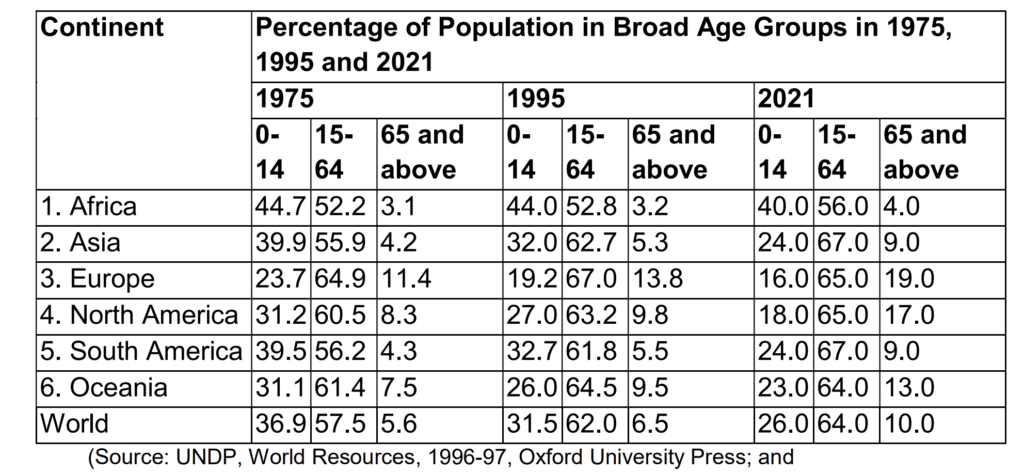
- If analysis of age composition of population is done for broad age groups like 0–14, 15–64 and 65+, globally the proportions are:
- 0–14 → 26%
- 15–64 → 64%
- 65+ → 10%
- (as per 2021 estimate)
- Among continents:
- Highest share of children (0–14) → Africa (40%)
- Lowest share → Europe (16%)
- In Europe, ageing has advanced to such an extent that:
- Population aged 65+ (19%) exceeds 0–14 age group
- Trend (1975–2021):
- Global decline in 0–14 age group → from 36.9% to 26.0%
- Decline is:
- Slow in Africa → 44.7% → 40.0%
- Fast in Asia → 39.9% → 24.0%

Key Observations (Country-Level Pattern)
- Age composition varies significantly across continents and countries.
- Asia shows highest variation, while Europe shows lowest variation.
- Example (Asia):
- Yemen (0–14 → 39.2%) vs Japan (12.5%)
- Japan:
- Very high 65+ population → results in:
- High dependency ratio (71.5%)
- Very high ageing index (233.6%)
- Very high 65+ population → results in:
- Niger (Africa):
- Very high young population (0–14) →
- High dependency ratio (114.1%)
- Very low ageing index (5.3%)
- Very high young population (0–14) →
Conclusion
- Developed countries (low fertility + high life expectancy):
→ High dependency ratio + High ageing index - Less developed countries (high fertility):
→ High dependency ratio but Low ageing index
Spatial Pattern in India
- Due to considerably high fertility in India, the proportion of population (Census 2011) in:
- 0–14 age group → 30.8% (high)
- 65+ age group → 5.5% (low)
- However, there exists marked spatial variation in age composition among states and UTs due to:
- Variation in fertility behaviour
- Mortality behaviour
- Life expectancy
- Age-selective migration
- Rural–urban migration
Rural–Urban Variation
- Age composition also varies between rural and urban areas:
- 0–14 population:
- Rural → 32.8%
- Urban → 26.2%
- 0–14 population:
- This results in:
- Higher dependency ratio in rural areas → 62.3%
- Compared to urban areas → 45.6%
Age Composition of Population in States/UTs of India, 2011
| State/UT | 0–14 | 15–64 | 65+ | Dependency Ratio (%) | Ageing Index (%) |
|---|---|---|---|---|---|
| Jammu & Kashmir | 33.8 | 61.4 | 4.8 | 62.9 | 14.2 |
| Himachal Pradesh | 25.9 | 67.2 | 6.9 | 48.9 | 26.6 |
| Punjab | 25.5 | 67.7 | 6.8 | 47.7 | 26.2 |
| Chandigarh | 25.3 | 70.8 | 3.9 | 41.2 | 15.4 |
| Uttarakhand | 31.0 | 63.3 | 5.7 | 58.1 | 18.3 |
| Haryana | 29.7 | 65.0 | 5.3 | 53.9 | 17.8 |
| NCT of Delhi | 27.2 | 68.7 | 4.1 | 45.4 | 14.7 |
| Rajasthan | 34.6 | 60.5 | 4.9 | 65.8 | 14.1 |
| Uttar Pradesh | 35.7 | 59.4 | 4.9 | 69.3 | 13.7 |
| Bihar | 40.1 | 55.3 | 4.6 | 81.1 | 11.2 |
| Sikkim | 27.2 | 68.3 | 4.5 | 46.5 | 16.5 |
| Arunachal Pradesh | 35.7 | 61.5 | 2.8 | 62.6 | 7.8 |
| Nagaland | 34.3 | 62.4 | 3.3 | 60.3 | 9.6 |
| Manipur | 30.2 | 65.2 | 4.6 | 53.3 | 14.9 |
| Mizoram | 32.4 | 63.6 | 4.0 | 57.3 | 12.3 |
| Tripura | 27.7 | 67.0 | 5.3 | 49.1 | 18.7 |
| Meghalaya | 39.7 | 57.2 | 3.1 | 67.9 | 7.5 |
| Assam | 32.8 | 62.9 | 4.3 | 58.8 | 12.8 |
| West Bengal | 27.1 | 67.4 | 5.5 | 48.4 | 20.3 |
| Jharkhand | 36.1 | 59.6 | 4.3 | 67.7 | 11.7 |
| Odisha | 28.8 | 65.2 | 6.0 | 53.5 | 20.8 |
| Chhattisgarh | 32.0 | 63.1 | 4.9 | 58.6 | 15.3 |
| Madhya Pradesh | 33.5 | 61.4 | 5.1 | 62.9 | 15.2 |
| Gujarat | 28.9 | 65.9 | 5.2 | 51.8 | 17.6 |
| Daman & Diu | 22.6 | 74.4 | 3.0 | 34.3 | 12.8 |
| Dadra & Nagar Haveli | 31.4 | 66.3 | 2.3 | 51.0 | 7.3 |
| Maharashtra | 26.6 | 66.8 | 6.6 | 49.7 | 24.8 |
| Andhra Pradesh | 25.8 | 68.2 | 6.0 | 46.6 | 23.2 |
| Karnataka | 26.2 | 67.7 | 6.1 | 47.7 | 23.2 |
| Goa | 21.8 | 71.2 | 7.0 | 40.4 | 32.1 |
| Lakshadweep | 25.5 | 69.5 | 5.0 | 43.9 | 19.6 |
| Kerala | 23.4 | 68.3 | 8.3 | 46.4 | 35.4 |
| Tamil Nadu | 23.6 | 69.8 | 6.6 | 43.26 | 27.9 |
| India | 30.8 | 63.7 | 5.5 | 57.0 | 17.9 |
Key Observations
- Children population (0–14) varies widely:
- Highest → Bihar (40.1%)
- Lowest → Goa (21.8%)
- Dependency ratio:
- Highest → Bihar (81.1%)
- Lowest → Goa (40.4%)
- India average → 57.0%
Regional Pattern
- Northern states → Very high:
- 0–14 population
- Dependency ratio
- Eastern & North-Eastern states → High to moderate values
- Western states → Low to moderate values
- Southern states → Lowest values
General Trend
- Areas with high proportion of children population:
- Due to high fertility rate
- These areas also show:
- Low 65+ population
- Low adult (15–64) population
- Result:
- High dependency ratio
- Low ageing index