Sex Composition

- The proportion of males and females in a population is termed as sex composition.
- Its numerical expression is given through the sex ratio.
Measurement of Sex Ratio
- Although the concept remains same, methods of calculation vary across countries:
- Russia:
- Expressed as percentage of male or female population to total population
- Balanced → 50% male : 50% female
- USA & UK:
- Number of males per 100 females
- New Zealand:
- Number of females per 100 males
- India:
- Number of females per 1000 males
- Formula:
- Sex Ratio = (Total female population / Total male population) × 1000
- Russia:
- Hence, availability of male and female population data is essential for calculation.
Types of Sex Ratio
- Sex composition can be classified into three types:
- Primary Sex Ratio
- Ratio of female to male population at conception
- Secondary Sex Ratio
- Ratio of female to male population at birth
- Also called natural sex ratio
- Tertiary Sex Ratio
- Ratio of female to male population at the time of enumeration (census)
- Primary Sex Ratio
Determinants and Variations
- Primary Sex Ratio
- Deviates from theoretical equality due to:
- Abortions (male/female selective)
- Miscarriages
- Still-births and live birth variations
- Deviates from theoretical equality due to:
- Secondary Sex Ratio (Natural Sex Ratio)
- Generally shows male dominance at birth
- Range: 105–107 males per 100 females
- Reasons:
- Higher male births globally
- Higher mortality among male babies at birth due to pregnancy-related complications
- Also influenced by:
- Age-specific mortality differences
- Generally shows male dominance at birth
- Tertiary Sex Ratio
- Determined by:
- Sex ratio at birth
- Sex ratio at death
- Sex ratio of migrants
- Migration plays a crucial role:
- Economic migration is male-selective
- Areas of in-migration → excess males
- This pattern is:
- More prominent in large urban areas and cities
- Associated with rural–urban migration
- Determined by:
World Pattern
- The sex ratio (number of females per thousand males) shows significant variation across countries.
- Unless specified, sex ratio generally refers to the tertiary sex ratio (measured at the time of enumeration).
- At the global level (2021 estimate):
- Females constitute 49.58% of total population
- Global sex ratio: 983 females per 1000 males
- Trend of Sex Ratio (World)
- The global sex ratio has shown slight fluctuations over time:
- Declined from 993 (1980) to 983 (2015)
- Projected to increase to:
- 991 by 2050
- 997 by 2100
- The global sex ratio has shown slight fluctuations over time:
- Developed vs Developing Countries
- Higher sex ratio (female dominance) observed in:
- Developed regions → Europe, North America
- Lower sex ratio (male dominance) observed in:
- Less developed regions → Asia, South America
- Higher sex ratio (female dominance) observed in:
- Country-Level Variations
- Sex ratio varies widely across countries:
- Lowest: Qatar (~334)
- Highest: Hong Kong (~1184)
- Very low sex ratio observed in:
- Gulf and Muslim-dominated countries such as
- Qatar, UAE, Oman, Bahrain, Kuwait, Saudi Arabia, Maldives
- Reasons:
- Male-selective migration
- Relatively lower status of females
- Gulf and Muslim-dominated countries such as
- Globally:
- Around 66 countries have sex ratio below 1000
- Around 135 countries/territories have sex ratio above 1000
- Sex ratio varies widely across countries:
- Sex Ratio in Top 10 Populous Countries (2021)
- Highest:
- Russia → 1157
- Mexico → 1041
- Moderate / Near Balance:
- USA → 1021
- Brazil → 1037
- Low Sex Ratio:
- China → 950
- India → 925 (lowest among top 10)
- Pakistan → 943
- World Average: 983
- Highest:
Key Observations
- Regional Pattern:
- High sex ratio → Europe, North & South America
- Low sex ratio → Asia and Africa
- Major Causes of Low Sex Ratio:
- Higher male births
- Female child mortality
- Male-selective migration (especially in Gulf countries)
Spatial Pattern in India
- India is characterised by a marked paucity of females in the population.
- Trend of sex ratio (females per 1000 males):
- 1901 → 972
- 1991 → 927
- 2011 → 943 (after slight improvement)
- The deficit of females is mainly associated with:
- Excess of male births
- High female child mortality
- High maternal mortality
- Low status of women
- Factors of Spatial Variation
- Significant inter-state variation exists due to:
- Male-selective migration
- Rural–urban differences
- Socio-economic variations
- Ethno-religious and caste-based factors
- Locational characteristics
- Significant inter-state variation exists due to:
- Rural–Urban Differential
- Due to male-selective rural–urban migration:
- Urban sex ratio (2011) → 929
- Rural sex ratio (2011) → 949
- Thus, urban areas show lower sex ratio than rural areas.
- Due to male-selective rural–urban migration:
- State-Level Variation
- Sex ratio varies widely across states/UTs (2011):
- Highest:
- Kerala → 1084
- Puducherry → 1038
- Lowest:
- Daman & Diu → 618
- Dadra & Nagar Haveli → 775
- Highest:
- Only Kerala and Puducherry show female-favourable sex ratio (>1000).
- Near balanced sex ratio observed in:
- Tamil Nadu
- Andhra Pradesh
- Chhattisgarh
- Sex ratio varies widely across states/UTs (2011):
- Rural Pattern
- Generally higher sex ratio in rural areas
- Range:
- Lowest → 690 (Chandigarh)
- Highest → 1078 (Kerala)
- Sex ratio ≥1000 in seven states/UTs
- Urban Pattern
- More distorted pattern compared to rural areas
- Range:
- Lowest → 551 (Daman & Diu)
- Highest → 1091 (Kerala)
- Female-favourable urban sex ratio in:
- Kerala
- Puducherry
- Manipur
- Meghalaya
- Near balance in:
- Tamil Nadu
- Mizoram
- Regional Pattern
- Better sex ratio observed in:
- Southern India
- North-Eastern India
- Poor sex ratio observed in:
- Northern and North-Western states
- Better sex ratio observed in:
- Child Sex Ratio (0–6 Age Group)
- India (2011): 919 → highly discouraging
- Range across states:
- Lowest: Haryana → 834
- Highest: Arunachal Pradesh → 972
- Causes:
- Excess male births
- High female child mortality
- Female foeticide / sex-selective abortion
Age-Sex Pyramid
- The shape of age-sex pyramid varies from country to country depending upon:
- Stage of demographic transition
- Incidence of epidemics, wars and migration
- Countries with:
- High birth rate and high death rate → Broad base and sharply narrowing top (triangular shape)
- Advanced stages of demographic transition (Stage III/IV) → Narrow base with relatively wider middle and gradual tapering
- Thus, the shape of pyramid reflects:
- Stage of demographic transition
- Nature of age structure
- Fertility and mortality patterns
India: Expansive (Youthful) Population
- India shows expansive pyramid due to:
- High fertility
- Low life expectancy
- Characteristics:
- Broad base → High proportion of children
- Narrow apex → Low proportion of aged population
- Indicates:
- Youthful population
- High population growth potential

Ethiopia and Bangladesh: Similar Expansive Pattern
- Both countries exhibit expansive age-sex pyramids
- Features:
- Wide base → High fertility
- Narrow top → Low life expectancy
- Reflect:
- Developing economy
- Early stage of demographic transition


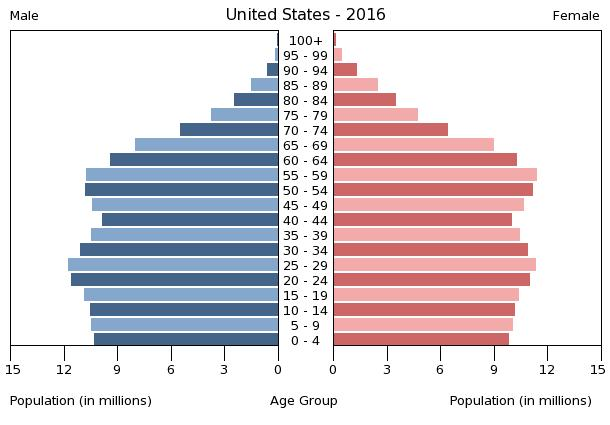
USA and Australia: Constrictive Pyramid
- These countries show constrictive pyramids due to:
- Low fertility
- Increasing life expectancy
- Characteristics:
- Narrow base → Low birth rate
- Wider middle age groups
- Gradual tapering
- Indicates:
- Ageing population
- Advanced stage of demographic transition

Japan: Stationary / Ageing Population
- Japan represents stationary and ageing population
- Features:
- Very narrow base → Very low fertility
- Wide middle and top → High life expectancy
- Situation:
- Fertility sometimes lower than mortality
- Completed all stages of demographic transition