Conceptual Understanding of Rural-Urban Distribution

- Rural–urban distribution reflects the spatial division of population based on dominant economic activities, settlement patterns, and level of development, where rural areas are largely associated with primary activities (agriculture, forestry, fishing) while urban areas are characterized by secondary and tertiary activities (industry, services, trade, administration).
- This distribution is inherently uneven and dynamic, shaped by:
- Industrialization
- Urbanization
- Migration flows
- Technological advancement
- State policies and planning
- The contrast between rural and urban population is more pronounced in:
- Developed vs developing countries
- Within regions of the same country (regional disparity)
Global Scenario of Rural-Urban Distribution
- The world has undergone a historic urban transition, where:
- Around 56% of global population lived in urban areas in 2020
- By 2023–24, this has increased to ~57–58% (UN DESA estimates)
- Projected to reach ~68% by 2050, indicating accelerating urbanization
- Regional variation in urbanization levels is highly significant:
- North America & Europe → Highly urbanized (>75–80%)
- Latin America → Rapidly urbanized (~80%+)
- Asia → Moderate but fast-growing (~50–55%)
- Africa → Lowest but fastest growing (~40–45%)
- In terms of share of global urban population:
- Asia dominates due to its large absolute population (China, India)
- Africa shows high growth potential due to demographic momentum
- The global pattern shows a clear relationship between economic development and urbanization:
- Developed countries → High urbanization, low growth
- Developing countries → Low/moderate urbanization, high growth
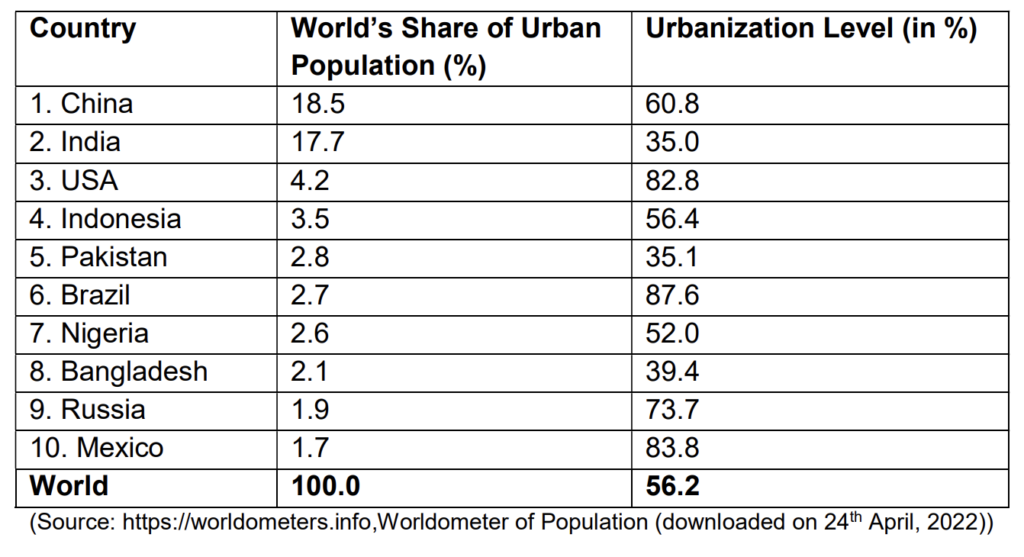
Rural–Urban Contrast: Developed vs Developing Countries
- Developed Countries
- High urbanization levels (70–85%)
- Rural population is minimal and often mechanized
- Urban growth driven by:
- Service sector expansion
- Knowledge economy
- Examples:
- USA (~83%), Japan (~92%), Germany (~77%)
- Developing Countries
- Lower urbanization but rapid increase
- Large rural base with agrarian economy
- Urban growth often migration-driven rather than industrial absorption, leading to:
- Informal settlements
- Slums
- Examples:
- India (~35% in 2011 → ~36–38% now)
- Nigeria (~52%), Bangladesh (~39%)
Global Distribution of Urban Population (Major Countries)
- Countries like China and India dominate global urban population share, not because of very high urbanization levels, but due to huge population size:
- China → ~60% urbanized, but largest urban population
- India → ~35–38% urbanized, yet second largest urban population
- Highly urbanized countries like:
- USA (~83%)
- Brazil (~87%)
- Mexico (~83%)
contribute less in absolute share compared to Asian giants
Indian Scenario of Rural–Urban Distribution
- India is still predominantly rural, though undergoing rapid urban transition:
- Urban population (2011) → 31.16%
- Estimated (2023–24) → ~36–38%
- Rural population still constitutes ~62–64%
- India’s urbanization is characterized by:
- Gradual but uneven growth
- Strong regional disparities
- Dominance of Class I cities and metropolitan regions
State-Level Pattern of Urbanization in India
- Highly Urbanized Regions (>60%)
- Delhi (~97%), Chandigarh (~97%), Goa (~62%)
- Driven by:
- Administrative functions
- Tourism
- Industrial concentration
- Moderately Urbanized States (40–50%)
- Tamil Nadu (~48%), Maharashtra (~45%), Gujarat (~42%)
- Features:
- Industrial corridors
- Port-based development
- Urban networks
- Low Urbanization States (<30%)
- Bihar (~11%), Assam (~14%), Odisha (~16%)
- Reasons:
- Agrarian economy
- Low industrial base
- Poor infrastructure
| State/Union Territory | Percentage Share of Urban Population | Urbanization Level (%) |
|---|---|---|
| Uttar Pradesh | 11.81 | 22.28 |
| Maharashtra | 13.48 | 45.23 |
| Bihar | 3.12 | 11.30 |
| West Bengal | 7.72 | 31.89 |
| Madhya Pradesh | 5.32 | 27.63 |
| Tamil Nadu | 9.27 | 48.45 |
| Rajasthan | 4.52 | 24.89 |
| Karnataka | 6.26 | 38.57 |
| Gujarat | 6.84 | 42.58 |
| Andhra Pradesh & Telangana | 7.48 | 33.36 |
| Odisha | 1.86 | 16.68 |
| Kerala | 4.22 | 47.72 |
| Jharkhand | 2.10 | 24.05 |
| Assam | 1.16 | 14.08 |
| Punjab | 2.76 | 37.49 |
| Chhattisgarh | 1.57 | 23.24 |
| Haryana | 2.34 | 34.79 |
| Delhi* | 4.34 | 97.50 |
| Jammu & Kashmir | 0.91 | 27.21 |
| Uttarakhand | 0.81 | 30.55 |
| Himachal Pradesh | 0.18 | 10.04 |
| Tripura | 0.25 | 26.18 |
| Meghalaya | 0.16 | 20.08 |
| Manipur | 0.22 | 30.21 |
| Nagaland | 0.15 | 28.97 |
| Goa | 0.24 | 62.17 |
| Arunachal Pradesh | 0.08 | 22.67 |
| Puducherry* | 0.23 | 68.31 |
| Mizoram | 0.15 | 51.51 |
| Chandigarh* | 0.27 | 97.25 |
| Sikkim | 0.04 | 24.97 |
| Andaman & Nicobar Islands* | 0.04 | 35.67 |
| Dadra & Nagar Haveli* | 0.04 | 46.62 |
| Daman & Diu* | 0.05 | 75.16 |
| Lakshadweep* | 0.01 | 78.08 |
| India | 100.00 | 31.16 |
Regional Imbalance in India
- Western and Southern India show higher urbanization due to:
- Industrialization (Maharashtra, Gujarat)
- IT sector (Karnataka, Telangana, Tamil Nadu)
- Northern and Eastern India remain less urbanized, due to:
- High population pressure on agriculture
- Slower economic transformation
- This leads to:
- Migration flows from BIMARU states → urban-industrial regions
- Creation of urban corridors and megacities
Key Processes Shaping Rural–Urban Distribution
- Urbanization
- Expansion of cities and towns
- Growth of metropolitan regions
- Migration
- Rural → Urban (push: poverty; pull: jobs)
- Seasonal and circular migration
- Economic Transformation
- Shift from agriculture → industry → services
- Technological Change
- Mechanization reduces rural labour demand
- ICT enables new urban economies
Emerging Trends
- Rise of megacities (>10 million population):
- Delhi, Mumbai, Shanghai, Lagos
- Growth of urban corridors and clusters:
- Delhi–Mumbai Industrial Corridor
- Pearl River Delta (China)
- Emergence of counter-urbanization and suburbanization in developed countries
- Increasing rural transformation:
- Rural areas becoming semi-urban (rurban concept in India)
Challenges in Rural–Urban Distribution
- In developing countries:
- Slums and informal settlements
- Urban unemployment
- Infrastructure deficit
- In rural areas:
- Agrarian distress
- Outmigration
- Regional imbalance
- Environmental issues:
- Urban pollution
- Rural resource degradation