Global Pattern of Population Density

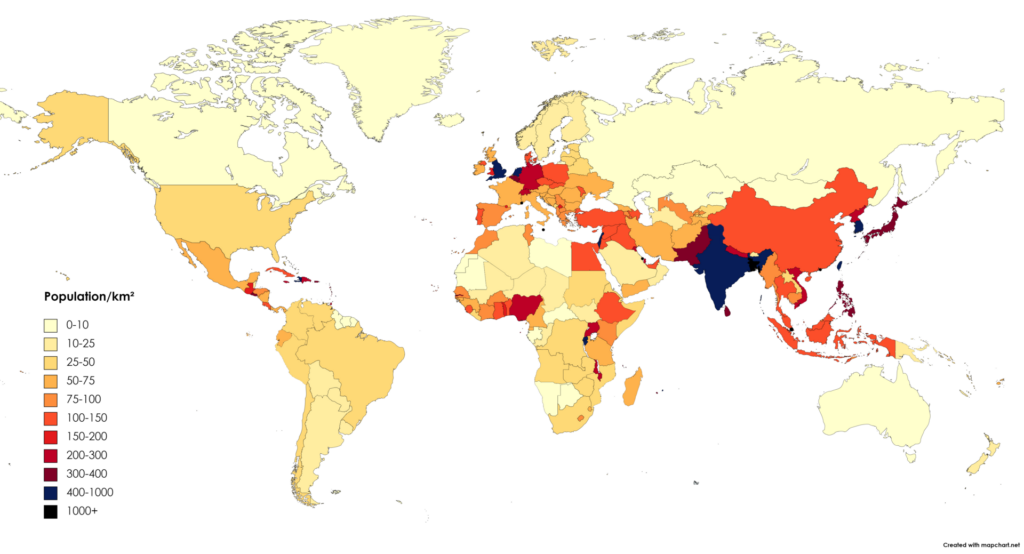
- The global distribution of population density reflects extreme spatial unevenness, arising from the combined influence of physical factors (relief, climate), economic development, technological advancement, and historical processes, rather than uniform demographic spread.
- The average world population density today (2024–25 estimates) is around ~60–65 persons per sq km, but this average conceals wide regional disparities, ranging from:
- Extremely high densities in regions like South Asia, East Asia, Western Europe,
- To very low densities in deserts, polar regions, and mountainous terrains.
- The variation in density operates across multiple scales:
- Macro level (continents) → moderate variation
- Meso level (countries) → high variation
- Micro level (regions within countries) → extreme variation (urban vs rural, plains vs mountains)
Continental Pattern of Population Density (Macro-Level Analysis)
- At the continental scale, population density shows relatively moderate variation, but clear regional contrasts exist:
- Asia (≈ 100–110 persons/km²)
- The most densely populated continent due to:
- Fertile river valleys (Ganga, Yangtze, Mekong)
- Long agricultural history
- Monsoonal climate
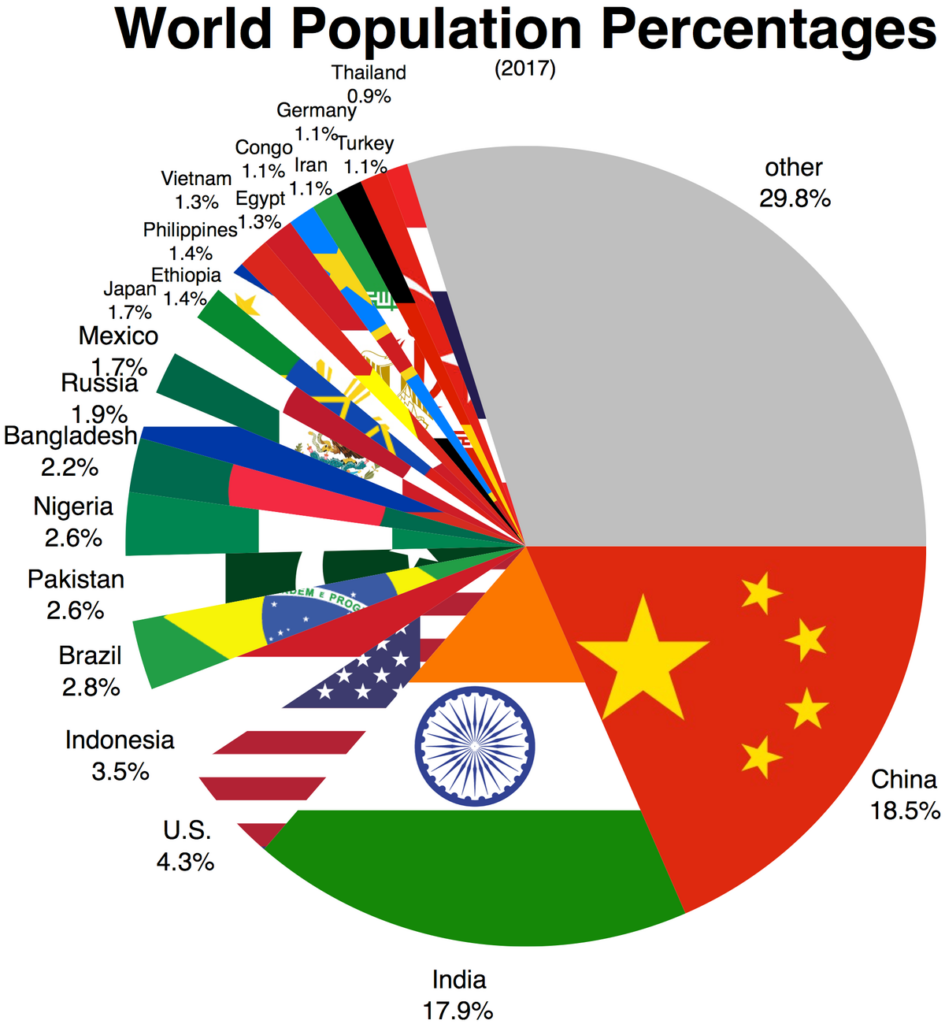
- Houses more than 55–60% of global population, making it the global demographic core.
- The most densely populated continent due to:
- Europe (≈ 65–70 persons/km²)
- High density due to:
- Early industrialization
- Urbanization
- Dense transport networks
- Despite low natural growth, density remains high due to historical accumulation and migration.
- High density due to:
- Africa (≈ 45–50 persons/km², rapidly increasing)
- Moderate but rising density due to:
- High fertility rates
- Rapid population growth
- Uneven distribution with dense clusters (Nile Valley, Nigeria) and sparse regions (Sahara).
- Moderate but rising density due to:
- North America (≈ 20–25 persons/km²)
- Low density overall due to:
- Large landmass
- Uneven settlement
- Population concentrated in:
- Eastern USA
- Great Lakes region
- Low density overall due to:
- South America (≈ 25–30 persons/km²)
- Low density due to:
- Amazon Basin constraints
- Population concentrated along:
- Coastal regions (Brazil, Argentina)
- Low density due to:
- Oceania (≈ 5 persons/km²)
- Very low density due to:
- Arid interiors (Australia)
- Island geography
- Very low density due to:
Country-Level Variation (Meso-Level Analysis)
- At the national level, variation becomes extremely pronounced, reflecting differences in:
- Resource base
- Economic development
- Historical settlement
- Examples of extreme contrasts:
- Bangladesh (>1200 persons/km²) → among the highest densities due to fertile deltaic plains and high fertility
- India (~470 persons/km²) → high density with strong regional variation
- China (~150 persons/km²) → uneven distribution (dense east vs sparse west)
- USA (~36 persons/km²) → low average but high urban concentration
- Russia (<10 persons/km²) → extremely sparse due to cold climate and vast territory
- Singapore (>8000 persons/km²) → extreme urban density
- This demonstrates that population density is not merely a function of area, but of economic viability and habitability.
Micro-Level Variation (Intra-Regional Differences)
- Within countries, population density shows extreme spatial contrasts, often more significant than inter-country variation:
- Urban vs Rural contrast:
- Mega cities (Delhi, Tokyo) → >10,000 persons/km²
- Rural areas → <500 persons/km²
- Physiographic contrast:
- Indo-Gangetic Plain → very dense
- Himalayas/Plateau regions → sparse
- Coastal vs Interior regions:
- Coastal belts → high density due to trade and accessibility
- Interior regions → relatively sparse
- Urban vs Rural contrast:
Global Population Density Zones (Spatial Typology)
(a) High Density Zones (>250 persons/km²)
- These regions represent the core areas of human settlement, characterized by:
- Fertile soils
- Favourable climate
- Long agricultural history
- High level of economic development
- Major regions include:
- South Asia → Indo-Gangetic Plain (India, Bangladesh, Pakistan)
- East Asia → Eastern China, Japan, South Korea
- Southeast Asia → Java (Indonesia), Mekong delta
- Western Europe → UK, Germany, Netherlands
(b) Moderate Density Zones (50–250 persons/km²)
- These regions are characterized by:
- Mixed economic activities
- Moderate agricultural productivity
- Urban-industrial development
- Examples:
- Eastern USA
- Parts of Europe
- Coastal China
- Southern Brazil
(c) Low Density Zones (10–50 persons/km²)
- These areas experience:
- Environmental constraints
- Limited agricultural productivity
- Examples:
- Interior USA
- Central Asia
- Parts of South America
(d) Very Low Density Zones (<10 persons/km²)
- These regions are extremely inhospitable, with severe physical constraints:
- Hot deserts → Sahara, Arabian Desert
- Cold regions → Siberia, Greenland
- Mountain regions → Himalayas, Andes
- Dense forests → Amazon Basin
Determinants of Global Density Pattern
- The observed pattern reflects interaction of:
- Physical factors → climate, soil, water
- Historical factors → early civilizations
- Economic factors → industrialization, urbanization
- Technological factors → irrigation, transport
- Thus, density is best understood as a dynamic outcome of human-environment interaction (possibilism).
Key Observations and Trends
- Nearly 90% of the world’s population lives in the Northern Hemisphere, especially between 20°N–60°N,
- Around 50% of global population is concentrated in less than 5% of land area, reflecting extreme clustering,
- Coastal areas and river valleys continue to dominate population density due to:
- Accessibility
- Fertility
- Economic opportunities
- Emerging trend:
- Rapid growth in Africa and South Asia,
- Stabilization or decline in Europe and Japan,
- The global pattern of population density is a reflection of deep-rooted geographical, economic, and historical processes, exhibiting multi-scalar variation from global to local levels.
- Understanding these patterns is crucial for:
- Resource planning
- Sustainable development
- Managing population pressure and regional inequalities
Patterns of Population Distribution and Density in India
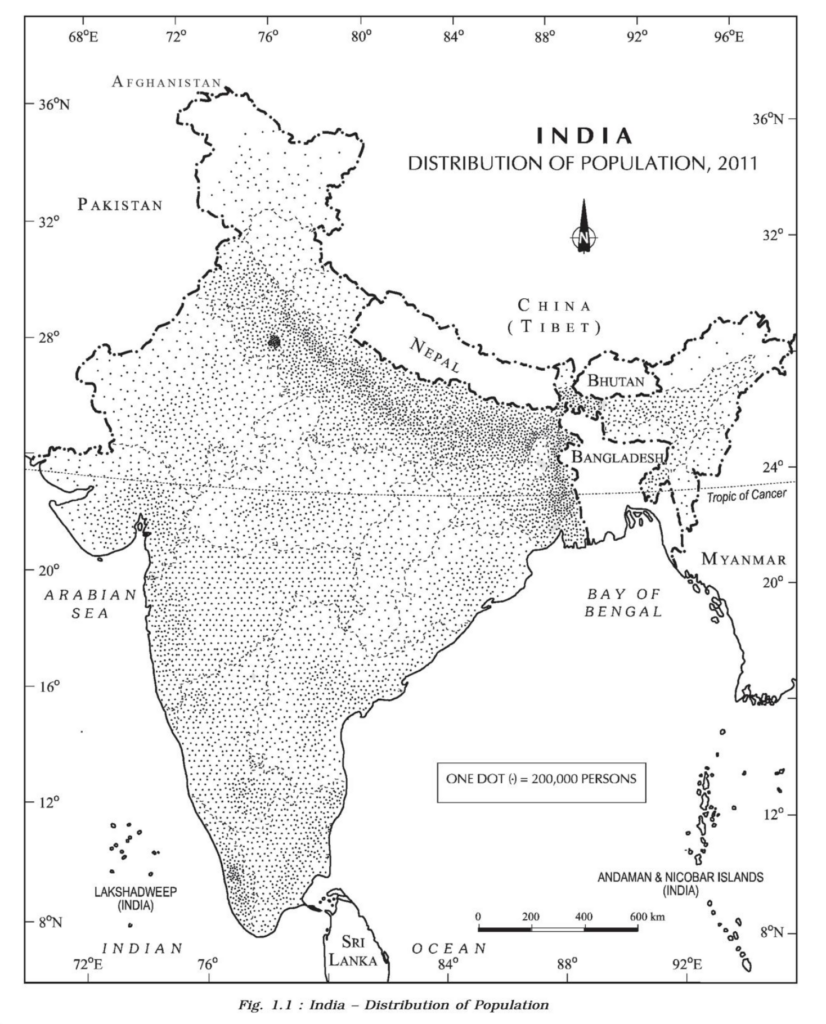
- India exhibits a highly uneven and regionally differentiated pattern of population distribution, which is fundamentally shaped by the interaction of physiography, climate, resource endowment, historical settlement, and socio-economic development, rather than uniform demographic spread across space.
- The Indo-Gangetic-Brahmaputra Plain forms the largest population cluster, accounting for nearly 40–45% of India’s population, due to:
- Fertile alluvial soils
- Abundant water availability
- Flat terrain suitable for agriculture and settlement
- Long history of civilization and urbanization
- The Peninsular Plateau including coastal plains accounts for around 35–40% of population, characterized by:
- Moderate densities
- Regional variation based on irrigation, industrialization, and urban growth
- The Himalayan and North-Eastern mountainous region remains sparsely populated (~3–5%), despite large area share, due to:
- Rugged terrain
- Climatic constraints
- Poor accessibility
- Thus, there exists a clear mismatch between area and population share, reflecting selective concentration of population in favourable ecological niches.
Physiographic Basis of Population Distribution
- Indo-Gangetic Plain (High Density Zone)
- Population density often exceeds 700–1000 persons/km², especially in:
- Uttar Pradesh, Bihar, West Bengal
- Favourable conditions include:
- Alluvial fertility
- Intensive agriculture
- High rural settlement density
- Represents the classical agrarian demographic core of India
- Population density often exceeds 700–1000 persons/km², especially in:
- Peninsular Plateau (Moderate Density Zone)
- Density generally ranges between 200–400 persons/km²
- Variability due to:
- Soil quality (black soil vs red soil)
- Irrigation availability
- Industrialization (e.g., Maharashtra, Tamil Nadu)
- Coastal regions (Kerala, Tamil Nadu) show higher densities due to trade and urbanization
- Himalayan Region (Low Density Zone)
- Density often below 100–150 persons/km²
- Constraints include:
- Steep slopes
- Harsh climate
- Limited agricultural land
- Example: Arunachal Pradesh (<20 persons/km²)
State-Level Pattern of Population Density (Meso-Level Analysis)
- India shows sharp inter-state variation, reflecting uneven development and resource distribution:
- High Density States (>800 persons/km²)
- Bihar (~1100), West Bengal (~1000), Kerala (~850), Uttar Pradesh (~800+)
- Reasons:
- Fertile land
- High fertility (historically)
- Dense rural settlement patterns
- Moderate Density States (300–600 persons/km²)
- Tamil Nadu, Punjab, Haryana, Gujarat
- Influenced by:
- Agricultural modernization
- Industrial growth
- Urbanization
- Low Density States (<200 persons/km²)
- Rajasthan (desert), Madhya Pradesh, Chhattisgarh
- Constraints:
- Aridity
- Forest cover
- Low urbanization
- Very Low Density Regions (<100 persons/km²)
- Arunachal Pradesh, Mizoram, Ladakh
- Dominated by:
- Mountains
- Forests
- Isolation

Urban Concentration and Extreme Density
- Certain regions exhibit extreme population density due to urbanization and economic concentration:
- Delhi (>11,000 persons/km²)
- Mumbai Metropolitan Region
- Kolkata urban agglomeration
- These areas demonstrate:
- Economic pull factors
- Migration-led growth
- Infrastructure pressure and urban sprawl
Micro-Level Variation (Intra-State Differences)
- Within states, density variation is even more pronounced:
- Coastal vs Interior:
- Coastal Andhra Pradesh and Tamil Nadu → high density
- Interior plateau → moderate density
- Plain vs Hilly regions:
- Assam plains → dense
- North-East hills → sparse
- Urban vs Rural:
- Cities → extremely high density
- Villages → dispersed
- Coastal vs Interior:

Factors Responsible for Uneven Distribution
- Physical Factors
- Relief → plains attract, mountains repel
- Climate → monsoon regions dense, arid regions sparse
- Soil → alluvial regions densely populated
- Economic Factors
- Industrialization → Maharashtra, Gujarat
- Urbanization → Delhi, Bengaluru
- Infrastructure → transport corridors
- Historical Factors
- Ancient civilizations → Ganga valley
- Colonial port cities → Mumbai, Kolkata, Chennai
- Demographic Factors
- Fertility variations → BIMARU states historically high
- Migration → rural to urban shift
Key Patterns and Observations
- India’s population distribution reflects a “core-periphery structure”:
- Core → Indo-Gangetic plain
- Periphery → Himalayan and desert regions
- There is a clear eastward and northward concentration, with:
- Eastern India (Bihar, WB) → high density
- Western desert (Rajasthan) → low density
- Coastalization trend:
- Increasing population concentration along coasts due to:
- Trade
- Ports
- Industrial corridors
- Increasing population concentration along coasts due to:
- Urban corridors emerging:
- Delhi–Mumbai Industrial Corridor
- Chennai–Bengaluru region
Recent Trends
- India’s population density (2021 est.) is ~460+ persons/km², showing continued increase
- Growth shifting from:
- Fertility-driven → migration-driven (urban growth)
- Increasing regional imbalance:
- Southern states → stabilizing population
- Northern states → continued growth