

Migration in India

- Migration in India constitutes a crucial dimension of population studies, reflecting the interaction between economic development, social structure and regional disparities. For a vast and diverse country, migration patterns help in understanding spatial inequalities, labour mobility and societal transformation, especially in the context of rapid growth in manufacturing, IT and service sectors.
- Concept and Measurement of Migration in India
- In the Indian Census, a person is considered a migrant if he/she is enumerated at a place different from the place of birth or last residence, indicating permanent or semi-permanent relocation.
- Evolution of migration data collection:
- Till 1961 Census: based on place of birth
- 1971 onwards: included last place of residence (more realistic measure)
- Since 1981: incorporation of reasons for migration, enabling analytical understanding
- NSSO data supplements census to capture short-term and seasonal migration, which is often missed due to decadal census gaps
- Magnitude and Nature of Migration
- Around 25–30% of India’s population is classified as migrants (Census-based estimates), though:
- Internal migration dominates (~85–90%)
- India is often considered a low mobility society, as:
- Nearly 90% of people are enumerated in the same district of birth
- About 7% move to neighbouring districts
- This reflects strong attachment to place, shaped by:
- Agrarian economy
- Joint family system
- Limited awareness and mobility constraints
- Around 25–30% of India’s population is classified as migrants (Census-based estimates), though:
- Reasons for Migration (Census Classification)
- Migration in India is driven by multiple socio-economic and demographic reasons, with clear gender differentiation:
- Economic reasons (dominant):
- Work/employment and business opportunities
- Rural–urban migration for livelihood
- Social reasons:
- Marriage (most dominant reason for female migration)
- Family movement (dependents moving with earning members)
- Demographic reasons:
- Movement at birth (children shifting with parents)
- Educational reasons:
- Migration for higher education and skill development
- Political reasons:
- Forced migration due to:
- Ethnic, tribal or religious conflicts
- Development-induced displacement (dams, mining projects)
- Forced migration due to:
- In-Migration and Out-Migration Patterns
- In-migration to India:
- Limited but increasing in recent decades
- Primarily includes:
- Refugees from Bangladesh, Tibet, Sri Lanka, Afghanistan
- Reflects regional geopolitical dynamics
- Out-migration from India (historical to modern phases):
- Indentured labour migration (19th century): to Caribbean, Africa, Southeast Asia
- Colonial and early modern migration: to Europe and USA
- Partition (1947): massive cross-border movement
- Contemporary migration:
- Skilled professionals (IT, medicine, academia)
- Labour migration to Gulf countries
- In-migration to India:
- Internal Migration Patterns
- Migration within India is largely:
- Rural → Rural (marriage-driven)
- Rural → Urban (economic migration)
- Urban → Urban (professional mobility)
- Regional patterns:
- Source regions: Bihar, Uttar Pradesh, Odisha, Rajasthan
- Destination regions: Maharashtra, Delhi, गुजरात, Punjab, Karnataka, Tamil Nadu
- 👉 Reflects core–periphery dynamics and regional development imbalance.
- Migration within India is largely:
- Causes of Low Mobility in India
- Compared to developed countries, India shows low spatial mobility due to:
- Agrarian social structure and land attachment
- Strong family and kinship ties
- Poverty and lack of resources to migrate
- Limited transport and communication (historically)
- Lack of information and opportunities awareness
- Compared to developed countries, India shows low spatial mobility due to:
Internal Migration in India
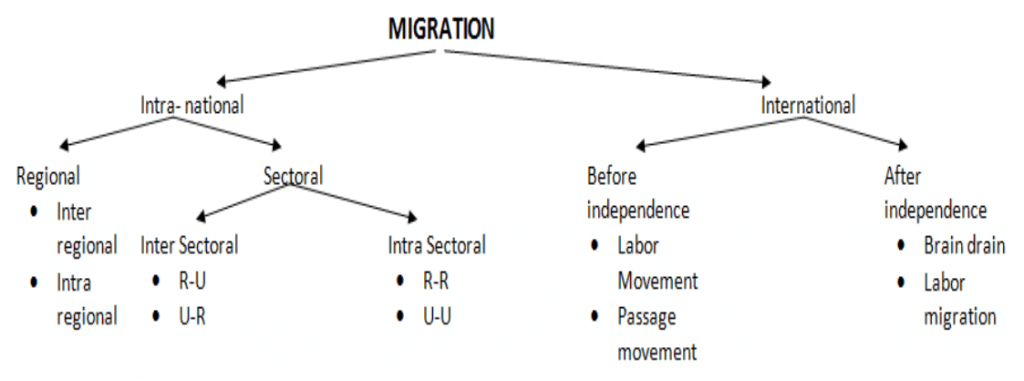
- Internal migration refers to the movement of people within national boundaries, and in India it constitutes the dominant form of migration, reflecting regional inequalities, labour market dynamics and socio-cultural practices. It includes both permanent relocation and circular/seasonal mobility, making it a multi-layered demographic process.
- Types and Nature of Internal Migration
- Internal migration can be classified spatially and temporally:
- Inter-regional migration: movement between states/regions, economically most significant as it redistributes labour across regions
- Intra-regional migration: movement within the same region (rural–rural, urban–urban, rural–urban), often linked with marriage, seasonal work or short-distance shifts
- Based on duration:
- Long-term migration: permanent or semi-permanent relocation (employment, marriage)
- Short-term/seasonal migration: cyclical movement between source and destination (agricultural labour, construction workers)
- Internal migration can be classified spatially and temporally:
- Magnitude and Structure
- Internal migrants constitute a large share of India’s population (~30% or over 300 million, Census-based estimates), highlighting its significance in shaping population distribution.
- Gender dimension:
- Female migration (~70%) is largely marriage-driven, especially rural–rural migration
- Male migration is predominantly economic (employment-oriented)
- Employment pattern:
- Migrants are concentrated in informal and labour-intensive sectors such as:
- Construction, brick-kilns, mining
- Domestic work, transport
- Agriculture and small-scale industries
- Migrants are concentrated in informal and labour-intensive sectors such as:
- Source and Destination Regions (Spatial Pattern)
- Major source regions (push regions):
- Uttar Pradesh, Bihar, Rajasthan, Madhya Pradesh, Odisha, Chhattisgarh
- Characterised by:
- High population pressure
- Agrarian distress and unemployment
- Major destination regions (pull regions):
- Delhi, Maharashtra, Gujarat, Punjab, Haryana, Karnataka
- Characterised by:
- Industrialization, urbanization and higher wages
- 👉 Reflects core–periphery dynamics, where labour flows from less developed to more developed regions.
- Major source regions (push regions):
Intra-Regional Migration (Within Region)
- Intra-regional migration refers to short-distance movement within the same region/state, and though high in volume, it is generally considered to have limited macro-level economic impact compared to inter-regional migration, as it does not significantly alter regional labour distribution.
- The dominant forms include:
- Marriage migration (especially among females), which constitutes the largest share of intra-regional movement in India
- Seasonal migration of landless labourers, linked with agricultural cycles, where workers move temporarily to areas with higher labour demand
- Socio-economic characteristics:
- Middle and high-income groups migrate within regions for better urban facilities, education, and housing conditions
- Landless and marginal farmers engage in circular/seasonal migration, often entering informal occupations
- Case-based insight:
- Studies such as Dr. Satyadev Sinha (Patna region) highlight that seasonal migration leads to:
- Increase in rickshaw pullers and informal workers
- Growth of squatter settlements and temporary housing clusters
- Studies such as Dr. Satyadev Sinha (Patna region) highlight that seasonal migration leads to:
- Functional and cultural migration patterns:
- Religious and tourism-linked migration (e.g., Kedarnath, Badrinath):
- Seasonal inflow of labour and service providers
- Creation of temporary economic hubs
- Tourism centres act as alternative livelihood zones for nearby rural populations
- Religious and tourism-linked migration (e.g., Kedarnath, Badrinath):
- Distress-driven migration:
- In regions like Bihar, Eastern UP, Odisha, West Bengal, rural unrest and insecurity have led even well-off families to migrate to nearby towns (e.g., Jehanabad, Buxar)
- Indicates role of social instability as a push factor
- Overall interpretation:
- Though intra-regional migration shows clear social and seasonal patterns, its impact on large-scale economic restructuring remains limited, as movements are short-distance and often reversible.
Inter-Regional Migration (Between Regions/States)
- Inter-regional migration is economically and geographically more significant, as it redistributes population and labour across regions, contributing to urbanisation and regional development.
- Rural–Urban Migration (Dominant Form)
- Rural–urban migration represents a national trend in India, driven by a combination of economic, social and demographic factors:
- Economic factors (dominant):
- Rural unemployment and disguised labour (push)
- Urban employment opportunities (pull)
- Social factors:
- Better education, healthcare and lifestyle
- Escape from caste, ethnic and communal tensions
- Demographic factors:
- Rapid rural population growth → pressure on land and resources
- Economic factors (dominant):
- 👉 In India, push factors (rural distress) are often stronger than pull factors, making migration largely compulsion-driven.
- Rural–urban migration represents a national trend in India, driven by a combination of economic, social and demographic factors:
- Case Studies and Regional Examples
- Forced/Conflict Migration:
- Migration of Kashmiri Pandits to Jammu due to political insecurity
- Tribal–non-tribal conflicts in North-East and Eastern India triggering rural–urban migration
- Industrial Growth Centres:
- Example: Bokaro Steel City
- Transformed from a cluster of villages into a major industrial township
- Population grew rapidly (over 1 lakh by 1971), largely due to in-migration
- Initially driven by pull factors (industrial jobs), but sustained by push factors (rural distress)
- Example: Bokaro Steel City
- Forced/Conflict Migration:
- Urban Growth and Migration Patterns
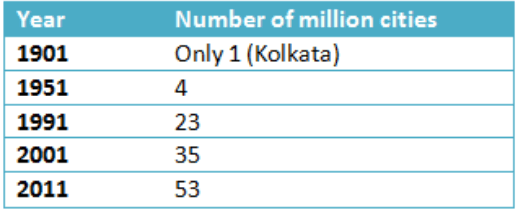
- Major metropolitan cities show very high in-migration rates:
- Mumbai, Delhi: ~3–4 lakh migrants annually
- Bengaluru, Hyderabad, Ahmedabad, Surat: >1 lakh/year
- Lucknow, Jaipur, Patna: >50,000/year
- Industrial regions like Hooghly Industrial Belt:
- Earlier drew migrants from Eastern UP
- Now attracts migrants from Bihar, Assam, North-East, showing expansion of migration catchment areas
- Result:
- Rapid growth of metropolitan regions and urban corridors
- Emergence of mega cities and urban agglomerations
- Major metropolitan cities show very high in-migration rates:
Problems Created Due to Rural–Urban Migration
- Rural–urban migration in developing countries like India is largely push-driven (rural distress) and often unplanned, leading to multiple urban socio-economic and environmental stresses. These problems are interlinked and reflect the inability of urban infrastructure to absorb rapid population influx.
- Major Problems:
- Slum Growth and Informal Settlements:
- Large-scale influx of migrants results in housing shortages, forcing people to settle in:
- Slums, squatter settlements, pavement dwellings
- These areas are characterised by:
- Overcrowding, poor sanitation, lack of basic services
- Reflects mismatch between urban growth and housing provision, a typical feature of over-urbanisation
- Large-scale influx of migrants results in housing shortages, forcing people to settle in:
- Pressure on Urban Infrastructure and Public Utilities:
- Rapid population increase leads to excessive burden on:
- Transport systems → overcrowded buses and trains
- Water supply and drainage systems → water scarcity, flooding, sewage problems
- Electricity supply → power shortages
- Public spaces → encroachment of roads and land
- Results in declining quality of urban life and service delivery inefficiency
- Rapid population increase leads to excessive burden on:
- Cultural and Social Tensions:
- Migration leads to interaction between diverse socio-cultural groups, which may create:
- Adjustment problems between migrants and native urban population
- Perception of migrants as economic competitors
- This sometimes results in:
- Social friction, identity conflicts, and regionalism
- Highlights challenges of urban integration and social cohesion
- Migration leads to interaction between diverse socio-cultural groups, which may create:
- Environmental Degradation and Urban Ecological Stress:
- Unplanned urban expansion due to migration causes:
- Urban Heat Island effect (rise in city temperatures)
- Air pollution due to increased vehicles and industrial activities
- Water pollution and eutrophication of urban lakes and rivers
- Improper solid waste management
- Leads to deterioration of urban ecological balance and sustainability
- Unplanned urban expansion due to migration causes:
- Slum Growth and Informal Settlements:
Seasonal Migration in India
- Seasonal migration refers to the cyclical and temporary movement of people between source and destination, largely governed by seasonal demand for labour, climatic conditions and livelihood opportunities. It is a form of circular migration, prominent in developing economies where agrarian distress and informal labour markets coexist.
- Patterns and Forms of Seasonal Migration:
- Seasonal migration in India is primarily labour-driven and regionally structured, with clear source–destination linkages:
- Labour Migration (Agricultural and Industrial):
- Major flows from Bihar, Eastern Uttar Pradesh, Odisha, Jharkhand, Chhattisgarh (push regions)
- Destinations include Punjab, Haryana (agriculture), Gujarat, Maharashtra (industry), Jammu & Kashmir and North-East India
- Driven by:
- Seasonal demand for agricultural labour (harvesting, sowing)
- Informal sector jobs in construction, brick-kilns, small industries
- Migration to Metropolitan Cities:
- Migrants move to cities for construction work, informal services and footloose industries
- Employment is often:
- Temporary and underpaid, yet relatively better than rural unemployment
- Reflects distress-driven migration with limited upward mobility
- Migration to Religious and Tourist Centres:
- Prominent in Himalayan region (Uttarakhand) and South India
- Example:
- Migrant workers from Eastern UP move to hill stations and pilgrimage centres during peak tourist seasons
- Creates seasonal service economies in these regions
- Labour Migration (Agricultural and Industrial):
- Seasonal migration in India is primarily labour-driven and regionally structured, with clear source–destination linkages:
- Associated Problems of Seasonal Migration:
- Seasonal migrants constitute one of the most vulnerable sections of the labour force, facing multiple socio-economic challenges:
- Insecurity and Lack of Legal Protection:
- Absence of formal contracts → job insecurity and arbitrary dismissal
- No institutional support in disputes with employers
- Lack of Social Security and Identity:
- Absence of proper documentation → exclusion from:
- Public Distribution System (PDS)
- Healthcare and welfare schemes
- Leads to informal and invisible workforce conditions
- Absence of proper documentation → exclusion from:
- Labour Exploitation and Low Wages:
- Migrants are often paid below minimum wages
- Poor working conditions in construction, brick-kilns and agriculture
- Occupational and Agricultural Hazards:
- Exposure to:
- Pesticides, unsafe machinery, harsh climatic conditions
- Particularly in Punjab–Haryana agricultural belt, where migrants accept risks due to lack of alternatives
- Exposure to:
- Social Vulnerability:
- Migrants often belong to SC/ST, landless and BPL groups, making them:
- Socially marginalized
- Economically dependent
- Poor living conditions at destination (temporary shelters, lack of sanitation)
- Migrants often belong to SC/ST, landless and BPL groups, making them:
- Insecurity and Lack of Legal Protection:
- Seasonal migrants constitute one of the most vulnerable sections of the labour force, facing multiple socio-economic challenges:
- Measures and Policy Interventions:
- Addressing seasonal migration requires portable and inclusive welfare mechanisms:
- Identity and Social Security:
- Introduction of portable ration cards (One Nation One Ration Card)
- Proposed UWIN (Unorganised Workers Identification Number) to create a unified database
- Labour Protection:
- Formalisation of contracts and enforcement of minimum wages
- Regulation of working conditions in informal sectors
- Basic Amenities at Destination:
- Provision of:
- Temporary housing
- Sanitation, drinking water, healthcare facilities
- Provision of:
- Rural Development Measures:
- Strengthening rural employment (e.g., MGNREGA)
- Reducing distress-driven migration

Sectoral Migration in India
- Internal migration in India can be understood through four sectoral streams, reflecting the direction of movement between rural and urban sectors.
- Rural to Rural (47%)
- Rural-Urban (32%)
- Urban-Urban (15%)
- Urban to Rural (6%)
- These streams capture the functional transformation of economy, settlement hierarchy and labour mobility.

1. Rural → Rural Migration (≈47%)
- This is the largest and most dominant stream of migration, primarily intra-sectoral, and reflects the traditional agrarian and social structure of India.
- It has both:
- Intra-regional dominance (short-distance, high volume)
- Limited but significant inter-regional flows
- Major causes include:
- Marriage migration (especially among females), forming the bulk of this stream
- Agricultural labour mobility, involving movement from:
- Overpopulated to relatively underpopulated agricultural regions
- Examples:
- Awadh–Rohilkhand plains → Delta regions
- Marusthali (Rajasthan desert) → Banas Valley
- UP & Bihar → Punjab, Haryana, Assam (Green Revolution regions)
- Government-induced migration:
- Resettlement policies have also contributed:
- Sikh resettlement in Tarai (UP)
- Dandakaranya Project (rehabilitation of displaced populations)
- Resettlement policies have also contributed:
- 👉 This stream reflects agrarian linkages, social customs and regional labour adjustments.
2. Rural → Urban Migration (≈32%)
- This is the most significant inter-sectoral migration, historically dominant since independence, though now second in share.
- It is driven by:
- Push factors: rural poverty, unemployment, land fragmentation
- Pull factors: urban jobs, infrastructure, better living conditions
- Key features:
- Migrants originate largely from population surplus states (UP, Bihar, MP, Odisha)
- Destinations include:
- Metropolitan cities and megacities
- Emerging industrial and service hubs
- Impact:
- Major driver of urbanisation and growth of megacities
- Expansion of informal sector and urban periphery
- Sub-patterns:
- Intra-regional migration: within states (e.g., within UP, Kerala)
- Inter-regional migration: across states (e.g., to Maharashtra, Delhi, Chandigarh)
- 👉 Reflects structural transformation (Lewis Model) and core–periphery interaction.
3. Urban → Urban Migration (≈15%)
- This stream involves movement from smaller towns to larger cities, reflecting urban hierarchy and economic mobility.
- Key characteristics:
- Dominated by middle-class and skilled population
- Motivated by:
- Better employment opportunities
- Higher-order services and lifestyle
- Often follows Step Migration (Ravenstein):
- Rural → Small town (Class II/III) → Large city (Class I/metropolitan)
- Consequences:
- Growth of metropolitan dominance
- Creation of vacuum in small towns (loss of skilled workforce)
- 👉 Reflects urban system restructuring and hierarchical diffusion of population.
4. Urban → Rural Migration (≈6%)
- This is the least dominant stream, often termed as counter-current or reverse migration.
- Occurs due to:
- Urban push factors:
- Congestion, pollution, high cost of living
- Stressful urban lifestyle
- Seen in:
- Retired population returning to rural areas
- Some cases of counter-urbanisation
- Urban push factors:
- Characteristics:
- Limited scale in India compared to developed countries
- More visible in advanced stages of urbanisation
- 👉 Reflects early signs of counter-urbanisation, though still weak in India.
Spatial Trends of Migration in India
- Spatial patterns of migration in India reflect regional disparities in development, resource endowment and employment opportunities, producing clear source–destination corridors. These patterns largely follow economic gradients and proximity principles, consistent with Ravenstein’s laws (short-distance dominance with notable long-distance exceptions).
- Major Source and Destination Regions:
- Core source regions (out-migration zones):
- Uttar Pradesh and Bihar are the largest suppliers of migrants due to:
- High population pressure
- Agrarian distress and unemployment
- Other contributors include Odisha, Rajasthan, Madhya Pradesh
- Uttar Pradesh and Bihar are the largest suppliers of migrants due to:
- Major destination regions (in-migration zones):
- Maharashtra, Gujarat, Delhi (NCT), Haryana, Punjab, Karnataka
- These regions attract migrants due to:
- Industrialisation (Maharashtra, Gujarat, Delhi)
- Agricultural prosperity (Punjab, Haryana)
- Service sector growth (Karnataka)
- Core source regions (out-migration zones):
- Sectoral and Regional Linkages
- Industrial pull regions:
- Delhi (NCT), Maharashtra, Gujarat → attract labour for:
- Manufacturing, construction, services
- Represent urban-industrial cores
- Delhi (NCT), Maharashtra, Gujarat → attract labour for:
- Agricultural pull regions:
- Punjab and Haryana → attract seasonal and permanent agricultural labour
- Linked with Green Revolution regions
- Regional migration patterns:
- Karnataka receives migrants mainly from southern states (intra-regional dominance)
- Domestic workers in metropolitan cities largely originate from West Bengal
- Industrial pull regions:
- Role of Distance and Historical Factors
- Most migration follows the principle of adjacency (neighbouring states) due to:
- Lower cost and cultural similarity
- However, notable exceptions (long-distance migration):
- Migrants from UP → Maharashtra
- Migrants from Odisha → Gujarat
- Historical-industrial factors:
- Eastern India’s migration historically oriented towards:
- Kolkata and Damodar Valley industrial region
- Reflects legacy of colonial industrialisation and transport networks
- Eastern India’s migration historically oriented towards:
- Most migration follows the principle of adjacency (neighbouring states) due to:
- Stable and Special Regions
- Peninsular India (South India):
- Shows relatively stable migration patterns, due to:
- Balanced development
- Distance from major northern source regions
- Shows relatively stable migration patterns, due to:
- States attracting migrants consistently:
- West Bengal, Assam, Punjab → due to:
- Agriculture, tea plantations, industry
- West Bengal, Assam, Punjab → due to:
- Peninsular India (South India):
- Kerala: A Unique Case
- Kerala represents a distinct migration pattern:
- Despite being relatively developed, it is a net out-migration state internationally
- Limited scope for:
- Agriculture
- Large-scale industrial employment
- High out-migration to Middle East (Gulf countries) →
- Leads to remittance-driven economy (“Money Order Economy”)
- 👉 Illustrates external migration compensating for internal limitations.
- Kerala represents a distinct migration pattern:
- Areas of Low Migration (Isolated Regions)
- Certain regions remain migration-deficit or isolated due to physical constraints:
- Himalayan region (Northern mountain wall)
- Thar Desert
- Rann of Kutch
- These areas have:
- Harsh climate
- Poor accessibility
- Limited economic opportunities
- Certain regions remain migration-deficit or isolated due to physical constraints:
External Migration in India
- External migration refers to the movement of population across international boundaries, and in the Indian context it includes emigration (outflow), immigration (inflow), and refugee migration (forced inflow).
- It reflects India’s historical linkages, colonial legacy, global labour integration and geopolitical position in South Asia.
1. Emigration from India (Historical to Contemporary Phases)
- Indian emigration has evolved through distinct historical phases, each shaped by economic demand, political change and global linkages:
- Colonial Phase (19th Century – Early 20th Century):
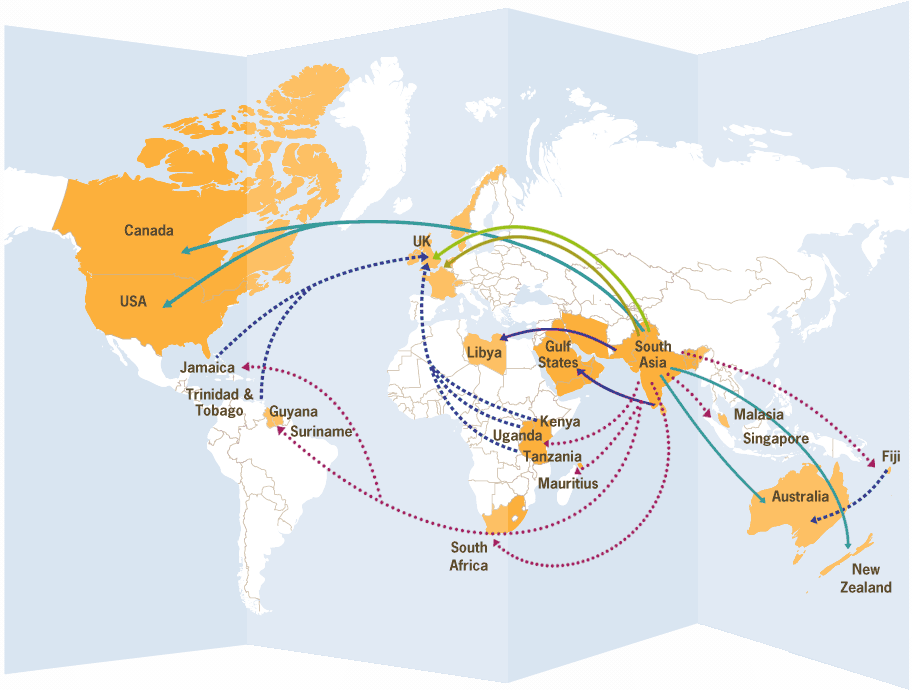
- Beginning in 1834, under British rule, Indians were exported as indentured labour to plantation economies:
- Mauritius, Guyana, Trinidad, Suriname, Fiji, South Africa
- Similar systems were adopted by France and Netherlands
- This phase laid the foundation of the Indian diaspora across Caribbean, Africa and Southeast Asia
- Beginning in 1834, under British rule, Indians were exported as indentured labour to plantation economies:
- Pre-Independence / Partition Phase (1940s):
- The Partition of India led to one of the largest migrations in history:
- 12–18 million people displaced between India and Pakistan
- Massive violence with 200,000–1 million deaths
- This migration was bi-directional and politically driven
- The Partition of India led to one of the largest migrations in history:
- Bangladesh Crisis (1971):
- During the formation of Bangladesh, around 10 million refugees entered India, though many later returned
- Post-Independence Phase (1950s–1980s):
- Migration of unskilled and semi-skilled workers (especially Punjabi Sikhs) to the UK
- Driven by:
- Post-war labour demand in Britain
- Commonwealth migration policies
- Legal facilitation through Passports Act, 1967
- Contemporary Phase (Globalised Migration):
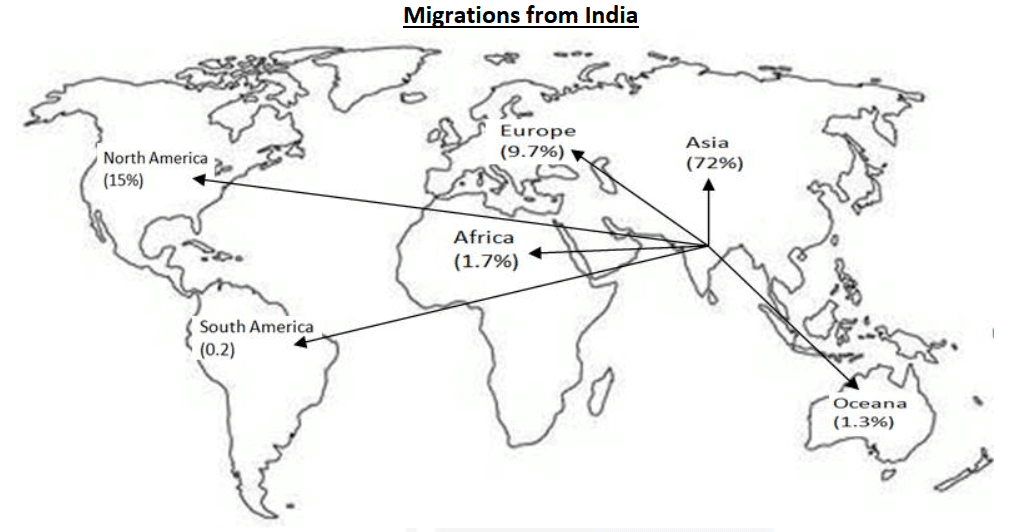
- India is the largest source of international migrants (~17.5 million)
- Major destinations:
- Gulf countries (UAE, Saudi Arabia) → labour migration
- USA, UK, Canada, Australia → skilled migration (IT, healthcare)
- India is also the largest recipient of remittances (~$78 billion+)
- 👉 This phase reflects brain drain → brain circulation → global Indian diaspora networks.
2. Immigration into India (In-Migration)
- Immigration into India is relatively limited but regionally significant, driven by geographical proximity and political instability in neighbouring countries:
- Major source countries:
- Bangladesh, Pakistan, Nepal
- Also includes migrants from Afghanistan, Myanmar (Rohingya), Tibet
- Key features:
- India is both:
- A source of global migrants
- A regional destination for neighbouring populations
- According to UNDESA:
- India contributes ~6.4% of global migrant population
- India is both:
- Immigration contributes to:
- Labour markets (informal sector)
- Cultural diversity in border regions
3. Refugee Migration (Forced External Migration)
- Refugee migration is a significant component of India’s external migration, driven by political conflict, persecution and humanitarian crises.
- A refugee is defined (UN framework) as a person fleeing due to:
- Race, religion, nationality, political opinion or social group persecution
- Major refugee inflows into India:
- Partition Refugees (1947):
- Large-scale forced migration across India–Pakistan borders
- Tibetan Refugees (1959 onwards):
- Settled in northern and northeastern India
- Led by Dalai Lama
- Bangladesh War Refugees (1971):
- Millions entered India during conflict
- Sri Lankan Tamil Refugees:
- Due to ethnic conflict and civil war (1980s onwards)
- Rohingya Refugees (Myanmar):
- ~40,000 entered India; many registered under UNHCR
- Partition Refugees (1947):
- Key characteristics:
- Refugees do not change nationality
- Often concentrated in border states and specific settlements
Geographical Synthesis
- External migration in India reflects:
- Historical legacy (colonial diaspora)
- Economic globalisation (labour + skilled migration)
- Geopolitical location (South Asian refugee inflows)
- The pattern aligns with:
- Push–Pull Model (Lee) → economic pull (Gulf, West) + political push (neighbouring conflicts)
- Zelinsky’s Mobility Transition → increasing international mobility in advanced stages
International Migration in India
- International migration in India involves cross-border movement of people, and is broadly classified into:
- International In-Migration (Immigration)
- International Out-Migration (Emigration)
- It reflects India’s historical experiences (partition, colonialism), regional geopolitics, and integration into global labour markets.
1. International In-Migration (Immigration into India)
- India has not been a major destination globally, but specific historical and geopolitical events have led to significant inflows:
- Partition Migration (1947–1951):
- One of the largest migrations in history during the Partition of India
- Around 73 lakh refugees entered India, mainly:
- Hindus and Sikhs from Pakistan
- Settlement patterns:
- Urban areas, refugee colonies, and Tarai region of Uttar Pradesh
- Impact:
- Rather than creating instability, migrants contributed to economic growth and urban expansion
- Tibetan (Buddhist) Migration (1954–59):
- Around 1 lakh Tibetans migrated to India, settling mainly in Dharamshala (Himachal Pradesh)
- Led by Dalai Lama
- Created distinct cultural enclaves with minimal conflict
- Bangladesh Liberation War (1971):
- Around 10 million refugees entered India during the conflict
- India provided humanitarian support on an unprecedented scale
- Many later returned after independence of Bangladesh
- Sri Lankan Tamil Migration:
- Result of ethnic conflict and civil war in Sri Lanka
- Tamil refugees settled mainly in Tamil Nadu
- Contemporary In-Migration Trends:
- Includes migrants from:
- SAARC countries and African nations
- Driven by:
- Education (scholarships), business, healthcare
- Return migration of Indians (reverse migration):
- From conflict zones like Yemen, Syria, Iraq due to geopolitical instability
- Includes migrants from:
2. International Out-Migration (Emigration from India)
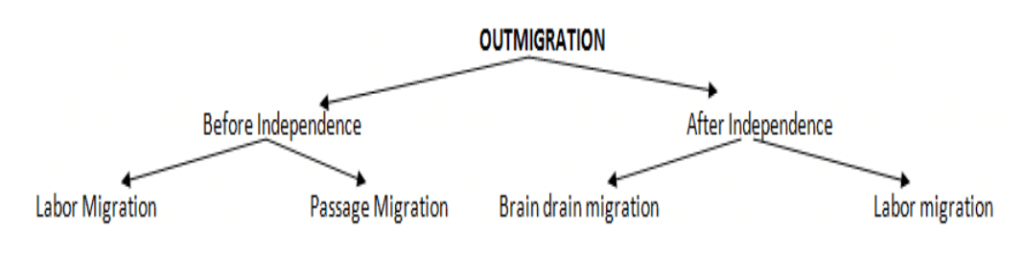
(A) Pre-Independence Migration
- Indentured Labour Migration (Post-1833):
- After abolition of slavery, labour shortage led to migration of Indians to plantation economies:
- From UP, Bihar → Caribbean, Mauritius
- From Punjab, Western UP → Fiji
- From Tamil Nadu → Malaysia (rubber plantations)
- These migrants formed the base of the Indian diaspora
- After abolition of slavery, labour shortage led to migration of Indians to plantation economies:
- Passage Migration (Free Migration):
- More organised and voluntary migration to:
- Hong Kong, Kenya, Uganda, Singapore, South Africa
- Source regions:
- Gujarat (traders), Punjab, Tamil Nadu, Maharashtra
- Migrants settled permanently and contributed to commercial networks
- More organised and voluntary migration to:
(B) Post-Independence Migration
- Brain Drain Migration:
- Migration of highly skilled professionals to:
- USA, Canada, Europe
- Driven by:
- Better opportunities, higher wages, research environment
- Example:
- Indian professionals in Silicon Valley with high income levels
- Recently shifting towards brain circulation (return migration, global networks)
- Migration of highly skilled professionals to:
- Labour Migration to Gulf Countries:
- Triggered by oil boom (1970s) after West Asian geopolitical events
- Large-scale migration of semi-skilled and unskilled workers
- Around 7 million Indians working in Gulf region
- Major source states:
- Kerala, Andhra Pradesh, Tamil Nadu, UP, Bihar
- Consequences:
- High remittance inflows
- Creation of “remittance economies” (e.g., Kerala)
Geographical Synthesis
- International migration in India shows:
- Historical continuity: from indentured labour → modern global labour migration
- Regional specialization:
- North India → labour migration
- South India → Gulf migration
- Urban India → skilled migration
- The pattern aligns with:
- Push–Pull Model (Lee):
- Push → unemployment, low wages
- Pull → global opportunities, higher income
- Globalisation: integration of India into global labour and knowledge economy
- Push–Pull Model (Lee):
Conclusion
- International migration in India is a multi-layered process combining historical legacy, economic necessity and geopolitical realities.
- While out-migration dominates, in-migration is shaped by regional conflicts and proximity.
- Overall, India has emerged as:
- A major global labour supplier
- A leading remittance economy
- A regional refuge space in South Asia






Dear LotusArise,
Thank you for such precise and clear notes. Thanks for your valuable efforts and help to future civil servants. and All The Best for your journey as well.
Thanks
Most Welcome, Deepak
Thankyou sir thank you very much