

- Social well-being and quality of life (QoL) are multidimensional concepts in Population Geography that go beyond mere income or economic growth and focus on the overall condition of human life in terms of health, education, dignity, security, and environmental quality.
- While social well-being emphasizes the collective welfare of society, quality of life reflects the individual’s level of satisfaction and living conditions within a given socio-spatial context.
- Social well-being refers to the state in which individuals and communities experience social justice, equity, inclusion, and access to basic services, enabling them to lead meaningful lives.
- Quality of life refers to the degree to which individuals enjoy physical, economic, social, and environmental conditions that contribute to a fulfilling life, including both:
- Objective indicators (income, literacy, life expectancy)
- Subjective indicators (happiness, satisfaction, perception of well-being)
- Thus, QoL integrates: Material well-being + social equity + environmental sustainability
Social Well-Being and Quality of Life

- Quality of life is a concept, which in recent years, has generated a great deal of interest but it is not only a notion of the twentieth century. Rather it dates back to philosophers like Aristotle (384-322 BC) who wrote about “the good life‟ and “living well‟ and how public policy can help to nurture it.
- With Critical Revolution in geography, man became the centre of study (welfare geography). The concept of social well-being and Quality of Life has emerged from the concept of welfare geography.
- General definition of “Quality of life‟ is “a person’s sense of well-being, his satisfaction or dissatisfaction with life, or his happiness or unhappiness”
- WHO defines Quality of Life as “the condition of life resulting from the combination of effects of a complete range of factors such as those determining health, happiness, education, social and intellectual attainment, freedom of action, justice and freedom of expression”.
- Quality of Life requires that people’s basic and social needs are met and that they have the autonomy to choose to enjoy life, to flourish, and to participate as citizens in a society with high levels of civic integration, social connectivity, trust, and other integrative norms including at least fairness and equity, all within a physically and socially sustainable global environment.
- Quality of Life includes both the objective and subjective realities, measurable and non-measurable aspects of human living. Quality of Life is a multi-faceted phenomenon which means welfare in general and health prosperity in particular.
- Physical well-being – It includes environmental conditions such as climatic variation, local topographical variations, physical density, physical and mental health.
- Material well-being – It includes household equipment including electrical and electronics equipment, means of conveyance, and communications.
- Social well-being – It includes social health, social security, social amenities and social relations including social ethos.
- Economic well-being – It includes employment opportunities, level of income and savings and purchasing power, consumption of goods and services.
- Perception of well-being – It includes attitude towards external living and nonliving things, individual/social traits, experiences of real-world situations, and an element of subjectivity.
- Spiritual well-being – It includes religious beliefs, practices, taboos, and various approaches to seek truth and happiness.
- Quality of life should not be confused with the concept of standard of living, which is based primarily on income. Instead, standard indicators of the quality of life include not only wealth and employment, but also the built environment, physical and mental health, education, recreation and leisure time, and social belonging.
Social Well-Being
- The study of social well-being in geography is the inevitable result of the relevance movement which started in the 1970s. It aimed at addressing those human problems which were afflicting society at large. It was launched to groom geography as a socially relevant discipline. Hence, geography began to address the welfare issues which provided a new framework for micro-level inquiries. Microlevel spatial analysis has enhanced the role of geography in developmental planning. Through the social relevance movement, the emphasis of inquiry in geography shifted from the study of marginal land to the marginal social space.
- An important dimension of quality of life is ,of course, social well-being which connotes “a condition in which basic human needs are met, anti people are able to coexist peacefully in communities with opportunities for advancement”.
- Social well-being means a healthy relationship environment with society, social stability, and Peace. Social well-being is required to overcome loneliness in life. Good communication networks and healthy relationships amongst people are essential for social well-being.
- A “well society”, for example, is one in which all people have sufficient income to meet their basic needs, where all are treated with equal dignity and have equal rights, where they have reasonable access to their needed range of services, and where their opinions are heard and respected. The quality of a society can be measured by its success on variables reflecting such desiderata, as can variations within society.
- The following are the components of measurement of social well being:
- Health
- Education
- Food and nutrition
- Equality
- Freedom
- Pollutions
- Law and order
- Social structure
- Sex ratio
- Social well-being is subjective in nature. Preference and components of the social well-being of the person living in the village, town, city, hilly areas, plain areas, or different climatic regions will be different for different people. Even, the meaning of social well-being will differ living in the same geographical areas with different age or ethnicity groups.
- The social well-being of any society over the world has cultural and technological overtones. The developed countries with their advanced technology are ahead in the level of well-being due to the early and rapid urbanization and industrialization and concomitant change in social needs and values.
- But the process of industrialization and urbanization is slow and selective in a majority of other third world countries resulting in a limited change in social needs. The social values change in accordance to the social needs which are governed by the micro geographical conditions level of technology, and cross-cultural assimilation.
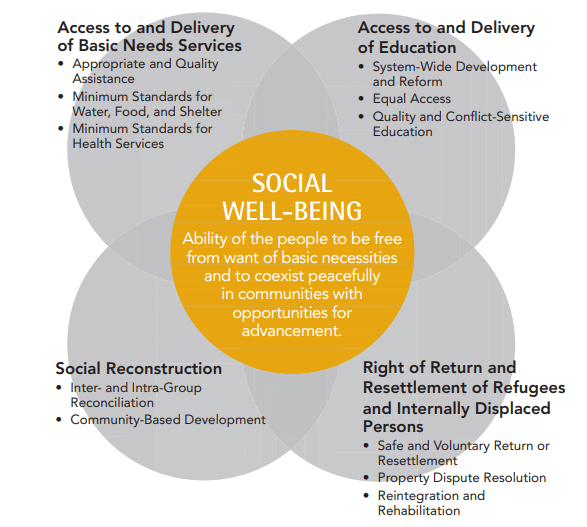
Dimensions of Social Well-Being and Quality of Life
- Social well-being and quality of life are inherently multidimensional, as human life is influenced by a wide range of economic, social, environmental, and institutional factors. No single indicator can capture this complexity; therefore, these dimensions must be analysed in an integrated manner.
1. Economic Dimension (Material Well-being and Livelihood Security)
- The economic dimension relates to the material conditions of life, including income, employment, and access to resources, which determine the standard of living of individuals and households.
- It includes:
- Income levels and purchasing power
- Employment opportunities and job security
- Access to productive resources such as land, capital, and technology
- However, economic prosperity alone does not guarantee high quality of life because:
- Income inequalities can persist
- Benefits of growth may not be equitably distributed
- Thus, the focus has shifted from economic growth to inclusive growth, ensuring that development benefits all sections of society.
2. Health Dimension (Physical and Mental Well-being)
- Health is a core component of QoL as it determines the ability of individuals to live productive and fulfilling lives.
- It includes:
- Life expectancy
- Infant and maternal mortality
- Disease burden (morbidity)
- Access to healthcare services
- Mental health is equally important, as stress, depression, and anxiety affect:
- Productivity
- Social relationships
- Overall life satisfaction
- Regions with better healthcare infrastructure and nutrition levels exhibit:
- Higher life expectancy
- Better human development outcomes
3. Educational Dimension (Human Capital and Awareness)
- Education enhances the capabilities, skills, and awareness of individuals, making it a key determinant of social well-being.
- It includes:
- Literacy rates
- Educational attainment
- Access to quality education
- Education contributes to:
- Better employment opportunities
- Lower fertility rates
- Improved health and nutrition
- Female education plays a transformative role by:
- Empowering women
- Improving family welfare
- Promoting gender equality
4. Social Equality and Inclusion
- Social well-being depends on the extent to which a society ensures:
- Equality
- Justice
- Inclusion
- It involves:
- Gender equality
- Reduction of caste, class, and ethnic disparities
- Equal access to opportunities and resources
- Societies with high inequality experience:
- Social tension
- Reduced overall well-being
- Inclusive development ensures that marginalized groups:
- Participate in growth
- Benefit from development processes
5. Environmental Dimension (Sustainability and Livability)
- Environmental quality directly influences human health and comfort, making it a vital dimension of QoL.
- It includes:
- Air and water quality
- Availability of natural resources
- Waste management and sanitation
- Urban environmental conditions
- Environmental degradation leads to:
- Health hazards
- Reduced life expectancy
- Decline in overall well-being
- Sustainable development aims to balance:
- Economic growth
- Environmental conservation
6. Political and Institutional Dimension (Governance and Rights)
- Governance plays a critical role in determining access to:
- Public services
- Justice
- Security
- This dimension includes:
- Political stability
- Rule of law
- Transparency and accountability
- Protection of human rights
- Effective governance ensures:
- Equitable distribution of resources
- Better implementation of welfare policies
7. Cultural and Social Cohesion
- Cultural factors influence:
- Identity
- Values
- Social relationships
- Strong social cohesion leads to:
- Community support systems
- Reduced social conflict
- Higher levels of trust and cooperation
- Cultural diversity, when managed inclusively, enriches:
- Social life
- Creativity and innovation
8. Psychological and Subjective Well-being
- Quality of life is not only objective but also subjective, depending on how individuals perceive their lives.
- It includes:
- Happiness
- Life satisfaction
- Sense of security and dignity
- Even in economically developed regions, QoL may be low if:
- Stress levels are high
- Social isolation exists
- This dimension highlights that:
- Well-being is as much about perception as it is about material conditions
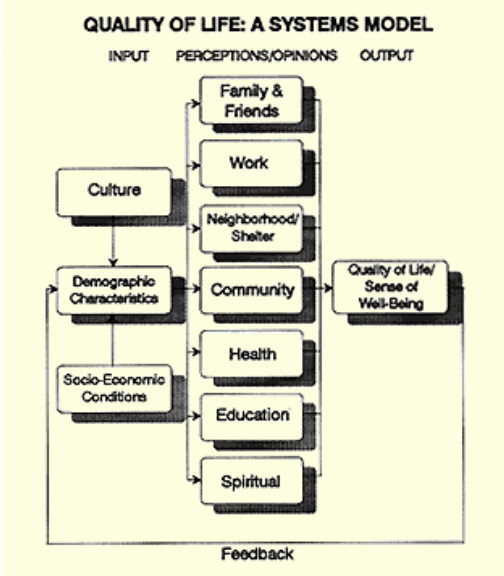
Quality of Life: A Systems Model
- The approach to the measurement of the quality of life derives from the position that there are a number of domains of living.
- Each domain contributes to one’s overall assessment of the quality of life. The domains include family and friends, work, neighborhood (shelter), community, health, education, and spirituality.
- Recent trends with respect to demographic, economic, social indicators provide ground for optimism about human well being due to unprecedented growth in both developed and developing countries, but with problems at local or regional level especially in developing regions, the challenge for making the quality of life better for the people in these regions is complex.
- Problems faced by least developed countries across various facets of well-being are due to the pressure of the population.
- The interaction between population growth & human well-being is complex. An increase in population leads to problems related to environmental degradation in developing countries and if it is unchecked, it will lead to severe consequences.
Cross-National Indices for Measuring Quality of Life / Social Well-Being
- In Population Geography, cross-national indices are used to compare levels of development and well-being across countries, moving beyond income-based measures to capture human, social, and environmental dimensions of life.
- These indices provide a standardized and comparable framework to analyse global inequalities, regional disparities, and development trajectories.
Human Development Index (HDI)
- The Human Development Index (HDI), developed by the United Nations Development Programme, is the most widely used indicator of quality of life and human development.
- It combines three core dimensions:
- Health (Life Expectancy at Birth):
- Indicates longevity and overall health conditions
- Education:
- Measured through:
- Mean years of schooling
- Expected years of schooling
- Measured through:
- Standard of Living (Income):
- Measured through Gross National Income (GNI) per capita (PPP)
- Health (Life Expectancy at Birth):
- HDI values range between 0 and 1, and countries are classified as:
- Very high, high, medium, or low human development
- Significance:
- Moves beyond GDP to focus on human capabilities (Amartya Sen’s approach)
- Useful for cross-country comparison and policy formulation
- Limitation:
- Does not fully capture:
- Inequality
- Gender disparity
- Environmental sustainability
- Does not fully capture:
Inequality-Adjusted HDI (IHDI)
- IHDI modifies HDI by incorporating inequality within a country.
- It shows the actual level of human development, accounting for unequal distribution of:
- Income
- Education
- Health
- Significance:
- Reveals that countries with high HDI may still have low effective development due to inequality
Physical Quality of Life Index (PQLI)
- The Physical Quality of Life Index (PQLI) was developed by Morris D. Morris as an alternative to income-based measures.
- It focuses on basic human needs through three indicators:
- Infant Mortality Rate (IMR)
- Life Expectancy at Age One
- Basic Literacy Rate
- Each indicator is scaled from 0 to 100, and the average gives the PQLI score.
- Significance:
- Emphasizes social development over economic growth
- Useful for assessing basic living conditions
- Limitation:
- Ignores income and economic aspects
- Limited scope compared to modern indices
Multidimensional Poverty Index (MPI)
- The Multidimensional Poverty Index (MPI), developed by Oxford Poverty and Human Development Initiative and UNDP, measures deprivation across multiple dimensions of life.
- It includes three broad dimensions:
- Health:
- Nutrition
- Child mortality
- Education:
- Years of schooling
- School attendance
- Standard of Living:
- Indicators such as:
- Electricity
- Drinking water
- Sanitation
- Housing
- Cooking fuel
- Assets
- Indicators such as:
- Health:
- MPI identifies:
- Intensity and incidence of poverty, not just income poverty
- Significance:
- Captures real living conditions and deprivation
- Useful for targeted policy interventions
- Limitation:
- Data-intensive and complex
- May vary based on indicators selected
World Happiness Index (WHI)
- The World Happiness Index, published under the United Nations Sustainable Development Solutions Network, focuses on subjective well-being.
- It is based on people’s self-reported life satisfaction and includes factors such as:
- Income levels
- Social support
- Healthy life expectancy
- Freedom to make life choices
- Generosity
- Perception of corruption
- Significance:
- Captures psychological and emotional dimensions of well-being
- Highlights that economic prosperity alone does not guarantee happiness
- Limitation:
- Subjective in nature
- Influenced by cultural perceptions and expectations
Gender Development Index (GDI) and Gender Inequality Index (GII)
- These indices focus on gender-based disparities:
- GDI: Compares HDI values of males and females
- GII: Measures inequality in:
- Reproductive health (MMR, adolescent fertility)
- Empowerment (education, political participation)
- Labour force participation
- Significance:
- Reflects status of women in society
- Highlights gender gaps in development
Human Poverty Index (HPI) [Historical]
- Earlier used by UNDP (now replaced by MPI), HPI measured deprivation in:
- Longevity
- Knowledge
- Standard of living
- Significance:
- Focused on absence of basic capabilities
Sustainable Development Goals (SDG Index)
- Tracks progress of countries towards 17 Sustainable Development Goals.
- Covers:
- Poverty
- Health
- Education
- Inequality
- Environment
- Significance:
- Integrates economic, social, and environmental sustainability
Quality of Life Index
- Various global indices (e.g., Economist Intelligence Unit QoL Index) include:
- Political stability
- Climate
- Job security
- Family life
- These provide a broader perspective on livability.





awesome and valuable content. thanks 4 ur efforts.
One of best site for upsc aspirants.It bacame compulsory refence material just like majid Hussain and others.
Thank you
Thanks for your kind words, Keep reading.
Excellent Content. God bless YOU