

- Soil is the upper weathered layer of the Earth’s crust, shaped by the combined action of climate, parent rock, plants and animals over time. A vertical section through it is a soil profile, made of layers called horizons, each with its own kind of soil material.
- Soil holds matter in all three physical states: solid, liquid and gas. Its behaviour depends on how these phases are arranged, so soils are described by diagnostic properties that can be observed or measured.
- These properties fall into three groups: physical (texture, structure, colour, porosity, water, temperature), chemical (pH, colloids, cation exchange, nutrients) and biological (organisms, humus, nutrient cycling). Together they decide soil fertility and soil health.
Soil as a Three-Phase System

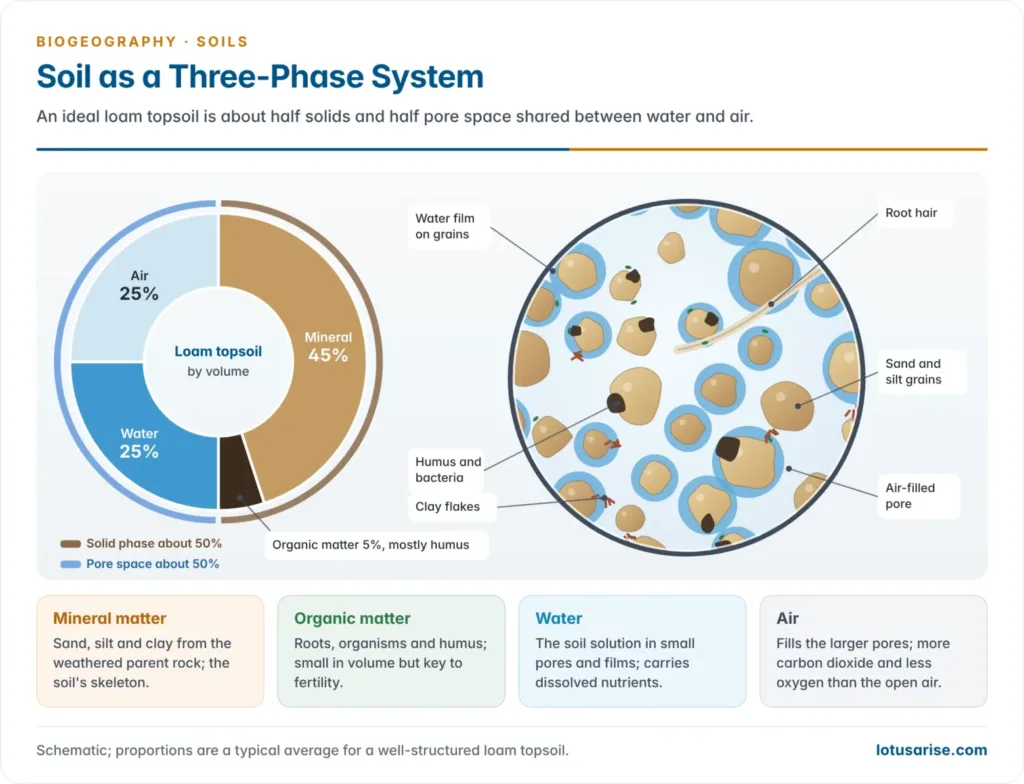
Components of soil
- The inorganic (mineral) part consists of particles derived from the parent material, the rocks whose weathering forms the soil.
- The organic portion consists of living and decayed plant and animal material, such as roots and worms.
- The end-product of decay is humus, a black, amorphous and chemically stable organic matter.
- Soil water is a dilute but chemically complex soil solution, supplied by direct precipitation and by run-off, seepage and groundwater.
- The soil atmosphere fills the pore spaces whenever they are not occupied by water.
- An ideal loam topsoil holds, by volume, about 45% mineral matter, 5% organic matter, 25% water and 25% air.
- Water and air share the same pore space, so a waterlogged soil is starved of oxygen. These proportions help judge a soil’s productivity and best use.
Diagnostic properties at a glance
- Texture is the size make-up of the mineral particles, from coarse sand to fine clay. It largely sets the water-retention properties of a soil.
- In sandy soil pores are large and water drains fast; in clay soil single pores are too small for adequate drainage. Loam textures are best for plant growth.
- Acidity depends on the proportion of exchangeable hydrogen (and aluminium) ions relative to other cations. It is measured on the logarithmic pH scale from 0 (extreme acidity) to 14 (extreme alkalinity).
- Few soils approach these extremes; a pH of about 6.5 is normally the most favourable for cereal crops.
- Colour reveals how a soil was formed and what it is made of. Young soils take the colour of their parent rock; older soils often differ markedly from the rock beneath.
Physical Properties of Soil
- Physical properties depend on the amount, size, shape, arrangement and mineral composition of soil particles, and on the organic matter and pore space in the soil body.
Soil texture
- Soil texture is the relative proportion of sand, silt and clay in the mineral fraction: the coarseness or fineness of the soil. These size groups are called soil separates.
- Texture is a near-permanent property, unlike structure, which management changes.
- Sand and silt contribute little to holding water or nutrients. Clay is the active fraction: its tiny particles have a very large surface area per unit mass, which stores ions and water.
- Texture governs water-holding capacity, nutrient retention and fixation, drainage, aeration, compressibility and ease of tillage.
| Separate | USDA diameter | International (Atterberg) diameter | Contribution to soil function |
|---|---|---|---|
| Clay | Below 0.002 mm | Below 0.002 mm | Active fraction; stores ions and water; drives cation exchange |
| Silt | 0.002–0.05 mm | 0.002–0.02 mm | Intermediate; holds some water, little nutrient |
| Sand | 0.05–2 mm | 0.02–2 mm | Coarse; large pores, fast drainage, low retention |
| Gravel and stones | Above 2 mm | Above 2 mm | Not soil particles; reported as a coarse-fragment modifier |
The texture triangle
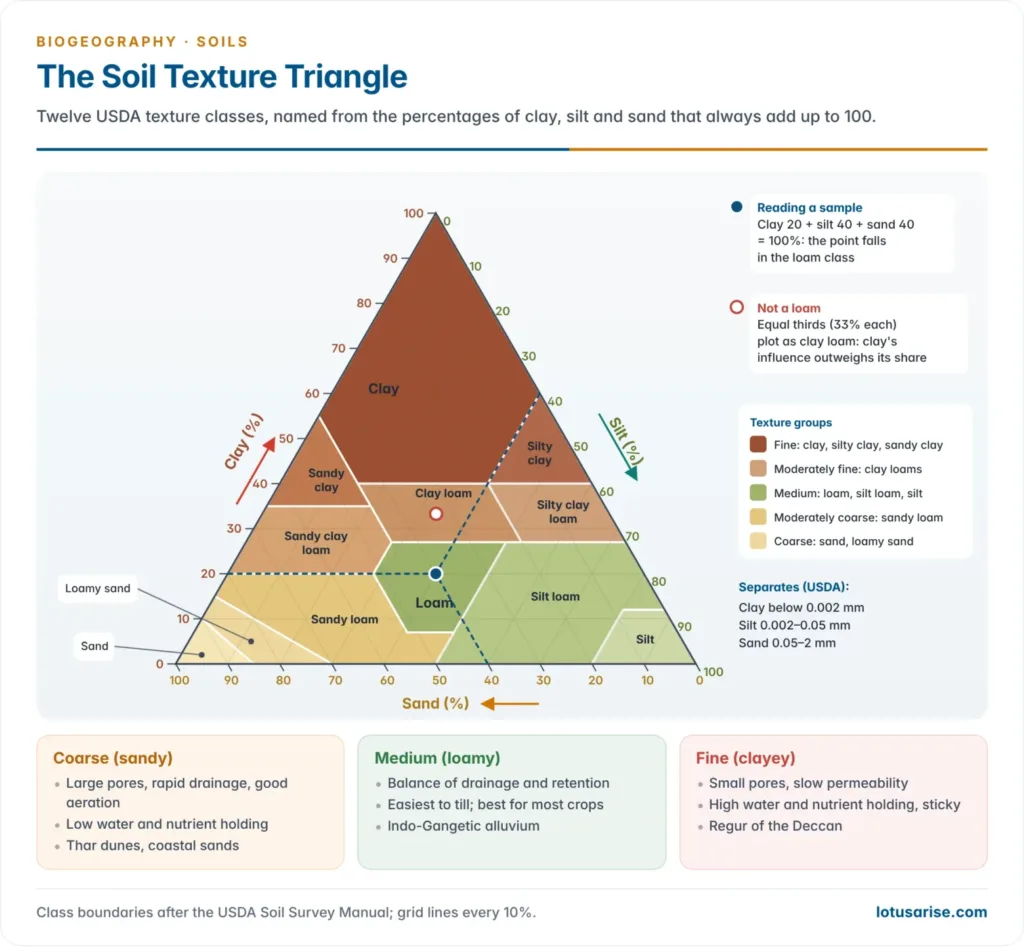
- The USDA soil texture triangle names a soil from its sand, silt and clay percentages, which always add up to 100. It recognises 12 textural classes.
- Clay percentage is read along the left side, silt along the right side and sand along the base. The point where the three readings meet falls in one class.
- Loamy soil is one in which no single fraction dominates. A typical loam has about 40% sand, 40% silt and 20% clay, which is why it is regarded as the ideal agricultural texture.
- Equal thirds of sand, silt and clay do not make a loam: with 33% clay such a soil plots as a clay loam, because clay’s influence is out of proportion to its share.
- The 12 classes form five texture groups:
- Coarse: sand, loamy sand.
- Moderately coarse: sandy loam.
- Medium: loam, silt loam, silt.
- Moderately fine: sandy clay loam, clay loam, silty clay loam.
- Fine: sandy clay, silty clay, clay.
- Indian examples: the Thar dunes are sand and loamy sand; the alluvium of the Indo-Gangetic plain is mostly sandy loam to silt loam; the regur of the Deccan is clay, often with 40–60% clay.
Soil structure
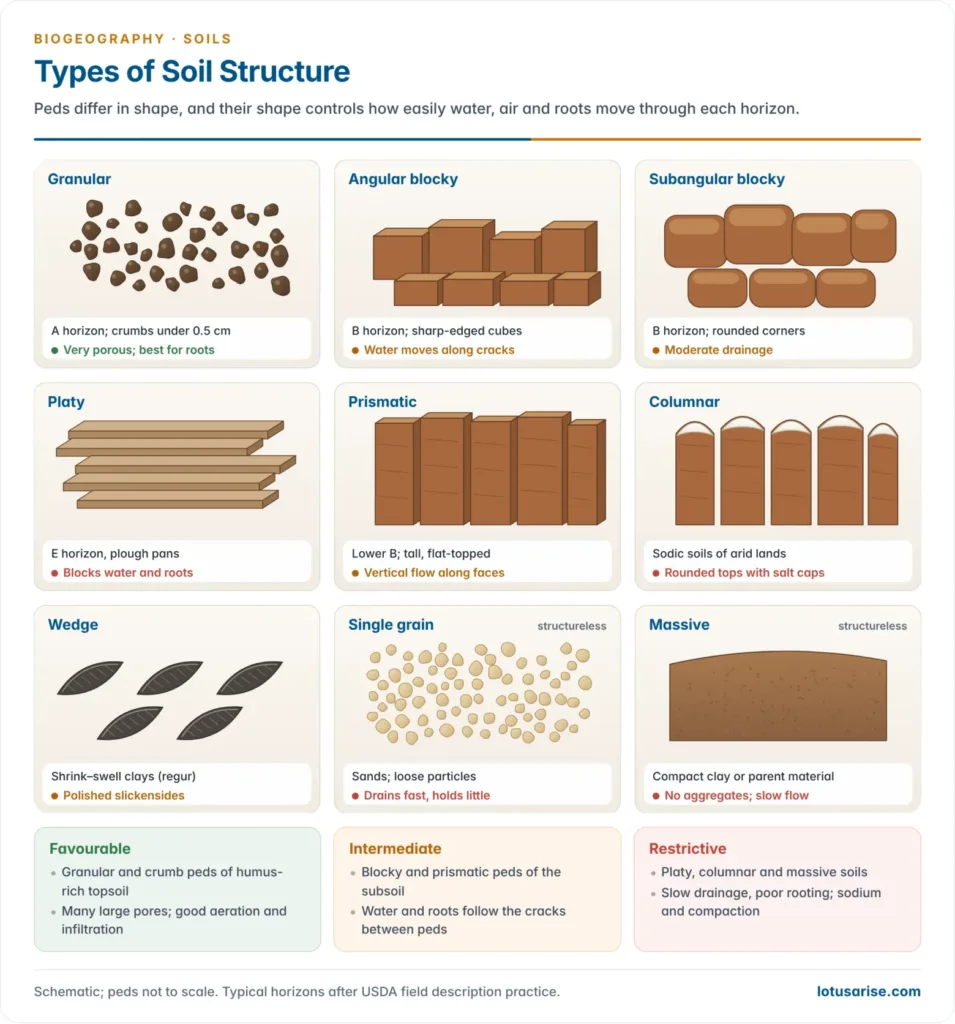
- Soil structure is the arrangement of soil particles into aggregates, called peds, such as plate-like, block-like or prism-like units.
- Binding agents: clay, organic matter, iron and aluminium oxides, calcium, fungal threads, roots and gums excreted by soil organisms such as earthworms and bacteria cement particles into aggregates.
- Structure regulates air and water movement, root growth and nutrient availability.
- Good-quality soils are friable (crumbly), with fine aggregates that break easily when squeezed.
- Poor structure is coarse, forms very firm clods, or has no structure at all.
- Unlike texture, structure changes with management:
- Heavy machinery and repeated ploughing at one depth form a compacted plough pan.
- Sodium disperses clay and destroys aggregates, so sodic soils turn sticky when wet and crust when dry.
- Organic manure, crop residues and grass leys rebuild aggregates.
Types of structure
- Platy: thin, flat plates lying parallel to the horizons, like pages in a book.
- It reduces air, water and root movement. It is typical of the E horizon and of compacted surface soils.
- Blocky: irregular blocks, usually 1.5–5.0 cm across, common in the B horizon.
- Angular blocky peds are cube-like with sharp corners; subangular blocky peds have rounded corners.
- Prismatic and columnar: the vertical axis is longer than the horizontal one, giving columns several centimetres long in lower horizons.
- With flat tops they are prismatic; with rounded tops they are columnar. Columnar peds, often with a salt cap, occur in sodium-rich soils of arid climates.
- Granular: small, round and porous peds, usually less than 0.5 cm across, formed where roots and soil animals are active. This is the usual structure of A horizons.
- Structureless: no observable aggregation.
- Single grain: loose particles that do not stick together, common in sandy soils.
- Massive: a continuous, unconsolidated mass without aggregates.
- Wedge-shaped peds with polished, grooved faces (slickensides) form in shrink–swell clays such as the black soils of the Deccan.
Soil colour
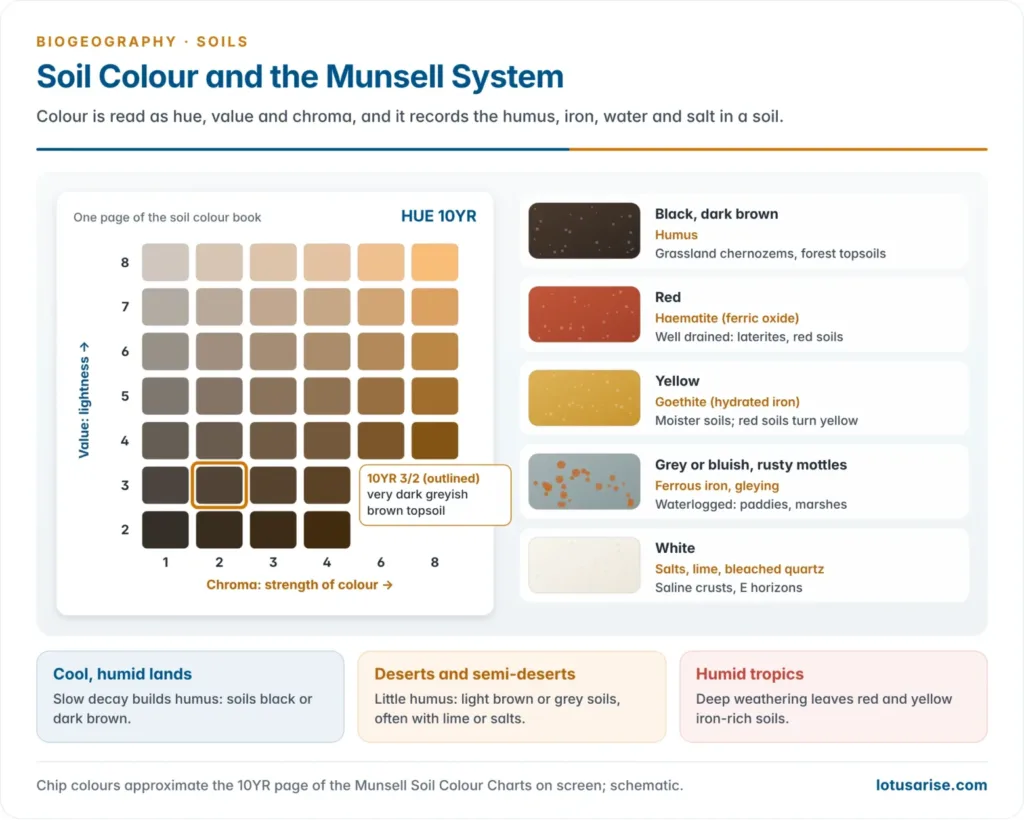
- Soil colour is the most visible property. It depends mainly on organic matter and on the form of iron present.
- The darker the soil, the more organic matter it usually contains.
- Soils rich in humus are dark brown or black and usually very fertile, so they are often called “rich”.
- Dark soils absorb more solar radiation and warm faster when dry, which helps early growth.
- Red and yellow colours come from ferric (oxidised) iron compounds.
- Red comes from haematite and signals a well-drained, well-oxidised soil, though locally it may simply be inherited from a red parent rock.
- Yellow comes from hydrated iron oxide (goethite) in moister soils.
- Grey, bluish or green colours with rusty mottles come from reduced (ferrous) iron under waterlogging, a process called gleying.
- White colours come from salts, calcium carbonate or bleached quartz.
- Regional pattern:
- In cool, humid areas most soils are rich in humus and black or dark brown.
- In deserts and semi-deserts little humus is present and soils are light brown or grey.
- In the humid tropics, deep weathering leaves red and yellow iron-rich soils.
- Indian examples:
- The laterite soils of the Western Ghats are red from ferric oxides and hydroxides concentrated under intense wet–dry leaching.
- The red soils of Tamil Nadu, Karnataka and the Chotanagpur plateau are red where iron is oxidised and yellow where it is hydrated.
- The black colour of regur is not due to abundant humus: its organic carbon is usually low. It comes mainly from clay–humus complexes and titaniferous magnetite inherited from the Deccan basalt.
The Munsell system
- Soil colour is described by three parameters: hue, value and chroma.
- Hue is the dominant wavelength of light (red, yellow-red, yellow), written as 10R, 5YR, 10YR and so on.
- Value is the lightness of the colour, from 0 (black) to 10 (white).
- Chroma is the purity or strength of the colour, from 0 (neutral grey) upward.
- Colour is read by matching a sample against standard colour chips in the Munsell Soil Colour Charts, based on the colour system of Albert Henry Munsell (1905) and adopted by the United States soil survey in 1949.
- Each page carries one hue, marked in the top right-hand corner; value runs up the vertical axis and chroma along the horizontal axis.
- A notation such as 10YR 3/2 means hue 10YR, value 3 and chroma 2: a very dark greyish-brown, humus-rich topsoil.
Porosity, bulk density and permeability
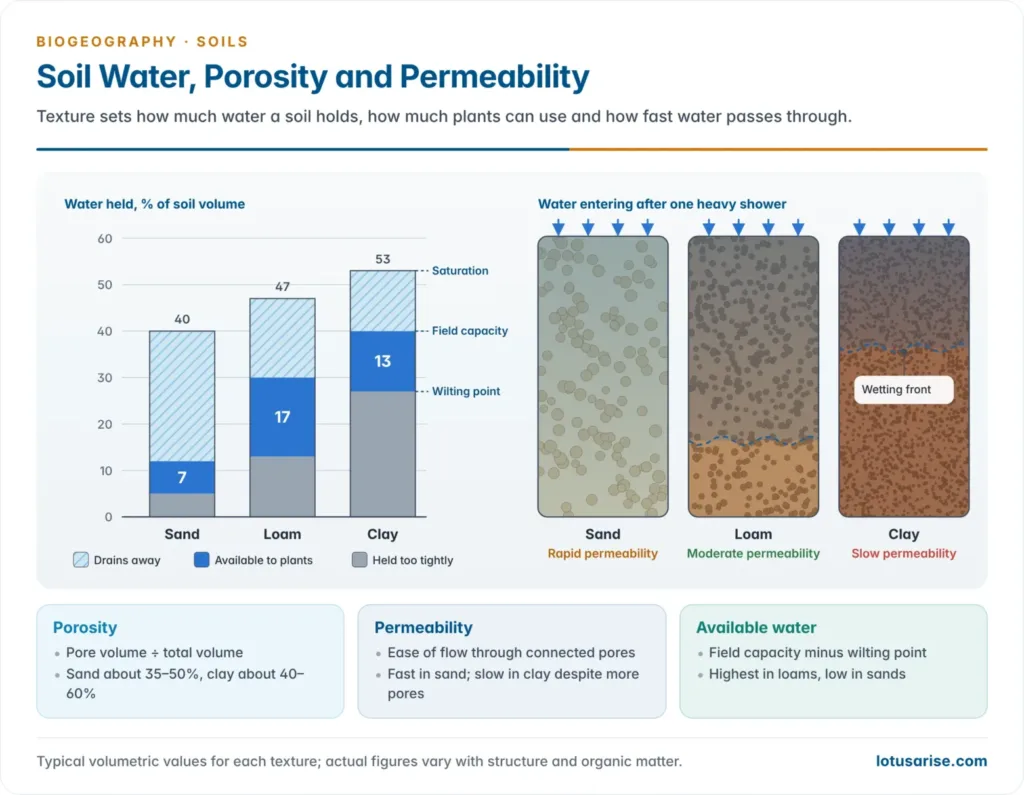
- Porosity is the volume of pores (voids) as a ratio of the total volume of the soil. It sets how much water and air the soil can hold.
- Macropores drain freely and carry air and roots; micropores hold water by capillarity.
- Sandy soils have fewer but larger pores (about 35–50% porosity); clayey soils have more but tiny pores (about 40–60%).
- A soil with high organic content also tends to have high porosity.
- Bulk density is the mass of dry soil per unit of its total volume, pores included. Most mineral soils range from about 1.1 to 1.6 g/cm³.
- The mineral grains themselves have a particle density of about 2.65 g/cm³, so porosity = 1 − bulk density ÷ particle density.
- Compaction raises bulk density; above about 1.6 g/cm³ roots struggle to penetrate.
- Permeability is the ease with which water or air passes through a soil or rock layer. It depends on the size, shape, packing and continuity of pores.
- It is greatest in sandy soils and poor in clayey soils, and it can be altered by management.
- Permeability must be known to plan irrigation and drainage and to understand the soil’s water balance.
- Porosity and permeability differ:
- Clay is highly porous yet nearly impermeable, because its pores are so small that water is held in them by surface tension.
- Granite is non-porous but permeable: its crystals absorb little or no water, but water passes through its joints and cracks.
Soil water and soil air
- Forms of soil water:
- Gravitational water fills large pores after rain and drains away within a day or two, recharging groundwater.
- Capillary water is held in micropores and around grains; it is the main water used by plants.
- Hygroscopic water is a thin film held tightly on particle surfaces and is unavailable to plants.
- Soil-water constants:
- Saturation: all pores are filled with water.
- Field capacity: the water left after free drainage, held at a tension of about −33 kPa.
- Permanent wilting point: the moisture at which plants wilt and cannot recover, at about −1,500 kPa.
- Available water = field capacity − wilting point. It is highest in loams and silt loams, lowest in sands, and only moderate in clays, which hold much water too tightly.
- Soil air has more carbon dioxide (often ten to a hundred times the atmospheric level), less oxygen and near-saturated humidity, because roots and microbes respire. Waterlogging cuts off oxygen, causing denitrification and gleying.
Consistence and plasticity
- Soil consistence is the resistance of a soil to deformation or rupture, a result of cohesion between particles. It changes with moisture: dry soil is loose, soft or hard; moist soil friable or firm; wet soil sticky and plastic to varying degrees.
- Albert Atterberg (1911) defined moisture limits: the liquid limit (soil flows), the plastic limit (soil can just be rolled into a thread) and the plasticity index between them.
- Shrink–swell clays rich in montmorillonite, such as the regur, are very sticky and plastic when wet and very hard when dry. They crack deeply in the dry season, which makes them hard to till and damaging to roads and buildings.
Soil temperature
- Soil temperature controls seed germination, root growth, microbial activity and decomposition.
- It depends on incoming radiation, colour, moisture, plant cover and slope aspect. Wet soils warm slowly because water has a high specific heat.
- The daily range shrinks rapidly with depth; below about 50 cm only seasonal change remains. Mulching and plant cover moderate extremes.
- Soil Taxonomy groups soils by temperature regime (cryic, frigid, mesic, thermic, hyperthermic); most of the Indian plains and plateaus are hyperthermic.
Properties through the profile
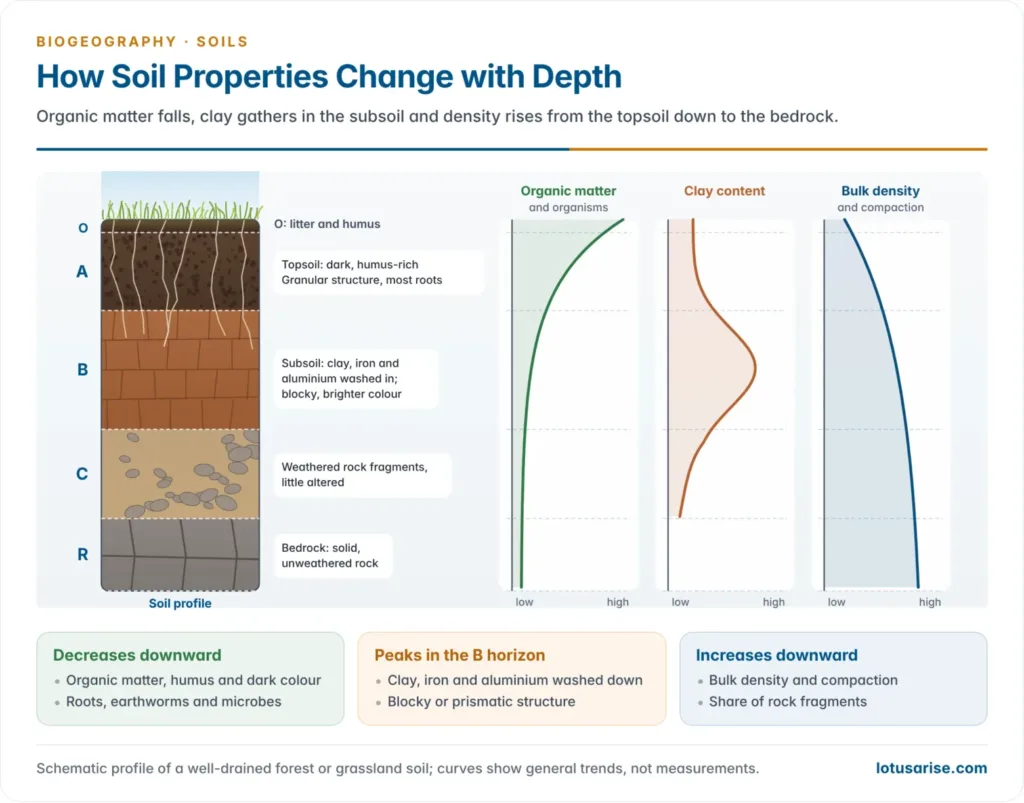
- Physical and chemical properties change with depth as the profile develops, and these changes define the horizons of the soil profile:
- A horizon (topsoil): richest in humus and organisms, dark, with granular structure; it supports most roots.
- B horizon (subsoil): poorer in humus than the A horizon but enriched in clay, iron and aluminium washed down from above; blocky or prismatic structure and brighter colours.
- C horizon: weathered fragments of rock, little altered by soil-forming processes.
- Bedrock (R): the solid, unweathered rock below.
- Organic matter and biological activity decline downward, while bulk density and rock fragments increase.
Chemical Properties of Soil
- Chemical properties depend on:
- Inorganic matter: the mineral content is the major factor that differentiates soils, because of its sheer abundance.
- Organic matter: though present in small quantities, it plays a large role in fertility.
- Colloids: clay colloids adsorb large quantities of water and nutrients; organic colloids raise the moisture- and nutrient-retention capacity.
- pH: the soil’s chemical reaction, which decides its acidic or basic nature.
Soil reaction: acidity and alkalinity
- Soil pH is the negative logarithm of the hydrogen-ion activity in the soil solution. Low pH means acidic soil and high pH means alkaline soil; each unit is a tenfold change.
- Most soils lie between about pH 4 and 10; most complex plants grow only within this range, and the optimum varies with the species.
| pH | Reaction | Typical setting |
|---|---|---|
| Below 4.5 | Extremely acidic | Acid sulphate soils, peat, mine spoils |
| 4.5–5.5 | Strongly acidic | Laterites, hill soils of North-east India |
| 5.5–6.5 | Moderately to slightly acidic | Leached forest and red soils |
| 6.5–7.5 | Near neutral | Most productive alluvial soils |
| 7.5–8.5 | Alkaline | Calcareous soils, regur |
| Above 8.5 | Strongly alkaline (sodic) | Usar, reh and kallar lands |
- Causes of acidity:
- Leaching of bases (calcium, magnesium, potassium) by heavy rainfall, leaving hydrogen and aluminium on exchange sites.
- Acidic parent rocks such as granite and sandstone.
- Organic acids from slowly decaying litter, especially under conifers.
- Ammonium fertilisers, removal of bases in harvested crops, and acid rain.
- Oxidation of sulphides in drained coastal swamps, as in the acid sulphate kari soils of Kuttanad in Kerala.
- Causes of alkalinity:
- Low rainfall, where evaporation exceeds precipitation and bases are not leached.
- Accumulation of calcium carbonate or of sodium salts.
- Poor drainage and seepage from canals, which raise salts by capillarity.
- Arid and semi-arid soils tend to be alkaline; humid-region soils tend to be acidic.
How acidity and alkalinity affect fertility
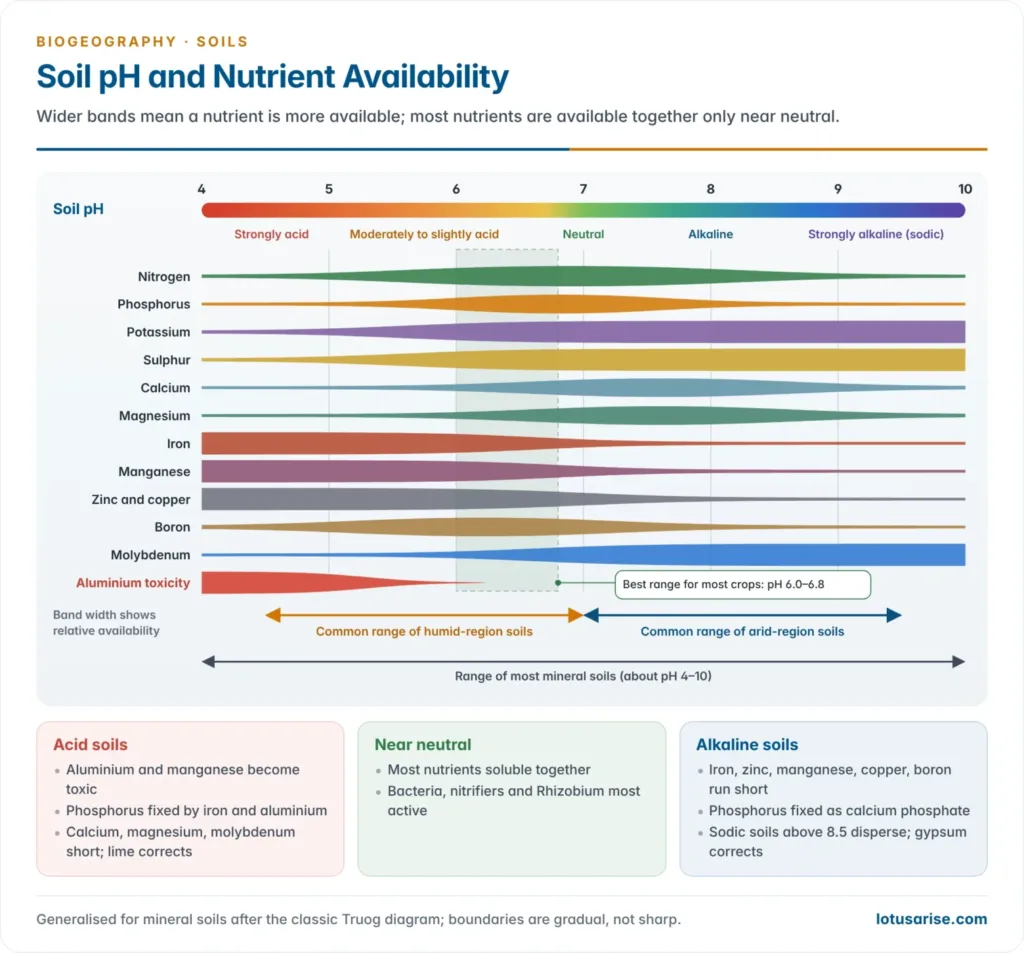
- The most important effect of pH is on ion solubility, which in turn controls nutrient supply and microbial growth.
- A pH of 6.0–6.8 is ideal for most crops, because it coincides with optimum solubility of the main nutrients.
- In acidic soils:
- Aluminium and manganese become toxic, especially below about pH 5.5, and stunt roots.
- Phosphorus is fixed by iron and aluminium; calcium, magnesium and molybdenum run short.
- Bacteria, including nitrifiers and nitrogen-fixing Rhizobium, slow down; fungi take over decomposition.
- Iron and most heavy metals are more soluble at low pH, so pH management also controls the movement of heavy metals and groundwater contamination.
- In alkaline soils:
- Iron, zinc, manganese, copper and boron become insoluble, causing deficiencies such as zinc deficiency in rice and wheat.
- Phosphorus is fixed as calcium phosphates.
- In sodic soils above about pH 8.5, sodium disperses clay, seals the surface and is toxic to plants.
- Tea (pH about 4.5–5.5) thrives in the acid soils of Assam and the Nilgiris; barley and cotton tolerate alkaline soils.
Correcting soil reaction
- Acidity is corrected by adding lime (calcium carbonate or dolomite). The lime requirement, the amount needed to raise pH to a target level, increases with cation-exchange capacity, because a high-CEC soil holds a large reserve of acidity (buffer capacity).
- Alkalinity is lowered by adding sulphur, which forms sulphuric acid in the soil, or acid-forming manures.
- Saline soils are reclaimed by flushing with good-quality irrigation water and drainage; sodic soils first need gypsum to replace sodium with calcium, and then leaching.
| Class | Electrical conductivity (dS/m) | Exchangeable sodium (%) | pH | Look |
|---|---|---|---|---|
| Saline | Above 4 | Below 15 | Below 8.5 | White salt crust (“white alkali”) |
| Sodic (alkali) | Below 4 | Above 15 | Above 8.5 | Dark, dispersed surface (“black alkali”) |
| Saline–sodic | Above 4 | Above 15 | Around 8.5 | Mixed |
- India’s acid soils: a 2026 ICAR assessment maps about 98.7 million ha, some 31% of the country, as acidic (pH 6.5 or less). The whole of Assam, Meghalaya, Mizoram, Nagaland, Sikkim, Tripura and Goa is acidic, as is most of Kerala, Odisha, Jharkhand and Chhattisgarh.
- Salt-affected soils cover about 6.7 million ha, mainly in the irrigated plains of Uttar Pradesh, Haryana, Punjab and Gujarat. Their spread through faulty irrigation is a form of soil degradation.
Soil colloids
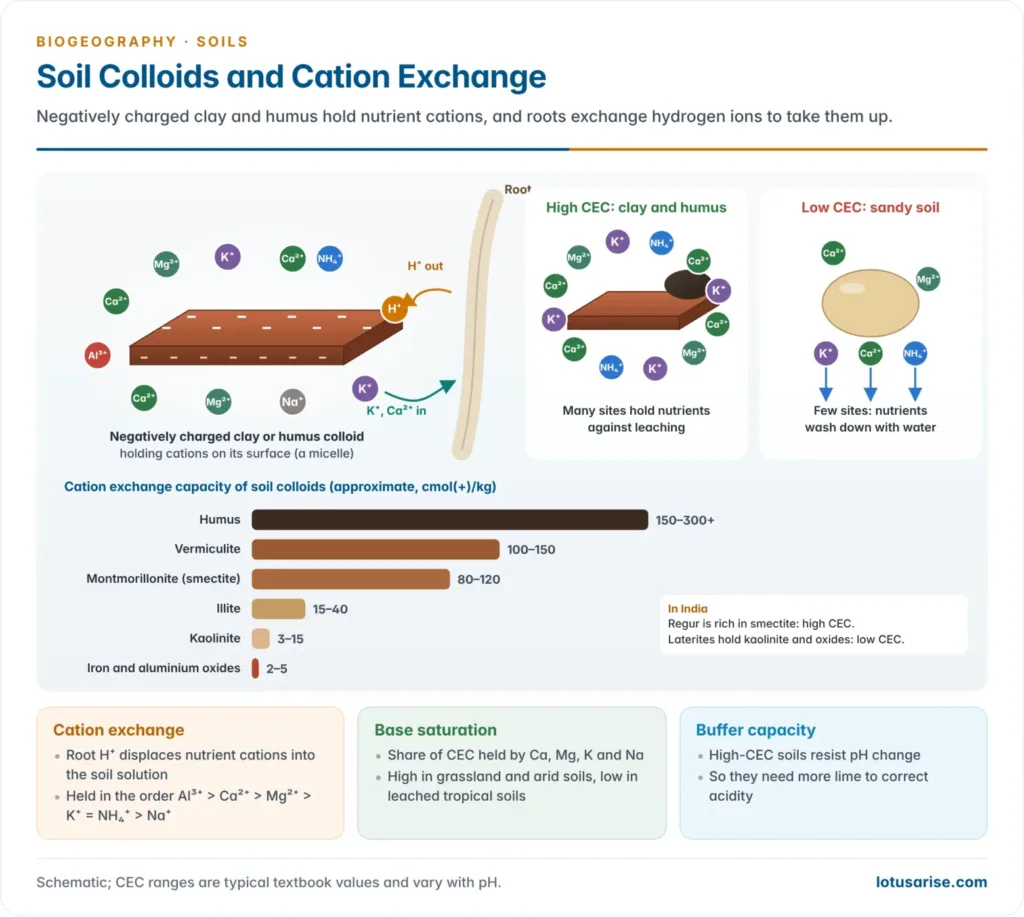
- Soil colloids are particles finer than about 0.001 mm (1 µm). They are the most active constituent of the soil because of their huge surface area and net negative charge.
- They attract dissolved nutrients as positively charged ions (cations), holding them against leaching.
- Inorganic (clay) colloids:
- Kaolinite (a 1:1 clay) has a rigid lattice and little charge; it dominates red and lateritic soils.
- Montmorillonite (smectite) and vermiculite (2:1 clays) swell, carry a high charge and dominate the regur.
- Illite is intermediate; iron and aluminium oxides carry little charge.
- Organic colloids are humus, which has the highest charge of all.
- A colloid with its swarm of adsorbed cations is called a micelle. Cations are held with strength in the order Al³⁺ > Ca²⁺ > Mg²⁺ > K⁺ = NH₄⁺ > Na⁺, so sodium is the easiest to leach and aluminium the hardest to displace.
- Cations needed by plants include calcium (Ca²⁺), magnesium (Mg²⁺) and potassium (K⁺). Plants take them up from the soil solution when it is in close contact with root membranes.
- Sodium (Na⁺) is also held on colloids but is essential only to a few plants; in excess it causes sodicity.
Cation exchange capacity and base saturation
- Cation exchange capacity (CEC) is the total amount of exchangeable cations a soil can hold, expressed in centimoles of charge per kilogram (cmol(+)/kg, numerically equal to milliequivalents per 100 g).
- The fertility of the soil solution rests on this capacity to hold and exchange cations. Without colloids, most vital nutrients would be leached out by percolating water and carried away in streams.
- Roots release hydrogen ions that exchange for nutrient cations on colloid surfaces, which then pass into the soil solution.
| Colloid | Approximate CEC (cmol(+)/kg) | Typical soils |
|---|---|---|
| Humus | 150–300 or more | Chernozems, peaty and forest topsoils |
| Vermiculite | 100–150 | Weathered micaceous soils |
| Montmorillonite (smectite) | 80–120 | Regur (Vertisols) |
| Illite | 15–40 | Alluvium |
| Kaolinite | 3–15 | Red and lateritic soils |
| Iron and aluminium oxides | 2–5 | Laterites (Oxisols) |
- CEC rises with clay content, clay type and organic matter. Sands may have a CEC below 5; clays and humus-rich soils can exceed 40.
- Black soils of the Deccan have a high CEC, so they hold nutrients and respond well to fertiliser; red and lateritic soils have a low CEC and lose nutrients quickly.
- Base saturation is the share of the CEC occupied by base cations (calcium, magnesium, potassium, sodium) rather than acidic hydrogen and aluminium.
- It is high in grassland and arid soils and low in leached tropical soils. Soil Taxonomy uses it to separate orders such as Mollisols and Alfisols (high) from Ultisols and Oxisols (low), part of the scheme of soil classification.
- A high CEC must still be read with pH and organic content: a high-CEC soil can be infertile if its pH renders nutrients insoluble.
Plant nutrients and soil organic carbon
- Plants need 17 essential elements. Carbon, hydrogen and oxygen come from air and water; the other 14 come from the soil:
- Primary macronutrients: nitrogen, phosphorus, potassium.
- Secondary macronutrients: calcium, magnesium, sulphur.
- Micronutrients: iron, manganese, zinc, copper, boron, molybdenum, chlorine, nickel.
- Growth is held back by whichever nutrient is scarcest, as Liebig’s law of the minimum states, so a balanced supply matters more than a large dose of one fertiliser.
- Soil organic carbon (SOC) is the carbon in soil organic matter, which is roughly 58% carbon.
- Indian soil-testing rates SOC as low (below 0.5%), medium (0.5–0.75%) or high (above 0.75%).
- SOC is the single best indicator of soil health: it feeds organisms, builds structure, holds water and supplies nitrogen, phosphorus and sulphur.
- Soils store more carbon than the atmosphere and vegetation combined; raising SOC is the aim of the “4 per 1000” initiative (COP21, 2015).
- The C:N ratio of humus is about 10–12:1; wide-ratio residues such as cereal straw lock up soil nitrogen while decomposing.
Biological Properties of Soil
- Organic matter improves soil structure, increases the nutrient- and water-holding capacity of the soil and provides the food supply for soil life.
- Soils with low organic matter tend to have a poor structure, hold little water and erode or leach nutrients easily. The exception is cracking clay soils, where clay minerals, not organic matter, control structure.
- Soils with high organic matter have a good structure, good water-holding capacity, and less erosion and nutrient leaching.
- Biological properties include:
- organic matter and humus;
- soil organisms and their activity;
- the presence of disease-causing organisms.
Soil organisms
- Soil is the most species-rich habitat on Earth: a 2023 estimate holds that about 59% of all species live in it. A single gram of fertile soil can hold hundreds of millions of bacteria.
| Group | Size | Examples | Main roles |
|---|---|---|---|
| Microflora | Microscopic | Bacteria, actinomycetes, fungi, algae and cyanobacteria | Decomposition, nitrogen fixation, nutrient release, antibiotics |
| Microfauna | Below 0.1 mm | Protozoa, nematodes | Graze bacteria and release nitrogen |
| Mesofauna | 0.1–2 mm | Mites, springtails, potworms | Shred litter, spread microbes |
| Macrofauna | Above 2 mm | Earthworms, termites, ants, beetle larvae | Burrow, mix and aggregate soil |
| Megafauna | Large | Moles, rodents, snakes | Mix and aerate soil |
- Earthworms rework the soil by burrowing and by passing soil through their gut, leaving nutrient-rich, stable casts. Charles Darwin (1881) first showed how they bury and renew the topsoil.
- Termites take over this role in tropical savannas and dry forests, moving subsoil to the surface in their mounds.
- Biological nitrogen fixation:
- Rhizobium in the root nodules of legumes such as pulses and groundnut.
- Free-living Azotobacter, and cyanobacteria such as Anabaena, which partners the water fern Azolla in rice paddies.
- Mycorrhizal fungi extend root networks and greatly increase phosphorus uptake.
- Pathogens such as Fusarium wilt fungi and root-knot nematodes cut yields; a diverse soil community keeps them in check.
Organic matter and humus
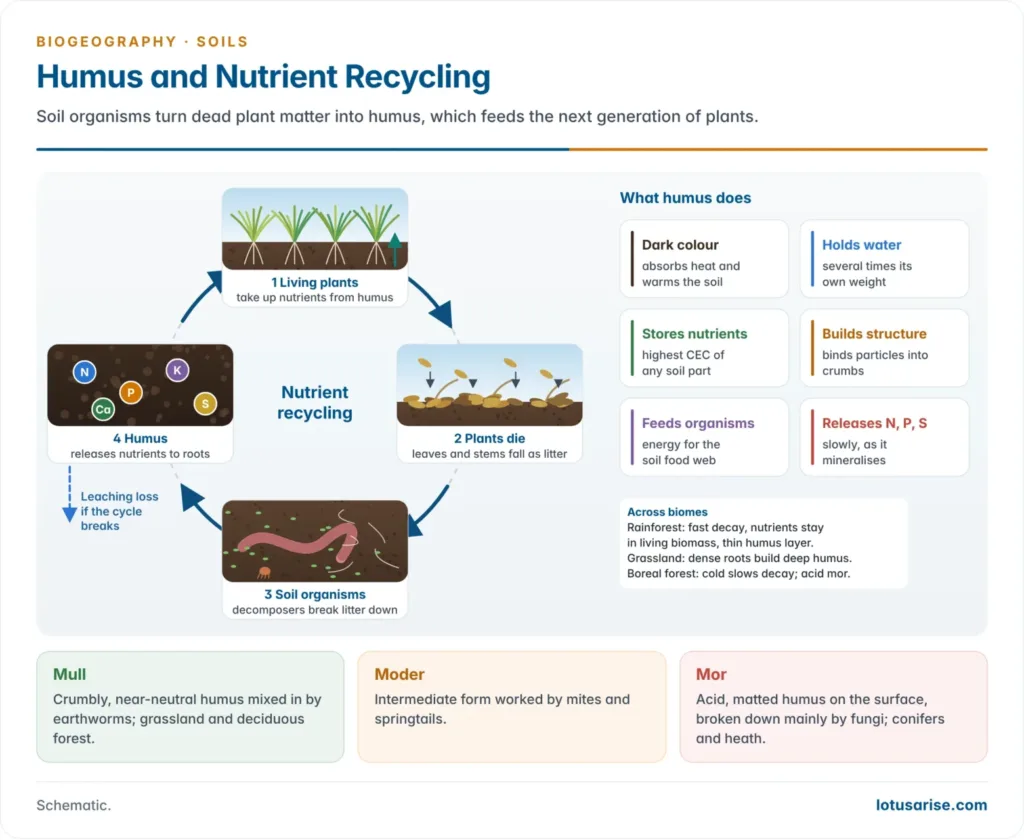
- Soil organic matter passes from fresh litter through decomposition to humus, in a process called humification.
- Humus is the dark, colloidal end-product of decay. It:
- gives a brown or black colour that absorbs heat;
- holds several times its own weight of water;
- stores nutrients, having the highest CEC of any soil constituent;
- binds fine particles into aggregates, improving structure;
- feeds micro-organisms and slowly releases nitrogen, phosphorus and sulphur, improving plant growth.
- Humus forms depend on vegetation and climate:
- Mull: crumbly, near-neutral humus mixed into the mineral soil by earthworms, under grassland and deciduous forest.
- Mor: acidic, matted humus lying on the surface, decomposed mainly by fungi, under conifers and heath.
- Moder: intermediate, worked by small arthropods.
Biomass and nutrient recycling
- Biotic processes in soil formation include living plants and animals and their non-living organic products. Living plants contribute in two basic ways:
- Biomass: the production of organic matter above ground as stems and leaves, and below ground as roots.
- It supplies the raw material of the O horizon and of organic matter lower down.
- Decomposer organisms reduce it to humus and ultimately to its initial components, carbon dioxide and water.
- Nutrient recycling: nutrients pass from dead plant tissues back into the soil and are taken up again by roots.
- This cycle stops nutrients escaping through leaching by surplus water moving down through the soil.
- Biomass: the production of organic matter above ground as stems and leaves, and below ground as roots.
- Biome contrast:
- In the tropical rainforest, rapid decay and uptake keep most nutrients in the living biomass, so cleared land soon turns poor.
- Temperate grasslands build deep, humus-rich chernozems from dense root mats.
- In the boreal forest, cold slows decay and an acidic mor layer piles up. These contrasts run through the biomes of the world.
Indicators of biological activity
- Respiration rate: CO₂ released under standard laboratory conditions or in the field.
- Potential nitrogen and carbon mineralisation: the rise in mineral nitrogen or carbon under standard laboratory conditions.
- Earthworms: the density of earthworms in the soil.
- Microbial and bacterial biomass: the total for a given soil mass.
- Bacterial diversity: by functional groups or by genetic diversity (DNA sequencing).
- Presence of pathogens: assessed by techniques from cultures to DNA profiling.
Soil Fertility, Soil Health and Indian Evidence
Fertility, productivity and health
- Soil fertility is the capacity of a soil to supply nutrients in adequate amounts and in the right balance for plant growth.
- Soil productivity is its capacity to produce crops under a given system of management. A fertile soil can be unproductive if it is waterlogged, saline, too cold or too steep.
- Soil health is the continued capacity of soil to function as a living ecosystem that sustains plants, animals and people. It joins all three groups of properties.
- Interlinkages:
- Texture governs permeability and structure.
- Structure and colour signal organic matter and drainage.
- pH governs nutrient solubility and, through colloids and CEC, links directly to fertility.
- Biological activity creates and sustains the humus behind nearly every favourable physical and chemical property.
| Framework | Contribution | Key insight | Critique |
|---|---|---|---|
| USDA particle-size and texture classes | Standard sand, silt and clay limits and the texture triangle | Names and compares soils reproducibly across regions | Size cut-offs are conventions, not natural breaks; the international scale sets the silt–sand limit at 0.02 mm |
| Munsell Soil Colour Charts | Hue–value–chroma code for colour | Turns a visual impression into a comparable code | Needs the physical chart and steady daylight |
| Cation exchange capacity | Measures a soil’s power to hold and exchange cations | Links colloid chemistry to fertility and lime need | Must be read with pH and organic content |
Indian evidence
- Regur (black cotton) soils of the Deccan Trap: clayey, montmorillonitic, high CEC and moisture-retentive, but low in organic carbon. Their dark colour comes from basalt-derived minerals and clay–humus complexes. They are one of the soil types of India.
- Laterites of the Western Ghats: red, acidic, kaolinitic and low in CEC and bases, the product of intense leaching.
- Arid soils of Rajasthan are sandy and alkaline; the high-rainfall soils of the Western Ghats and North-east are acidic.
- Soil Health Card Scheme: launched on 19 February 2015 at Suratgarh, Rajasthan, it puts these chemical properties to work at farm level.
- Each card reports 12 parameters: nitrogen, phosphorus, potassium and sulphur; zinc, iron, copper, manganese and boron; and pH, electrical conductivity and organic carbon. It recommends fertiliser and lime doses.
- Cards are reissued every two years. More than 25 crore cards had been issued by January 2026.
- Since 2022–23 the scheme runs as the “Soil Health and Fertility” component of the Rashtriya Krishi Vikas Yojana.
- A 2023 mobile app geotags samples with QR codes on a GIS portal. By February 2025, 665 village-level soil-testing labs were running in 17 states.
- What the cards show: an October 2025 analysis of about 13 million samples tested in 2023–25 found 64% low in nitrogen and 48.5% low in organic carbon. Deficiencies of zinc, boron and sulphur are also widespread, reflecting years of nitrogen-heavy, unbalanced fertiliser use.
| Dimension | India | Global comparison |
|---|---|---|
| Colour standard | Munsell charts in ICAR–NBSS&LUP soil surveys | Munsell system, developed in the USA, is the world standard |
| Correcting pH | Lime for acid soils of the North-east and Western Ghats; gypsum and leaching for sodic and saline tracts | Same lime-versus-sulphur logic in temperate farming |
| Monitoring | Soil Health Card: pH, EC, organic carbon and 9 nutrients every two years | USDA NRCS soil-health assessment; EU Soil Monitoring Law (in force December 2025) targets healthy soils by 2050 |





Splendor work……
Thanks alot
sir, 12th line from below it was Lil typo error instead of LEACHING it is written as TEACHING please rectify.
by the way Thankyou soo much for the information
Thank you so much for pointing out the mistake.
Is granite porous or non porous?
granite is coarse-grained. so less porous
It is crystalline that don’t allow water to percolate but the joints between them allow water to percolate. Comparatively less porous than sandy soil.
thank you sir