

- Economic planning is the deliberate use of the state’s authority to set goals, priorities and resource allocations for an economy over a fixed period, instead of leaving every outcome to the market.
- India planned through the Planning Commission (1950–2014) and twelve Five Year Plans (1951–2017). Since 1 January 2015 the NITI Aayog has replaced plan-making with policy advice, outcome indices and cooperative and competitive federalism.
- Planning matters to geography because every plan decided where investment went: which regions received steel plants, dams, irrigation and programmes, and which were left behind.
Economic Planning: Meaning and Types
Meaning and Rationale
- A plan is a set of general goals and specific, time-bound targets, with the resources and instruments needed to reach them.
- It is thought turned into action: goals, usually prosperity and social development, are chosen first, and the actions fitted to them, using natural and human resources to the full while keeping the environment healthy.
- The Planning Commission saw it as accepting a clear system of objectives, framing a strategy for them, and coordinating means and ends rationally, in place of the hit-and-miss methods of older reform.
- Its premise is that markets and prices alone cannot secure welfare.
- Infrastructure, transport, power and other public goods need investment that private capital will not make at the scale, or in the places, required.
- Poverty, unemployment and regional imbalance persist unless the state redistributes.
- In a newly independent, poor and largely agrarian country, planning was also an instrument of nation-building: rapid industrialisation, self-reliance and social justice within a democracy.
- India’s starting point made the case stronger:
- two centuries of colonial rule had left de-industrialised crafts, stagnant agriculture and a thin industrial base concentrated in a few port cities;
- savings and investment were low, and private capital was too small and too cautious for steel, power or irrigation;
- Partition added millions of refugees, food shortages and inflation;
- the regional pattern was already lopsided: Bombay, Calcutta and Madras and their hinterlands held most of modern industry.
Types of Economic Planning
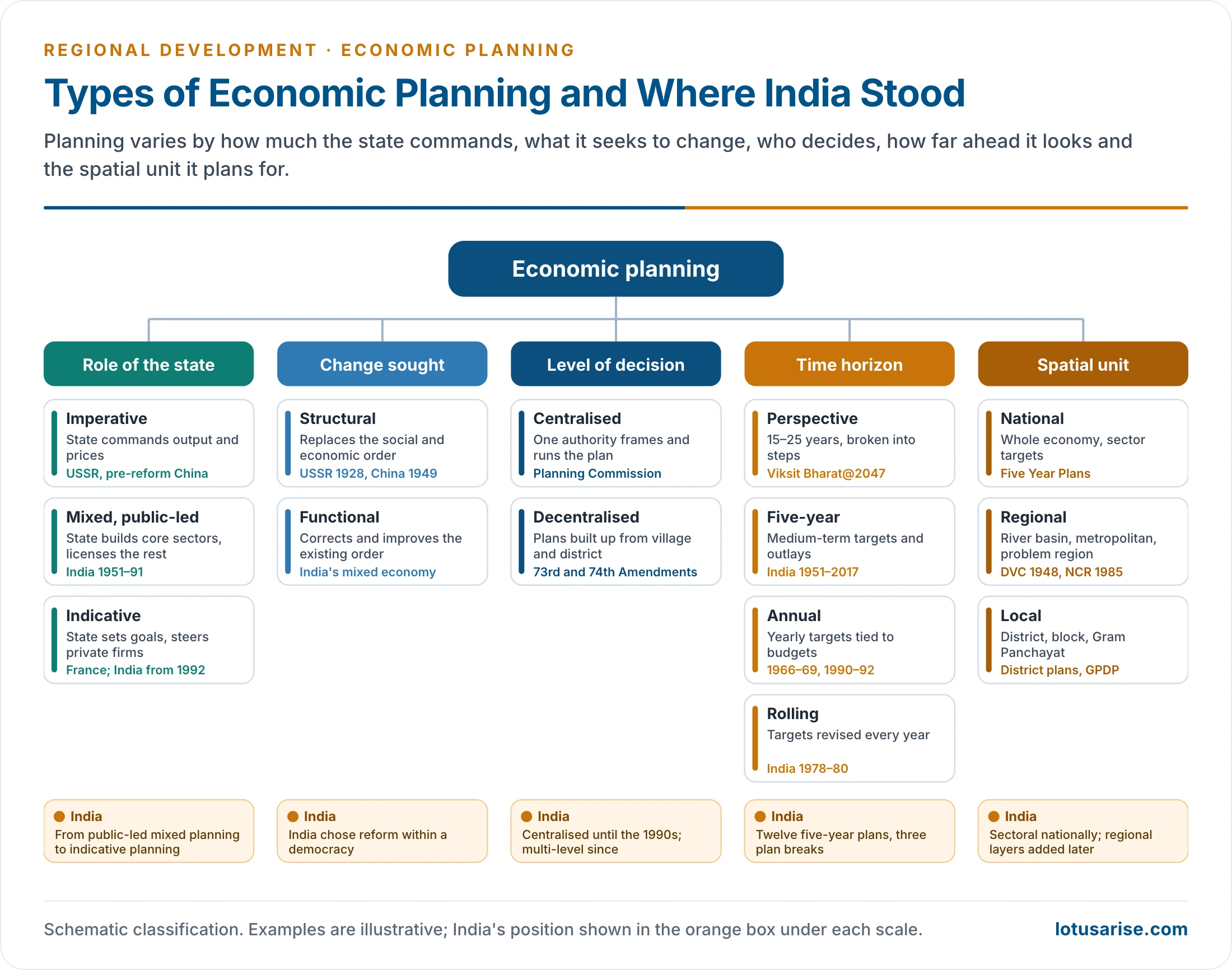
- Most economies today are mixed, with public and private sectors working side by side, so planning types are best read as positions along several scales.
- By the role of the state:
- Imperative (comprehensive, directive) planning: central planning and execution, with the state allocating resources, as in the former USSR and pre-reform China.
- Every sector follows the plan. Consumers receive fixed quantities at fixed prices, so consumer sovereignty is sacrificed.
- Policies are rigid: a change in one part ripples through the whole economy.
- Indicative planning: the state indicates broad goals and guidelines and steers, rather than commands, the private sector.
- It began in post-war France. The state assists private firms through credit, incentives and information, and directs them into priority areas, but does not control them. Other mixed economies control the private sector by quotas, prices and licences.
- India moved towards indicative planning from the Eighth Plan (1992–97).
- Imperative (comprehensive, directive) planning: central planning and execution, with the state allocating resources, as in the former USSR and pre-reform China.
- By the change sought:
- Structural planning replaces the existing social and economic structure with a new one, such as a shift from a capitalist to a socialist order. The USSR after 1928 and China after 1949 followed it.
- Functional planning keeps the existing structure and corrects and improves it from within. It is evolutionary rather than revolutionary, and it leaves the social order in place. Ferdynand Zweig, in The Planning of Free Societies, described it as repairing the existing order rather than building anew.
- By the level of decision-making:
- Centralised planning: one central authority frames, adopts, executes and supervises the plan, and fixes targets and priorities, from the top down.
- Decentralised (multi-level) planning: responsibility lies with regional and local bodies; plans start at the grassroots and are aggregated upwards through block, district and State levels.
- India’s multi-level planning after the 73rd and 74th Amendments (1992) follows this logic.
- By time horizon:
- Perspective planning sets goals for 15–25 years. It is not one plan for the whole period: it is broken into five-year and annual plans, or other short-run plans of four to six years, so that long-run goals are reached in short steps.
- Rolling plans revise targets every year in the light of performance, as India tried in 1978–80.
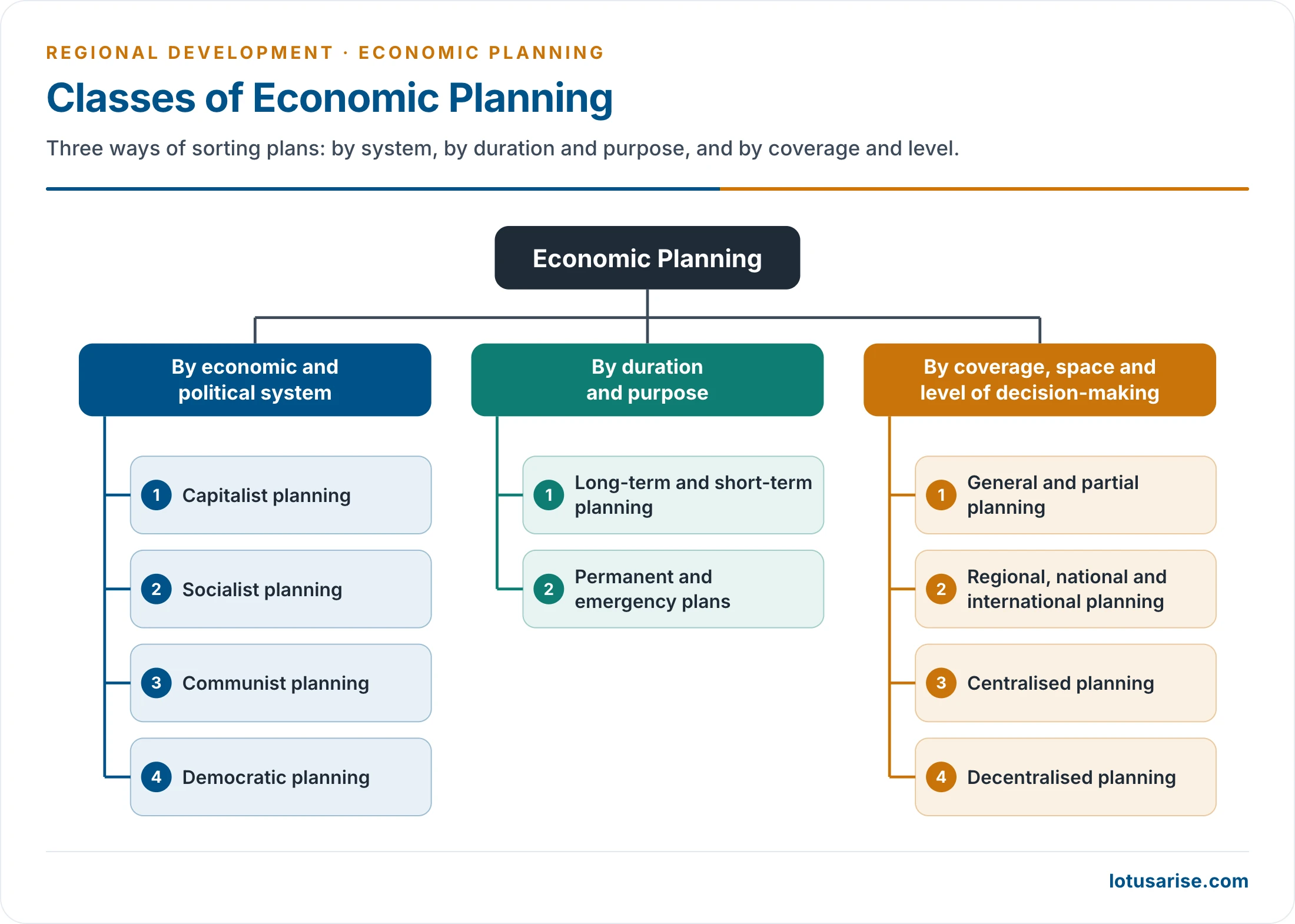
- By coverage and space: general (whole economy) versus partial (selected sectors) planning, and regional, national and international planning.
- By economic and political system: capitalist, socialist, communist and democratic planning.
- By duration and purpose: long-term and short-term planning, and permanent and emergency plans.
| Basis | Type | Core idea | Example |
|---|---|---|---|
| Role of the state | Imperative vs indicative | Command vs guidance | USSR; France, India after 1992 |
| Change sought | Structural vs functional | Replace vs reform the system | USSR 1928; India’s mixed economy |
| Level | Centralised vs decentralised | Top-down vs bottom-up | Planning Commission; Gram Panchayat plans |
| Time | Perspective, five-year, annual, rolling | Long-run goal in short steps | India 1951–2017 |
| Space | Regional, national, international | Unit of the plan | DVC, Five Year Plans, EU cohesion policy |
Planning in India: Evolution and Machinery
Planning before Independence
- The idea of a planned economy took shape in the 1930s, when national leaders, influenced by socialist thought, watched the Soviet Union grow rapidly under its five-year plans.
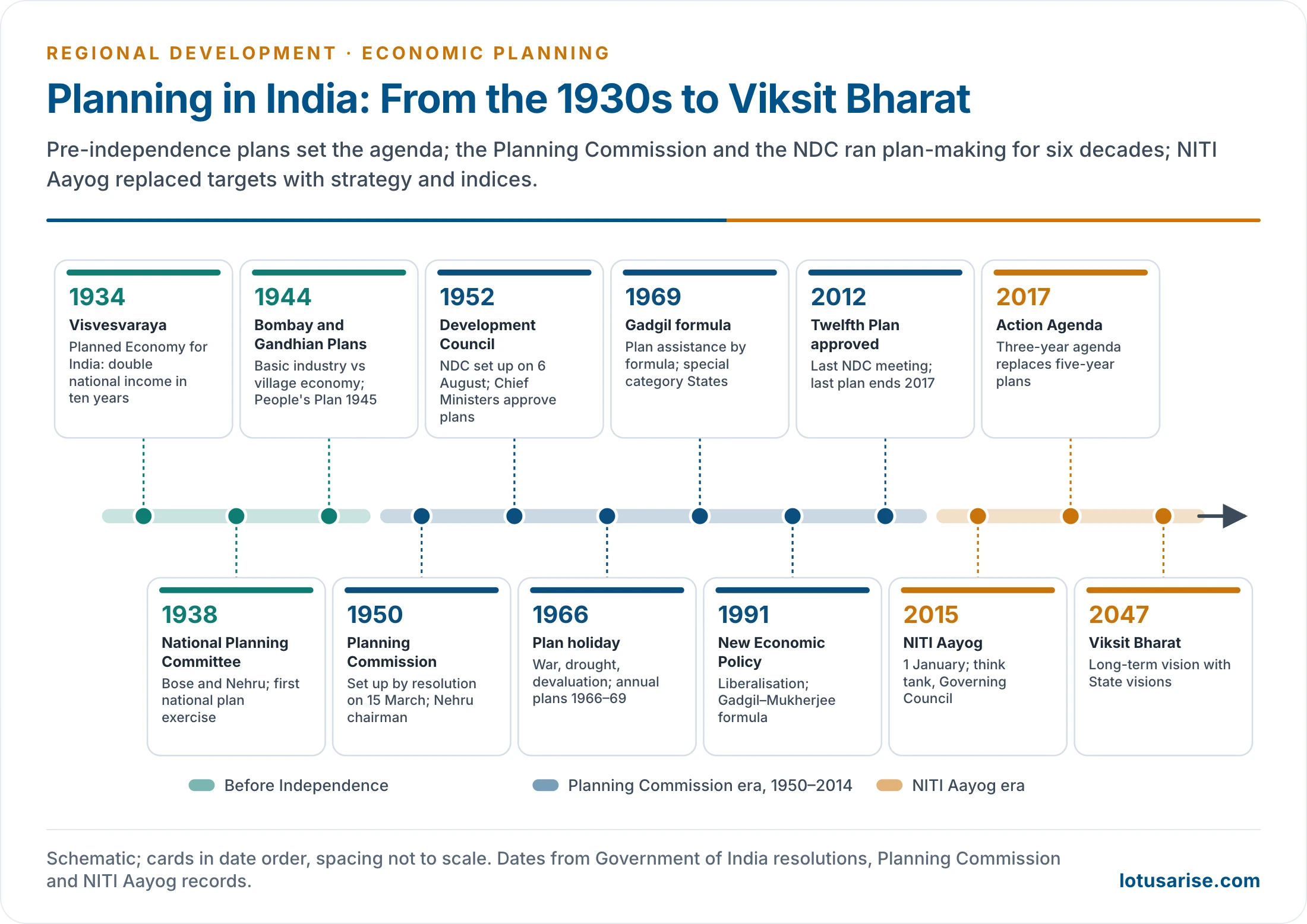
- Sir M. Visvesvaraya wrote Planned Economy for India (1934), the first scholarly plan. It proposed a ten-year programme to shift labour from agriculture to industry and double national income.
- The economic outlook of the freedom movement took form between the Karachi session (1931) and the Faizpur session (1936) of the Indian National Congress.
- National Planning Committee (1938): set up by Congress President Subhas Chandra Bose, with Jawaharlal Nehru as chairman, the first attempt at a national plan.
- Its sub-committees covered agriculture, industry, transport and finance, but its papers appeared only in 1948–49.
- Bombay Plan (1944): eight industrialists, J. R. D. Tata, G. D. Birla, Purshotamdas Thakurdas, Lala Shriram, Kasturbhai Lalbhai, A. D. Shroff, Ardeshir Dalal and John Mathai, proposed a 15-year plan in A Brief Memorandum Outlining a Plan of Economic Development for India.
- It aimed to double per capita income and treble national income in 15 years, with the state building basic industry.
- Nehru did not adopt it, but many of its ideas entered the later plans.
- Gandhian Plan (1944): by Shriman Narayan Agarwal, principal of Wardha Commercial College, stressing economic decentralisation, rural development and cottage industries.
- People’s Plan (1945): by M. N. Roy for the Indian Federation of Labour, a ten-year plan on Marxist lines that gave top priority to agriculture and proposed nationalising land and production.
- Sarvodaya Plan (1950): by Jayaprakash Narayan, drawing on the Gandhian Plan and Vinoba Bhave’s Sarvodaya idea.
- It stressed agriculture, small and cottage industries, land reform, freedom from foreign technology and participatory planning.
- Official bodies prepared the ground:
- the Planning and Development Department (August 1944) of the British Indian government under Ardeshir Dalal, abolished in 1946;
- the Advisory Planning Board (October 1946) of the Interim Government, to review plans and projects;
- the Economic Programme Committee (1947) of the All India Congress Committee under Nehru. It was to balance public and private enterprise and urban and rural economies, and in 1948 it recommended a planning commission.
| Plan | Year | Author | Emphasis |
|---|---|---|---|
| Planned Economy for India | 1934 | M. Visvesvaraya | Industrialisation, doubling national income |
| National Planning Committee | 1938 | S. C. Bose, J. Nehru | First national planning exercise |
| Bombay Plan | 1944 | Eight industrialists | Basic industry, trebling national income |
| Gandhian Plan | 1944 | Shriman Narayan Agarwal | Village economy, cottage industry |
| People’s Plan | 1945 | M. N. Roy | Agriculture, nationalisation |
| Sarvodaya Plan | 1950 | Jayaprakash Narayan | Land reform, decentralisation |
The Planning Commission (1950–2014)
- The Planning Commission was set up on 15 March 1950 by a resolution of the Government of India, with Nehru as chairman. It was an extra-constitutional, non-statutory, advisory body.
- Its declared aim was a rapid rise in the standard of living through efficient use of the country’s resources, higher production and employment for all.
- Its charge, in the resolution’s terms:
- assess the country’s material, capital and human resources, and augment those found deficient;
- formulate plans for their most effective and balanced use;
- fix priorities and the stages in which each plan would be carried out, and allocate resources to them;
- identify the factors that retard development, and the machinery needed to carry out the plan;
- appraise progress periodically and recommend adjustments;
- encourage people’s participation in planning.
- With the NDC, State Planning Boards completed the machinery of planning.
- The Prime Minister was ex officio chairman. A full-time Deputy Chairman (the first was Gulzarilal Nanda) and full-time members ran it, with the Finance Minister and other ministers as members.
- It became powerful because it allocated plan funds to ministries and States, alongside the Finance Commission, which devolved taxes.
- The Five Year Plans it prepared ran from 1951 to 2017, broken by the plan holiday (1966–69) and the annual plans (1990–92).
The Planning Process
- Approach Paper: the Commission set the growth target and broad strategy. The NDC approved it, as it did the Twelfth Plan’s in 2011.
- Working groups and steering committees of experts, ministries and States drew up sector plans.
- Draft plan → NDC approval → Parliament: the final document was adopted, as the Twelfth Plan was in December 2012.
- Annual plans translated the five-year targets into yearly budgets. Each State’s annual plan was negotiated with the Commission.
- A mid-term appraisal reviewed progress and revised targets halfway through.
Central Assistance and Its Formulas
- Plan assistance to States was distributed by formula from the Fourth Plan.
- Gadgil formula (1969): approved by the NDC in April 1969.
- The special category States were first given a fixed share off the top, then the rest was divided by:
- population 60%;
- per capita income 10%, only for States below the national average;
- tax effort 10%;
- ongoing major irrigation and power projects 10%;
- special problems 10%.
- The special category States were first given a fixed share off the top, then the rest was divided by:
- Gadgil–Mukherjee formula (1991): population 60%, per capita income 25%, fiscal performance 7.5% and special problems 7.5%.
- Special category States received 30% of Normal Central Assistance, as 90% grant and 10% loan. Other States received theirs as 30% grant and 70% loan.
- Assistance thus carried a deliberate tilt towards poorer, hill and border States: the planners’ main fiscal tool against regional imbalance.
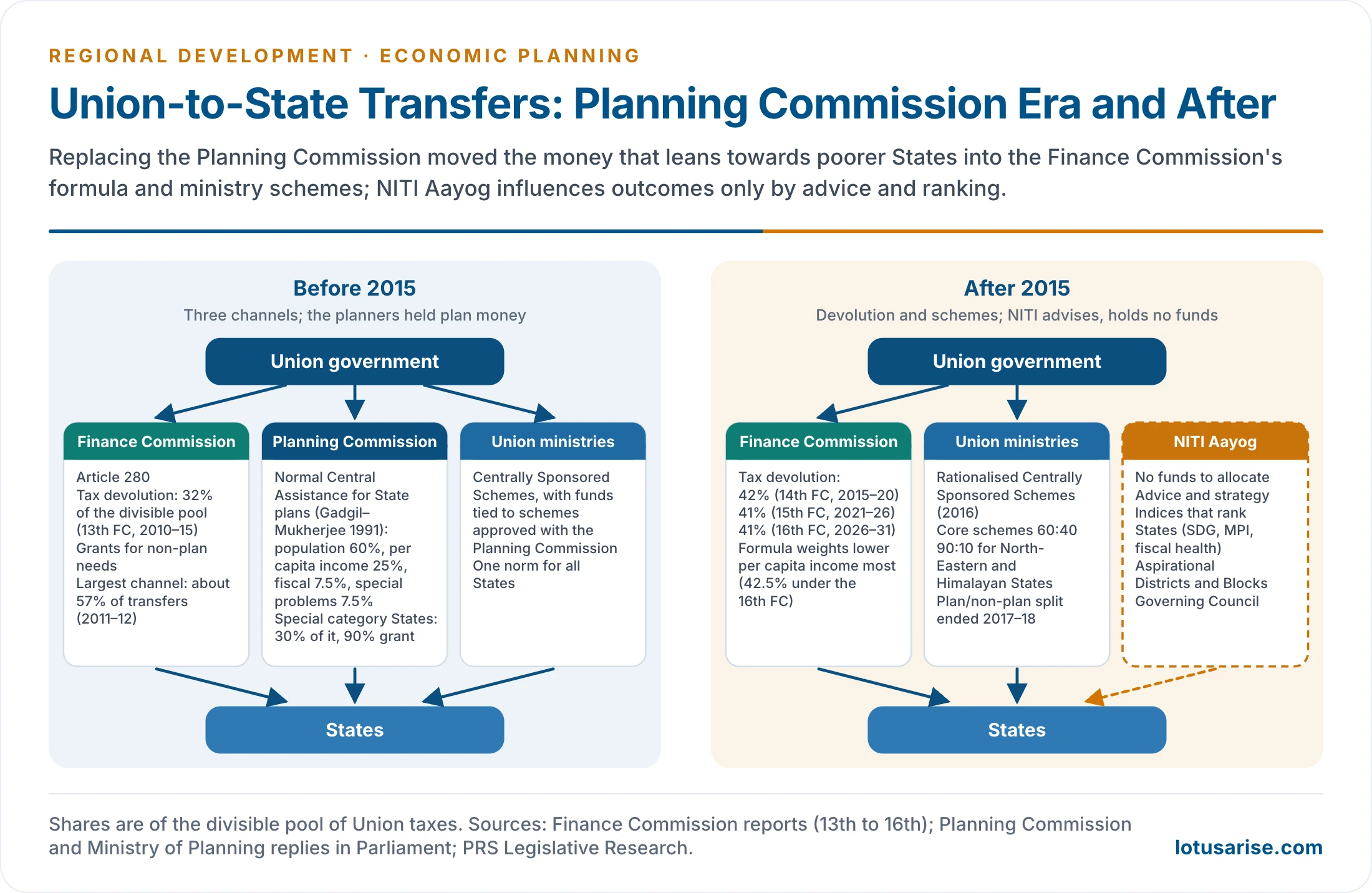
- Two channels therefore ran side by side until 2015:
- the Finance Commission (Article 280, constitutional) devolved taxes and gave grants for non-plan needs;
- the Planning Commission gave plan assistance, and ministries ran Centrally Sponsored Schemes under its oversight.
- The constitutional channel was always the larger. By 2011–12, tax devolution made up about 57% of all Union transfers to the States, while Normal Central Assistance was only about 5%.
National Development Council
- Economic and social planning is item 20 of the Concurrent List. Plans therefore needed the States’ consent, and Centre–State cooperation had to run deeper than a resolution.
- The National Development Council (NDC) was set up on 6 August 1952 for that purpose.
- It comprised the Prime Minister, Union Cabinet ministers, Chief Ministers and members of the Commission.
- It approved each plan, reviewed its working, and decided matters such as special category status (1969) for hill and frontier States.
- Its last meeting, in December 2012, approved the Twelfth Plan. NITI Aayog’s Governing Council has since taken over its role.
Features of Indian Planning
- Five-year plans within a perspective: short-term targets nested in long-term goals.
- A Perspective Planning Division, set up in the Commission in 1958 under Pitambar Pant, projected the economy 15–20 years ahead, so that each plan was a stage of a longer path.
- Comprehensive planning: social goals (education, health, poverty) alongside growth, and the reduction of both vertical (class) and horizontal (regional) disparities: in later language, inclusive growth.
- Mixed economy with a public-sector tilt: the state built heavy industry and infrastructure and regulated private capital.
- Private enterprise was checked by licensing and the MRTP Act (1969). The public sector supplied food and essentials through the public distribution system.
- From the 1990s the private sector became the main engine.
- Democratic planning: the Commission drafted, the NDC approved, Parliament debated and States prepared their own plans. Village and district bodies were meant to carry the plans down.
- Planning models: the First Plan used the Harrod–Domar growth model. The Second used P. C. Mahalanobis’s two-sector and four-sector models. Later plans used input–output and consistency models.
- Financial rather than physical planning: plans were mostly allocations of money to sectors, which weakened the monitoring of outcomes.
Objectives of Planning
- Long-term objectives, constant across plans, summed up as growth with social justice:
- Growth: higher national and per capita income.
- Employment: productive work for a growing labour force.
- Equity and social justice: the fruits of growth should reach the lower strata of society, and inequality should narrow.
- Removal of poverty: the explicit theme of the Fifth (garibi hatao) and Sixth Plans.
- Modernisation: new technology and institutions, as the Green Revolution and the IT revolution showed, and the empowerment of women.
- Self-reliance: less dependence on foreign aid and imported food.
- The lesson came in 1965–66, when the United States used food aid under PL-480 as leverage during the war with Pakistan.
- Balanced regional development: an explicit objective from the Third Plan (1961–66).
- Constitutional basis: the Directive Principles (Article 39) give planning three principles:
- men and women alike have the right to an adequate means of livelihood;
- ownership and control of the community’s material resources are to serve the common good;
- the economic system must not concentrate wealth and the means of production to the common detriment.
- Short-term objectives varied with immediate needs: refugee rehabilitation and food in the First Plan, heavy industry in the Second, food again in the annual plans of 1966–69.
- They mostly concerned the allocation of resources among sectors according to current demand.
Planning Strategy: Before and After 1991
- Strategy meant allocating resources in line with objectives, and choosing between agriculture and industry, the public and private sectors, and a closed and open economy.
Pre-reform Phase (1951–1991)
- Heavy reliance on the public sector: private capital could not, or would not, invest in heavy industry or in backward regions.
- Heavy industry first: the Nehru–Mahalanobis strategy of the Second Plan (1956–61) put steel, machine-building and power at the top. The Industrial Policy Resolution of 1956 reserved key industries for the state.
- Regulated private sector: industrial licensing under the Industries (Development and Regulation) Act, 1951, confined private firms to permitted areas.
- Protection of small industry: boards for each small-industry sector, and products reserved for small-scale units.
- Inward-looking trade: high import duties and import substitution; domestic firms were sheltered from world competition.
- Thrust on savings and investment: high interest rates and tax concessions to mobilise savings.
- Restrictions on foreign capital: the Foreign Exchange Regulation Act (FERA), 1973.
- Centralised planning: State plans were aligned to the national plan’s objectives and strategy.
The 1991 Shift
- The crisis of 1990–91 forced a change of strategy:
- high fiscal and revenue deficits after a decade of expansion;
- a balance of payments crisis, worsened by the Gulf War (1990–91), costlier oil and lost remittances from the Gulf;
- foreign exchange reserves that by mid-1991 covered only about two weeks of imports, so that gold had to be pledged abroad for loans (some counts in 1990–91 put them at under 10 days);
- double-digit inflation, fed by deficit financing and money supply, with slow growth: stagflation;
- poor performance of public sector undertakings.
- The New Economic Policy (July 1991) had three parts:
- Liberalisation: freeing the economy from licences, controls and quotas; industrial licensing was abolished for all but a short list of industries.
- Privatisation: opening sectors reserved for the state to private firms, and disinvestment in public enterprises.
- Globalisation: integration with the world economy through trade, FDI and portfolio investment, lower tariffs and a market-determined exchange rate, with partial convertibility of the rupee.
- Consequences for planning:
- competition rather than controls became the driver of growth, with fiscal and monetary policy reoriented to the free play of market forces;
- import limits were cut to a minimum, and export promotion took high priority;
- the state confined itself to strategic sectors (such as atomic energy, minerals and railways), infrastructure and the social sectors;
- planning became indicative from the Eighth Plan;
- sustainable development, meeting present needs with regard for future generations, joined the plan objectives.
The Planning Era in Balance (1951–2017)
- Growth: GDP grew at about 3.5% a year from 1950 to 1980, the “Hindu rate of growth” in Raj Krishna’s phrase. It rose to about 5.5% in the 1980s, 6–7% after 1991 and 8% in the Eleventh Plan (2007–12).
- Institutions and capacity: the plans built a base in steel, power, irrigation, railways, science and higher education. They also created the institutions of a modern state: the IITs, the agricultural universities and national laboratories.
- Food and health: foodgrain output rose from about 51 million tonnes (1950–51) to over 330 million tonnes (2023–24). Life expectancy rose from about 32 years around 1951 to about 70 (SRS 2016–20), and literacy from 18.3% (1951) to 74.0% (2011).
- Shortfalls:
- Poverty fell slowly: 21.9% of Indians were below the poverty line in 2011–12 on the Tendulkar method.
- Land reform stalled, employment lagged behind output, and the public sector grew inefficient behind protection.
- Plan after plan named balanced regional development, yet the gap between leading and lagging States widened.
- The targets and achievements of each plan show the same pattern: shortfalls in crisis years (the Third and Fourth Plans) and overshooting in good ones (the Eighth).
The Regional Dimension of National Planning
- National planning was sectoral: targets for agriculture, industry and power, with little thought for where investment would land.
- Regional balance became an explicit objective only in the Third Plan.
- The spatial instruments came later and in layers:
- river valley authorities such as the Damodar Valley Corporation (1948);
- public-sector steel plants in backward mineral regions;
- industrial location incentives after 1969;
- area programmes for drought-prone, hill, desert and tribal areas from the Fourth and Fifth Plans;
- formulas for plan assistance and tax devolution that favoured poorer States.
- The experience of regional planning in India and the instruments of planning against regional imbalance are therefore part of the story of national planning, not a separate one.
Why the Planning Commission Was Replaced
- Model-driven targets: plans rested on aggregate input–output models with highly aggregated coefficients and weak data. Targets often failed on the ground.
- Duplication: the Commission’s subject divisions paralleled Union ministries, and its approval process duplicated the States’ own planning.
- Plans out of step with budgets:
- targets were compromised arbitrarily because they had no annual break-up;
- five-year plans were not synchronised with annual budgets, so many schemes ran on their own timelines, such as Bharat Nirman (2005–09) and JNNURM (seven years from 2005);
- five years proved too long a span: a plan began to drift soon after launch. A firm three-year plan with two tentative years was suggested instead.
- The plan/non-plan distinction in spending had lost meaning. It was abolished from the 2017–18 Budget.
- Shrinking central assistance: assistance for State plans dwindled and Central on-lending to States stopped, so annual plan approval lost purpose. The system of transfers itself needed reform.
- One size fits all: schemes designed in Delhi, with funds tied to projects the Commission approved, suited neither Keralam (Kerala) nor Nagaland.
- The North-Eastern and other backward States suffered most from uniform norms, in a country with wide vertical and horizontal imbalances.
- Lost credibility: the Commission was seen as a parking place for favoured officials and academics, and its reports as theoretical.
- The Union government, in the words of Finance Minister Arun Jaitley, argued that a body designed for a command economy did not fit a market economy of diverse States at different stages of development.
- The Prime Minister announced the change on 15 August 2014.
- The counter-argument was regional. A body that could tie money to priorities had kept hill, tribal and backward States in national view. A think tank without funds, its defenders warned, could advise on imbalance but not correct it.
- That gap was filled partly by the Fourteenth Finance Commission (2015–20), which raised the States’ share of the divisible pool from 32% to 42% and ended the special category distinction in devolution.
NITI Aayog (2015– )
Establishment and Nature
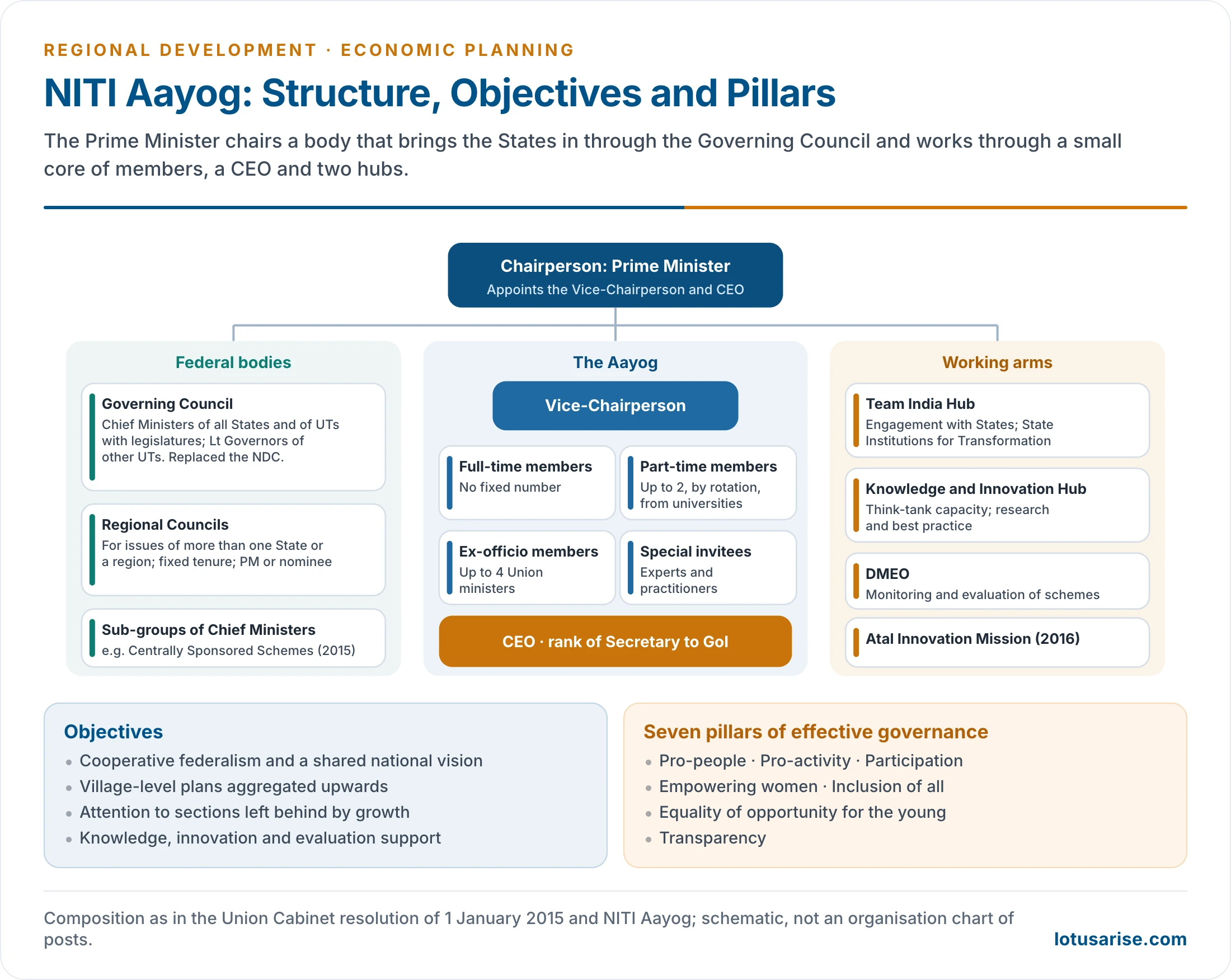
- The National Institution for Transforming India (NITI Aayog) was set up by a Union Cabinet resolution on 1 January 2015. Like its predecessor it is extra-constitutional, non-statutory and advisory.
- Niti means policy, and aayog commission. It is the government’s premier policy think tank. It does not allocate funds and cannot impose policy on States: it acts as an enabler.
- Its central idea is that strong States make a strong nation: development priorities are shared with the States, not prescribed to them.
- India had been perhaps the first non-communist country to adopt central planning, with sectoral output and investment targets from the Harrod–Domar and Mahalanobis models. NITI replaces target-setting with strategy, monitoring and evaluation.
- It works through two hubs:
- the Team India Hub, which engages the States;
- the Knowledge and Innovation Hub, which builds its think-tank capacity.
Objectives
- Give directional and strategic inputs to the Union government, and to States on request.
- End slow implementation by fostering inter-ministry, inter-state and Centre–State coordination.
- Foster cooperative federalism through structured, continuing support to States.
- Evolve a shared vision of national priorities with the States.
- Develop mechanisms to prepare credible plans at village level and aggregate them at higher levels: a bottom-up approach in place of the old top-down one.
- Pay special attention to sections at risk of not benefiting from economic progress.
- Ensure that economic policy takes account of national security interests.
- Design strategic and long-term policy frameworks, and monitor their progress, with feedback for continuous improvement.
- Offer a platform to resolve inter-sectoral and inter-departmental issues, to speed up the development agenda.
- Maintain a knowledge, innovation and entrepreneurial support system, with national and international think tanks and practitioners as partners.
- Serve as a state-of-the-art resource centre for research on good governance and best practice.
- Monitor and evaluate programmes, and focus on technology upgradation and capacity building.
Composition
- Chairperson: the Prime Minister.
- Governing Council: Chief Ministers of all States and of Union Territories with legislatures, and Lieutenant Governors of other UTs. It replaces the NDC as the meeting place of the Union and the States.
- Regional Councils: formed for a specified tenure to address issues affecting more than one State or a region. They include the Chief Ministers and Lieutenant Governors of the region and are chaired by the Prime Minister or his nominee.
- Few have been formed. The older regional forums remain the five Zonal Councils (States Reorganisation Act, 1956) under the Home Ministry and the statutory North Eastern Council (1971).
- Vice-Chairperson: appointed by the Prime Minister. The first was Arvind Panagariya. The economist Ashok Kumar Lahiri was appointed in 2026, succeeding Suman K. Bery.
- Full-time members, with no fixed number.
- Part-time members: at most two, by rotation, from universities, research organisations and other relevant institutions.
- Ex-officio members: at most four members of the Union Council of Ministers, nominated by the Prime Minister.
- Special invitees: experts, specialists and practitioners with domain knowledge, nominated by the Prime Minister.
- Chief Executive Officer: appointed by the Prime Minister for a fixed tenure, in the rank of Secretary to the Government of India, with a secretariat as needed.
- Attached bodies include the Development Monitoring and Evaluation Office (DMEO) and the Atal Innovation Mission (2016).
Seven Pillars of Effective Governance
- Pro-people: fulfils the aspirations of society as well as of individuals.
- Pro-activity: anticipates and responds to citizens’ needs.
- Participation: involves citizens in governance.
- Empowering: women, in all respects.
- Inclusion of all: Scheduled Castes, Scheduled Tribes, Other Backward Classes and minorities; the village, the poor and the farmer.
- Equality: of opportunity, especially for the young.
- Transparency: a government that is visible and responsive.
Cooperative and Competitive Federalism
- Cooperative federalism means the Union and the States working as partners on shared goals, through consultation rather than direction.
- Competitive federalism means States competing, for investment and on development outcomes, with the Centre setting benchmarks and publishing rankings.
- NITI was given both tasks. The two can pull apart: competition rewards the strong, while cooperation must carry the weak.
Cooperative Federalism
- The Governing Council brings the Prime Minister and the Chief Ministers together on a shared agenda.
- The 11th meeting (11 June 2026) took up “Inclusive Human Development for Viksit Bharat@2047”. For the first time, all 28 States attended.
- The 10th meeting (24 May 2025) took up “Viksit Rajya for Viksit Bharat@2047”.
- Sub-groups of Chief Ministers (2015) reported on the rationalisation of Centrally Sponsored Schemes, Swachh Bharat and skill development.
- The scheme sub-group divided schemes into “core of the core”, core and optional groups. Core schemes now follow a 60:40 Centre–State sharing pattern, and 90:10 for the North-Eastern and Himalayan States.
- NITI helps States set up State Institutions for Transformation, their own think tanks, and prepare State visions for 2047.
Competitive Federalism
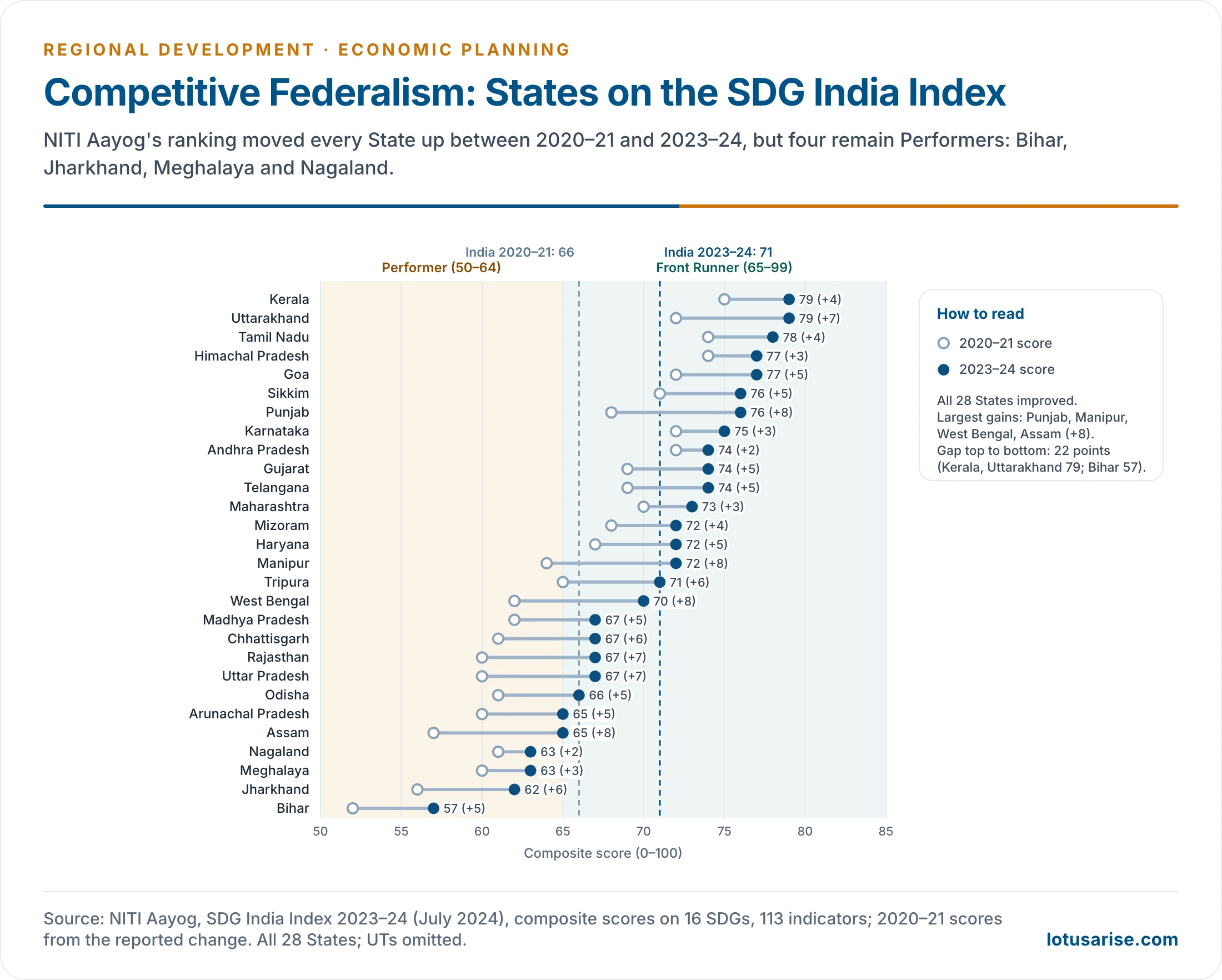
- NITI ranks States and districts on outcomes, so that States compete to improve and learn from one another’s practice.
| Index | First edition | Latest edition | What it measures |
|---|---|---|---|
| SDG India Index | 2018 | 2023–24 (July 2024) | Progress on 16 SDGs, 113 indicators |
| National Multidimensional Poverty Index | 2021 | 2023 review; 2024 discussion paper | Health, education and living-standard deprivations |
| Fiscal Health Index | 2025 | 2026 (March) | Quality of spending, revenue, prudence, debt |
| Export Preparedness Index | 2020 | 2024 (January 2026) | Export policy, environment, infrastructure, performance |
| India Innovation Index | 2019 | Third (2021), released 2022 | Innovation capacity and outcomes |
| State Health Index | 2018 | Round 4, 2019–20 | Health outcomes, governance, inputs |
| School Education Quality Index | 2019 | 2019 | Learning outcomes, access, equity |
- What the indices show:
- SDG India Index 2023–24: India’s composite score rose from 57 (2018) to 66 (2020–21) and 71.
- State scores ranged from 57 (Bihar) to 79 (Keralam and Uttarakhand), and every State improved on its 2020–21 score.
- National MPI: the share of multidimensionally poor people fell from 24.85% (2015–16) to 14.96% (2019–21).
- NITI’s 2024 discussion paper estimates a fall from 29.17% (2013–14) to 11.28% (2022–23), with about 24.8 crore people escaping multidimensional poverty.
- The gaps remain regional: in 2019–21, 33.8% of Bihar’s people were multidimensionally poor, against 0.6% of Keralam’s.
- SDG India Index 2023–24: India’s composite score rose from 57 (2018) to 66 (2020–21) and 71.
- The Aspirational Districts Programme (2018) applies the same method at district level, ranking 112 lagging districts in real time.
- The Aspirational Districts and Blocks Programmes extended it to 500 blocks in 2023.
- With the Ministry of DoNER, NITI also built a North Eastern Region District SDG Index (first edition 2021), carrying the ranking down to districts.
Vision, Strategy and Action Agenda
- In place of five-year plans, NITI proposed a 15-year vision, a 7-year strategy and a 3-year action agenda.
- The Three Year Action Agenda (2017–18 to 2019–20) was released in 2017. It sets out a roadmap but no schemes or allocations, and needs no Cabinet approval, so it binds no one.
- Strategy for New India @75 followed in 2018, with goals for 2022–23.
- The long-term vision has since become Viksit Bharat@2047: a developed India by the centenary of Independence, built partly on State visions.
- NITI’s sectoral reports and roadmaps range from digital public infrastructure and city government to natural farming. The DMEO evaluates Centrally Sponsored Schemes.
NITI Aayog and Regional Development
- NITI has no plan funds to direct to backward regions, so its regional role works through targeting, convergence and ranking:
- Aspirational Districts (2018) and Aspirational Blocks (2023): convergence of existing schemes in the most backward districts and blocks, with monthly ranking on outcome indicators.
- NITI Forum for North East (2018): set up with the Ministry of DoNER to identify constraints and projects for the eight North-Eastern States.
- Holistic development of islands (2017): NITI led the plans for selected islands of Andaman and Nicobar and Lakshadweep.
- District-level SDG ranking for the North-East, and support for State visions that carry the 2047 goals to districts.
- What it cannot do is redistribute. Inter-regional transfers now depend on the Finance Commission’s formula and on how ministries share scheme funds.
- Regional policy has therefore moved from the planners to the fiscal federalism of devolution and to programme design.
NITI Aayog and the Planning Commission Compared
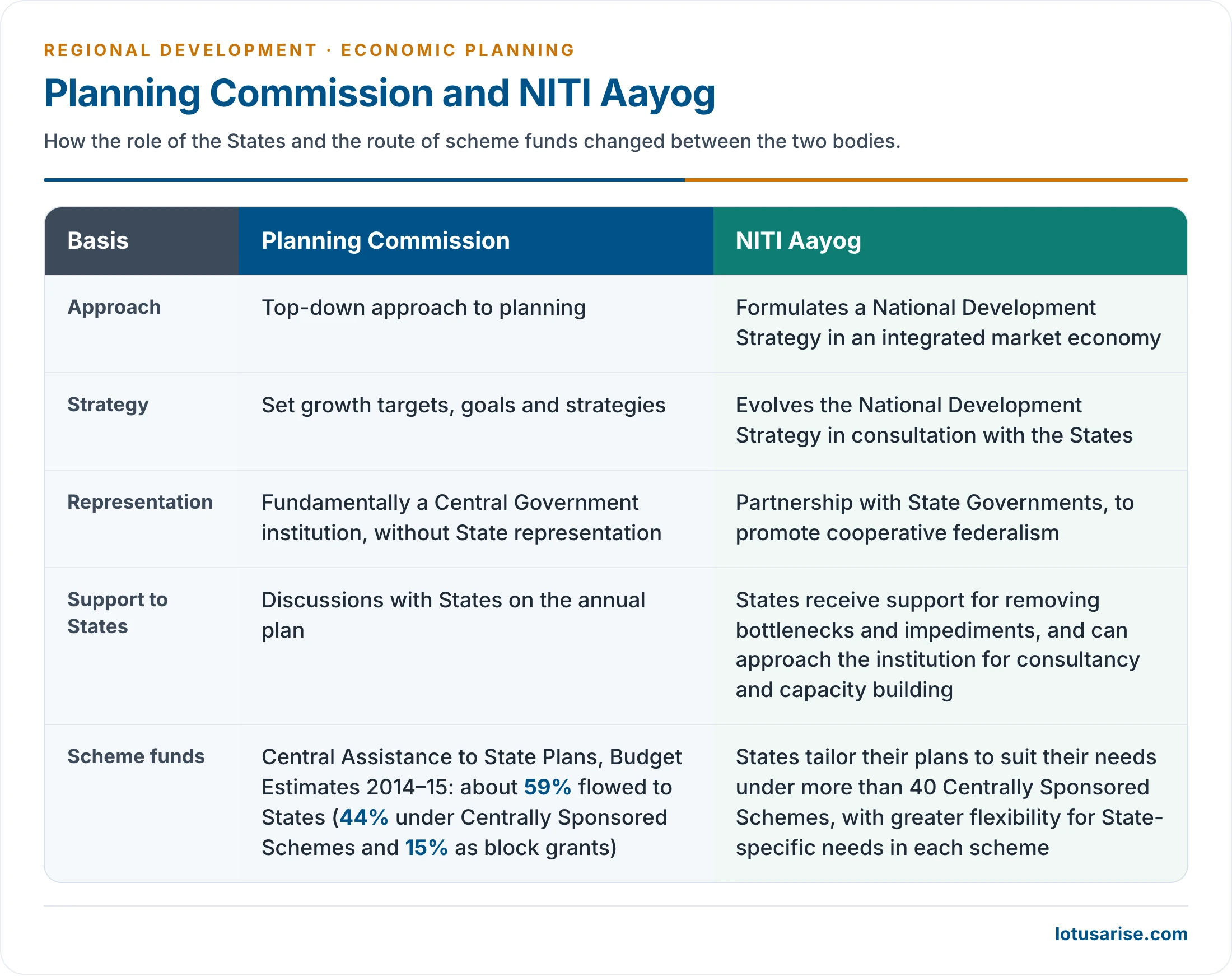
| Basis | Planning Commission | NITI Aayog |
|---|---|---|
| Nature | Advisory, but controlled plan funds | Think tank; no power to allocate funds |
| Approach | Top-down, one size fits all | Bottom-up, State-specific |
| Main output | Five Year Plans with targets | Vision, strategy, action agenda, indices |
| Role of States | Annual plan approval; NDC role | Governing Council of all Chief Ministers |
| Regional bodies | None | Regional Councils |
| Federal principle | Centralised | Cooperative and competitive federalism |
| Funds to States | Gadgil–Mukherjee formula, plan grants | Finance Commission devolution and ministry schemes |
| Members | Full-time, as decided | Full-time; up to two part-time and four ex-officio |
| Chief executive | Member-Secretary | CEO in the rank of Secretary |
| Representation | Fundamentally a Central institution, without State representation | Partnership with State governments |
| Strategy | Set growth targets, goals and strategies | Evolves a national development strategy with States, for an integrated market economy |
| Support to States | Discussion of annual plans | Help in removing bottlenecks; consultancy and capacity building |
| Scheme funds | Of Central assistance in 2014–15, about 59% flowed to States (44% through Centrally Sponsored Schemes, 15% as block grants) | States tailor plans under more than 40 Centrally Sponsored Schemes, with more flexibility |
- The key difference is money. The Commission could allocate funds to ministries and States; that function now lies with the Finance Ministry.
- The bulk of transfers now comes through the Finance Commission’s tax devolution: 42% (2015–20) and 41% (2021–26 and 2026–31) of the divisible pool.
- The Governing Council resembles the old NDC, but it meets on themes, not to approve plans.
- NITI has added national security to economic strategy and evaluation to its functions. It frames no Central plans.
Assessment of NITI Aayog
- Achievements:
- States have a standing forum with the Centre and a voice in national priorities.
- Outcome indices made State performance visible and comparable. The Aspirational Districts method drew praise in an independent appraisal by the UNDP (2020).
- Evaluation and data improved, through DMEO studies and the National Data and Analytics Platform (2022).
- Atal Innovation Mission labs and incubators spread innovation support to schools and universities.
- Limitations and criticism:
- Without funds, its advice binds no one. States, especially opposition-ruled ones, have at times boycotted Governing Council meetings.
- Critics see it as an arm of the Union government rather than a neutral body between the Centre and the States.
- Rankings can reward data reporting more than outcomes, and seldom allow for States’ different starting points.
- With the NDC dormant, no forum with constitutional standing settles Union–State planning disputes.
- NITI faces two continuing challenges:
- building a pool of high-quality researchers across disciplines who can work with policymakers;
- creating a willingness to learn from evidence among policymakers, instead of relying on habit, institutions or ideology.
Previous Year Questions
- No direct PYQ has been asked on this sub-topic yet.





I don’t know who you are but You are great sir, you helped me to crack state prelims
Thanks, Keep reading & Keep improving.
Sir please post full economics notes
superb notes sir. for UPSC specially
your geography notes are amazing.
sir please post more economic notes .
Superb notes
please share material for mobilisation of resources
It would be good if you can provide preview for your notes, to help us understand better before buying.