

- Human Development is the process of enlarging people’s choices. The ethos of planning in India has always been people-centric. However, the introduction of the human development paradigm in the planning mechanism ensured the focus of human development in the growth process.
- As the country was opening up its economy in the 1990s, this central position was essential for policy planners to continue focussing on people who may be excluded from market-oriented growth. Additionally, it is extremely essential to incorporate human development into the planning process so that people can be empowered to hold their governments to account and Governments can be encouraged to be responsive to the needs of the people. (UNDP, 2010).
- Thus, in 1990, the UNDP gave a call for a broad approach to improving human well-being that would cover all aspects of human life, for all people, in both high-income and developing countries, both now and in the future. It went far beyond narrowly defined economic development to care for the full flourishing of all human choices essential for the quality of life.
- For a large country such as India, the utility of the study of human development is enhanced once the exercise is attempted at the state level. Apart from the diversity, an important reason for establishing a “benchmark” and subsequent “follow-up” on different aspects of human welfare at the state level is due to the dominant role played by the states in social sectors in the country.
Human Development Approach

- For decades, countries’ levels of welfare were measured in terms of economic growth or an increase in per capita gross domestic product (GDP). While this approach has the advantage of being straightforward and easy to use, the failure of economic growth to improve the wellbeing of a significant proportion of people in many countries has underscored the need for a more encompassing measure that also captures human development.
- The concept of human development emerged in the late 1980s based on the conceptual foundation provided by Dr. Amartya Sen and Dr. Mahbub ul Haq. The HD approach puts people at the center of the development agenda, where economic growth and wealth are considered means to development, not an end by itself.
- Put simply, the starting point for the human development approach is the idea that the purpose of development is to improve human lives by not only enhancing income but also expanding
the range of things that a person can be and can do, such as be healthy and well-nourished, be knowledgeable, and to participate in community life.- Seen from this viewpoint, development is about removing the obstacles to what a person can do in life, obstacles such as lack of income, illiteracy, ill-health, lack of access to resources, or lack of civil and political freedoms.
- The first Human Development Report defines human development as a process of enlarging people’s choices. To lead a long and healthy life, to be educated, and to enjoy a decent standard of living are the three most critical choices identified in the first HDR. Additional choices include political freedom, guaranteed human rights, and self-respect.
Human Development Index
- HDI is part of the Human Development Report that is published by the United Nations Development Programme (UNDP). The Human Development Index (HDI) is a summary measure of average achievement in key dimensions of human development:
- a long and healthy life,
- being knowledgeable
- and have a decent standard of living.
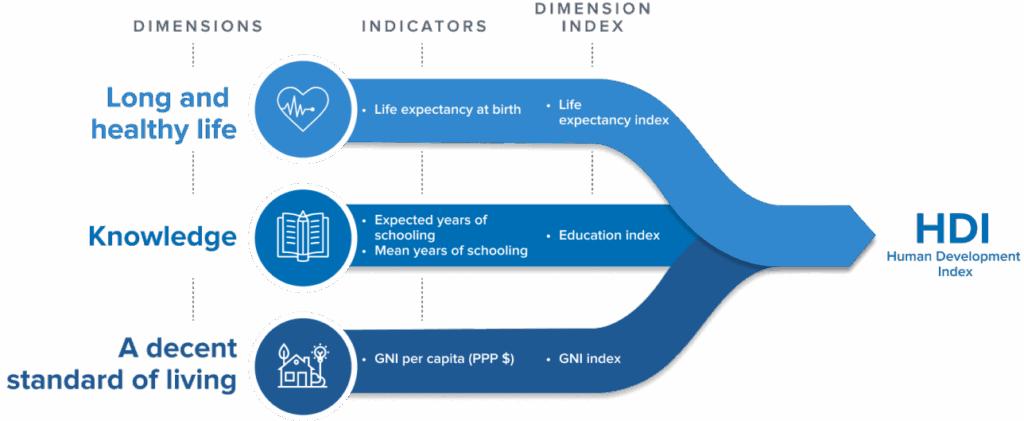
- The HDI is the geometric mean of normalized indices for each of the three dimensions.
- The health dimension is assessed by life expectancy at birth, component of the HDI is calculated using a minimum value of 20 years and a maximum value of 85 years.
- The education component of the HDI is measured by means of years of schooling for adults aged 25 years and more and expected years of schooling for children of school entering age.
- Mean years of schooling are estimated by UNESCO Institute for Statistics based on educational attainment data from censuses and surveys available in its database.
- Expected years of schooling estimated are based on enrolment by age at all levels of education. Expected years of schooling are capped at 18 years.
- The indicators are normalized using a minimum value of zero and maximum aspirational values of 15 (Mean years of schooling) and 18 (Expected years of schooling) years respectively.
- The two indices are combined into an education index using arithmetic mean.
- The standards of living dimension is measured by gross national income per capita.
- The scores for the three HDI dimension indices are then aggregated into a composite index using geometric mean.
- Classification of countries
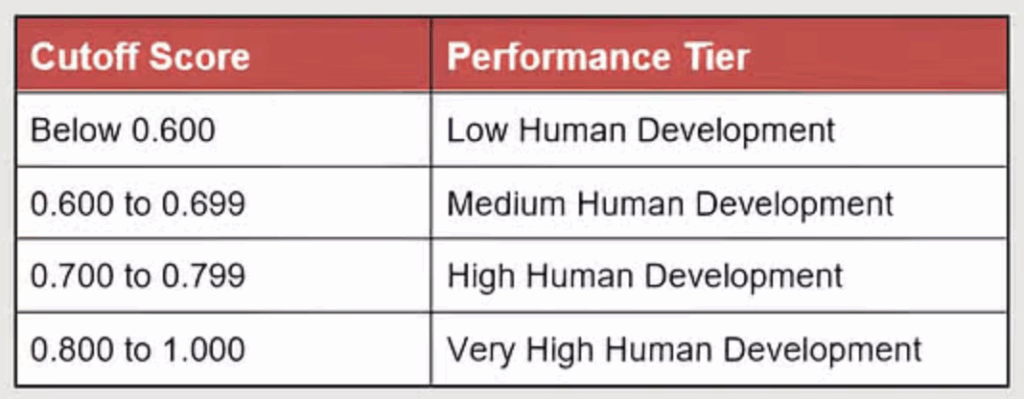
- Very high human development (HDI 0.900 and above)
- High human development (HDI 0.800 – 0.899)
- Medium human development (HDI 0.500 – 0.799)
- Low human development (HDI below 0.500)
- India lies in medium human development category.
Inequality-adjusted Human Development Index (IHDI)
- The IHDI indicates percentage loss in HDI due to inequality.
- The Inequality-adjusted Human Development Index (IHDI) takes into account not only the average achievements of a country on health, education, and income, but also how those achievements are distributed among its citizens by “discounting” each dimension’s average value according to its level of inequality.

- The IHDI is distribution-sensitive average level of human development.
- Two countries with different distributions of achievements can have the same average HDI value.
- Under perfect equality the IHDI is equal to the HDI, but falls below the HDI when inequality rises.
- The difference between the IHDI and HDI is the human development cost of inequality, also termed – the overall loss to human development due to inequality.
- The IHDI allows a direct link to inequalities in dimensions, it can inform policies towards inequality reduction.
- It leads to a better understanding of inequalities across populations and their contribution to the overall human development cost.
Gender Inequality Index (GII)
- The GII is an inequality index.
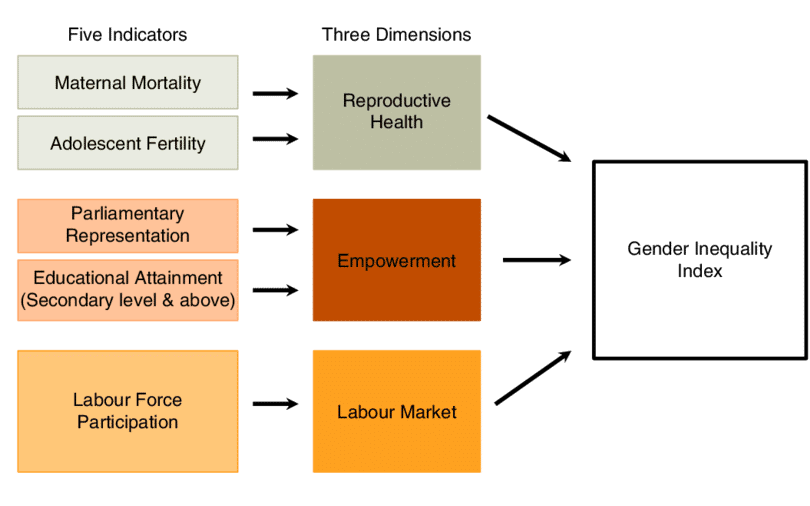
- It measures gender inequalities in three important aspects of human development—
- reproductive health, measured by maternal mortality ratio and adolescent birth rates;
- empowerment, measured by the proportion of parliamentary seats occupied by females and the proportion of adult females and males aged 25 years and older with at least some secondary education;
- and economic status expressed as labor market participation and measured by labor force participation rate of female and male populations aged 15 years and older.
- The GII sheds new light on the position of women in 162 countries;
- it yields insights in gender gaps in major areas of human development.
- The component indicators highlight areas in need of critical policy intervention and it stimulates proactive thinking and public policy to overcome systematic disadvantages of women.
- It measures the human development costs of gender inequality. Thus, the higher the GII value the more disparities between females and males.
Gender Development Index (GDI)
- GDI measures disparities in the HDI by gender.
- The GDI measures gender gaps in human development achievements by accounting for disparities between women and men in three basic dimensions of human development—health, knowledge, and living standards using the same component indicators as in the HDI.
- Health measured by female and male life expectancy at birth.
- Education measured by female and male expected years of schooling for children and female and male mean years of schooling for adults ages 25 and older.
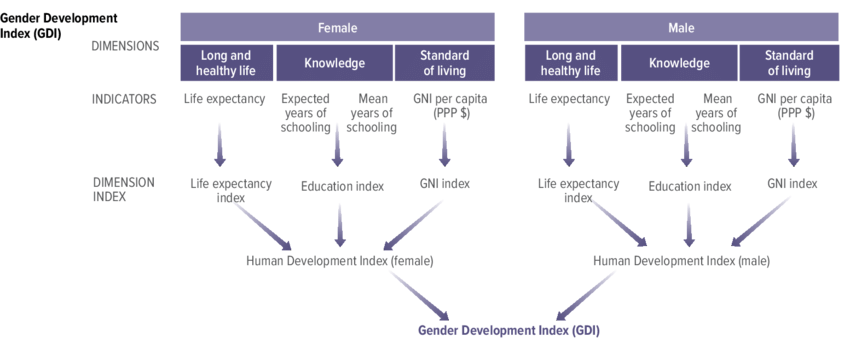
- Command over economic resources measured by female and male estimated earned income.
- The GDI is the ratio of the HDIs calculated separately for females and males using the same methodology as in the HDI.
- The goalposts are also the same except for life expectancy at birth where the minimum and maximum goalposts are varied (minimum of 22.5 years and a maximum of 87.5 years for female; and the corresponding values for males are 17.5 years and 82.5 years.) The rationale is to take into account a biological advantage averaging five years of life that females have over males.
Multidimensional Poverty Index (MPI)
- The Multidimensional Poverty Index (MPI) published for the first time in the 2010 report, complements monetary measures of poverty by considering overlapping deprivations suffered by people at the same time.
- MPI captures the multiple deprivations that people in developing countries face in their health, education, and standard of living.
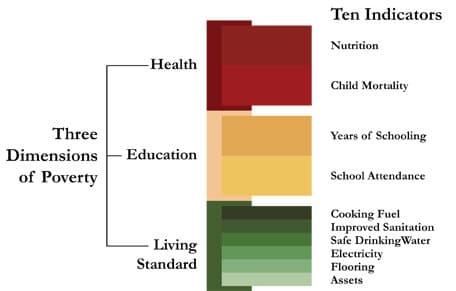
- The Index identifies deprivations across the same three dimensions as the HDI and shows the number of people who are multi-dimensionally poor (suffering deprivations in 33% of weighted indicators) and the number of deprivations with which poor household typically contend with.
- It can be deconstructed by region, ethnicity and other groupings as well as by dimensions, making it an apt tool for policymakers.
- The MPI can help the effective allocation of resources by making possible the targeting of those with the greatest intensity of poverty.
- It can help addressing MDGs strategically and monitoring of impacts of policy intervention.
- The MPI can be adapted to the national level using indicators and weights that make sense for the region or the country, it can be adopted for national poverty eradication programs, and it can be used to study changes over time.
- The Global Multidimensional Poverty Index (MPI) was developed in 2010 by the Oxford Poverty & Human development initiative (OPHI) and the United Nations Development programme, and uses different factors to determine poverty beyond income-based lists.
- It replaced the previous Human Poverty Index. The global MPI is released annually by OPHI and the results published on its website.
Human Development Report 2025
- India has been ranked 130th out of 193 countries and territories in the 2025 Human Development Report (HDR), titled “A Matter of Choice: People and Possibilities in the Age of AI”, released by the United Nations Development Programme (UNDP).
Key Highlights of Human Development Report 2025
Global
- Stalled Human Development Progress: The global HDI saw its smallest increase since 1990 (excluding the 2020-2021 crisis years).
- If pre-Covid trends had continued, most countries could have reached very high human development by 2030, this is now likely to be delayed by decades.
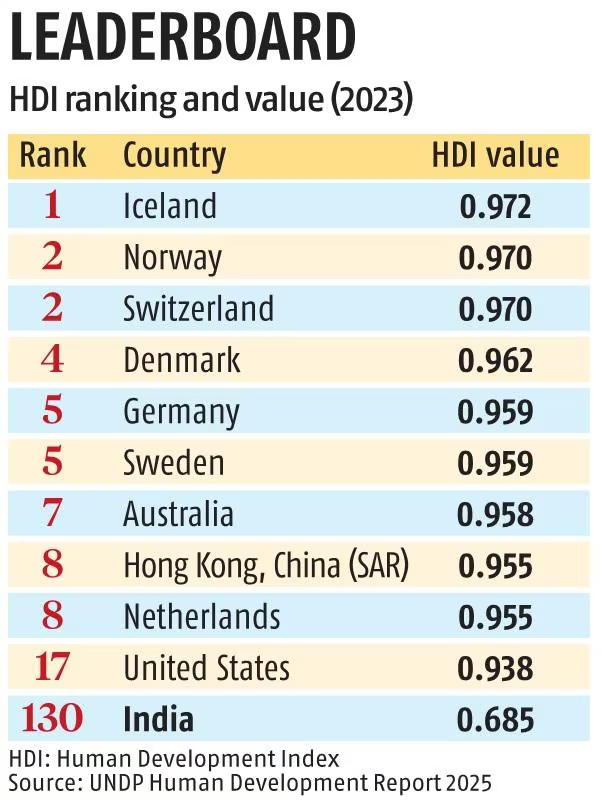
- Top and Bottom Ranks: Iceland ranked first with an HDI of 0.972, while South Sudan ranked last with an HDI of 0.388.
- Growing Inequality: The disparity between the richest and poorest nations has been widening, with high-HDI countries continuing to make progress while low-HDI countries face stagnation.
- AI and Future of Work: The report notes that Artificial Intelligence (AI) is rapidly spreading, with 1 in 5 people globally already using AI tools.
- While 60% served people believe AI will create new job opportunities, half fear it could replace or transform their current roles.
- The 2025 Human Development Report emphasizes the need for inclusive, human-centered AI policies to ensure AI contributes positively to human development, rather than exacerbating inequalities or displacing jobs.
India
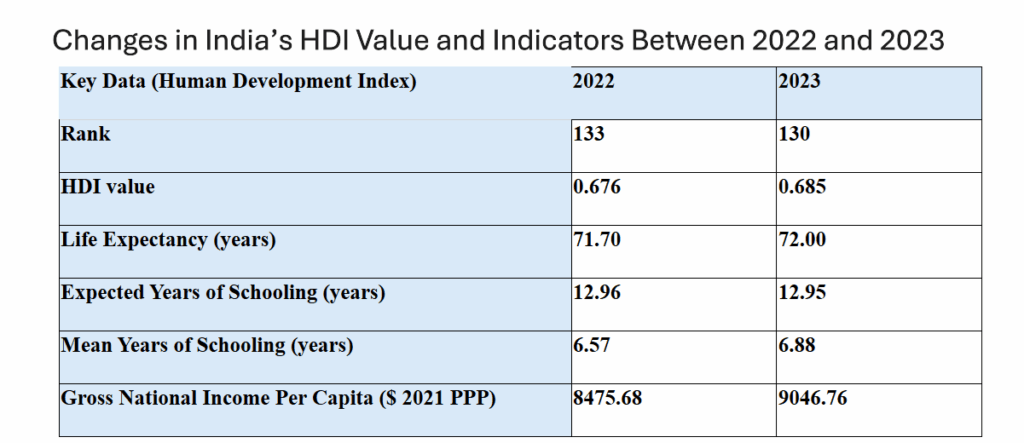
- India’s HDI Ranking: India ranked 133rd in 2022 and improved to 130th in 2023, with its HDI value rising from 0.676 to 0.685.
- The country remains in the “medium human development” category, though it is approaching the threshold for “high human development” (HDI ≥ 0.700).
- Regional Comparison: Among India’s neighbors, China (78th), Sri Lanka (89th), and Bhutan (125th) rank above India, while Bangladesh (130th) is on par. Nepal (145th), Myanmar (150th), and Pakistan (168th) are ranked below India.
- Progress in Key Areas:
- Life Expectancy: India’s life expectancy rose from 58.6 years in 1990 to 72 years in 2023, the highest ever, reflecting a strong post-pandemic recovery.
- This progress is attributed to national health programs like National Health Mission, Ayushman Bharat, Janani Suraksha Yojana, and Poshan Abhiyaan.
- Education: India’s mean years of schooling have increased, with children now expected to stay in school for 13 years, up from 8.2 years in 1990.
- Initiatives like the Right to Education Act 2009, National Education Policy 2020, and Samagra Shiksha Abhiyan have improved access, though quality and learning outcomes still require attention.
- National Income: India’s Gross National Income per capita rose over fourfold, from USD 2,167 in 1990 to USD 9,046 in 2023 based on 2021 Purchasing Power Parity (PPP).
- Additionally, 135 million Indians escaped multidimensional poverty between 2015-16 and 2019-21, contributing to HDI improvement.
- AI Skills Growth: India is emerging as a global AI leader with the highest self-reported AI skills penetration.
- 20% of Indian AI researchers now remain in the country, a significant rise from nearly zero in 2019.
- Life Expectancy: India’s life expectancy rose from 58.6 years in 1990 to 72 years in 2023, the highest ever, reflecting a strong post-pandemic recovery.
- Challenges Impacting India’s HDI:
- Inequality Reduces HDI: Inequality has reduced India’s HDI by 30.7%, one of the highest losses in the region.
- Gender Disparities:Female labour force participation (at 41.7% and political representation continue to lag.
- Steps like the 106th constitutional amendment reserving one-third of legislative seats for women show promise for transformative change.





Thank you so much…this is really helpful….
well consolidated material … Thanks a lot