

- Language and religion are the two most powerful components of cultural geography. They shape identity, social organisation, landscapes and the boundaries between peoples, and they are the main criteria used to draw culture realms.
- Secularisation is the process by which religion loses influence over public and personal life. It changes how religion is expressed in space, from sacred landscapes to the law of the state.
- Geography cannot settle questions of grammar or theology. What it studies is their spatial context: where languages and faiths arose, how they diffused, how they interact and where they are retreating.
Language

Meaning and Functions
- A language is a system of conventional spoken, signed or written symbols through which members of a social group express themselves and take part in its culture.
- Functions: communication, expression of identity, transmission of culture, imaginative and emotional expression.
- Geographical importance:
- Values, literature and practices pass between generations through language.
- Language is a key criterion for demarcating regions. Most Indian states were reorganised on linguistic lines after 1956.
| Term | Meaning | Example |
|---|---|---|
| Dialect | Regional or social variety of a language | Awadhi, Bhojpuri within the Hindi belt |
| Language family | Languages descended from a common ancestor | Indo-European, Dravidian |
| Lingua franca | A common language between speakers of different tongues | Swahili in East Africa; English worldwide |
| Pidgin | Simplified contact language, no native speakers | Early trade pidgins of West Africa |
| Creole | A pidgin that has become a mother tongue | Haitian Creole; Nigerian Pidgin is creolising |
| Isolate | Language with no known relatives | Basque; Nihali (India) |
Language Families and World Distribution
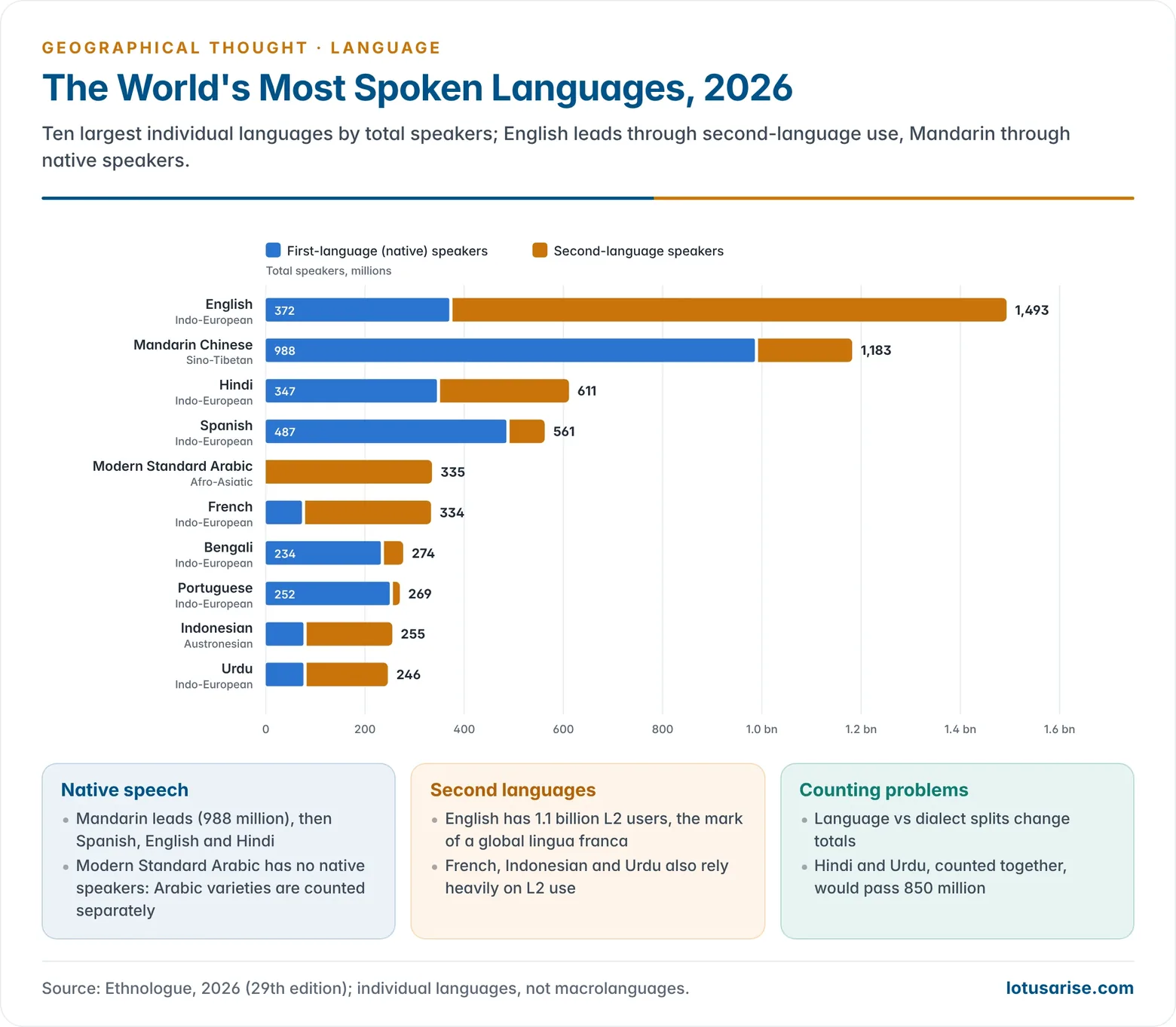
- Ethnologue (2026) counts 7,170 living languages, but distribution is extremely uneven:
- the 20 largest languages are the mother tongue of over 3.7 billion people;
- roughly 44% of all languages are endangered.
- Major families:
- Indo-European: spoken by nearly half of humanity, from India to the Americas through colonial spread.
- Sino-Tibetan: Mandarin and the Tibeto-Burman languages, including those of North-East India.
- Niger–Congo: the family with the most languages (about 1,500), across sub-Saharan Africa, including the Bantu group.
- Austronesian: the widest pre-colonial spread of any family, from Madagascar to Easter Island.
- Afro-Asiatic: Arabic, Hebrew, Amharic and Hausa.
- Dravidian: the South Indian family, also found in Brahui (Pakistan) and Kurukh.
- Austroasiatic: Munda (Santali, Ho) and Mon-Khmer (Khasi, Vietnamese).
| Rank | Language | Total speakers (million) | Of which first-language |
|---|---|---|---|
| 1 | English | 1,493 | 372 |
| 2 | Mandarin Chinese | 1,183 | 988 |
| 3 | Hindi | 611 | 347 |
| 4 | Spanish | 561 | 487 |
| 5 | Modern Standard Arabic | 335 | 0 (learned only as a second language) |
| 6 | French | 334 | 75 |
| 7 | Bengali | 274 | 234 |
| 8 | Portuguese | 269 | 252 |
- Reading the table: English leads only because of its 1.1 billion second-language users. Mandarin leads by mother tongue.
- Counts depend on how Chinese and Arabic varieties, and Hindi and Urdu, are split. Ethnologue counts Urdu separately (246 million).
Origin and Diffusion of Languages
- A language originates at a particular hearth and spreads mainly through the migration of its speakers (relocation diffusion). Conquest, trade, religion and states spread it further (expansion and hierarchical diffusion).
- Indo-European: two rival hearth theories.
- The steppe (Kurgan) hypothesis of Marija Gimbutas (1956) places the hearth north of the Black Sea, with spread by horse-riding pastoralists.
- The Anatolian hypothesis of Colin Renfrew (1987) ties the spread to farming. Recent ancient-DNA studies favour a steppe role in Europe.
- Austronesian: spread out of Taiwan by seafaring farmers across the Pacific and Indian Oceans.
- Bantu expansion: iron-using farmers carried Bantu languages from West-Central Africa south and east.
- Religion and empire: Arabic spread with Islam. Sanskrit and Pali spread with Hinduism and Buddhism into Southeast Asia. English, Spanish, Portuguese and French spread with colonialism.
- Isolation preserves diversity. Mountains, forests and islands slow contact, so they hold many small languages. The same isolation leaves them vulnerable once roads and markets arrive.
Language Hotspots and Endangered Languages
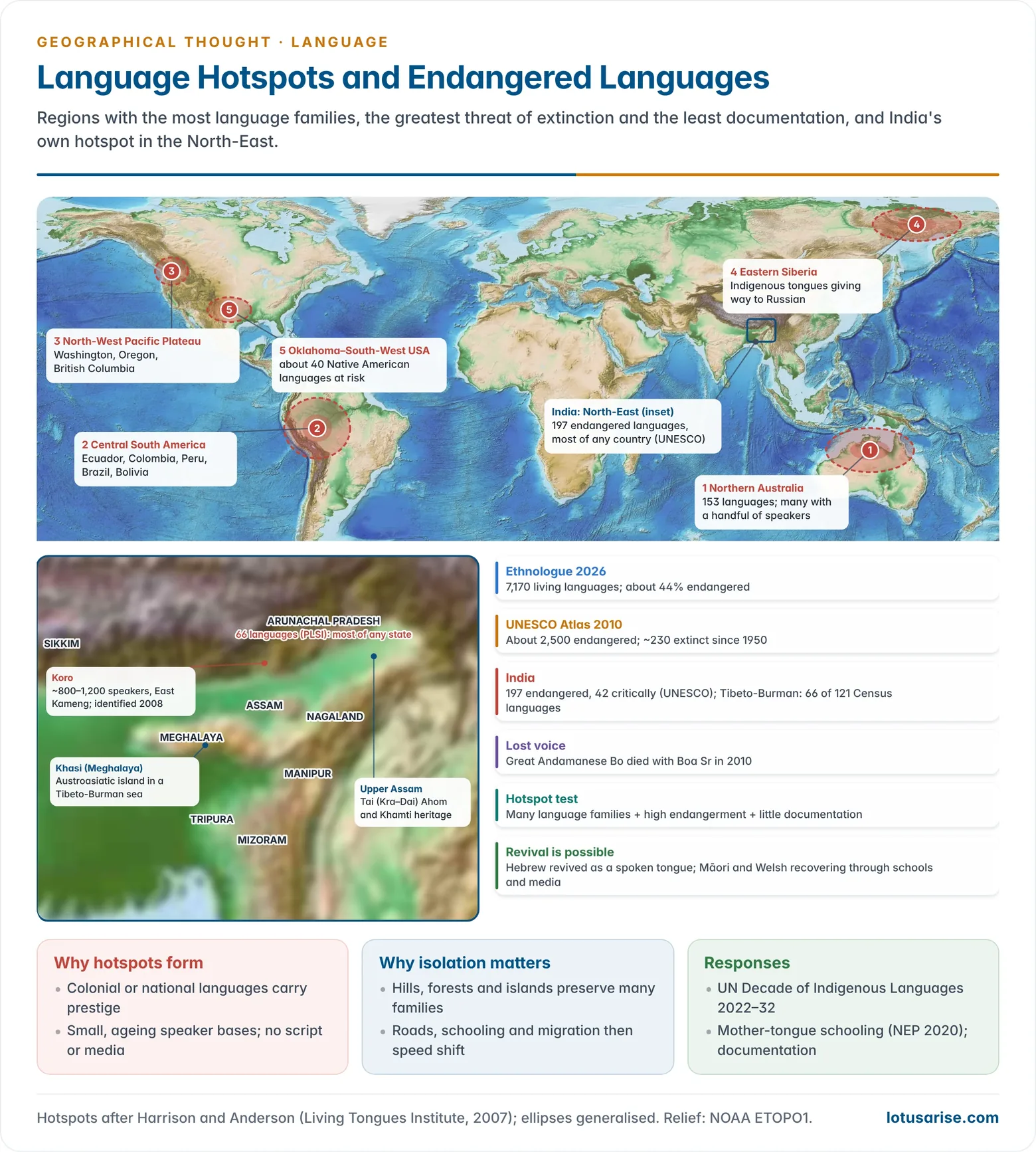
- A language hotspot is a region with the highest linguistic diversity (counted in language families, not just languages), the highest endangerment and the least documentation.
- The concept was devised by K. David Harrison and Gregory D. S. Anderson of the Living Tongues Institute, with National Geographic’s Enduring Voices project, in 2007.
- Five top-priority hotspots (2007): Northern Australia (153 languages, many with a handful of speakers), central South America, the North-West Pacific Plateau, eastern Siberia, and Oklahoma and the US South-West.
- All five were colonised: a prestigious colonial language (English, Spanish, Russian) displaced indigenous tongues.
- UNESCO’s Atlas of the World’s Languages in Danger (3rd ed., 2010) lists about 2,500 endangered languages, from “vulnerable” to “extinct”. About 230 have become extinct since 1950.
- India: 197 languages are endangered on UNESCO’s scale, the highest number of any country, and 42 of them are critically endangered.
- North-East India is India’s linguistic hotspot. Arunachal Pradesh alone has about 66 languages, the most of any state in the People’s Linguistic Survey of India.
- Koro, an unwritten Tibeto-Burman language of about 800–1,200 speakers in East Kameng, was identified only in 2008 and announced in 2010.
- Great Andamanese Bo died with its last speaker, Boa Sr, in 2010.
- North-East India is India’s linguistic hotspot. Arunachal Pradesh alone has about 66 languages, the most of any state in the People’s Linguistic Survey of India.
- Causes of endangerment:
- language shift to dominant languages for jobs and schooling;
- migration and urbanisation;
- small, ageing speaker bases;
- stigma attached to minority speech;
- no script and no place in mass media.
- Revitalisation is possible:
- Hebrew was revived as a spoken language, and Māori and Welsh have recovered through schooling and media.
- The UN declared 2022–2032 the International Decade of Indigenous Languages.
- India’s National Education Policy 2020 favours mother-tongue instruction up to Class 5.
Globalisation and Language
- Globalisation concentrates language use: English is used on about 49.5% of websites (W3Techs, October 2026), while Hindi, with 611 million speakers, appears on under 0.1%.
- It also creates new opportunities. Machine translation, India’s Bhashini platform and social media give minor languages new outlets. Hinglish-type hybrid codes reflect glocal mixing.
Language in India
- Census 2011: 121 languages, 22 scheduled in the Eighth Schedule. Hindi is the mother tongue of 43.6% of the population.
- Four main families:
- Indo-European (Indo-Aryan): 78.1%;
- Dravidian: 19.6%;
- Austroasiatic: 1.1%;
- Tibeto-Burman: 1.0%, though it accounts for 66 of the 121 languages.
- Classical languages: 11 since October 2024, when Marathi, Pali, Prakrit, Assamese and Bengali joined Tamil, Sanskrit, Telugu, Kannada, Malayalam and Odia.
- The regional pattern of India’s linguistic diversity mirrors its physiography: large Indo-Aryan and Dravidian blocks in the plains and peninsula, and small Austroasiatic and Tibeto-Burman pockets in the hills of central and North-East India.
Religion
Meaning and Geographical Significance
- A religion is a community of shared belief in the sacred or supernatural and shared moral values that binds people together. The word comes from the Latin religare, “to bind”.
- Why geographers study it:
- Religion shapes diet, dress, festivals, land use, settlement and architecture. The sacred cow and the paddy calendar of festivals are examples.
- Faiths are no longer confined to their hearths. Their spread has produced both conflict and persecution and, elsewhere, tolerance and coexistence.
- Religious ethics can support conservation, as in sacred groves and river worship.
Universalising and Ethnic Religions
| Feature | Universalising | Ethnic |
|---|---|---|
| Membership | Open; actively seeks converts | Born into; tied to a people or place |
| Founder and hearth | Precise founder and place | No single founder; diffuse origin |
| Diffusion | Wide, by missions and conquest | Limited; mainly by migration |
| Calendar | Events in the founder’s life | Agricultural and natural cycles |
| Examples | Christianity, Islam, Buddhism, Sikhism | Hinduism, Judaism, Shinto, Daoism |
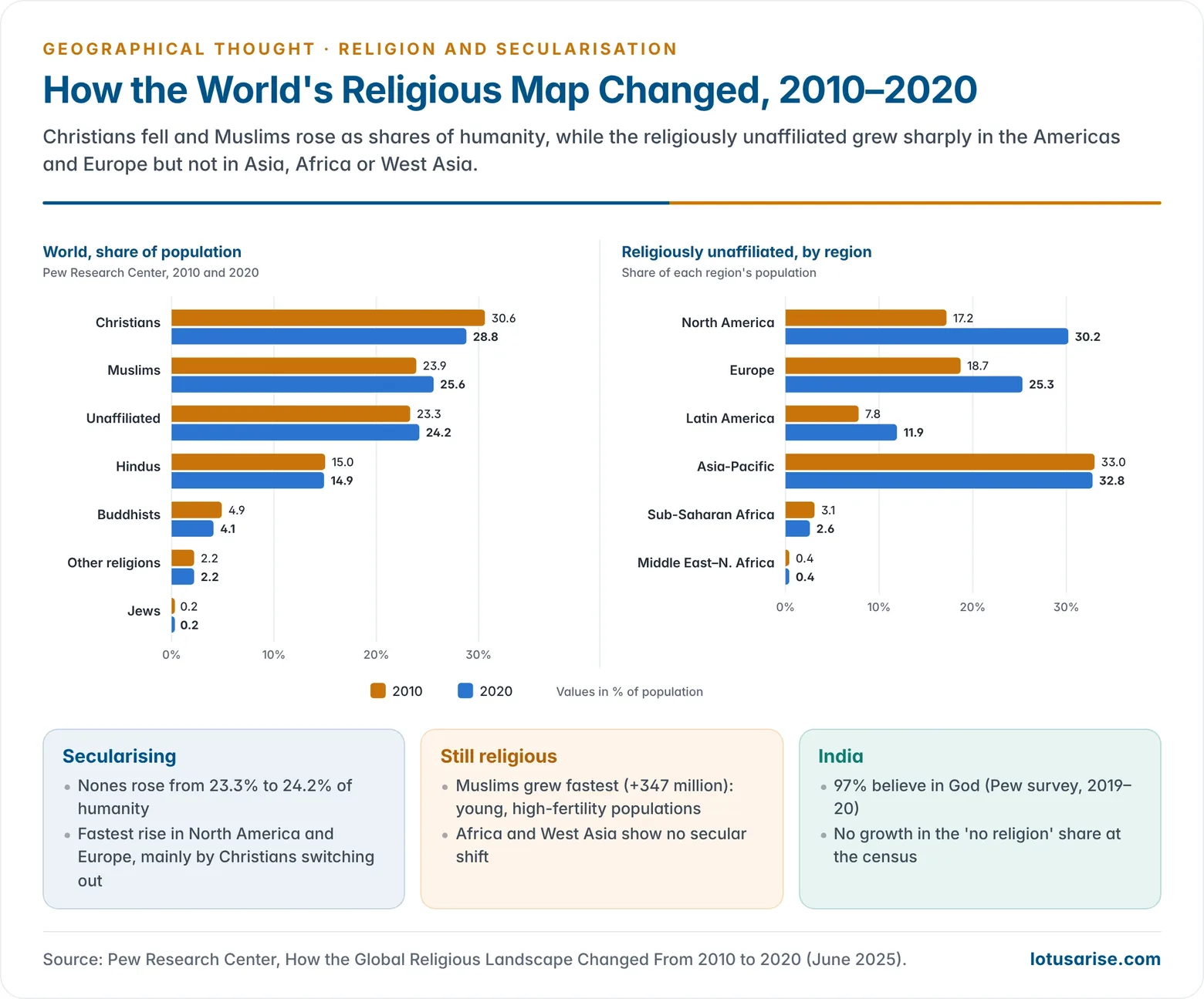
- World pattern (Pew, 2020):
- Christians 2.3 billion (28.8%);
- Muslims 2.0 billion (25.6%);
- religiously unaffiliated 1.9 billion (24.2%);
- Hindus 1.2 billion (14.9%);
- Buddhists 324 million (4.1%);
- Jews 14.8 million (0.2%).
- India (Census 2011): Hindus 79.8%, Muslims 14.2%, Christians 2.3%, Sikhs 1.7%, Buddhists 0.7%, Jains 0.4%. Their spatial pattern is regionally concentrated: Sikhs in Punjab, Christians in the North-East and Kerala, Buddhists in Maharashtra and the Himalaya, and Muslim majorities in Jammu and Kashmir and Lakshadweep.
Hearths and Diffusion of Religions
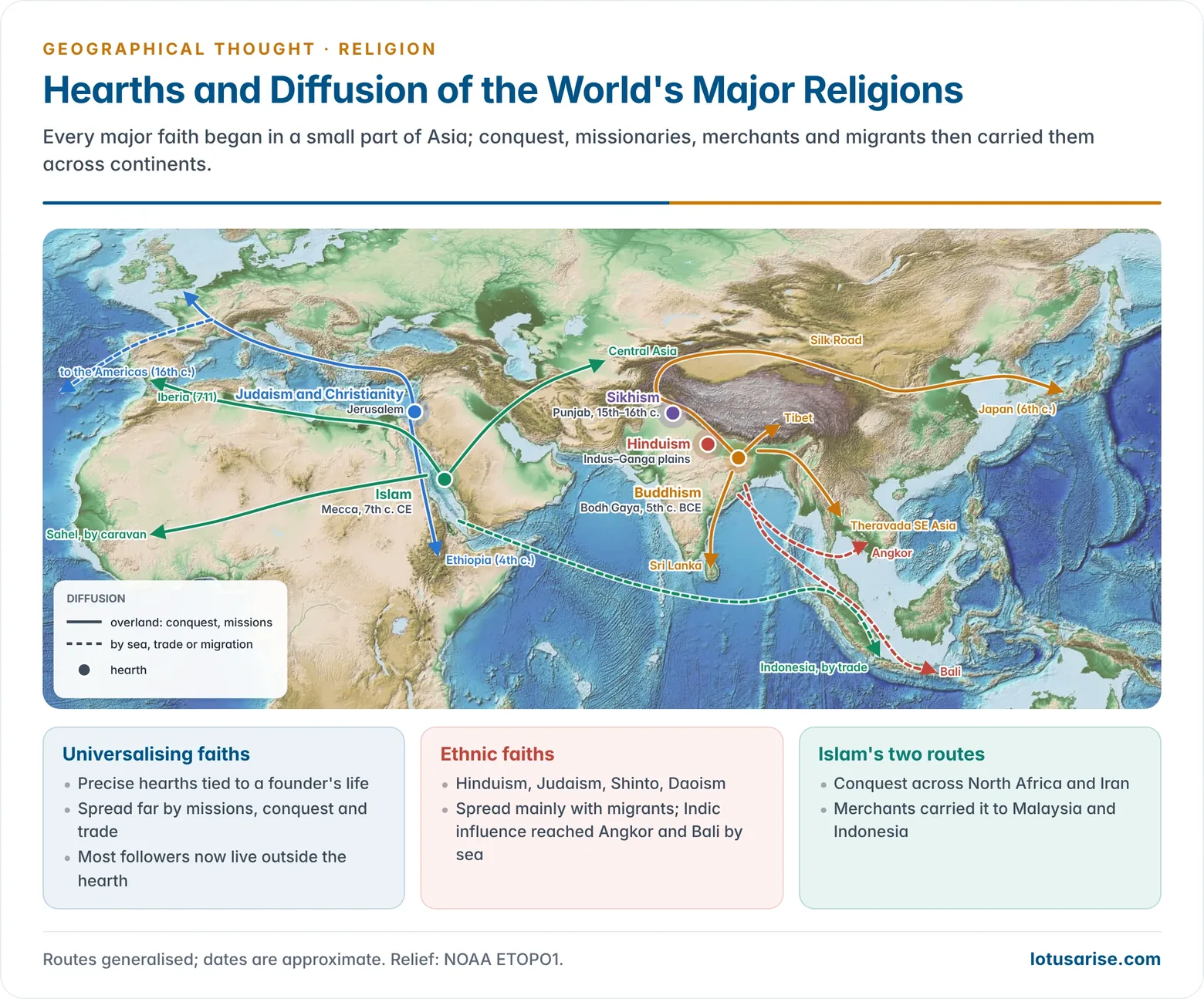
- The great religions arose in small areas of Asia:
- Hinduism in the Indus–Ganga plains;
- Buddhism at Bodh Gaya and Sarnath (5th century BCE);
- Judaism and Christianity in Palestine;
- Islam at Mecca and Medina (7th century CE);
- Sikhism in Punjab (15th–16th centuries).
- Modes of diffusion:
- Conquest and empire: Islam across North Africa, Iran and Central Asia. Christianity in Latin America under Iberian colonialism.
- Missionaries (hierarchical diffusion): Buddhism under Ashoka, through monasteries along the Silk Road. Christianity through Roman cities and later colonial missions.
- Trade (contagious diffusion): Islam reached Malaysia and Indonesia with merchants, not armies.
- Migration (relocation): Hinduism and Sikhism through the Indian diaspora in Fiji, Mauritius, the Caribbean, the UK and North America.
- Political expansion: state patronage and the redrawing of boundaries.
- Result: universalising faiths now have most followers outside their hearths. Buddhism is a minority in India, and Christianity’s centre of gravity has shifted to the Global South.
Sacred Space and Religious Landscapes
- Sacred places organise space and movement:
- Jerusalem is holy to three faiths;
- Mecca draws the annual Hajj;
- Varanasi and the Ganga are central to Hindu sacred geography;
- the Maha Kumbh at Prayagraj (2025) drew an officially estimated 66 crore pilgrims.
- Landscape imprint: temples, mosques, churches, gurdwaras, cemeteries and cremation ghats, place names, and sacred groves such as Mawphlang in Meghalaya.
- Contested space: shared sacred sites can become flashpoints. Religion also underlay the Partition of 1947.
Secularisation
Meaning
- Secularisation is the long-term process in which religion loses social and cultural significance:
- faith loses cultural authority;
- religious organisations lose social power;
- public life proceeds without reference to the supernatural.
- History of the word:
- It first described the transfer of church lands to state control after the Peace of Westphalia (1648) ended Europe’s wars of religion.
- By the late 19th century it meant the shrinking place of religion in modernising societies.
- José Casanova (1994) separated three meanings:
- differentiation of state, economy and science from religion;
- decline of belief and practice;
- privatisation of religion.
Theories and Debates
- Max Weber (1864–1920): modern rationality and science bring the “disenchantment of the world”.
- Bryan Wilson (1966) and Peter L. Berger (The Sacred Canopy, 1967) set out the classic secularisation thesis. Berger later reversed his view and wrote of the “desecularization of the world” (1999).
- Pippa Norris and Ronald Inglehart (Sacred and Secular, 2004): religion declines where existential security (welfare, health, income) is high. It persists where life is insecure, so secular rich societies and religious poor societies coexist.
- Grace Davie: many Europeans are “believing without belonging”, holding faith privately but leaving institutions.
Global Trends
- Nones are rising: the unaffiliated share rose from 23.3% to 24.2% of the world between 2010 and 2020 (Pew).
- Their growth comes mainly from people raised Christian switching out.
- The rise is steepest in North America (17.2% to 30.2%) and Europe (18.7% to 25.3%), with Latin America following (7.8% to 11.9%).
- Religion is also growing: high fertility in sub-Saharan Africa, South Asia and West Asia keeps religious populations young. Muslims were the fastest-growing group (+347 million).
- Revivalist and fundamentalist movements and Pentecostal Christianity show that secularisation is neither universal nor linear.
Secularism and Secularisation in India
- Secularism (the state) and secularisation (society) differ in India.
- The Constitution guarantees freedom of religion (Articles 25–28). The 42nd Amendment (1976) added “secular” to the Preamble.
- S. R. Bommai (1994) made secularism part of the basic structure. In November 2024 the Supreme Court upheld “socialist” and “secular” in the Preamble.
- The Indian model is sarva dharma sambhava (equal respect for all religions), described by Rajeev Bhargava as “principled distance” rather than a wall of separation.
- Secularisation as a process aims to:
- make outlooks rational and scientific;
- reduce the dominance of religious institutions and symbols in public life;
- separate religion from the state;
- free society from superstition;
- support communal harmony.
- Society remains devout: 97% of Indians believe in God (Pew survey of 29,999 adults, 2019–20), and India shows no growth in the “no religion” share.
- Urbanisation and education have secularised institutions (law, education, occupations) more than belief.
- South India is the least observant region: 69% of South Indians call religion very important, the lowest share of any region.




GREAT WORK SIR. WE APPRECIATE YOUR EFFORTS. BLESSING FROM ALL THE NEEDY ASPIRANTS.
dont know u sir personally….bt u r doing great job..thanku sir
Thanku,
This is the best material I have on the internet about geography optional. And video suggestion make it a treasure for us “aspirants”. Thank you so much and May god bless you !!
You’re welcome. Keep Reading