

- A culture realm is the largest areal unit of cultural similarity on the earth: a group of culture regions whose peoples share a broad, mutually reinforcing complex of religion, language, social organisation, livelihood and landscape.
- It answers the oldest regional question in human geography: where do ways of life resemble each other, and why do they differ from place to place?
- Culture is hard to pin down in words. It is abstract, but it shows itself through language, religion, ethnicity, customs, rituals, diet, dress, tools, technology, standard of living and the way a people perceive their environment.
- Culture is dynamic. It changes slowly, often imperceptibly, and is enriched by cross-fertilisation when peoples meet.
- Culture realms are therefore generalisations at the world scale. India itself is a mosaic of cultures: Himalayan, north Indian, Dravidian, tribal and island cultures sit within one realm.
Culture Realm, Region and Hearth

Building Blocks of Cultural Regionalisation
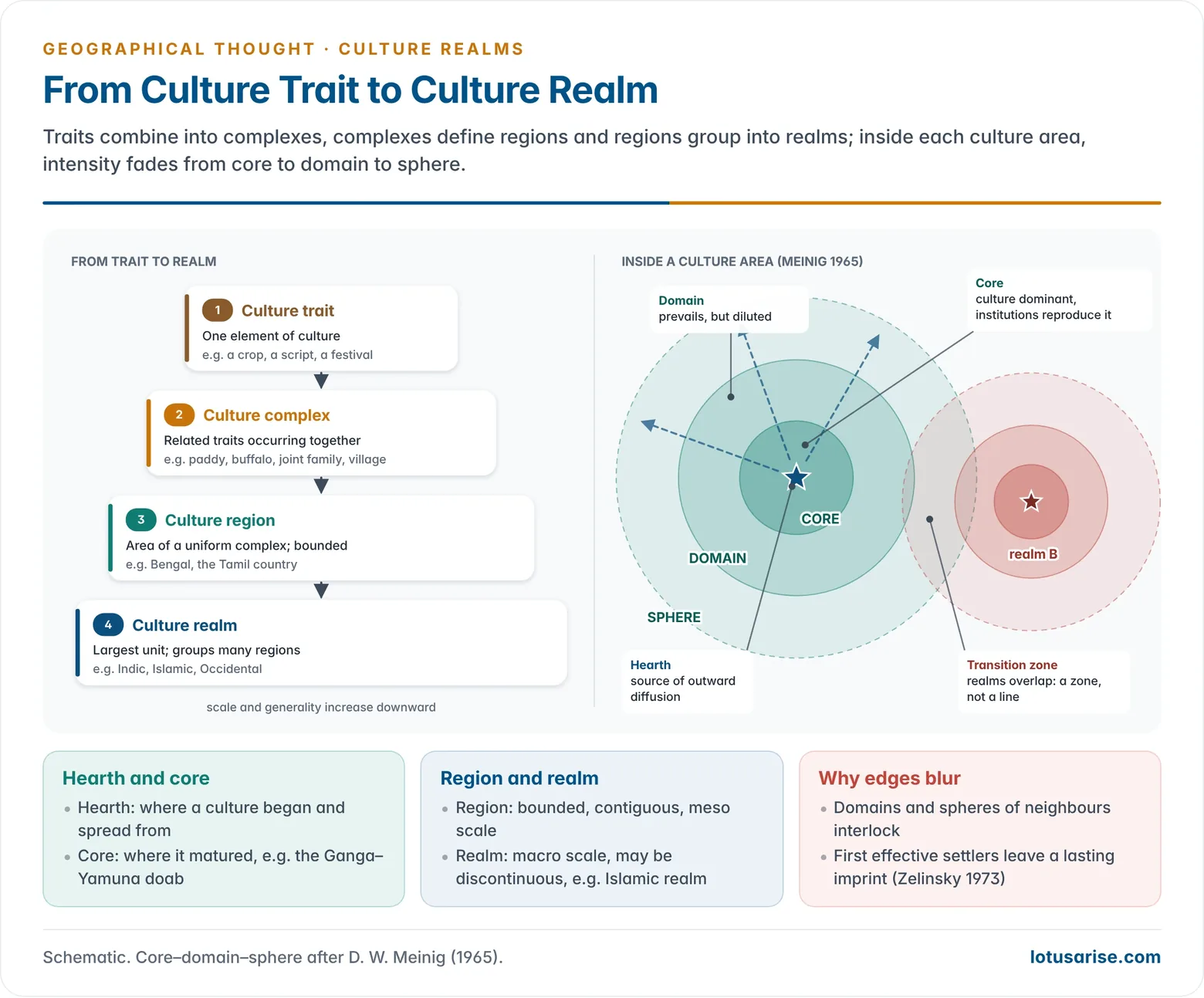
- Culture trait: a single element of culture, such as a crop, a house type, a festival or a script.
- Culture complex: a set of related traits that occur together, such as the paddy–buffalo–joint family–village complex of monsoon Asia.
- Culture region: an area over which a culture complex is relatively uniform and distinct from its neighbours.
- Regions may be formal, functional or vernacular (perceived by their own people).
- A region is bounded and contiguous at a meso scale; political states are often used as its working outline.
- Culture realm: the widest sphere of a culture’s influence. It groups many regions, contains overlaps and transition zones, and can be discontinuous.
- The Islamic realm, for example, stretches across separate deserts, oases and river basins from Morocco to Pakistan.
- Culture hearth: a source area from which ideas, innovations and ideologies radiated outward and changed the world beyond.
- Core: a secondary centre into which a hearth’s culture expanded and matured.
- India has three classical cores:
- the Rigvedic core in the Sapta Sindhu (Punjab);
- the later Vedic core in the Ganga–Yamuna doab, which shifted to Magadha (Bihar) by the 6th century BCE;
- the Dravidian core of the Kaveri delta around Thanjavur.
- India has three classical cores:
| Unit | Scale | Basis | Boundary | Example |
|---|---|---|---|---|
| Hearth | Point of origin | Invention and outward spread | Not bounded | Indus valley, Mesopotamia |
| Core | Sub-regional | Mature, dense form of a culture | Fairly sharp | Ganga–Yamuna doab |
| Region | Meso | Uniform culture complex | Bounded, contiguous | Bengal, Tamil country |
| Realm | Macro | Broad similarity of regions | Fuzzy, may be discontinuous | Islamic, Indic realm |
- Internal structure: Donald W. Meinig (1965), studying the Mormon culture region of the American West, showed that a culture area is a graded field, not a flat plate.
- Core: the culture is dominant and reproduced by its institutions.
- Domain: the culture prevails but is diluted.
- Sphere: the culture survives only as a minority or residual influence, overlapping the sphere of the next region.
- This is why realm boundaries are zones, not lines.
- Wilbur Zelinsky’s doctrine of first effective settlement (1973) adds a historical rule: the first group to establish a self-perpetuating society leaves an imprint far greater than its numbers, which is why hearths and realms so often coincide.
Culture Hearths of the World
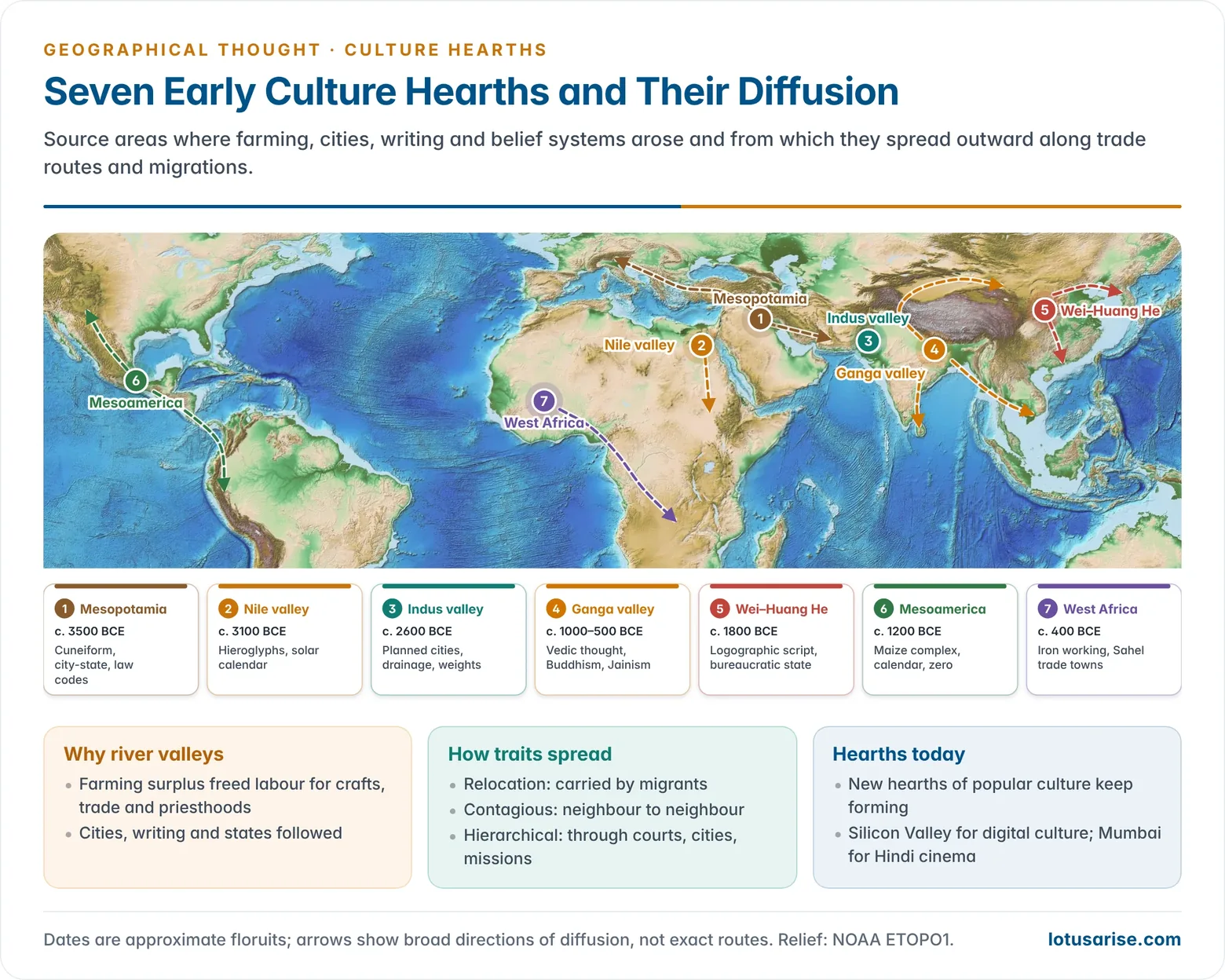
- Hearths are historical source areas. Most of the early ones were river valleys where farming produced a surplus, which allowed cities, writing, priesthoods and states to grow.
- Seven early culture hearths are commonly recognised:
| Hearth | Region | Approx. floruit | Signature contributions |
|---|---|---|---|
| Mesopotamia | Tigris–Euphrates | c. 3500 BCE | Cuneiform, city-state, law codes |
| Nile valley | Egypt | c. 3100 BCE | Hieroglyphs, solar calendar, monumental stone |
| Indus valley | Indus and its tributaries | c. 2600 BCE | Planned cities, drainage, standard weights |
| Ganga valley | Middle and upper Ganga plain | c. 1000–500 BCE | Vedic–Upanishadic thought, Buddhism, Jainism |
| Wei–Huang He | North China | c. 1800 BCE | Logographic script, bureaucratic state |
| Mesoamerica | Mexico, Maya lowlands | c. 1200 BCE | Maize complex, calendar, the zero |
| West Africa | Middle Niger | c. 400 BCE | Iron working, Sahel trade towns |
- Diffusion carried hearth culture outward: by migration (relocation diffusion), by contact between neighbours (contagious diffusion) and through rulers, cities and missionaries (hierarchical diffusion). Torsten Hägerstrand’s work on innovation diffusion later gave these processes a spatial model.
- Hearths are not only ancient. New hearths of popular culture keep forming, such as Silicon Valley for digital culture and Mumbai for Hindi cinema.
Bases of Delimiting Culture Realms
- Cultural variables used to regionalise the world include race, religion, language, economic organisation, folk customs, diet, dress and beliefs (orthodox or scientific), along with social customs and traditional values.
- Environmental factors create some differences, because people adapt diet, dress and shelter to climate. Polar peoples, for example, do not adopt cotton clothing.
- Social and emotional factors, above all language and religion, draw the sharpest dividing lines between peoples. The growth of European nation-states along linguistic lines is an example.
- Intellectual roots of the exercise:
- Friedrich Ratzel’s anthropogeography mapped the spread of peoples and their cultural traits.
- Otto Schlüter’s Kulturlandschaft and Carl O. Sauer’s “The Morphology of Landscape” (1925) made the cultural landscape the object of study: culture is the agent, the natural area the medium, and the cultural landscape the result.
- Paul Vidal de la Blache’s genre de vie and pays gave the French school a way of reading culture regions through ways of life.
- Historians, anthropologists and sociologists have also divided the world into cultural units.
- Communications and the global village have made the task harder, because cultures now intermingle faster than boundaries can be drawn.
Classification of World Culture Realms
Broek and Webb’s Classification
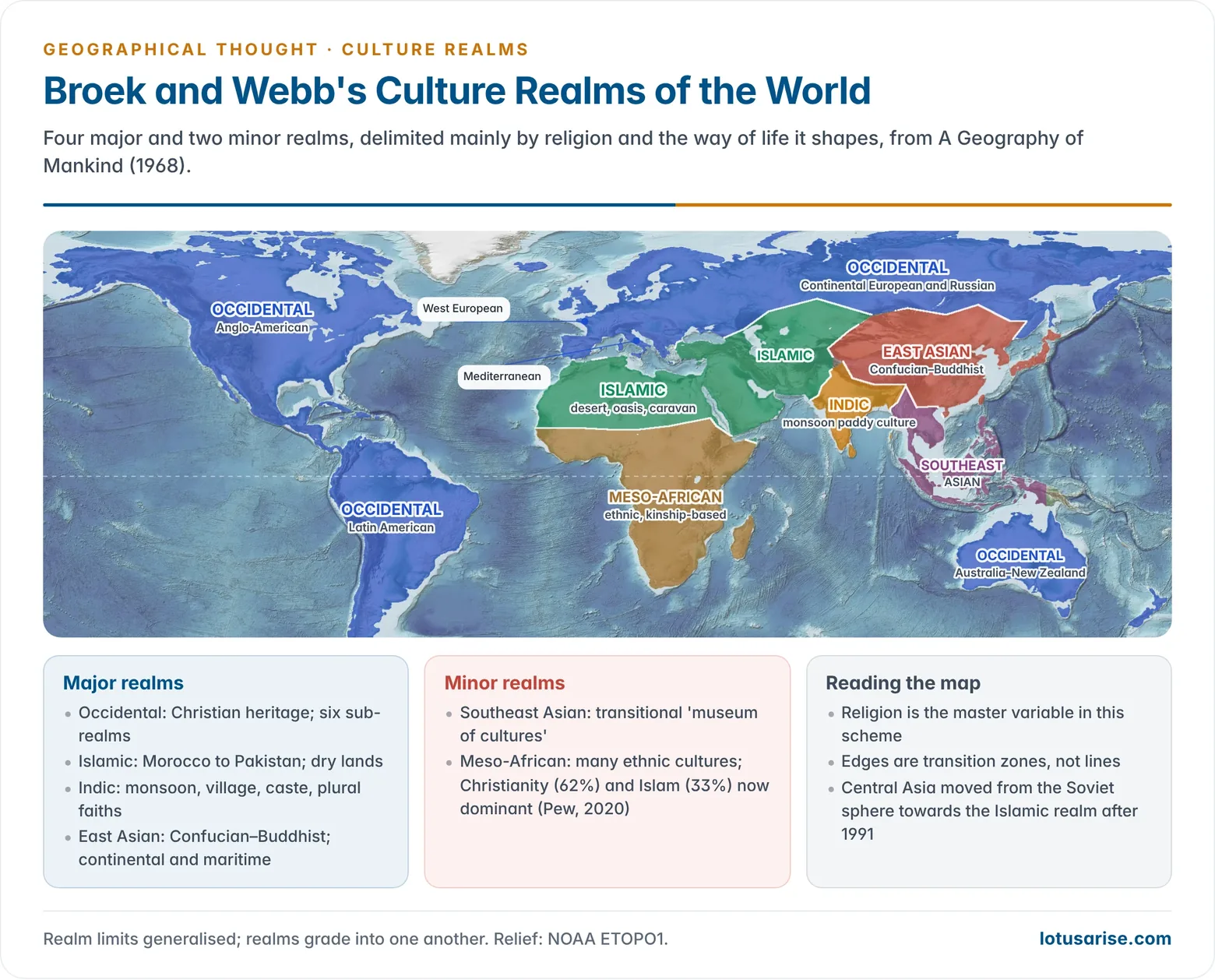
- Jan O. M. Broek and John W. Webb, in A Geography of Mankind (1968), produced the classification most widely used for world culture realms.
- They looked for the one phenomenon that dominates the evolution of a cultural landscape and found it in religion.
- In their view, religion shapes the economy, dress, diet and beliefs of a people, encourages the learning of certain languages, and sets limits on cultural mixing.
- When religious influence is withdrawn, a region’s culture tends to lose its coherence.
- Giving due weight to the other variables as well, they divided the world into four major realms and two minor realms, each subdivided into smaller units.
- Major: Occidental, Islamic, Indic, East Asian.
- Minor: Southeast Asian, Meso-African.
Occidental Realm
- The culture of European society and of the lands Europeans settled. Christianity is its historic base.
- Its regional variety comes from different levels of industrialisation, urbanisation, colonisation and commercialisation, from transport development, and from contrasting political and economic thought.
- In much of the realm, modernisation has pushed religion to the margins. Post-industrial north-west Europe is among the most secular societies in the world.
- It has six sub-realms:
| Sub-realm | Distinctive features |
|---|---|
| West European | Most industrialised and urbanised; secular, service-based economies |
| Continental European | Shaped by contrasting political–economic systems, including the socialist legacy of the east; Christianity still significant |
| Mediterranean | South of the Alps; strong Catholic and family traditions; industrialised later than north-west Europe |
| Anglo-American | Settled mainly from north-west Europe; immigrant, urban, high-consumption |
| Australian (Australia–New Zealand) | An offshoot of west European culture with regional differences |
| Latin American | Iberian languages, Catholicism and colonial architecture; the only tropical and less developed part of the realm |
- Latin America joined the realm through conversion and colonisation. Spanish and Portuguese became state languages, building styles followed Iberian models, and its countries keep close cultural ties with the Mediterranean lands.
Islamic Realm
- A realm of desert and semi-desert culture bound by Islamic values, stretching from Morocco in the west to Pakistan in the east.
- The British call its core the “Middle East”. It lies between the Indian realm to the east and the modernised European realm to the west.
- Population is sparse and clustered on coasts, river basins and oases, the cradles of its civilisation.
- Traditional livelihoods: pastoral nomadism, oasis farming and caravan trade, all shaped by scarcity of food and water.
- Religion and settlement: five daily prayers facing Mecca and congregational Friday worship favoured permanent settlements around mosques, and so gave the culture stability.
- Recent change: oil wealth (“petro-dollars”) has brought rapid urbanisation and modern infrastructure to the Gulf states. Large migrant workforces have created plural urban cultures, while social institutions change more slowly than incomes.
- Transitional areas:
- Israel is a distinct culture in religious terms.
- The Central Asian republics were long tied to the East European system by Soviet economic union. Since independence in 1991 they have moved closer to the Islamic realm.
Indic Realm
- The culture of the Indian subcontinent, also called a monsoonal or paddy culture.
- It is a well-framed realm: the Himalaya to the north, the Hindu Kush and Sulaiman ranges to the west, and the Indian Ocean to the south.
- Defining traits:
- the joint family and the village community;
- the caste system and semi-feudal land relations (historically);
- subsistence paddy farming, with the monsoon rhythm setting one agricultural calendar across the realm;
- an underlying Vedic substratum of values, even among communities of other faiths.
- Religious plurality and tolerance: the realm is the hearth of Hinduism, Buddhism, Jainism and Sikhism, and home to one of the world’s largest Muslim populations. Christians are a small minority outside the North-East, Kerala and Goa.
- Many streams of people entered and stayed, enriching the culture. Communities borrowed each other’s customs, as in the Bhakti–Sufi traditions.
- Its regional variety is treated under the cultural regions of India.
East Asian Realm
- The realm of China, Japan, the Koreas, Taiwan and Mongolia, built on Confucian ethics, Mahayana Buddhism, Daoism and, in Japan, Shinto, with a shared heritage of Chinese characters.
- Its peoples’ ancestors include horse-riding pastoralists of the steppe. Settled life on the plains of China and the islands of Japan produced permanent villages and intensive rice farming.
- Today social philosophy and economic system matter more than religion in defining the realm. It has two sub-realms:
- Continental (Chinese): shaped by the socialist tradition. Collective and commune farming ran from Mongolia to Hainan, and market reforms since 1978 have transformed it. It remains a paddy culture in the south.
- Maritime (Japan, South Korea, Taiwan): a stronger Buddhist and Confucian imprint, combined with democratic institutions and an industrial–commercial culture built after the Second World War.
- Japan is often called the “Britain of the East”: an island, industrial, trading nation.
Southeast Asian Realm (Minor)
- A transitional realm where every major culture of Asia met and intermingled over a strong indigenous base. It is often called a “museum of cultures”.
- Theravada Buddhism dominates in Myanmar, Thailand, Laos and Cambodia, and Confucian–Mahayana traditions in Vietnam.
- Islam prevails in Malaysia, Indonesia and Brunei. Indonesia is the largest Muslim-majority country in the world.
- Christianity prevails in the Philippines and Timor-Leste.
- Indic culture survives in Bali’s Hinduism and in monuments such as Angkor Wat.
- Singapore is a deliberately plural society of Chinese, Malay and Indian communities.
- It is a realm of cultural tolerance, shaped by its position on the sea route between India and China.
Meso-African Realm (Minor)
- The culture of the ethnic communities of tropical (sub-Saharan) Africa.
- Fragmentation: many ethnic groups with distinct cultures. Africa alone holds nearly a third of the world’s living languages.
- Belief: traditional and nature-centred (animist) beliefs were the old base. Today Christianity (62%) and Islam (33%) dominate the region’s affiliation (Pew, 2020), often blended with older practice.
- Contact with modern values began late and is now accelerating through cities, schools and mobile networks.
- Scattered parallels: some geographers extend the realm to culturally similar, long-marginalised communities elsewhere, such as Indigenous peoples of the Americas, Australian Aborigines and the Inuit. So defined, it becomes a widely scattered realm of relatively isolated communities.
Other Classifications
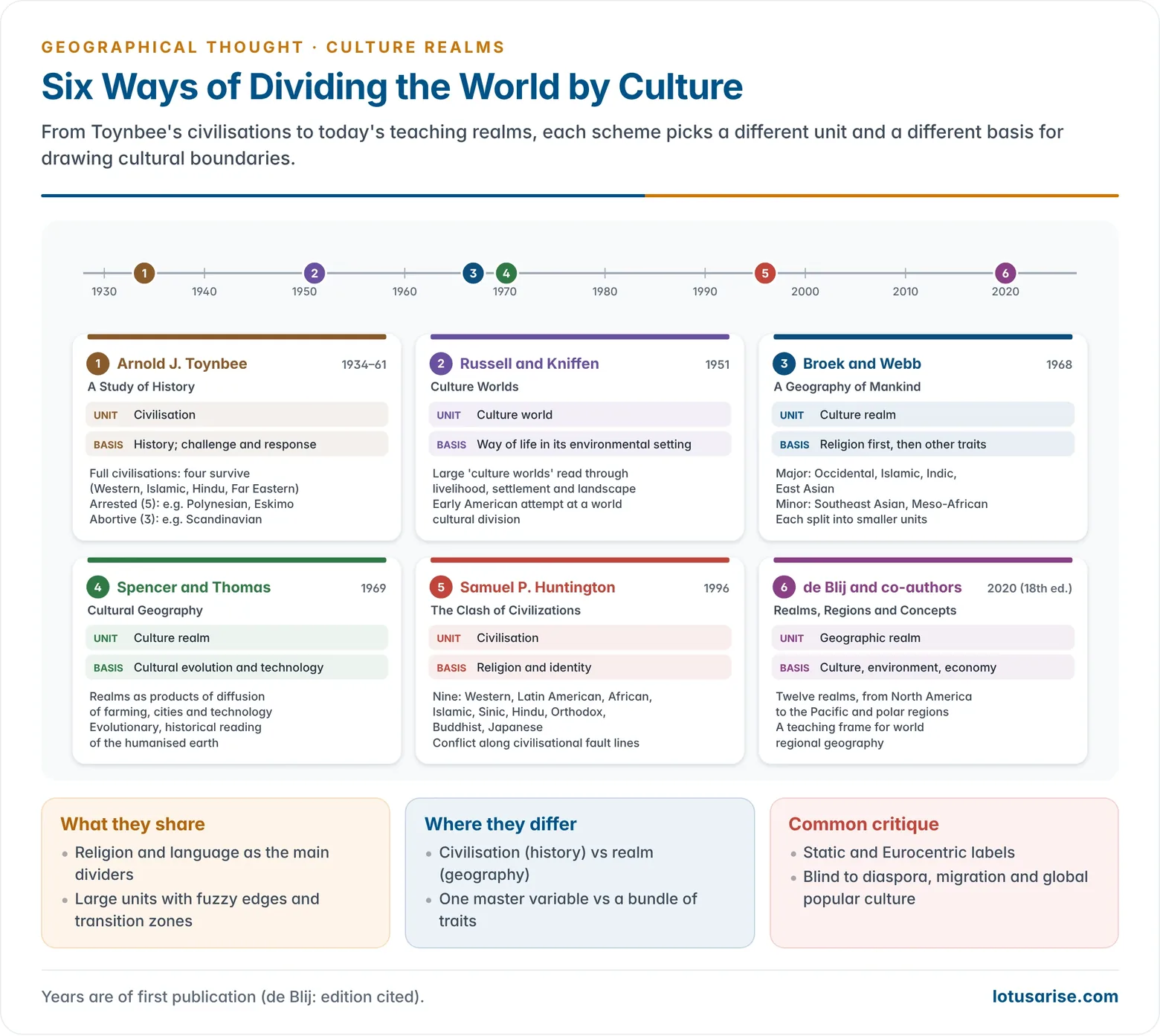
- Arnold J. Toynbee, in A Study of History (12 volumes, 1934–61), classified civilisations rather than realms:
- full civilisations, of which four survive: Western, Islamic, Hindu and Far Eastern;
- arrested civilisations: Polynesian, Eskimo, Nomadic, Ottoman and Spartan;
- abortive civilisations: Far Western Christian, Far Eastern Christian and Scandinavian.
- Richard J. Russell and Fred B. Kniffen, in Culture Worlds (1951), divided the earth into large “culture worlds” defined by ways of life in their environmental settings.
- Joseph E. Spencer and William L. Thomas (Cultural Geography, 1969) traced culture realms in an evolutionary framework, through the spread of farming, cities and technology.
- Samuel P. Huntington’s The Clash of Civilizations (1996) recognised nine civilisations: Western, Latin American, African, Islamic, Sinic, Hindu, Orthodox, Buddhist and Japanese. He predicted that conflict would follow their fault lines.
- Harm de Blij and his co-authors use twelve geographic realms (Geography: Realms, Regions and Concepts, 18th ed., 2020). These combine culture, physical setting and political economy.
- The twelve are North America, Middle America, South America, Europe, Russia–Central Asia, North Africa–Southwest Asia, Subsaharan Africa, South Asia, East Asia, Southeast Asia, the Austral realm, and the Pacific and polar regions.
| Scheme | Unit | Main basis | Number | Distinctive point |
|---|---|---|---|---|
| Toynbee (1934–61) | Civilisation | History, challenge and response | Full, arrested, abortive | Civilisations rise and decline |
| Broek and Webb (1968) | Culture realm | Religion first, then other traits | 4 major + 2 minor | Religion as the master variable |
| Spencer and Thomas (1969) | Culture realm | Cultural evolution and technology | Evolutionary stages | Realms as products of diffusion |
| Huntington (1996) | Civilisation | Religion and identity | 9 | Conflict along fault lines |
| de Blij and others (2020) | Geographic realm | Culture, environment, economy | 12 | Teaching framework for world regions |
The Indo-Gangetic Hearth and India’s Cultural Regions
The Indo-Gangetic Hearth
- The alluvial trough from the Indus plain through Punjab and the Ganga–Yamuna doab to Magadha and the Bengal delta is a primary hearth, ranking with Mesopotamia, the Nile and the Huang He.
- Physical basis: deep, renewable Himalayan alluvium, perennial snow-fed rivers and monsoon rain produced a large grain surplus.
- The surplus freed labour for crafts, trade, cities and a scholarly class. The environment made a civilisation possible, not inevitable: other fertile plains produced no comparable culture.
- Why it ranks among the richest realms:
- Antiquity with continuity: the mature Harappan cities (c. 2600–1900 BCE) were followed by an unbroken living tradition. Sanskrit-derived languages, ritual and village forms survive, whereas the cultures of Sumer and ancient Egypt left no living successors.
- Four religions from one plain: Hinduism (Vedic–Upanishadic thought), Buddhism and Jainism (middle Ganga plain, 6th–5th centuries BCE) and Sikhism (Punjab, 15th century).
- Diffusive reach: Buddhism spread to Sri Lanka, Central Asia, China, Korea, Japan and Southeast Asia. Today the faith’s followers live mostly outside its hearth, the mark of a true hearth.
- Learning and statecraft: Panini’s grammar, the decimal place-value system, the imperial capital of Pataliputra, and the universities of Taxila, Nalanda (a UNESCO World Heritage Site since 2016) and Vikramashila.
- Syncretism: incomers from the north-west were absorbed and layered, not substituted. The results include Indo-Islamic architecture, Hindustani music and Urdu.
- Living sacred geography: the Maha Kumbh at Prayagraj in 2025 drew an officially estimated 66 crore (660 million) pilgrims over 45 days.
- Qualifications:
- “Richest” is an evaluative claim. The Chinese hearth rivals it in continuity, and Mesopotamia preceded it.
- The plain is a mosaic, not a monolith.
- The same plain now carries India’s highest multidimensional poverty: Bihar 33.8% (NITI Aayog National MPI, 2023, for 2019–21).
Cultural Regions of India
- Within the Indic realm, India divides into culture regions based on language, religion, race and custom:
- the western Himalayan cultures (Ladakhi Buddhist, Kashmiri, Kinnauri);
- the eastern Himalayan cultures (Sikkimese and Arunachali Buddhist);
- the Naga and other tribal cultures of the North-East;
- the Indo-Aryan cultures (western Hindi, eastern Hindi, Bengali, Punjabi and others);
- the Dravidian cultures (Tamil, Telugu, Kannada, Malayalam).
- Joseph E. Schwartzberg’s ten-fold scheme is the standard detailed regionalisation. R. L. Singh’s regional division of India (1971) blends physical and cultural criteria in its smaller regions, such as Awadh, Rohilkhand and Malwa.
- The States Reorganisation Act of 1956 turned many language regions into states.
Evaluation
- Merits:
- Culture realms give a single framework for comparing ways of life across the world.
- They connect religion, language and livelihood in one unit.
- They explain why development and social change differ between realms.
- Criticisms:
- Broek and Webb over-emphasise religion, and they neglect physiography and economic structure as differentiating factors.
- Boundaries are arbitrary, because realms grade into one another through broad transition zones.
- The schemes are static. They describe a mid-20th-century world and miss migration, diaspora and urban plurality.
- Their labels are Eurocentric (“Occidental”, “Meso-African”), and older schemes used racial categories that science has abandoned.
- Scale problem: a realm hides great internal diversity. The Indic realm alone contains hundreds of languages.
- The present: globalisation is weakening realm boundaries. Media, migration and markets spread a global popular culture.
- Yet the same forces provoke revivals of identity and hybrid, glocal cultures. Civilisations are moving towards a multifaceted global culture, not a single uniform one.
Previous Year Questions
2015“Cultural regions are the most suited units to study the diversity of an area.” Comment.2014“Indo-Gangetic hearth is considered to be one of the world’s richest cultural realms.” Examine.2010Write short explanatory note on Occidental culture realm.2009Provide a broad classification of world cultural regions.2006Write short note: Cultural regions of the world.1989Write short note on – Major cultural realms of the world.


Thanks sir
Thank u very much for your efforts sir/madam
Thank you so much for these notes. Indebted for life!
Very précised notes. Thanks “lotusarise” for valuable efforts.
Wow… Best explanation..
Thank you Sir for these amazingly curated notes. Helped enormously in my preparation. My deep gratitude for your hardwork.
thank u so much….
Why the term ‘great naga culture’
We (Jamian) Appreciate……………………………..
Thank You much much
Great efforts by Lotus Aries
Thank you sir 🙏
Love you sir meri pehli salary me se aadha aapak after IAS meri taraf se tohfa