

- The cropping pattern of an area is the set of crops it grows at a given time, and the share of land each one holds.
- It depends on climate (temperature, rainfall, wind), soil, support price, value and market demand, labour and history.
- India’s range of relief, soil and climate, with a long growing season, lets it raise tropical, sub-tropical and temperate crops alike.
- A few examples show how the pattern responds to conditions:
- Rice spreads when the monsoon is good. In weak monsoon years, farmers turn to millets.
- Maharashtra’s cotton, Assam’s tea and West Bengal’s jute stay dominant because conditions favour them so strongly.
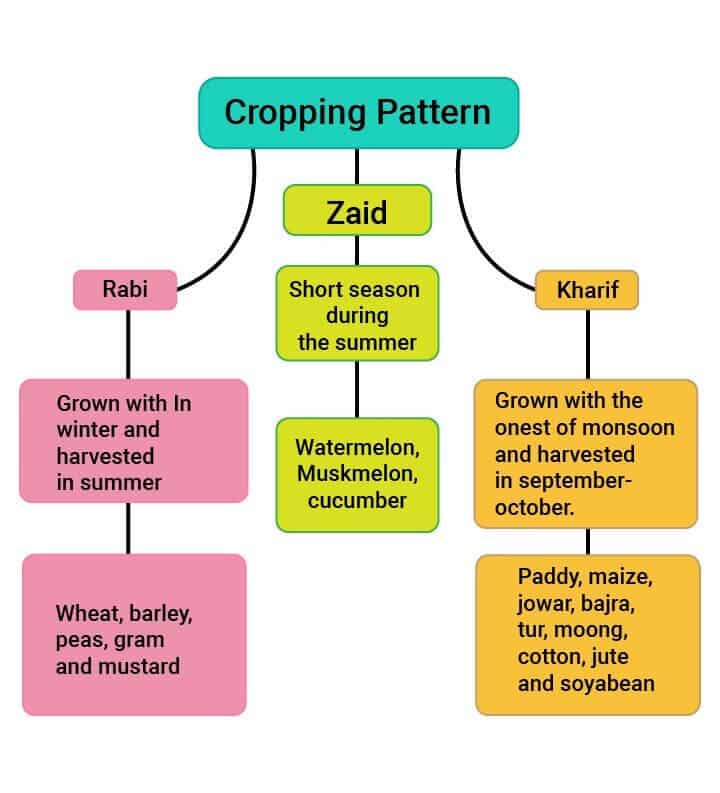
- On this chart, rabi crops are those sown at the start of winter and harvested at the start of summer.
- The definitions, and the cropping systems through which farmers arrange these crops, are treated separately. The classification of crops sets out the groups used here.
Cropping Pattern and Its Controls
Change Over Time
- At Independence, food crops held about three-fourths of the cropped area, with little diversification.
- Almost the entire northern plain grew food crops and sugarcane.
- The first three Five Year Plans (1951–66) changed this little.
- Green Revolution: the food-crop share rose to about 82% in older accounts, led by wheat and rice.
- By 1990-91, the pattern had grown more complex. Rice and wheat held about 40% of the cropped area, pulses 14% and oilseeds 13%.
- The table shows the movement since then.
| Share of gross cropped area (%) | 2009-10 | 2012-13 | 2022-23 |
|---|---|---|---|
| Rice | 22.52 | 21.98 | 22.58 |
| Wheat | 15.10 | 15.70 | 15.95 |
| Coarse cereals | 14.71 | 12.90 | 11.06 |
| Pulses | 11.94 | 11.38 | 12.55 |
| All foodgrains | 64.28 | 61.96 | 62.14 |
| Oilseeds | 14.76 | 14.81 | 15.13 |
| Cotton | 5.28 | 6.33 | 5.93 |
| Sugarcane | 2.41 | 2.80 | 3.10 |
- Three shifts stand out:
- Coarse cereals are shrinking. Jowar alone fell from 4.13% to 1.66% of the cropped area between 2009-10 and 2022-23.
- Rice and wheat together hold close to 39%.
- Foodgrains still fill about 62% of the cropped area, a mark of the pattern’s subsistence roots. In 2023-24, all food crops together took 73.9%.
- Crop diversification is the movement towards other crops:
- Causes include falling groundwater in the north-west, a support-price system that favours rice and wheat, the market pull of horticulture and dairy, and climate stress.
- Benefits include less water use and better soil nutrition when pulses replace paddy.
- Record output: foodgrains reached 357.73 million tonnes in 2024-25 and are estimated at 376.56 million tonnes in 2025-26 (Third Advance Estimates, May 2026).
Factors Affecting Cropping Pattern
- A region’s pattern depends on physical and technical factors, economic factors and government action. They fall under four heads:
- Geographical factors
- Economic factors
- Political factors and government policies
- Historical factors
Geographical Factors
Relief
- Relief has a strong say in what a region can grow.
- Rice is the main crop on irrigated hill terraces.
- Tea and coffee need well-drained slopes with good rainfall, because their roots cannot stand stagnant water.
- Rice (a tropical crop) and sugarcane dominate well-irrigated tracts with a fairly warm climate.
- Wheat (a temperate crop) does well on plains with moderate temperature and rainfall.
Temperature
- Most crops prefer lower temperature at sowing and higher temperature at ripening.
- Kharif crops (rice, cotton and others) need higher temperature and are sown in summer, just before the south-west monsoon breaks. Most of their growth falls in the rainy season.
- Rabi crops (wheat and others) need lower temperature and moisture, and are sown in winter.
- Sugarcane yields better in south India than on the northern plains, because it needs warm conditions.
Rainfall
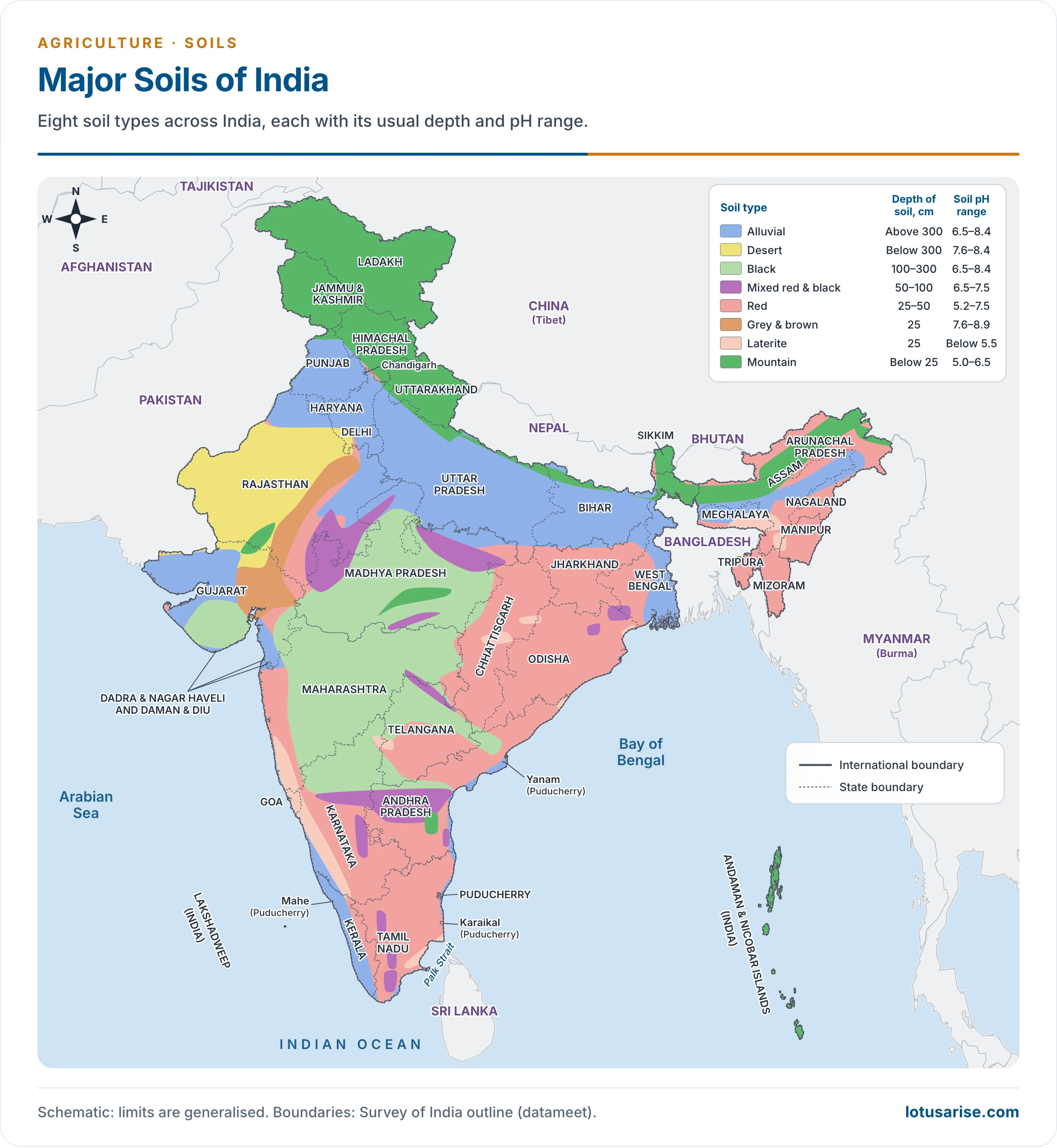
- Rainfall is a major determinant of the pattern where land depends on the sky, through both its amount and its duration.
| Rainfall zone | Annual rainfall | Areas | Major crops |
|---|---|---|---|
| Heavy | Over 150 cm | East India, west coastal plains | Rice, tea, coffee, sugarcane, jute; also tubers, maize, ragi |
| Medium | 75–150 cm | Eastern Uttar Pradesh, Bihar, Odisha, eastern Madhya Pradesh, Vidarbha | Wheat, maize, cotton, soybean, millets, pulses |
| Low | 25–75 cm | Semi-arid belt from Kashmir to Kanniyakumari | Millets, oilseeds, pulses; irrigated wheat |
- Areas of heavy rainfall:
- Animal numbers are fairly high, thanks to fodder and grazing land.
- Large tracts are under rice monoculture, though there is much scope to diversify.
- Areas of medium rainfall:
- Places near the 150 cm isohyet suit rice. Those near the 75 cm isohyet suit maize, cotton and soybean.
- The areas are rich in natural resources but poorly managed, and poverty remains high.
- Wheat is the principal rabi crop. Millets are the natural choice when rain falls short, because they need less water.
- Rice follows only if September rains are adequate, and large areas may lie fallow in the kharif season to recover fertility.
- Areas of low rainfall:
- Rain is scarce and also highly variable, so only hardy crops survive.
- Jowar and bajra lead in the north of the belt, jowar in the centre and ragi in the south.
- Wheat is the main rabi crop, grown under irrigation.
- Mixed cropping is very common, with pulses mixed with cereals, so that no single crop dominates.
- Dry land farming is common. Groundnut, sunflower, rapeseed and mustard are the oilseeds of this belt.
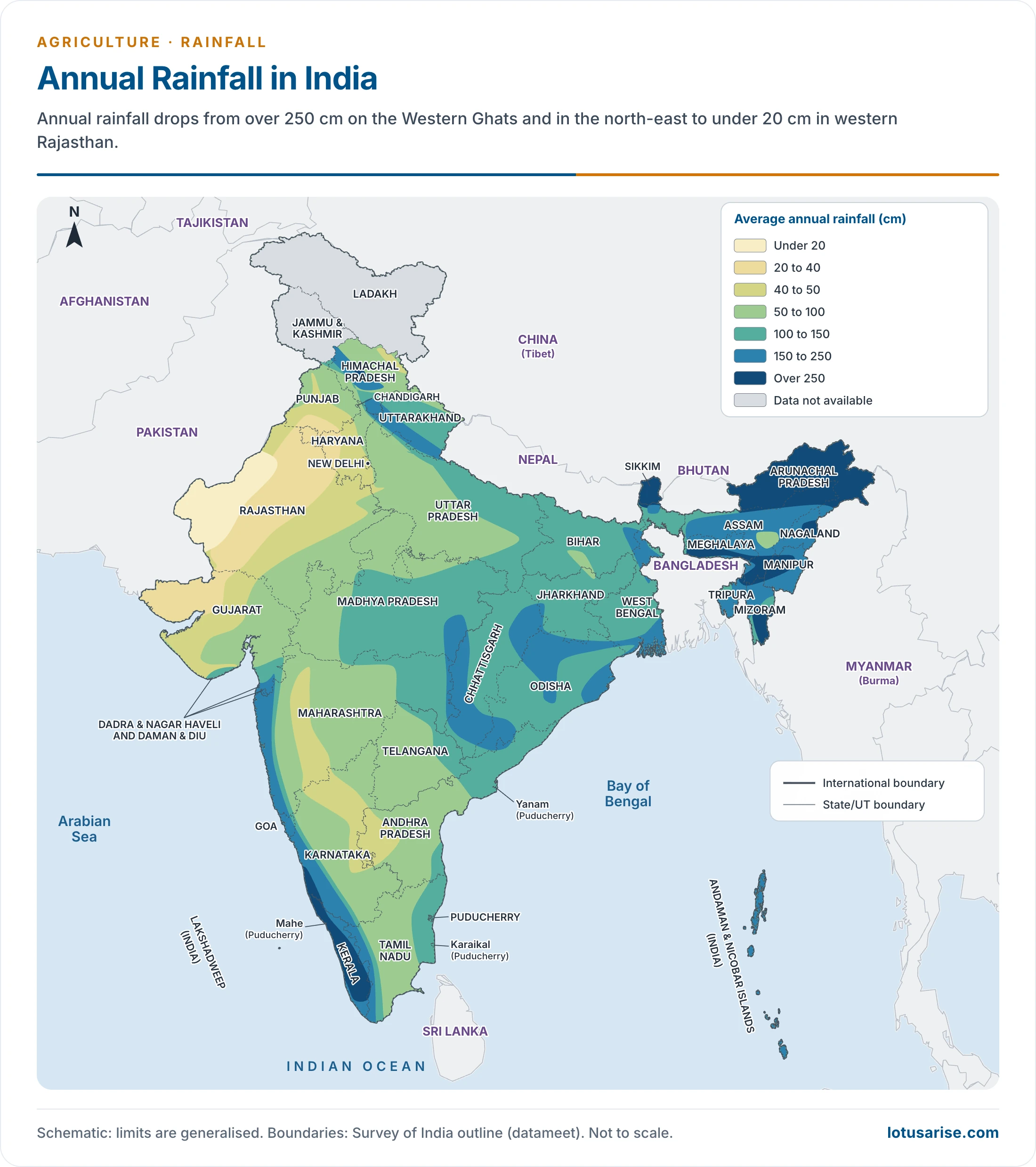
Soil
- Different crops have different edaphic needs, so soil is an important control.
- Rice prefers clayey soils, and wheat prefers loams.
- The regur of the Deccan Plateau suits cotton best.
- Coarse grains (jowar, bajra, maize, ragi, barley) grow on inferior land: light sandy, light black, red and laterite soils.
- The delta soils of West Bengal, renewed by floods every year, are very fertile and ideal for jute. Farmers take 2–3 crops a year there, and sometimes four.
- The Darjeeling hills hold enough humus, iron, potash and phosphorus for the tea bush, which helps give that tea its quality.
Economic Factors
- Economic motivation weighs most in deciding the pattern. The main factors are irrigation, power, size of holdings, sale price, farm income, insurance and investment.
- Irrigation:
- Rice dominates wherever water is reliable and the climate warm, as in the coastal plains and the irrigated belts of south India.
- The deltas and irrigated tracts of the east and south can support 2–3 rice crops a year. The irrigated north-western plain takes one rice crop, followed by wheat.
- Irrigation has also held back diversification. Rice dominates the well-watered south, wheat the north-west, and coarse grains get less attention in both.
- With irrigation from the mid-1960s, Punjab, Haryana and western Uttar Pradesh became major rice producers.
- Size of holdings:
- On small holdings, the first priority is food grain for the family, which is subsistence farming.
- Large holdings can take up cash crops and diversify, which is commercial farming.
- Yet despite that potential, large holdings are often used for a monoculture of rice or wheat.
- Sale price and income:
- Farmers in the north-west took up rice from the late 1960s because it paid well. Tube wells multiplied, and groundwater is falling fast as a result.
- Insurance against risk:
- The wish to limit crop-failure risk explains diversification and some specific features of the pattern.
- Older accounts link the large spread of plantation crops in the southern States to suitable insurance.
- The Pradhan Mantri Fasal Bima Yojana is the main cover today, with claims of over ₹1.90 lakh crore paid (March 2026).
- Availability of inputs: seeds, fertilizers, water storage, marketing and transport all shape the choice.
- Investment: changing a pattern takes money for irrigation, seeds, fertilizers and machinery.
- Better groundnut seed and its shorter duration helped groundnut replace cotton in Madhya Pradesh.
- Value: in the hills of Himachal Pradesh and Uttarakhand, high-value horticulture such as apple has replaced millets.
- Demand: rice is preferred in densely populated regions, where the market is ready and demand high.
Political Factors and Government Policies
- Legislation and administration can steer the pattern: Food Crops Acts, Land Use Acts, intensive schemes for paddy, cotton and oilseeds, and subsidies.
- Government may encourage or discourage a crop because of drought, flood or inflation. Policy has also curbed crops such as tobacco, indigo and poppy.
- Minimum Support Price (MSP): farmers prefer rice and wheat, which enjoy high MSP and assured procurement, over other food crops.
- Rural roads bring villages within reach of city markets, and farmers then turn to vegetables and fruit.
Historical Factors
- Some patterns reflect long-standing cultivation for historical reasons, such as the tea plantations set up by the British in the Kangra valley of Himachal Pradesh.
- Sugarcane is grown more in north India, although conditions favour the south. The British encouraged it in Uttar Pradesh as an alternative to indigo, after artificial dyes destroyed indigo’s market.
- The food grain surplus after the Green Revolution made room for diversification. Oilseeds and pulses became more prominent.
All-India Picture
| Crop | 1950-51 (Mt) | 2024-25 (Mt) | Yield 2024-25 (kg/ha) | 2025-26, Third Advance Estimate (Mt) |
|---|---|---|---|---|
| Rice | 20.58 | 150.18 | 2,929 | 154.02 |
| Wheat | 6.46 | 117.95 | 3,595 | 120.66 |
| Maize | 1.73 | 43.41 | 3,590 | 55.09 |
| Jowar | 5.50 | 4.95 | 1,240 | |
| Bajra | 2.60 | 11.20 | 1,523 | |
| Gram | 3.65 | 11.11 | 1,218 | 12.51 |
| Tur | 1.72 | 3.62 | 836 | 3.59 |
| All pulses | 25.68 | 926 | ||
| Nine oilseeds | 5.16 | 42.99 | 1,412 | 43.06 |
| Sugarcane | 57.05 | 454.61 | 83,416 | 500.06 |
| Cotton (million bales of 170 kg) | 3.04 | 29.72 | 440 | 29.02 |
| Jute and mesta (million bales of 180 kg) | 3.31 | 8.80 | 2,758 | 9.18 (jute) |
| Tobacco | 0.26 | 1.04 | 2,110 |
| Crop | Leading States by share of output, 2024-25 (%) |
|---|---|
| Rice | Uttar Pradesh 13.8, Telangana 11.6, West Bengal 10.7, Punjab 9.6 |
| Wheat | Uttar Pradesh 30.2, Madhya Pradesh 20.8, Punjab 15.3, Haryana 9.7 |
| Maize | Madhya Pradesh 15.3, Karnataka 14.3, Bihar 12.6, Maharashtra 10.9 |
| Jowar | Maharashtra 37.2, Karnataka 16.5, Rajasthan 10.5 |
| Bajra | Rajasthan 44.9, Uttar Pradesh 16.9, Haryana 11.4, Gujarat 11.2 |
| Pulses | Madhya Pradesh 20.4, Maharashtra 19.6, Rajasthan 15.3 |
| Oilseeds | Rajasthan 21.4, Madhya Pradesh 19.2, Maharashtra 18.1, Gujarat 17.8 |
| Sugarcane | Uttar Pradesh 48.6, Maharashtra 24.2, Karnataka 10.6 |
| Cotton | Maharashtra 24.8, Gujarat 24.1, Telangana 19.5 |
| Jute and mesta | West Bengal 79.9, Bihar 9.6, Assam 8.3 |
Food Crops
Major Food Crops of India
- India’s food and non-food crops vary from place to place with soil, climate and cultivation practice.
- The major crops are rice, wheat, millets, pulses, tea, coffee, sugarcane, oilseeds, cotton and jute.
- Food crops grow in every part of the country, either alone or with other crops, because they supply the basic food of a large population.
Rice
- Rice feeds most Indians, above all in the south and north-east. It covers about 22.6% of the cropped area (2022-23) and feeds about half the population.
- India was long the second largest producer after China. In 2024-25, its 150.18 million tonnes passed China’s roughly 145.3 million tonnes on USDA figures.
- It is a kharif crop needing high temperature and humidity. Older accounts give above 25°C and annual rainfall above 100 cm.
- Where rain is short, it grows with irrigation. About 69.5% of the rice area was irrigated in 2023-24, against about 40% in older accounts.
- It is making quick inroads into the north-western plain.
- Rice tracts suit mixed farming (crops and livestock) well.
- Unpolished rice keeps its bran and germ, which hold B vitamins and minerals. Polishing removes much of them.
- About 4,000 of the world’s roughly 10,000 rice varieties are grown in India. The United Nations named it the subject of its International Year in 2004.
Crop Season of Rice
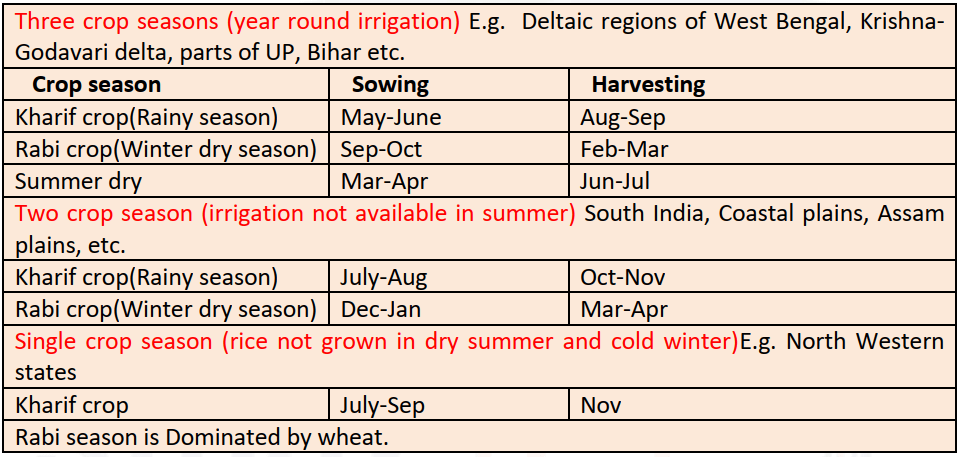
- Rice is mainly a kharif crop, since it thrives in wet, warm weather. In the rabi season, it grows only in well-irrigated areas.
- Most rice tracts lie barren in the hot months of April and May.
- It can be a summer crop in deltas with water all year, such as those of West Bengal and the Krishna and Godavari.
- Such places have three cropping seasons, taking rice as a kharif, rabi and summer crop.
| Local crop | Season | Sowing | Harvest | Older share of area (%) |
|---|---|---|---|---|
| Aus or Kar | Autumn | May–June | September–October | 39.4 |
| Aman, Sali or Karthika | Winter | June–July | November–December | 54.2 |
| Boro or Dalua | Summer (spring) | November–December | March–April | 6.4 |
Climatic Conditions for Growth
- Rice needs plenty of heat, rain and labour. George Babcock Cressey added alluvium to this list.
- It grows from about 8°N to 30°N, and from sea level up to 2,500 m. It cannot stand the cold above that height.
- Rice can grow just below sea level, as in the Kuttanad region of Keralam (Kerala).
- It is a tropical crop needing warmth.
- Temperature runs about 20–22°C when it is sown, rising to 23–25°C in growth and 25–30°C by harvest.
- The hot, humid east and south raise 2–3 crops, almost through the year.
- Winters are too cold in the northern and hilly parts, so they take only one crop, in summer.
- It needs semi-aquatic conditions: rain or irrigation all through the season, with soil that never dries out while the crop grows.
- Fields must stand under 10–12 cm of water at sowing and in the early stages. This confines rice mainly to plains, with level fields and low mud walls.
- Wet or lowland rice grows on well-watered plains.
- Terraced cultivation is followed on slopes, and the hills of the north-east also grow rice under shifting cultivation (jhum).
- Hill terraces get less water, and the crop there is called dry or upland rice.
- An average of over 150 cm of annual rainfall suits the crop well.
- It dominates above 200 cm and is still important at 100–200 cm.
- Distribution matters more than the annual total.
- The 100 cm isohyet marks the limit of rainfed rice. An isohyet is a line joining points of equal rainfall.
- Punjab, Haryana and western Uttar Pradesh, with less than 100 cm, grow rice through intensive irrigation.
Soil Condition for Growth
- Rice dominates deltas, river valleys, flood plains and coastal plains, since these are easily flooded.
- Loamy soils hold water poorly and need frequent irrigation, as in the deltas, Punjab, Haryana and the northern plains.
- Clayey soils hold water well, as on the coastal plains of south India and in irrigated parts of Karnataka and Telangana.
- Rice tolerates both acidic and alkaline soils. Deep clays and loams that puddle easily suit it best, and black lava soil can also be used.
Labour Requirement
- Rice is traditionally labour intensive, and its culture has been called hoe-culture because machines suit it poorly.
- It is grown mainly in densely populated areas, which give labour and a ready market.
- In Punjab and Haryana, it depends largely on migrant labourers from Bihar and eastern Uttar Pradesh.
Methods of Rice Cultivation
| Method | How it is done | Where | Input and labour | Yield |
|---|---|---|---|---|
| Broadcasting | Seed scattered by hand | Dry or less fertile land, or areas short of labour | Minimum; the easiest | Minimum |
| Drilling | One person ploughs, the other sows | Dry regions of peninsular India | Low | Low |
| Transplantation | Seedlings from a nursery moved to the field | Fertile soil with abundant rain or irrigation | Heavy; little scope for machines | Among the highest |
| Japanese | High-yielding seed, raised nursery, planting in rows, heavy fertilizer | Japan and South Korea; adopted in India’s main rice areas | Highly mechanized where fully practised | Very high |
- In transplantation, seedlings are uprooted after about a month and replanted in a prepared field. It is the advanced traditional method.
- In the Japanese method, machines transplant in rows, and weeding and fertilizing are mechanized.
Production and Productivity
- India is among the top two producers and consumers of rice, alongside China.
- Low productivity is the weak point:
- Older figures set India’s yield of 2.3 tonnes per hectare against a global average of 4.374, with China at 6.5, Australia at 10 and the USA at 7.5.
- India’s average has since reached 2,929 kg per hectare (2024-25), on a milled-rice basis.
- Output has risen far faster than area, from 20.58 million tonnes on 30.81 million hectares in 1950-51 to 150.18 million tonnes on 51.27 million hectares in 2024-25.
- The table below names the older leaders.
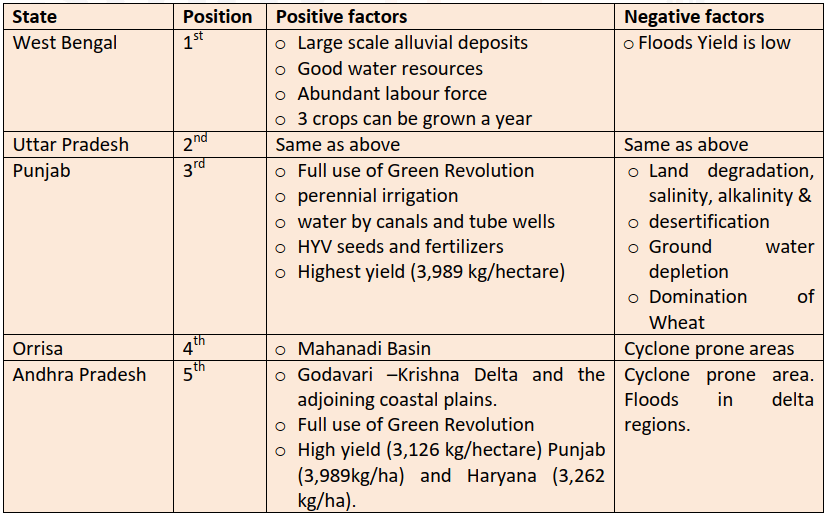
- This table shows an older ranking. In 2024-25, the order was Uttar Pradesh (20.76 million tonnes), Telangana (17.45), West Bengal (16.02), Punjab (14.36) and Chhattisgarh (10.37).
- Yields then ran Punjab 4,428 kg per hectare, Andhra Pradesh 3,928, Telangana 3,627, against the 3,989 and 3,126 shown here.
- Other main producers:
| State | Older yield, 2012-13 (kg/ha) | Yield, 2024-25 (kg/ha) | Main tracts |
|---|---|---|---|
| Bihar | 2,258 | 2,561 | Rohtas, Bhojpur, Champaran |
| Chhattisgarh | 1,749 (low) | 2,655 | Mahanadi basin |
| Tamil Nadu | 2,785 | 3,288 | Cauvery delta, Thanjavur |
| Odisha | 1,896 | 2,485 | Sambalpur, Cuttack, Puri, Ganjam |
| Madhya Pradesh | 1,479 | 2,345 | Seventh by output in 2024-25 |
- Assam (the Brahmaputra valley), Haryana, Karnataka and Jharkhand also matter.
- West Bengal takes three crops, aman, aus and boro.
- The Godavari-Krishna delta is one of the country’s outstanding rice tracts.
- Rice is absent from the high Himalaya above 2,500 m, Marusthali, Kachchh-Saurashtra, Malwa and Marathwada.
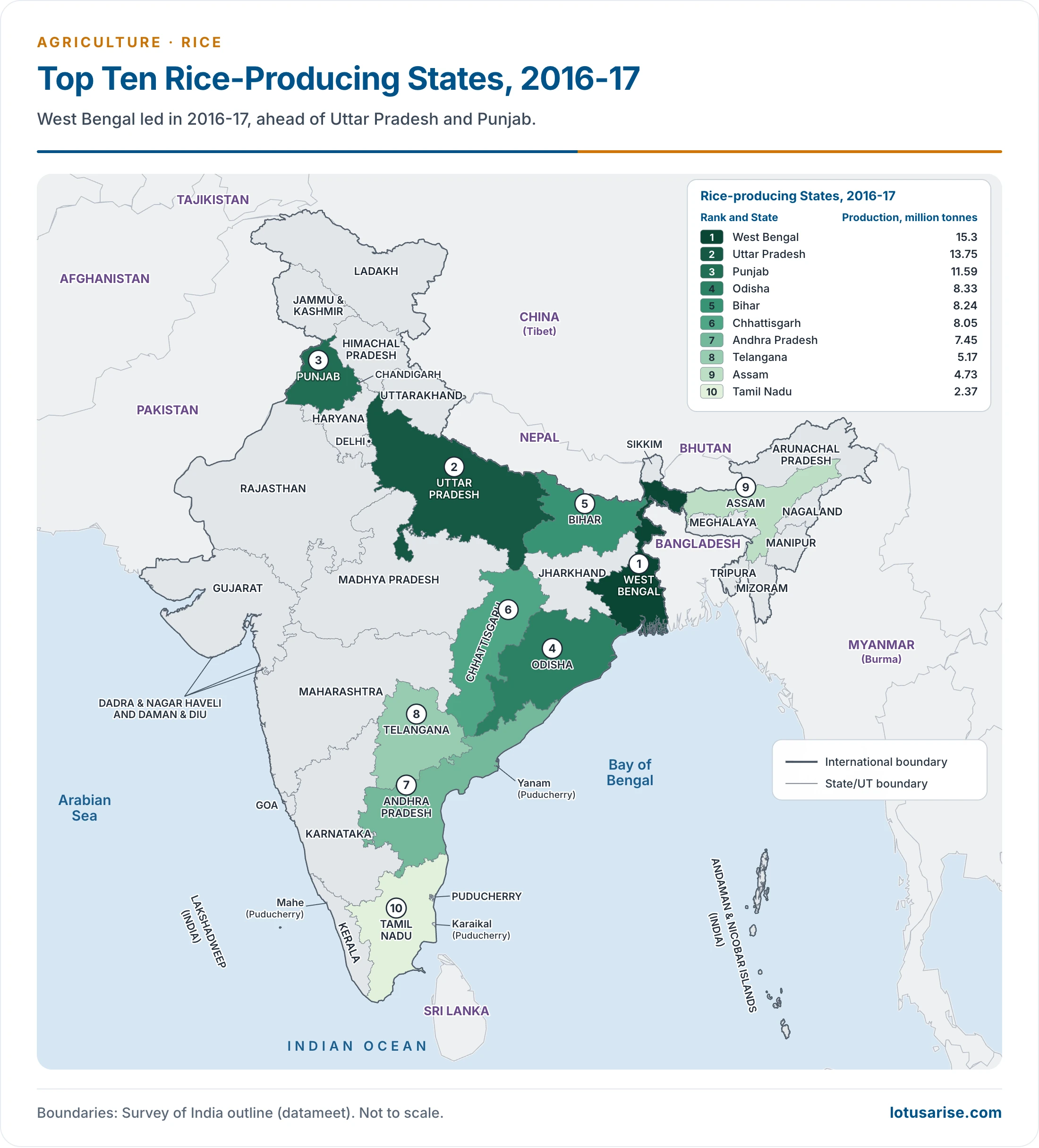
- This map shows 2016-17, when West Bengal led. Compare the 2024-25 order above.
Trade
- Older accounts held that home output met home demand, with little surplus for trade. About a tenth entered inter-State trade.
- Exports have since soared, to about 20.1 million tonnes worth USD 12.95 billion in 2024-25.
- India, once second to Thailand, now leads world rice exports, with about two-fifths of the trade by industry estimates in 2025.
- India is the biggest exporter of basmati, at about 6 million tonnes in 2024-25.
- Punjab, Haryana and western Uttar Pradesh grow the best basmati.
- Surplus States: Punjab, Haryana, Tamil Nadu, Andhra Pradesh and Uttar Pradesh. They supply deficit West Bengal, Maharashtra, Gujarat, Keralam and Delhi.
Wheat
- Wheat has been grown in India for over 5,000 years.
- Triticum sphaerococcum, the round-grained Indian dwarf wheat, has been linked with the Indus Valley Civilization. It has since given way to other species.
- Present species are Triticum aestivum (common bread wheat), Triticum durum (macaroni wheat) and Triticum dicoccum (emmer wheat).
- It is the second most important staple, and the preferred one in the north and north-west.
- It is a rich source of calcium, thiamine, riboflavin and iron, along with protein.
Climatic Conditions for Cultivation of Wheat
- Wheat is a temperate crop needing a cool climate with moderate rainfall.
- It adapts well and can grow in the tropics too, though yields there are low.
- It is a rabi crop. The ideal range is about 10–15°C in the winter months and 21–26°C towards harvest. A sudden rise at maturity hurts it.
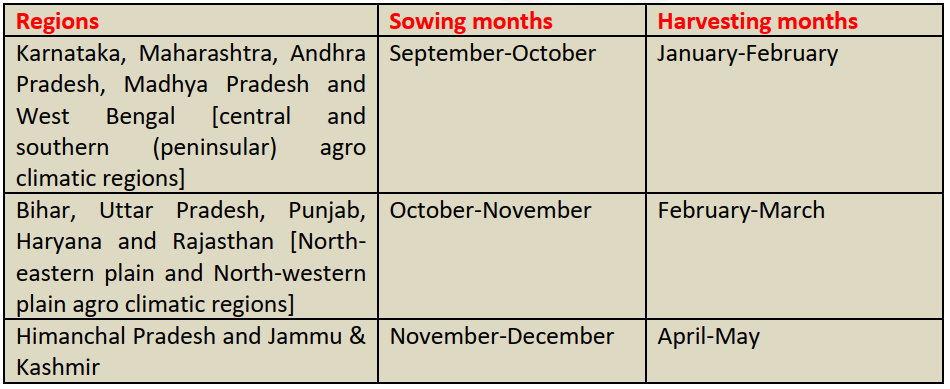
- On this table, harvest in the north-western plain runs mainly through March and April.
- It needs about 75 cm of well-distributed rainfall, and 100 cm is the upper limit.
- The 100 cm isohyet separates wheat from rice.
- Below 50 cm, it needs irrigation, with about 5–7 waterings. With irrigation, it can grow in areas getting only 20–25 cm of rain.
- In the kharif season, rice replaces wheat in the winter wheat belt of Punjab, Haryana and neighbouring tracts.
- Light drizzle and cloud at ripening, as brought by Western Disturbances, raise yields.
- Frost or hail during flowering and ripening is very harmful.
Soil Requirement for Wheat
- Well-drained, fertile, friable loams (mostly alluvial) and clay loams with a good share of sand are the best.
- It also does well on Deccan black soil.
- Having fewer limiting factors, wheat is more flexible than rice.
- It depends more on mechanization and needs less labour than rice.
Production of Wheat
- India is the second largest producer, after China.
- Wheat fills about 16% of the cropped area (15.95% in 2022-23), against 13% in older accounts.
- Yield has come closer to the world average. Older figures gave India 2.9 tonnes per hectare against a global 3.0, with France at 7.0, the USA at 3.11 and China at 4.8.
- The national average was 3,595 kg per hectare in 2024-25.
- Production has grown from 6.46 million tonnes in 1950-51 to 117.95 million tonnes in 2024-25. The leap followed the Green Revolution of the late 1960s.
- Output can rise further through:
- Area-specific technology, for example micro-irrigation in the dry Deccan.
- Better seed supply.
- Better fertilizer supply.
- Control of weeds, pests and diseases.
- Extension to non-traditional areas such as the Assam valley and Odisha, through timely kharif harvest and less fallow. West Bengal already grows a sizeable crop.
Distribution of Wheat in India
- Production is concentrated in the north-west.
- Punjab, Haryana and western Uttar Pradesh are called the “Granary of India”.
- Other important producers are Bihar (2,423 kg per hectare in 2012-13, 3,145 in 2024-25), Gujarat, West Bengal, Maharashtra, Uttarakhand and Himachal Pradesh.
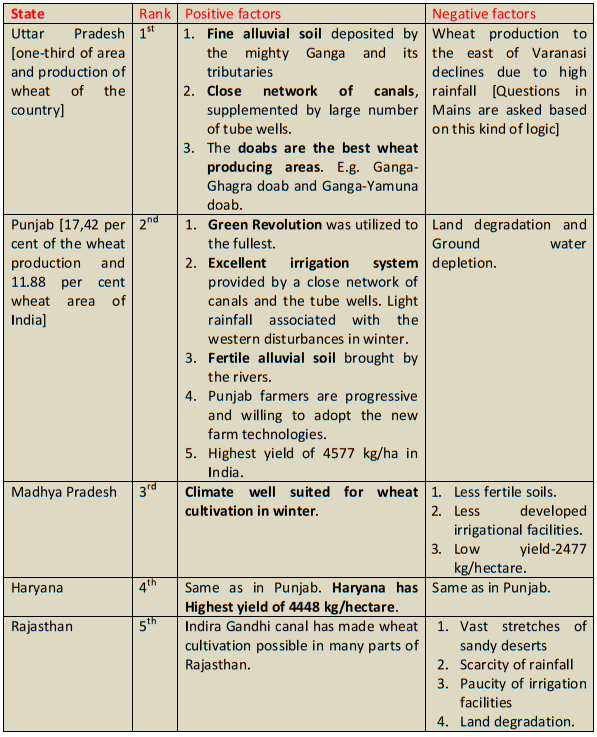
- This table reflects 2012-13. In 2024-25, Uttar Pradesh remained first (35.65 million tonnes, 30.2%), and Madhya Pradesh rose to second (24.51 million tonnes, 20.8%), ahead of Punjab (17.99, 15.3%), Haryana (11.40) and Rajasthan (11.27).
- Punjab has the highest yield (5,123 kg per hectare in 2024-25), and Haryana the second highest (4,774).
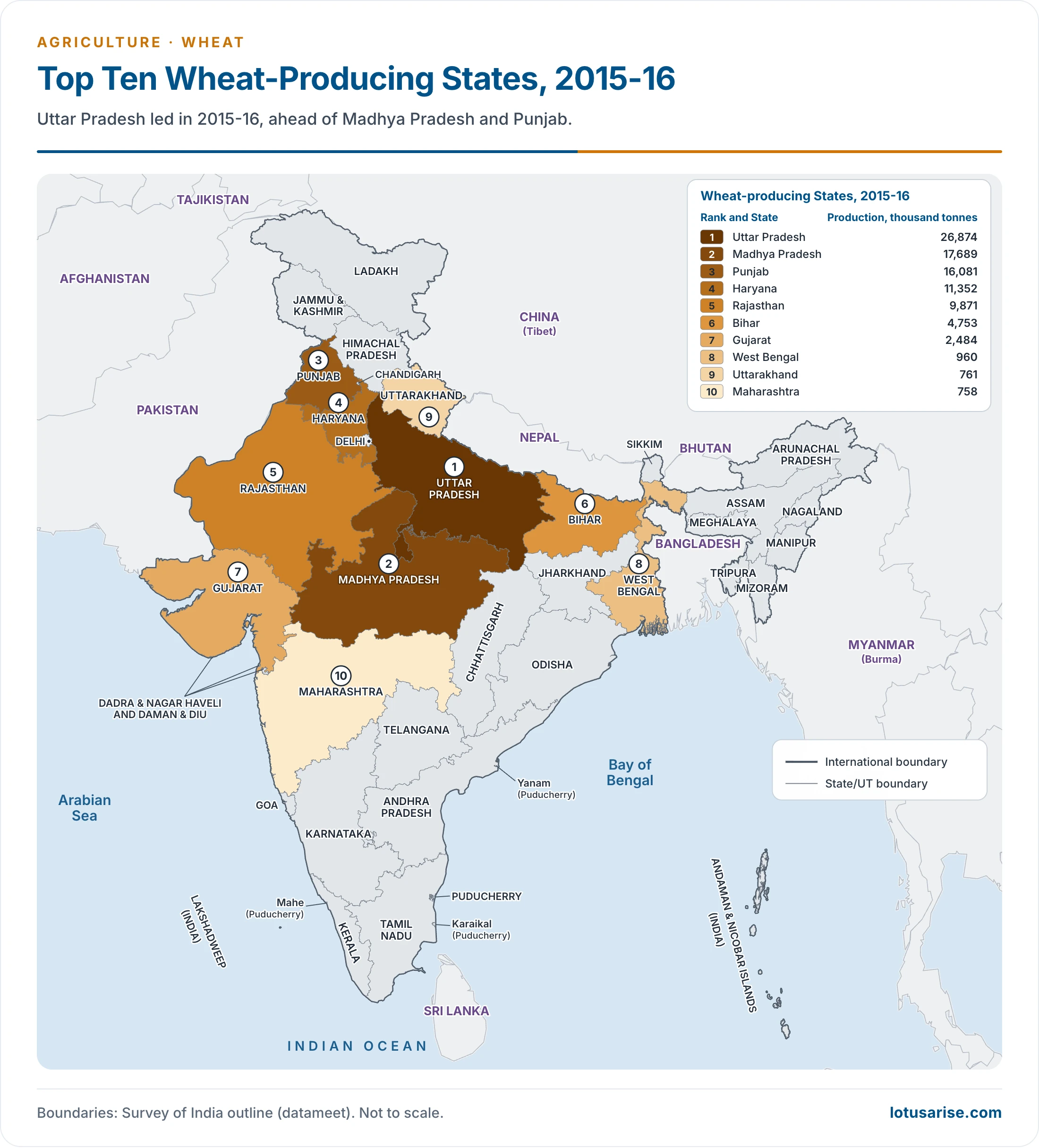
- This map shows 2015-16.
- Uttar Pradesh: the Ganga-Ghagra and Ganga-Yamuna doabs yield most of the State’s crop. Output falls east of Varanasi with higher rain and heavier soil.
- Madhya Pradesh: suited by a cool winter, and its yield has risen from 2,477 kg per hectare (2012-13) to 3,163 (2024-25).
- Rajasthan: deserts and scarce water limit wheat, but the Indira Gandhi Canal has extended it.
- Trade: about a third of the crop is sold across State lines, from surplus Punjab, Haryana, Uttar Pradesh, Rajasthan and Madhya Pradesh to deficit Maharashtra, West Bengal, Bihar and Delhi.
Maize
- Maize, or Indian corn (Zea mays L.), is a versatile emerging crop with wide adaptability.
- It is known globally as the “queen of cereals”, for having the highest genetic yield potential among cereals.
- In India, it is the third most important food crop after rice and wheat, used as food and fodder.
- It is a basic raw material for thousands of products: starch, oil, protein, alcoholic beverages, sweeteners, pharmaceuticals, cosmetics, film, textile, gum, packaging and paper.
- The USA grows maize mainly to fatten cattle, in its warm-summer Corn Belt, and very little is eaten.
Conditions for Growth of Maize
- Maize depends largely on rain and is mostly a kharif crop, doing best at 21–27°C.
- It grows mostly under semi-arid conditions, where rice and wheat are hard to raise. Older accounts give 25–75 cm or 50–100 cm of rain, and no crop above 100 cm.
- Tamil Nadu grows it in the rabi season, sowing in September and October, a few weeks before the winter rains of November and December.
- It grows on soils from loamy sand to clay loam.
- High organic matter, good water-holding capacity and neutral pH favour higher output.
- Well-drained fertile loams, rich in nitrogen and free of coarse material, are ideal.
- It is sensitive to excess moisture and salinity, so low-lying, badly drained or saline fields should be avoided.
- Maize is characterised by inter-culture, with pulses, vegetables and oilseeds.
Distribution of Maize in India
- It is grown throughout the year across the country, for grain, fodder, green cobs, sweet corn, baby corn and, near cities, popcorn.
- Older shares: Andhra Pradesh 20.9%, Karnataka 16.5%, Rajasthan 9.9%, Maharashtra 9.1%, Bihar 8.9%, Uttar Pradesh 6.1%, Madhya Pradesh 5.7% and Himachal Pradesh 4.4%, together over 80%. Jammu and Kashmir and the north-eastern States also grow it.
- Current order (2024-25): Madhya Pradesh 6.64 million tonnes, Karnataka 6.19, Bihar 5.47, Maharashtra 4.75, Telangana 3.39.
- Maize has spread into non-traditional peninsular India.
- Andhra Pradesh, then fifth in area (0.79 million hectares), once topped both production (4.14 million tonnes) and yield (5.26 tonnes per hectare), with some districts equal to the USA.
- West Bengal (6,999 kg per hectare), Andhra Pradesh (6,510) and Bihar (6,101) had the top yields in 2024-25.
- Output has surged to a record 55.09 million tonnes in 2025-26 (Third Advance Estimates), from 43.41 the year before.
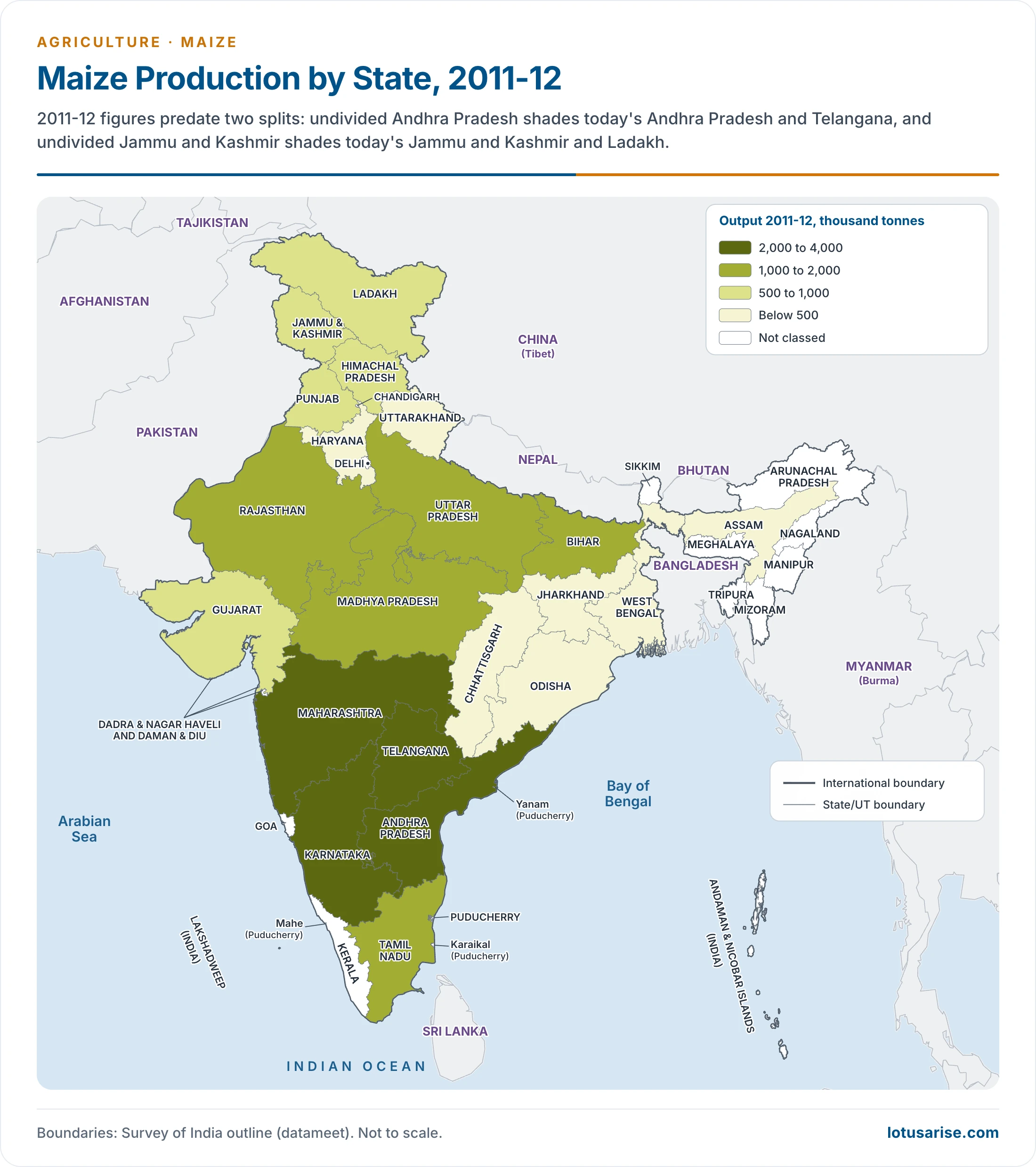
- This map shows 2011-12 output in thousand tonnes, before the Andhra Pradesh and Telangana split.
Millets
- Millets have been grown and eaten in the subcontinent for over 5,000 years. They are short-duration (3–4 months), small-grained, warm-weather annual cereals of the grass family.
- They grow on less fertile land, tolerate drought and extreme weather, and need little or no purchased input. This makes them the backbone of dry land farming.
- They are highly nutritious, non-glutinous and non-acid-forming, with high fibre and health-promoting properties. They feed the poor and provide fodder.
- India ranks first in the world in millet output, at about 18.59 million tonnes in 2024-25, led by Rajasthan, Maharashtra and Karnataka. They are now promoted as Shree Anna (17.58 million tonnes in 2025-26, Third Advance Estimates).
- Constraints: other crops have taken their land. Jowar’s area fell from 15.57 million hectares (1950-51) to 4.00 million (2024-25).
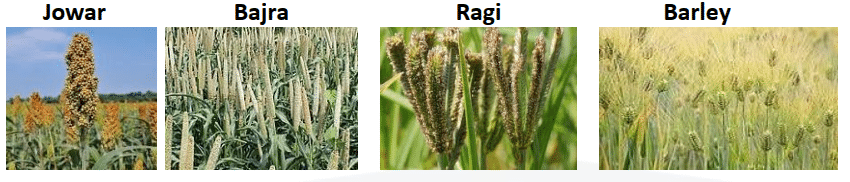
Jowar (Sorghum)
- High nutritional value: rich in protein, fibre, thiamine, riboflavin, folic acid and carotene.
- Sorghum proteins are significantly less digestible on cooking than other cereal proteins, which may benefit certain dietary groups.
- Conditions:
- Grown on rain in dry farming tracts, in both the kharif and rabi seasons.
- Temperature of 26–33°C as a kharif crop. The rabi crop needs at least 16°C.
- It needs over 30 cm of rain and does not grow above 100 cm.
- Clayey deep regur and alluvium suit it best.
- It can climb gentle slopes up to 1,200 m.
- Production and distribution:
- Maharashtra (37%) and Karnataka (26%) led in older figures. In 2024-25, Maharashtra kept 37.2% while Karnataka had 16.5%.
- Madhya Pradesh, Andhra Pradesh, Telangana, Rajasthan, Uttar Pradesh and Tamil Nadu are other producers.
Bajra (Bulrush Millet)
- Among millets, bajra ranks second. Africa and the subcontinent have grown it since prehistoric times.
- It suits drought, low fertility and high temperature, and performs well on high-salinity or low-pH soils.
- Like jowar, it provides food and fodder in drier parts.
- Conditions:
- A rainfed kharif crop of dry, warm climate, at about 25–30°C.
- 40–50 cm of annual rainfall, with an upper limit of 100 cm.
- It grows on poor light sandy soils and black and red soils.
- It is sown pure or mixed with cotton, jowar and ragi.
- Production and distribution:
- Rajasthan is first, with 44.39% in 2012-13 and 44.9% in 2024-25, from about three-fifths of the area.
- Uttar Pradesh is second (16.9%), followed by Haryana (11.4%) and Gujarat (11.2%).
Ragi (Finger Millet)
- Ragi grows mainly in the drier parts of south India, above all Karnataka.
- It is the richest source of calcium among cereals (300–350 mg per 100 g).
- It needs a warm climate (20–30°C) and 50–100 cm of rain.
- It grows on red, light black, sandy and well-drained alluvial loams.
- A kharif crop raised on rain. Sowing runs from May to August, and harvest from September to January.
- Production and distribution:
- Karnataka is the largest producer. It had 73.23% of output in 2005-06, and about 6.05 of 10.99 lakh hectares of kharif ragi area in 2023-24.
- In the older ranking, Uttarakhand was second and Tamil Nadu third. By area in 2023-24, Odisha came second (1.91 lakh hectares), then Uttarakhand (0.87) and Tamil Nadu (0.42).
- Maharashtra and Andhra Pradesh also grow ragi.
Barley
- Barley is a major temperate cereal, usually grouped with coarse grains. It was among the first cultivated grains, particularly in Eurasia, as early as 10,000 years ago.
- It serves as animal fodder, a source of fermentable material for beer and distilled drinks such as whisky, and an ingredient of health foods.
- Conditions:
- It cannot stand high heat and humidity, and does best with about three months at 10–15°C.
- It takes 75–100 cm of rain.
- It is a rabi crop of the Great Plains and the valleys of the western Himalaya.
- It grows up to about 1,300 m, as in Uttarakhand, and higher in Lahaul-Spiti.
- Production and distribution:
- Output and area have declined over time, like most millets, as wheat took its land.
- In older figures, Rajasthan was the largest producer (40%) and Uttar Pradesh second (33.8%).
More on Millets
- Millet Village scheme: a special scheme to promote millet, ragi, bajra and maize by setting up a millet village at Attappady in Keralam. It protects traditional seed and secures food and livelihood for tribals.
- International Year of Millets 2023: the 160th session of the Food and Agriculture Organization (FAO) Council, in Rome in December 2018, approved India’s proposal.
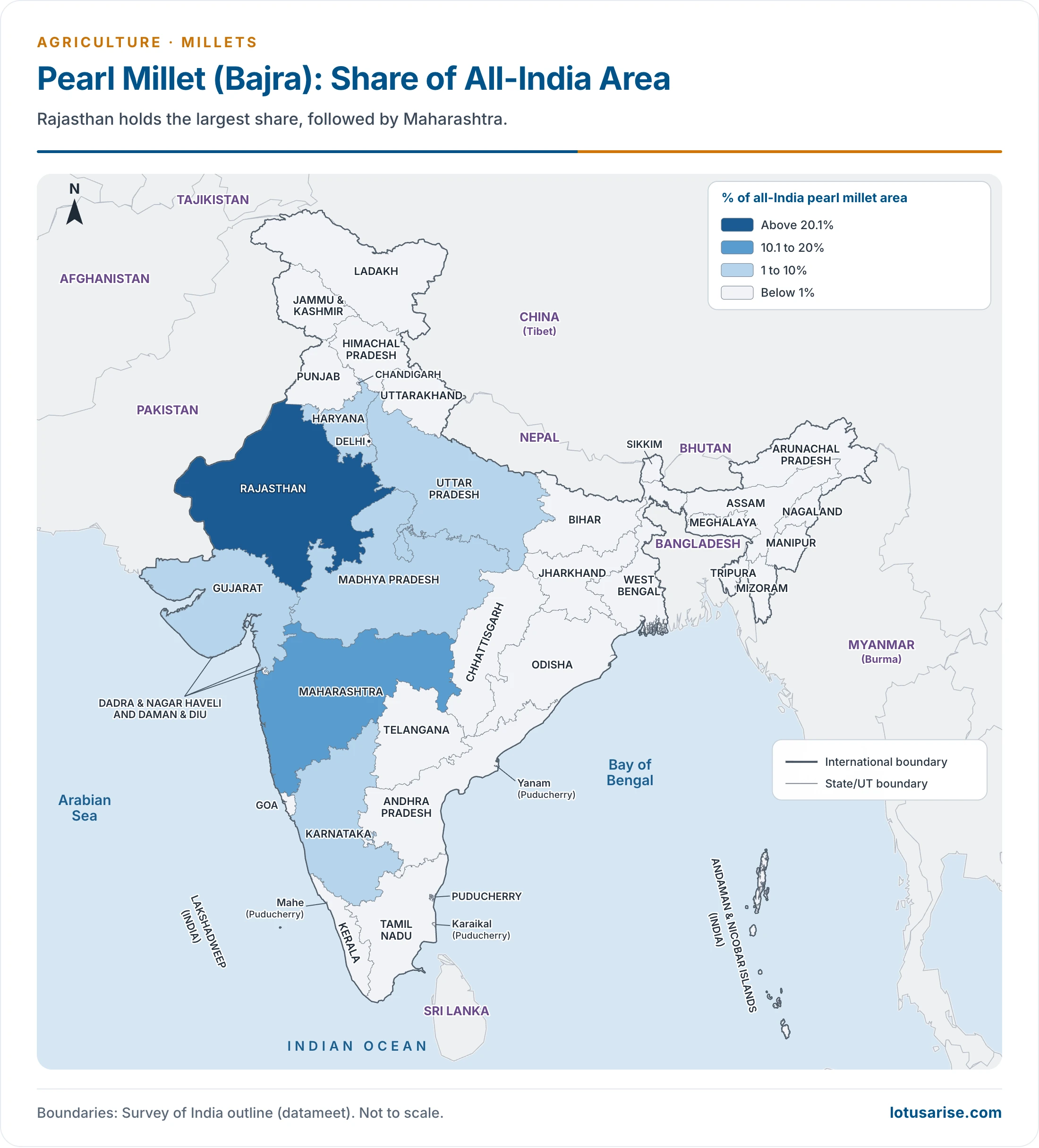
- This map shows the share of pearl millet (bajra) area only.
Pulses
- Pulses are the edible seeds of legumes, growing in pods of many shapes, sizes and colours.
- The FAO recognises 11 types: dry beans, dry broad beans, dry peas, chickpeas, cow peas, pigeon peas, lentils, Bambara beans, vetches, lupins and “pulses nes” (not elsewhere specified).
- They give protein to much of the world, and they help soil health and climate mitigation through nitrogen fixation. Hence they are normally rotated with other crops.
- India is the largest producer (25% of the world), consumer (27%) and importer (14%) by older figures.
- Output was 25.68 million tonnes in 2024-25, led by Madhya Pradesh (5.24), Maharashtra (5.04) and Rajasthan (3.93).
- The Mission for Aatmanirbharta in Pulses (2025-26 to 2030-31), approved on 1 October 2025 with ₹11,440 crore, aims at 35 million tonnes from 31 million hectares by 2030-31.
Gram
- Gram is the most important pulse, about 43% of pulse output in 2024-25.
- It prefers a mildly cool (20–25°C), comparatively dry climate with 40–50 cm of rain, on loamy soil.
- It is a rabi crop, sown alone or with wheat, barley, linseed or mustard.
- Such mixing gives some protection from gram blight.
- Production and distribution:
- Like millets, gram lost ground to wheat. Its area fell from 10.33 million hectares (1959-60) to 5.19 million (2000-01), then recovered to 9.12 million (2024-25).
- Most comes from Madhya Pradesh, Rajasthan and Maharashtra.
- Madhya Pradesh led with 40% in 2012-13 and 26.4% in 2023-24. In 2024-25, Maharashtra (2.96 million tonnes, 26.7%) moved ahead of Madhya Pradesh (2.11) and Rajasthan (2.01).
- Andhra Pradesh (Rayalaseema), Uttar Pradesh and Karnataka are other major producers, and Gujarat has risen quickly (1.56).
Tur or Arhar (Pigeon Pea or Red Gram)
- Tur ranks second among pulses, eaten widely in South Asia and a major protein source across the subcontinent.
- As dal, it goes with rice or roti and is a staple all over India.
- It is chiefly a kharif crop, and a rabi crop where winters are mild.
- It is a dry crop mixed with jowar, bajra, ragi, maize, cotton or groundnut, and is seldom grown alone.
- Its growing conditions resemble those of other pulses and millets.
- Distribution:
- Maharashtra is the largest producer, with 29% in 2012-13 and 39.3% in 2024-25.
- Madhya Pradesh was second in 2012-13. In 2024-25, Karnataka (27.5%) took that place, and Madhya Pradesh had 3.5%.
- Bihar recorded the highest yield in 2012-13 (1,667 kg per hectare, against 806 nationally).

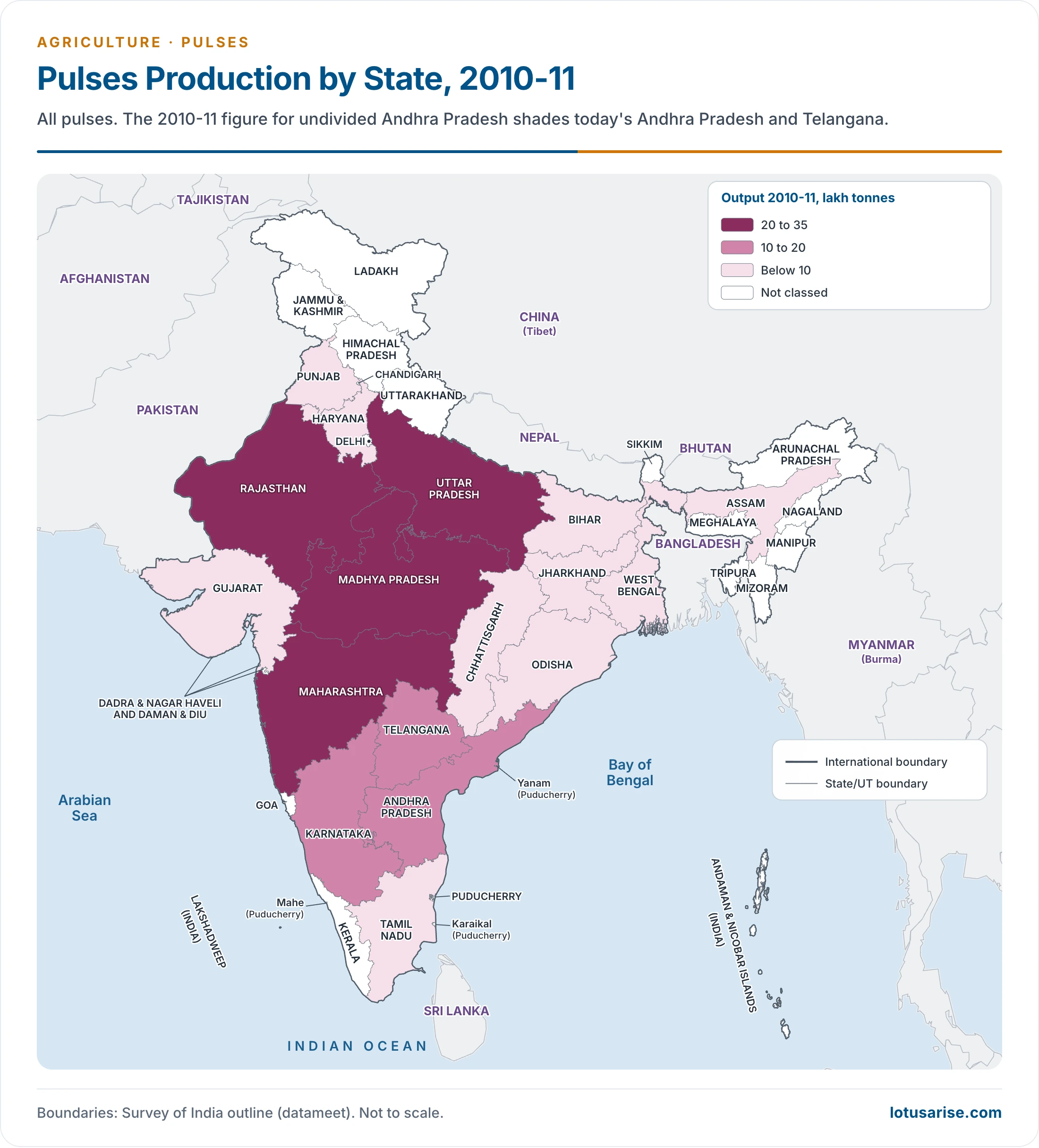
- This map shows 2010-11 output of all pulses.
Major Cash Crops of India
- Cash crops are raised to be sold, for example cotton, jute, sugarcane, tobacco and oilseeds.
- They are major contributors to agricultural GDP and supply raw material to many industries.
- Older accounts credit them with only 15% of the cropped area but over 40% of farm output by value.
- Their area today is larger: oilseeds, cotton and sugarcane alone held about 24% in 2022-23.
Cotton
- Of about 50 species of cotton plant, only four are domesticated for fibre. India is perhaps the only country growing all four commercially:
- Gossypium arboreum (Asian cotton)
- Gossypium herbaceum (Asian cotton)
- Gossypium barbadense (Egyptian cotton)
- Gossypium hirsutum (American upland cotton)
- It is the most important fibre crop. Its seed feeds the vanaspati industry and gives fodder for milch cattle.
Conditions for Growth
- Cotton is a tropical and sub-tropical crop needing uniformly high temperature (21–30°C) and 50–100 cm of rain.
- Punjab, Haryana, Gujarat and Rajasthan hold most of the irrigated cotton. About half of the area was irrigated in 2023-24.
- Good early rain helps seeds sprout, and sunny, dry weather at ripening reduces pest attack.
Unfavourable Factors
- Growth is retarded below 20°C.
- Frost is its chief enemy, so it needs at least 210 frost-free days.
- Moist weather and heavy rain at boll-opening and picking damage the fibre and invite pests.
- Older accounts put about 65% of cotton area as rainfed, with erratic rain and severe pest attack.
Crop Season
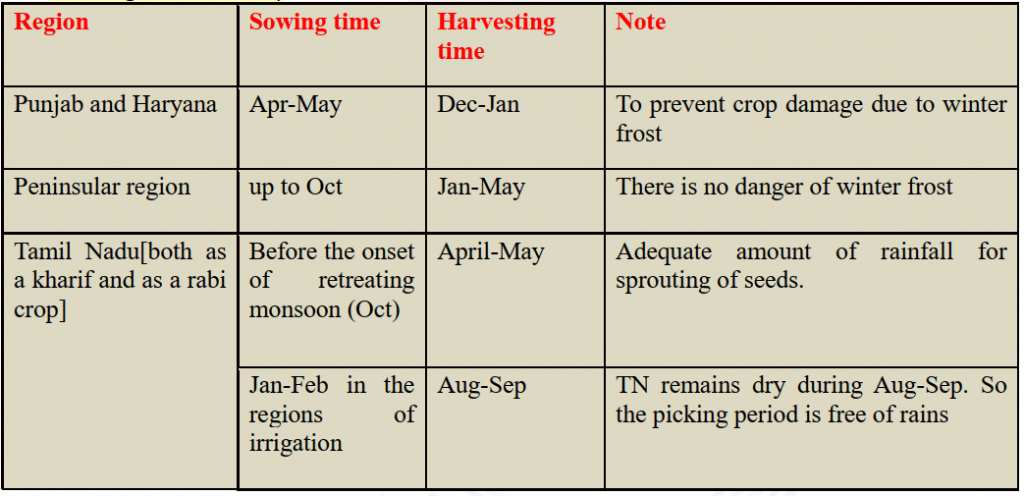
- Cotton is a kharif crop taking 6–8 months to mature, with sowing and harvest differing by region.
- Most of it grows mixed with kharif crops such as maize, jowar, ragi, sesamum, castor and groundnut.
Soil
- The deep black regur of the Deccan and Malwa plateaus and Gujarat suits it best, being derived from lava.
- It also does well on the alluvium of the Satluj-Ganga plain and the red and laterite soils of the Peninsula.
- Cotton quickly exhausts the soil, so it needs manure and fertilizer.
Labour
- Picking is not yet widely mechanized, so it needs much cheap and efficient labour.
- The picking season normally spreads over about three months.
Types of Cotton
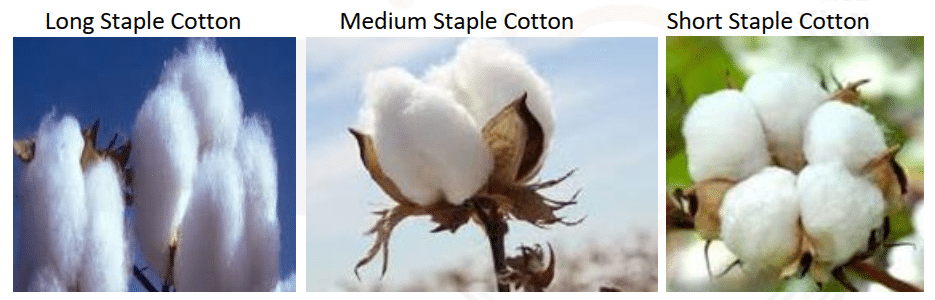
| Type | Older fibre length | Older share | Character | Main producers |
|---|---|---|---|---|
| Long staple | 24–27 mm | About half | Fine, lustrous; superior cloth; best price | Punjab, Haryana, Maharashtra, Tamil Nadu, Madhya Pradesh, Gujarat, Andhra Pradesh |
| Medium staple | 20–24 mm | About 44% | Rajasthan, Punjab, Tamil Nadu, Madhya Pradesh, Uttar Pradesh, Karnataka, Maharashtra | |
| Short staple | Under 20 mm | About 6% | Inferior cloth; lower price | Uttar Pradesh, Andhra Pradesh, Rajasthan, Haryana, Punjab |
- The Bureau of Indian Standards now uses five groups (IS 12171:2024): short up to 20 mm, medium 20–25 mm, superior medium 25–27 mm, long 27–32 mm and extra long above 32 mm.
Distribution
- India has three agro-ecological cotton zones:
- Northern: Punjab, Haryana, Rajasthan.
- Central: Gujarat, Maharashtra, Madhya Pradesh.
- Southern: Andhra Pradesh, Telangana, Tamil Nadu, Karnataka.
- In older rankings, Gujarat was first, followed by Maharashtra and Andhra Pradesh, with Haryana fourth.
- The lead now swings between two States. Gujarat led in 2023-24 (9.06 million bales), and Maharashtra in 2024-25 (7.37 million bales, against 7.16 for Gujarat). Telangana is third (5.79).
- Maharashtra has the largest area (4.12 million hectares) but a low yield, at 304 kg per hectare in 2024-25.
- Older trade pattern: India sold inferior cotton mainly to the UK for blending, and bought long staple from the USA, Russia, Sudan and Kenya. Exports then grew strongly, as domestic output of fine cotton rose.
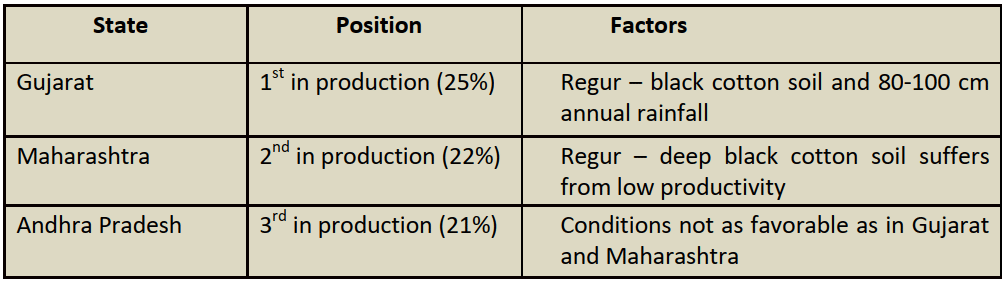
- This table reflects 2012-13, before the Andhra Pradesh and Telangana split.
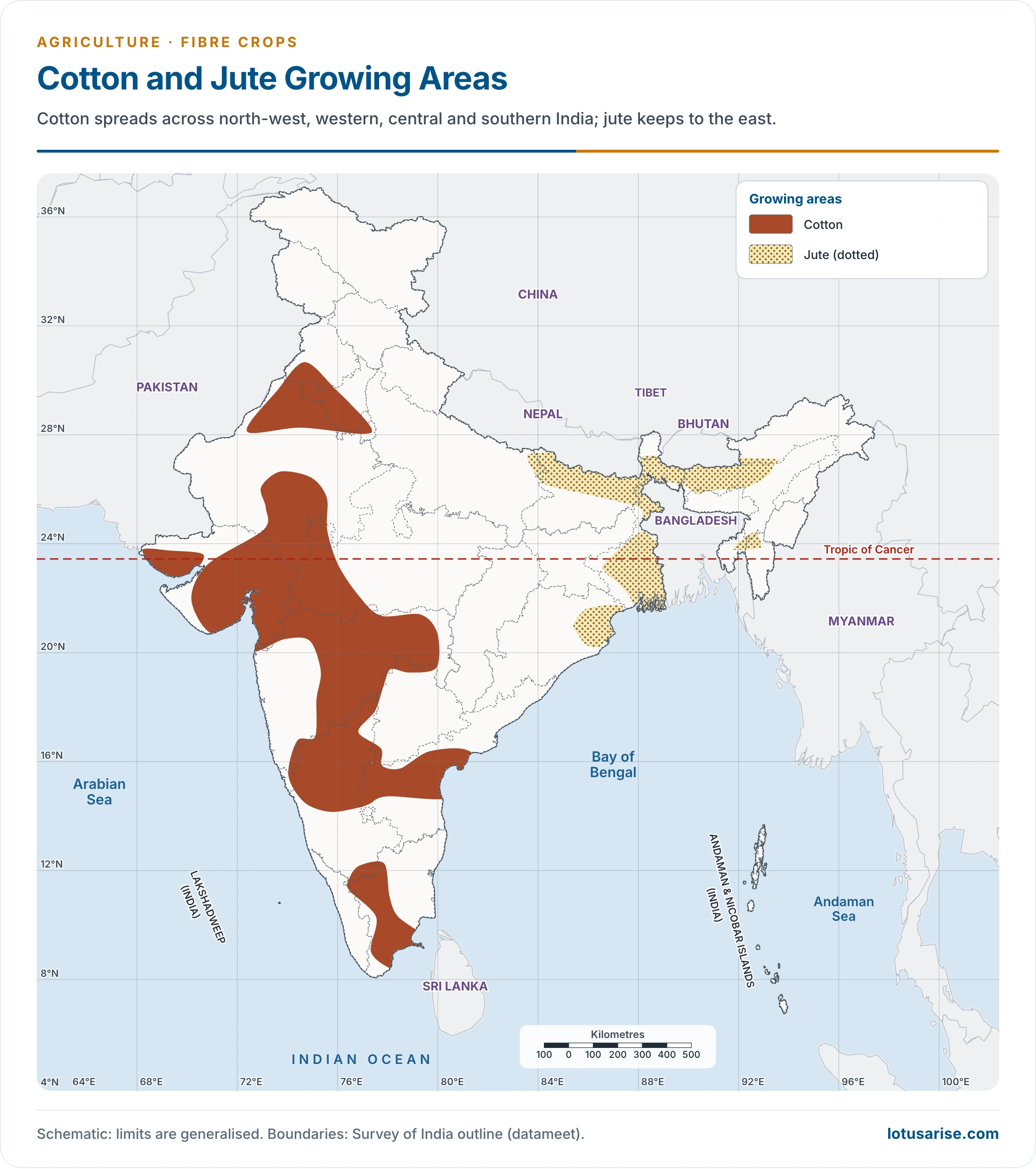
- Main tracts: Khandesh, Vidarbha and Marathwada in Maharashtra; the Gujarat plains; Malwa in Madhya Pradesh; Guntur and Prakasam in Andhra Pradesh; and the Malwa region of Punjab, where cotton is called “white gold”.
Production
- The 2019 projection of 354 lakh bales was presented as the highest ever. Output has since been 297.2 lakh bales (2024-25) and an estimated 290.2 lakh bales (2025-26).
- This came after a roughly threefold rise over two decades, which supporters of GM crops cite to extend the technology.
- No country has more land under cotton: about 114.84 lakh hectares, or 38% of the global area.
- Its yield is low (440 kg per hectare in 2024-25), so far more land is needed for the same output. For over four decades, it has been about a third of that of other major producers.
- India and China are the largest producers. Older figures gave India 18.53 million tonnes and China 17.14 million tonnes, most of it used by their own textile mills. India now ranks second (March 2026), with about a fifth of world output.
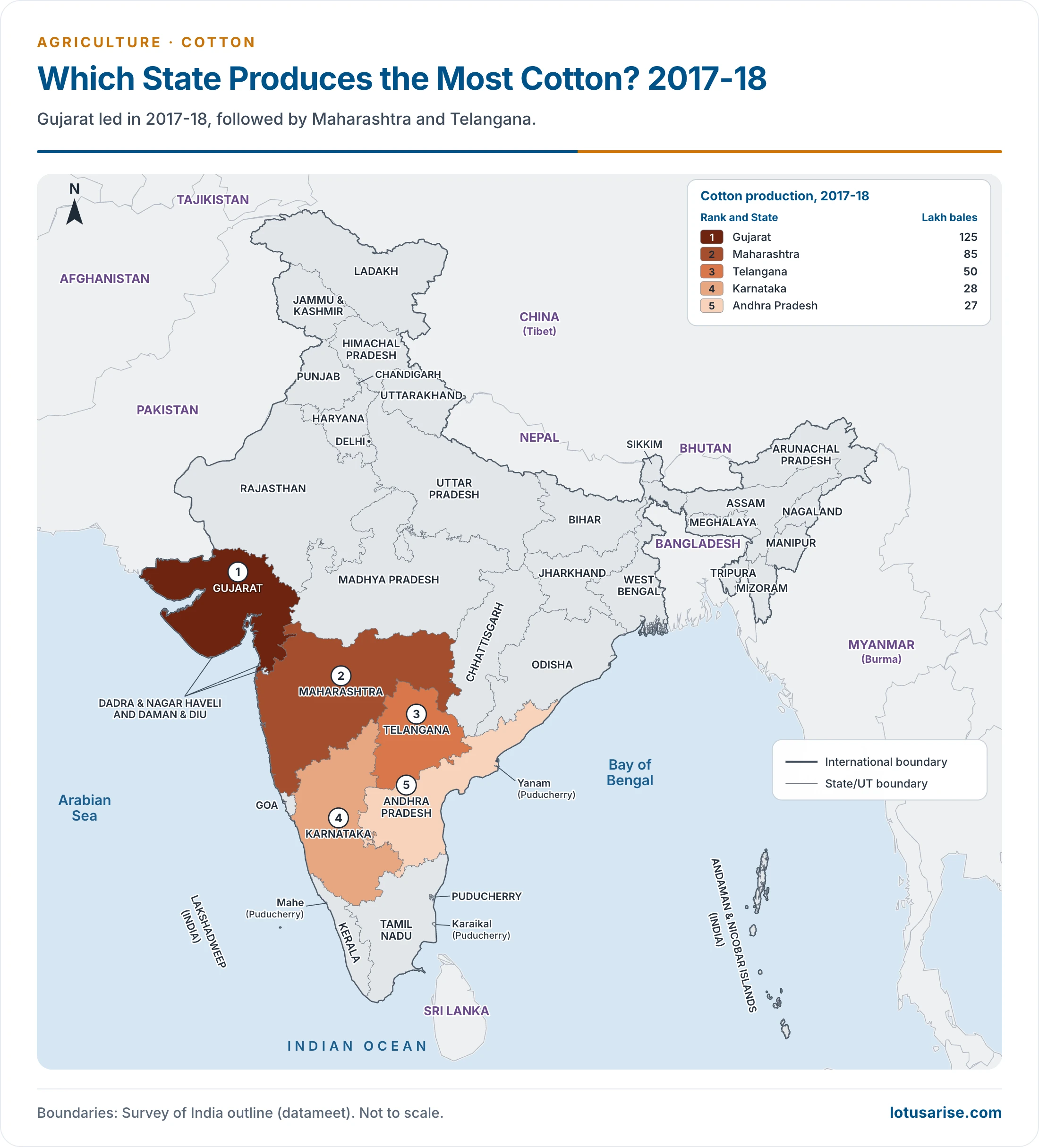
- This map shows 2017-18 figures.
Bt Cotton
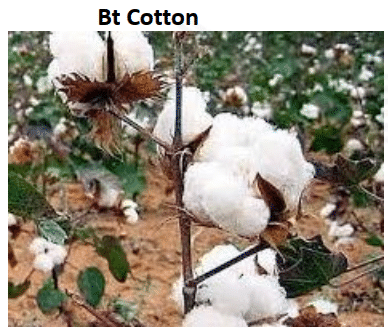
- Genetically modified (GM) pest-resistant hybrids have taken over the market since their introduction in 2002. They cover over 95% of the area, with seed entirely from the private sector.
- Maharashtra has the largest Bt area in older figures, followed by Andhra Pradesh, Gujarat and Madhya Pradesh. Punjab and Haryana lead in the north.
- Bt stands for the bacterium Bacillus thuringiensis, whose toxin kills bollworms. The trait is inserted into cotton by genetic modification.
- Benefits: higher yield through bollworm control, far less pesticide spraying, higher profit and survival of useful insects.
- Concerns:
- Yields later fell sharply, as other pests went uncontrolled. The toxin controls only bollworm, while cotton attracts over 100 different pests.
- Bollworm may develop resistance, as it did in China.
Cotton Corporation of India
- The Cotton Corporation of India (CCI) was set up in 1970 under the Companies Act, 1956.
- It is a Government of India agency for trade, procurement and export of cotton.
- It is governed by the Textile Policy, 1985, of the Ministry of Textiles.
- It operates in Punjab, Haryana, Rajasthan, Gujarat, Maharashtra, Madhya Pradesh, Andhra Pradesh, Karnataka, Tamil Nadu and Odisha.
Jute
- Jute is the second most important fibre crop after cotton, used for gunny bags, ropes, carpets, rugs and tarpaulins.
- It was in great demand for its low price, softness and strength. Synthetic alternatives have cut that demand, though jute’s biodegradable nature remains in its favour.
Conditions for Growth
- It needs a hot (24–35°C), humid climate, with 120–150 cm of rain and 80–90% relative humidity. It uses much water in growth.
- Sowing and early growth come in the pre-monsoon season, with 25–55 cm of rain, so as to make the most of the monsoon that follows.
- It is generally sown from February on lowlands and March–May on uplands, and harvested from July to October.
- Older accounts give 8–10 months to mature. Crop manuals now give about 120–140 days.
- Light sandy or clayey loams of alluvial origin suit it best.
- Like cotton, it exhausts the soil quickly, so the silt of annual floods has to renew it.
Processing of Jute
- It needs a large supply of cheap labour and plenty of water after harvest.
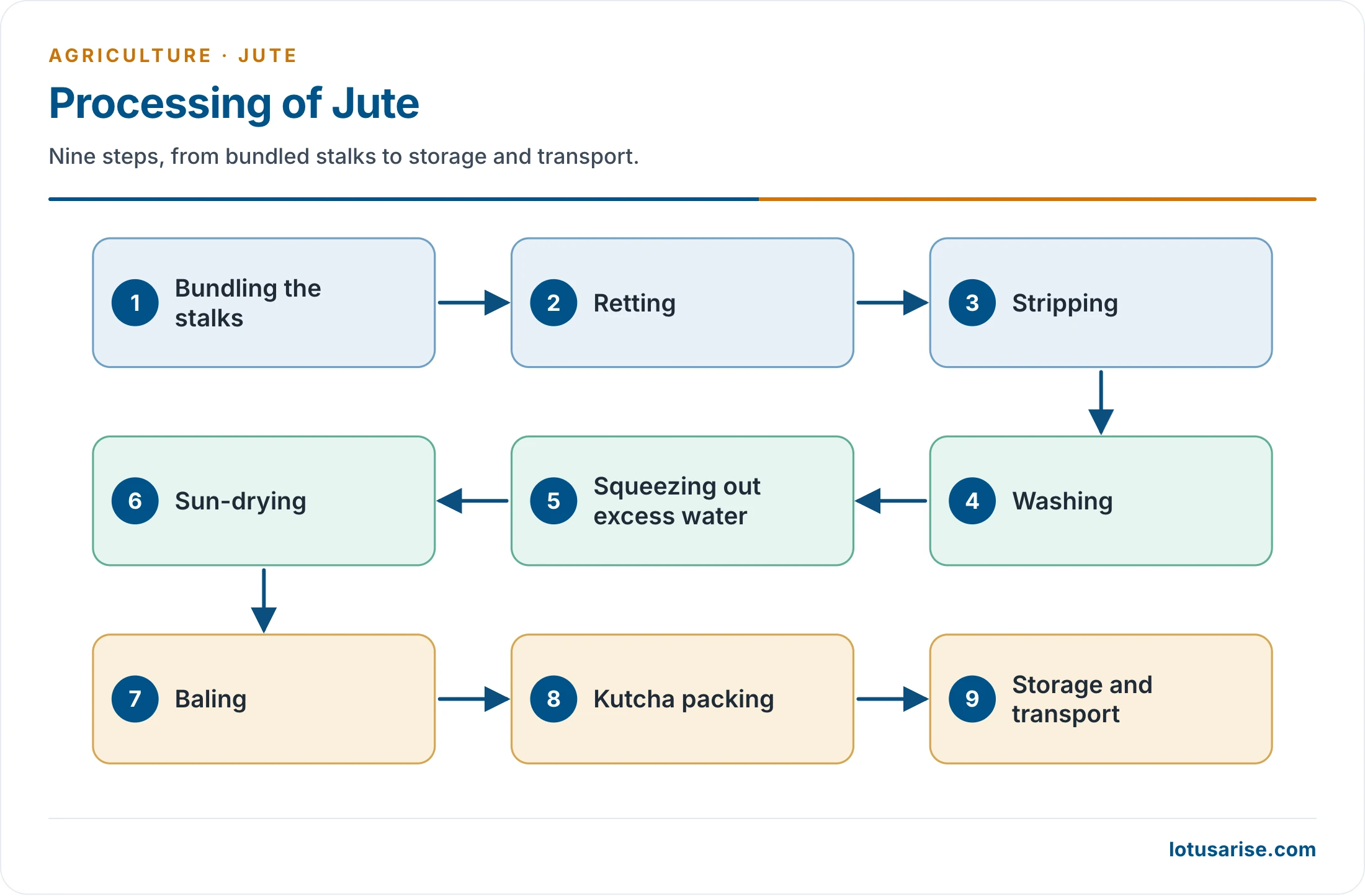
- Bundles (sheaves) of stalks are immersed in stagnant water for about 3 weeks for retting, which softens them. Warm water speeds up the process.
- The bark is then peeled and the fibre removed, followed by stripping, rinsing and cleaning.
- Sun-drying and pressing into bales follow.
- All of this is done by hand, so jute is grown only where population is dense.
Production
- Partition sent about 75% of the jute area to Bangladesh, while most mills stayed in India.
- Area, output and yield rose quickly from 1950 to 1980.
- Since 1981, area has been falling, because of weather changes, more land under rice and synthetic substitutes. Area fell from 1.30 million hectares in 1980-81 to 0.57 million in 2024-25, though higher yield has held output at about 8–11 million bales.
- Older figures gave India about 56% of world jute and Bangladesh 25%.
Distribution
- Over 99% of India’s jute came from five States in older figures: West Bengal, Bihar, Assam, Andhra Pradesh and Odisha.
- Andhra Pradesh (delta area) and Odisha are the other important producers.

- In 2024-25, West Bengal had 79.9% of jute and mesta, Bihar 9.6% and Assam 8.3%.
- This map repeats the cotton and jute map above. Jute appears in the dotted tracts of the lower Ganga-Brahmaputra plain.
Trade
- India imports raw jute from Bangladesh, because local output has fallen short of mill needs.
- It exports jute hessian, including to Bangladesh.
Sugarcane
- Sugarcane has the largest value of production among commercial crops, and is farmers’ first choice wherever conditions allow.
- It is indigenous to India and belongs to the grass family, like bamboo.
- Thickened cane juice gives sugar, gur (jaggery) and khandsari.
- Older accounts send two-thirds of the cane to gur and khandsari. More recent estimates send over half to sugar mills.
- Molasses, bagasse and pressmud are by-products of the sugar industry.
- Molasses is the raw material for alcohol (ethanol), an efficient substitute for certain petroleum products.
- Bagasse (cane residue) makes paper and serves as fuel in the mills. As paper it saves trees, while as fuel it burns inefficiently.
- Pressmud is a compost that improves the soil.
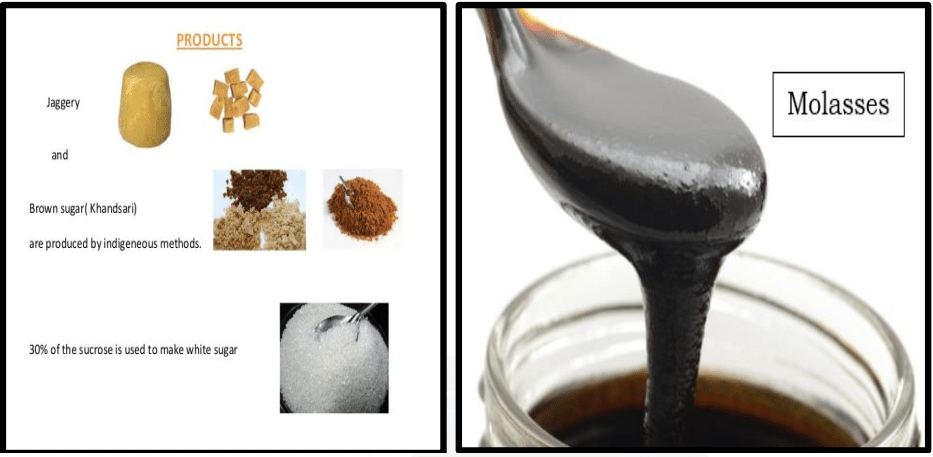
- The share of cane going to white sugar on this panel is an old figure. It now exceeds half, as noted above.
Conditions for Growth: Climate
- Sugarcane is predominantly a tropical crop, needing a hot (21–27°C), humid (75–150 cm) climate. It takes 10–18 months to mature, depending on conditions.
- Sugar beet, a root crop, is its temperate alternative.
- Too much rain lowers the sugar content, and too little makes the crop fibrous.
- Temperature above 20°C with clear skies in the second half of the season helps juice to form and thicken.
- A short, cool, dry winter is ideal for ripening and harvest.
- Frost is harmful, so in the north, the crop must be cut before the frost season.
- Hot, dry winds such as the loo also harm it. South India has neither frost nor loo, which makes it ideal.
- Coastal plains and the western side of the Western Ghats are generally avoided, since gusty monsoon winds damage the crop.
Conditions for Growth: Soil and Labour
- It tolerates any soil that can retain moisture, and it exhausts fertility fast.
- Flat plains or level plateaus help irrigation and the carriage of cane to mills.
- Cheap, abundant labour is a prerequisite.
Production
- India has a very large area under sugarcane (5.45 million hectares in 2024-25). It stands second to Brazil in output, at 454.61 million tonnes.
- Productivity is low compared with Colombia, Peru, Indonesia and Egypt.
- In 2012-13, India had 66.9 tonnes per hectare, against Brazil 79.0, Colombia 101.3, Egypt 116.7 and Peru 125.5.
- India reached 83.4 tonnes per hectare in 2024-25.
- Causes of low yield, common to rice and sugarcane: scarce or badly timed fertilizer, uncertain weather, too little irrigation, poor cane varieties, tiny scattered holdings and old-fashioned methods.
- The Sugarcane Breeding Institute at Coimbatore, started in 1912, evolved better varieties and popularised ratooning, which cuts costs.
- A ratoon crop is the second or a later crop from roots left in the field. The cane is cut and the root stays in the soil.
- Advantages: low cost, a shorter maturation period and saved time, since there is no fresh sowing.
- Limit: yield falls every year, and ratooning becomes uneconomical after one or two years.
Distribution
- Three distinct belts can be identified:

- Why the north leads despite better southern conditions:
- Before the First World War, the northern plain grew indigo. Cheap aniline dyes took away its market, and sugarcane took its place.
- Cane needs water through the year. Perennial rivers provided this in the north, while the south has non-perennial rivers and, formerly, little irrigation.
- In the south, cane faced competition for land from cotton, tobacco, groundnut and coconut.
- Why the south is gaining:
- More cane has brought more sugar mills, and the weather is better, without loo or frost.
- Irrigation has grown extensively over recent decades.
- Crushing runs through the year. Mills in the north stand idle in the coldest months.
- Maritime influence gives a moderate climate that keeps sugar content up, since very high temperature and low rain make the crop fibrous.
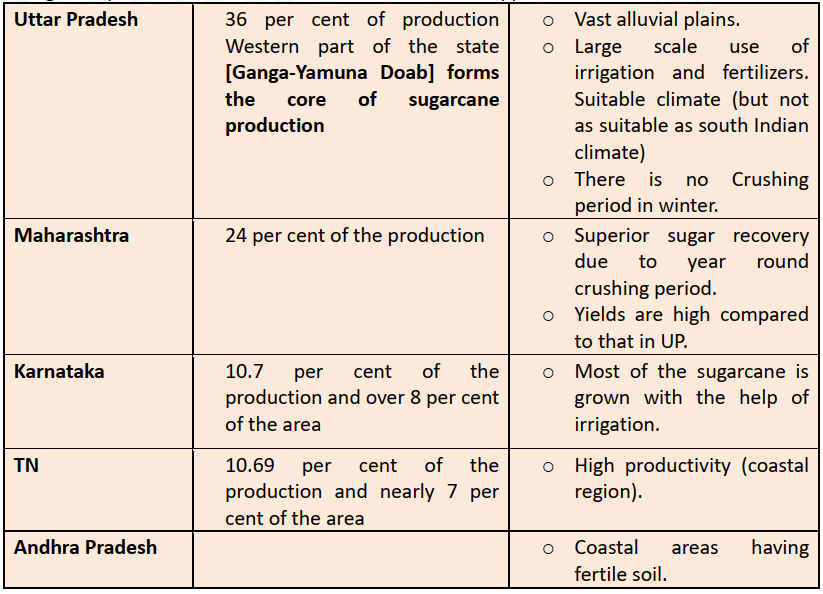
- These shares reflect 2012-13. In 2024-25, the figures were Uttar Pradesh 48.6%, Maharashtra 24.2%, Karnataka 10.6%, Gujarat 3.0% and Tamil Nadu 2.9%.
- Tamil Nadu still has the top yield among major States (102 tonnes per hectare).
- Other important producers:
- Bihar.
- Gujarat, whose sugar recovery of 10.31% is one of the highest among major States.
- Uttarakhand, mostly hilly and poorly suited, except parts of Haridwar, Nainital, Dehra Dun and Udham Singh Nagar on the plains and foothills.
- Punjab, where wheat has taken over cane land.
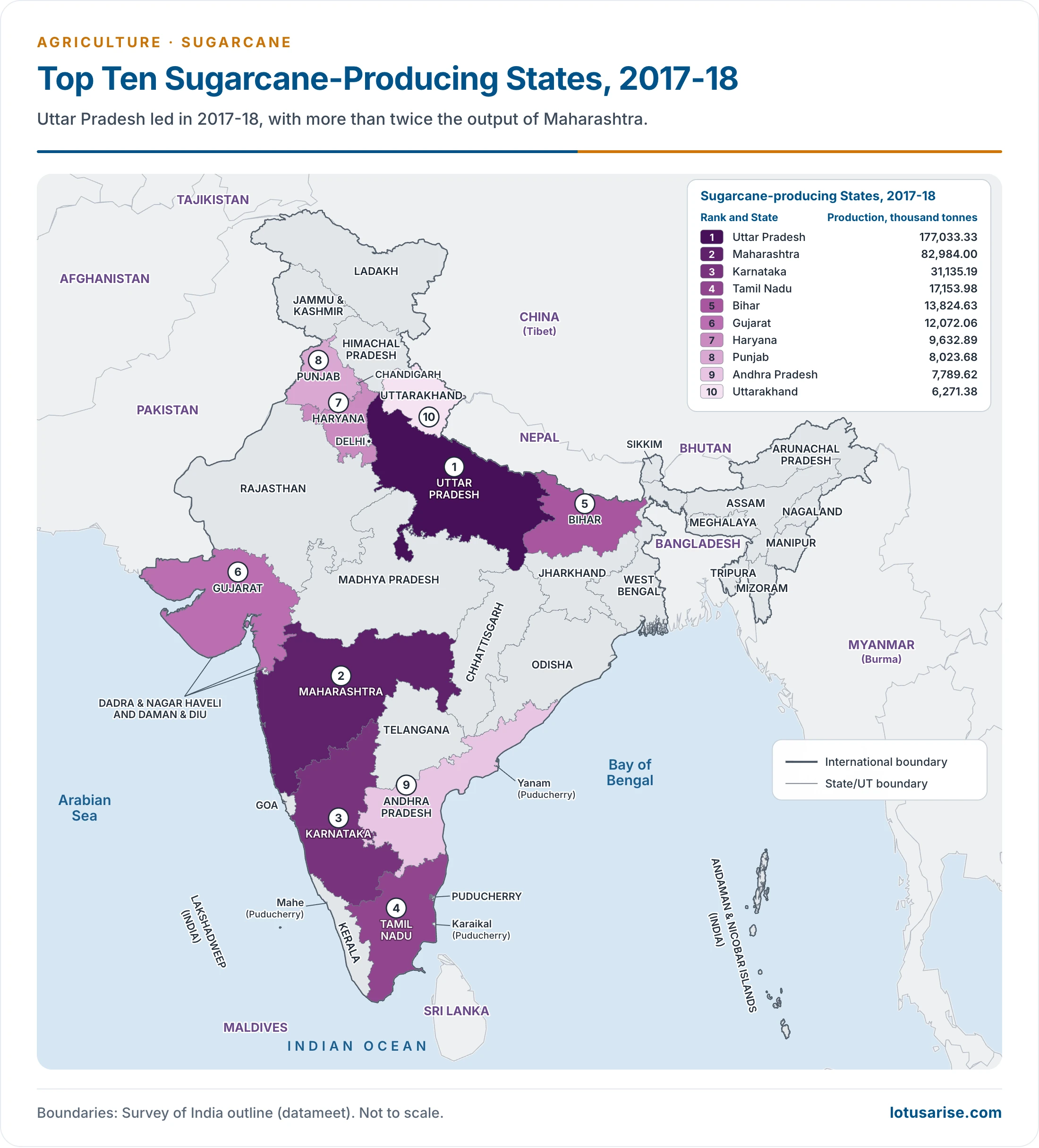
- This map shows 2017-18.
Tobacco
- The Portuguese introduced tobacco in 1508.
- It is mainly used for smoking, and also for chewing and for insecticides. Returns are high, so the same land often carries it year after year.
Conditions for Growth
- A crop of warm climates, tropical and sub-tropical, it tolerates 16–35°C and so grows in many agro-climatic regions.
- It needs fairly well-distributed rain of about 100 cm.
- It grows from low plains up to 1,800 m.
- Frost is injurious, and bright rainless weather helps at the curing stage.
- Soil matters more than climate in its distribution:
- Well-drained, friable sandy loams are ideal.
- Soil should be rich in mineral salts (for full root growth), but not in organic matter.

- Cheap, abundant labour is needed at all stages.
Types of Tobacco
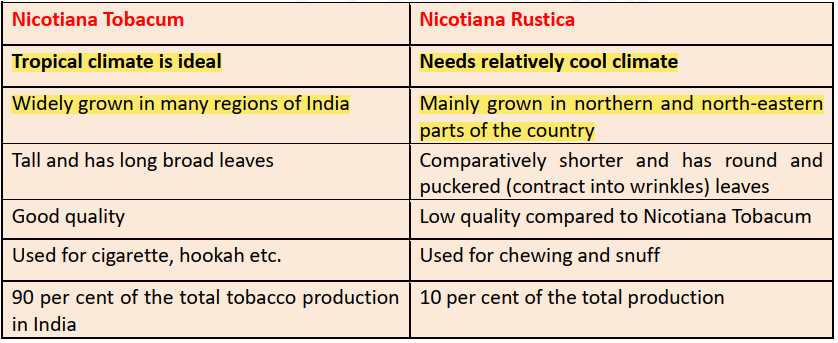
- Two main types are grown: Nicotiana tabacum and Nicotiana rustica.
Production and Distribution
- India ranked third after China and Brazil, followed by the USA, Malawi, Indonesia and Argentina, in 2011-12. It now has about 13% of world output.
- Output rose from 0.56 million tonnes in 1990-91 to 1.04 million tonnes in 2024-25, on 0.49 million hectares.
- Gujarat and Andhra Pradesh together gave 65.3% of output in 2011-12. Gujarat had 33.9%, and Andhra Pradesh 31.5%.
- Other producers in that year: Uttar Pradesh (15%), Karnataka (13%), Bihar (2%), Tamil Nadu and Maharashtra.
- A 2024 government summary gives Gujarat 47%, Andhra Pradesh 23%, Uttar Pradesh 12% and Karnataka 10%.
- Uttar Pradesh gave the highest yield, over twice the national average, in 2011-12.
- Regional specialisation: Gujarat grows mainly bidi tobacco, and Andhra Pradesh and Karnataka grow FCV (flue-cured Virginia) for cigarettes.
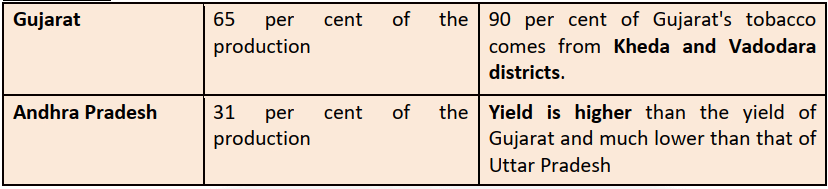
- On this table, 65% is the joint share of Gujarat and Andhra Pradesh in 2011-12. Gujarat alone held 33.9%.
Trade
- India was the fourth largest exporter in older accounts.
- Only about 20% of output was traded abroad, and most of that was unmanufactured tobacco.
- Russia and the UK bought about two-thirds of exports, and Chennai handled about 90% of the trade.
- Export earnings reached ₹12,005 crore in 2023-24.
Other Major Crops
Oilseeds
- Oil from these seeds is used in food and in paints, varnishes, soaps, perfumes and lubricants, and the leftover oil-cake is a valued cattle feed and manure.
- Nine oilseeds covered 30.44 million hectares in 2024-25, yielding 42.99 million tonnes.
- Output still falls short of demand, so India imports edible oil. The National Mission on Edible Oils (Oilseeds) was launched to close this gap.
| Oilseed | Season | Climate and soil | Leading States, 2024-25 (%) |
|---|---|---|---|
| Groundnut | Mostly kharif | 20–30°C, 50–75 cm; light sandy loams, red, yellow, black soils | Gujarat 43.7, Rajasthan 17.9, Madhya Pradesh 13.0 |
| Rapeseed and mustard | Rabi | Cool Satluj-Ganga plain, often mixed with wheat, gram, barley | Rajasthan 42.8, Uttar Pradesh 19.0, Haryana 11.3 |
| Soybean | Kharif | Rainfed, on black soils | Maharashtra 48.3, Madhya Pradesh 35.3, Rajasthan 7.7 |
| Sunflower | Rabi and kharif | Dry belts | Karnataka 44.6, Haryana 22.6, Odisha 11.6 |
| Sesamum (til) | Kharif in the north, rabi in the south | 21–23°C, 45–50 cm, light loams | West Bengal, Gujarat, Rajasthan in older accounts |
| Linseed | Rabi | About 20°C, 75 cm; clay loams, black soils | Madhya Pradesh, Bihar, Uttar Pradesh in older accounts |
| Castor | Kharif in the north, rabi in the south | 20–25°C, 50–75 cm; red sandy loams, light alluvium | Gujarat, Rajasthan, Telangana in older accounts |
- Groundnut is a good rotation crop, because it fixes nitrogen. Andhra Pradesh led it in 2012-13 (23.4%), and Gujarat leads today.
- Linseed oil dries readily, which suits paints and printing ink. Castor oil serves as a lubricant, and castor leaves feed silkworms.
Tea
- Tea is India’s main beverage crop. Major Robert Bruce reported wild bushes in upper Assam in 1823, and commercial gardens followed in the Brahmaputra valley from about 1840.
- Conditions: 20–30°C and 150–300 cm of well-spread rain, with high humidity, dew and morning fog. Its roots cannot stand stagnant water, so it grows on slopes, at about 600–1,800 m.
- Soil: deep, well-drained friable loams, and humus-rich and iron-rich virgin forest soils are the best.
- Labour: skilled and plentiful, especially women, to pluck two leaves and a bud.
- Output: 1,284.78 million kg in 2024 (Tea Board), and India ranks second in the world.
- Distribution in 2024:
- Assam 649.84 million kg (50.6%), from the Brahmaputra and Surma valleys.
- West Bengal 373.48 (29.1%), from the Duars, Terai and Darjeeling. Darjeeling is prized for flavour, though it produced only 5.60.
- Tamil Nadu 163.92 (12.8%), from the Nilgiri and Anaimalai hills.
- Keralam 58.38 (4.5%) and Karnataka 4.50.
- Himachal Pradesh’s Kangra valley grows green tea, and Uttarakhand also grows some.
- Small growers now produce 53.9% of India’s tea.
- Trade: rising home use and competition from Sri Lanka, Kenya and others have reduced India’s share of the world market, from about 45% in 1950-51 to about 10% in 2012-13.
Coffee
- Origin: Ethiopia to Arabia, then to India with Baba Budan in the 17th century, in the hills of Karnataka that bear his name.
- Conditions: 15–28°C and 150–250 cm of rain, with dry weather at ripening. It needs shade, and grows on slopes at about 600–1,600 m, on well-drained, humus-rich loams.
- Varieties: Arabica and Robusta.
- Output: about 3.63 lakh tonnes in 2024-25 (Ministry of Commerce and Industry).
- Distribution: Karnataka (Kodagu, Chikkamagaluru, Hassan) led with over 71% in older figures, then Keralam (Wayanad) and Tamil Nadu (Nilgiri). New areas include Andhra Pradesh, Odisha and the north-east.
Rubber
- Natural rubber comes from the latex of Hevea brasiliensis. India’s first plantations came up in Kerala in 1895.
- Conditions: hot and humid, at 25–35°C, with over 200 cm of well-spread rain. It grows on deep, well-drained loamy slopes at about 300–450 m.
- Output: 8.75 lakh tonnes in 2024-25, from a sector dominated by small holdings.
- Distribution: Keralam gave about 92% in older figures, with Tamil Nadu, Karnataka and Tripura far behind. The north-east is the main zone of expansion.
Spices, Coconut, Fruit and Vegetables
- These belong to horticulture, with an output of 362.08 million tonnes in 2024-25.
- India is the leading spice producer (12 million tonnes in 2023-24). Pepper suits the Western Ghats, and cardamom the Cardamom hills. Chilli centres on Andhra Pradesh, and turmeric and ginger spread more widely.
- India ranks first in coconut output, chiefly in Keralam, Tamil Nadu, Karnataka and Andhra Pradesh.
- Estate farming as a world system is treated under plantation agriculture.
Fox Nut (Makhana)
- Fox nut (Euryale ferox) is an aquatic crop of shallow ponds, lakes and wetlands, and field-system farming is now spreading.
- India is the world’s largest producer. Bihar gives nearly three-fourths of its output, mainly in North Bihar, and West Bengal and Assam also grow it.
- Mithila Makhana holds a GI tag, and the National Makhana Board was launched in Bihar on 15 September 2025.
- Output was 63,910 tonnes in 2024-25, and 80,590 tonnes in the Second Advance Estimates of 2025-26, of which Bihar gave 60,000.
Previous Year Questions
2026Examine the causes and consequences of crop diversification in India. How can crop diversification contribute to sustainable agriculture?2025How does Himalayan ecosystem regulate the cropping pattern and agricultural activities in Himalayan region of India? Discuss.2025Discuss the necessary conditions for the cultivation of fox nuts and describe the areas of its production in India.2023Why are millets considered as ‘nutri-cereals’ and climate-resilient? Discuss the constraints and opportunities of millet cultivation in India.2018Examine the ongoing process of agricultural diversification and its implications for food security in India.1998Discuss the cropping patterns in different agricultural regions of India.1990Analyse critically whether the existing cropping in different parts of India would need any change for better agriculture performance in future.1986Describe the problems of production and distribution of food crops in India from the regional point of view.





Thanks sir for providing such a topic in details .I appreciate your support sir.
Thank You Very Much It Helps A Lot for making our project for farmers
Thank you sir
Thanks sir!
thanks a lot to team lotus arise
sir we get very valuable information from your blogs via article
keep helping us ….thanks again.