

World Resources

- “Anything that can be used to satisfy a need is a resource“. A resource is a source or supply from which benefit is produced. Resources are vital to the existence of people.
- Changing Perspective:
- Traditional view → resources as given by nature.
- Modern view → resources are dynamic, socially constructed, and technology-dependent.
- Geographical Significance: Resource distribution explains spatial inequality, patterns of trade, economic development, and even geopolitical tensions.
Classification of World Resources
- On basis of origin – Natural (land, water, minerals, forests) vs. Human (skills, institutions, capital).
- On renewability – Renewable (forests, fisheries, solar) vs. Non-renewable (coal, oil, minerals).
- On distribution – Ubiquitous (air, sunlight) vs. Localized (oil, uranium, rare earths).
Factors Governing Resource Distribution
- Geological factors: e.g., mineral belts shaped by tectonics (Canadian Shield, South African plateau).
- Climatic factors: rainfall determines soil fertility, vegetation, water resources.
- Historical–technological factors: colonial exploitation shaped global resource geography (oil in Middle East, cotton in India).
- Economic & political factors: investments, technology, and geopolitics (OPEC, Arctic oil disputes, Rare Earths controlled by China).
Mineral Resources and their Distribution
Iron Ore
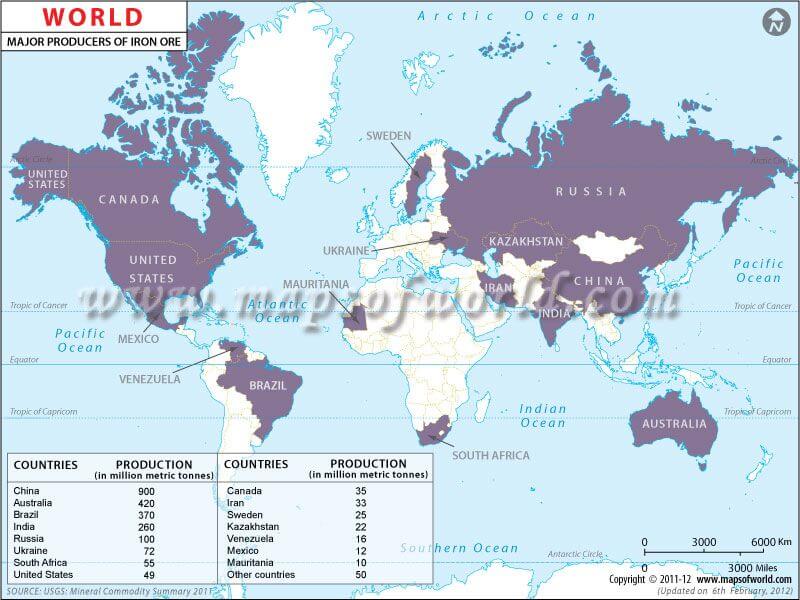
- Iron ore-producing areas are widely distributed in the world. There are about 60 countries in the world, which produce iron ore.
- China, Brazil, Australia, India, Russia, Ukraine, USA, South Africa, Canada, Sweden, etc., are the main producers of iron ore.
- Australia is the world’s largest producer of iron-ore followed by Brazil and China at the second and third position respectively.
- Australia – Pilbara Region, Koolyanobbing, Iron Duke, Iron Knob
- China – Manchuria, Sinkiang, Si-kiang, Shandog Peninsula
- Europe – Ruhr, South Whales, Krivoy Rog, Bilbao, Lorraine
- Africa – Transvaal, Liberia
- South Africa – Postmasburg area, Transvaal
- Russia, Kazakhstan – Ural region [Magnitogorsk, Novotrotsk, Zlaloust, Nizny Taghil, and Seerow], Tula region [Kursk Magnetic], Angara and Krasnoyarsk.
- North America – Great Lakes [Mesabi Region], Labrador
- South America – Carajas, Itabira, Minas Geriais
- Brazil – Minas Gerais Region (Itabiria hills)
Manganese
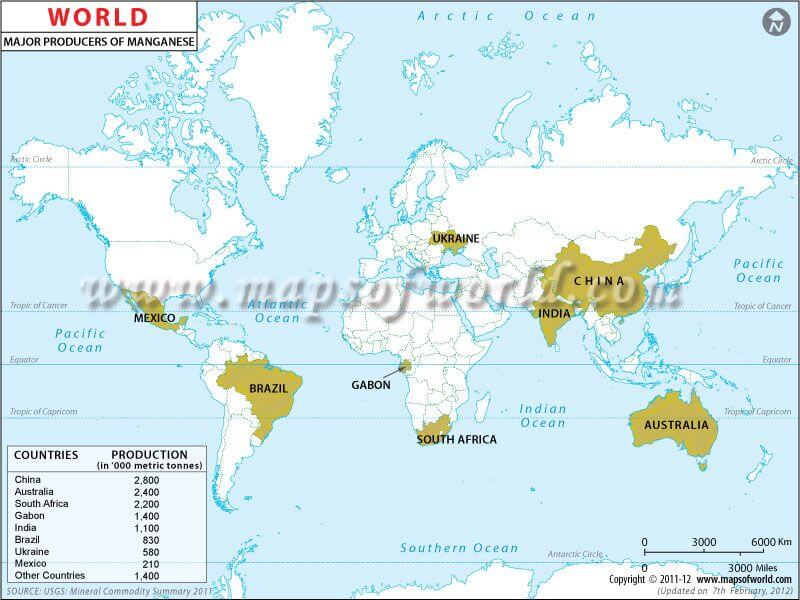
- The main producers of manganese in the world are South Africa, Australia, China, Gabon, Kazakhstan, Brazil, India, Ghana, Ukraine, Georgia, and Mexico.
- China: Kiangsi, Hunan, Kuangsi, Kwangtung, Kuangsi and Kwichou.
- South Africa: Cape Province (Krugersdorp, Postmasburg, Manganore)
- Gabon: Moanda mine
- Brazil: Amapa region
- Australia: Leonara, Victoria, Queensland, and Woodie Woodie.
- India: Odisha, Madhya Pradesh, Chhattisgarh, Maharashtra, Jharkhand(Damodar valley), Andhra Pradesh, and Karnataka.
Copper
- In the Earth s crust, the copper content is about 0.01%. Only in a few copper deposits, the copper content is found at up to 3%-5%. Copper in nature often exists in compounds. The world reserves of copper metal are assessed at 720 million tonnes of copper content.
- Chile has the largest share accounting for about 29.2% of world reserves followed by Australia (12.2%), Peru (11.4%), Mexico (6.4%), USA (4.6%), and China & Russia (4.2% each)
- As per world mine production of copper, Chile was the largest single producer of copper in 2014 with 31.28% share followed by China (8.9%), Peru (7.5%), USA (7.4%), and Australia (5.3%).
- The main producers of copper in the world are Chile, Peru, USA, China, Australia, Indonesia, Russia, Canada, Jambia, Poland, Kazakhstan, and Mexico.
- Chile: Mt. Chuquicamata, El Teniente, El Salvador and La-Africana.
- Peru: Cerro de Pasco, Morococha, Casapalca and Toquepala.
- USA: Arizona, Utah(Bingham Canyon Mine), Montana, Nevada and New Mexico (El Chino Mine) states.
- Canada: Ontario(Sudburry district), Manitoba, Quebec and Saskatchewan.
- Zaire: Katanga region
- South Africa: Transvaal, Cape province.

Aluminium (Bauxite Ore)
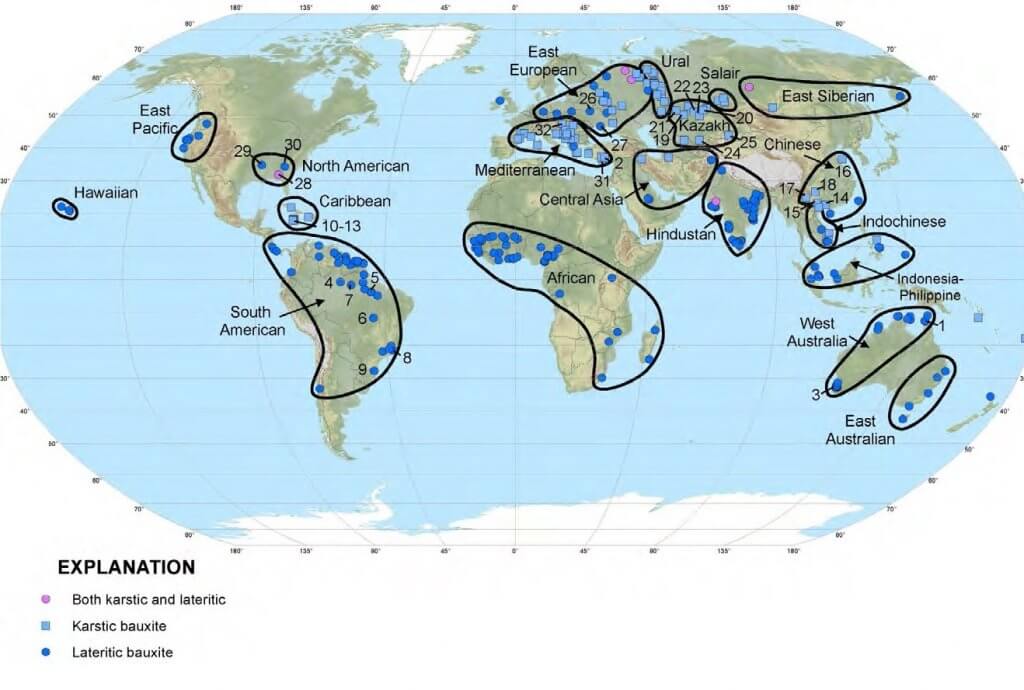
- The world bauxite reserves are estimated at 28 billion tonnes and are located mainly in Guinea (26%), Australia (22%), Brazil (9%), Vietnam (8%), Jamaica (7%), Indonesia (4%), Guyana & China (3% each).
- The important bauxite producers are (their percentage in world’s production is given in bracket): Australia (31.34%), China (18.41%), Brazil (13.93%), Guinea (8.36%), Jamaica (3.98%), Russia (1.64%), Venezuela (2.39%), Surinam (1.99%), Kazakhstan (2.44%), Greece (1.09%), Guyana (0.60%) and Vietnam (0.01%).
- Australia: Cape York Peninsula(Queensland), New South Wales, and Western Australia
- China: Hunan, Guichou and Sichuan
- Brazil: the central region is the main producing area.
- India: Madhya Pradesh, Chhattisgarh, Jharkhand, Odisha, Maharashtra, Andhra Pradesh, Tamil Nadu and Gujarat
- Jamaica: St Elizabeth and St Mary region
- USA: Saline county region of Arkansas state
- Erstwhile USSR: Kola peninsula
- Guinea: Boko and Baruka island
- South Africa: North Natal Province
Gold
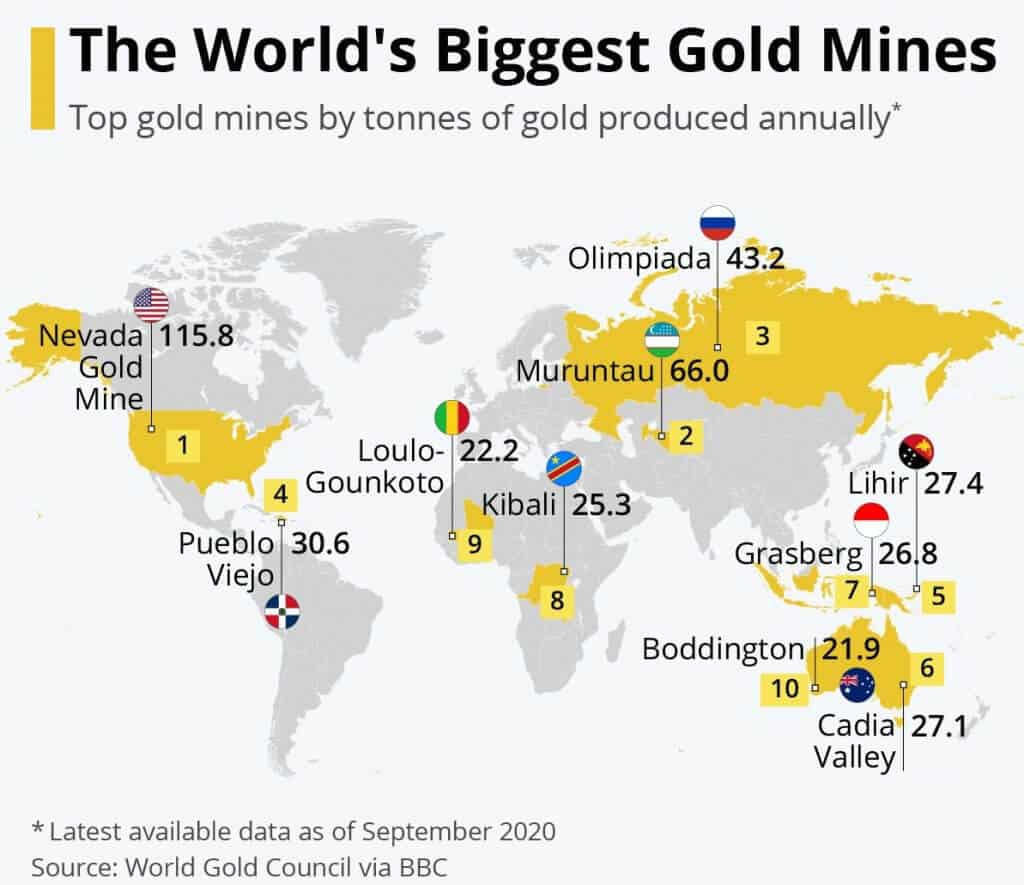
- Until 2006 South Africa was the world’s largest gold producer. In 2007 increasing production from other countries and declining production from South Africa meant that China became the largest producer, although no country has approached the scale of South Africa’s period of peak production during the late 1960s and early 1970s.
- Countries with significant deposits: South Africa, Australia, Indonesia, Canada, Ghana, Chile, China, USA, Russia, etc.
- South Africa: Johannesburg, Boksburg and Orange free state, Kimberley
- USA: Salt lake region and Alaska.
- Australia: Mount Morgan, Kalgoorlie and Coolgardie. (Newcrest’s Cadia Valley mine in New South Wales, Boddington Gold Mine, Fosterville Gold Mine)
- Russia: Polyus Gold’s Olimpiada gold mine in the Krasnoyarsk region of Eastern Siberia, Blagodatnoye gold mine, Kupol gold mine in the Chukotka region of Far East Russia, Natalka gold mine(northern Pacific coast in the Magadan Region), Verninskoye gold mine, Sukhoi Log gold mine.
Silver
- The chief ore minerals of silver are agentite, stephanite, pyrargyrite, and proustite.
- It is found mixed with several other metals such as copper, lead, gold, zinc, etc.
- Used in chemicals, electroplating, photography and for colouring glass, etc.
- 80 % of all silver produced in the world comes as a by-product of Industrial processes and so silver mining is concentrated in only a handful of countries.
- Mexico is the world leader in terms of silver production.
- Major silver producing countries are Mexico, Peru, China, Russia, Chile, Canada, USA, Australia, Bolivia, and South Africa.
- Mexico: Chihuahua, Hildago
- Canada: Ontaria, British Colombia, Quebec
- USA: Utah, Montana, Arizona, Colorado
- Australia: Mt No, Kalgoorlie, Broken bill
- Bolivia: Potosi
- South Africa: Transvaal, and Natal Province

Tin
- The tin-producing areas of the world are limited in certain pockets and very unevenly distributed around the world.
- Nearly 75 percent of the total output comes from China and Malaysia.
- Malaysia: Selangor, Penang Island, Kinta valley, Kelang valley, Jelebu valley
- Indonesia: northern coast of Sumatra including Bangka, Billiton, and Singkil and there are also marine deposits in the Strait of Malacca.
- China: Yunnan, Nanking mountains, Kiangsi and Hunan.
- Peru: San Antonio de Palo is the main tin-producing area in Peru.
- Bolivia: high plateau of Bolivia is the main tin-producing area
- Brazil: Boreborema plateau
- Myanmar: Shan plateau, Kayinni plateau
Lead (Galena)
- Major lead producing countries are China, Australia, Peru, United States, and Russia.
- Australia: Broken bill, Mt. Isa(Queensland)
- Canada: Sudbury
- Peru: Cerro-de-Pasco
Zinc
- Since lead and zinc so often occur together, the major zinc producers are much the same as for lead.
- The main producers of zinc in the world are China, Peru, Australia, USA, Canada, India, Kazakhstan, Ireland, and Mexico.
- China: Yunan Province
- Peru: Cerro de Pasco, Huaras and Ayacacho
- Australia: Broken Hill in western New South Wales, Reed Elsevier, Western Queensland and Captains Flat
- USA: Arizona, Idaho, Colorado, Missouri, Oklahoma, Kansas, New Jersey, Tennesee, Virginia, Illinois and New York
- Canada: British Columbia is the largest mining area not only in Canada but also in the world. Kimberley in British Columbia, Flin-Flon in Manitoba, and Saskatchewan are the main areas of zinc mining.
- India: Rajasthan state is the leading producer of zinc.
Diamond
- The leading producers of natural diamonds are Russia, Botswana, Canada, Australia, South Africa, Russia, and Zaire [Congo].
- Other important producers include Namibia, Ivory Coast, Sierra Leone, Venezuela, Brazil, etc.
- The US is the largest producer of synthetic industrial diamonds
- Russia holds what is believed to be the world’s largest and richest diamond resource.
- Botswana is the leading diamond-producing country in terms of value, and the second largest in terms of volume. The two important ones are Orapa and Jwaneng, two of the most prolific diamond mines in the world.
- Botswana’s resources produce the full range of diamonds, in all sizes, colors, and clarities.
- Democratic Republic of Congo (DRC) is also one of Africa’s largest diamond producers.
- Australia is the leading producer of color diamonds. Australia is famous for its pink, purple and red diamonds.
- South Africa has the most diverse range of diamond deposits in the world. Deposits include open pit and underground kimberlite pipe/dyke/fissure mining.
- South Africa: Kimberley, Johannesburg, Cape town
- Zaire: Catanga plateau
- India: Parma and Golkonda mines
- Angola: Catoca
Nickel
- Uses: Stainless steel (≈ 70% of demand), alloys, batteries (esp. EVs → lithium-nickel batteries).
- World Reserves (USGS 2023): ~95 million tonnes.
- Asia-Pacific
- Indonesia – world’s largest producer (≈ 50% global output, Sulawesi, Halmahera, Papua).
- Philippines – Mindanao, Palawan, Surigao.
- China – Jilin, Gansu, Xinjiang.
- India – small deposits in Odisha (Sukinda Valley), Jharkhand (Jajpur, Singhbhum), Nagaland.
- Australia – Kalgoorlie, Kambalda, Western Australia (2nd largest reserves).
- Russia – Norilsk-Talnakh region (Siberia), Kola Peninsula.
- Canada – Sudbury Basin (Ontario), Manitoba, Labrador.
- Latin America – Brazil (Goias, Piaui), Cuba (Moa Bay, Nicaro).
- Africa – South Africa (Bushveld complex), Madagascar (Ambatovy), Botswana.
Tungsten (Wolfram)
- Uses: Hardest metal, high melting point; used in steel alloys, tools, electronics, defense industry.
- World Reserves (USGS 2023): ~3.7 million tonnes.
- Asia
- China – world’s largest producer (>80%), deposits in Jiangxi, Hunan, Guangdong, Yunnan.
- Russia – Primorsky Krai, Transbaikal, Siberia.
- India – small deposits in Rajasthan (Degana, Sirohi), Andhra Pradesh, Karnataka.
- Europe
- Austria – Mittersill mine.
- Portugal & Spain – Panasqueira (Portugal), Galicia (Spain).
- UK – Hemerdon mine (Devon).
- North America
- USA – Nevada, California, Alaska (minor, not self-sufficient).
- Canada – Yukon and Northwest Territories.
- South America – Bolivia (historically significant), Peru.
Antimony
- Uses: Flame retardants, alloys (lead-acid batteries), semiconductors.
- World Reserves: ~1.8 million tonnes (USGS 2023).
- Asia
- China – dominates reserves & production (>50%), Hunan (Xikuangshan mine = world’s largest).
- Tajikistan – Anzob region.
- Russia – Sakha-Yakutia, Buryatia.
- India – very small occurrences in Andhra Pradesh, Rajasthan, Jharkhand.
- Europe
- Turkey – western Anatolia.
- Slovakia, Bosnia, Spain – minor deposits.
- North America
- USA – historically in Idaho (Stibnite mine). Now largely imports.
- Mexico – small deposits.
- Africa
- South Africa – Murchison Range.
- Algeria – minor.
Mica
- Uses: Electrical insulation, paints, cosmetics, electronics.
- India + Madagascar + China account for majority of production.
- Asia
- India – world’s largest producer & exporter (though illegal mining is an issue).
- Bihar (Gaya, Nawada), Jharkhand (Koderma, Giridih), Andhra Pradesh (Guduru, Nellore), Rajasthan.
- China – major reserves in Inner Mongolia, Xinjiang.
- India – world’s largest producer & exporter (though illegal mining is an issue).
- Africa
- Madagascar – major supplier (Itremo region).
- South Africa, Zimbabwe, Tanzania – smaller reserves.
- North America
- USA – New Mexico, South Dakota, North Carolina.
- Canada – Ontario, Quebec.
- South America
- Brazil – Bahia, Minas Gerais.
- Europe
- Russia – Karelia, Ural region.
- Finland – minor production.
Energy Resources and their Distribution
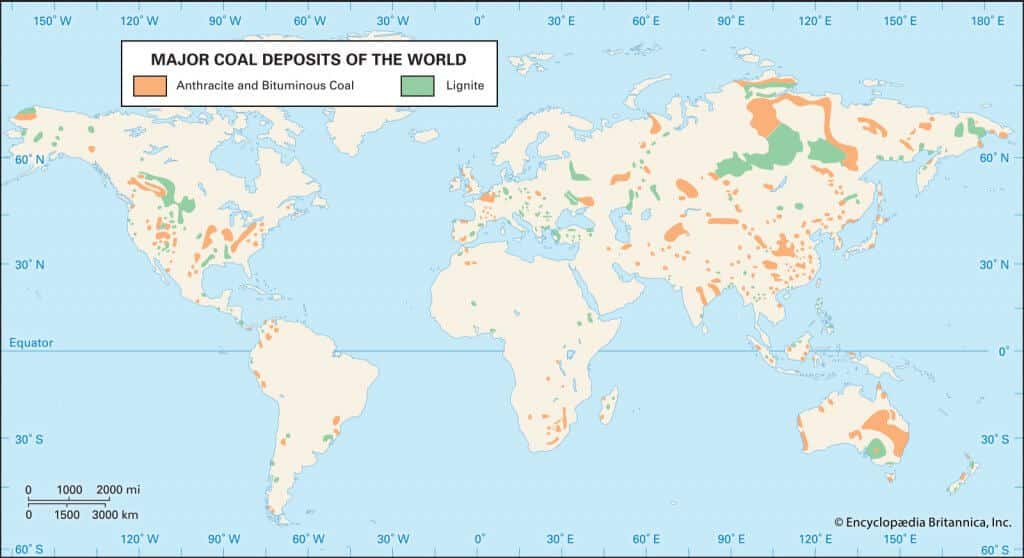
Coal
- Coal is also the cheapest source of power if used near the coal mines. Since it is bulky, its transportation to far-off places involves high costs. For this reason, the industries which consume a large quantity of coal, are located near coal mines.
- Coal is the oldest source of commercial energy and was the backbone of the Industrial Revolution. It is still the second largest source of primary energy (26%) and accounts for 36% of global electricity generation (IEA, 2023).
- Coal is used as a source of power for running machines, trains, ships, etc. Coal is also essential for the manufacture of iron and steel and a variety of chemicals. Coal-tar and chemicals such as ammonia, benzol, etc. are obtained as by-products in the manufacture of iron and steel when coal is burnt to get the coke.
- The coal deposits although exist in nearly every part of the world, but commercially exploitable coal reserves are found mainly in China, USA, India, Australia, Indonesia, Russia, Canada, South Africa, Columbia, Kazakhstan, and Ukraine.
Distribution of Coal
- China – World’s largest producer (~50% global output). Major fields:
- Shanxi, Inner Mongolia, Shaanxi (Shensi), Heilongjiang, Jilin, Liaoning, Henan, Shandong.
- Shanxi alone accounts for nearly 25% of China’s coal.
- USA – 2nd largest reserves. Important fields:
- Appalachian region (West Virginia, Pennsylvania, Kentucky, Alabama),
- Illinois Basin,
- Wyoming (Powder River), Montana, Ohio, Texas, Indiana.
- India – 5th largest reserves, but 2nd largest consumer.
- Major basins: Jharia, Raniganj, Bokaro (Jharkhand–West Bengal), Talcher (Odisha), Singrauli (Madhya Pradesh–UP), Korba (Chhattisgarh), Nagpur–Wardha (Maharashtra), Neyveli (Tamil Nadu – lignite).
- Russia –
- Donetsk basin (Ukraine border), Pechora basin (NW Russia),
- Kuznetsk (Kuzbass, Siberia), Kansk–Achinsk, South Yakutsk, Irkutsk.
- Australia – World’s leading exporter.
- Queensland (Bowen Basin), New South Wales (Hunter Valley, Sydney Basin), Victoria (brown coal in Latrobe Valley).
- Canada –
- Nanaimo, Bowser, Skeena (British Columbia), Maritime provinces, Moose River basin.
- Germany –
- Ruhr basin (North Rhine–Westphalia), Saar Basin, Rhineland, Garzweiler (lignite).
- Ukraine –
- Donbas coalfield → industrial hub.
- South Africa –
- Witbank, Highveld, Transvaal, Natal.
- Kazakhstan –
- Karaganda, Ekibastuz, Maikuben, Turgay.
- Colombia – Largest reserves in South America.
- Guajira peninsula – Cerrejón mine (one of the world’s biggest).
- Other notable fields:
- Poland (Upper Silesia), UK (Yorkshire, Wales), Indonesia (Sumatra, Kalimantan), Mozambique (Tete).
Petroleum
- Oil is the lifeblood of modern industry. It provides fuel (petrol, diesel, kerosene, aviation fuel) and feedstock for petrochemicals, plastics, fertilizers, pharmaceuticals. It accounts for 29% of world’s primary energy.
- Because it is light, valuable, and easily transportable (pipelines, tankers), petroleum has a globalized trade network.
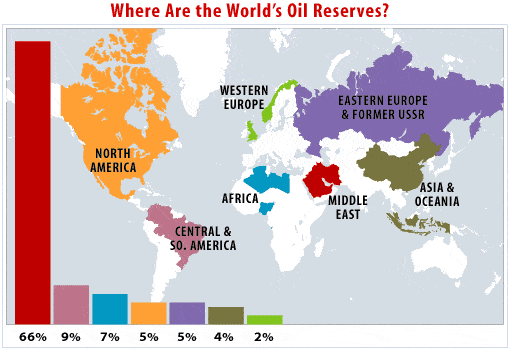
- The Arabian-Iranian sedimentary basin in the Persian Gulf region contains two-thirds of these supergiant fields.
- The remaining supergiants are distributed in the United States, Russia, Mexico, Libya, Algeria, Venezuela, etc.
Distribution of Petroleum
- Middle East – The Oil Crescent
- This region accounts for ~47% of global proven reserves (BP Statistical Review, 2023), making it the richest oil region on Earth.
- Saudi Arabia – Second-largest proven reserves (~17%).
- Major fields: Al-Ghawār (largest onshore field in the world), Safaniyah (largest offshore field, Persian Gulf), Khurais, Shaybah.
- Kuwait – Burgan oilfield, one of the world’s largest onshore fields.
- Iraq – Kirkuk (north), Rumaila and Basra (south).
- Iran – Ahwaz, Abadan, Persian Gulf offshore, shared South Pars–North Dome field with Qatar.
- Qatar – Dukhan onshore, offshore fields in Persian Gulf.
- UAE (Abu Dhabi) – Zakum (Upper Zakum = world’s 2nd largest offshore field).
- Oman & Bahrain – Smaller but significant reserves.
- Syria – Deir ez-Zor basin.
- South America
- Venezuela – Largest proven reserves in the world (~18%).
- Orinoco Belt (heavy crude), Lake Maracaibo.
- Brazil – Offshore Campos and Santos basins (pre-salt reserves).
- Colombia – Magdalena Valley, Guajira.
- Argentina – Neuquén Basin (shale potential – Vaca Muerta).
- Peru, Chile, Ecuador – Moderate reserves.
- Venezuela – Largest proven reserves in the world (~18%).
- North America
- USA – World’s largest oil producer (due to shale revolution).
- Fields: Texas (Permian Basin), Oklahoma, Kansas, California, Louisiana, Alaska (Prudhoe Bay), North Dakota (Bakken), Pennsylvania (historic oilfield).
- Offshore: Gulf of Mexico.
- Canada –
- Alberta (Athabasca Tar Sands) – world’s largest unconventional oil deposits.
- Mexico –
- Historic fields: Tampico and Tuxpan (discovered in 1901).
- New discoveries: Tehuantepec (south), Campeche Sound (Gulf of Mexico).
- USA – World’s largest oil producer (due to shale revolution).
- Africa
- Africa contributes significantly to global oil exports, especially to Europe and Asia.
- North Africa – Libya (Sirte Basin), Algeria (Hassi Messaoud), Egypt (Suez, Western Desert).
- West & Central Africa – Nigeria (Niger Delta), Angola (Cabinda offshore), Gabon.
- East Africa (new frontiers):
- Sudan, South Sudan, Uganda (Albertine Graben), Mozambique offshore gas–oil.
- Caucasian Region (Transcaucasia)
- Azerbaijan – Historic Baku fields (first modern oil boom).
- Georgia & Armenia – Smaller reserves.
- Northern Caucasus (Russia) – Grozny (Chechnya), Maykop (first well in 1863).
- Russia
- Russia is the second-largest oil producer after the USA.
- Volga–Ural Basin (Tatarsk, Bashkira).
- Western Siberia (Ob Basin, Tyumen) → largest production zone.
- Northern Caspian Sea region.
- Far East: Sakhalin offshore fields, Kamchatka.
- Europe
- North Sea oilfields – Shared by UK, Norway, Denmark, Germany, and Netherlands.
- Brent (UK), Ekofisk & Statfjord (Norway) are major fields.
- Romania – Ploiești oilfield (historic).
- Italy – Po Valley (minor).
- North Sea oilfields – Shared by UK, Norway, Denmark, Germany, and Netherlands.
- Asia (outside Middle East)
- China –
- Daqing (Heilongjiang) – discovered 1959, backbone of Chinese oil industry.
- Shengli (Shandong), Tarim Basin (Xinjiang), Bohai Gulf offshore, Changqing Basin (Shaanxi–Gansu).
- Indonesia – Central Sumatra, Java, Kalimantan.
- Myanmar – Irrawaddy and Chindwin valleys.
- Vietnam & Philippines – Offshore reserves in South China Sea.
- Japan – Small reserves in Hokkaido, Honshu.
- India –
- Onshore: Assam (Digboi – Asia’s first refinery, Naharkatia, Moran).
- Offshore: Bombay High (largest), Krishna–Godavari Basin (KG-D6), Cauvery, Cambay.
- Rajasthan (Barmer – Mangala field).
- China –
Natural Gas
- Natural gas is a cleaner fossil fuel (less CO₂ than coal & oil) and contributes ~24% of global primary energy supply (IEA, 2023).
- It is found both associated (with crude oil) and non-associated (independent reservoirs). Liquefied Natural Gas (LNG) has expanded trade across continents.
Distribution of Natural Gas
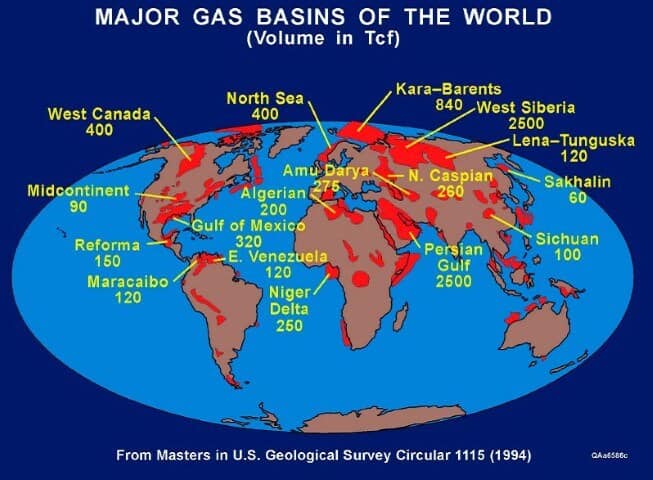
- Middle East (≈ 40% of proven reserves)
- Iran –
- Holds second-largest proven reserves (~17%).
- Fields: South Pars–North Dome (shared with Qatar, world’s largest gas field), Ahwaz, Kish Island.
- Qatar –
- North Dome field (largest in world, shared with Iran).
- Major LNG exporter (Ras Laffan).
- Saudi Arabia –
- Associated gas from Ghawar and offshore fields.
- UAE –
- Reserves in Abu Dhabi (Upper Zakum, Umm Shaif).
- Oman, Kuwait, Bahrain – smaller reserves.
- Iran –
- Russia & CIS Countries (~20% of proven reserves)
- Russia – World’s largest natural gas reserves and top exporter (via pipelines + LNG).
- West Siberian Basin (Yamal Peninsula, Urengoy, Yamburg, Medvezhye) – major producing area.
- Eastern Siberia & Sakhalin Island – emerging fields.
- Pipelines: Nord Stream, Power of Siberia (to China).
- Turkmenistan – Galkynysh field (second-largest in world).
- Kazakhstan – Karachaganak field.
- Uzbekistan – Amu Darya basin.
- Russia – World’s largest natural gas reserves and top exporter (via pipelines + LNG).
- North America (~6–7% reserves, but top producer due to shale gas)
- USA – World’s largest producer (shale revolution).
- Marcellus & Utica Shales (Pennsylvania, Ohio, West Virginia) – largest unconventional fields.
- Other regions: Texas (Permian, Barnett shale), Louisiana (Haynesville), Oklahoma, Alaska (North Slope).
- Canada –
- Alberta (Western Canadian Sedimentary Basin).
- Offshore fields in Newfoundland.
- Shale reserves: Horn River, Montney.
- Mexico –
- Burgos Basin (shale potential).
- Offshore Gulf of Mexico fields.
- USA – World’s largest producer (shale revolution).
- South America
- Venezuela – Maracaibo & Orinoco basin.
- Brazil – Offshore Santos & Campos basins (pre-salt layers).
- Argentina – Neuquén Basin (Vaca Muerta shale gas).
- Bolivia – Tarija region (San Alberto, Margarita fields) → exports to Brazil & Argentina.
- Peru – Camisea field.
- Africa (≈ 7% of reserves, growing exporter)
- Nigeria –
- Niger Delta, Bonny & Brass LNG projects.
- Algeria –
- Hassi R’Mel field (largest in Africa).
- Key LNG exporter to Europe (Sonatrach).
- Egypt –
- Zohr offshore field (Mediterranean).
- Nile Delta reserves.
- Libya – Sirte basin.
- Mozambique – Rovuma Basin offshore → emerging LNG hub.
- Tanzania – Offshore deepwater fields.
- Nigeria –
- Europe
- North Sea Basin – Shared by UK, Norway, Netherlands.
- Norway: Troll, Ormen Lange.
- UK: Southern North Sea gas basin.
- Netherlands – Groningen field (now winding down due to earthquakes).
- Romania & Poland – modest reserves (shale potential).
- Ukraine – Dnieper-Donets basin.
- North Sea Basin – Shared by UK, Norway, Netherlands.
- Asia (Outside Middle East & Russia)
- China –
- Sichuan Basin, Ordos Basin, Tarim Basin (Xinjiang).
- World’s largest shale gas reserves (commercial development in Sichuan).
- India –
- Onshore: Assam, Gujarat (Cambay Basin), Rajasthan.
- Offshore: Krishna-Godavari Basin (KG-D6), Cauvery Basin, Mumbai High.
- New finds: Mahanadi offshore.
- Indonesia – Kalimantan, Sumatra.
- Myanmar – Offshore Shwe gas field (export to China).
- Bangladesh – Sylhet, Titas, Habiganj.
- Pakistan – Sui gas field (Baluchistan, discovered 1952).
- Japan – Small reserves in Niigata & Hokkaido.
- China –
Uranium
- Uranium is a strategic mineral used primarily for nuclear power generation and also in defence (nuclear weapons, naval reactors).
- Major isotopes: U-238 (99.3%) and U-235 (0.7%) → fissile isotope used in reactors.
- World’s recoverable uranium resources (2023, IAEA & NEA Red Book): ~6.1 million tonnes.
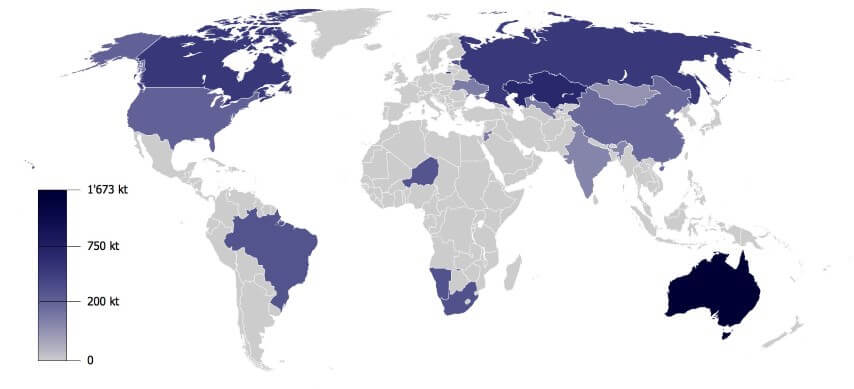
- Top producers (2022): Kazakhstan (~43%), Canada (~15%), Namibia (~11%), Australia (~9%).
- Top holders of reserves: Australia (~28%), Kazakhstan, Canada, Russia, Namibia, South Africa.
Distribution of Uranium
- Australia (≈ 28% of global reserves)
- Largest proven reserves (~1.7 million tonnes).
- Major fields:
- Olympic Dam (South Australia) – world’s largest uranium deposit (also copper & gold).
- Ranger mine (Northern Territory) – one of the richest grade deposits (closed 2021).
- Beverley, Honeymoon, Four Mile (South Australia) – In-situ leach mines.
- Exports primarily to Europe, Japan, China, India.
- Kazakhstan (≈ 13% reserves, top producer)
- World’s largest producer of uranium (ISL technology).
- Major mines:
- Inkai, South Inkai, Central Mynkuduk, Akdala, Tortkuduk (all in-step leach mines in Kazakh steppe).
- Production controlled by Kazatomprom (state company) + joint ventures with Russia, China, France.
- Canada (≈ 9% reserves, high-grade ores)
- Produces ~15% of global uranium.
- Athabasca Basin (Saskatchewan) – richest uranium ores in the world (up to 20% U₃O₈ content).
- Mines: McArthur River, Cigar Lake, Key Lake, Rabbit Lake.
- Ontario – Elliot Lake deposits (mostly depleted).
- Exports mainly to USA & Europe.
- Africa (≈ 15% reserves)
- Namibia –
- Rossing mine (oldest open-pit uranium mine).
- Husab mine (largest uranium mine in Africa).
- Langer Heinrich.
- Niger –
- Arlit, Akouta mines (French Orano/Areva).
- Key supplier to France’s nuclear power.
- South Africa –
- Uranium recovered as by-product of gold mining (Witwatersrand).
- Malawi – Kayelekera mine.
- Namibia –
- Russia & Central Asia
- Russia –
- Streltsovsk deposits (Transbaikal region).
- Dalmatovo (Kurgan region).
- Elkon deposit (Yakutia, huge reserves but undeveloped).
- Uzbekistan – Navoi, Uchkuduk mines.
- Mongolia – Dornod deposit (with Russia).
- Russia –
- Europe
- Ukraine – Zheltye Vody mine (Dnieper region).
- Czech Republic – Rozna mine (closed in 2017).
- France, Germany, UK – past producers, now dependent on imports.
- Romania – Banat & Transylvania regions.
- United States (≈ 1% reserves, declining producer)
- Once world’s largest producer (1950s–70s).
- Deposits in:
- Colorado Plateau (Utah, Colorado, Arizona, New Mexico).
- Wyoming Powder River Basin.
- Texas (in-situ recovery).
- Many mines shut due to cheap imports; revival possible with strategic stockpiling.
- South America
- Brazil – Poços de Caldas, Itataia (significant reserves).
- Argentina – Sierra Pintada, Cerro Solo deposits.
- Asia (Outside Kazakhstan)
- India – modest reserves (~2% of global).
- Singhbhum Shear Zone (Jaduguda, Narwapahar, Turamdih in Jharkhand).
- Tummalapalle (Andhra Pradesh, large but low-grade).
- Domiasiat & Wahkyn (Meghalaya).
- New finds: Rajasthan (Udaipur), Karnataka.
- China –
- Xinjiang, Jiangxi, Guangdong, Liaoning provinces.
- Expanding domestic production but also major importer.
- Pakistan – Dera Ghazi Khan deposits.
- Iran – Saghand mine, Yazd province.
- India – modest reserves (~2% of global).
Thorium
- Thorium (Th-232) is a radioactive metal, about 3–4 times more abundant than Uranium in the earth’s crust.
- Unlike Uranium-235, thorium is not fissile but fertile → it absorbs neutrons to form fissile U-233, which can be used in nuclear reactors.
- Major source: Monazite sands (phosphate mineral) found in coastal regions.
- Commercially viable deposits of Monazite can be found mainly in the beach sands in the coastal tracts of India, Brazil, Australia, Ceylon, and Malaysia.
- Estimated world reserves: ~6.5–7 million tonnes (IAEA & OECD/NEA, 2022).
- India has one of the largest reserves (~25% of global), but globally thorium is underutilized due to technology constraints.
Distribution of Thorium
- India (≈ 25% of world reserves)
- India is the largest holder of monazite sand deposits.
- Major regions:
- Kerala (Chavara, Quilon, Aluva beaches) – richest deposits.
- Tamil Nadu (Manavalakurichi, Tuticorin, Kanyakumari).
- Odisha (Chhatrapur-Gopalpur beach sands).
- Andhra Pradesh (Bhimunipatnam, Srikakulam).
- Maharashtra (Ratnagiri coast).
- Inland deposits: Jharkhand (Singhbhum), Madhya Pradesh.
- India’s Nuclear Policy – Thorium is central to the 3-stage nuclear programme:
- Stage I: Pressurised Heavy Water Reactors (PHWRs) using natural uranium.
- Stage II: Fast Breeder Reactors (FBRs) producing plutonium.
- Stage III: Thorium-based reactors (Advanced Heavy Water Reactors, AHWRs).
- Australia
- Holds ~19% of global thorium reserves.
- Rich monazite sands along the coastal belts of Western and South Australia.
- Deposits also found in Queensland and New South Wales.
- United States
- Reserves mainly in Idaho, Montana, Colorado, and Wyoming.
- Monazite sands in North & South Carolina, Florida.
- Historically explored but less utilized due to abundance of cheap uranium.
- Brazil
- Third-largest reserves (after India & Australia).
- Deposits in Minas Gerais, Espirito Santo, Bahia.
- Coastal monazite placer deposits significant.
- Other Asia-Pacific Nations
- China – Sichuan, Jiangxi provinces (associated with rare earth minerals).
- Myanmar, Sri Lanka, Thailand, Malaysia – monazite-bearing placer sands.
- Indonesia – Bangka-Belitung islands.
- Africa
- South Africa – Cape Coast sands.
- Madagascar – monazite placers.
- Egypt – Nile Delta sands contain monazite.
- Europe
- Norway – Arendal region (first thorium discovered in 1828).
- Turkey – Eskişehir region.
- Finland & Sweden – minor deposits associated with rare earth elements.
- Russia & Central Asia
- Deposits in Kola Peninsula, Ural Mountains, Siberia.
- Kazakhstan has potential resources associated with uranium ores.

Hydro-Power
- Canada:
- Canada is the highest producer of hydro-power.
- The major generating areas are the Great Lake Region, Niagara Falls, British Columbia region.
- Some of the noted hydroelectric projects in Canada are Marie Rapid Project in Great Lake, Kitimal project in British Columbia, and Prescott, Kingston in St. Lawrence Valley.
- USA:
- The U.S.A. is the second-largest producer of hydro-power.
- Appalachian Region – Tennessee Valley Project is an integrated large project producing huge amount of hydro-power.
- North-West Region – Mountainous, rugged terrain and huge water volume of Columbia and Snake rivers provided ideal condition for hydro-power generation.
- South-West Region – Colorado River provided excellent favourable conditions for water power development.
- Niagara – It is the largest hydropower project in the world, jointly developed by U.S.A. and Canada. The Niagara River flows from Lake Erie to Lake Ontario and the Niagara Falls and the hydro-electric project forms part of the boundary between the U.S.A. and Canada.
- Europe:
- The percentage contribution of hydro-power to total electricity production in few countries are Norway, Switzerland, Sweden.
- The other notable producing countries are France, Germany and Italy.
- Africa:
- Africa has immense potential in hydro-power generation. Due to an underdeveloped economy and lack of technology and industrialization, much of it is yet to be tapped.
- Some of the important hydel power projects are Kariba Dam on Zambesi, Owen project in Uganda, Aswan Dam in Egypt, Sennar Dam in Sudan, Kafui Dam in Zambia etc.
- Oceania:
- Australia is a leading hydro-power generating country. Most of its hydel projects are located in New South Wales and Victoria.
- Asia:
- China, India, Japan, Indonesia, N. and S. Korea.
- China:
- Three Gorges Hydro-electric Project on Chang Jiang (Yangtze) river
- Most of the hydro-power projects in China are located on the Yangtze Kiang, Sikiang and Hwang Ho rivers.
- Few important projects are San-men, Liu-chia etc.
- India:
- As far as the potential of hydro-power is concerned, North-Eastern states secure the first position, followed by Gangetic and Indus valley, South Indian Rivers and Central Indian Rivers.
- Damodar Valley Project — Bihar & W. Bengal
- Bhakra-Nangal Project — Punjab.
- Hirakud Project — Orissa
- Chambal Project — M.P.
- Ukai Project — Gujarat
- Ramganga Project — U.P.
- Parambikulam — Aliyar — Tamil Nadu.
- Tunga-Bhadra Project — Karnataka & A.P.
- Nagarjuna Sagar Project — Telangana & Andhra Pradesh
- Mettur Project — Tamil Nadu
- Idukki Project — Kerala
- Bhibpuri and Khopli Project — Maharashtra.
Nuclear Energy
- Nuclear energy is derived from the fission of Uranium-235, Plutonium-239 or the breeding of Thorium-232 into fissile U-233.
- It is considered a low-carbon energy source and has gained importance in the context of climate change and global energy security.
- According to IAEA (2023):
- Nuclear power provides ~10% of global electricity and ~25% of low-carbon electricity.
- As of 2023 → 32 countries operate nuclear reactors, with 440 operational reactors and ~60 under construction.
- The distribution of nuclear energy capacity is highly uneven, concentrated in technologically advanced countries.
Global Distribution of Nuclear Energy
- North America
- USA
- Largest producer of nuclear power (~30% of global nuclear electricity).
- ~93 reactors (Illinois, Pennsylvania, South Carolina, Alabama major states).
- Key companies: Westinghouse, Exelon.
- Canada
- Uses indigenous CANDU reactors (heavy water).
- Ontario, Quebec → ~15% of Canada’s electricity from nuclear.
- USA
- Europe
- France
- World’s highest nuclear dependency: ~70% of its electricity from nuclear.
- Key plants: Gravelines, Cattenom, Paluel.
- Russia
- ~36 reactors, major in Kursk, Novovoronezh, Leningrad regions.
- Exporting nuclear tech through Rosatom (to Turkey, Bangladesh, India).
- Ukraine
- Historically important (Chernobyl disaster, 1986). Still operates 15 reactors (Zaporizhzhia, Europe’s largest).
- United Kingdom
- Nuclear contributes ~15% of power. Hinkley Point C is under construction.
- Germany
- Once nuclear-dependent, but after Fukushima disaster (2011) → pursued “Energiewende” policy → phased out all reactors by 2023.
- Other Europe
- Sweden, Finland, Czech Republic, Slovakia, Hungary all maintain nuclear fleets.
- France
- Asia
- China
- Fastest-growing nuclear program.
- ~55 reactors operating; ~22 under construction.
- Key provinces: Guangdong, Fujian, Zhejiang, Liaoning.
- Japan
- Heavy reliance pre-2011 (Fukushima). All reactors shut down post-disaster; gradual restart since 2015. Nuclear share still <10%.
- India
- ~23 reactors operational, 7 under construction.
- Sites: Tarapur (Maharashtra), Kalpakkam (TN), Kaiga (Karnataka), Rawatbhata (Rajasthan), Narora (UP), Kakrapar (Gujarat).
- Three-Stage Nuclear Program (Bhabha strategy):
- Natural uranium reactors (PHWRs).
- Fast breeder reactors.
- Thorium-based reactors.
- India holds ~25% of world’s Thorium reserves (Kerala, Odisha, Tamil Nadu coasts).
- South Korea – ~24 reactors, nuclear share ~30%.
- Pakistan – Chinese-assisted reactors at Chashma, Karachi.
- Iran – Bushehr reactor operational, linked with geopolitical tensions.
- China
- South America
- Brazil – Angra I, II reactors.
- Argentina – Atucha, Embalse reactors.
- Limited expansion due to economic constraints.
- Africa
- South Africa – Only African country with operational reactors (Koeberg near Cape Town).
- Others (Egypt, Nigeria) have future projects with Russian/Chinese support.
Renewable Energy
- Renewable energy refers to energy derived from natural sources that are replenished constantly, such as solar, wind, hydro, biomass, geothermal, tidal, and ocean energy.
- According to IRENA (International Renewable Energy Agency, 2023):
- Global renewable energy capacity: 3,372 GW (≈40% of global installed power capacity).
- Hydropower: ~1,250 GW (~37% of renewables).
- Solar power: fastest growing – ~1,000 GW.
- Wind power: ~900 GW.
- Renewables accounted for 83% of all new power capacity additions in 2022.
- Renewables are central to meeting SDG-7 (Affordable & Clean Energy) and Paris Climate Agreement goals.
Solar Energy
- Best potential in tropical & subtropical regions (high insolation, cloud-free).
- Major Countries:
- China – World leader (>350 GW capacity, Gobi Desert solar parks).
- USA – California, Nevada, Arizona deserts.
- India – ~70 GW installed (2023), National Solar Mission; Bhadla Solar Park (Rajasthan, 2.25 GW, world’s largest).
- Germany – Early pioneer, though less insolation.
- Middle East & North Africa (MENA) – Saudi Arabia, UAE, Morocco (Noor Ouarzazate Solar Complex).
Wind Energy
- Favours mid-latitude temperate coasts and tropical trade-wind belts.
- Global leaders:
- China – ~365 GW (Gansu Wind Farm, largest on Earth).
- USA – ~145 GW; Texas & Midwest “wind corridor”.
- Germany – ~65 GW, mainly North Sea & Baltic coast.
- India – ~44 GW, Tamil Nadu (Muppandal), Gujarat, Maharashtra.
- Brazil – Leading in South America, esp. coastal NE region.
- Offshore wind: UK, Denmark, Netherlands pioneers.
Hydropower
- Largest renewable source globally.
- Major Regions:
- China – >400 GW, Three Gorges Dam (22.5 GW, world’s largest).
- Brazil – Amazon Basin (Itaipu Dam, 14 GW, shared with Paraguay).
- Canada – Quebec, British Columbia (Manicouagan, Churchill Falls).
- USA – Grand Coulee, Hoover Dam.
- Norway – ~95% of electricity from hydro.
- India – ~52 GW installed; Bhakra-Nangal, Tehri, Sardar Sarovar.
- Africa – Congo Basin (Inga Dam potential ~40 GW).
Biomass & Bioenergy
- Traditional in developing countries, modern bioenergy rising globally.
- Regions:
- Brazil – Sugarcane-based ethanol industry (largest producer with USA).
- USA – Corn-based ethanol, biodiesel.
- India – National Bio-Energy Mission; bagasse, rice husk, gobar gas.
- EU – Germany, France: biogas and biomass-based district heating.
Geothermal Energy
- Derived from geothermal hotspots (tectonically active regions).
- Global leaders:
- USA – California (The Geysers, ~1.5 GW).
- Iceland – >25% of electricity from geothermal; Reykjavik heating.
- Philippines – Leyte, Mindanao.
- Indonesia – Sumatra, Java (Ring of Fire).
- New Zealand – Taupo volcanic zone.
- Italy – Larderello field (historic, since 1911).
- Kenya – Olkaria geothermal plant (leading in Africa).
Tidal and Wave Energy 🌊
- Still experimental but high potential.
- Key locations:
- France – La Rance tidal plant.
- UK – Severn Estuary project.
- South Korea – Sihwa Lake Tidal Plant (254 MW, world’s largest).
- India – Gulf of Kachchh, Gulf of Khambhat, Sundarbans (pilot projects).
- Canada – Bay of Fundy, with world’s highest tidal range.


Sir, please start an answer writing program over here! for geography optional.
Thanx alot for these notes and my request is can you provide us all of the notes and link in a single pdf form
Yeah Sure, but in the future. For now, Please make your own short notes.
Thanks
Geography as a subject is very scattered so thank you for providing such consolidated notes
Keep Reading
Nagarjuna Sagar Project in Andhra Pradesh correction
All important resources at one place. Exactly the way I wanted. Thank you so much.
Legendary notes
Wonderful notes.
PYQ ADD KARO SIRJI
You should also add up some crucial points such as largest exporter or importer of natural resources
FIRST TIME VISITED THIS WEBSITE AND GOT AMAZING PRECISE AND WELL DEFINED MATERIAL,……..THANK YOU