The roots of planning in India can be traced to the National Planning Committee of the Indian National Congress, set up under the leadership of Subhash Chandra Bose as President of INC, with Jawaharlal Nehru as its Chairman, and with the blessings of Mahatma Gandhi. This committee, formed in 1938, laid the intellectual and institutional foundation for post-independence planned development.
1938 (Pre-Indep): National Planning Committee (INC) — Under S.C. Bose & J.L. Nehru
First organized effort at economic planning in India. Subcommittees on agriculture, industry, transport, finance. Established that independent India would require planned development to overcome colonial legacy of underdevelopment and regional imbalance.
1944 (Pre-Indep): Bombay Plan — Tata-Birla Plan
Leading industrialists — Tata, Birla, Dalal, Shroff — proposed a 15-year economic plan envisioning ₹10,000 crore investment over 15 years. Combined private enterprise with state planning. Emphasized industrialization and infrastructure. Showed that regional development thinking pre-dated independence.
1948 (Post-Indep): DVC — India’s First Multipurpose River Valley Project
Damodar Valley Corporation (DVC) established on 7 July 1948 — India’s first post-independence multipurpose river project, modelled on Tennessee Valley Authority (TVA). W.L. Voorduin (TVA’s senior engineer) designed the plan. First real regional planning project in independent India — integrated flood control, irrigation, power generation across West Bengal and Bihar.
1950 (Planning): Planning Commission Established — March 1950
Planning Commission set up by Government of India Resolution to promote rapid economic growth, efficient exploitation of resources, and increasing business and employment opportunities. Jawaharlal Nehru as Chairman. P.C. Mahalanobis as Statistical Adviser. First Five Year Plan launched 1951.
Planning Commission — India’s Regional Development Architect
Role of Planning Commission
The Planning Commission, formed during the 1950s, played an important role in reducing regional disparities both at the micro and macro level. The effort of the Planning Commission was also to bridge the functional and spatial gap between underdeveloped and developed regions. With the help of the National Development Council (NDC), it provided participation of every state — also helpful in resolving issues related to natural resources, sharing of water, and inter-state disputes.
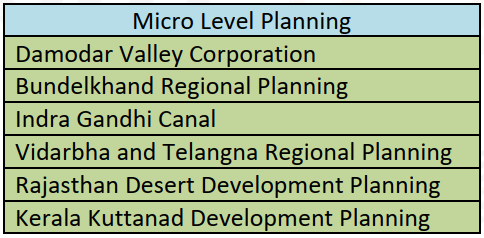
The planning process initiated after Independence resulted in the construction of multipurpose projects for macro-level regions — progressing to recent advanced packages for specific problem regions like Bundelkhand and Kuttanad. Planning at the micro level included regional projects for the development of underdeveloped regions.
Macro-Level vs. Micro-Level Regional Planning
🏗️ Macro-Level Planning
Multipurpose river valley projects (DVC, Bhakra-Nangal, Hirakud, Rihand), regional infrastructure, industrial clusters, national highways, inter-state power grids. Covered large multi-district or multi-state regions as integrated planning units.
🏘️ Micro-Level Planning
Projects specific to particular problem areas: Jhabua District Watershed Development Programme; Special Category State status for backward states; Bharat Mala Project (connectivity); Sagar Mala Project (port-led development); Bundelkhand Special Package; Kuttanad Development Package (Kerala’s below-sea-level agricultural region).
Planning Commission → NITI Aayog (2015)
Feature
Planning Commission (1950-2014)
NITI Aayog (2015-present)
Role
Directive — allocated resources, formulated FYPs, approved state plans
Area programmes (DPAP, DDP, TSP), Special Category Status
Aspirational Districts Programme, PM-DevINE, competitive state rankings
Inter-state disputes
NDC as coordination platform
Governing Council with CMs; inter-ministerial coordination
The TVA Model — Global First in Regional Planning
Tennessee Valley Authority (TVA, 1933) — World’s First Large Regional Planning Agency
The first time regional-level planning was used by any country was by the USA in Tennessee River Valley Planning (TVA, 1933).
Created by Congress as part of President Roosevelt’s New Deal, TVA was the first large regional planning agency of the US federal government — and remains the largest.
It was simultaneously a power supplier and a regional economic development agency to modernise one of America’s most impoverished regions devastated by the Great Depression.
TVA’s Functions
Flood control — taming the Tennessee River’s devastating annual floods
Soil conservation — addressing severe soil erosion across the Appalachian catchment
Providing electricity — universal electrification of the least electrified region of the USA at cheapest rates
Industrial development — attracting manufacturing industries with cheap power and flood-protected sites
Forest and wildlife conservation — afforestation of degraded hillsides
Town planning — planned townships for relocated communities
Construction of roads and rails — transport connectivity to isolated valley communities
Agriculture practice — demonstration farms, HYV seeds, fertilizer production
TVA’s Global Legacy — Three River Valley Projects
🇺🇸 TVA — Tennessee, USA (1933)
7 major dams on Tennessee River
40,000 MW power generation capacity today
Reduced the region’s poverty dramatically
Model for global river valley planning
President Truman (1948): “What we have done in the Tennessee Valley, we can do elsewhere”
🇮🇳 DVC — Damodar Valley, India (1948)
India’s first multipurpose river project — directly modelled on TVA
TVA engineer W.L. Voorduin designed DVC plan (1944)
Became template for Bhakra-Nangal, Hirakud, Rihand
TVA’s Inspiration Beyond India: TVA inspired river valley development globally — Volta River Project, Ghana (1966); Cauca River Valley, Colombia; Papaloapan Basin, Mexico; Khuzistan region, Iran. However, TVA’s later critics noted it narrowed to power generation over time, with regional development receiving less attention — a pattern mirrored by DVC in India. The promise of comprehensive regional development was often reduced to power sector infrastructure in practice.
The Damodar River was historically called the “Sorrow of Bengal” — its devastating floods (the 1943 flood galvanized action) disrupted agriculture, spread disease, and destroyed property across Bengal and Bihar annually. The 1944 Damodar Flood Enquiry Committee explicitly recommended creating an authority similar to TVA. DVC (1948) was India’s engineering response to centuries of flood devastation — transforming a river of sorrow into a regional development anchor. The irony is that DVC’s narrowing to power generation over time, and the displacement of thousands without adequate rehabilitation, echoed TVA’s own limitations.
Objectives of Five Year Plans for Regional Development
All Five Year Plans, despite their individual thematic focuses, shared a set of common regional development objectives:
To increase national income and standard of living — reducing the absolute and relative gaps between regions in per capita income and consumption.
To increase the level of industrialization — both of heavy and basic sectors — extending manufacturing beyond the existing developed coastal and metropolitan regions.
To increase the employment potential of various sectors — especially in backward regions where disguised unemployment in agriculture dominates.
To decrease both horizontal (region-specific, e.g., BIMARU states) and vertical (Centre-State-Panchayat level) inequalities — spatial and institutional.
To launch schemes for self-reliance — decreasing foreign aid dependence across all regions, making India’s economy self-sustaining at the national and regional level.
The Horizontal-Vertical Inequality Distinction:Horizontal inequality refers to inter-regional disparity — the income gap between advanced states (Maharashtra, Karnataka) and backward states (Bihar, Jharkhand). Vertical inequality refers to the institutional hierarchy — when Centre allocates more resources to itself and less to states; when states allocate more to themselves and less to Panchayats; when the 3Fs (Functions, Functionaries, Finance) are not devolved. Both dimensions of inequality must be addressed simultaneously for effective regional development.
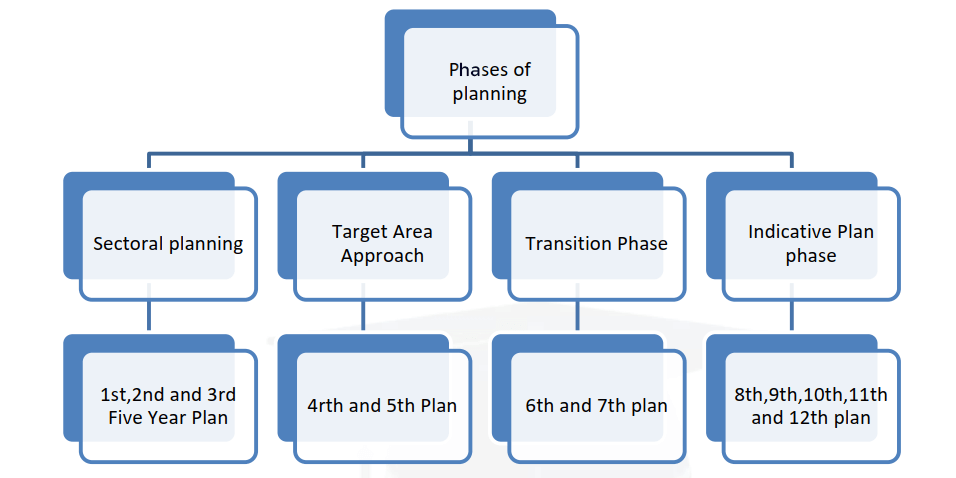
First Five Year Plan (1951–1956)
Balanced Development Plan 1951 – 1956
Model: Nurse-Rosenstein (Harrod-Domar based) — Equal weightage to all sectors + social overhead capital
Balanced Development Plan: Based on Nurkse-Rosenstein-Rodan’s “Big Push” model — equal weightage to all sectors including “social overhead capital” (health, education). Not widely popular in India as a resource-scarce country, but ensured increase in income and overall improvement in living standards.
Agriculture as prime goal: India faced acute post-independence challenges — resettlement of migrants from Pakistan, food shortage, large-scale food grain imports, high inflation. Regional Development Strategies identified agriculture as prime goal.
Multipurpose Projects launched: Bhakra-Nangal Dam (Punjab), Hirakud Dam (Odisha), Rihand Dam (UP), Damodar Valley Corporation — providing irrigation, flood control, energy, aquaculture.
Division into 5 broad regions: All states divided into 5 broad divisions — considered India’s first step toward formal regional planning. Problem areas like Damodar Valley were recognized; importance of resource planning at regional level acknowledged.
Recognizing regional planning: Research committees formed to study regional problems; Planning Commission acknowledged the need for spatial equity in development investment.
Outcome: India achieved GNP growth of 3.6% against target of 2.1%. Food production increased. Basic infrastructure laid. But persistent regional disparities were not addressed — the plan was too focused on macro-level aggregate growth.
Challenges at the Start
Since the First Five Year Plan, just after independence, India faced problems like resettlement of migrants from Pakistan, acute shortage of food, large-scale imports of food grains (under PL-480 from USA), and high inflation. Due to these factors, regional development planning shifted its focus toward the agriculture sector — making the plan more reactive than proactively spatial in character.
Second Five Year Plan (1956–1961)
Mahalanobis / Rapid Industrialisation Plan
Model: Nehru-Mahalanobis — Capital-intensive heavy industries; Growth Pole / Trickle-Down Strategy
Objectives: 25% increase in national income; large-scale industrialisation; expansion of employment; reducing inequalities in income.
Mahalanobis model: Designed by statistician P.C. Mahalanobis — focused on optimal allocation of investment between productive sectors to maximise long-run economic growth; assumed closed economy; capital goods-intensive approach.
Growth pole strategy: On the line of France’s industrial cluster model, growth of industrial clusters in Bhilai, Durgapur, and Rourkela were developed for infrastructure development and enhancement of investment through forward and backward integration — classic Growth Pole Theory application.
Outcomes: Development of basic and heavy industries — iron and steel, chemical fertilizers, heavy engineering, mechanical and building industries. Control of inflation to some extent. Rate of investment jumped to 11% (1961) from 7% (1955).
Regional failures: Agriculture was neglected and regional disparities increased. The growth pole strategy worked for industrial townships but spread effects did not reach rural hinterlands. Development aimed at establishing socialist pattern of society.
Industrial Policy 1956: Based on establishment of socialist pattern of society — public sector reserved key industries; private sector regulated through licensing.
Forward and Backward Integration in Steel Towns
Forward linkages from the steel plants: Steel output → automobile manufacture, construction, machinery, railways, consumer durables. Backward linkages to the steel plants: Iron ore mines, coal mines, limestone quarries, power plants, water supply infrastructure, skilled labour training institutions. The plan assumed these linkages would generate the regional multiplier. In practice: steel plant management was dominated by engineers and managers from distant regions; local tribal populations received primarily unskilled construction and maintenance jobs; cultural friction between incoming industrial culture and indigenous forest-based communities created social breakdown.
Third Five Year Plan (1961–1966)
Self-Reliant, Self-Generating Economy
1961 – 1966: First separate chapter on regional balance; Growth Centres & Growth Points introduced
Objectives: National income growth >5%; self-sufficiency in food grains; industrial base expansion; utilise manpower resources; decrease regional disparities.
Take-off stage: First and Second FYPs had generated required infrastructure — Indian economy entered the “take-off stage” at beginning of Third FYP. Plan aimed at securing self-reliance, self-generating and self-sustained growth.
First time — Regional Balance Chapter: For the first time, the Third Five Year Plan had a separate chapter on regional balance, both inter-state and intra-state, with emphasis on Growth Centres and Growth Points for elimination of intra-state disparities. This was a landmark moment — regional equity became an explicit planning objective for the first time.
Industrial identification: Basic industries identified for backward regions — cement plants at Satana and Katni (MP); fertilizer plants at Sindri (Jharkhand) and Vidhisha (MP); paper mills at Balrampur (Maharashtra); refineries, petrochemicals, synthetic fibres.
External shock: Focus shifted from development to defence due to Chinese invasion (1962) and Indo-Pak War (1965) — derailing regional planning priorities in the plan’s later years.
Outcome (Actual vs. Target): Target 5.6% growth; actual 2.8% — poor performance due to 1962 and 1965 wars, severe drought 1965-66.
Annual Plans / Plan Holiday (1966–1969)
The period 1966-1969 is also known as the Plan Holiday. Annual Plans were framed due to:
Indo-Pak conflict of 1965;
Two successive years of severe drought (1965-66, 1966-67);
Devaluation of currency;
General rise in prices;
Erosion of resources for plan purposes;
Shortage of food grains leading to import dependence on the USA under the PL-480 programme (“Ship to Mouth” dependency on American food aid).
PL-480 (Public Law 480): US Food for Peace programme — India imported massive quantities of American wheat under this programme, creating import dependency and public humiliation that galvanized the political will for agricultural self-sufficiency
Agricultural transformation: A new agricultural strategy was implemented involving the distribution of high-yielding variety (HYV) seeds, extensive use of fertilizers, exploitation of irrigation potential, and soil conservation measures — the precursor to the Green Revolution
Devaluation impact: Rupee devalued by 57.5% in 1966 to boost exports — but caused inflation and instability that undermined plan resource generation
Regional impact: The plan holiday further widened regional disparities as crisis-response management replaced strategic spatial planning. Food shortage response concentrated on wheat-growing regions (Punjab, Haryana, Western UP) — planting the seeds of the Green Revolution’s regionally unequal outcomes
Fourth Five Year Plan (1969–1974)
Growth with Stability & Self-Reliance
1969 – 1974: Watershed year for regional planning — first area-specific programmes; SFDA; REC
Watershed year in regional planning: Fourth Five Year Plan was a watershed year for regional development planning in India — first time special area-specific programmes were systematically launched.
DPAP launched:Drought Prone Area Programme (DPAP) — targeting 70+ chronically drought-prone districts for watershed treatment, soil conservation, water harvesting, and alternative livelihoods.
SFDA established:Small Farmer Development Agency (SFDA) — providing credit, technology, and marketing support to small and marginal farmers excluded from Green Revolution benefits.
Backward area focus: Emphasis on Bundelkhand (MP/UP) and Dandakaranya (Chhattisgarh/Odisha) development with overall purpose of self-sustaining growth.
Pilot rural employment: Pilot initiative for rural employment programme — technical and financial programme — addressing rural labour market failures in backward regions.
Economic concentration: Provisions to decrease economic concentration of wealth and promote equality — bank nationalisation (1969), FERA, MRTP Act to check monopolistic growth.
Fifth Five Year Plan (1974–1979)
Special Area Approach — Self-Reliance & Poverty Elimination
1974 – 1979: Most significant for regional planning — CADP, HADP, Tribal Area, resource + problem oriented programmes
Special Area Approach: Fifth FYP adopted the special area approach with overall emphasis on self-reliance and poverty elimination by tackling regional disparity. The most comprehensive spatial planning effort in India’s FYP history.
Three categories of area programmes: (a) Resource and problem-oriented: CADP, HADP; (b) Target group-oriented: Tribal Area Development Programme; (c) Incentive-based: Subsidies to farmers, tax concessions for backward district industries.
CADP — Command Area Development Programme (1974-75): Launched to narrow the gap between irrigation potential created and actually utilized. A Command Area Development Authority established — construction of field channels, field drains, land levelling; introduction of rotational water supply (warabandi); medium and minor irrigation for drought-affected areas; special plans for afforestation, orchards, dairy farming, road construction, drinking water.
HADP — Hill Area Development Programme: 15 hill districts; horticulture, animal husbandry, forest industries, erosion control.
Tribal Sub-Plan (1974-75): Ring-fenced funds proportional to Scheduled Tribe population share; administered through ITDPs/ITDAs.
DDP: Desert Development Programme (1977-78) — Thar Desert districts; sand dune stabilization, shelter belts, water harvesting.
Minimum Needs Programme (MNP): Guarantee of minimum social services across all regions — primary education, health, drinking water, roads, housing.
Fifth FYP as the Golden Age of Spatial Regional Planning: The 5th FYP launched more area-specific programmes than any other plan. CADP, HADP, Tribal Sub-Plan, DDP, DPAP — together these constituted India’s first comprehensive spatial approach to regional development. The plan recognized that general sectoral growth would not reach chronically backward areas without specific, targeted spatial interventions. This is the plan that most directly addressed regional imbalances through spatial planning rather than just growth aggregates.
Sixth & Seventh Five Year Plans (1980–1990)
6th FYP
Poverty Alleviation & Rural Development
1980 – 1985: IRDP national launch; NREP; RLEGP; agriculture + industrial base strengthened
Sixth FYP had two phases: Janata Government (1978-1983): Focus on employment, agriculture, small/cottage industries, low-income groups; Congress government (1980-85): poverty alleviation, IRDP, rural employment.
IRDP nationally launched:Integrated Rural Development Programme (IRDP) — asset transfer + subsidized credit to BPL rural households through DRDAs at block level; most comprehensive rural poverty programme.
NREGP and RLEGP: National Rural Employment Generation Programme and Rural Landless Employment Generation Programme — addressing rural-urban divide and backward region employment deficit.
Systematic approach: Stress on tackling inter-related problems using systematic approach; focus on all sectors with active people’s involvement at local level.
1985 – 1990: Jawahar Rozgar Yojana; settlements as planning unit; local technology emphasis
Selective local technology: Emphasised selective use and development of local technology and capacity building at local level — shift toward appropriate technology for backward regions.
Jawahar Rozgar Yojana: Government merged NREP and RLEGP into Jawahar Rozgar Yojana — comprehensive employment generation programme with larger scale and unified implementation.
Settlement planning: Planners recognised settlements and their development as a prime goal in regional development strategy — applying Christaller’s hierarchy at the planning level.
Annual Plans (1989-91): Political changes led to plan holiday — focused on employment generation and social transformation. Beginning of privatisation and liberalisation era.
Eighth to Twelfth Five Year Plans (1992–2017)
8th FYP
Modern Approach — Growth with Regional Equity
1992 – 1997: DRDA; National Water Mission; Mega Cities; 73rd Amendment era; LPG reforms backdrop
Modern approach: “Growth is to be achieved in such a way that regional disparity should be reduced and benefit of this growth should be dispersed or distributed.” First plan to explicitly state spatial equity as a growth condition.
DRDA: District Rural Development Agencies formed — institutional mechanism for district-level spatial planning and IRDP implementation.
National Water Mission + Mega Cities concept: Water as a regional resource; metropolitan planning beyond city limits.
Mahila Samridhi Yojana: Women’s savings and credit — precursor to SHG-bank linkage model.
Liberalisation context: 1991 LPG reforms — shift from command economy to market with planning guidance; regional implications of market forces discussed.
9th FYP
Seven Basic Minimum Services
1997 – 2002: First overall regional planning indication; Mid-Day Meal; rural connectivity; PRI focus
First indication of overall regional planning: 9th FYP provided the first indication of comprehensive regional planning and implementation of union schemes including new development areas — sanitation, education, food security, rural connectivity, agro and cottage industries.
Seven Basic Minimum Services: (1) Safe drinking water; (2) Primary Health Care; (3) Universalisation of primary education; (4) Public housing for shelterless; (5) Nutritional support to children; (6) Village connectivity; (7) Streamlining PDS.
Priority sectors: Agriculture, rural development, population control, environmental stability, women’s empowerment, backward class empowerment, PRI strengthening, cooperatives, Forex reserves.
Mid-Day Meal Scheme: National food security programme for school-going children — directly reducing one dimension of regional nutritional disparity.
10th FYP
Bharat Nirman — Holistic Rural Development
2002 – 2007: Monitorable targets by state; NRHM; JnNURM; Rajiv Awas Yojana; skill development
Inclusive growth mandate: Holistic plan targeting inclusive growth to fill loopholes in all existing regional development programmes.
SGSY → NLM: Swarnjayanti Gram Swarozgar Yojana converted into National Livelihood Mission — scaling up SHG-bank linkage as primary backward-region poverty strategy.
26 major performance indices: Comprehensive monitoring framework covering poverty, health, education, women and children, infrastructure, and environment — 26 indices across all regions.
Smart grid + renewable energy: Power sector innovation — smart grid, accelerated power generation, renewable energy development.
Command Area + watershed: Accelerated Irrigation Benefit Programme + watershed management for irrigation expansion in backward rainfed regions.
Rajiv Swasthya Bima Yojana: Health insurance for BPL families — directly reducing health-based regional inequity.
Watershed as grassroots platform: Watershed programmes integrating ecological, equity, employment, and economic issues with grassroots participation.
12th FYP
Faster, Sustainable and More Inclusive Growth
2012 – 2017 (Last FYP): 8% GDP target; regional equality across states; NITI Aayog replaces Planning Commission 2015
Regional equality objective: Explicitly aimed to improve regional equality across states and within states; improve living conditions for SCs, STs, OBCs, Minorities; eliminate gender gaps.
Key targets: Reduce poverty by 10%; 50 million non-farm jobs; 9% GDP infrastructure investment; universal road connectivity and power; 90% banking access; secondary education for all by 2017; IMR to 25, MMR to 100.
Climate action: National Action Plan on Climate Change — 20-25% reduction in emission intensity by 2020; 1 million hectare annual green cover increase.
NITI Aayog (2015): Planning Commission abolished mid-plan; NITI Aayog established as advisory think-tank with 15-year Vision, 7-year Strategy, 3-year Action Agenda framework.
Achievements vs. targets: Budget ₹47.7 lakh crore (135% more than 11th FYP); most targets partially achieved; NITI Aayog’s Aspirational Districts replaced the FYP-based approach to backward region planning.
Achievements of Five Year Plans in Regional Development
“Although most of the Five Year Plans failed to achieve the fixed targets, yet the constructive role played by these plans in socio-economic development of the country can’t be underestimated.” Plans built the infrastructure, institutions, and human capital foundations that make India’s contemporary growth possible.
✅ Major Achievements
Food self-sufficiency: From food-import dependency (PL-480) to food exporter — Green Revolution, White Revolution, Blue Revolution achieved food security
Income growth: National income increased by over 7 times; GDP increased by over 8 times since 1951
Infrastructure: Tremendous development in energy, irrigation, communication, power, transportation — the physical foundation for regional development
Life expectancy: From 37 years (1951) to 68 years (2014) — most dramatic indicator of social development across all regions
Literacy: From 18% (1951) to 74% (2011) — though inter-state disparities remain (Kerala 96% vs. Bihar 64%)
Industrial base: Growth poles established in Second FYP (steel towns) now provide base for public and private sector industrialisation
Exports diversification: From primarily jute and cotton to diverse manufacturing and services exports
HDI improvement: Significant rise in India’s Human Development Index ranking over 70 years of planning
Migration reduction: Five Year Plans helped substantially reduce rural-to-urban migration through rural development programmes
Science, technology, space, nuclear: Tremendous development in areas giving India strategic autonomy
❌ Limitations & Failures
Poor land reforms: Land redistribution did not achieve meaningful change — zamindars replaced by new elites; concentrated land ownership persists
Social inequalities persist: Untouchability not eradicated; racial discrimination between North-East and mainland India continues; women inadequately represented
Sex ratio decline: 946 (1951) → 940 (2011) — a regression in gender equity despite decades of planning
Illiteracy: One-third of population still illiterate after 70 years of education planning
Corruption and black money: Implementation of growth strategies produced black money, corruption, red tapism instead of equitable growth
Income inequality worsened: Increase in income inequality; health outcome gaps between regions widened
Unemployment: Absolute number of unemployed youth increased; skill development programme recognised only in 11th FYP
Poverty persistence: One-fourth of population still below poverty line despite successive plans
Industrial sickness: Over-reliance on public sector led to industrial sickness, inefficiency, and fiscal drain
Naxalism, separatism: Failure to achieve balanced regional development led to rise of Naxalism, demands for separate states, secessionist movements in North-East
Hunger and malnutrition: Five Year Plans failed to eliminate hunger, malnutrition, child labour, social injustice
Structural Limitations of Five-Year Plans
Beyond the visible failures, India’s Five Year Plans had deeper structural limitations that explain why regional imbalances persisted despite 65 years of planning:
Absence of financial planning: Development plans, welfare programmes, infrastructure development, and sectoral outlays lacked financial planning. Not much thought was given to strategy for generating funds and ensuring their efficient use. Corruption and leakages were a consequence of this lack — benefits of FYPs did not fructify at the intended scale.
Agriculture and manufacturing neglected: Development is possible only through income generation — which requires jobs and employment. Agriculture and manufacturing were relatively neglected in favour of the services sector in later plans. MGNREGS had low productivity — less productive assets created.
Lack of spatial dimensions — the fundamental flaw: Our programmes lack spatial dimensions. Traditionally India’s planning has been sectoral in nature. The investments are sector-specific and lack spatial content. That is why: (a) Green Revolution increased regional disparities — it succeeded only where irrigation and HYV seeds could be deployed together, concentrating gains in Punjab-Haryana while rainfed eastern regions stagnated; (b) Industries remained confined to few areas — Gujarat, Maharashtra, Tamil Nadu attracted private investment while genuinely backward states were bypassed.
Growth Pole theory failure: Growth Pole theory was used (steel towns, industrial clusters) but in the absence of functional linkages and non-existence of growth spread channels, the real spread of growth did not happen — aggravating disparities in regional development. The poles became islands, not engines.
Sectoral vs. spatial planning disconnect: Five Year Plans were fundamentally sectoral in design — agriculture, industry, infrastructure, services each had their own chapters and targets, with inadequate integration across space. Regional planning was an add-on, not the foundation.
The Core Diagnosis
“Our programs lack spatial dimensions. Traditionally India’s planning has been sectoral in nature. The investments are sector-specific and lack spatial content. That is why Green Revolution increased regional disparities and industries remained confined to few areas such as Gujarat, Maharashtra etc. Growth Pole theory was used but in absence of functional linkages and non-existence of growth spread channels the real spread of growth did not happen aggravating the disparities in regional development.”
The Political Economy of Planning Failures
Beyond technical limitations, India’s FYP failures in regional equity reflect a political economy problem: representatives from advanced states (Maharashtra, Gujarat, Tamil Nadu) were better organised and more influential in Planning Commission deliberations than representatives of backward states. Industrial licensing was granted more to backward districts of advanced states than to genuinely backward states — suggesting that even within the backward-area policy framework, political economy shaped spatial outcomes. The Pande Committee (1968), Wanchoo Committee, and subsequent backward area identification exercises all faced implementation failures partly because of this political economy.
A Mains Master Kit gives you the complete notes, premium articles and PDFs for the whole syllabus. A PYQ Master Pack gives you model answers to every previous year question, topic by topic.
Mains Master Kit: syllabus-mapped notes, updated through the year
PYQ Master Pack: every question since 2013, solved the way toppers write
One-time payment · instant access · no subscription









Thnq