- The epidemiological transition is the long-term shift in a population’s pattern of disease and death: from infections, famine and high mortality to chronic, degenerative and man-made diseases with low mortality and long lives.
- It was formulated by the Egyptian-American epidemiologist Abdel R. Omran (1971). It complements the demographic transition: one explains the fall in death and birth rates, the other the change in the causes of death and illness.
- Later scholars widened it into the health transition, which adds the social, behavioural and health-system response, and added stages for an age of chronic disease, new infections and pandemics.
Epidemiological Transition Theory

Omran’s Five Propositions
- Omran set out the theory in The Epidemiologic Transition: A Theory of the Epidemiology of Population Change (Milbank Memorial Fund Quarterly, 1971) as five propositions:
- Mortality is the fundamental factor in population dynamics. Its fall, not a rise in births, started modern population growth.
- Over the transition, pandemics of infection are gradually displaced by degenerative and man-made diseases as the chief forms of morbidity and the main causes of death.
- The changes are most profound among children and young women, who gain most as infections and maternal deaths recede.
- The shifts in health and disease are closely tied to the demographic and socio-economic transitions of modernisation.
- Differences in pattern, pace, determinants and consequences distinguish three models of transition: classical, accelerated and delayed.
Conceptual Basis
- Human ecology:
- Disease reflects the interaction of population, environment and technology.
- Pre-modern societies of subsistence farming, poor sanitation and crowded settlements were a favourable ecology for epidemics and famine.
- Modernisation, with stable food supply, clean water and medicine, alters that ecology and cuts communicable disease.
- Mortality decline drives the demographic transition: falling infant, child and maternal mortality comes first; fertility follows. This is why mortality falls long before fertility.
- A shift in the dominant disease structure:
- stable food systems reduce malnutrition;
- water supply and sewerage reduce water-borne disease;
- public health institutions break epidemics;
- industrial and sedentary living brings hypertension, heart disease, cancer and diabetes.
- Socio-economic modernisation restructures health risks: rising incomes, education, urban access to hospitals and state capacity for vaccination and surveillance. The theory shares this modernisation paradigm with the demographic, mobility (Wilbur Zelinsky, 1971) and fertility transition models.
- Technological and behavioural change: the diffusion of medical knowledge, women’s education and changing diets and work are drivers alongside income.
- Age-structural consequences: more people survive to old age, so degenerative disease rises and dependency changes.
- Stage sequencing: all societies are expected to pass through broadly similar stages, at different speeds.
- The geographical view of disease ecology gives the theory its spatial meaning:
- Jacques M. May (1958) saw disease as the outcome of pathogens meeting geogens, the environmental factors of a place (climate, relief, water, soils, vectors), filtered through the culture of the people.
- Melinda Meade’s triangle of human ecology links health to population (age, genes, nutrition), habitat (natural and built environment) and behaviour (culture, technology, mobility).
- As habitat and behaviour change with modernisation, the diseases that a place produces change too: this is the epidemiological transition seen from the ground.
Omran’s Three Stages
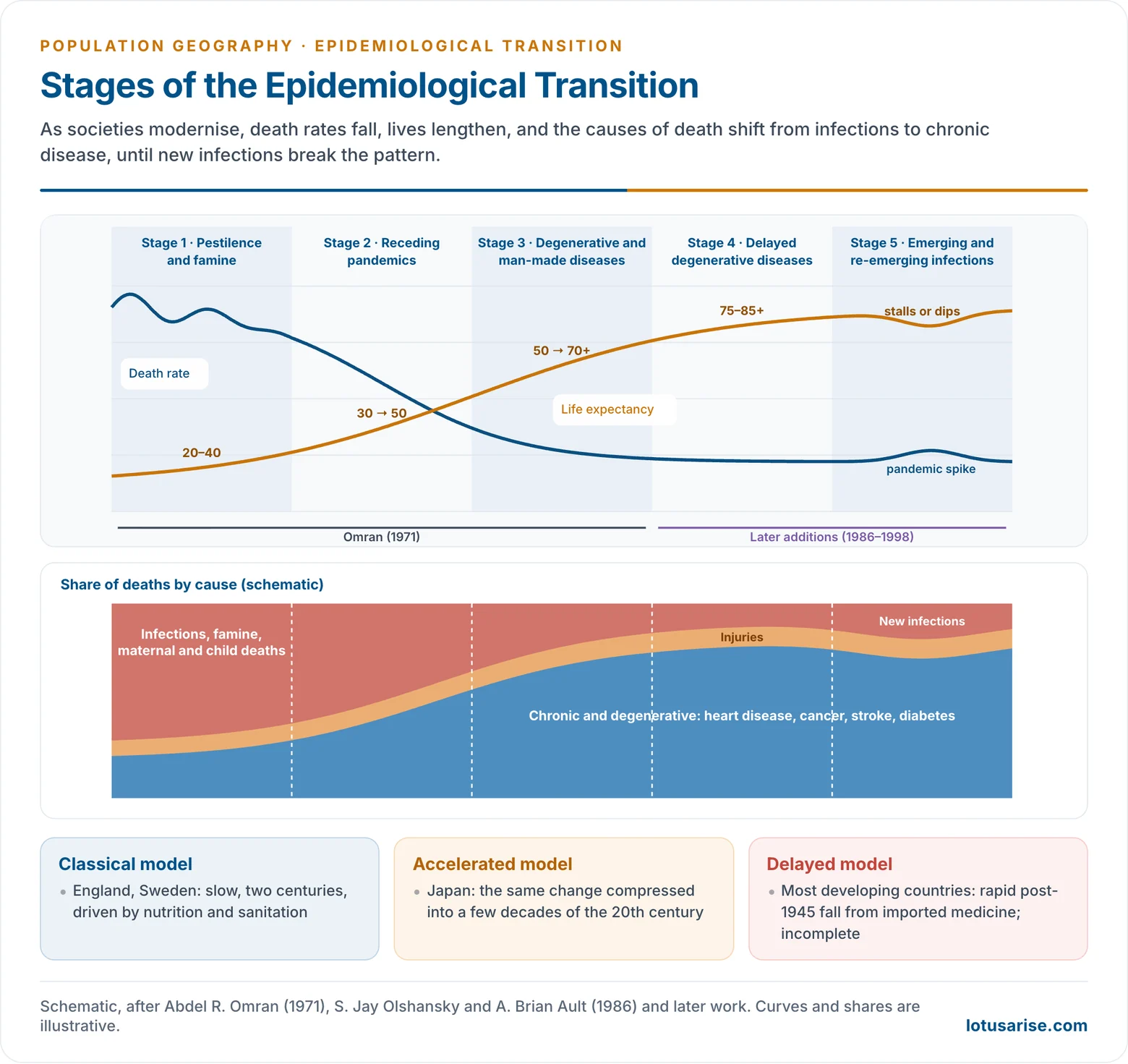
- 1. Age of Pestilence and Famine
- Very high and fluctuating mortality, especially of infants, children and young mothers. Life expectancy 20–40 years.
- Mortality crises from epidemics (plague, cholera, smallpox), famine and war; dominant diarrhoeal and respiratory infections and malnutrition.
- Subsistence agriculture, poor sanitation, low calorie intake.
- Population growth is slow and unstable, with periodic decline.
- Pre-industrial Europe, medieval Asia, Sub-Saharan Africa and colonial India in the early 20th century.
- 2. Age of Receding Pandemics
- Mortality declines steadily as epidemics become less frequent and less severe, through sanitation, food security and, later, medicine.
- Life expectancy rises from about 30 to 50 years.
- Mortality falls faster than fertility, so population grows rapidly: the second stage of the demographic transition.
- Western Europe in the 19th century, Japan in the early 20th, most developing countries after 1950.
- 3. Age of Degenerative and Man-made Diseases
- Mortality stabilises at a low level; life expectancy rises above 50 and then beyond 70.
- Non-communicable diseases dominate: cardiovascular disease, cancer, stroke, diabetes.
- Man-made hazards rise: smoking, high-fat diets, stress, occupational disease, pollution, road accidents.
- Fertility becomes the main factor in growth; the population ages.
- Western Europe, North America, Australia and Japan by the mid-20th century; the emerging East Asian economies later.
| Stage | Dominant causes of death | Life expectancy | Population growth | Examples |
|---|---|---|---|---|
| 1 Pestilence and famine | Epidemics, famine, infections | 20–40 | Slow, unstable | Pre-industrial Europe, colonial India |
| 2 Receding pandemics | Infections declining | About 30 → 50 | Rapid | 19th-century Europe; Global South after 1950 |
| 3 Degenerative and man-made | Heart disease, cancer, stroke | Above 50, later 70+ | Slow; ageing | Western Europe, USA, Japan |
| 4 Delayed degenerative | Same diseases at older ages | 75–85+ | Very slow or negative | Japan, Western Europe |
| 5 Emerging infections | New and resurgent infections plus NCDs | Stalls or dips | Uneven | HIV in Africa; COVID-19 worldwide |
Omran’s Three Models
- Classical (Western) model: England and Wales, Sweden and other Western European countries.
- A slow, gradual decline over two centuries, driven mainly by socio-economic improvement (nutrition, housing, sanitation) before effective medicine.
- Fertility fell with a long lag.
- Accelerated model: Japan (and parts of Eastern Europe).
- The same transition compressed into a few decades in the 20th century, helped by sanitary and medical advances and a social push to modernise.
- Fertility fell quickly after the Second World War.
- Contemporary (delayed) model: most developing countries, such as Sri Lanka, Chile and India.
- Mortality fell sharply after 1945, largely through imported medical and public-health technology (DDT, vaccines, antibiotics) rather than development.
- Fertility stayed high for decades, so growth was explosive, and the transition is incomplete: infections persist alongside chronic disease.
Epidemiological and Demographic Transition Compared
- Common ground: both are stage models of modernisation, both begin with falling mortality, and both end with an old, slowly growing or shrinking population.
- Differences:
- The demographic transition tracks rates (births and deaths); the epidemiological transition tracks causes (which diseases kill and disable).
- The demographic transition ends with low fertility; the epidemiological transition goes on into the age structure of disease, as people survive to die of chronic illness in old age.
- The epidemiological transition gives the health explanation of why the demographic transition’s death rate falls first.
Later Refinements: Fourth and Fifth Stages
- 4. Age of Delayed Degenerative Diseases
- Proposed by S. Jay Olshansky and A. Brian Ault (1986).
- The same degenerative diseases kill, but at much older ages, through better diagnosis, treatment (bypass surgery, statins), prevention and health education.
- Life expectancy rises to 75–85 and beyond, and death rates fall even among the oldest old. People live long with chronic illness.
- Richard G. Rogers and Robert Hackenberg (1987) called it a “hybristic” stage, in which individual behaviour and lifestyle (smoking, alcohol, violence, diet) decide most deaths.
- Japan, South Korea, Western Europe, Canada.
- 5. Age of Emerging and Re-emerging Infectious Diseases
- Proposed by Olshansky and colleagues (1997) and by Ronald Barrett and colleagues (1998), who called it a “third epidemiological transition”.
- It recognises that the transition is not linear:
- re-emergence of controlled diseases: tuberculosis, malaria, dengue, cholera;
- new pathogens: HIV/AIDS, SARS, Ebola, Zika, Nipah, COVID-19;
- antimicrobial resistance.
- Its drivers are globalisation and travel, antibiotic misuse, climate change (spreading vectors), urban crowding and ecological disruption that brings zoonoses into human contact.
- Omran himself (1998) revised the model with two further phases: an age of declining cardiovascular mortality, ageing and lifestyle change, with emerging diseases; and an age of aspired quality of life, with long lives but persistent inequalities.
- Some writers propose an age of obesity and inactivity: obesity, metabolic syndrome, depression and other mental disorders, driven by sedentary work and ultra-processed food. It applies to the Gulf states, the USA and urban middle classes in developing countries.
- The double and triple burden: many countries carry the old and the new diseases together:
- maternal and child deaths alongside diabetes;
- undernutrition alongside obesity;
- dengue and tuberculosis alongside heart disease;
- plus a third burden of injuries, from road accidents and violence.
- India, Pakistan, Bangladesh and Nigeria are typical.
The World Map of the Transition
- Sub-Saharan Africa: largely in stage 2. Infections, malaria and maternal and child deaths still dominate; HIV/AIDS reversed life expectancy in southern Africa in the 1990s, and NCDs are now rising in cities.
- South Asia: a mixed stage 2–3. Infections are receding, but NCDs already cause most deaths.
- Latin America and East Asia: stage 3, moving to 4; China’s transition was among the fastest recorded.
- Europe, North America, Japan and Australia: stage 4, with deaths postponed to old age.
- Former Soviet Union: a reversal in the 1990s, when male deaths from alcohol, cardiovascular disease and violence pushed life expectancy down for a decade.
Health Transition
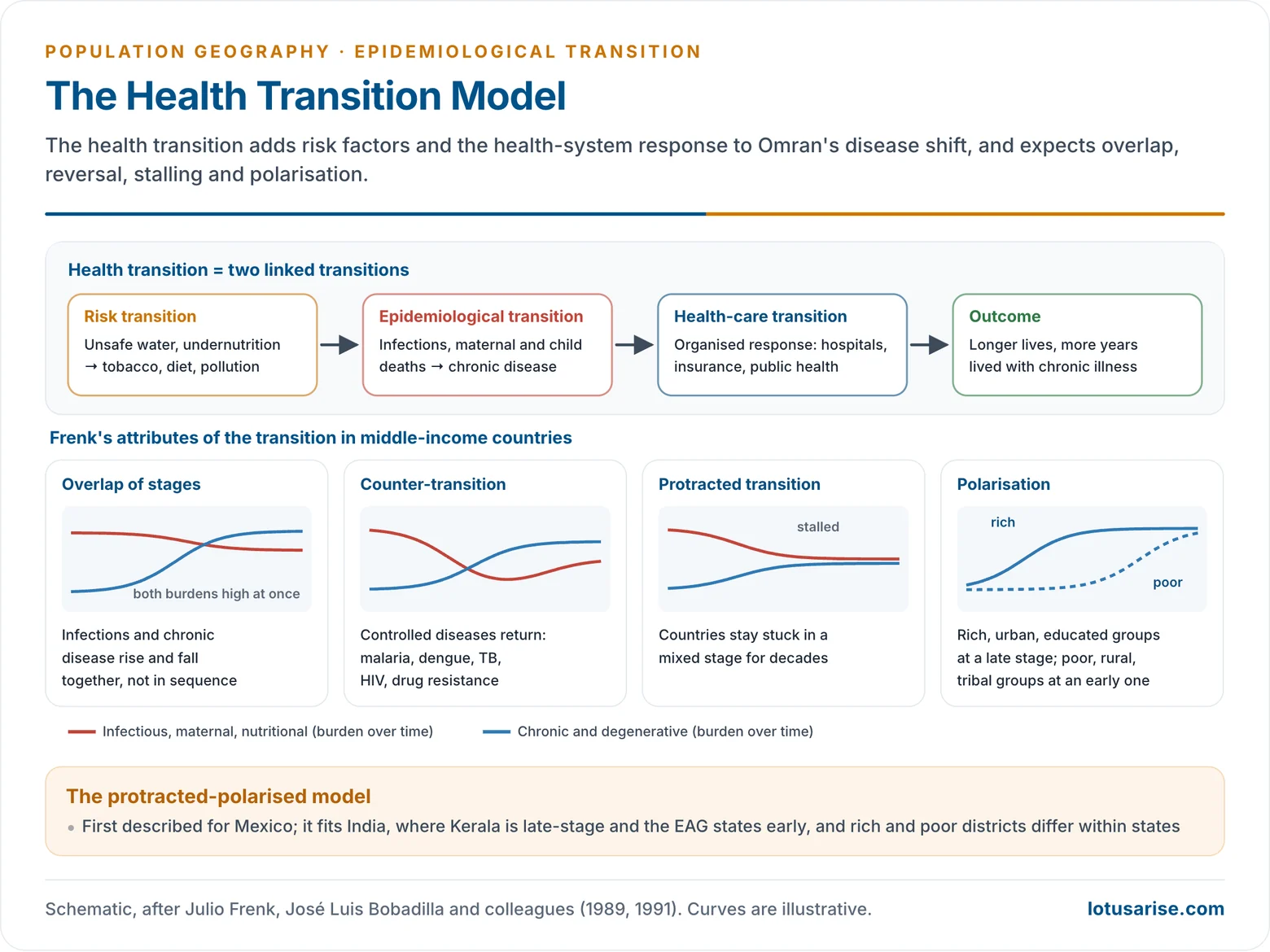
- Health transition is the broader idea, popularised around 1990 by the demographer John C. Caldwell and the Health Transition Centre in Canberra, and theorised by Julio Frenk, José Luis Bobadilla and colleagues (1989, 1991). It has two parts:
- the epidemiological transition: changes in the health conditions of the population (disease, disability, death);
- the health-care transition: changes in the organised social response, meaning health systems, financing, insurance and public health.
- It also covers the risk transition (from unsafe water and undernutrition to tobacco, diet and pollution), and the cultural and behavioural determinants of health that Caldwell stressed, such as women’s education.
- Frenk’s attributes of transition:
- Overlap of stages: infections and chronic disease coexist; they are not sequential.
- Counter-transition: diseases once controlled return (malaria, dengue, tuberculosis).
- Protracted transition: countries remain stuck in a mixed stage for long periods.
- Epidemiological polarisation: the rich, urban and educated are in a late stage; the poor, rural and marginalised remain in an early one, within the same country.
- These define a “protracted-polarised” model, first described for Mexico, that fits most middle-income countries, including India, better than Omran’s linear sequence.
- India’s health-care transition shows both sides: a public system of primary health centres built for infections and maternity, and a fast-growing private hospital sector for chronic disease.
- Out-of-pocket spending was still 43.4% of total health expenditure in 2022–23 (National Health Accounts), though falling; publicly funded insurance under PM-JAY (2018) aims to reduce it.
Key Drivers of the Transition
- Demographic change: falling child mortality, ageing (more chronic disease), urbanisation, smaller families (lower maternal risk).
- Socio-economic development: income, nutrition, housing and sanitation; a shift from farm work to sedentary and stressful jobs; female literacy.
- Public health: mass vaccination (smallpox eradicated in 1980; India polio-free since 2014), chlorination and sewerage, disease surveillance, institutional delivery.
- Medical technology: antibiotics, antiretroviral therapy, better diagnosis and surgery, telemedicine.
- Nutrition and food security: the Green Revolution and food distribution ended famine mortality; later, excess calories feed obesity and diabetes.
- Environment: clean water and air reduce infection, but urban air pollution, heat and climate change create new disease patterns, and land-use change brings zoonoses (Nipah in Kerala).
- Behaviour: diets high in sugar, salt and fat; tobacco and alcohol; inactivity; stress.
- Globalisation and mobility: fast spread of infections (SARS, H1N1, COVID-19) and of medical knowledge and drugs.
- Governance: health missions (the National Health Mission, Ayushman Bharat), regulation of food, drugs and air quality, investment in primary care and insurance.
India’s Epidemiological Transition
- From infections to chronic disease:
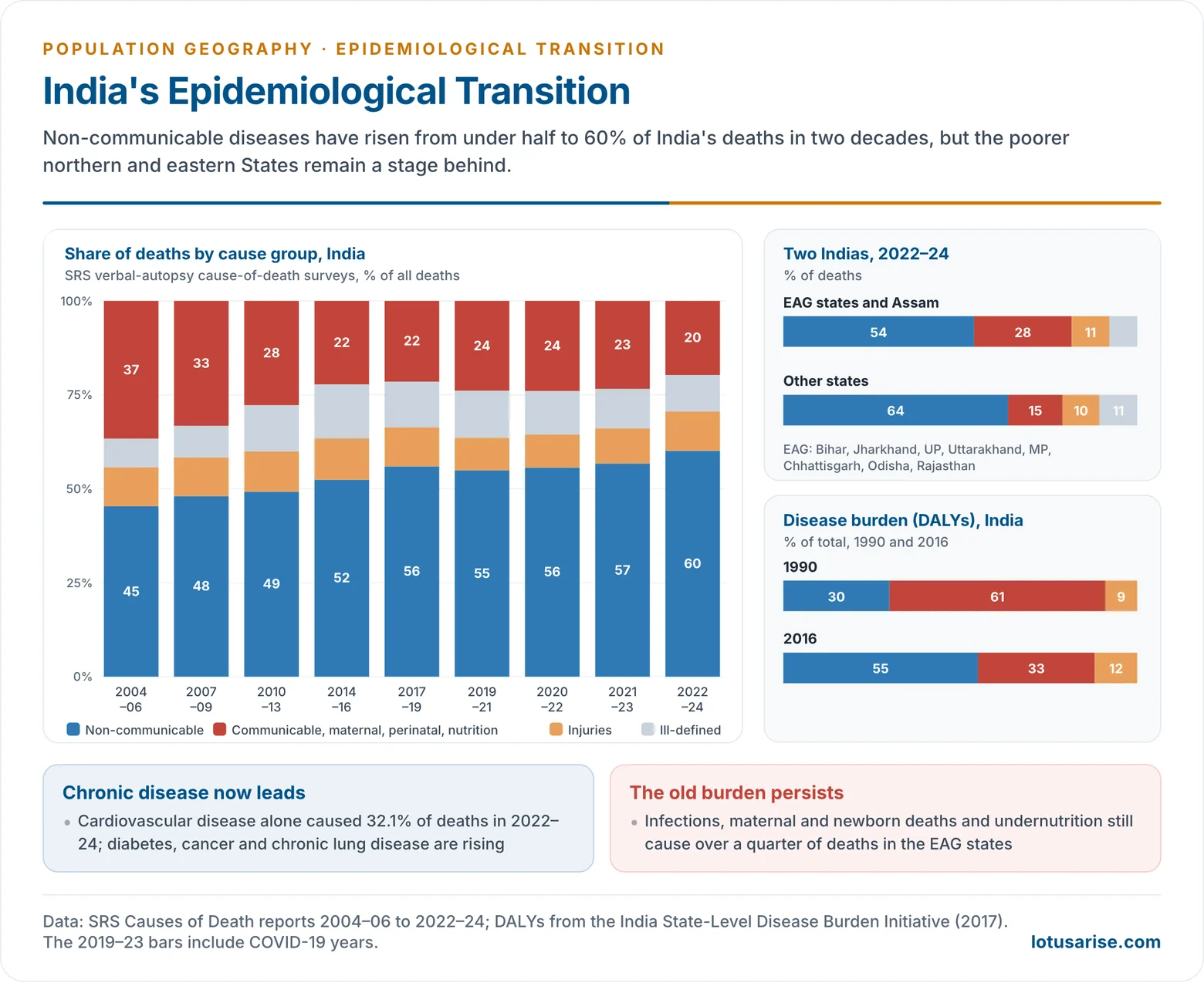
- The SRS cause-of-death surveys show the share of deaths from communicable, maternal, perinatal and nutritional (CMPN) conditions falling from 36.7% in 2004–06 to 19.7% in 2022–24.
- Non-communicable diseases rose from 45.4% to 60.1% of deaths. Cardiovascular disease is now the leading cause, at 32.1%.
- Injuries have stayed at about 10%.
- Measured by disease burden (DALYs), CMPN conditions fell from 61% in 1990 to 33% in 2016, while NCDs rose from 30% to 55% (India State-Level Disease Burden Initiative, 2017).
- That study ranked states by an epidemiological transition ratio: the burden of CMPN conditions divided by that of NCDs and injuries. The lower the ratio, the further a state has moved through the transition.
- A polarised, protracted transition:
- In 2022–24, NCDs caused 63.5% of deaths in the more developed states but 53.9% in the EAG states and Assam, where CMPN conditions still caused 27.6% (SRS).
- Kerala, Goa and Tamil Nadu are in a late stage, close to high-income countries; Bihar, Uttar Pradesh, Madhya Pradesh, Chhattisgarh, Jharkhand, Odisha and Rajasthan lag by two decades or more.
- The double burden:
- Old diseases persist: India has about a quarter of the world’s tuberculosis cases (WHO), along with dengue, malaria in tribal forest belts, and rising antimicrobial resistance.
- New diseases spread: ICMR’s INDIAB study (2023) estimated 101 million people with diabetes (11.4% of adults).
- The nutrition paradox: NFHS-6 (2023–24) found 29.3% of children under five stunted while 30.7% of women aged 15–49 were overweight or obese.
- COVID-19 reversed recent gains: the SRS death rate rose from 6.0 in 2020 to 7.5 in 2021, and the world lost almost two years of life expectancy in 2020–21 before recovering by 2023.
- It struck hardest where the two burdens meet: people with diabetes, hypertension and obesity in crowded cities with weak hospital capacity, as in the 2021 second wave, when oxygen and beds ran short.
- It showed that a late-transition society still needs the public-health defences of the early stages: surveillance, isolation, vaccination and primary care.
- Policy implications:
- a health system built for mothers and children must now also screen and treat chronic disease, through Ayushman Arogya Mandirs (health and wellness centres) and NCD screening;
- surveillance and preparedness for new infections (the Integrated Health Information Platform, One Health);
- regional priority for the lagging states, where the old agenda of child and maternal health is unfinished.
Criticism of the Theory
- Eurocentric and linear:
- Built mainly on Western Europe, Japan and North America.
- It assumes a one-way sequence from infections to chronic disease, which developing countries with coexisting disease regimes do not follow.
- Ignores the double and triple burden: low- and middle-income countries face infections, NCDs and injuries together, not one after another.
- Treats populations as homogeneous: it misses inequality by class, gender, caste and region. Kerala resembles a late-transition country while the EAG states resemble early ones; women and marginal groups often have a delayed or incomplete transition.
- Did not foresee reversals: the resurgence of tuberculosis, drug-resistant pathogens, dengue and chikungunya, HIV/AIDS in Africa, the mortality crisis of the former Soviet Union in the 1990s and COVID-19, which showed that rich societies are not immune.
- Underestimates public health and the state: Omran stressed socio-economic development, but vaccination, sanitation and health missions often mattered more. Sri Lanka, Costa Rica and Kerala achieved low mortality at low income.
- Neglects behaviour and lifestyle: diet, inactivity, substance use and mental health are now central to disease patterns.
- Too mortality-centred: it explains causes of death, not morbidity and disability. Chronic disease often adds years lived with disability more than deaths, which DALYs capture.
- Underplays political and structural factors: governance, conflict, displacement, social protection and environmental regulation.
- Stages are not universal: societies leap, skip, overlap or stall. Some are stuck by poverty and conflict; others move fast through technology and public action.
- Current view: the theory remains a useful descriptive framework, but is now read through Frenk’s protracted-polarised health transition and the burden-of-disease approach, which measure the full mix of death and disability across places and groups.