Fertility

Fertility refers to the actual reproductive performance of a population, measured through the number of live births occurring to women of child-bearing age (usually 15–49 years). It is a demographic process that directly influences population growth, age structure, labour supply, dependency ratios, and long-term socio-economic development trajectories.
While Fecundity represents the biological capacity to reproduce, fertility captures the realised number of births, shaped by a wide set of biological, socio-economic, cultural, health, and policy factors. Hence, fertility is not merely a biological process but a behavioural and socio-economic phenomenon, embedded in household strategies, cultural norms, and state interventions.
From a population-studies perspective, fertility plays a central role because:
- It is the most variable demographic component compared to mortality or migration.
- Small changes in fertility have large cumulative impacts, particularly in developing societies.
- Fertility patterns reflect broad processes of social change, including education expansion, urbanisation, women’s empowerment, and economic transitions.
- Fertility decline is closely linked with the Demographic Transition Model (DTM) and the Epidemiological Transition Theory, shaping the future health and age-structure profile of societies.
Key Measures of Fertility
Understanding fertility requires a set of demographic indicators that capture both the level and pattern of childbearing in a population. These measures help assess population growth, reproductive behaviour, and the impact of socio-economic changes on fertility.
1. Crude Birth Rate (CBR)
- Represents the number of live births relative to the average population size within a specific year and region.
- Definition: Number of live births per 1,000 people in a given year.
- Strength: Easy to calculate; widely used in national statistics.
- Limitation: Includes the entire population—not just women of reproductive age—leading to an over-general estimate.
- Unsuitable for comparing fertility levels between two populations due to potential significant differences in their age and sex structures
- Not a true fertility rate since it encompasses the entire population, including those not at risk of childbearing

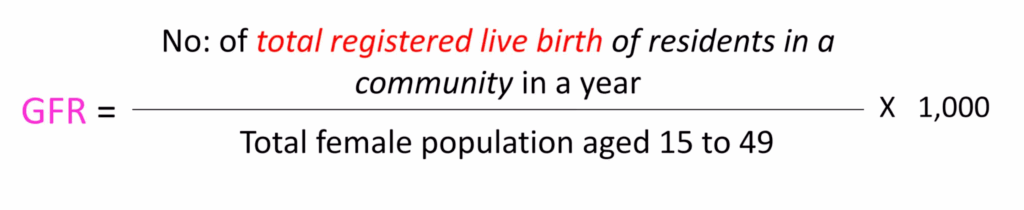
2. General Fertility Rate (GFR)
- The most straightforward indicator of fertility levels. It represents the annual number of live births per 1,000 women aged 15 to 49, measured at the midpoint of the year.
- Definition: Number of live births per 1,000 women aged 15–49.
- Strength: More accurate than CBR since it considers only the reproductive-age population.
- Limitation: Still does not reflect differences in fertility across specific age groups within 15–49.
3. Age-Specific Fertility Rate (ASFR)
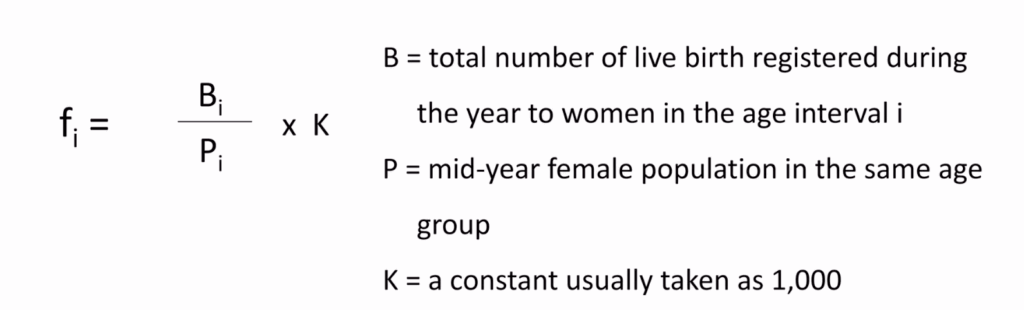
- Definition: Number of live births per 1,000 women in a specific age group (e.g., 20–24, 25–29).
- Typically calculated for five-year age segments, such as 10-14, 15-19, up to 45-49 years.
- The ASFR provides a detailed fertility profile by age, often covering intervals like 15-19 through 45-49 or 15-19 through 40-44.
- Strength: Reveals the age pattern of childbearing, important for assessing teenage fertility, delayed marriage, etc.
- Relevance: Helps understand socio-cultural transitions (e.g., India’s rising fertility in age 25–29 due to delayed marriages).
4. Total Fertility Rate (TFR)
- Definition: The average number of children a woman is expected to bear during her reproductive years, assuming current age-specific rates continue.
- Formula: Sum of ASFRs × 5 (age interval).
- Importance:
- Most widely used measure.
- Determines whether a population is growing, stabilising, or declining.
- Benchmark:
- Replacement level fertility: ≈ 2.1 children/woman.
- Relevance to India: India reached below-replacement TFR (2.0) according to NFHS-5.

5. Gross Reproduction Rate (GRR)
- Definition: Number of daughters a woman is expected to bear during her lifetime, ignoring mortality.
- A variant of the Total Fertility Rate (TFR) with a specific focus.
- The key difference lies in the numerator: GRR counts only female births, unlike TFR, which includes all births.
- While TFR estimates the total number of children a group of women is expected to have, GRR specifically calculates the average number of daughters born to these women.
- This metric holds significant value in demographic studies as it reflects the population’s ability to sustain itself through female offspring.
- GRR represents the mean number of female children born to women who survive through their reproductive years (typically ages 15 to 49), assuming no mortality during this period.
- Significance:
- Shows whether women are producing enough daughters to “replace” themselves.
- Limitation: Does not consider survival of daughters to reproductive age.
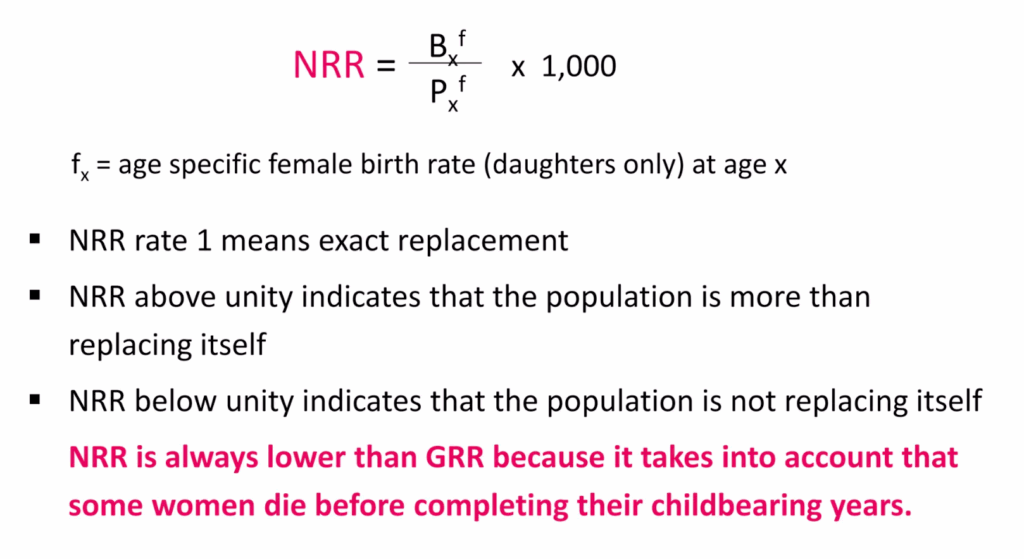
6. Net Reproduction Rate (NRR)
- Definition: Average number of daughters a woman is expected to bear who survive to reproductive age.
- This metric tracks a theoretical group of women, monitoring their survival and the number of daughters they give birth to throughout their reproductive years, typically from ages 15 to 49.
- NRR estimates how many daughters a group of newborn girls is expected to have over their lifetimes, assuming fertility and mortality rates remain constant.
- It reflects the degree to which a generation of newborn girls will replace themselves, based on specific age-related fertility and mortality patterns for females.
- Interpretation:
- NRR = 1: Stable population (each woman replaces herself with one daughter).
- NRR < 1: Population will decline in the long run.
- Relevance: Crucial for long-term population stabilisation strategies.
7. Child-Woman Ratio (CWR)
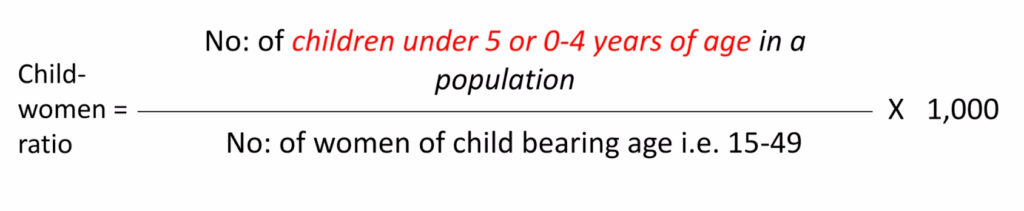
- Definition: Number of children (0–4 years) per 1,000 women aged 15–49.
- Represents the proportion of children under five years old relative to women in their reproductive years.
- Acts as an improvised indicator to estimate fertility levels when direct birth data is unavailable.
- Calculated solely from age-specific data collected during a single census.
- Most effective as a comparative tool to evaluate fertility trends across different groups within the same population, assuming minimal interference from external factors.
- Usage: Useful where reliable birth registration is absent (e.g., remote areas, developing states).
- Note: This ratio reflects surviving children from previous births rather than actual birth counts, which can influence its accuracy.
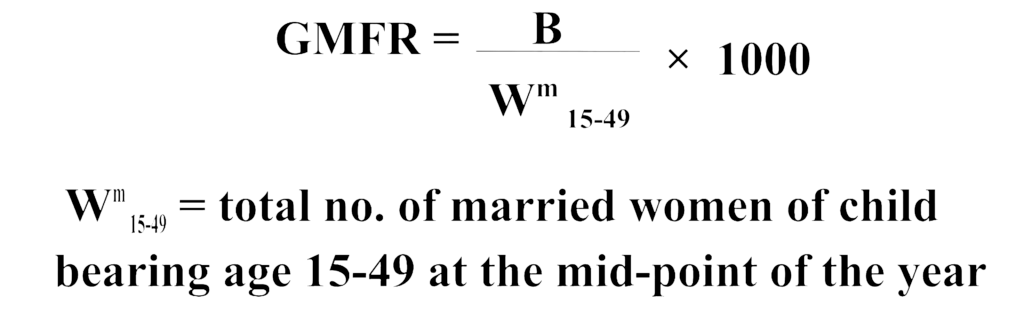
8. General Marital Fertility Rate (GMFR)
- Definition: Births per 1,000 currently married women aged 15–49.
- Relevance: Significant for societies like India, where fertility is overwhelmingly within marriage.
9. Total Marital Fertility Rate (TMFR)
- Definition: Expected number of births a married woman will have during her reproductive span.
- Importance: Helps isolate the influence of marriage patterns versus fertility control behaviour.
10. Cohort Fertility Measures
- Definition: Tracks births to a group of women (a cohort) over their life course.
- Strength: More accurate for long-term demographic analysis than period measures.
Determinants of Fertility
1. Biological Determinants
These factors shape the biological capacity of individuals and populations to reproduce. They act as the most fundamental base for fertility variation across societies.
Fecundity
- Fecundity refers to biological potential to conceive and bear children.
- Determined by genetics, hormonal balance, reproductive anatomy, and physiological health.
- Peak fecundity between 20–30 years due to optimal ovulatory function.
- Declines after 35 due to lower ovarian reserve—reflected in rising infertility rates in urban India.
- Example: India’s urban TFR decline is partly linked to delayed childbearing and reduced fecundity.
Age at Menarche & Menopause
- Early menarche → longer reproductive span → higher fertility potential.
- Late menopause similarly prolongs childbearing years.
- Improvements in nutrition and health have reduced age at menarche globally.
- Example: India’s NFHS data shows declining age at menarche from 14.2 (1990s) to nearly 12.5 today, expanding reproductive span.
Health & Nutrition
- Poor nutrition delays ovulation, increases pregnancy complications, and reduces fertility.
- Micronutrient deficiencies (iron, iodine, folate) impair reproductive function.
- Better nutrition enhances menstrual regularity and fecundity.
- Example: Sub-Saharan Africa shows high infertility due to chronic undernutrition & infections.
Breastfeeding & Postpartum Amenorrhoea
- Lactational Amenorrhoea delays ovulation and naturally spaces births.
- Traditional societies with prolonged breastfeeding observe 2–3 year birth intervals.
- Modern shift to formula feeding reduces natural birth spacing.
- Example: In rural Rajasthan, exclusive breastfeeding contributes to longer birth intervals.
Disease Prevalence
- Reproductive Tract Infections (RTIs), STDs (syphilis, gonorrhoea), HIV impair fertility.
- Chronic diseases like TB, malaria reduce fecundity by weakening the reproductive system.
- Example: High infertility pockets in Central Africa due to untreated STDs.
Biological Replacement Effect
- When a child dies, parents may intentionally have another child to “replace” the loss.
- Higher in societies with high Infant Mortality Rate (IMR).
- Example: Families in high-IMR districts of Uttar Pradesh show intentional replacement fertility.
2. Socio-Cultural Determinants
These shape reproductive behaviour through norms, tradition, religion, and social structure.
Marriage Patterns
- Age at marriage is the strongest predictor of fertility.
- Early marriage → long reproductive span → high fertility.
- Example: Bihar, where early marriage persists, shows one of India’s highest TFRs.
Religious Beliefs
- Religious doctrines influence contraception acceptance.
- Some religions discourage family planning (e.g., Catholic Church).
- Others promote large families for cultural continuity.
- Example: Israel’s ultra-orthodox Haredi community has TFR > 6.
Family Structure
- Joint families: Support high fertility due to childcare support and pooled resources.
- Nuclear families: Higher cost burden & limited support → lower fertility.
- Example: Kerala’s nuclear family system aligns with its low TFR (~1.8).
Gender Norms
- Patriarchal settings promote higher fertility to maintain lineage.
- Son preference keeps fertility high until a desired number of sons is achieved.
- Example: North Indian states show “stopping behaviour” only after securing sons.
Cultural Perceptions of Children
- Agrarian societies: Children → labour support → high fertility.
- Modern-industrial societies: Children → economic liability → low fertility.
- Example: High fertility in rural Madhya Pradesh vs. low fertility in urban Bengaluru.
3. Economic Determinants
Economic development, labour markets, and household income directly influence fertility decisions.
Level of Economic Development
- Pre-industrial agriculture → high fertility (labour demand, low cost).
- Urban-industrial economies → low fertility (education costs, urban living expenses).
- Example: TFR in rural India far exceeds urban TFR.
Children as Economic Asset vs. Liability
- Agrarian economies: Children help with farming → high fertility.
- Industrial economies: Mandatory schooling & high expenses → low fertility.
- Example: Japan’s extremely high child-rearing cost drives fertility < 1.3.
Employment of Women
- Women in formal employment face high opportunity costs of childbearing.
- Career-oriented women delay or limit childbearing.
- Example: IT sector women in cities like Bengaluru show late marriage & low fertility patterns.
Household Income
- Poor households may have more children for old-age support & labour.
- Wealthy households invest more per child (education, health), preferring fewer children.
- Becker’s Theory: Rise in income → shift from “quantity” to “quality” of children.
4. Demographic Determinants
Infant & Child Mortality
- High mortality → parents have more children for insurance and replacement.
- Mortality decline → reduces fertility (classic Demographic Transition).
- Example: Kerala’s low IMR correlates with low TFR.
Age Structure
- Young population → high fertility potential.
- Ageing population → natural fertility decline.
- Example: Japan & South Korea’s ageing → record-low fertility.
Migration
- Migrants often adopt new fertility norms at destination.
- Rural-to-urban migration generally reduces fertility.
- Example: Migrant households in Mumbai show lower fertility compared to their native villages.
5. Educational Determinants
Female Education
- Most powerful socio-demographic determinant.
- Education leads to:
- Delayed marriage
- Higher contraceptive awareness
- Greater autonomy
- Lower desired family size
- Example: Kerala & Tamil Nadu’s high female literacy aligns with low fertility.
Male Education
- Educated men favour smaller families & invest in child quality.
- Better health behaviour reduces child mortality → lower fertility needs.
- Example: NFHS shows inverse relation between male education and TFR.
6. Technological Determinants
Contraceptive Technology
- Availability & awareness of methods (pills, IUDs, implants) → reduced fertility.
- LARC methods ensure long-term reduction.
- Example: Increase in female sterilisation contributed to decline in India’s TFR.
Reproductive Health Services
- Antenatal care, safe delivery, counselling reduce unplanned births.
- Example: Kerala’s strong reproductive health infrastructure stabilised fertility early.
Medical Technologies
- IVF and assisted technologies extend reproductive age.
- Prenatal sex-detection tech affects fertility behaviour in patriarchal states.
- Example: IVF boom in urban India has altered late fertility trends.
7. Psychological Determinants
Desired Family Size
- Reflects values, aspirations, lifestyle changes.
- Modern urban middle class increasingly chooses 1–2 children.
- Example: OECD countries show rising “voluntary low fertility.”
Attitude Toward Contraception
- Myths, misinformation, cultural taboos reduce contraceptive use.
- Education and counselling improve acceptance.
- Example: Northern India shows lower contraceptive acceptance due to misconceptions.
Aspirations of Women
- Career ambitions, desire for autonomy delay or reduce fertility.
- Example: Rising female employment in metros reduces fertility.
8. Environmental Determinants
Climate & Geography
- Harsh climates → poor health → reduced fecundity.
- Extreme cold/high altitude reduces fertility (nutritional stress).
- Example: Ladakh and Spiti valley exhibit low fertility linked to climate stress.
Urban vs. Rural Environment
- Urban: Higher living costs, crowding, career opportunities → low fertility.
- Rural: Agriculture-based livelihoods favour larger families.
- Example: India’s urban TFR (1.6) < rural TFR (2.2).
9. Policy & Institutional Determinants
Family Planning Policies
- Strict policies (China’s one-child) sharply reduce fertility.
- Voluntary programmes (India’s NPP 2000) encourage small families.
- Example: India’s Mission Parivar Vikas targeted high TFR districts.
Maternity/Paternity Benefits
- Supportive policies encourage stable fertility levels.
- Scandinavia’s generous parental leave maintains moderate fertility (~1.7).
Health Policies
- Immunisation & maternal health reduce IMR → lower fertility.
- Example: India’s IMR decline from 68 (2000) to 27 (2022) pushed fertility down.
Legal Age of Marriage
- Higher marriage age reduces reproductive span → lowers fertility.
- Example: Raising legal marriage age for women to 21 (proposed) aims to reduce fertility further.
Determinants of Fertility: The Huw Jones Framework
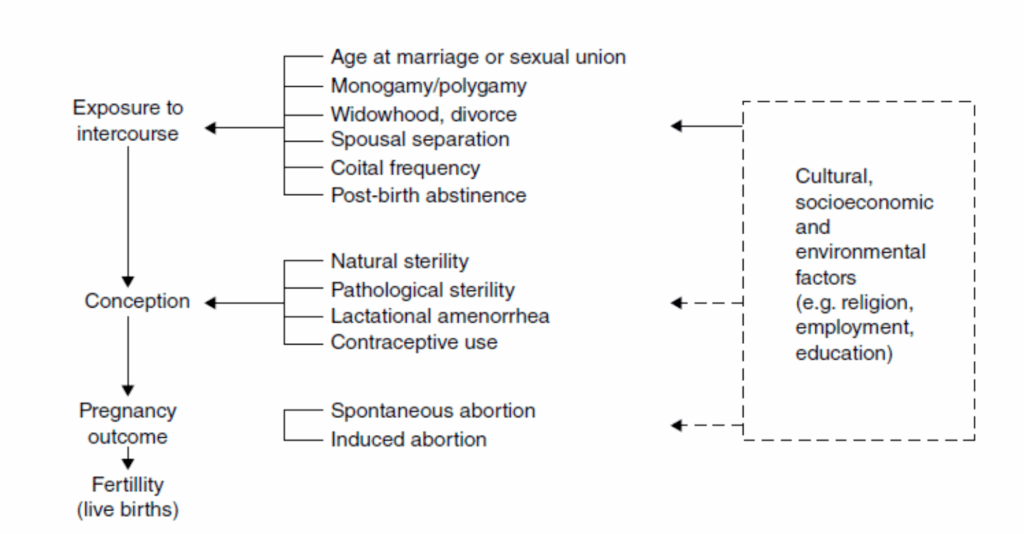
Welsh population geographer Huw Jones provides a widely used analytical framework to understand what shapes fertility levels in any society. His model distinguishes between proximate (direct) determinants and ultimate (indirect) determinants of fertility, clarifying how social and biological factors interact to produce actual birth outcomes.
According to Jones, the number of births occurring in a country is determined by three immediate processes:
- The frequency of sexual intercourse,
- The proportion of intercourse that results in conception, and
- The proportion of conceptions that progress to live births.
These three processes are directly influenced by a set of immediate or biological–behavioural factors, which Jones calls the proximate determinants of fertility (e.g., age at marriage, breastfeeding, contraception, postpartum infecundability, etc.). These are the factors that most immediately regulate the biological chances of pregnancy and childbirth.
However, Jones emphasizes that behind these direct processes lie a broader set of ultimate or fundamental determinants—the socioeconomic, cultural, institutional, and environmental factors—which operate indirectly. These include education, income, gender norms, family systems, cultural beliefs, healthcare infrastructure, and policy environment. Such deeper determinants influence fertility only through their effect on the proximate variables (for example, female education influences fertility by raising the age at marriage and increasing contraceptive use).
Thus, the total fertility observed in any society is the outcome of a multi-layered causal structure, where fundamental societal conditions shape reproductive behaviours, which in turn shape biological outcomes.
Proximate and Fundamental Determinants
Jones categorizes the factors influencing these three components into two main types:
1. Proximate (or Direct) Determinants
- These are the immediate biological and behavioral factors that directly determine the levels of the three components above. They work directly to inhibit or promote fertility.
- Factors affecting Exposure to Intercourse:
- Age at marriage or sexual union.
- Monogamy/Polygamy.
- Widowhood, divorce.
- Spousal separation.
- Marital frequency.
- Post-birth abstinence.
- Factors affecting Conception:
- Natural sterility.
- Pathological sterility (e.g., from venereal disease, gonorrhea).
- Lactation and amenorrhea.
- Contraceptive use.
- Factors affecting Pregnancy Outcome:
- Spontaneous abortion.
- Induced abortion.
- Factors affecting Exposure to Intercourse:
2. Fundamental (or Ultimate) Determinants
- These are the deeper socioeconomic, cultural, and environmental factors that do not directly influence fertility but rather work through the proximate determinants to shape fertility levels. They create a societal context that restricts births in the first instance, ultimately leading to lower levels of fertility.
- Socioeconomic, Cultural, and Environmental Factors:
- Religion, education, employment, and the overall cultural and environmental setting.
- Socioeconomic, Cultural, and Environmental Factors:
- The following factors are examples of how fundamental determinants work to lower fertility by influencing the proximate determinants (e.g., through increased contraceptive use, later marriage, or induced abortion):
- City Living (Urbanisation): Rural populations traditionally tend to have larger families as children are a vital source of farm labour. Mass migration (urbanisation) reduces the number of people working on the land and diminishes the need for large families.
- Pensions and Social Insurance: Increasingly, state organizations provide care for the elderly, sick, or unemployed. When people no longer need to rely on their children for financial or personal support in old age, the economic incentive for having large families is significantly reduced.
- Compulsory Schooling: Schooling raises the economic exploitation of young children by removing them from the labor force and introducing new costs for parents (e.g., uniforms and books). This direct economic burden acts to induce smaller family sizes.
- Education (Especially for Women): Education opens people’s eyes to broader career opportunities and increases their awareness of the existence and benefits of contraception. It is one of the most powerful determinants.
- Changing Status of Women in Society: Greater female participation in the labor market leads to changing views on the role of women. This diminishes the traditional perception of women as principally child-bearers and increases their contribution to household income, delaying marriage and reducing the desired family size.
- Consumption: As the consumption of luxury goods becomes a higher priority, having fewer mouths to feed means families can dedicate more of their household budget to servicing wants rather than just needs, making smaller families more economically attractive.
- Secularism: Some religions promote large family sizes and/or discourage modern approaches to human sexuality. Modernization often leads to secularism, where religion’s influence on marriage, child bearing, contraception, and abortion diminishes. People are better able to control the size of their families using modern means.
Trends and Patterns of Fertility: World and India
Global Trends in Total Fertility Rate (TFR)
- Total Fertility Rate (TFR) is a standardised and widely accepted indicator of fertility, used for inter-country comparisons, and according to the United Nations report “World Fertility and Family Planning, 2020”, the global TFR declined significantly from 3.2 live births per woman in 1990 to 2.5 in 2019, although the pace and extent of decline vary considerably across regions due to differing levels of socio-economic development.
- Fertility transition has been a defining feature of developed regions, where fertility has declined from high to low levels, and regions such as Europe, Northern America, Australia, and New Zealand had already reached below-replacement fertility (TFR < 2.1) by 1990, with Europe and Northern America recording TFR around 1.7 in 2019, and Australia–New Zealand around 1.8, indicating advanced demographic transition and ageing populations.
- Developing regions have also witnessed rapid fertility decline, although at varying rates, as seen in Eastern and South-Eastern Asia where TFR declined from 2.5 (1990) to 1.8 (2019), and in Latin America and the Caribbean where TFR fell from 3.3 to 2.0, reflecting urbanisation, education, and improved access to contraception, while Central and Southern Asia also saw a decline from 4.3 to 2.4, indicating a broad-based fertility transition across Asia.
- Sub-Saharan Africa remains the region with the highest fertility levels, where despite decline, TFR reduced only from 6.3 in 1990 to 4.6 in 2019, highlighting slow demographic transition due to persistent poverty, low female literacy, limited access to healthcare, and cultural preferences for large families, while Northern Africa and Western Asia also recorded a decline from 4.4 to 2.9, though still above replacement level in many countries.
- Extreme regional contrasts in fertility are evident globally, as Niger recorded the highest TFR (~6.9 in 2020) and all countries with TFR above 5 are concentrated in Africa, whereas very low fertility (TFR ≤ 1) is observed in countries such as Republic of Korea (0.8), Hong Kong (0.9), Puerto Rico (0.9), and British Virgin Islands (1), reflecting advanced urban-industrial societies with delayed marriage and low fertility preferences.
- Among the most populous countries, fertility levels show significant variation, with Pakistan maintaining TFR above replacement level, while China (1.28), USA (1.63), India (2.05), and Indonesia (2.19) indicate different stages of demographic transition, clearly demonstrating that global fertility trends are marked by strong regional and intra-regional heterogeneity.
Fertility Trends in India
- India has experienced a sustained decline in fertility over the past three decades, as reflected in NFHS data, where TFR declined from 3.4 in 1992–93 (NFHS-1) to 2.0 in 2020–21 (NFHS-5), indicating that India has now reached below-replacement fertility level, marking a significant milestone in demographic transition.
- However, the national average conceals substantial regional disparities, as fertility remains above replacement level in a few states such as Bihar (2.98), Uttar Pradesh (2.35), Jharkhand (2.26), and Manipur (2.17), while most other states have achieved or fallen below replacement fertility, indicating uneven pace of demographic transition across regions.
- Several states and Union Territories exhibit very low fertility levels, such as Sikkim (1.05), Goa (1.3), Ladakh (1.31), Chandigarh (1.40), Jammu & Kashmir (1.41), Lakshadweep (1.42), and Puducherry (1.49), reflecting advanced socio-economic development, urbanisation, higher female education, and greater access to healthcare and contraception.
- In the majority of Indian states, TFR now ranges between 1.5 and 2.0, indicating that fertility decline has become a nationwide phenomenon, although pockets of high fertility persist in socio-economically lagging regions, particularly in the BIMARU states, highlighting the need for targeted policy interventions.
- The Indian fertility transition clearly demonstrates spatial heterogeneity, where southern and western states have achieved demographic maturity earlier, while northern and central states continue to lag, thereby reinforcing the idea that fertility decline is closely linked with literacy, urbanisation, income levels, and women’s empowerment.
Implications of Declining Fertility
- Fertility decline is generally associated with economic development and improved quality of life, as it leads to lower dependency ratios and potential demographic dividend, but sustained below-replacement fertility can create long-term challenges such as ageing population, labour shortages, and increased burden on social security systems.
- Examples from developed countries such as Japan (TFR ~1.3) illustrate how persistently low fertility leads to shrinking workforce, rising dependency ratios, and economic stagnation, thereby highlighting that very low fertility poses serious socio-economic challenges.
- Thus, while most regions of the world are moving towards lower fertility regimes, the key policy challenge lies in managing both ends of the spectrum, i.e., reducing high fertility in lagging regions and addressing the consequences of very low fertility in advanced regions, making fertility transition a central concern of population geography and public policy.
Conclusion
- Global and Indian fertility trends reflect a clear shift towards lower fertility regimes, but the process remains uneven across regions, and therefore, future demographic policies must focus not only on reducing fertility but also on managing its consequences, ensuring a balance between population stabilisation, economic development, and social well-being.