

- Population plays a crucial role in determining the economic and social well-being of a nation. The relationship between population size and resources determines whether a country has too many people, too few, or just the right number to ensure the highest standard of living.
- Thus, geographers and economists classify population–resource relationships under three main concepts:
- Overpopulation
- Underpopulation
- Optimum population
- Each concept helps in understanding how the balance between human numbers and resource potential affects development, productivity, and living standards.
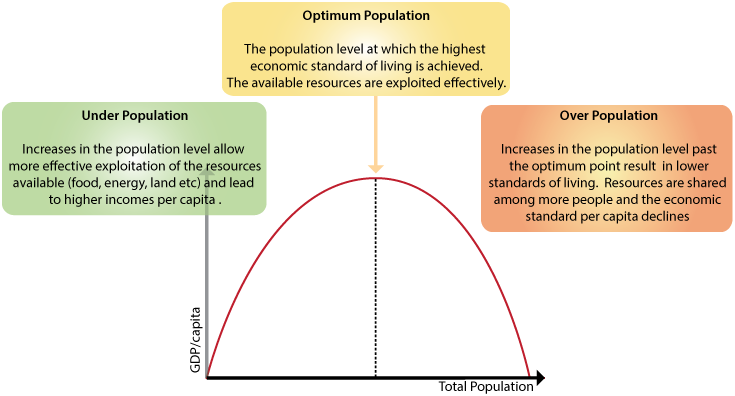
Concept of Optimum Population

- Definition and Origin
- The concept of optimum population was first introduced by Richard Cantillon in the 18th century and further developed by economists like Edwin Cannan (1924), Carr-Saunders, and Dalip Singh Sidhu.
- Cantillon emphasised that the “best possible population is that which produces the highest per capita income with available resources and technology.”
- Meaning:
- Optimum population is the size of population that enables maximum utilization of resources to achieve the highest per capita income and standard of living.
- It is not the maximum population, but the most desirable population — neither too large nor too small.
- At this level, the marginal productivity of labour is zero — implying that adding more people would reduce per capita output, while fewer people would lead to underutilization of resources.
- Optimum population is the size of population that enables maximum utilization of resources to achieve the highest per capita income and standard of living.
- Determinants
- Optimum population depends on:
- Resource base (land, minerals, water, etc.)
- Technology and capital
- Social and political structure
- Level of economic organization and transport
- Cultural and institutional factors
- Thus, the optimum population is dynamic, varying with time and progress. Improvement in technology or capital can increase the optimum size.
- Optimum population depends on:
- Examples
- Near-optimum population: United Kingdom, Belgium, France, West Germany — countries where population roughly matches resource capacity and technological level.
- Multidimensional Nature
- Optimum population should be viewed not only in economic terms but also in:
- Social terms – education, health, and welfare.
- Military terms – ability to defend national interests.
- Environmental terms – sustainable resource use.
- Optimum population should be viewed not only in economic terms but also in:
Criticism
- Difficult to measure precisely due to dynamic economies.
- Subjective — depends on what is considered an “ideal” standard of living.
- Neglects ecological and environmental factors in early formulations.
Concept of Overpopulation
- Definition:
- Overpopulation occurs when the population exceeds the capacity of available resources to maintain an adequate standard of living.
- In simple terms, there are more people than jobs, food, or opportunities, leading to declining per capita income and welfare.
- Causes:
- Rapid population growth (high birth rate, low death rate)
- Resource depletion (soil erosion, deforestation)
- Natural calamities (drought, floods, epidemics)
- Declining labour demand due to automation or structural unemployment
- Types:
- Absolute Overpopulation
- Occurs when, even with full use of resources, the population cannot maintain a minimum standard of living.
- Example: Bangladesh, Jordan.
- Often marked by chronic hunger, poverty, and dependence on aid.
- Relative Overpopulation
- Exists when available resources and technology could sustain a higher standard of living if the population were smaller.
- Example: India, Philippines.
- Not an absolute shortage of resources, but mismanagement and unequal distribution.
- Absolute Overpopulation
- Clarifications:
- Density ≠ Overpopulation:
- High density doesn’t always imply overpopulation.
- Example: Venezuela imports food despite low population — showing that resource management, not density, is decisive.
- On the other hand, Japan and the Netherlands have high densities but efficient economies.
- Density ≠ Overpopulation:
- Implications
- Falling per capita income
- Rising unemployment and poverty
- Resource exhaustion and environmental degradation
- Low savings and investment capacity
- Remedies
- Population control measures (family planning, education)
- Economic diversification and industrialization
- Migration and emigration policies
- Sustainable resource management
Migration and Overpopulation
- Migration acts as a natural pressure valve:
- Example: Italy and Ireland historically experienced overpopulation, but emigration to the Americas reduced population pressure.
Concept of Underpopulation
- Definition:
- Underpopulation occurs when a country’s population is too small to optimally utilize its available natural and capital resources, leading to underproduction and high per capita costs.
- It is the opposite of overpopulation — here, resources remain underutilized due to labour scarcity.
- Types:
- Absolute Underpopulation: Extremely rare; refers to sparsely populated regions with vast unexploited resources.
- Relative Underpopulation: More common; occurs where more people could raise productivity and efficiency.
- Examples:
- Brazil – large area, low population density, and many untapped natural resources.
- Australia, New Zealand, Republic of South Africa, North American Prairies – regions with extensive farming and high living standards, but potential for larger populations.
- Ehrlich’s Observation on Australia:
- Paul Ehrlich, the population biologist, noted that “Australia could improve its infrastructure and resource utilization with a larger population.”
- Yet, overexploitation of fragile ecosystems and water scarcity constrain its food potential — a case of relative underpopulation with environmental limits.
- Consequences:
- High labour costs and dependence on immigration
- Underutilized resources and infrastructure
- Difficulty in sustaining economic growth
- Vulnerability in defence (military understrength)
- Remedies:
- Encouraging immigration
- Improving birth rates through incentives
- Technological innovation to maximize productivity
- Regional development to attract labour
Factors Influencing Population States
- Natural Resources and Environmental Conditions
- The availability of resources, such as water, arable land, and minerals, plays a pivotal role in determining whether an area is overpopulated, underpopulated, or optimally populated.
- For example, regions with limited water resources, like the Sahel in Africa, often struggle with overpopulation, while resource-rich but sparsely populated areas, like Siberia, may face underpopulation.
- Technology and Innovation
- Technological advancements can shift the balance between population and resources. Improved agricultural techniques, renewable energy, and sustainable development practices can increase a region’s carrying capacity, allowing for more people to live sustainably in the same area.
- Conversely, regions that lack access to modern technologies may find it difficult to maintain an optimal population balance.
- Government Policies and Economic Systems
- Government interventions, such as family planning programs or immigration policies, can significantly influence population dynamics.
- For instance, China’s one-child policy (now relaxed) was an attempt to curb overpopulation, while countries like Canada encourage immigration to address underpopulation and labor shortages.
- Cultural and Social Factors
- Cultural attitudes towards family size, migration, and resource use also play a role in shaping population trends. In many developing countries, large families are seen as an asset, contributing to overpopulation.
- In contrast, in developed nations, low birth rates and ageing populations contribute to underpopulation concerns.
- Global Economic Trends
- Globalisation, trade, and international labour mobility can shift population dynamics.
- A region experiencing economic growth may attract workers and investors, leading to higher population densities, while areas facing economic decline may see an exodus of people, leading to underpopulation.
Important Determinants of Population
The size and growth of population in any region depend on several demographic, economic, and technological factors. These determinants help in understanding whether a country is under-populated, over-populated, or has reached an optimum population level.
1. Demographic Structure
- Demographic variables such as birth rate, death rate, fertility rate, and mortality rate play a crucial role in determining population size.
- High mortality rates (due to poor health, wars, or epidemics) can create situations of underpopulation, while low mortality and high fertility lead to overpopulation.
- Age and sex composition also affect the productive capacity of the population — a younger population may increase growth potential but strain resources, whereas an aging population may reduce economic productivity.
2. Availability of Resources and Level of Technology
- The availability of natural resources (land, water, minerals, forests) and the technological capability to exploit them largely determine the population-supporting capacity of a region.
- The Optimum Population Theory assumes that factors like production techniques, capital stock, natural resources, working population ratio, and business organization remain constant.
- However, in reality, all these factors change dynamically over time due to innovation and human ingenuity.
- For instance:
- Improvement in agricultural and industrial technology can raise the productivity of land and labour, allowing more people to be sustained.
- Conversely, depletion of natural resources or environmental degradation can lower the carrying capacity.
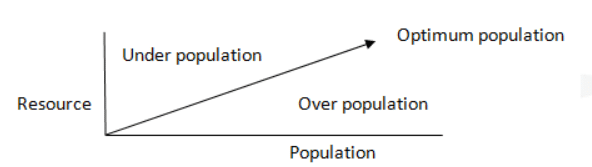
3. Per Capita Production and Standard of Living
- Per capita production and income are direct indicators of economic well-being and determine whether a region’s population is within its sustainable limits.
- A higher standard of living implies efficient use of resources and controlled population growth.
- If resources are efficiently utilized and per capita income increases, the population may rise toward a new optimum level.
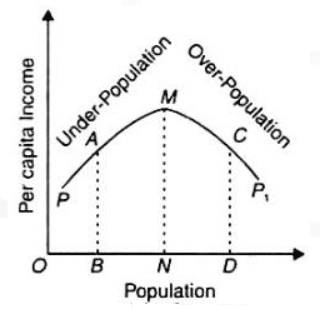
4. Dynamic Nature of Optimum Population
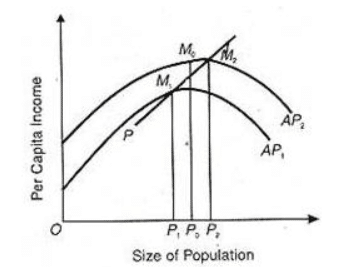
- The optimum population is not a fixed point — it changes with improvements in production techniques, technology, and capital accumulation.
- Suppose there is an innovation that enhances productivity — this shifts the average product (AP) curve from AP₁ to AP₂, leading to:
- Higher per capita income.
- An increase in the optimum population level from OP₁ to OP₂.
- Improved economic welfare as the income rises from P₁M₁ to P₂M₂.
- Thus, technological progress and capital expansion push the optimum point upward over time.
Methods to Tackle Overpopulation and Underpopulation
To maintain the balance between population and resources, certain measures can be adopted:
1. Migration
- Migration helps redistribute population from densely populated regions to sparsely populated ones.
- Example: Migration from South Asia (overpopulated) to Middle Eastern countries (underpopulated) creates mutual economic benefits.
- It reduces pressure on resources in source regions and meets labour shortages in destination regions.
2. Technology Transfer
- Diffusion of technology from developed to developing nations enhances resource utilization and productivity.
- It helps raise the optimum population limit by improving production efficiency and creating new economic opportunities.
3. Population Policy and Family Planning
- Promoting birth control, education, and women’s empowerment helps curb population growth in overpopulated areas.
- In underpopulated regions, policies can encourage higher fertility, immigration, or labour participation to achieve economic balance.
When Population Becomes Overpopulated?
A region becomes overpopulated when its population exceeds the carrying capacity of the environment and resources. This situation arises when:
- Population exceeds resource availability and the land cannot support existing people.
- Natural resources are insufficient to meet basic needs such as food, housing, and healthcare.
- Rate of population growth surpasses the rate of economic development.
- Per capita income falls below the subsistence level.
- Continuous population pressure leads to overexploitation of resources, deforestation, soil degradation, and unsustainable growth patterns.
Impacts of Overpopulation, Underpopulation, and Optimum Population
- Economic Impacts
- Overpopulation: High unemployment, lower wages, and pressure on infrastructure are common economic outcomes. Countries like India, for instance, experience overcrowding in urban centres, where job creation cannot keep pace with population growth.
- Underpopulation: Shrinking labour forces and higher dependency ratios pose challenges for economic sustainability. Japan, with its ageing population and low birth rates, faces significant economic consequences as a result of underpopulation.
- Optimum Population: Economic efficiency is maximised, with adequate job opportunities and a balanced labour market. Countries like Germany strive to maintain an optimum population through policies that balance immigration and domestic workforce growth.
- Environmental Impacts
- Overpopulation: Environmental degradation, including deforestation, loss of biodiversity, and increased carbon emissions, is a major consequence. Overpopulated regions often face severe air and water pollution, as seen in many parts of Southeast Asia.
- Underpopulation: While underpopulated areas may experience less environmental stress, they may also struggle to manage and conserve their ecosystems due to a lack of human resources. For example, vast areas of the Amazon Rainforest are sparsely populated, making it difficult to monitor and protect against illegal logging and deforestation.
- Optimum Population: Striking a balance between human needs and environmental conservation is key to sustainable development. Countries with an optimum population size tend to have robust environmental regulations and conservation efforts.
- Social and Cultural Impacts
- Overpopulation: Overcrowded cities often suffer from poor living conditions, inadequate healthcare, and strained educational systems. Social unrest and increased crime rates are also common.
- Underpopulation: Isolated communities may experience social fragmentation and a lack of access to essential services. In some cases, underpopulation can lead to the disappearance of cultural traditions and languages, as seen in indigenous communities in remote areas.
- Optimum Population: Social cohesion is easier to maintain in societies with balanced population sizes, where access to services and quality of life is high. Education, healthcare, and social services are adequately provided, contributing to overall well-being.





Best notes ever thumbs up easy to understand