

Population Distribution and Density in India

- Population distribution in India is highly uneven and regionally differentiated, reflecting the interaction of physical, socio-economic and historical factors.
- The population is categorized into:
- Densely populated regions
- Moderately populated regions
- Sparsely populated regions
- 👉 This unevenness is a defining feature of India’s population geography.
Concept of Population Density
- Population density is defined as the number of persons per unit area (per sq km).
- It provides a quantitative measure of human-land relationship.
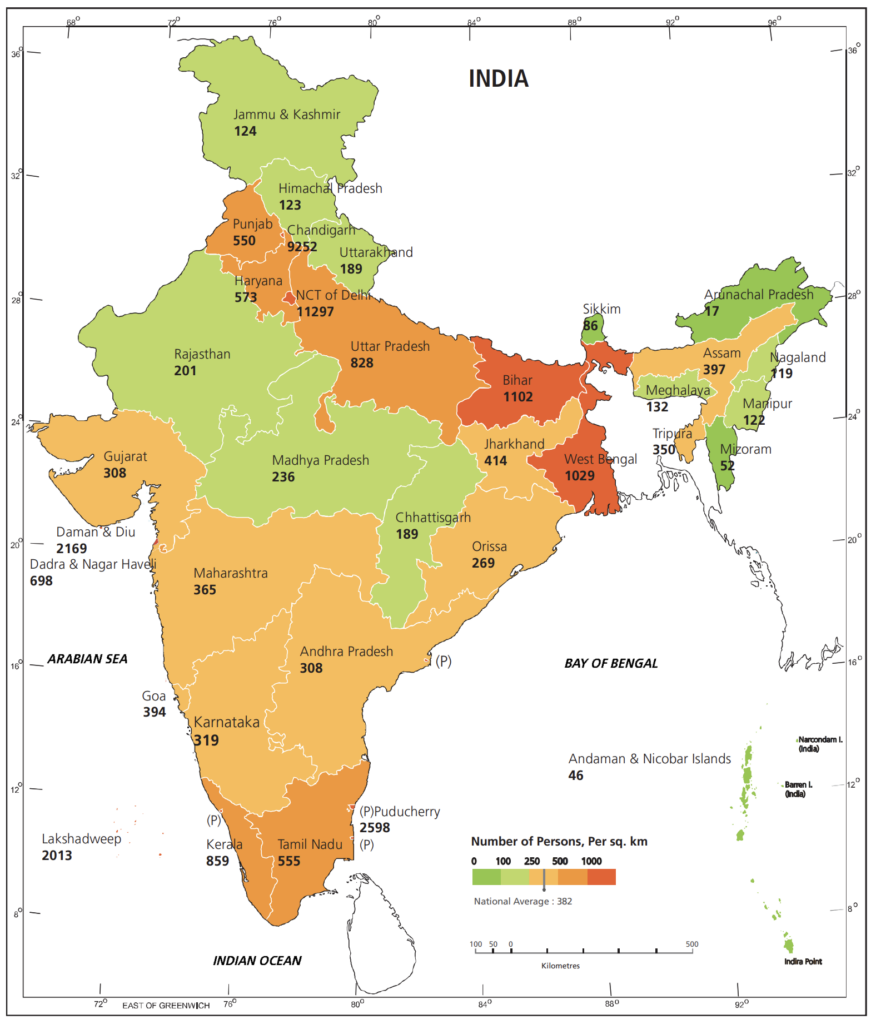
- According to Census 2011,
👉 India’s average density = 382 persons/sq km - Over time:
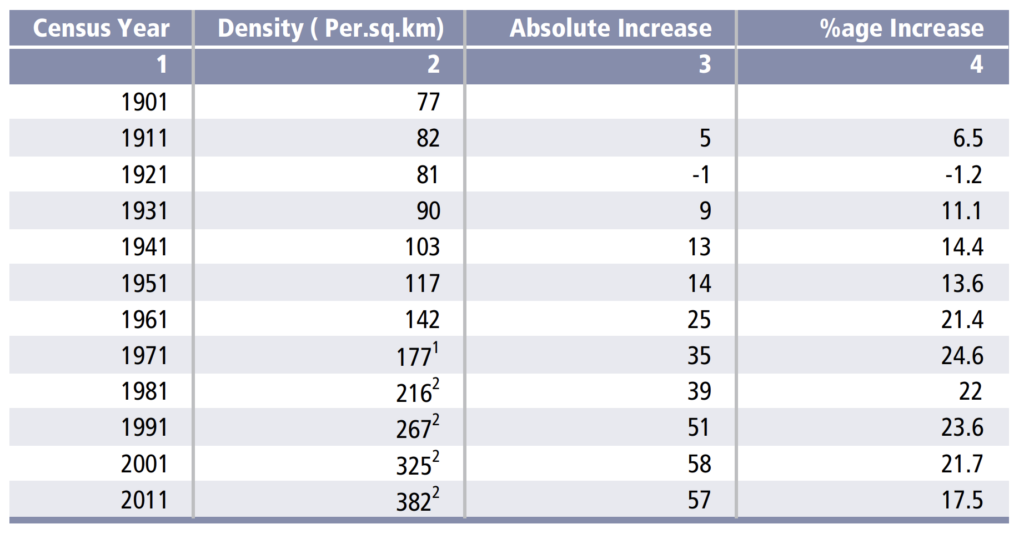
- 1901: 77 persons/sq km
- 2011: 382 persons/sq km
👉 Indicates more than fourfold increase, reflecting population pressure on land.
Nature of Population Distribution
- The average density figure is misleading if interpreted uniformly, because:
- Population is not evenly spread across space
- There are extreme regional contrasts
- Example:
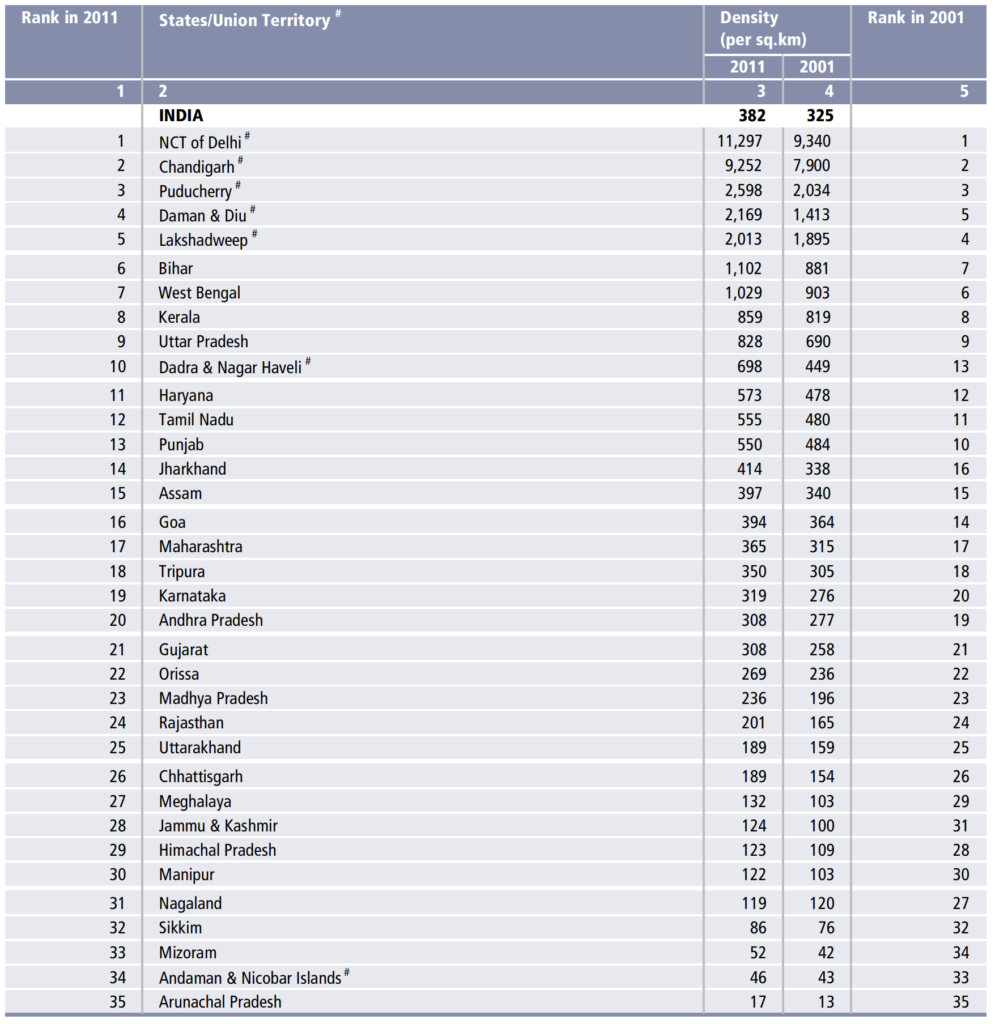
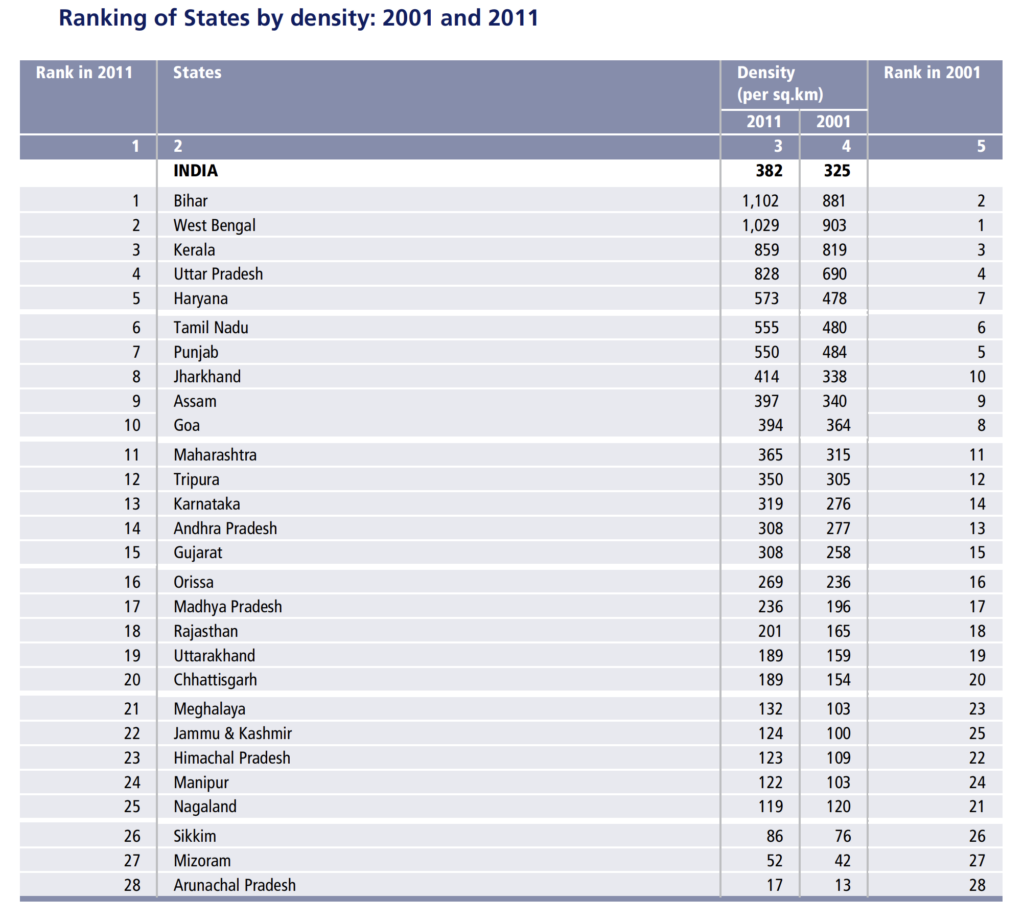
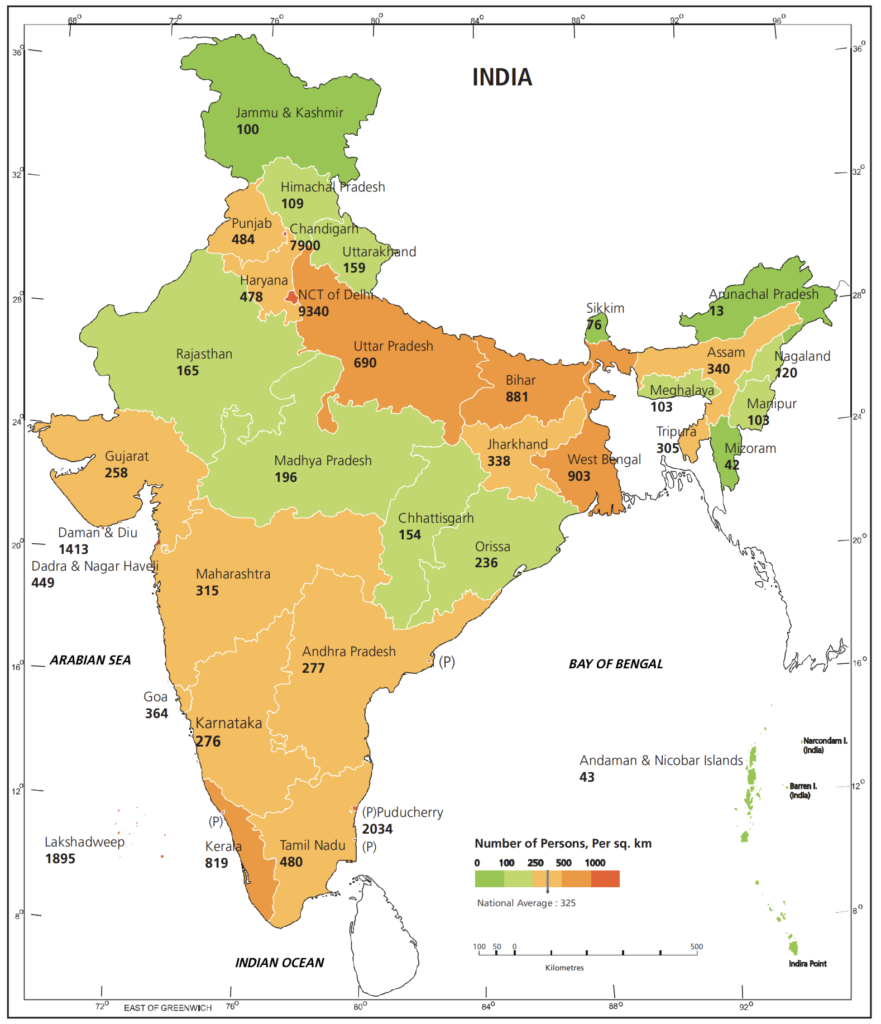
- Arunachal Pradesh: ~17 persons/sq km (sparse)
- Delhi (NCT): >11,000 persons/sq km (extremely dense)
- 👉 This highlights spatial inequality in population distribution.

Regional Pattern of Distribution
(A) High Density Regions
- Indo-Gangetic Plains (UP, Bihar, West Bengal)
- Coastal plains and deltas (Kerala, Tamil Nadu)
- Reasons:
- Fertile alluvial soil
- Adequate water supply
- Flat terrain
- Long history of settlement
(B) Moderate Density Regions
- Peninsular Plateau (Maharashtra, Karnataka, Gujarat)
- Reasons:
- Mixed agricultural potential
- Mineral resources and industrialization
- Developing transport networks
(C) Low Density Regions
- Himalayan region (J&K, Himachal, Uttarakhand)
- North-East states (Arunachal Pradesh, Mizoram)
- Desert regions (Rajasthan)
- Reasons:
- Rugged terrain
- Harsh climate
- Poor accessibility
- Limited economic opportunities

4. Population Concentration (State-wise Pattern)
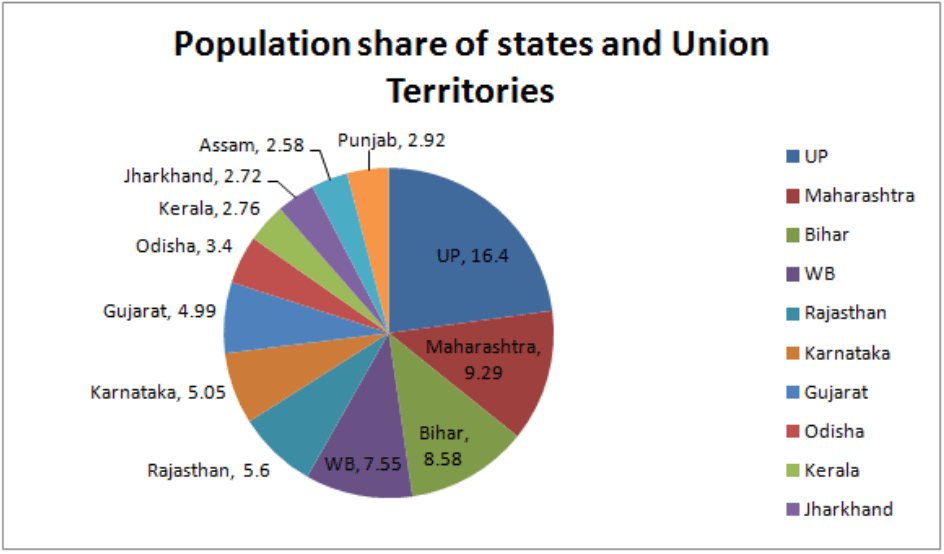
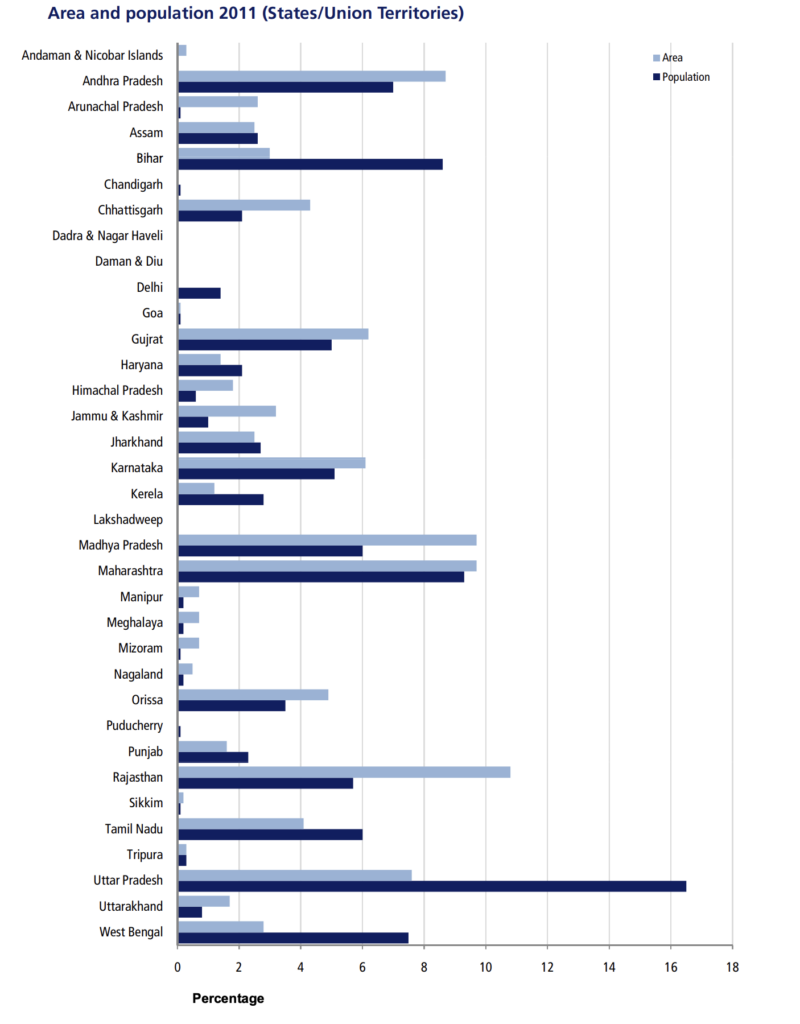
- A few states dominate India’s population:
- Uttar Pradesh, Maharashtra, Bihar, West Bengal, Andhra Pradesh, Telangana
👉 Together account for ~50% of India’s population
- Uttar Pradesh, Maharashtra, Bihar, West Bengal, Andhra Pradesh, Telangana
- In contrast:
- Jammu & Kashmir, Arunachal Pradesh, Sikkim, NE states
👉 Have low population share despite larger areas
- Jammu & Kashmir, Arunachal Pradesh, Sikkim, NE states
- 👉 Reflects imbalance between area and population distribution.
Temporal Analysis of Population Density in India (1901–2011)
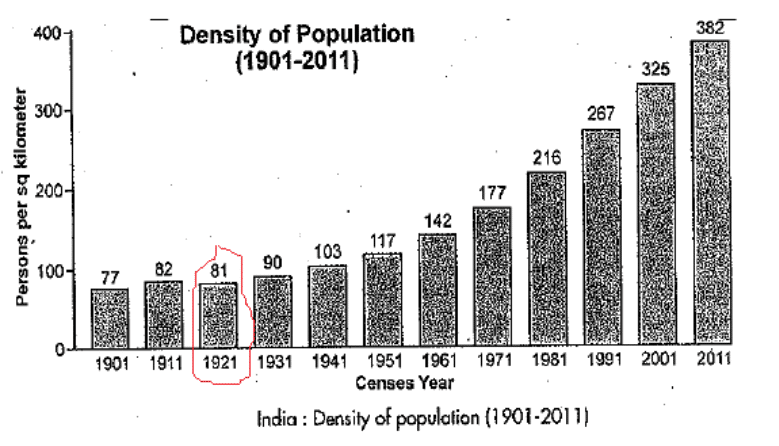
- The temporal trend of population density in India clearly reflects the phases of demographic transition, showing a shift from stagnation to rapid growth and gradual stabilization.
- The 1921 divide is a turning point not just statistically but structurally:
- Before 1921 → “Malthusian regime” (high mortality checks)
- After 1921 → “modern demographic regime” (controlled mortality + rising population)
- The continuous rise in density post-1951 indicates:
- Increasing man–land ratio pressure
- Greater strain on agricultural land and resources
- The 1921 divide is a turning point not just statistically but structurally:
- Key Phases in Density Growth:
- 1901–1921: Stagnation and Decline (Phase of Demographic Stagnation)
- Density increased marginally from 77 (1901) to 82 (1911) but declined to 81 in 1921.
- This is the only decade showing negative growth, hence 1921 is called the “Year of the Great Divide”.
- The decline was due to:
- Severe epidemics (e.g., influenza pandemic 1918)
- Famines and food shortages
- World War I casualties
- Reflects Stage I of Demographic Transition Model (DTM) → high birth rate + high death rate.
- 1921–1951: Gradual Increase (Early Expanding Phase)
- Density rose from 81 (1921) to 117 (1951).
- Decline in death rate due to:
- Public health improvements
- Better food supply and transport
- Birth rate remained high → moderate population increase.
- 1951–1981: Rapid Increase (Population Explosion Phase)
- Density sharply increased from 117 to 216.
- Marked by:
- Medical advancements
- Control of epidemics
- Development planning (Five-Year Plans)
- Death rate declined sharply, while birth rate remained high → fertility-induced growth.
- 1981–2011: High but Decelerating Growth (Late Expanding Phase)
- Density rose from 216 to 382 persons/sq km.
- Growth rate slowed due to:
- Declining fertility rates
- Family planning programmes
- Rising literacy and urbanization
- Reflects transition towards Stage III of DTM.
- 1901–1921: Stagnation and Decline (Phase of Demographic Stagnation)
Spatial Distribution of Population Density in India
- India exhibits a highly differentiated spatial pattern of population density, which reflects the interplay of physical geography, resource base, historical settlement, and economic development. The classification into density categories helps in understanding regional demographic contrasts and developmental imbalances.
- Areas of Extremely Low Density (< 100 persons/sq km)
- These regions represent ecologically fragile and geographically constrained zones, where human habitation is limited by relief, climate, and accessibility.
- States/regions include: Arunachal Pradesh (~17), Mizoram (~52), Sikkim (~86), Andaman & Nicobar Islands (~46).
- The North-Eastern hill states are characterized by:
- Rugged mountainous terrain, dense forests, shifting cultivation
- Poor connectivity and infrastructural limitations
- Sikkim and Arunachal Pradesh → high altitude + seismic vulnerability
- Andaman & Nicobar Islands → isolation, fragile ecosystem, limited economic base
- The North-Eastern hill states are characterized by:
- 👉 Geographically, these regions align with low carrying capacity zones, where environment restricts population concentration.
- Areas of Low Density (101–250 persons/sq km)
- These regions represent transitional zones, where some resource potential exists but is constrained by topography, climate, or socio-economic backwardness.
- States include:
Nagaland, Manipur, Himachal Pradesh, Jammu & Kashmir (including Ladakh), Meghalaya, Chhattisgarh, Uttarakhand, Rajasthan, Madhya Pradesh- Himalayan region (HP, Uttarakhand, J&K):
- Steep slopes, cold climate, limited arable land
- Example: Ladakh (<10 persons/sq km) → cold desert
- Central tribal belt (MP, Chhattisgarh):
- Forested plateau, tribal economy, low urbanization
- Rajasthan:
- Western Thar Desert → water scarcity, arid climate
- Eastern Rajasthan → comparatively higher density due to irrigation
- Himalayan region (HP, Uttarakhand, J&K):
- 👉 Reflects negative correlation between rugged relief and population density.
- Areas of Moderate Density (251–500 persons/sq km)
- This category broadly represents India’s average density zone, indicating balanced interaction between resources and population.
- States include:
Odisha, Gujarat, Andhra Pradesh–Telangana, Karnataka, Tripura, Maharashtra, Goa, Assam, Jharkhand- Resource-based variation within this category:
- Assam → fertile Brahmaputra valley + tea plantations
- Jharkhand, Odisha → mineral-rich but low urban spread
- Maharashtra, Gujarat → industrialization + urban growth
- Tripura → relatively more plains in NE
- Resource-based variation within this category:
- 👉 These regions show mixed economic structures (agriculture + industry).
- Areas of High Density (501–1000 persons/sq km)
- These regions are characterized by intensive agriculture, high productivity, and significant rural settlement concentration.
- States/regions include:
Punjab, Haryana, Tamil Nadu, Uttar Pradesh, Kerala, Dadra & Nagar Haveli- Punjab–Haryana:
- Green Revolution region → irrigation, HYV seeds, mechanization
- Ganga Plain (Uttar Pradesh):
- Fertile alluvial soil, dense rural settlements
- Kerala:
- Unique pattern → high density + high human development
- Plantation economy + remittance-driven growth
- Tamil Nadu:
- Agro-industrial economy + urbanization
- Punjab–Haryana:
- 👉 These regions demonstrate high man–land ratio but supported by productivity gains.
- Areas of Very High Density (> 1000 persons/sq km)
- These are demographic pressure zones, often associated with fertile plains, industrial clusters, or urban agglomerations.
- States/UTs include:
Bihar, West Bengal, Delhi, Chandigarh, Puducherry, Lakshadweep, Daman & Diu- Bihar & West Bengal:
- Located in Ganga–Brahmaputra plains → extremely fertile
- High natural growth + limited industrial absorption
- West Bengal (Hooghly basin):
- Historical industrial core + deltaic fertility
- Delhi & Chandigarh:
- Urban primacy + migration-driven density
- Economic opportunities attract large-scale in-migration
- Small UTs (Lakshadweep, Daman & Diu, Puducherry):
- High density due to small area effect
- Bihar & West Bengal:
- 👉 These areas indicate intense demographic pressure and urban congestion challenges.
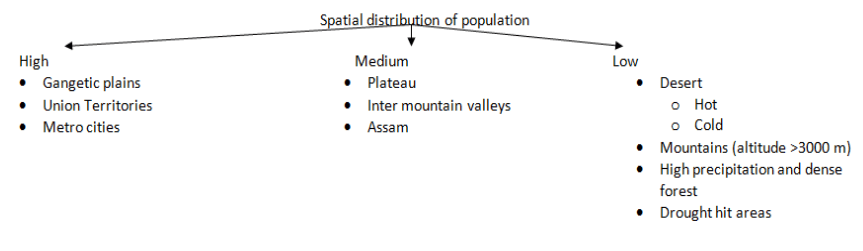
- India’s population density shows a clear physiographic control:
- Plains → High density
- Plateaus → Moderate density
- Mountains & deserts → Low density
- According to R.L. Singh and Chandna, population distribution in India reflects:
- “Resource-region relationship”
- “Historical inertia of settlement patterns”
- There exists a strong:
- Positive correlation with fertile soils, water availability, and urbanization
- Negative correlation with rugged terrain and climatic extremities
Causes of Uneven Distribution of Population in India
- The uneven spatial distribution of population in India is best understood as an outcome of interaction between physical constraints, socio-economic processes, and historical evolution of settlement systems.
- As noted by geographers like R.L. Singh and Chandna, population distribution reflects a “resource–region relationship” shaped over time.
- Physical Factors (Natural Controls on Distribution)
- Relief (Topography) plays a decisive role in determining settlement concentration:
- Fertile and flat Indo-Gangetic plains support very high density due to ease of agriculture and transport
- In contrast, Himalayas, North-East hills, and Deccan plateau show low density due to rugged terrain and limited cultivable land
- Climate influences habitability and agricultural productivity:
- Regions with moderate monsoonal climate (Punjab, UP, WB) → dense population
- Arid (Rajasthan) and extreme cold (Ladakh) → sparse population
- Availability of water resources is a fundamental determinant:
- River valleys (Ganga, Brahmaputra, Godavari deltas) → high concentration
- Water-scarce regions → low density unless irrigation intervenes
- However, technological intervention modifies physical constraints:
- Example:
- Canal irrigation in Rajasthan → increased population concentration
- Resource exploitation in Jharkhand → industrial settlements
- Example:
- Relief (Topography) plays a decisive role in determining settlement concentration:
- Socio-Economic Factors (Dynamic Drivers)
- Evolution of settled agriculture:
- Early agricultural regions (Indo-Gangetic plains) became nuclei of dense population
- Intensive agriculture sustains high man–land ratios
- Pattern of human settlement:
- Long-established rural settlements → high density clusters
- Tribal and shifting cultivation areas → dispersed population
- Development of transport networks:
- Railways, roads, ports → facilitate mobility, trade, and settlement expansion
- Example: Peninsular India shows moderate density due to improved connectivity
- Industrialization and urbanization:
- Industrial regions attract labour → population agglomeration
- Major urban centres:
- Delhi, Mumbai, Kolkata, Bengaluru, Chennai, Pune, Ahmedabad, Jaipur
- These act as growth poles (Perroux’s theory) drawing migrants
- Evolution of settled agriculture:
- Historical Factors (Legacy of Settlement Patterns)
- River plains and coastal areas:
- Cradles of ancient civilizations → early and continuous settlement
- Even with resource degradation, density remains high due to historical inertia
- Colonial legacy and transport development:
- Ports (Mumbai, Kolkata, Chennai) and railway networks shaped population concentration
- Plantation economies in Assam and coastal belts influenced migration patterns
- Migration trends:
- Rural → Urban migration driven by employment opportunities
- Leads to urban primacy and metropolitan concentration
- River plains and coastal areas:

Factors Influencing Distribution and Density of Population
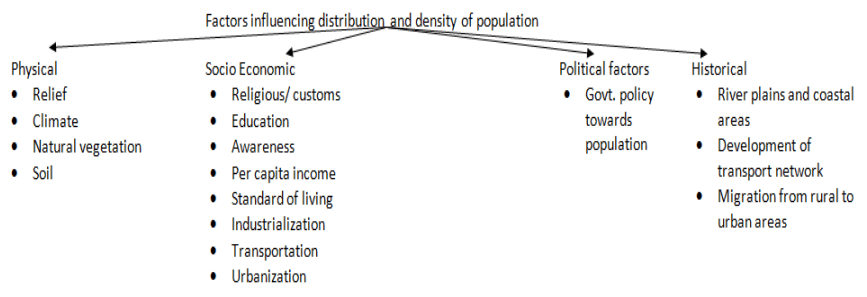
- The spatial distribution of population in India is shaped by a complex interaction of physical and cultural (socio-economic) factors. While early determinists emphasized nature, scholars like Clarke and Zelinsky argue that economic conditions, technology, social organization and state policy increasingly dominate population concentration in the modern era.
- Integrated Factors (Physical + Socio-economic)
- Terrain (Relief as a primary control, later modified by technology):
- Plains with gentle slopes (e.g., Indo-Gangetic Plain) facilitate intensive agriculture, transport networks and dense rural settlements, hence very high density.
- Mountainous regions (Himalayas, NE hills) face constraints of slope, landslides, poor accessibility and fragmented landholdings, leading to sparse population.
- Empirical contrast: ~<25% area of northern plains supports >50% of India’s population, whereas the Himalayan region (~13% area) supports only 1–2% population → classic case of relief–population inverse relationship.
- Climate (Rainfall–temperature regime shaping habitability):
- Moderate monsoonal climate supports dense population, whereas extreme climates (Thar desert, Ladakh) discourage settlement.
- In India, there is a broad tendency that “population distribution follows rainfall pattern” because rainfall sustains agriculture.
- However, geographical exceptions highlight complexity:
- Assam & Western Ghats → high rainfall but moderate density due to floods, forests, terrain
- Punjab–Haryana → relatively low rainfall but high density due to irrigation revolution
- Thus, climate influence is mediated by human intervention.
- Soil (Agricultural carrying capacity):
- Fertile alluvial soils (Ganga plain), deltaic soils (WB), and black cotton soils (Deccan) support high agricultural productivity → high population density.
- Poor or lateritic soils limit agricultural viability → lower density.
- Reflects Boserup’s thesis: population concentration intensifies agricultural practices.
- Water Availability (Hydrological control):
- Population clusters along river valleys (Ganga, Brahmaputra, Godavari) due to:
- Irrigation
- Domestic and industrial needs
- Water scarcity zones → low density unless compensated by canals (e.g., Indira Gandhi Canal region).
- Population clusters along river valleys (Ganga, Brahmaputra, Godavari) due to:
- Mineral Resources (Resource-based concentration):
- Regions rich in minerals (e.g., Chotanagpur Plateau) attract:
- Mining activities
- Industrial growth
- Labour migration
- Leads to localized high density pockets within otherwise moderate density regions.
- Regions rich in minerals (e.g., Chotanagpur Plateau) attract:
- Industrialization (Economic pull factor):
- Industrial regions act as growth poles (Perroux) attracting labour.
- Example:
- Mumbai–Pune, Ahmedabad–Surat, Kolkata–Hooghly belt
- Industrial land has high population carrying capacity compared to agriculture, leading to urban clustering.
- Transport and Communication (Spatial integration):
- Well-developed transport networks enhance:
- Market accessibility
- Mobility of labour
- Urban growth
- Hence, northern plains with dense transport networks → high population density, whereas interior plateau areas lag behind.
- Well-developed transport networks enhance:
- Urbanization (Concentration and agglomeration effect):
- Urban centres represent nodal points of economic activity, hence very high density.
- Migration-driven growth leads to urban primacy and megacity expansion.
- Example:
- Delhi (~11,000+ persons/sq km), Mumbai, Kolkata, Chennai
- Census criteria (≥400 persons/sq km + other conditions) indicate the threshold of urban concentration.
- Terrain (Relief as a primary control, later modified by technology):
Geographical Synthesis
- India’s population distribution demonstrates:
- Environmental Determinism → Possibilism Transition
(Natural factors set limits, but human agency modifies them)
- Environmental Determinism → Possibilism Transition
- The pattern reflects:
- Core–Periphery Structure:
- Core → fertile plains, industrial corridors, urban regions
- Periphery → mountains, deserts, tribal belts
- Core–Periphery Structure:
- Supports key theoretical insights:
- Zelinsky’s Mobility Transition → migration intensifies with development
- Clarke’s perspective → cultural-economic factors override physical controls in advanced stages





once again thank you for your support and help 🙂
great