

- The central theme of Industrial location theory has been the concept of optimum location, i.e. finding the best location where profit is maximum, and cost is minimum.
- The profit can be maximum —
- Where the cost of manufacturing is least due to the presence of Raw Material, Market, etc.
- Where Revenue is maximum.
- But such locations are rarely available, e.g. SAIL Plant has Raw Material within its vicinity but not market so the transportation cost is more.
Theories of Weber & Losch
- Question of cost & revenue was studies separately by 2 scholars
- Least Cost Theory of Alfred Weber
- Maximum Revenue Theory of Losch
- Weber‘s Assumption was that demand is uniform (i.e. price is the same everywhere) & wherever the cost of manufacturing is minimum, profit will be maximum. Therefore, known as the Least Cost Theory
- Losch presumed the cost of manufacturing to be the same everywhere, so the industry is located where demand is maximum and therefore the price is maximum, hence maximum revenue is generated.
Weber’s Model of Industrial Location

- Alfred Weber, a German regional economist, propounded his pioneering theory of industrial location in 1909 in his classic German work ‘Über den Standort der Industrien’, which was subsequently translated into English in 1929 as ‘The Theory of the Location of Industries‘.
- Regarded as the “Pure Theory” or “Least-Cost Theory,” Weber’s work represents the first scientific, macroeconomic exposition of manufacturing location. It established the framework for variable cost analysis, filling a significant theoretical void left by classical economists who largely ignored spatial dimensions of economic activity.
- It has probably had more influence on Industrial location theory than any other single contribution
- The model is a device for analyzing the location of industry, which he elaborated as ‘Locational Triangle’
- It is an idealistic model of industrial location based on a set of criteria & simplifying assumption
- It is a normative deductive model (considering man as economic and rational who conclude things based on facts/experiences/logical reasoning) which speaks partial truth and doesn’t claim the universal application of the theory.
- However, in idealistic conditions, such models can be aptly applied. Such models are known as Stochastic Models.
- Weber (German Scholar) presented his theory in 1909 on the basis of his studies of industries in South Germany
- Weber’s model provided the foundation for variable cost analysis which dominated the study of Industrial location for many decades.
Objectives
- To ascertain the minimum cost location of an industry, wherein Weber talked about 3 types of costs
- Transportation cost,
- Labour Cost, and
- Processing/Agglomeration Cost
- To establish that transportation cost plays a vital role in the selection of industrial location
- To prove that irrespective of socio-economic & political conditions, the location of industries depend on transportation cost. Transportation cost in the location of industries is universal.
Assumptions (General and Economic)
General Assumption
- Man is economic and rational who always takes economic decisions and rationalize its application
- Isotropic surface i.e., climate, soil fertility, physiography, etc are homogeneous with no variability
- Equal connectivity from everywhere
- The area under consideration has a self-supporting economy / self-sustainable system
- Perfect competition exists and the price of particular goods is identical
- There is uniformity and stability in the socio-economic and political environment in the region.
Economic Assumption
- Demand is uniform in the market.
- Transportation cost is directly proportional to / the product of – Distance, Weight & Volume.
- There is a single mode of transportation with equal connectivity everywhere.
- There is a single market over the given landscape where all the industrial products are sold.
- Price of industrial products in the market is uniform.
- The labour is static and wages are uniform in the region.
Classification of Raw Materials and Key Locational Indices
- A vital aspect of Weber’s deductive framework is his classification of manufacturing inputs based on spatial availability (Location) and physical transformational properties (Nature of Final Product):
- Spatial Availability
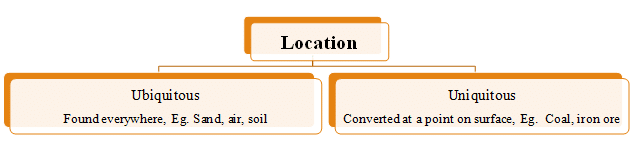
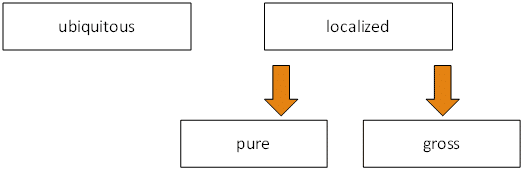
- Ubiquitous Materials: Inputs that are available everywhere across the isotropic surface (e.g., atmospheric water, ambient air, solar energy). These exert a strong pull toward the market because processing them locally incurs zero transport cost on the input side.
- Uniquitous/Localized Materials: Raw materials confined to specific, fixed coordinates (e.g., iron ore, coal, bauxite).
- Purity and Weight Transformation
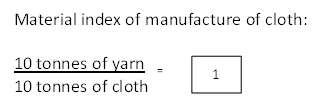
- Pure Raw Materials: Localized raw materials whose physical mass is transferred fully into the finished product without any nominal weight loss during processing (e.g., raw cotton yarn converted to cloth).
- Gross (Weight-Losing) Raw Materials: Localized inputs that undergo significant mass reduction during manufacturing, where a high percentage of waste is discarded (e.g., sugarcane, iron ore, timber).
- Spatial Availability
Postulations:
According to Weber, the optimum location of a firm is determined by transport cost, labour
cost and advantages of agglomeration. To him, at first, the point of least transport cost is
determined, and thereafter, the effect of the advantages of agglomeration is considered.
The factors that control the location of industries are as follows –
- Influence of Transport (General Factor)
- Influence of Labour Cost (General Factor)
- Influence of Industrial Agglomeration (Local or Specific Factor)
Working out of Material Index (MI)
To classify industries and mathematically predict whether a plant will drift toward raw material sources or consumer markets, Weber formulated two indices:
- Material Index (MI) = Total Weight of Localized Raw Materials Used / Total Weight of the Finished Product
- Location Weight = Total Weight of Localized Raw Materials + Total Weight of the Finished Product

- If Material Index is less than 1 (Weight Gaining Industry), location of the industry tends to be towards the market i.e. Market Oriented Industry.
- e.g. Cakes, Beer, etc.
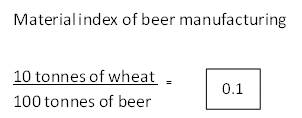
- If Material Index is greater than 1 (Weight Losing Industry), location of the industry tends to be towards raw material sources i.e. Material Oriented Industry.
- e.g. Iron Steel Industry, Sugar Industry, etc.
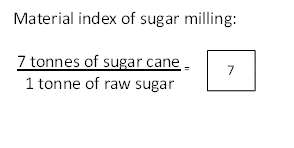
- If Material Index is equal to 1 (Same Weight, Neither Weight gaining nor Weight losing Industry), Industry has a footloose location.
Types of Costs (According to Weber)
- Transportation Cost – Determined by Distance, Weight & Volume
- Processing Cost – It is less where more than 3 industries are agglomerated. i.e., Use of common infrastructure e.g. Industrial zones in Mumbai, Delhi, Automobile agglomerations in Pune, etc
- Labour Cost – Away from the market, the labor cost diminishes
- A product may require one or more raw materials, depending upon the relative location of the market & raw material source.
- We get different geometric patterns/locations along which industry could be located –
- Linear (when single raw material is present)
- Non-Linear (when more than one raw material is present)
- Triangular (when 2 raw materials are present)
- Rectangular (when 3 raw materials present) and so on
- We get different geometric patterns/locations along which industry could be located –
1. Transportation Cost Analysis
1) Based on the nature of Raw Material & Location of the market, Weber worked on various permutations & combinations to assert various locations where profit could be maximised & the least cost occurs.
A. If there is a Single Market & Single Raw Material,
- If Raw Material is Gross & Ubiquitous, Industry will be located at the market, since away from the market transportation cost of finished goods increases.
- If Raw Material is Pure & Fixed (Weight Gaining/Uniquitous), Industry will be located at the Market because Raw Material is weight gaining & final product has greater volume & weight.
- If Raw Material is Gross & Fixed (Weight Losing), Industry will be located at the Raw Material source as the final product has lesser weight than Raw Material and transportation cost of Raw Material is more
- e.g. Coal and Iron Ore are weight-losing Raw Materials in Iron Steel Industry.
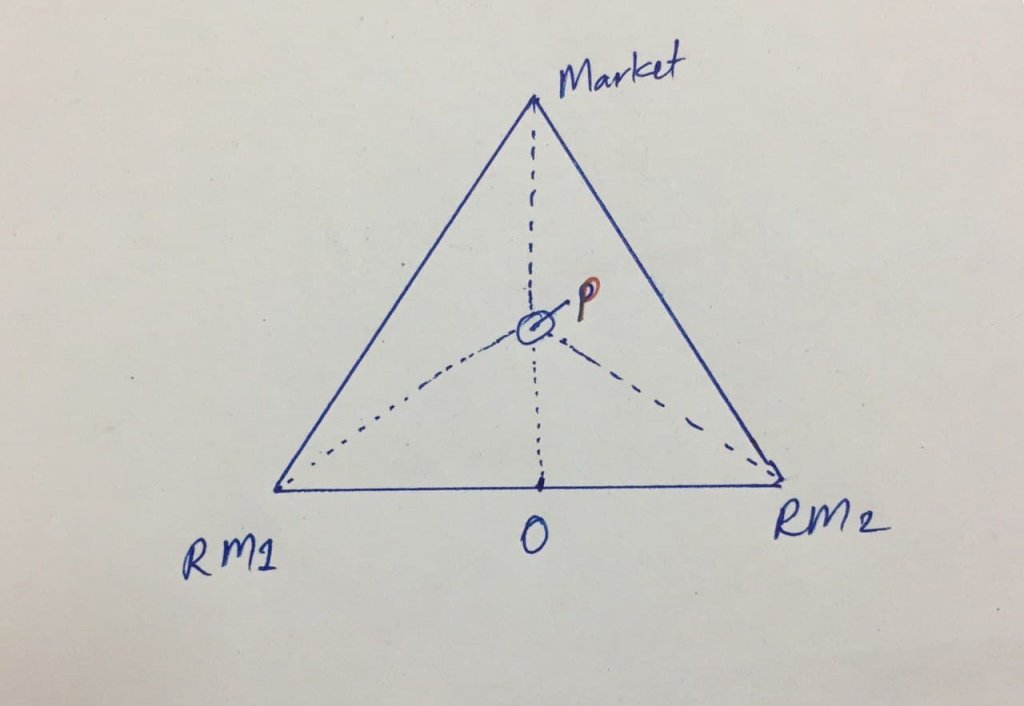
B. If there is a Single market & 2 Raw materials (RM1 & RM2) – a Triangle pattern is formed where the Material Index of each Raw Material & the distance of the market from Raw Material decides the location.
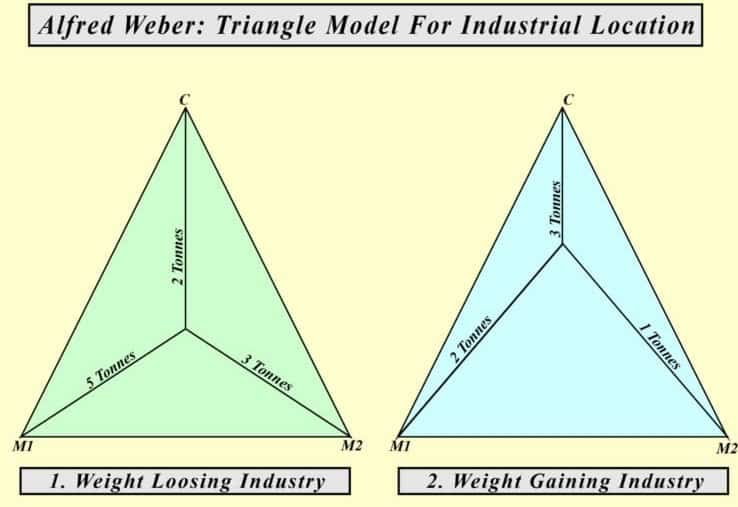
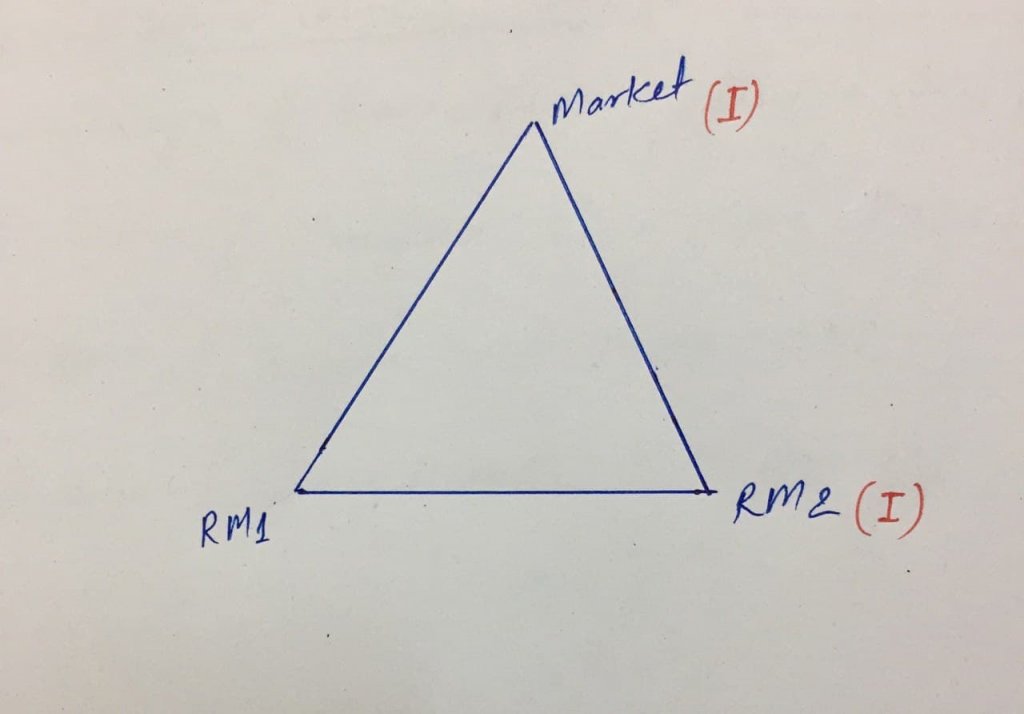
In case of 2 Raw Materials, there are 4 possible locations with a triangular set up –
- (i) If RM1 is Pure & Fixed, RM2 is Gross & Fixed & 3 points (RM1, RM2 & market) are equidistant from each other – Industry can be located either at the market or at RM2.
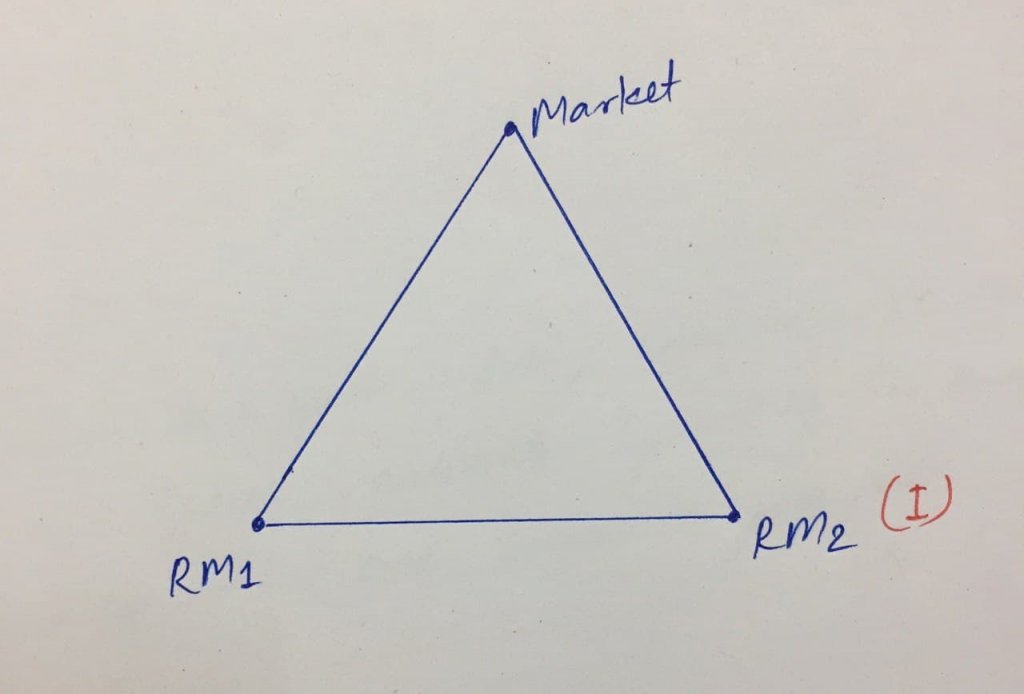
- (ii) If RM1 is Gross & Ubiquitous, RM2 is Gross & Fixed – Industry will be located at RM2.
- (iii) If RM1 is Gross & Fixed and RM2 is also Gross & Fixed, the preferred site of the industry is well defined upon relative weight loosing of Raw Material.
- e.g. Iron & steel (2-ton coal & 2-ton iron ore produce 1-ton steel)
- In this case, Weber considered a complex situation & suggested a centroid location (P) for the industry.
- Since RM1 & RM2 both are fixed & gross – they exert an equal pull.
- Based on Distance Minimization Principle, optimum location P will be closer to the RM sources to save transportation costs.
- The midpoint between RM1 and RM2 is O, which can’t be the optimum location because marketing also exacts its pull & P is the optimum location from where RM1 and RM2 are at the economic distance & also the optimum distance from the market.
- The least transport cost point P is the point at which the total cost of moving raw materials and finished products is the least.
- The location of an industry in a triangular area is closely influenced by the nature of raw material and the Material Index of each raw material.
- If P is shifted along with transportation line MO throughout the market, the transportation cost of Raw Material will be more as the distance of Raw Material from Industry will increase and profit will be less e.g. For Iron & steel industry, 1 Tonne of steel requires 2 Tonne each of Coal and Iron Ore, so optimum location of Industry P will be near to raw material, due to cost of transportation.
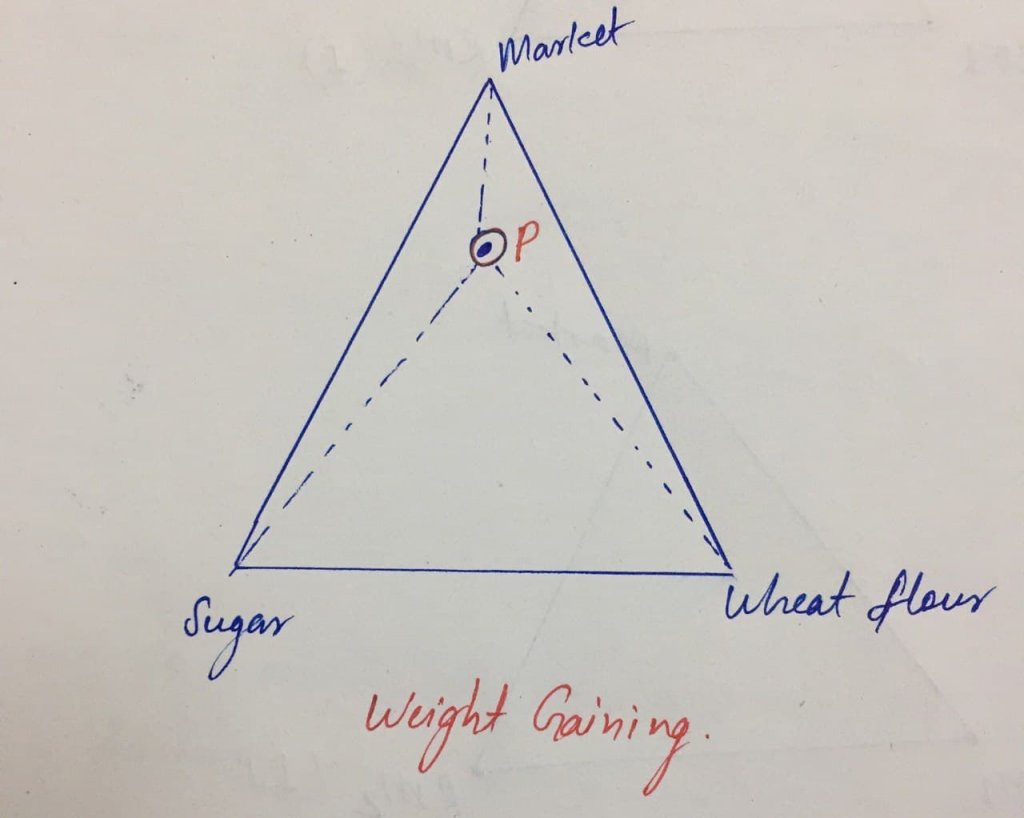
- (iv) If RM1 is Pure & Fixed and RM2 is Pure & Fixed: – For weight gaining industry, optimum location P will be closer to the market because Raw Materials gain weight as they are processed into the final product.
- e.g. In Bakery Industry, 1 T of Sugar and 1 T of Wheat flour make 4 T of Cake
- To save transportation costs, such industries are located near the market.
- e.g. In Bakery Industry, 1 T of Sugar and 1 T of Wheat flour make 4 T of Cake
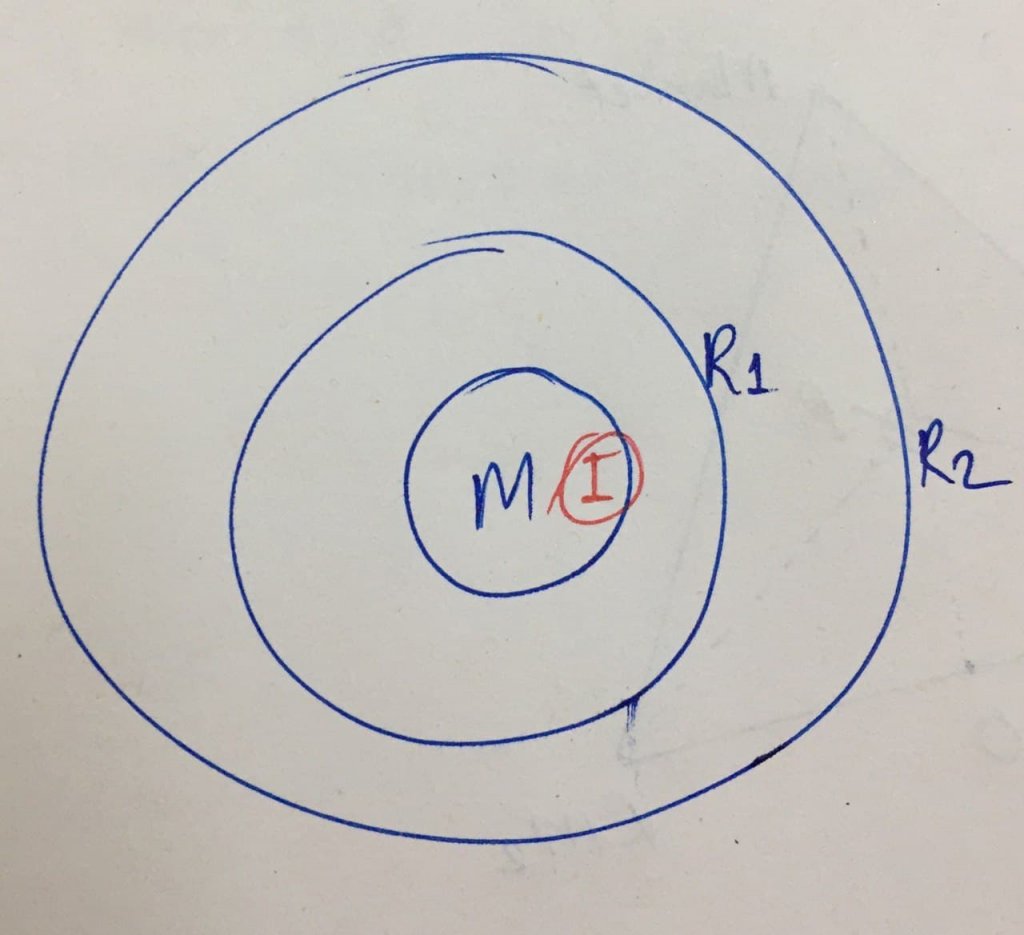
- (v) If both Raw Material are ubiquitous, then ideal location of plant is market.
2. Labour Cost Analysis
- Labour has been considered ubiquitous & static and the savings on labour increase away from the market.
- If any industry is located on Market, Labour cost is maximum
- Transportation costs also increases away from the market & the optimum location P depending on whether the industry is weight gaining or weight losing.
- Weber projected that optimum location P can be further shifted to L if the saving on labour is more than the extra transportation cost incurred leading to extra profit.
- Displacement of industries are thus motivated by profit maximization and to reduce the labour cost, industries can be shifted away from the centroid of the location Δ.
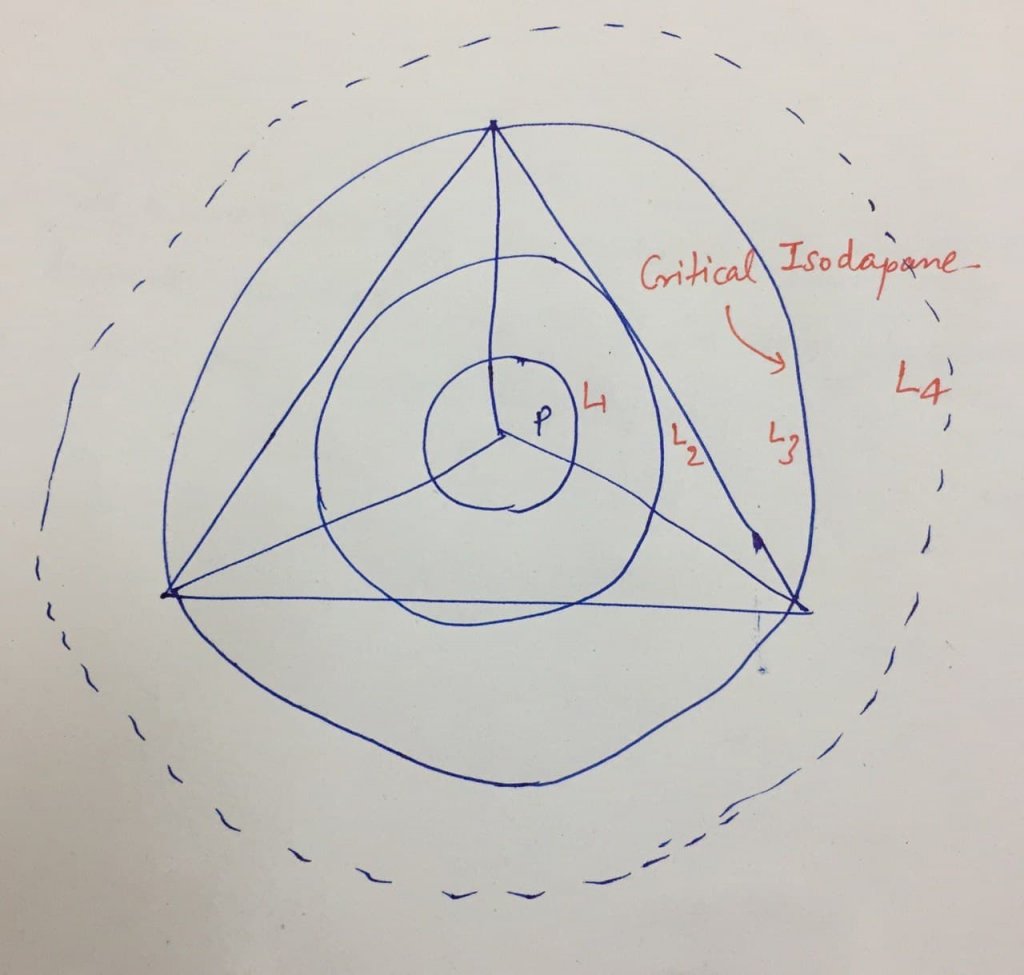
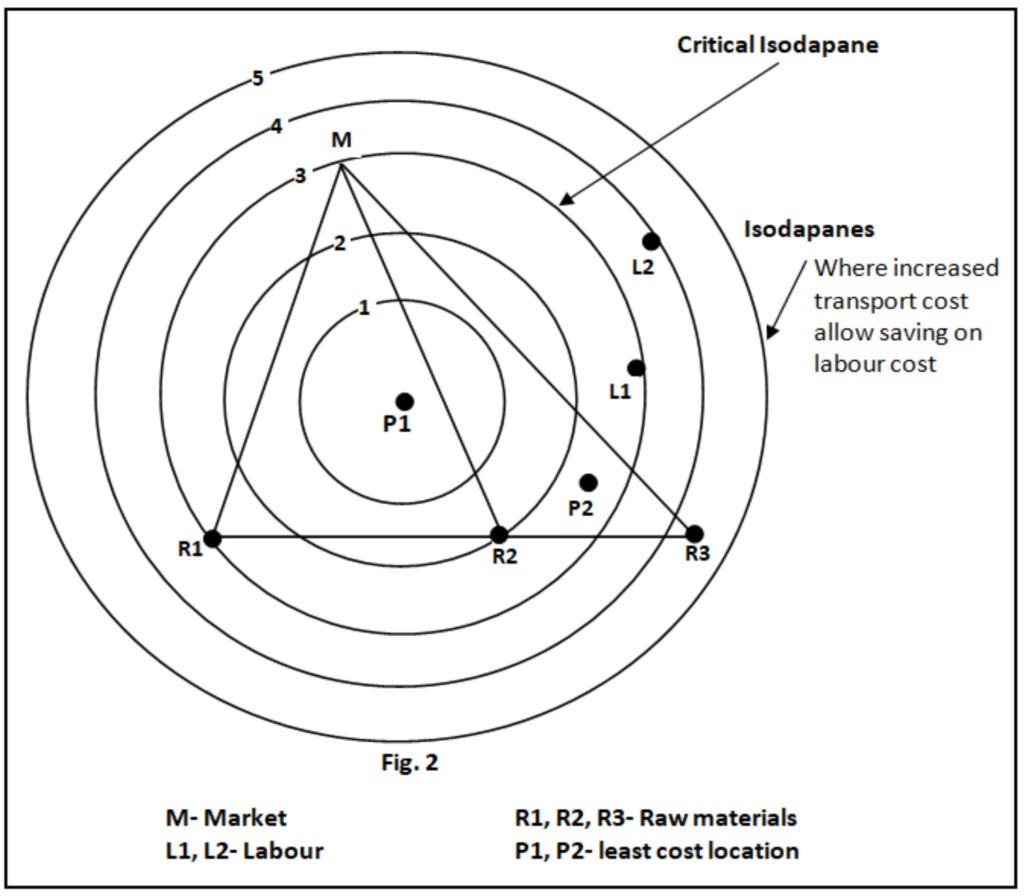
- Weber constructed cost-contour circles called Isodopanes, which are transportation cost circles such as L1, L2, etc
- These circles have the same transportation and labour costs at all points
- L3 is the critical isodopane where the saving on labour & extra transportation cost equalizes beyond which no extra profit can be earned.
- L4 is not a desired location as the transportation cost increases beyond the savings on Labour cost
- In the given example – L2 is the best location where profit can be earned.
- Isodopanes – Lines joining the points of equal additional transportation cost of the two materials and delivering the product to the market.
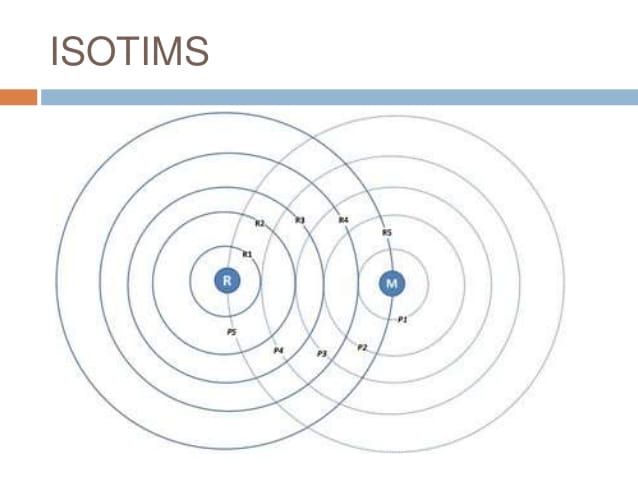
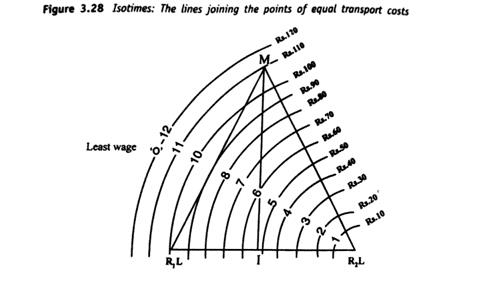
- Isotimes – Lines joining the points of additional equal transport costs of Raw material to the cheap labour centre.
- These costs are additional transportation costs when the location is changed for cheap labour
- All along the Isotimes, transportation cost is same per unit distance.
Isodapene:
- An isodapane is defined as a contour line drawn through all the points with equal total transport costs, with reference to the supply of each input at the point of industrial location, as well as the finished products.
- Isodapane joins those points where increased transport costs are balanced by labour movement cost savings.
Critical Isodapane
- The Critical Isodapane is the specific boundary loop where the additional transport costs exactly equal the labour savings offered by an alternative site.
- If a cheap labor center lies inside the critical isodapane, the labor savings exceed the added transport costs. The plant will shift to the labor center.
- If the labor center lies outside the critical isodapane, the added transport costs outpace the labor savings, and the industry stays at the least-transport-cost point.
3. Processing Cost Analysis (Role of agglomeration)
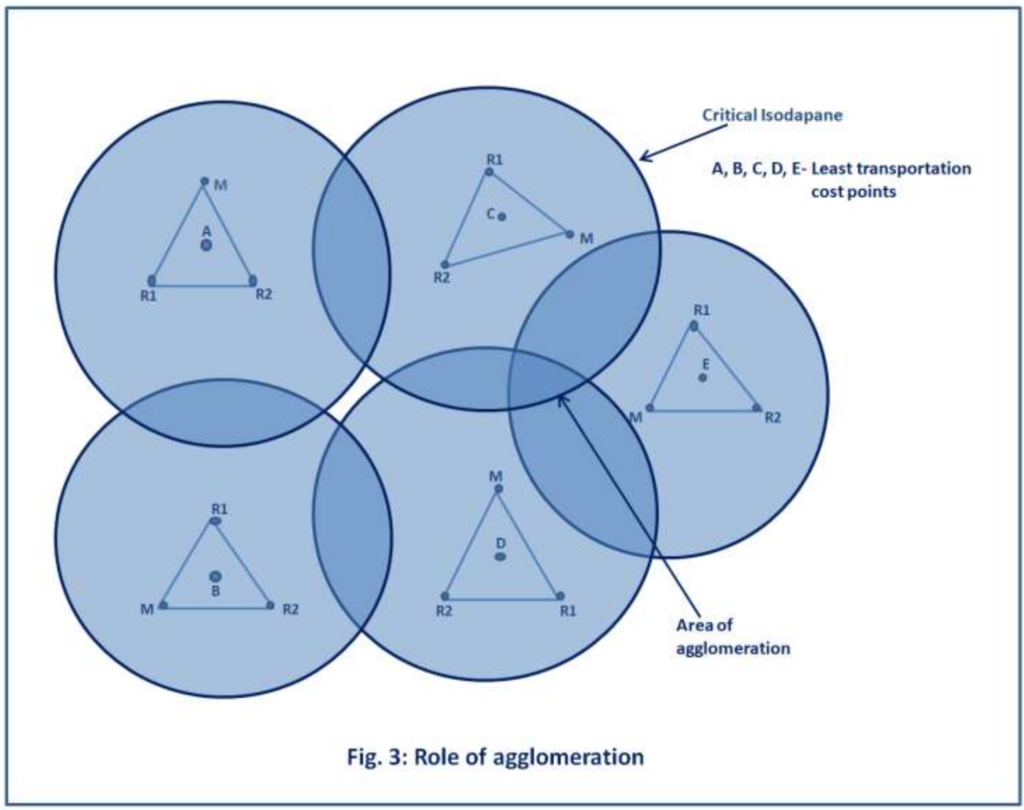
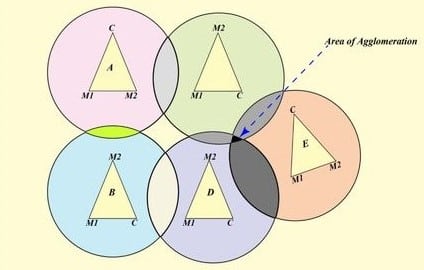
- Weber suggested that if 3 or more industries are located at a single point, the processing cost can be reduced , because of common use of infrastructure such as electricity, roads, etc & saving on processing cost can be made
- This is called the agglomeration effect which is the interference of 3 (at least 3) critical isodopane
- New industries should come up at the agglomeration area & even the existing industries can be shifted to it e.g. In Mumbai, Industries come up due to agglomeration effect
- But such shifting of Industries is again based on the saving on processing & extra transportation cost.
Application
- Weber’s model has no universal application because it is an idealistic & normative deductive model. However, it can be applied in USA and Europe Man is neither economic nor rational and can act differently in different situation
- Even isotropic surface is hypothetical situation
- Thus, such models are bound to have deviation from reality
- But they act as parameters for measurement of reality & departure from reality.
USA
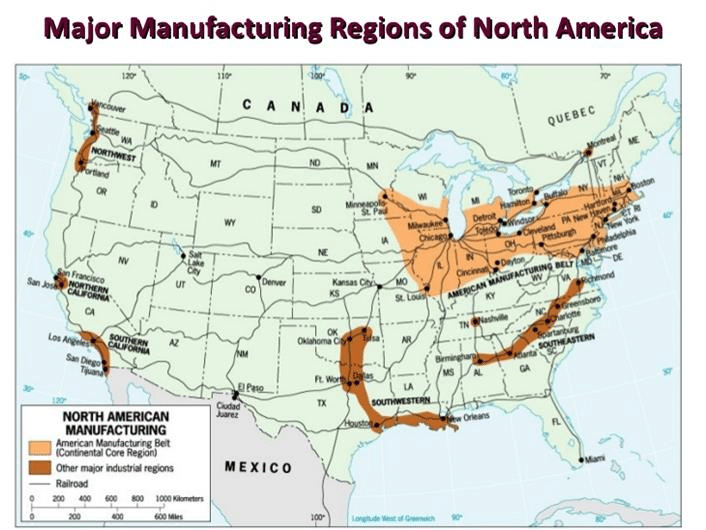
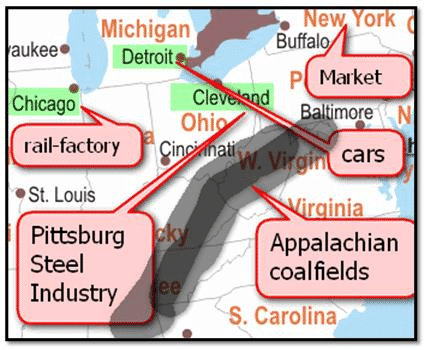
- W-Isard- has applied Weber’s model in the USA for Weight losing Industry
- Coal from Pennsylvania & North Appalachians
- Iron ore from Lake superior &
- Market at New England region & transportation line as St. Lawrence lake region
- All the Iron & Steel industries are found in a cluster which are similar to optimum location as delivered by Weber
- For example- Industries at Pittsburgh, Youngtown, Buffalo, Chicago are closer to the raw material.
Europe
- It was further applied in Europe for weight gaining industries like Bakery
- Market is the London-Rotterdam triangle
- Sugar is produced in Poland, Russia & Some parts of Germany
- Wheat flour in Ukraine, Hungary & Romania, Bulgaria, etc
- Bakery industries mostly in BENELUX (Belgium, Netherland, Luxembourg).
Application in India
- India- TISCO, Jamshedpur
- Raw Material is the most important determinant for the location of the TISCO plant in Jamshedpur
- Haematite Iron ore –Gurumahisani and Noamundi, Singhbhum within 100 km
- Coal- Jharia (Jharkhand) & Raniganj (WB), within 200 Km
- Calcutta- Port & Industrialized hinterland for market within 250 km
- Water- Subarnarekha river for cooling purpose
- Labour- Cheap & abundant: Bihar, Chota Nagpur (Tribal), Orissa.
- Good transport facility
- NH6 (Mumbai-Kolkata)
- NH5 (Chennai-Kolkata)
Applicability
- 19th & 20th century industrial location reflects resemblance with the model but modern industrial locations are affected by many other factors e.g. Iron & Steel in USA, Bakery in Europe, etc
- Transportation principle lost significance but the relationship between distance, volume & transportation costs still holds good
- Labour principle lost its significance due to high mobility & demand for skilled labour. However, developing countries still attract MNCs for their low labour costs. e.g. Around 11 million people work in middle east as labour due to mobility, Skilled Labour demand is rising, etc
- Agglomeration principle has high validity even today. E.g. Cluster Approach, SEZs, Export Oriented Units, Export Processing Zones, etc are based on these principles
- Post liberalization & globalization, industry considers both domestic & foreign market so preferred the location has become ports now for easy transportation
- Presently, Raw Material is also received from foreign countries. Also, the quality of Raw materials has attained greater significance which was not mentioned in Weber’s Model. For E.g. Quality Iron ore in India is imported from Australia
- Revolution in transportation facilities like refrigerated transportation has influenced locations greatly and nowadays, even perishable products can be transported to any distance. E.g.- Milk products from Gujarat are sent as far as to Kolkata today
- Modern transportation facilities have made the bulk carrying easier & cheaper even for the longer distance
Criticism
- Many assumptions made were unrealistic and such conditions are rarely found in real world
- The greatest challenge came from the Maximum Revenue Theory of Losch where the demand was not fixed rather cost was fixed because demand fluctuated in the market which is more practical
- Weber considers only 2 Raw Materials but many industries required more than 2 Raw Materials
- Single market for industries is also an insufficient assumption e.g. Cotton Industry in India has to market all over the country
- Too much emphasis on transport cost. Even the labour cost analysis & the agglomeration effects have been calculated in relation to the transport Cost. In modern days, Processing Cost has become more significant than transportation cost
- Transportation cost is proportionate to distance & weight but RM transportation is cheaper than finished goods. Also with an increase in distance, transportation cost decreases
- After the revolution in transportation & communication sectors, his model has become redundant because faster & cheaper modes of transportation like railways, waterways have reduced the role of transportation as the imposing factor
- Price is fixed for products but the price always fluctuates & is controlled by demand & supply mechanism
- Assumed perfect competition which in long run is difficult to sustain
- Role of influence of agglomeration factors ignored other factors such as space problem, energy crisis, etc. as agglomeration provides many other benefits
- Historical factors such as Inertia not taken in account e.g. India had Mumbai, Delhi, Kolkata as industrial cities before independence so it was a natural choice of Industries post-independence
- Physiographic & Climatic hazards & Geographical landscapes have been idealized into isotropic surfaces. Thus, this model has lesser practically
- Ignored Social, Political & other Human Considerations. In India, during the 2nd Five Year Plan, Government intervention led to the expansion of Iron & Steel industry, Government policy on the SSI locator in India reverses the trend visualized by Weber.
- An export-oriented unit would prefer a port location to have easy shipment rather than the least transport cost location of Weber
- Increased complexity of industrial organization with single product factory of 20th century replaced by multi-product international corporation. Thus Weber theory difficult to apply
- Entrepreneur do not have full knowledge of facts, thus they opt for a range of suboptimal locations rather than optimum location
- He gave more emphasis to supply, while the role of demand in the location of the industry has been ignored.





Wonderful structured thank you for helping us
Most Welcome Neeraj, Keep reading
Thanks a lot for these beautiful and resource rich notes sir..These notes will help self studying students..
Most welcome Srushti, Keep reading
Thank you very much sir for supporting us guiding us and special thanks for to making such wonderful notes..
Most welcome Vishal, Keep reading.
thanks a lot for the material.. sir.. kindly post the material for full syllabus before prelims…
Highly useful initiative thank u very much sir \ madam
Perfectly organised material..thanku for this one…I really need it
Thnq very much for elaborating this model in a very simple n layman language really ths helps me alottt..tnq very mch
Sir, I want to purchase your notes as pdfs which are available but sir if I have some doubts in understanding some topics will u be there for doubt clearing?
Hey sir/mam when u r going to update these notes as per the recent 2022 data…nd thnks for the well defined nd crisp notes….highly grateful….
Thank you sir,wish you ll become IAS OFFICER
great explanation sir ji