- Wind is air moving horizontally over the earth’s surface; vertical movements are called air currents. Winds are named after the direction they blow from.
- Four forces decide a wind’s speed and direction: the pressure gradient force, the Coriolis force, friction, and the centripetal acceleration needed when the path curves.
- Only the pressure gradient force starts the air moving. The other three modify the motion once it has begun, and the balance between them gives the geostrophic, gradient and surface winds.
Pressure Gradient Force

- The pressure gradient is the rate of change of pressure per unit distance at right angles to the isobars; it is also called the barometric slope.
- The pressure gradient force (PGF) pushes air from high to low pressure, at right angles to the isobars.
- Its strength is proportional to the gradient and inversely proportional to air density.
- Closely spaced isobars give strong winds (around a tropical cyclone); widely spaced isobars give light winds (the doldrums, the centre of an anticyclone).
- Indian example: the steep gradient between the summer heat low over north-west India and the high over the southern Indian Ocean drives the south-west monsoon across the Arabian Sea.
Coriolis Force
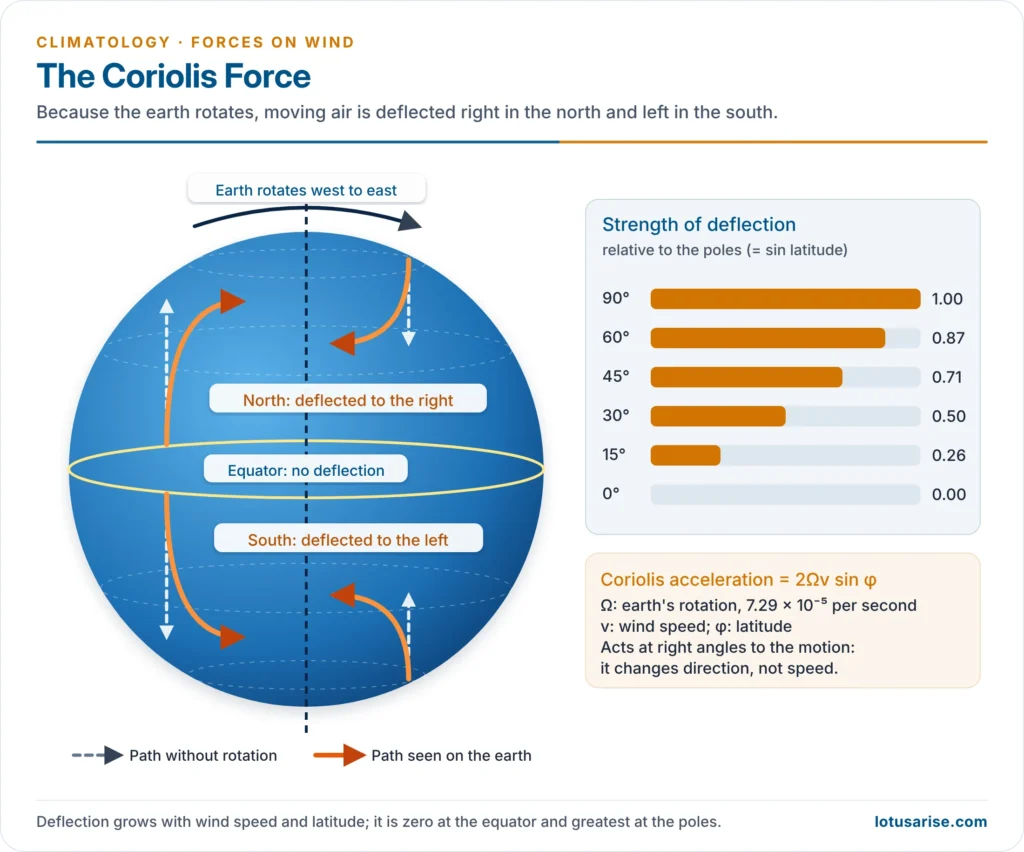
- The Coriolis force is an apparent force caused by the earth’s rotation: the ground turns beneath moving air, so the air’s path appears deflected. It is named after Gaspard-Gustave de Coriolis (1835), who described it mathematically.
- Ferrel’s law (William Ferrel, 1856): all moving bodies are deflected to the right in the northern hemisphere and to the left in the southern hemisphere.
- Properties:
- Its magnitude is 2Ωv sin φ (Ω = the earth’s angular velocity, v = wind speed, φ = latitude): zero at the equator, maximum at the poles.
- It is proportional to wind speed: the faster the wind, the stronger the deflection.
- It acts at right angles to the motion, so it changes direction, not speed.
- It matters for large-scale, long-lasting motion; for small, brief motions it is negligible.
- Evidence in wind systems:
- Air moving to the equator becomes the north-east and south-east trade winds.
- The south-east trades cross the equator and turn right into the south-west monsoon of India.
- Cyclones spin anticlockwise in the northern hemisphere and clockwise in the southern.
- Tropical cyclones rarely form within about 5° of the equator, where the deflection is too weak to start a spin; Typhoon Vamei (December 2001), near Singapore at about 1.5° N, is the rare exception.
Geostrophic Wind
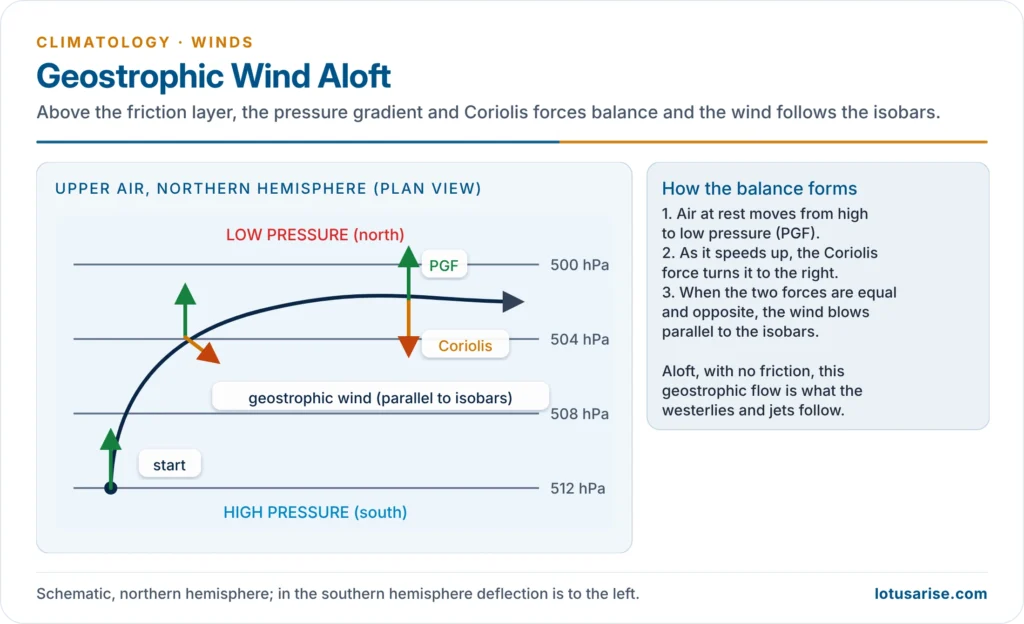
- Mechanism: air starts moving towards low pressure; the Coriolis force deflects it and grows as the air speeds up, until the PGF and the Coriolis force are equal and opposite. The wind then blows parallel to the isobars at a steady speed. This is the geostrophic wind.
- Where: above the friction layer, roughly above 1 km, over straight isobars; the upper westerlies and the jet streams are nearly geostrophic.
- Speed is directly proportional to the pressure gradient (inversely to the spacing of isobars), and inversely proportional to the sine of latitude and to air density.
- The same gradient gives a faster wind at low latitudes, and the balance breaks down near the equator, where the Coriolis force vanishes.
- Buys Ballot’s law (Christophorus Henricus Diedericus Buys Ballot, 1857): in the northern hemisphere, if you stand with your back to the wind, low pressure is on your left and high pressure on your right; the reverse holds in the southern hemisphere.
- It applies strictly to the wind aloft; near the ground, friction and relief disturb it.
- Relationship between barometric slope and circulation: the slope decides speed, the Coriolis force decides direction. Forecasters therefore read upper winds directly from the isobars of upper-air charts.
Gradient Wind and Centripetal Acceleration
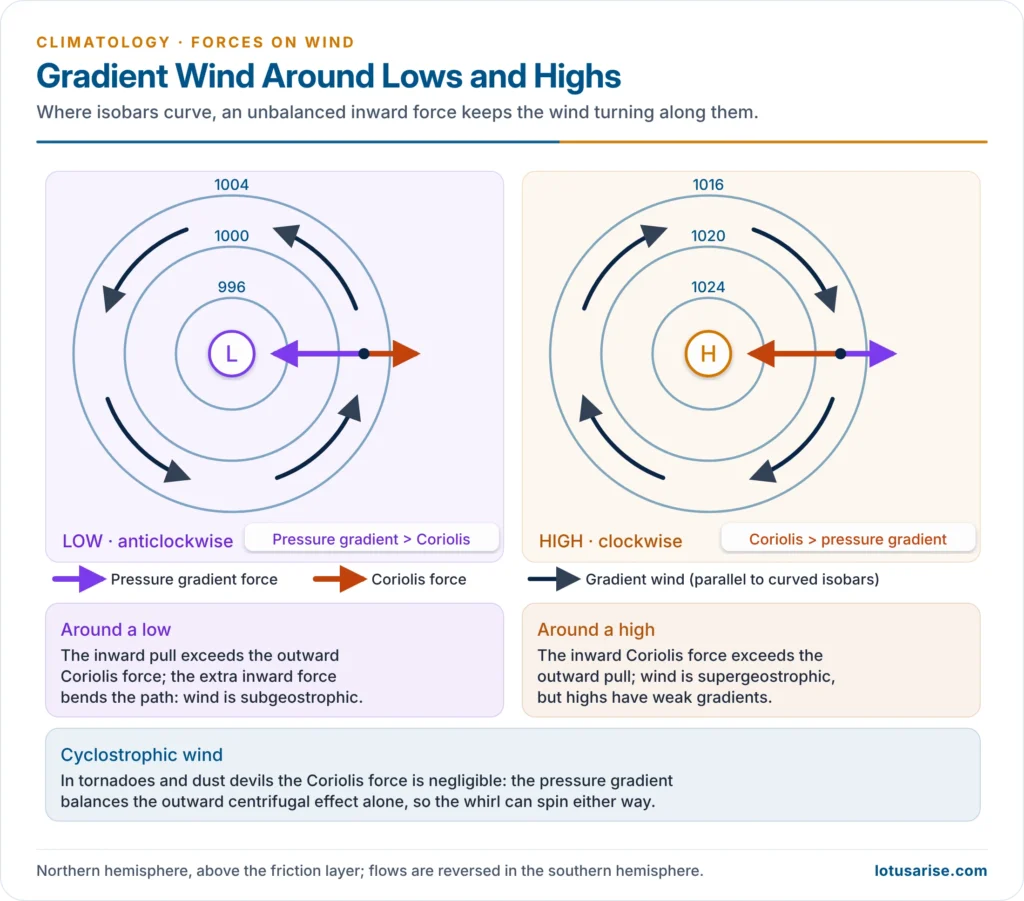
- Where isobars are curved, as around cyclones and anticyclones, air can follow them only if a net inward (centripetal) force keeps bending its path. The PGF and the Coriolis force are then unequal. The outward centrifugal effect of the curved motion is equal and opposite to this centripetal acceleration.
- The wind that blows parallel to curved isobars, with the PGF, the Coriolis force and the centrifugal effect in balance, is the gradient wind.
- Around a low: the inward PGF exceeds the outward Coriolis force; the flow is anticlockwise in the northern hemisphere and slower than geostrophic (subgeostrophic).
- Around a high: the inward Coriolis force exceeds the outward PGF; the flow is clockwise and faster than geostrophic (supergeostrophic).
- Real cyclones still have stronger winds than anticyclones because their pressure gradients are far steeper; a high’s gradient must stay weak near its centre.
- Cyclostrophic wind: in small, intense whirls (tornadoes, waterspouts, dust devils, the inner core of a tropical cyclone), the Coriolis force is negligible and the PGF is balanced by the centrifugal effect alone. Such whirls can turn either way.
Friction and the Ekman Spiral
- Surface friction acts in the lowest layer of the atmosphere, the friction layer (planetary boundary layer), roughly 1 km deep. Eddies carry the drag of the ground upward.
- Effects:
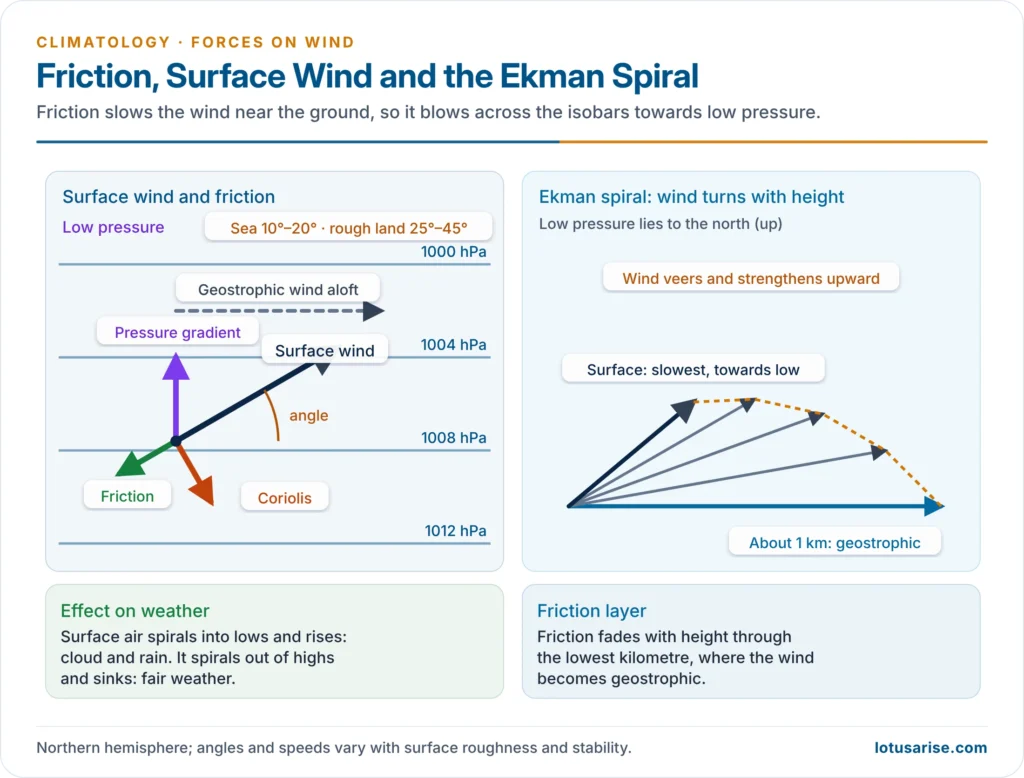
- Friction slows the wind; since the Coriolis force depends on speed, it weakens, the PGF wins, and the wind blows across the isobars towards low pressure.
- Over the sea, the angle is about 10°–20° and speed is roughly two-thirds of geostrophic; over rough land, it is 25°–45° and speed is much lower.
- Surface air therefore spirals into lows, converges and rises (cloud and rain), and spirals out of highs, diverging and sinking (fair weather).
- Ekman spiral (Vagn Walfrid Ekman, 1905): as friction decreases with height, the wind increases in speed and turns (clockwise, or veers, in the northern hemisphere) until it becomes geostrophic at about 1 km. Plotted from above, the wind directions trace a spiral.
- Indian example: over the plains, surface winds cut across the isobars into the monsoon trough, feeding convergence and rain along it.
| Wind | Forces in balance | Relation to isobars | Where |
|---|---|---|---|
| Geostrophic | PGF = Coriolis | Parallel, straight | Above about 1 km; jet streams |
| Gradient | PGF, Coriolis, centrifugal | Parallel, curved | Aloft around lows and highs |
| Cyclostrophic | PGF = centrifugal | Circular, tight | Tornadoes, dust devils |
| Surface (friction) | PGF, Coriolis, friction | Crosses at 10°–45° towards low | Lowest 1 km |