🏆 Best Geography Optional Coaching in India
Choosing the right Geography Optional coaching is one of the most decisive factors in securing a top rank in the UPSC Civil Services Examination. Geography remains one of the most popular optionals due to its scientific nature, overlap with GS, and scoring potential, but success depends heavily on conceptual clarity, answer writing, and expert guidance.
When it comes to Geography Optional in UPSC, the difference between an average score (240–260) and a top score (300+) is not the subject — it is the teacher, mentorship, and answer-writing guidance.
In memory: Himanshu Sharma Sir, who taught the Geography Optional programmes featured on this page, passed away in September 2026. We have updated this guide to remember his contribution. Read our tribute to Himanshu Sharma Sir.
Until September 2026, the Geography Optional programmes featured on LotusArise were taught by Himanshu Sharma Sir, one of the most respected Geography Optional teachers in India. This guide explains how to judge any Geography Optional coaching on the parameters that defined his results, and what LotusArise offers for self-study today.
Results from Himanshu Sharma Sir’s Students (Proof of What Works)
- The biggest indicator of the best Geography Optional coaching is not marketing — it is marks scored by students in UPSC Mains.
- 📊 Real Performance Indicators:
- Students under Himanshu Sharma Sir consistently scored:
- 300+ marks in Geography Optional
- Among the highest marks in the subject in multiple years
- Students under Himanshu Sharma Sir consistently scored:
- 🧾 Example: Topper-Level Performance
- Pratham Kaushik (UPSC Topper)
- 👉 Scored exceptionally high marks (327) in Geography Optional
- 👉 Followed a structured answer writing + concept clarity approach under the expert guidance of Himanshu Sharma Sir, 500+ batch
- Multiple students mentored by Himanshu Sharma Sir:
- Achieved 280–320 marks range {Deepti Rohilla (AIR 39, 323 marks, 2023), Banna Venkatesh (AIR 15, 296 marks, 2024), and Prajnandan Giri (AIR 24, 284 marks, 2023)}
- Demonstrated strong performance in:
- Paper 1 (concept-heavy)
- Paper 2 (application + Indian Geography)
- Pratham Kaushik (UPSC Topper)
- 👉 These results show what a structured, answer-writing-first approach can achieve in Geography Optional.

🎯 Why Geography Optional Needs Coaching?
Geography Optional is often perceived as a “safe and scoring subject”, but insights from UPSC toppers, Quora discussions, and Reddit communities reveal a more nuanced reality: Geography Optional is not difficult — but scoring high (280–320+) is extremely strategy-dependent.
- 🧠 Transition from “Static Subject” to Analytical Optional
- A common myth among beginners is that Geography Optional is largely NCERT + Reference books + factual recall.
- Reality (as highlighted by toppers & aspirants online):
- Questions are increasingly:
- Analytical (e.g., application of theories)
- Interdisciplinary (linking climate, economy, society)
- Requires:
- Integration of Paper 1 (concepts) with Paper 2 (India-specific)
- Questions are increasingly:
- 👉 Without guidance, aspirants often:
- Write generic answers
- Fail to apply theoretical frameworks and the perspective of Geographical Thought.
- ✍️ Answer Writing is the Real Game-Changer
- Across Quora and Reddit discussions, one consistent insight emerges: “Most Geography Optional students know content, but fail in answer presentation.”
- Common issues faced by self-study aspirants:
- Lack of structured answers
- Poor use of:
- Diagrams
- Flowcharts
- Maps, Case studies, etc.
- Inability to:
- Address directive keywords (analyze, examine, discuss)
- 👉 Coaching provides:
- Model Answers
- Continuous evaluation
- Improvement feedback loop
- 📊 Narrow Margin Between Average and Top Scores
- UPSC data trends show:
- Large number of candidates score:
- 240–260 marks (average band)
- Very few reach:
- 280–320+ (top band)
- Large number of candidates score:
- Why does this gap exist?
- Same content, but difference in:
- Presentation
- Conceptual clarity
- Answer enrichment
- Same content, but difference in:
- 👉 This “last-mile improvement” is where coaching plays a decisive role.
- UPSC data trends show:
- 🧩 Complexity of Syllabus & Resource Overload
- Geography Optional syllabus appears concise, but in reality:
- Covers:
- Physical Geography (technical concepts)
- Human Geography (theories & thinkers)
- Indian Geography (dynamic + current affairs)
- Covers:
- Problem faced by aspirants:
- Too many sources:
- NCERTs
- Standard and Reference books
- Coaching materials
- Confusion about:
- What to read
- What to skip
- Too many sources:
- 👉 Coaching solves this by:
- Providing filtered, exam-oriented content
- Structuring preparation in logical sequence
- Geography Optional syllabus appears concise, but in reality:
- 🧑🏫 Importance of Guidance in Thinkers & Theories
- Human Geography (Paper 1) includes:
- Thinkers like:
- Hartshorne
- Vidal de la Blache
- Christaller, etc.
- Thinkers like:
- Challenge:
- Students memorize theories but fail to:
- Apply them in answers
- Use them as value addition
- Students memorize theories but fail to:
- 👉 Coaching helps in:
- Converting theory → answer-writing tool
- Demonstrating:
- Where to use which thinker
- How to enrich answers
- Human Geography (Paper 1) includes:
- 🌍 Integration with Current Affairs
- Recent UPSC papers show:
- Increasing weightage of:
- Climate change
- Disaster management
- Urbanization issues
- Increasing weightage of:
- Self-study limitation:
- Difficulty in:
- Integrating current affairs with static content
- Difficulty in:
- 👉 Coaching provides:
- Ready-made:
- Case studies
- Examples
- Contemporary linkage
- Ready-made:
- Recent UPSC papers show:
- 📈 Test Series & Feedback Loop (Most Underrated Factor)
- From aspirant discussions online: “Writing answers is easy, but improving answers is difficult without feedback.”
- Without coaching:
- No evaluation benchmark
- Repeating same mistakes
- With coaching:
- Regular tests
- Expert feedback
- Performance tracking
- 👉 This creates:
- Continuous improvement
- Answer refinement
- Without coaching:
- From aspirant discussions online: “Writing answers is easy, but improving answers is difficult without feedback.”
- ⚖️ When Coaching is NOT Mandatory
- Geography Optional can be done without coaching if:
- Strong academic background (Geography graduates)
- Ability to:
- Analyze PYQs deeply
- Evaluate own answers critically
- Access to:
- Good peer group
- 👉 However, even toppers often highlight: Mentorship or test series becomes necessary at some stage.
- Geography Optional can be done without coaching if:
What the Best Geography Optional Coaching Should Offer
In the UPSC ecosystem, the term “best coaching” is often overused. Judge any Geography Optional coaching on objective parameters: who actually teaches, verifiable topper results, answer-writing outcomes and consistency in high scores. These were the parameters behind Himanshu Sharma Sir’s results, and they remain the right test for any institute.
The real strength of a coaching programme lies not in marketing claims, but in a systematic approach to converting aspirants into high scorers (280–320+ range). Look for the following.
- 📚 One Consistent, Experienced Teacher (Core Differentiator)
- The best programmes are faculty-driven rather than institution-driven, ensuring consistency in teaching quality and strategy throughout the preparation cycle. Always check who will actually teach you.
- Himanshu Sharma Sir was widely recognised for exactly this: deep conceptual clarity and UPSC-oriented pedagogy, focused not just on covering the syllabus but on decoding the demand of questions asked by UPSC.
- Unlike many institutes where multiple teachers create fragmentation, one teacher gives students a single, coherent strategy across all topics, leading to better retention and conceptual interlinkages.
- His teaching emphasized:
- Converting static content into analytical frameworks
- Using diagrams, flowcharts, and models effectively
- Building multi-dimensional answers required for top scores
- Over the years, his mentorship resulted in consistent production of high scorers, which established strong credibility.
- 🏅 Proven Track Record of High Scorers (Topper-Oriented Ecosystem)
- Good coaching is not merely focused on course delivery; it is designed around a results-first philosophy, where the ultimate metric is marks obtained in UPSC Mains.
- For example, students guided by Himanshu Sharma Sir repeatedly achieved:
- 300+ marks in Geography Optional (like Pratham Kaushik, Deepti Rohilla), which is considered an elite score range.
- Strong performance across both Paper 1 (conceptual) and Paper 2 (applied Indian Geography)
- Look for coaching that openly shares:
- Topper copies and marksheets
- Real answer scripts for analysis
- This creates a replicable success model, where aspirants can understand:
- What a 250-mark answer looks like vs a 300-mark answer
- Such transparency is what makes a programme far more credible than generic coaching platforms.
- ✍️ Strong Emphasis on Answer Writing (Key to 300+ Marks)
- One of the biggest gaps in Geography Optional preparation is that aspirants often accumulate knowledge but fail to translate it into high-quality answers within time constraints.
- Good coaching addresses this through:
- Structured answer writing programs aligned with PYQs.
- Continuous practice with topic-wise and full-length questions.
- Special focus is given to:
- Use of relevant diagrams and maps (a decisive factor in Geography answers)
- Integration of thinkers and theories in Human Geography
- Inclusion of case studies and current examples in Indian Geography
- A good evaluation system ensures:
- Detailed feedback on content, structure, and presentation
- Identification of weak areas and targeted improvement
- This systematic refinement process enables aspirants to move from average answers to rank-level answers.
- 🧠 Concept + Application Integrated Teaching Approach
- Unlike traditional coaching models that rely on rote memorization and bulky notes, the best coaching adopts a conceptual and application-driven methodology.
- Every topic is taught with a focus on:
- “Why does this concept exist?”
- “How can it be applied in a UPSC answer?”
- There is a strong emphasis on:
- Linking Paper 1 concepts with Paper 2 case studies
- Using real-world geographical examples (e.g., urbanization, climate change, disasters)
- This approach aligns perfectly with the changing trend of UPSC, where questions increasingly test:
- Analytical ability
- Interdisciplinary thinking
- As a result, students develop the ability to write value-enriched, multi-dimensional answers, which significantly boosts marks.
- 📊 Scientifically Designed Test Series & Evaluation Mechanism
- A good test series is not just a formality but a core component of preparation strategy, aimed at simulating real UPSC conditions.
- It includes:
- Sectional tests (topic-wise mastery)
- Full-length tests (exam simulation)
- The evaluation process focuses on:
- Answer structure and coherence
- Use of diagrams and examples
- Relevance to the question demand
- Students should receive:
- Detailed feedback
- Comparative performance insights
- This creates a continuous feedback loop, which is essential for:
- Improving answer quality
- Enhancing speed and time management
- Such structured evaluation is often missing in self-study, making this a major advantage.
- 🧑🏫 Personalized Mentorship & Strategy Building
- Geography Optional preparation varies significantly across aspirants depending on:
- Background (science vs humanities)
- Attempt stage (beginner vs experienced)
- Good coaching provides personalized mentorship, which includes:
- Individual strategy planning
- Continuous performance monitoring
- Guidance on:
- Resource selection
- Answer writing improvement
- This ensures that aspirants:
- Avoid common mistakes
- Stay consistent and focused
- Mentorship becomes especially crucial for:
- Repeat aspirants aiming for rank improvement
- Beginners needing structured direction
- Geography Optional preparation varies significantly across aspirants depending on:
- 📖 Highly Structured & Filtered Content (No Information Overload)
- One of the biggest challenges in Geography Optional is resource overload, where aspirants struggle with multiple books and materials.
- The best coaching solves this by providing:
- Highly curated and exam-oriented notes
- Content aligned strictly with:
- UPSC syllabus
- Previous year questions
- The focus is on:
- Quality over quantity
- Relevance over bulk content
- This enables aspirants to:
- Revise effectively
- Retain concepts longer
- The structured content acts as a single, reliable source, reducing confusion and saving time.
- 🌍 Alignment with Changing UPSC Trends
- Recent UPSC trends show a shift towards:
- Analytical questions
- Application-based answers
- Interdisciplinary approach
- Good coaching keeps its content and teaching updated with:
- Latest PYQ analysis
- Current affairs integration
- Students are trained to:
- Incorporate contemporary examples
- Address dynamic aspects of Geography
- This ensures that preparation remains relevant and future-oriented, rather than outdated.
- Recent UPSC trends show a shift towards:
- ⚖️ Marks Over Bulk
- Most coaching institutes focus on:
- Completing syllabus
- Providing bulky notes
- The best coaching focuses on:
- Maximizing marks
- Building answer-writing excellence
- Producing toppers consistently
- The combination of:
- Experienced, consistent faculty
- Proven results
- Structured methodology
creates a competitive advantage that is difficult to replicate.
- Most coaching institutes focus on:
Remembering Himanshu Sharma Sir
In Geography Optional preparation, the role of a teacher is not limited to completing the syllabus — it is about shaping the aspirant’s thinking, answer-writing ability, and conceptual clarity. Himanshu Sharma Sir, who passed away in September 2026, was one of the most respected Geography Optional teachers in India, known for producing consistent high scorers and rankers in UPSC CSE. Read our tribute to him.
What Made Himanshu Sharma Sir’s Teaching Stand Out
- Result-Oriented Teaching Approach (Marks-Focused, Not Content-Focused)
- Unlike conventional coaching where emphasis is on bulk content coverage, Himanshu Sharma Sir’s methodology was centered on maximizing marks in UPSC Mains.
- Every topic was taught with a clear objective:
- What UPSC asks from this topic
- How to structure answers to score maximum marks
- This approach directly bridges the gap between knowledge and marks, which is where most aspirants struggle.
- Proven Track Record of High Scorers (300+ Marks Range)
- Students mentored by Himanshu Sharma Sir consistently achieved:
- 280–320+ marks in Geography Optional
- Several aspirants secured top ranks in UPSC with Geography Optional under his guidance.
- His mentorship helped aspirants move from:
- Average performance → Top percentile performance
- This consistent result pattern established him as a credible and performance-driven mentor.
- Students mentored by Himanshu Sharma Sir consistently achieved:
- Deep Conceptual Clarity with Interlinking of Topics
- Geography Optional is not a fragmented subject; it requires:
- Linking Geomorphology with Indian landforms
- Connecting Climatology with monsoon system
- Himanshu Sharma Sir specialized in:
- Building strong conceptual foundations
- Teaching how to interlink topics across Paper 1 and Paper 2
- This enables aspirants to write multi-dimensional answers, which are essential for high scores.
- Geography Optional is not a fragmented subject; it requires:
- Mastery in Answer Writing (Key Differentiator)
- One of the biggest advantages of learning under Himanshu Sharma Sir was his focus on answer writing excellence, which is the decisive factor in UPSC Mains.
- Students were trained to:
- Structure answers logically (Introduction–Body–Conclusion)
- Use diagrams, maps, and flowcharts effectively
- Incorporate:
- Thinkers (Human Geography)
- Case studies (Indian Geography)
- His evaluation approach ensured:
- Continuous improvement
- Elimination of repeated mistakes
- Use of Diagrams, Models, and Value Addition Techniques
- Geography is one of the few subjects where visual representation can significantly boost marks.
- Himanshu Sharma Sir emphasized:
- Use of neat and relevant diagrams
- Representation of concepts through:
- Models
- Flowcharts
- This makes answers:
- More analytical
- More examiner-friendly
- UPSC-Centric Teaching (Aligned with PYQs & Trends)
- His teaching was deeply rooted in:
- Previous Year Questions (PYQs)
- Changing trends of UPSC
- Students were trained to:
- Identify recurring themes
- Understand examiner expectations
- This kept preparation:
- Focused
- Relevant
- Exam-oriented
- His teaching was deeply rooted in:
- Structured Preparation Model (From Basics to Advanced Level)
- Himanshu Sharma Sir followed a step-by-step preparation model, ensuring clarity at every stage:
- Foundation building (concepts)
- Advanced application (answer writing)
- Final refinement (test series + feedback)
- This structured approach was particularly beneficial for:
- Beginners
- Non-geography background aspirants
- Himanshu Sharma Sir followed a step-by-step preparation model, ensuring clarity at every stage:
- Mentorship Beyond Classroom Teaching
- His role extended beyond teaching into:
- Strategy building
- Personalized guidance
- Continuous motivation
- Aspirants received:
- Direction on:
- What to read
- What to avoid
- Guidance on:
- Improving weak areas
- Direction on:
- This holistic mentorship ensured:
- Consistency in preparation
- Reduced confusion
- His role extended beyond teaching into:
🏅 Real Impact: From Aspirants to High Scorers
- Under Himanshu Sharma Sir’s guidance:
- Many aspirants:
- Transitioned from low scores to 280+ marks and even 300+ marks (like Pratham Kaushik, Deepti Rohilla)
- Achieved top ranks in UPSC CSE
- Many aspirants:
- His teaching created:
- Conceptual clarity
- Answer-writing mastery
- Confidence in tackling complex questions
- 👉 This transformation is what truly defines a top teacher in UPSC preparation.
Himanshu Sharma Sir will be remembered as one of the finest Geography Optional teachers in India. His students’ results remain the clearest measure of what good Geography Optional teaching can achieve.
How to Structure Geography Optional Preparation (Stage by Stage)
A major reason why most aspirants fail in Geography Optional is not lack of effort, but lack of structured preparation. Many either jump directly into advanced topics without clarity or spend excessive time on content without mastering answer writing.
👉 The fix is a multi-stage structure, where each stage is aligned with the actual demand of UPSC Mains — from concept building to answer-writing mastery and final performance refinement. Whether you join a coaching programme or prepare on your own, cover these four stages.
📌 1. Foundation Stage (Concept Building + Syllabus Coverage)
- The foundation stage builds a strong conceptual base, which is essential for Geography Optional, especially for aspirants from non-geography backgrounds.
- It ensures complete and systematic coverage of the UPSC syllabus, including:
- Physical Geography (Geomorphology, Climatology, Oceanography)
- Human Geography (theories, models, thinkers)
- Indian Geography (applied and dynamic aspects)
- The teaching methodology focuses on:
- Concept clarity over rote learning, ensuring students understand the “why” behind every topic
- Interlinking between:
- Paper 1 (theoretical concepts)
- Paper 2 (Indian application)
- Content is:
- Highly curated and exam-oriented, avoiding unnecessary bulk
- Aligned with Previous Year Questions (PYQs)
- By the end of this stage, aspirants are able to:
- Understand the entire syllabus holistically
- Build a foundation for analytical answer writing
- 👉 This stage ensures that students do not remain at a superficial level but develop depth and clarity, which is crucial for high scores.
🚀 2. Advanced Answer-Writing Stage (From Concept to 300+ Marks Strategy)
- This stage is where most marks are won, pushing aspirants from:
- Basic understanding → Top scorer level (280–320+)
- It should be intensive and highly structured, focusing on:
- Advanced conceptual clarity
- Application of knowledge in answer writing
- Value addition techniques
- Key features include:
- Deep coverage of:
- Complex topics
- Frequently asked themes in UPSC
- Training on:
- Multi-dimensional answer writing
- Incorporation of:
- Thinkers
- Case studies
- Contemporary examples
- Deep coverage of:
- Special emphasis is given to:
- How to differentiate your answers from average copies
- How to convert a 250-mark answer into a 300+ answer
- It integrates:
- Concept revision
- Practice questions
- Answer discussion
- 👉 This stage is critical because it addresses the “last-mile problem”, where most aspirants fail to cross the 270+ mark barrier.
✍️ 3. Test Series (Performance Evaluation + Continuous Improvement)
- A good test series simulates actual UPSC Mains conditions, ensuring aspirants are exam-ready.
- It includes:
- Sectional Tests
- Topic-wise evaluation for strong foundation
- Full-Length Tests
- Complete syllabus coverage under time constraints
- Sectional Tests
- The evaluation process is highly detailed and focuses on:
- Relevance to the question
- Structure and presentation
- Use of:
- Diagrams
- Maps
- Examples
- Students should receive:
- Personalized feedback, highlighting:
- Strengths
- Weak areas
- Guidance on:
- Improving answer quality
- Enhancing speed and time management
- Personalized feedback, highlighting:
- Continuous testing creates:
- A feedback loop, where aspirants:
- Identify mistakes
- Correct them
- Improve progressively
- A feedback loop, where aspirants:
- 👉 This component ensures that preparation is not theoretical but performance-driven, which is essential for success in UPSC Mains.
📊 4. PYQ Analysis (Decoding UPSC Demand)
- One of the most crucial yet often neglected aspects of preparation is deep analysis of Previous Year Questions (PYQs).
- This stage focuses on:
- Understanding:
- UPSC question patterns
- Repeated themes and concepts
- Developing the ability to:
- Decode what UPSC actually expects in answers
- Understanding:
- Key features:
- Detailed discussion of:
- PYQs from both Paper 1 and Paper 2
- Demonstration of:
- How to structure answers for maximum marks
- How to integrate:
- Concepts
- Case studies
- Diagrams
- Detailed discussion of:
- Students learn:
- How to:
- Anticipate probable questions
- Approach unseen questions logically
- How to:
- 👉 PYQs act as the most reliable compass for preparation, and working through them ensures aspirants align their strategy with actual UPSC expectations.
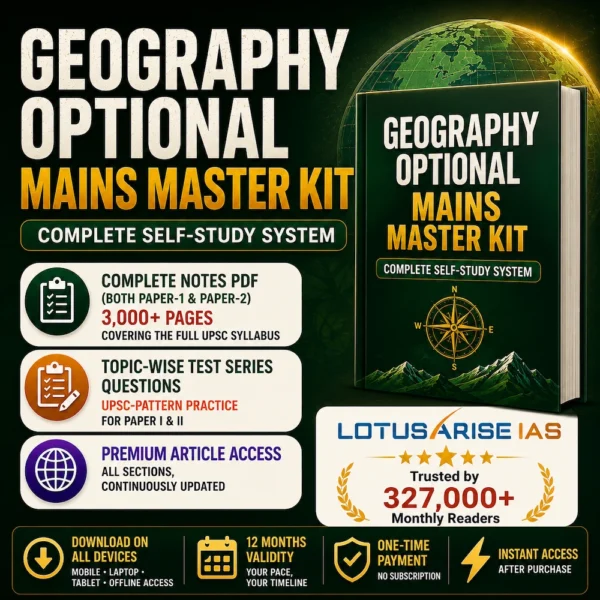
For self-study, the Geography Optional 300+ Score Pack covers stage 4 with solved PYQs from 2013 onwards, and the Geography Optional Mains Master Kit supports stages 1 and 2 with notes and model answers.