- Culture is the learned, shared and transmitted way of life of a people. Edward Burnett Tylor (Primitive Culture, 1871) defined it as the complex whole of knowledge, belief, art, morals, law, custom and every capability acquired as a member of society.
- It is learned, not inherited biologically. It is shared by a group and passed between generations, mainly through language.
- Culture is never static. It changes through invention, contact and diffusion, and through people’s changing relation with their environment and technology.
- Globalisation, the intensifying worldwide flow of goods, capital, people, images and ideas, is the most powerful agent of cultural change today.
- It homogenises some traits, hybridises many, and provokes a revival of local identities in others.
- Change also unsettles the culture realms mapped by classical geography, because global flows now cut across their boundaries.
Culture as a Dynamic Concept

Components of Culture
- Julian Huxley (1955) divided culture into three interlocking subsystems, a scheme cultural geographers still use:
- Artefacts (material culture): tools, houses, clothing, food, crops, machines. These are the most visible imprint on the cultural landscape.
- Sociofacts (social organisation): family, kinship, caste, village community, the state, educational and religious institutions.
- Mentifacts (ideas): language, religion, values, beliefs, myths, art and music. They are the deepest and slowest-changing layer.
- Traits, complexes and systems: a single element (trait) combines with others into a complex, and complexes form a culture system with a territorial expression.
- Material culture usually changes faster than non-material culture. The resulting mismatch is what William F. Ogburn (1922) called cultural lag.
- In India, for example, smartphone use spread far faster than the norms governing privacy and online conduct.
Why Culture Is Dynamic
- Classical cultural geography treated culture as a fairly stable superorganic force. In Carl O. Sauer’s Berkeley school, culture is the agent that shapes the cultural landscape.
- New cultural geography of the 1980s, led by Peter Jackson (Maps of Meaning, 1989) and Denis Cosgrove, recast culture as a shifting, contested system of meanings. Different groups produce, negotiate and resist these meanings, and power and identity are built through them.
- Drivers of cultural change:
- Innovation and invention: new tools, crops or ideas, such as the Green Revolution’s high-yielding seeds, which reshaped farm practices and rural society in Punjab.
- Contact and diffusion: trade, conquest, migration, missions and, today, media and the internet.
- Environmental and demographic change: drought, displacement, urbanisation.
- State policy and law: abolition of untouchability, reservation, language policy.
- Economic change: market integration and the shift from agrarian to service economies.
- Culture and environment: people do not simply obey nature. Within the range of possibilities an environment offers, culture chooses, and technology widens the range.
- Julian Steward’s cultural ecology showed how subsistence technology links environment to social organisation. A changed technology therefore changes culture.
- The canal colonies of Punjab and the tube-well revolution turned a pastoral–dryland culture into one of intensive wheat–rice farming within a century.
- Convergence and divergence: cultures in contact may converge, through shared technology and consumption, or diverge, by deliberately emphasising difference. Both trends run side by side today.
- Indian illustrations of a dynamic culture:
- Cricket, an English game, has been thoroughly indigenised. Arjun Appadurai calls this the “decolonisation” of cricket.
- Ganesh Chaturthi became a public festival only after Bal Gangadhar Tilak promoted it in 1893.
- Diwali is now celebrated worldwide by the diaspora and was inscribed by UNESCO in 2025.
- Joint families are giving way to nuclear households in cities.
- Food habits such as millets, tea and pizza keep being reinvented.
Processes of Cultural Change
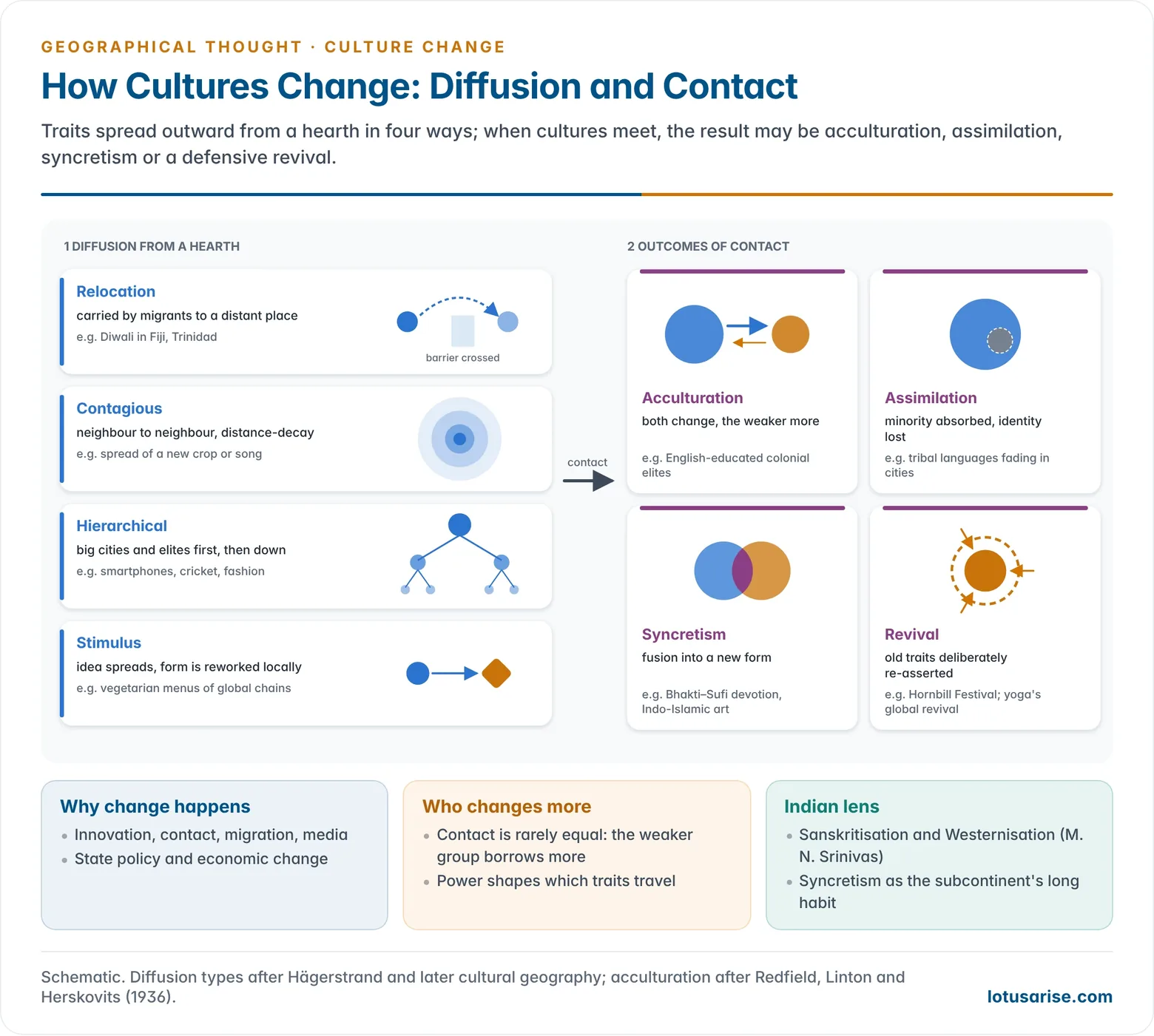
- Diffusion spreads a trait from its hearth:
- Relocation diffusion: carried by migrants, as with Indian festivals in Mauritius, Fiji and Trinidad.
- Expansion diffusion: the trait spreads while staying strong at the source. It takes three forms:
- contagious: neighbour to neighbour, like an epidemic;
- hierarchical: from large cities and elites downward, as with fashion and mobile phones;
- stimulus: the idea spreads but is reworked locally, as in the vegetarian menus of global fast-food chains in India.
- Torsten Hägerstrand’s spatial diffusion models gave these processes a measurable form, and his work underlies time geography.
- Acculturation: change in the cultures of groups that come into continuous first-hand contact. It was defined by Robert Redfield, Ralph Linton and Melville Herskovits (1936).
- The change is usually asymmetric: the weaker group borrows more, as in the Westernisation of colonial elites.
- Assimilation: a minority absorbs the dominant culture and loses its distinct identity. Many third-generation immigrant families in the USA, for example, speak only English.
- Syncretism: a fusion of traits from different cultures into a new form.
- Bhakti–Sufi devotion, Indo-Islamic architecture, Hindustani music and Goa’s Indo-Portuguese culture are examples.
- Fernando Ortiz (1940) called such two-way creation transculturation.
- Sanskritisation and Westernisation: M. N. Srinivas described lower castes and tribes adopting upper-caste customs to claim higher status (Sanskritisation), and elites adopting Western ways (Westernisation). These are two directions of Indian cultural change.
- Cultural revival: groups re-assert older traits, often in reaction to rapid change, as in language movements and the revival of folk festivals.
| Process | What happens | Direction | Indian example |
|---|---|---|---|
| Relocation diffusion | Migrants carry culture to a new place | Source to destination | Diwali in Fiji and Trinidad |
| Hierarchical diffusion | Spreads from cities and elites downward | Top-down | Smartphones, cricket |
| Acculturation | Mutual change after sustained contact | Mostly weaker to stronger | English-educated colonial elites |
| Assimilation | Minority absorbed into dominant culture | One-way | Loss of tribal languages in cities |
| Syncretism | Fusion into a new form | Two-way | Bhakti–Sufi traditions, Indo-Islamic art |
| Revival | Old traits re-asserted | Inward | Hornbill Festival, yoga’s global revival |
Cultural Evolution of Man
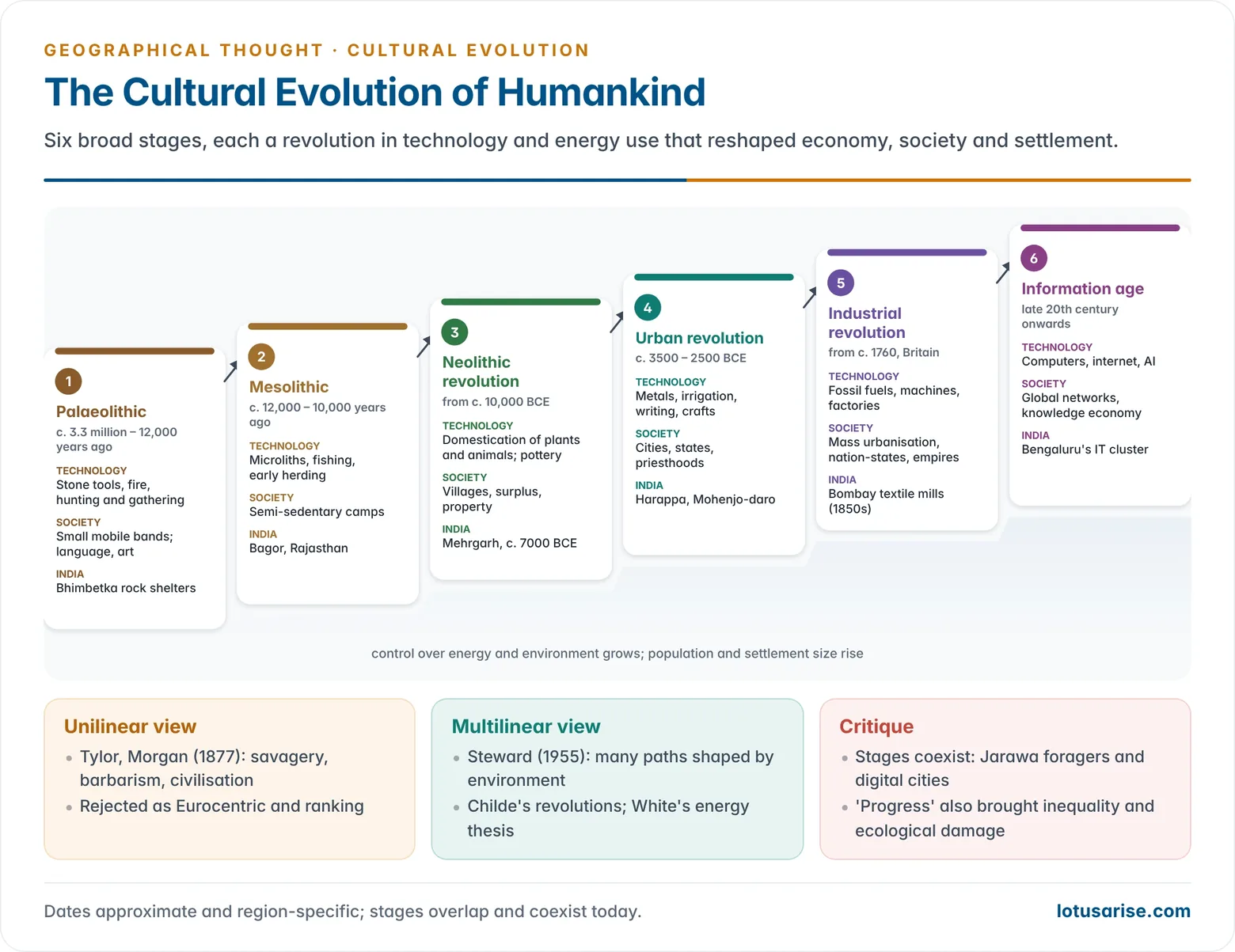
- Human culture evolved through a sequence of technological and social revolutions. Each enlarged humanity’s control over the environment and its population.
| Stage | Approx. time | Economy and technology | Society and landscape |
|---|---|---|---|
| Palaeolithic | From c. 3.3 million to 12,000 years ago | Stone tools, fire, hunting and gathering | Small mobile bands; language and art (Bhimbetka rock shelters) |
| Mesolithic | c. 12,000–10,000 years ago | Microliths, fishing, early herding | Semi-sedentary camps |
| Neolithic (agricultural) revolution | From c. 10,000 BCE, Fertile Crescent | Domestication of plants and animals, pottery | Villages, surplus, property (Mehrgarh, c. 7000 BCE) |
| Urban revolution | c. 3500–2500 BCE | Metals, irrigation, writing, specialised crafts | Cities, states, priesthoods (Harappa) |
| Industrial revolution | From c. 1760, Britain | Fossil fuels, machines, factories | Mass urbanisation, nation-states, colonial empires |
| Information age | Late 20th century onwards | Computers, internet, AI | Global networks, knowledge economy, global culture |
- Theories of cultural evolution:
- Unilinear evolutionism: Edward B. Tylor and Lewis Henry Morgan (Ancient Society, 1877) held that all societies pass through the same stages, from savagery through barbarism to civilisation.
- This was later rejected as Eurocentric and ranking.
- V. Gordon Childe named the Neolithic and Urban Revolutions, and Leslie White linked cultural progress to the energy a society harnesses.
- Julian Steward’s multilinear evolution (Theory of Culture Change, 1955) recognised several paths shaped by environment, through cultural ecology. It is close to the geographer’s possibilism. The anthropological neo-evolutionists carried this line further.
- Diffusionists such as Friedrich Ratzel stressed borrowing between cultures over independent invention.
- Unilinear evolutionism: Edward B. Tylor and Lewis Henry Morgan (Ancient Society, 1877) held that all societies pass through the same stages, from savagery through barbarism to civilisation.
- Critique: evolution is not linear or inevitable.
- Hunter-gatherers such as the Jarawa and Sentinelese of the Andamans coexist with information societies.
- “Progress” brought inequality, disease and environmental damage along with abundance.
Folk Culture and Popular Culture
Folk Culture
- Folk culture is traditionally practised by small, homogeneous, mostly rural groups living in relative isolation.
- Characteristics:
- Anonymous, multiple hearths: folk traits arise independently in many places and rarely have a known originator.
- Slow diffusion, mainly by relocation (migration). Traits are passed orally and by example.
- Close tie to the local environment: materials, diet and dress respond to climate and resources.
- Examples include Kutch’s round bhunga houses, built to resist earthquakes and heat; the Toda huts of the Nilgiris; and Ladakh’s flat-roofed mud houses.
- Strong role of custom, kinship and religion; resistance to change.
- Indian examples:
- painting: Warli, Madhubani, Pithora, Gond;
- performance: Bihu, Theyyam, Chhau, Kalbelia (the last two inscribed by UNESCO in 2010);
- crafts: handloom textiles, Channapatna toys.
Popular Culture
- Popular culture belongs to large, heterogeneous, mostly urban societies and is shared across wide areas regardless of local traditions.
- Characteristics:
- Known hearths: usually in economically powerful places, and often traceable to a company or a person. Examples are Hollywood, Mumbai and Seoul.
- Rapid, hierarchical diffusion through mass media, advertising and digital platforms.
- Mass production and standardisation; weak ties to the local environment.
- Short life cycles: fashions rise and fall quickly.
- Examples: jeans, fast food, the Indian Premier League (2008), Hindi film music, K-pop, streaming platforms and social-media trends.
| Feature | Folk culture | Popular culture |
|---|---|---|
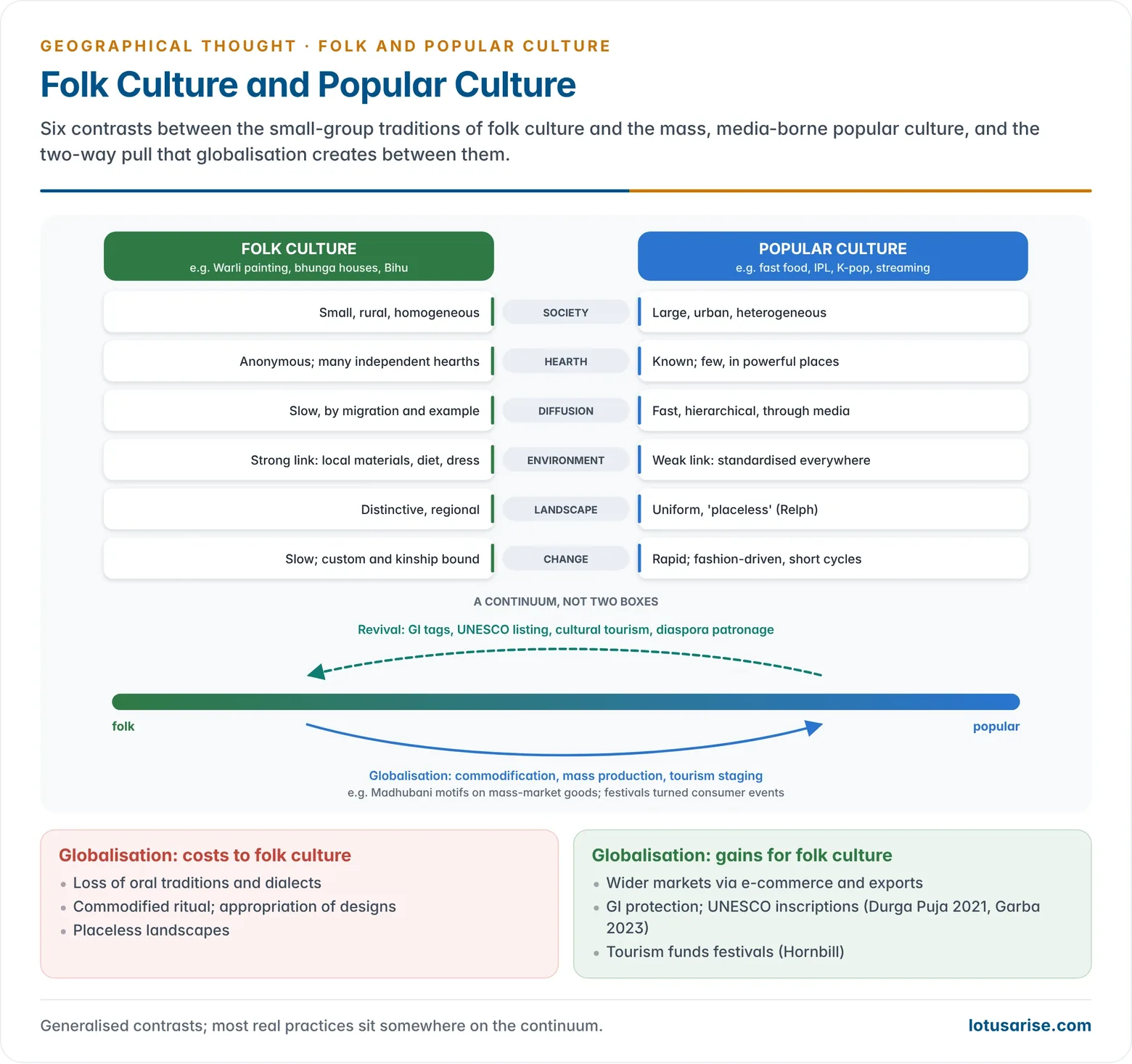
| Society | Small, rural, homogeneous | Large, urban, heterogeneous |
| Hearth | Anonymous, multiple | Known, usually few |
| Diffusion | Slow, by relocation | Fast, hierarchical, through media |
| Link to environment | Strong | Weak |
| Landscape | Distinctive, regional | Uniform (“placeless”) |
| Change | Slow, custom-bound | Rapid, fashion-driven |
| Example | Warli painting, bhunga houses | Fast food, IPL, K-pop |
- Placelessness: Edward Relph (1976) warned that standardised popular landscapes, the same malls, highways and chains everywhere, erode the distinctiveness of places.
Globalisation and Folk Culture
- Negative effects:
- Homogenisation and loss: mass-produced goods displace handicrafts, and oral traditions and folk languages decline as the young move to cities.
- Commodification: rituals and arts are staged for tourists and lose their meaning, and festivals turn into consumer events.
- Placelessness of new landscapes, and erosion of community institutions.
- Appropriation: global firms market folk designs without benefit to their creators.
- Positive effects:
- New markets: e-commerce and exports give artisans wider reach. Geographical Indication tags protect products such as Madhubani painting and Channapatna toys.
- Revival through recognition: UNESCO’s 2003 Convention on intangible cultural heritage, and inscriptions such as Durga Puja in Kolkata (2021), Garba (2023) and Deepavali (2025), India’s 16th element.
- Cultural tourism sustains festivals such as Nagaland’s Hornbill Festival (since 2000).
- Diaspora communities carry folk traditions abroad and fund them at home.
- Balance: globalisation does not simply erase folk culture. It transforms it, and outcomes depend on whether communities keep control and benefit.
Globalisation and Culture
Meaning and Drivers
- Globalisation compresses time and space. David Harvey (1989) called this time–space compression, and Marshall McLuhan foresaw a “global village” (1962).
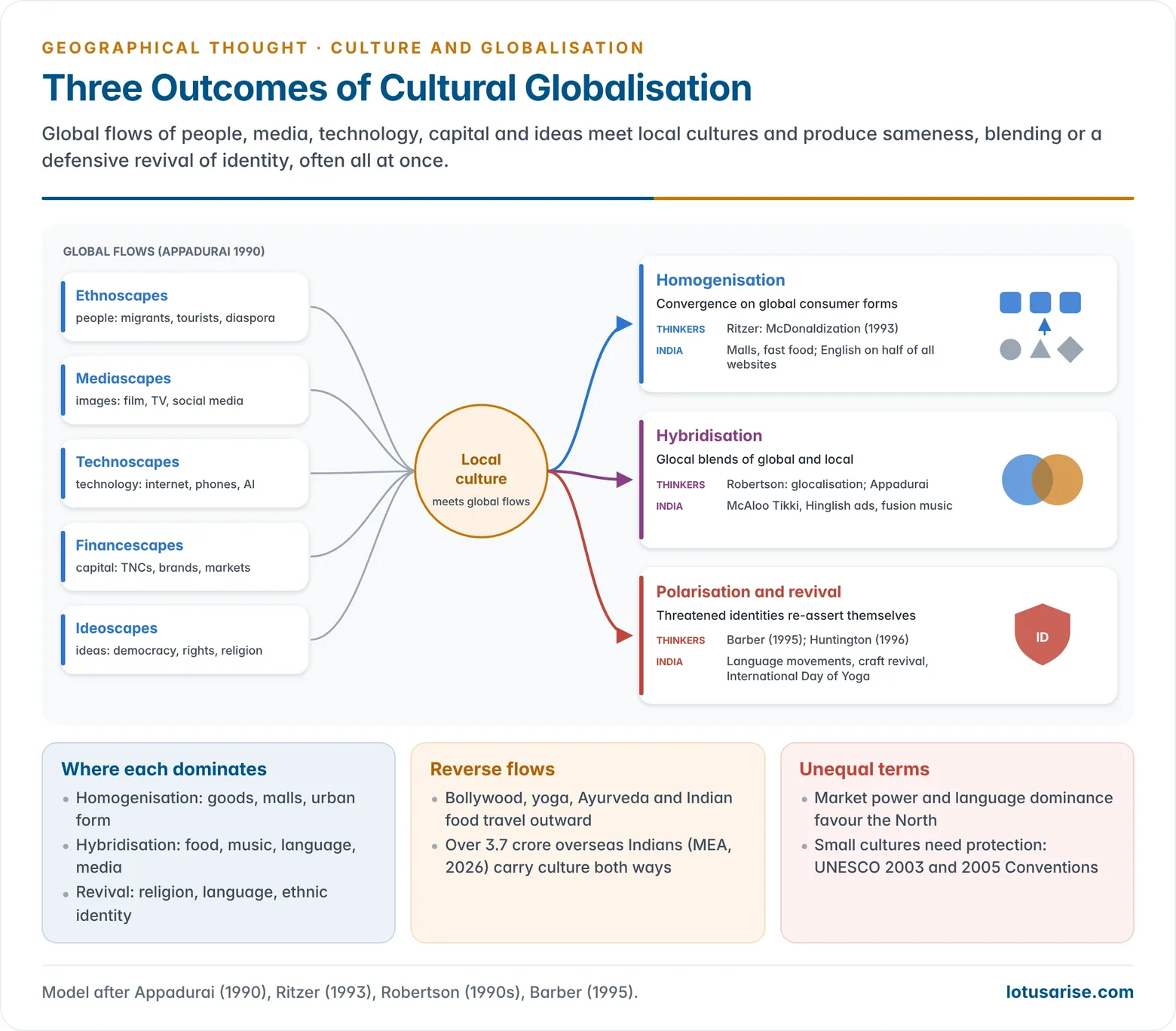
- Arjun Appadurai (1990) described global culture as five flows, or “scapes”, that move out of step with one another:
- ethnoscapes (people);
- mediascapes (images);
- technoscapes (technology);
- financescapes (capital);
- ideoscapes (ideologies).
- Drivers:
- Information and communication technology, the internet and social media.
- Migration: 304 million international migrants in 2024 (UN DESA), with India the largest country of origin (18.5 million).
- Transnational corporations, brands and advertising.
- Tourism, education abroad and global sport.
- Diaspora: about 3.7 crore overseas Indians (Ministry of External Affairs, January 2026).
Three Outcomes of Cultural Globalisation
- Homogenisation (convergence):
- A dominant, largely Western and American consumer culture spreads worldwide. George Ritzer’s McDonaldization (1993) names the global spread of efficiency, predictability and standardisation.
- Cultural imperialism: media flows run mainly from North to South. English dominates the internet, used on about half of all websites.
- Hybridisation (glocalisation):
- Global forms are localised and local forms go global, creating new mixtures. Roland Robertson popularised glocalisation (1990s).
- Indian examples:
- the McAloo Tikki;
- Hinglish advertising;
- fusion music;
- Bollywood’s global reach;
- yoga returning to India in a globalised form.
- Polarisation and revival of identity:
- Fear of losing identity provokes resistance and revival: ethnic, religious and linguistic movements.
- Benjamin Barber’s “Jihad vs McWorld” (1995) and Huntington’s civilisational fault lines describe this reaction.
- Indian examples include assertion of regional languages, revival of traditional crafts and festivals, and the UN’s International Day of Yoga (first observed 21 June 2015) as soft-power assertion.
| Outcome | Mechanism | Key thinker | Example |
|---|---|---|---|
| Homogenisation | Global brands and media standardise tastes | Ritzer (1993) | Fast food, malls, English on the web |
| Hybridisation | Global and local blend into new forms | Robertson; Appadurai | McAloo Tikki, Hinglish, fusion music |
| Polarisation and revival | Threatened identities re-assert themselves | Barber (1995); Huntington (1996) | Language movements, craft revival, yoga diplomacy |
Traditional Cultural Identities and Global Connectivity
- Identities under strain:
- Joint families, community rituals, local dialects and dress are weakening among the urban young.
- Consumer lifestyles spread through television and smartphones.
- Migration produces deterritorialised identities, people who belong to two places at once.
- Identities persisting and reinventing:
- Doreen Massey’s “global sense of place” (1991) holds that places are made of connections, so global links can enrich rather than erase local identity.
- Diaspora communities often hold traditions more firmly than people at home.
- Digital media spread regional cinema, folk music and minority languages to new audiences.
- In India, religious observance remains high despite rapid connectivity.
- Languages feel the strain most: global and national languages advance, and small languages are endangered. Yet translation technology and the internet also give minority tongues new outlets.
Globalisation and Culture in India
- Consumption and lifestyle:
- Malls, food delivery, streaming platforms and branded fashion have spread from metros to smaller towns.
- The urban middle class shows the clearest hybrid lifestyle: global brands combined with traditional rituals, family networks and regional food.
- Reverse flows: India is also a source of global culture.
- Exports include yoga, Ayurveda, Hindi and South Indian cinema, Indian cuisine and the Diwali and Holi festivals celebrated abroad.
- The diaspora and the information-technology workforce carry these flows, which question the one-way “cultural imperialism” thesis.
- Tribal and folk societies: they face the sharpest pressure from mining, markets and migration. They also show organised resistance.
- In 2013 the Dongria Kondh gram sabhas of Odisha’s Niyamgiri hills, acting on a Supreme Court order, rejected bauxite mining on a hill they hold sacred.
- Revival and re-invention:
- The International Year of Millets (2023), promoted by India at the UN, revalued a folk staple.
- Regional-language cinema and music reach national and global audiences through digital platforms.
- Folk forms are re-staged in urban festivals and on social media.
Policy Responses
- UNESCO’s 2003 Convention for the Safeguarding of the Intangible Cultural Heritage and its 2005 Convention on the Diversity of Cultural Expressions recognise culture as more than a commodity.
- India: intangible heritage inventories, GI protection, mother-tongue instruction under NEP 2020, and support for crafts and festivals.
- Cultural diversity as a resource: a source of identity, of the creative economy and of soft power, not an obstacle to development.
Evaluation
- Culture is dynamic and plural. Change is continuous, and what looks “traditional” is often the product of earlier diffusion and fusion.
- Globalisation’s cultural effects are uneven:
- homogenisation is strongest in consumer goods and urban landscapes;
- hybridisation in food, music, language and media;
- revival in religion, language and ethnic identity.
- The outcome is neither a single global monoculture nor frozen local cultures. It is a layered, multifaceted world culture in which global flows are constantly localised.
- Limits of the homogenisation thesis: audiences reinterpret global products rather than absorb them passively, and cultural flows increasingly run South to North too, through Bollywood, K-pop and yoga.
- Yet market power and language dominance remain unequal, so small cultures and languages still need active protection.
- For India, a civilisation long practised in absorbing and reworking outside influences, globalisation is the latest chapter of an old process, now running at far greater speed.
Previous Year Questions
2022“Culture is a dynamic concept”. Elucidate with example2022Analyse the effects of Globalisation on languages.2019Globalization can often subsumed folk culture. What are its positive and negative effects?2017“The traditional cultural identities are at loss with the growth of global connectivity.” Explain.1988Give a critical account of the cultural evolution of man. Illustrate your answer with suitable examples.