- Dryland farming and protected cultivation are two opposite answers to the same problem: how to grow more where the natural environment limits farming.
- Dryland farming works with a harsh environment. It conserves every drop of scarce rainfall and grows hardy crops without irrigation.
- Protected cultivation works against it. It encloses the crop and controls light, temperature, humidity, water and nutrients.
- Both have become central to food production as drylands expand and land and water per person shrink.
- Drylands now cover about 40.6% of the world’s land (excluding Antarctica) and are home to 2.3 billion people. They grew by about 4.3 million km² between 1990 and 2020 (UNCCD, 2024).
- Both also raise a wider question: how to raise food productivity without damaging the ecosystem, and whether agrarian development should be driven from the top down or from the bottom up.
Dryland and Rainfed Farming

Meaning and Classification
- Dryland farming is the cultivation of crops without irrigation in areas of low and erratic rainfall, where moisture stress is the main limit on yields.
- The idea took shape on the semi-arid Great Plains of the USA in the late 19th century.
- Hardy Webster Campbell popularised the “Campbell system“: deep ploughing, sub-surface packing, a “dust mulch” and summer fallow to store two seasons’ rain for one crop.
- Heavy ploughing of grassland, followed by severe drought, contributed to the Dust Bowl of the 1930s. Modern dryland farming therefore stresses soil cover and conservation, not bare fallows.
- Indian classification by rainfall and length of the growing period:
| Type | Annual rainfall | Growing period | Moisture stress | Main concern |
|---|---|---|---|---|
| Dry farming | Below 750 mm | Under 75 days | Severe; crop failure frequent | Conserve every drop of moisture |
| Dryland farming | 750–1,150 mm | 75–120 days | Moderate; dry spells common | Moisture conservation and water harvesting |
| Rainfed farming | Above 1,150 mm | Over 120 days | Little | Drainage of excess water, erosion control |
- In common usage, “rainfed agriculture” covers all three, meaning any farming that depends only on rain.
World Distribution
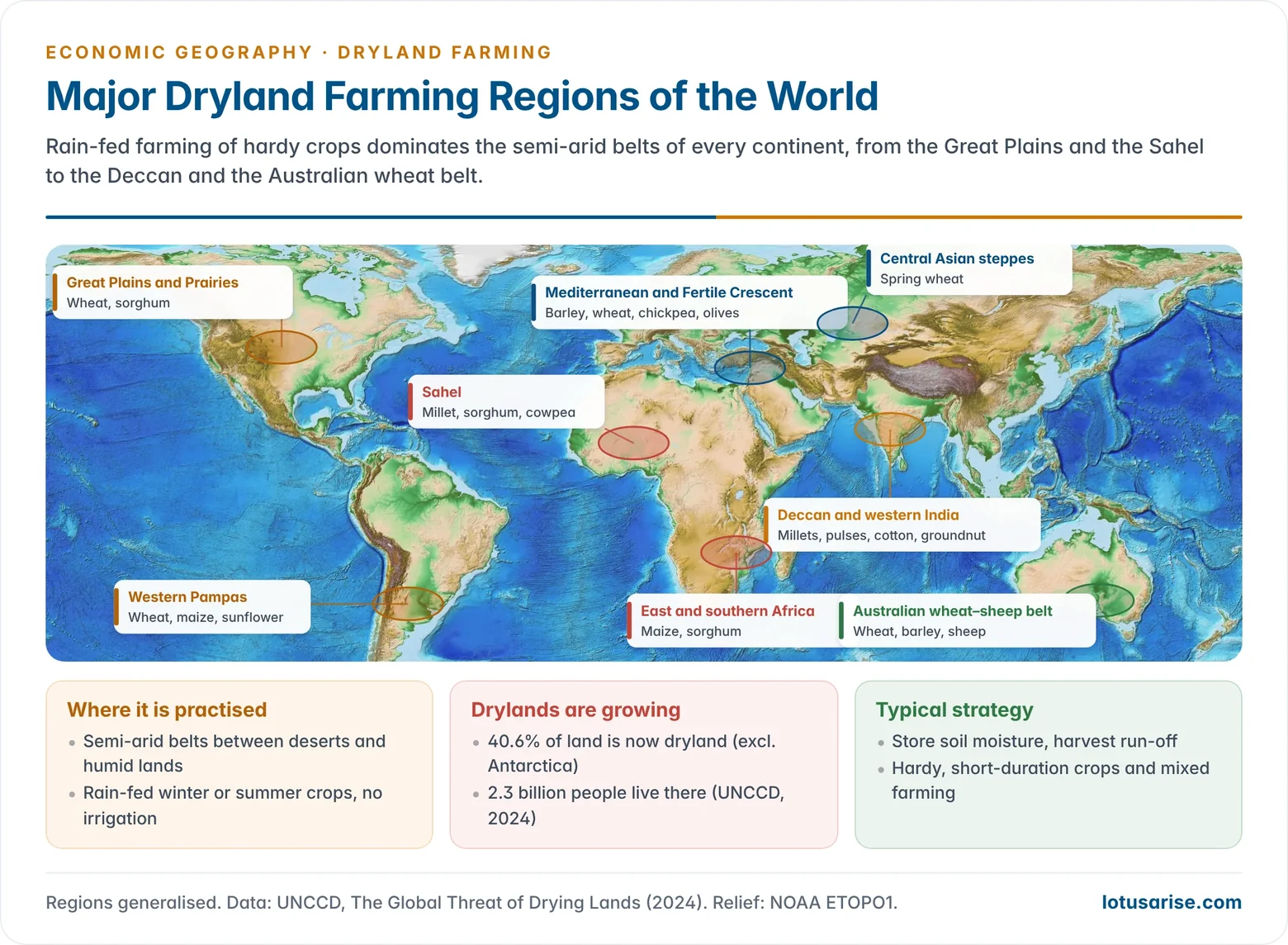
- Dryland farming dominates the semi-arid and dry sub-humid belts between deserts and humid lands:
- North America: the western Great Plains and Canadian Prairies (winter and spring wheat, sorghum).
- South America: the drier western Pampas of Argentina and north-east Brazil’s Sertão.
- Africa: the Sahel (millet, sorghum, cowpea), the Maghreb, and the drylands of East and southern Africa.
- Mediterranean and West Asia: the Spanish meseta, Anatolia and the Fertile Crescent (barley, wheat, chickpea, lentil).
- Central Asia and Russia: the steppes of Kazakhstan and southern Russia (spring wheat).
- South Asia: the Deccan plateau, western India and Pakistan’s barani lands.
- Australia: the wheat–sheep belt of New South Wales, Victoria and Western Australia.
- The UNCCD records that three-quarters of the world’s land (77.6%) became drier in 1990–2020 than in the previous three decades. The frontier of dryland farming is therefore moving into once-humid lands.
Dryland and Rainfed Farming in India
- Of about 142 million ha of net sown area, roughly half (≈51%) is rainfed.
- Rainfed lands grow about 90% of pulses and coarse cereals, about two-thirds of cotton, about half the rice area and most oilseeds.
- They support about 40% of the population and two of every three cattle, and supply over 40% of the country’s food.
- Rainfed share is highest in Assam, Maharashtra, Odisha, Karnataka, Gujarat, Andhra Pradesh and Rajasthan (well over half of net sown area in each).
- Main dryland tracts: western Rajasthan and Kutch, the rain-shadow Deccan (Marathwada, Vidarbha, north Karnataka, Rayalaseema, Telangana), Bundelkhand, and the interior of Tamil Nadu.
- These are also the tracts of chronic farm distress: repeated crop failure, debt and low incomes.
- Farmer distress in these tracts reflects the gap between their area and their share of support. Irrigation, procurement and credit long favoured the Green Revolution belt over dryland and rainfed agriculture in India.
Significance of Dryland Farming
- Food and nutrition security: drylands supply most of the country’s pulses, millets, oilseeds and cotton. Millets are rich in micronutrients and fibre, and suited to the fight against hidden hunger and diabetes.
- Livelihoods: most of India’s small and marginal farmers, tribal households and pastoralists live in rainfed tracts, so poverty reduction depends on them.
- Future growth potential: irrigated yields are close to a plateau, while dryland yields are often less than half of what is attainable. The next gains in national output can come from here at lower cost.
- Livestock economy: crop residues and common pastures sustain the bulk of India’s cattle, sheep and goats.
- Climate resilience: hardy crops, mixed cropping and diversified farm systems are natural adaptations to heat and drought.
- Ecological balance: careful dryland management checks desertification, recharges groundwater and protects fragile soils.
Problems of Dryland Farming
- Climatic: low, erratic and unevenly distributed rainfall; late onset and early withdrawal of the monsoon; long dry spells; high temperature and evaporation.
- Edaphic: shallow, light-textured or crusting soils; low organic matter, poor water-holding capacity; erosion by wind and water.
- Economic: small holdings, low input use (because of risk), poor credit and markets, and low crop insurance coverage.
- Ecological: overgrazing, loss of tree cover, and land degradation and desertification.
- Policy bias: procurement and subsidies favoured irrigated rice and wheat. Millets and pulses, the dryland staples, lost area for decades.
Techniques of Dryland Farming
In-situ Moisture Conservation
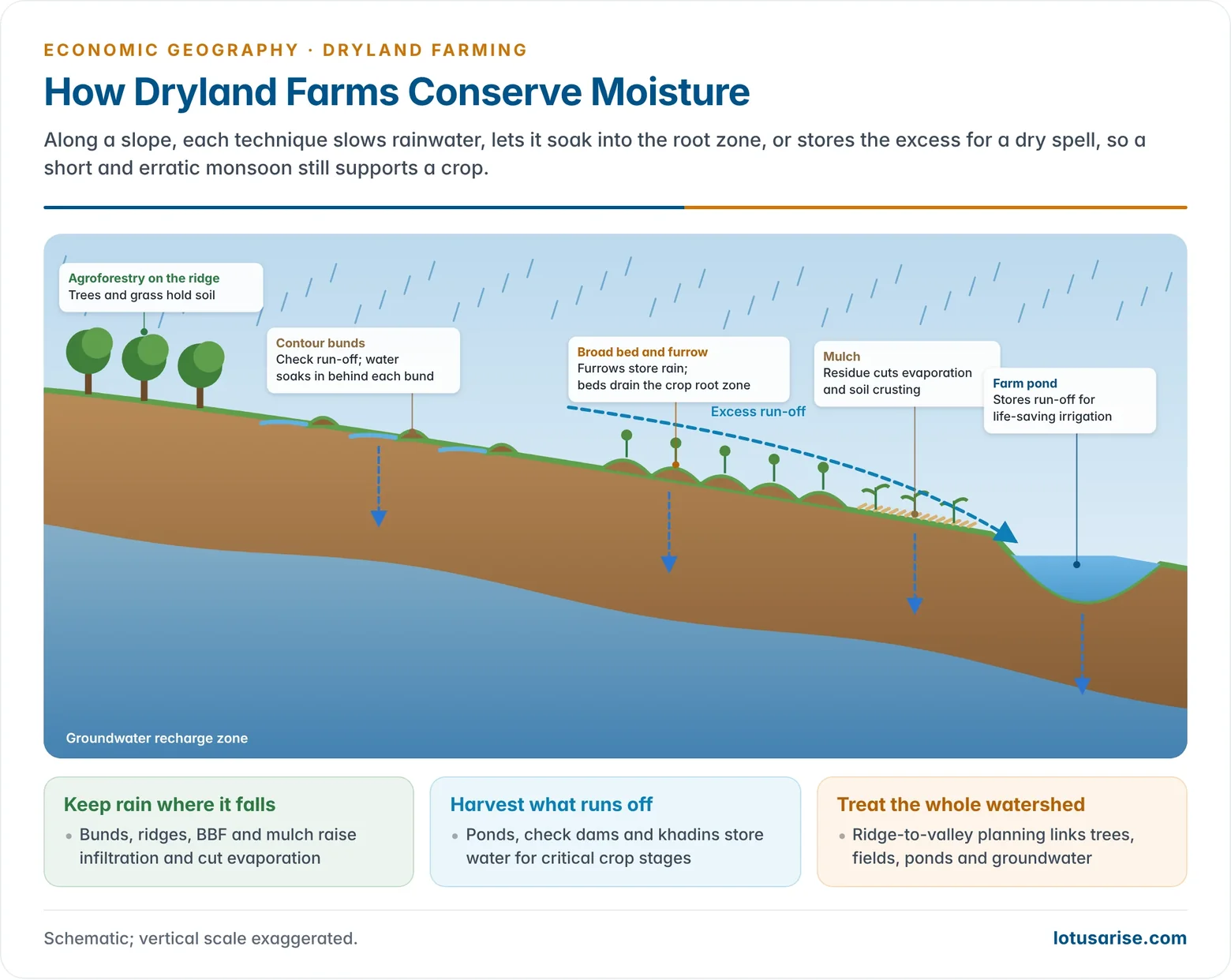
- Contour bunding and graded bunds check run-off and hold water where it falls.
- Ridge and furrow, broad bed and furrow (BBF), compartmental bunding and tied ridges trap rain in the field. BBF was developed at ICRISAT for the black soils of the Deccan.
- Mulching with crop residue or polythene cuts evaporation; summer ploughing and deep tillage improve infiltration.
- Conservation tillage keeps residue on the surface, protecting soil from crusting and wind erosion.
Rainwater Harvesting
- Farm ponds, check dams, percolation tanks and nala bunds collect run-off for life-saving irrigation at critical crop stages.
- Traditional systems carry the same logic: khadins and kunds of Rajasthan, tankas, the tank cascades of the Deccan, and the johads revived in Alwar.
- Micro-irrigation (drip and sprinkler) stretches harvested water over a larger area.
Crops and Cropping Systems
- Drought-tolerant crops: pearl millet, sorghum, finger millet and other millets; pigeon pea, chickpea, moth bean, cluster bean; groundnut, sesame, castor; cotton.
- Short-duration and drought-tolerant varieties that escape terminal drought.
- Intercropping (sorghum with pigeon pea, groundnut with pigeon pea) spreads risk; if one crop fails, the other survives.
- Contingency crop plans for each district tell farmers what to sow when the monsoon is delayed.
Integrated Farming and Land Use
- Alternate land use: agroforestry, agri-horticulture (ber, aonla, pomegranate) and silvi-pasture on marginal land.
- Livestock integration: small ruminants and fodder crops buffer income in drought years.
- Watershed development: treating a whole micro-catchment from ridge to valley. It combines soil and water conservation, afforestation, pasture and livelihood support.
- Watershed management is the main vehicle of dryland development in India.
Dryland Development in India
- Research: the Central Research Institute for Dryland Agriculture (CRIDA, Hyderabad), the All India Coordinated Research Project on Dryland Agriculture, and ICRISAT (Patancheru).
- Climate resilience: the National Innovations in Climate Resilient Agriculture (NICRA), launched by ICAR in 2011, tests resilient practices in climate-vulnerable districts.
- Programmes:
- Rainfed Area Development under the National Mission for Sustainable Agriculture.
- Watershed Development Component of PMKSY (WDC-PMKSY 2.0).
- “Per Drop More Crop” micro-irrigation.
- The National Rainfed Area Authority (2006) for policy co-ordination.
- Millets revival: the International Year of Millets (2023), proposed by India, and the “Shree Anna” push for millets in procurement, the PDS and nutrition schemes.
- Weather-based advisories and insurance: agro-meteorological advisories and PMFBY cover the risk that keeps dryland farmers from investing.
Protected Cultivation
Meaning
- Protected cultivation is growing crops in a structure that partially or fully modifies the micro-climate (temperature, light, humidity, CO₂, water and nutrients) and shields crops from pests, rain, frost, hail and wind.
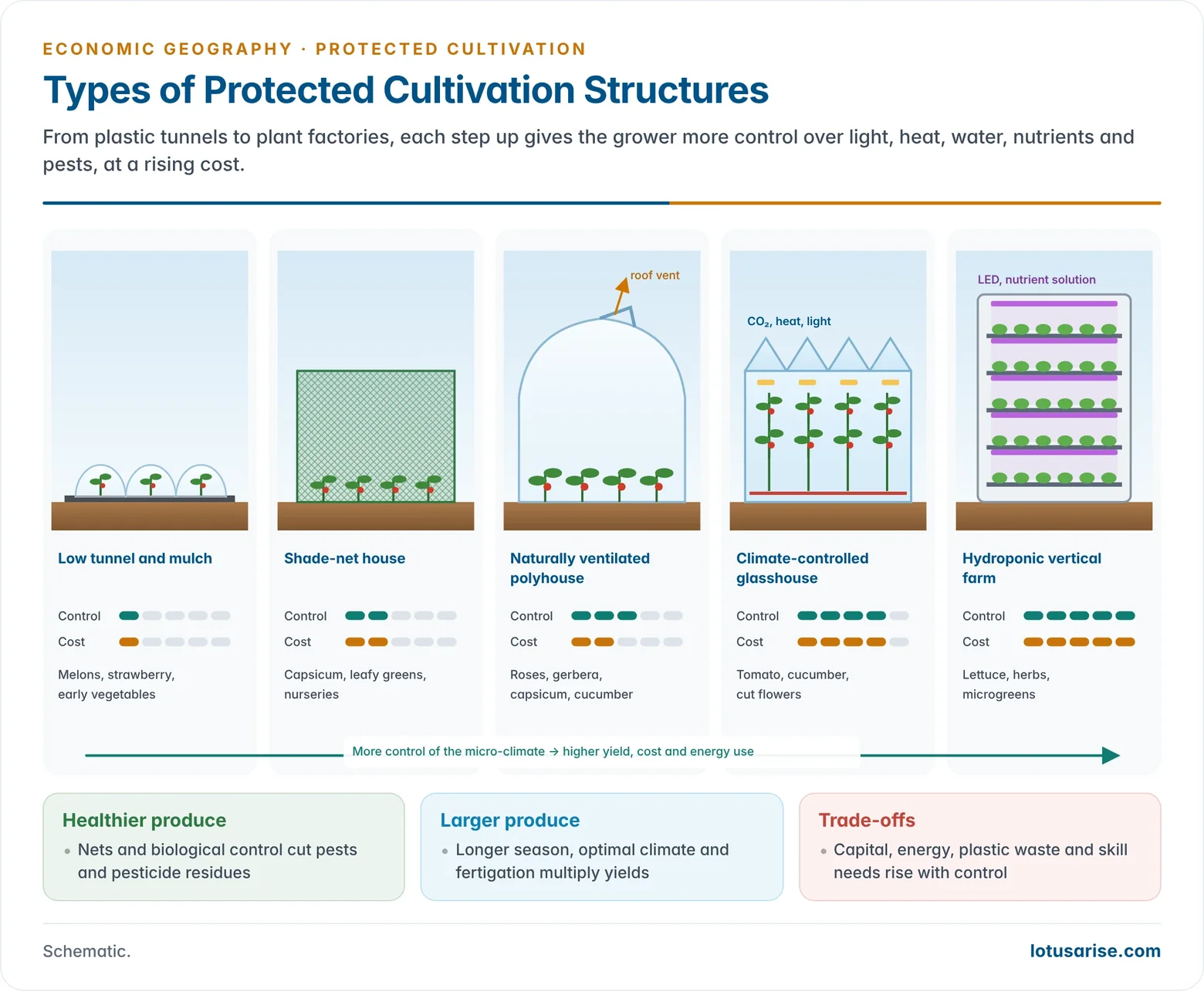
- The degree of control ranges from simple plastic mulch and low tunnels to fully climate-controlled glasshouses and soil-less vertical farms (plant factories).
| Structure | Degree of control | Typical crops | Typical regions |
|---|---|---|---|
| Plastic mulch, low tunnels | Low: warmth, moisture, weed control | Melons, strawberries, early vegetables | North China, Mediterranean, Punjab |
| Shade-net and insect-proof net houses | Low to medium: light, heat, pests | Capsicum, leafy vegetables, nursery plants | Peninsular India, Israel |
| Naturally ventilated polyhouses | Medium: rain, temperature, humidity | Roses, gerbera, capsicum, cucumber | Pune–Nashik, Bengaluru, Himachal |
| Passive solar greenhouses | Medium: winter warmth | Winter vegetables | North China, Ladakh |
| Climate-controlled glasshouses | High: heating, lighting, CO₂, fertigation | Tomatoes, cucumbers, flowers | Netherlands (Westland), Canada |
| Hydroponic vertical farms | Full: artificial light, soil-less | Lettuce, herbs, microgreens | Japan, Singapore, Gulf states, US cities |
How Protected Cultivation Gives Healthier and Larger Produce
- Higher yields: a longer season, an optimal micro-climate and precise nutrition give several times the open-field yield.
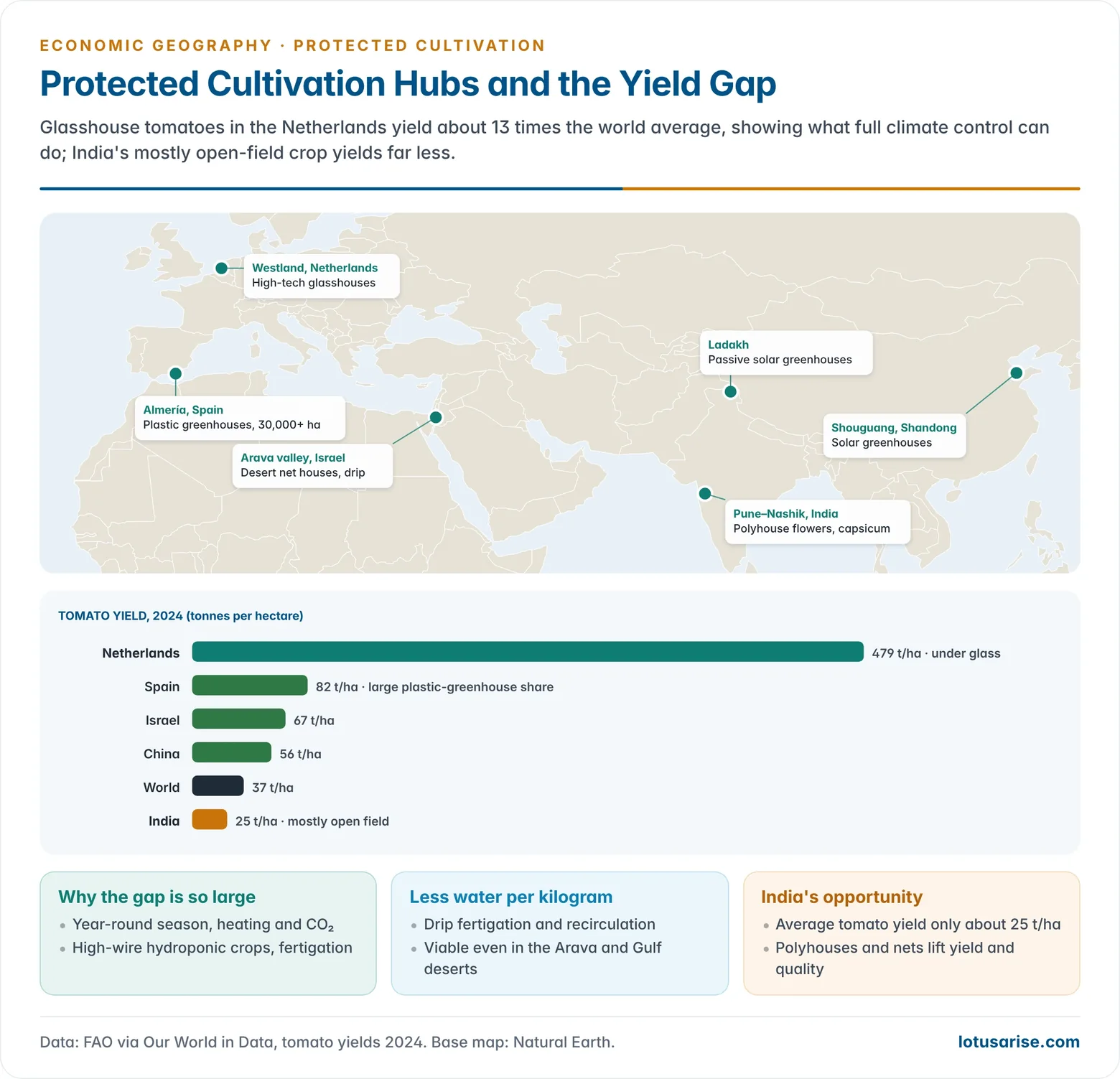
- Tomato yields: the Netherlands, almost entirely under glass, averages about 480 t/ha (2024) against a world average of about 37 t/ha and India’s about 25 t/ha (FAO data).
- Water saving: drip fertigation and recirculating hydroponics use far less water per kilogram of produce. This makes greenhouses viable even in deserts (Israel’s Arava valley, the UAE).
- Healthier produce:
- Insect-proof nets and physical barriers reduce pest attack, so pesticide use falls and residues are lower.
- Integrated pest management with biological control (predatory mites, bumblebee pollination) is standard in Dutch and Spanish greenhouses.
- Produce is cleaner, more uniform and less damaged by rain, hail or frost.
- Off-season and year-round supply fetches premium prices; growing in cold or high-altitude places is also possible.
- In Ladakh, passive solar and trench greenhouses supply fresh vegetables through the winter.
- Land saving: very high output per hectare suits peri-urban areas and countries short of land.
- Climate resilience: crops are protected from heatwaves, untimely rain and hail, which are now more frequent.
Limitations
- High capital and energy costs. The 2022 gas-price spike forced many Dutch growers to cut heated production.
- Skill and technology demands: climate control, fertigation and pest management need trained growers.
- Environmental costs:
- Plastic waste and landscape change: Almería’s “sea of plastic” in south-east Spain covers over 30,000 ha.
- Groundwater over-use and salinity build-up in polyhouse soils.
- Nutrient run-off from poorly managed fertigation.
- Disease build-up in a closed environment if hygiene fails.
- Market risk: perishable high-value crops need cold chains and assured buyers.
Geography of Protected Cultivation
- China has the largest area of protected cultivation in the world. Its solar greenhouses alone exceed 2.8 million ha (2022), concentrated in Shandong (Shouguang), Hebei and Liaoning.
- The Netherlands (Westland) has the most technology-intensive greenhouse cluster, making the country a leading exporter of vegetables, flowers and greenhouse know-how.
- Spain (Almería) has Europe’s largest concentration of low-cost plastic greenhouses, supplying winter vegetables to northern Europe.
- Israel, Japan, South Korea, Turkey, Mexico and Canada have large protected sectors. Gulf states and Singapore invest in vertical farms for food security.
- India:
- Polyhouses for flowers and vegetables in Maharashtra (Pune–Nashik), Karnataka (Bengaluru), Himachal Pradesh, Uttarakhand, Telangana and Gujarat.
- Low tunnels and shade nets across the north-western plains; passive solar greenhouses in Ladakh and the high Himalaya.
- Support comes through the Mission for Integrated Development of Horticulture (MIDH), the National Horticulture Board, and Indo-Israel Centres of Excellence that demonstrate protected cultivation and micro-irrigation.
Way Forward for India
- Cluster-based development: link polyhouse and net-house growers to FPOs, cold chains and export markets, as in the Pune–Nashik flower belt.
- Low-cost, climate-suited designs: naturally ventilated polyhouses and shade nets for the plains, and passive solar structures for the hills, rather than costly imported glasshouses.
- Skilling and finance: grower training, crop insurance for protected crops, and credit for small farmers.
- Sustainability safeguards: recycling of used plastic, rainwater harvesting from greenhouse roofs, and soil-less media to avoid salinity build-up.
Food Productivity with Ecosystem Integrity
The Problem
- The Green Revolution model raised yields through high-input monocultures. It also left ecological costs:
- Groundwater depletion and falling water tables in Punjab and Haryana.
- Soil health decline from imbalanced fertiliser use, and pesticide residues.
- Loss of crop diversity, and stubble burning and air pollution in north-western India.
- The challenge is sustainable intensification: more food per hectare with less water, chemicals and emissions, and without clearing more land.
Approaches
- Evergreen Revolution: M. S. Swaminathan’s call for productivity gains “in perpetuity without associated ecological harm”.
- Agroecology and conservation agriculture: minimum tillage, permanent soil cover, crop rotation and diversification.
- Organic and natural farming:
- Sikkim became India’s first fully organic state (2016).
- Andhra Pradesh Community-managed Natural Farming has spread to hundreds of thousands of farmers.
- The National Mission on Natural Farming was launched in 2024.
- Integrated nutrient and pest management, biofertilisers, the Soil Health Card, and precision application to cut waste.
- Crop diversification away from the rice–wheat cycle in water-stressed regions; millets and pulses in drylands.
- Climate-smart agriculture: resilient varieties, agroforestry and lower methane rice (alternate wetting and drying, direct-seeded rice).
- Dryland techniques and protected cultivation both fit here. One uses scarce water efficiently; the other gives high yields with less land, water and pesticide when well managed.
Top-down and Bottom-up Approaches in Agrarian Development
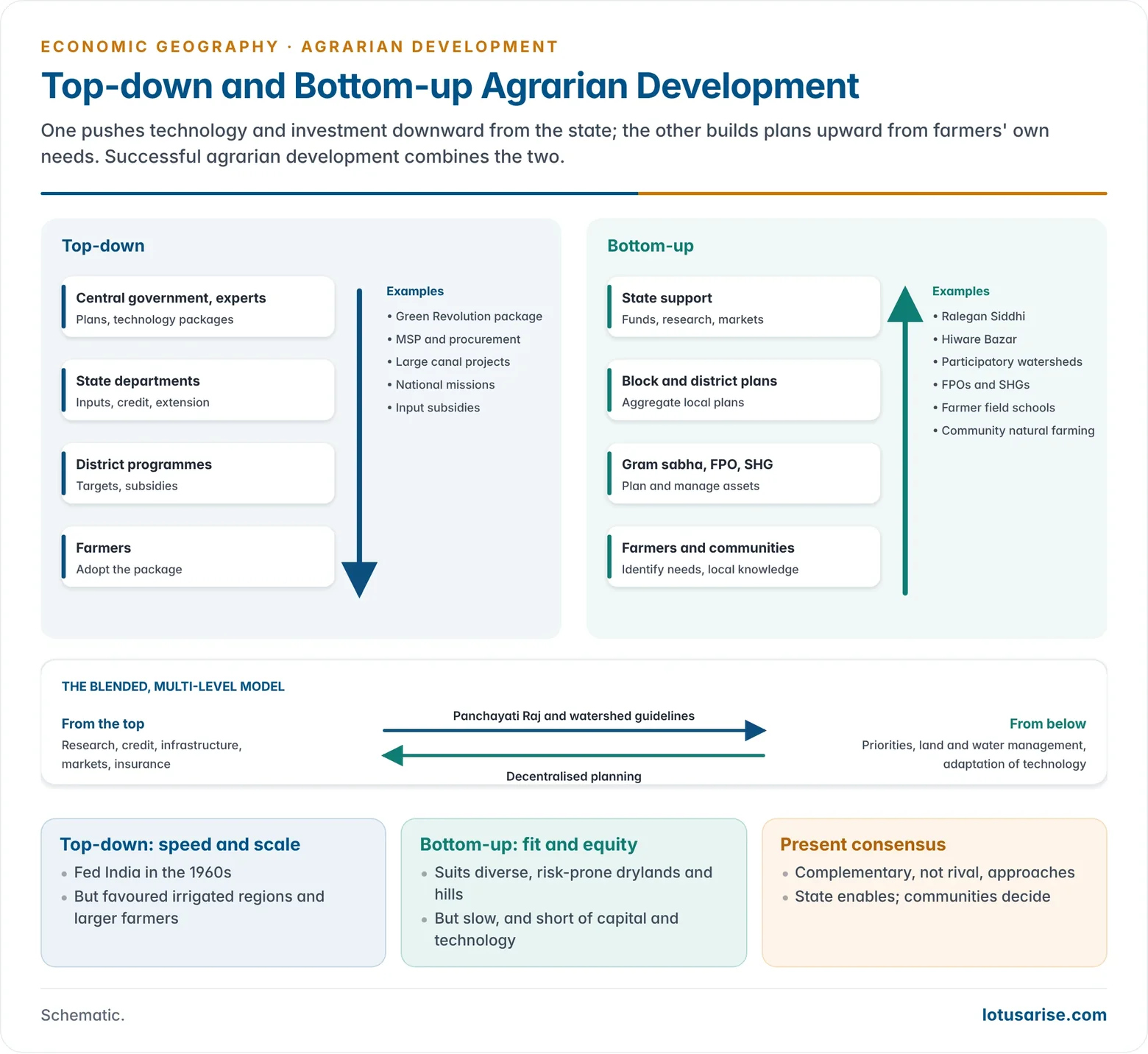
- Top-down approach: the state or an external agency plans and delivers technology, inputs and infrastructure, and farmers adopt them.
- Examples: the Green Revolution package (HYV seed, fertiliser, canals, credit, MSP and procurement); large irrigation projects; national missions and subsidy schemes.
- Strengths: rapid scale-up, large investment, and national food security in a crisis (India in the 1960s).
- Weaknesses: uniform packages ignore local ecology; gains go to favoured, irrigated regions and larger farmers; and ecological costs follow, while drylands and tribal areas are bypassed.
- Bottom-up approach: farmers and communities identify needs, plan and manage development, and the state supports them.
- Examples:
- Participatory watershed development at Ralegan Siddhi and Hiware Bazar (Maharashtra).
- Farmer Producer Organisations, self-help groups and farmer field schools.
- Community-managed natural farming in Andhra Pradesh, and water-user associations.
- Strengths: local knowledge, ecological fit, equity, ownership and sustainability of assets.
- Weaknesses: slow, hard to scale, dependent on local leadership, and short of capital and technology.
- Examples:
- Present view: the two are complementary.
- The state supplies research, credit, infrastructure and markets from the top.
- Communities set priorities, manage land and water and adapt technology from below.
- India’s multi-level and decentralised planning through Panchayati Raj institutions and the watershed guidelines are built on this blend.
| Aspect | Top-down | Bottom-up |
|---|---|---|
| Who plans | State, experts, agencies | Farmers, communities, local bodies |
| Typical tool | Technology package, subsidies, big projects | Watershed, FPO, SHG, participatory research |
| Best suited to | Irrigated, uniform, high-potential areas | Diverse, risk-prone drylands and hills |
| Main strength | Speed and scale | Local fit, equity, sustainability |
| Main risk | Regional and social inequality, ecological cost | Slow spread, weak capital and technology |
Previous Year Questions
2022Discuss the importance of ‘Dry-land’ farming in the drought-prone regions of India.2021Protected cultivation assists in healthier and larger produce. Justify with examples.2019Explain the significance of dry farming in drought prone areas of India.2015With the help of a map, indicate the principal areas of dryland farming in the country and account for farmers’ suicides mainly in those areas.2014“Food productivity with purity of ecosystem is the need of the hour.” Elaborate.2014Explain the relevance of bottom-up and top-down approaches in the development of agrarian economy.1995Write short note: Dryland farming.