- Time geography studies how individuals move through space and time together, treating both as scarce resources that every human activity must draw on.
- It traces each person’s path through the day or the lifetime, and asks what constraints decide which paths are possible.
- It was developed by the Swedish geographer Torsten Hägerstrand (1916–2004) and his colleagues at the University of Lund from the 1960s.
- Its premise is that every situation is rooted in past situations. Events happen in settings bounded in time and space, and their outcomes are shaped by sharing the same place and moment.
Origins and Philosophy

Time in Geography Before Hägerstrand
- History and geography were long seen as twins. Many early chairs of geography in France and Britain went to trained historians.
- Yet for much of the 20th century geography set time aside:
- Hettner and Hartshorne’s areal differentiation studied the present landscape and left its evolution to history.
- Spatial science studied geometric patterns, and behavioural geography studied momentary decisions. Neither dealt with sequences of change.
- Preston James (1954) warned that patterns cannot be explained without process, a sequence of change linked by cause and effect.
- Patterns are made by processes and in turn shape them. Geography studies both the “being” and the “becoming” of places.
- Three lines of work brought time back in the 1960s: Carl Sauer’s landscape history, diffusion studies, and time geography.
Hägerstrand and the Lund School
- Hägerstrand first made his name with innovation diffusion. His thesis (1953; English translation by Allan Pred and Greta Haag, 1967) traced the spread of farming innovations in central Sweden.
- Adoption spread mainly through personal contact, so nearness mattered: the neighbourhood effect, modelled with a mean information field and Monte Carlo simulation.
- Diffusion passed through four stages: primary, diffusion, condensing and saturation. It became a core theme of locational analysis.
- In India, high-yielding seed varieties spread outward from the early adopters of Punjab and Haryana in the late 1960s, a pattern this model fits closely.
- His reconstruction of individual migration histories from Swedish parish registers, and his diffusion work, showed him that process takes time. In the mid-1960s this led him from aggregate patterns to the individual moving through time-space.
- His presidential address “What about people in regional science?” (Copenhagen 1969; published 1970) is the founding statement.
- Regional science, he argued, studied aggregates and flows but forgot that people are indivisible bodies with finite lives.
- Lund school: Bo Lenntorp, Tommy Carlstein and later Kajsa Ellegård built the method. Allan Pred and Nigel Thrift (An Introduction to Time-Geography, 1977) carried it into Anglo-American geography.
Basic Premises
- Hägerstrand’s starting points are physical facts of human life:
- A person is indivisible and can be in only one place at a time.
- Life is finite, and so is the time in each day.
- Every activity takes time, and every movement consumes time.
- Space has limited capacity: two bodies cannot occupy the same spot.
- Every situation inherits the situations before it.
- Philosophical roots:
- Time geography revives Kant’s “physical” classification, in which history orders phenomena in time and geography in space. Hägerstrand insisted the two are inseparable.
- It is naturalist in spirit, a “situational ecology” of how activities fit together, like organisms in a habitat.
- It sits between behavioural and humanistic geography: it keeps the individual at the centre, but stresses structural limits rather than perception.
- Nigel Thrift (1977) distinguished biological, psychological and socio-ecological time, tied to bodily rhythms, learning, and the timetables of society.
- Unlike the static patterns of the quantitative revolution, it puts time and process back into geography, joining pattern and process.
Concepts and Notation
The Space-Time Aquarium
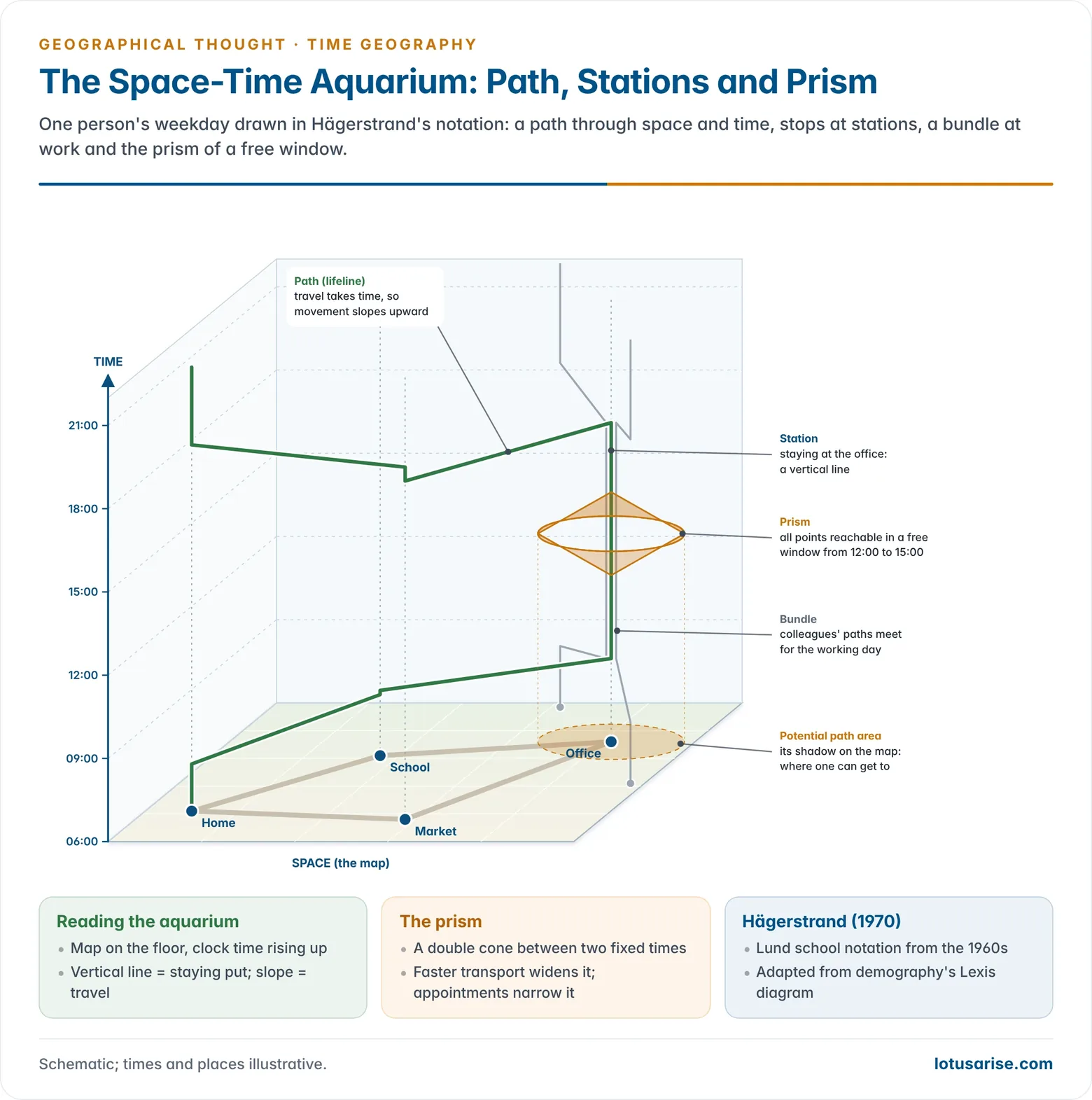
- Hägerstrand adapted the Lexis diagram of demography into a three-dimensional model. Two horizontal axes show space (the map), and the vertical axis shows time (the day).
- A person standing still traces a vertical line. Movement traces a sloping line, steeper for slower travel.
- A horizontal line is impossible for people, since all movement takes time. It is approached only by near-instant messages.
| Concept | Meaning | Example |
|---|---|---|
| Path (lifeline) | The trajectory of a person through time-space | One commuter’s day |
| Station | A place where paths stop for an activity | Home, school, office, market |
| Project | A series of tasks needed to reach a goal | Cooking a meal, completing a degree |
| Bundle | Paths that meet at a station for a shared activity | A class, a shift, a meeting |
| Domain | Time-space area under someone’s control | A factory during shift hours |
| Prism | All points a person can reach in the time available | Where one can go in a lunch hour |
- The prism (potential path area): if a person must leave home at one time and return by another, the reachable area forms a double cone.
- It is widest midway and narrows to the fixed points. Faster transport widens it; fixed appointments narrow it.
The Three Constraints
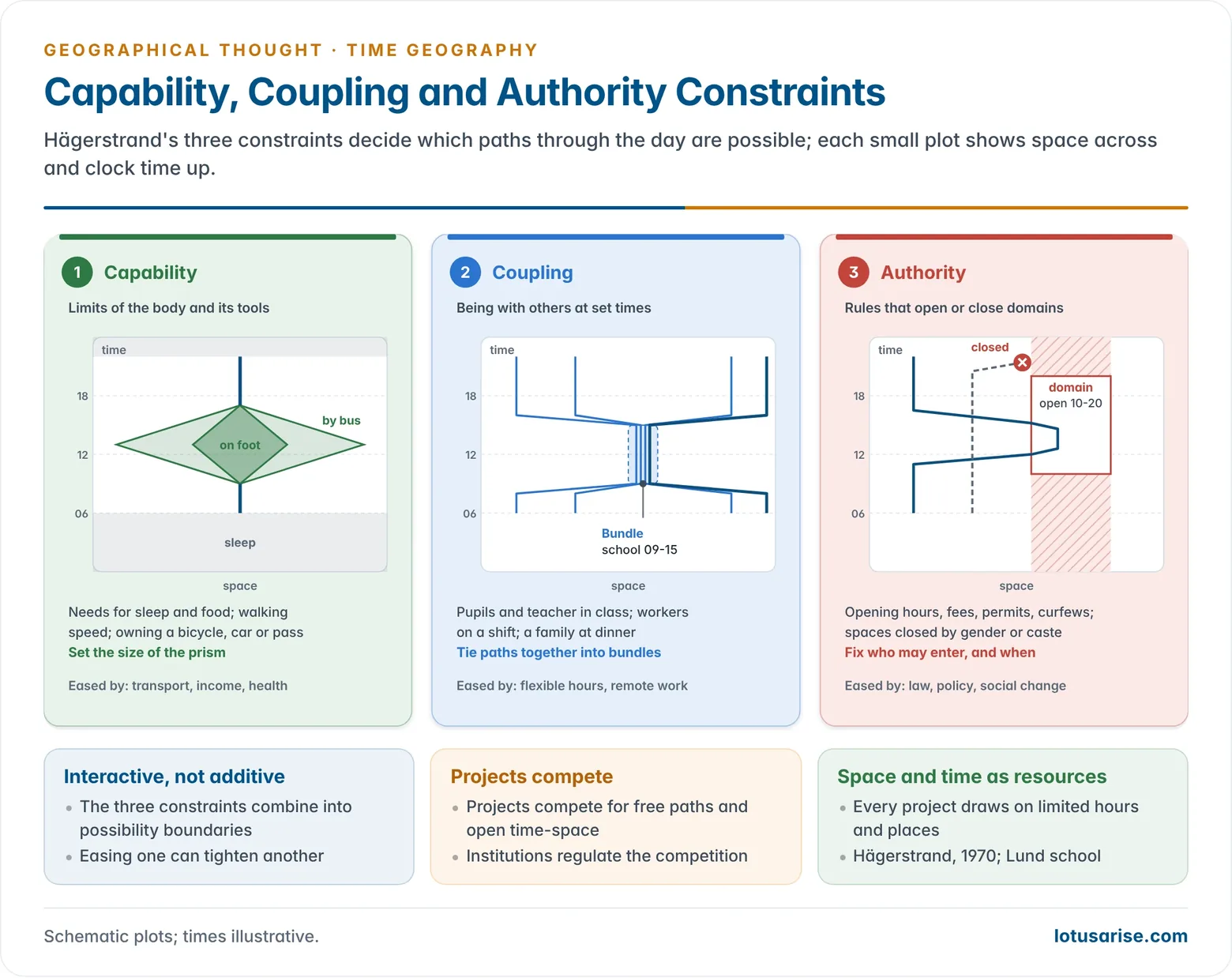
- Every project must fit within three kinds of constraint:
- Capability constraints: limits set by biology and by the tools a person commands. Examples are the need for sleep and meals, walking speed, or owning a car or metro pass. They define the size of the prism.
- Coupling constraints: the need to be in a given place at a given time with other people or tools. Pupils and teachers meet in school hours, workers on a shift. They define bundles.
- Authority (steering) constraints: rules, laws, prices and ownership that bar access to some domains at some times. Examples include office hours, entry fees, curfews, and spaces closed to women or lower castes.
- Four propositions follow:
- Space and time are resources that individuals draw on to carry out projects.
- Every project is limited by the three constraints.
- The constraints are interactive, not additive. Together they mark out possibility boundaries for each person.
- Projects compete for free paths and open time-space, and institutions regulate that competition.
| Constraint | Source | Typical example | What changes it |
|---|---|---|---|
| Capability | Body, technology | Sleep; travel speed | Transport, income |
| Coupling | Need to meet others | School hours; shifts | Flexible timing, remote work |
| Authority | Rules, power, prices | Opening hours; curfews | Law, policy, social norms |
Related Ideas: Convergence and Compression
- Time-space convergence (Donald Janelle, 1968): faster transport cuts the travel time between places, so places “move closer”. Each person’s prism widens accordingly.
- Time-space compression (David Harvey, The Condition of Postmodernity, 1989): capitalism’s drive to speed up turnover shrinks the world. Time geography supplies the individual-scale view of this change.
- India’s expressways, metro lines and Vande Bharat trains are recent examples of convergence that reshape daily and weekly paths.
From Landscape to Diorama
- In later work, Hägerstrand found “landscape” too static. He preferred the diorama: all entities, human and non-human, held together in a mixture produced by history.
- Outcomes emerge from many intersecting projects, often unintended by any actor.
Applications
- Accessibility and transport:
- Lenntorp’s PESASP model (Paths in Space-Time Environments, 1976) tested whether a person could complete a daily programme under a given timetable.
- It seeded activity-based travel modelling. Harvey Miller (1991) brought prisms into GIS.
- Gender and inequality:
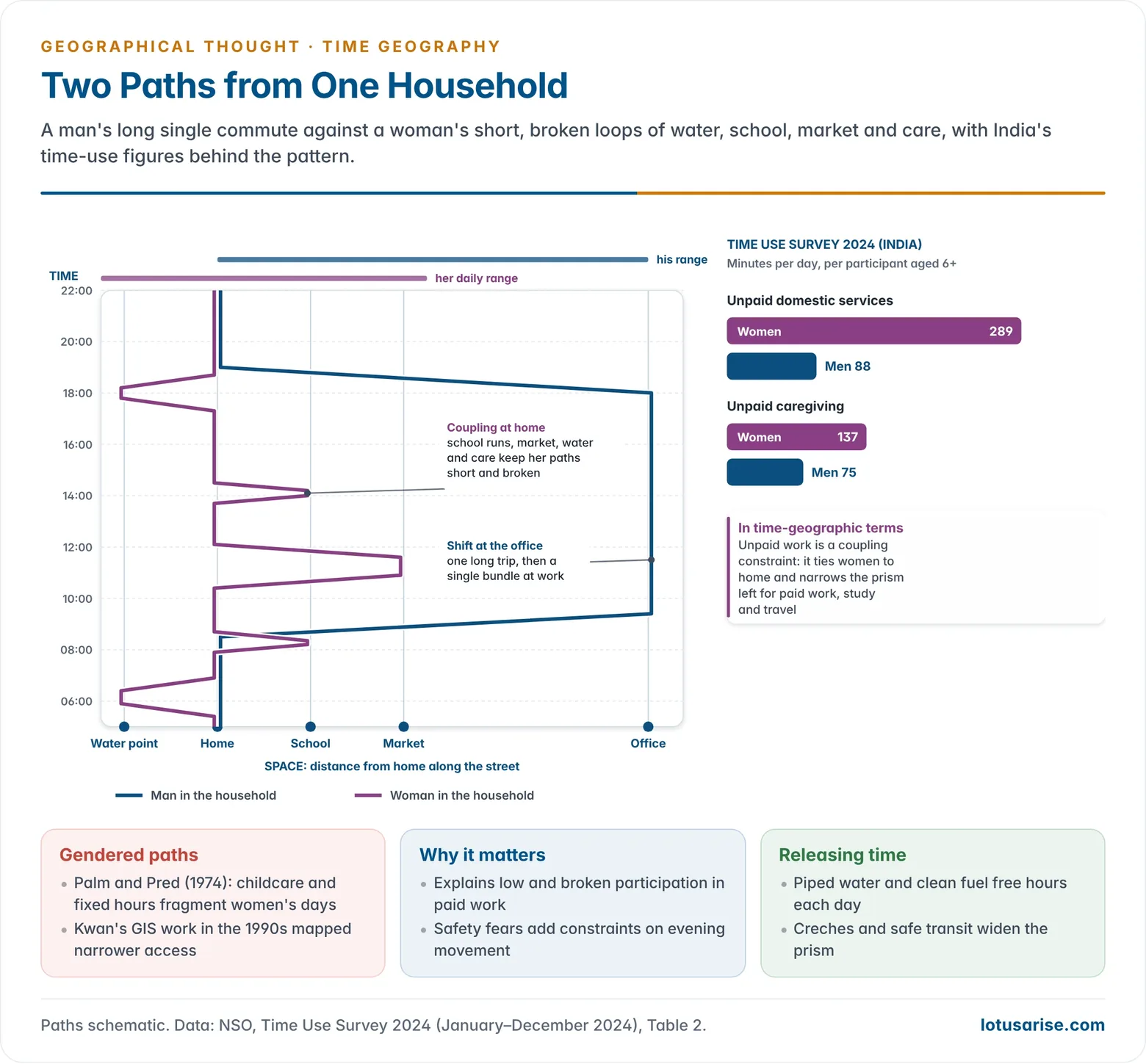
- Risa Palm and Pred (1974) showed how childcare and fixed opening hours tie women into short, fragmented paths.
- Mei-Po Kwan’s GIS studies of the 1990s mapped women’s narrower access to urban jobs and services.
- India’s Time Use Survey 2024 shows the scale: participating women spent about 289 minutes a day on unpaid domestic work, against 88 minutes for men.
- Coupling constraints at home shrink the prism available for paid work, study or travel. Safety fears add an authority-like constraint on evening movement.
- In rural India, time spent fetching water and fuel has long narrowed girls’ and women’s prisms. Piped water and clean cooking fuel programmes are, in time-geographic terms, ways of releasing time.
- Urban planning and daily life: school and office timings, public transport frequency and the siting of crèches, markets and clinics. India’s metro systems, for example, widen commuters’ prisms.
- Health, energy and tracking:
- GPS and mobile-phone traces now record real paths. They are used for exposure studies, epidemic contact tracing (as during COVID-19) and household energy use.
- Kwan’s “uncertain geographic context problem” (2012) asks which time-space context truly affects a person.
- Social theory:
- Anthony Giddens built time geography’s routines and co-presence into structuration theory (The Constitution of Society, 1984).
- Pred (1984) read place as historically contingent process, a link to the space, place and socio-spatial dialectic.
Evaluation
Strengths
- It restores the individual, the body and the day to geography, without giving up rigorous notation.
- It joins time and space, pattern and process, at every scale from a day to a lifetime.
- It reveals hidden inequality: who cannot reach jobs, clinics or schools, and why.
- It is operational: prisms and paths can be measured, mapped and simulated, which makes it useful for planning.
Criticism
- Small-scale and illustrative: much early work described a few individuals over short periods, and rarely added up to explanations of society.
- Institutions underplayed: it shows that constraints exist but not why they arise. Class, capital and the state appear only as given limits.
- Physicalism: people appear as bodies tracing lines. Meaning, emotion and intention are left out, a point humanistic geographers pressed.
- Feminist critique: Gillian Rose (Feminism and Geography, 1993) granted that it shares feminism’s interest in everyday paths, but called it a form of “social science masculinity”. It records where bodies go, not how gender shapes the experience of going, such as fear and harassment in public space.
- The digital challenge: Hägerstrand’s model assumed physical presence. Phones and the internet loosen coupling constraints through virtual presence.
Revival
- GIScience and big mobility data turned time geography from a sketching device into an analytical method. Kwan, Miller and others now model space-time prisms for millions of trips.
- Researchers have extended it to virtual activities, social media and remote work, and to sustainability. Kajsa Ellegård’s Thinking Time Geography (2019) restates the approach for these uses.
- Its central lesson holds in the age of smartphones: every life is a path through limited time and space, shared with others.